Effects of Electron Beam Irradiation and High-Pressure Treatment with Citrus Peel Extract on the Microbiological, Chemical and
Sensory Qualities of Marinated Chicken Breast Meat
Hyun-Joo Kim
1, Amali U. Alahakoon
2, Dinesh D. Jayasena
2,3, Muhammad I. Khan
4,5, Ki Chang Nam
6, Cheorun Jo
4and Samooel Jung
2,†1Crop Psot-Harvest Technology Division, National Institute of Crop Sciecne, Suwon 441-853, Korea
2Dept. of Animal Science and Biotechnology, Chungnam National University, Daejeon 305-764, Korea
3Dept. of Animal Science, Uva Wellassa University, Badulla 90000, Sri Lanka
4Dept. of Agricultural Biotechnology and Research Institute of Agricultural and Life Science, Seoul National University, Seoul 151-921, Korea
5National Institute of Food Science and Tehcnology, University of Agriculture, Faisalabad, Pakistan
6Dept. of Animal Science and Technology, Sunchon National University, Suncheon 540-950, Korea
ABSTRACT Chicken breast meat samples were injected with marinade solution (salt, sugar, phosphate, monosodium glutamate, and nucleic acid) with or without 2% citrus peel extract (CPE), and then a subset were irradiated with a 1 or 2 kGy electron beam (EB) and/or subjected to high-pressure (HP) at 300 or 400 MPa. The initial total aerobic bacterial (TAB) count of the control sample was 4.57 log CFU/g and reached 7.17 log CFU/g after 3 days of storage at 4°C. The 2 kGy EB reduced the TAB count to 4.61 log CFU/g after 7 days. The 400 MPa HP treatment was also effective in reducing the TAB count, but the effect was slightly less than that noted with the 2 kGy EB. The CPE, in combination with the EB and HP, decreased the TAB count by 1.71 and 1.32 log CFU/g at the initial stage and further decreased the count during storage.
The 2 kGy EB and the HP (300 and 400 MPa) increased the thiobarbituric acid-reactive substances value, whereas the CPE did not show an antioxidative effect. The EB and HP caused no difference in the sensory qualities. In contrast, the CPE decreased all sensory qualities tested. Sensory panelists commented that the samples with CPE were not in the “rejection”
category but were “unfamiliar” for chicken breast meat. In conclusion, the EB was more effective than HP in improving the microbial quality of marinated chicken breast meat. The use of CPE in the marinade solution may synergistically increase the shelf life; however, it is necessary to develop an appropriate formulation to ensure that the sensory qualities are maintained.
(Key words: electron beam irradiation, high pressure, citrus peel extract, chicken breast, shelf life)
†To whom correspondence should be addressed : [email protected]
INTRODUCTION
Injecting marinade solution to enhance the edible quality and functional property of chicken meat is an established prac- tice. Salt and phosphate are commonly used, sometimes alone, but often in combination to exploit their synergistic activity (Sheard and Tali, 2004). However, marination shortens the shelf life of the meat, which can interfere with the growth of industry. Bjorkroth (2005) reported that marination was not originated to increase the shelf life of meat products and its tenderizing effect as cited in several other studies. In addition, Thippareddi et al. (2000) found that mechanical tenderization and needle injection caused the translocation of Salmonella
Typhimurium from the surface to the interior of pork loin muscle.
Citrus peel is known to be rich in polyphenolic compounds, with the majority of citrus fruits in major citrus producing countries (Brazil and the United States) converted into juice.
Since the juice yield is about half of the fruit weight, very large amounts of citrus peel are generated as a by-product of the juice industry (Kang et al., 2006). Isolation of functional compounds such as dietary fiber from citrus peel can be of great interest to the food industry (Fernandez-Lopez et al., 2004). Furthermore, flavonoids present in citrus peel possess antimicrobial and antioxidant activity owing to their free radical scavenging activity (Anagnostopoulou et al., 2006). Recently,
Alahakoon et al. (2013) showed that citrus and onion peel extracts are efficient treatment methods to prevent microbial spoilage of seasoned chicken products during storage at 4℃.
The concept of combining several preservation technologies has been developed the hurdle effect (Leistner, 1995). No single technology is responsible for making the product stable, but rather stability results from the synergistic or additive action among the combined technologies (Mexis et al., 2012).
Many previous studies evaluating the efficacy and the safety and storability of different foods, such as meat products and shrimp, have reported the use of different agent combination (Kim et al., 2013; Kanatt et al., 2006).
Irradiation with electron beam (EB) and processing at high pressure (HP) are non-thermal technologies for food preserva- tion that involve inactivation of post-processing contaminants, especially for foods whose nutritional, sensory, and functional characteristics are thermo-sensitive (Marcos et al., 2008). Pro- cess variables such as the irradiation dose or the pressure level, together with the temperature and time of treatment, may affect the sensory properties of food (Medina et al., 2009).
Thus, EB and HP have been developed in combination with other techniques such as use of bacteriocin or natural anti- microbial agents (Rastogi et al., 2007; Jung et al., 2012a).
The objective of this study was to investigate the efficacy of the addition of citrus peel extract (CPE) in marinade solu- tion, followed by EB and HP on the microbial, chemical and sensory qualities of chicken breast meat during 7-day storage at 4℃.
MATERIALS AND METHODS
1. Sample Preparation
Chicken breast meat was obtained from a local market (Daejeon, Korea). CPE was obtained by treating peels with 70
% ethanol for 72 h at room temperature, followed by solvent evaporation (Kim et al., 2013). Thereafter, the extracts were lyophilized using a freeze drier (Il Shin Lab. Co. Ltd., Korea).
The marinade solution was composed of salt, sugar, phosphate, monosodium glutamate, and nucleic acid with or without CPE (2%). An injector was used to inject the marinade solution (15% per weight of meat; v/w) into chicken breast meat.
2. EB and HP Treatments
The prepared sample was vaccum-packaged (polyethylene bag) and irradiated on both sides by a linear EB radio fre- quency accelerator (energy, 2.5 MeV; beam power, 40 kW;
EB Tech. Daejeon, Korea). The beam current was 0∼4.5 mA.
Irradiation was performed at a conveyor velocity of 10 m/min and a dose rate of 1.1∼2.2 kGy/s. Because the incident EB had low penetration power, all samples were sliced to a thick- ness of 0.7 cm to enhance the effectiveness of irradiation. To confirm the target dose, alanine dosimeters, attached to the top and bottom surfaces of the sample packs, were read using a 104 Electron Paramagnetic Resonance unit (Bruker Instruments Inc., Bullerica, MA). The doses employed in this study were 0, 1, and 2 kGy.
For HP studies, the samples were transported to the Korea Food Research Institute (Seongnam, Korea) in a cooled con- tainer and were subjected to the treatment. The samples were placed in a pressure vessel submerged in a hydrostatic fluid medium (Quintus food processor 6; ABB Autoclave Systems, Inc., USA) and subjected to treatment at 300 and 400 MPa for 5 min, with the initial temperature of the pressure vessel at 15±3℃.
The experiment was replicated 4 times and 3 observations were made during each experiment. After treatment, the sam- ples were immediately stored under storage conditions at 4℃
for 7 days, until analyses.
3. Microbial Analysis
Each sample (5 g) was homogenized for 2 min in a sterile stomacher bag containing 45 mL of sterile saline (0.85%) by using a stomacher (Bag mixer® 400; Interscience Co., France).
Subsequently, the homogenized samples were serially diluted in sterile saline (0.85%) and were plated by spreading 0.1 mL on Total Plate Count agar (Difco Laboratories, Detroit, MI, USA) and Eosin Methylene Blue agar (Difco) for determining the total count of aerobic bacteria and coliforms, respectively.
Plates were then incubated at 37℃ for 48 h. The number of co- lonies was expressed as colony-forming units per gram (CFU/g).
4. 2-Thiobarbituric Acid Reactive Substances (TBARS) Value
Each sample (5 g) and deionized distilled water (15 mL) were homogenized with butylated hydroxytoluene (7.2%; 50 μL) for 15 s. Two milliliters of homogenate was transferred to a tube and 4 mL of 20 mM TBA in 15% trichloroacetic acid (TCA) solution was added. The mixture was blended and incubated in a boiling water bath for 15 min. The sample was cooled in cold water for 10 min, and then centrifuged for 15 min at 2,500 × g at 4℃. The absorbance of the supernatant was measured at 532 nm with a spectrophotometer (DU 530;
Beckman Instruments Inc., Fullerton, CA, USA). The amount of malondialdehyde was calculated using a standard curve pre- pared from tetraethoxypropane, and the TBARS value was reported as mg malondialdehyde/kg meat.
5. Sensory Evaluation
In the present study, the injected chicken samples were eva- luated on the first day of sampling with 3 repeated sessions.
The samples (2.0 × 3.0 × 1.5 cm) were pan-fried for 4 min to attain a core temperature of ∼72℃.
Each pan-fried sample was placed in a white plastic tray with randomly coded 3-digit number and provided for evalua- tion. Water was provided to cleanse the oral cavity between samples. The pan-fried samples were evaluated for color, odor, flavor, taste, tenderness and overall acceptability by seven semi- trained panelists who have experience in sensory evaluation of chicken meat more than one year. A 9-point hedonic scale (9=like extremely, 5=like moderately 1=dislike extremely) was used in this study.
6. Statistical Analysis
Each set of data presents the mean of three different expe- riments with three observation of measurements for microbial and sensory experiment. Statistical analysis was performed by one-way analysis of variance (ANOVA). When significant di- fferences were detected, the differences among the mean values were identified by Student Newman Keul’s multiple-range tests using SAS software at a confidence level of P<0.05. Mean values and standard errors of the mean are reported.
RESULTS AND DISCUSSION
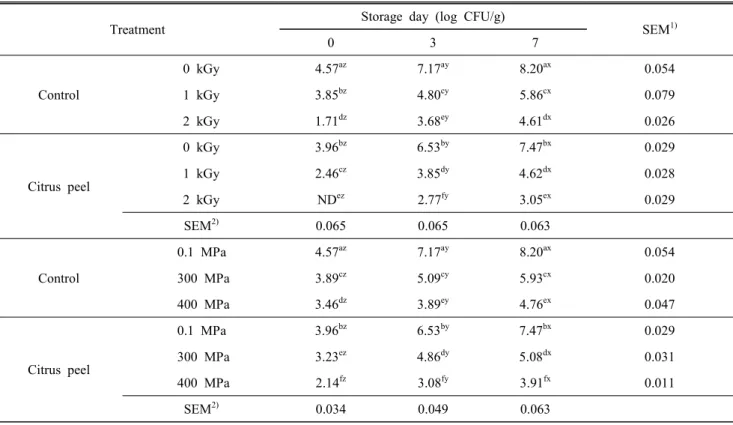
1. Microbial AnalysisThe total aerobic bacterial count (TAB) of control sample was 4.57 log CFU/g and reached 7.17 log CFU/g at only 3 days of storage. Irradiation at 2 kGy reduced the TAB during the entire duration of storage; the TAB after 7 days was 4.61 log CFU/g. HP also decreased TAB, but the effect was slightly weaker than that of EB (Table 1). Coliform bacteria were not detected in all samples (data not shown). Very few studies have compared the inactivation of pathogens caused by EB and HP.
Lewis et al. (2002) showed that microbial populations were not detected after the chicken breast meat samples were irradi- ated with 1.8 kGy by using EB at 10 MeV. The shelf life of marinated loin slices has been extended from 7∼16 days with the application of 1 and 2 kGy, respectively (Garcia-Marquez et al., 2012). Kruk et al. (2011) reported that 450 MPa, com- pared to 300 MPa, was more effective for the inactivation of pathogens in chicken breast fillets. The bactericidal effect of irradiation is due to the production of oxygen and hydroxyl radicals, which damage the DNA of microorganisms (Kim et al., 2013). HP kills and/or sub-lethally injures the cells by de- stroying the functionality of the cell wall and the cytoplasmic membrane, dissociating the proteins and the ribosomal subunit structures, and inactivating some enzymes (Hoover et al., 1989).
CPE with either EB or HP was able to maintain the maxi- mum permissible TAB, <7 log CFU/g, throughout the storage period. Moreover, CPE addition had a significant (P<0.05) effect on TAB reduction compared to control samples (Table 1). However, the combination of CPE with EB and HP further decreased the TAB by 1.71 and 1.32 log CFU/g, respectively, at the initial stage; the decrease was even greater during sto- rage. Similarly, EB at 2 kGy with CPE in the injection solution greatly improved the microbial quality of chicken breast meat compared to that treated with HP-CPE. Plant extracts usually contain multiple compounds with antimicrobial activity attribu- ted to a number of phenolic compounds. Phenolic compounds can degrade the cell wall, disrupt the cytoplasmic membrane, cause leakage of cellular components, change fatty acid and phospholipid constituents, influence synthesis of DNA and RNA, and destroy protein translocation (Shan et al., 2007).
Mexis et al. (2012) reported that the addition of CPE had preservative effects on fresh ground chicken meat with a shelf- life extension of 2 days during refrigerated storage. In this study, treatment with CPE followed by EB resulted in a sy-
Table 1. Microbial population (log CFU/g) of marinated chicken meat added with citrus peel extract in marinade solution with electron-beam irradiation and high pressure
Treatment
Storage day (log CFU/g)
SEM1)
0 3 7
Control
0 kGy 4.57az 7.17ay 8.20ax 0.054
1 kGy 3.85bz 4.80cy 5.86cx 0.079
2 kGy 1.71dz 3.68ey 4.61dx 0.026
Citrus peel
0 kGy 3.96bz 6.53by 7.47bx 0.029
1 kGy 2.46cz 3.85dy 4.62dx 0.028
2 kGy NDez 2.77fy 3.05ex 0.029
SEM2) 0.065 0.065 0.063
Control
0.1 MPa 4.57az 7.17ay 8.20ax 0.054
300 MPa 3.89cz 5.09cy 5.93cx 0.020
400 MPa 3.46dz 3.89ey 4.76ex 0.047
Citrus peel
0.1 MPa 3.96bz 6.53by 7.47bx 0.029
300 MPa 3.23ez 4.86dy 5.08dx 0.031
400 MPa 2.14fz 3.08fy 3.91fx 0.011
SEM2) 0.034 0.049 0.063
1) Standard errors of the mean (n=9), 2) (n =18).
a∼f Values with different letters within the same column differ significantly (P<0.05).
x∼z Values with different letters within the same row differ significantly (P<0.05).
nergistic antimicrobial effect compared HP and CPE alone.
2. TBARS Value
The effect of EB and HP on TBARS value of CPE added marinated chicken breast meat is shown in Table 2. At initial storage, EB at 2 kGy and HP at 300 and 400 MPa increased TBARS value and CPE did not show any antioxidative effects.
Lipid oxidation, caused by EB, depends on the irradiation dose, and is accelerated in presence of oxygen (Song et al., 2009). Furthermore, irradiation has been reported to increase TBARS value in different meat species, and under different packaging and storage conditions (Hampson et al, 1996; Du et al., 2000).
In HP processing, lipid oxidation is accelerated because of damage of the muscular fiber inside the meat and degene- ration of heme-containing proteins, resulting in the isolation or separation of iron ion from heme (Fuentes et al., 2010, Jung et al., 2012b). Cheah and Ledward (1996) stated the
changes leading to catalysis of lipid oxidation in pressure processed meat were initiated at around 300 MPa at room temperature.
In the present study, CPE could not suppress the lipid oxi- dation in samples treated with EB and subsequently stored.
However, several studies reported that CPE known to be par- ticularly rich in polyphenolic compounds was shown to inhibit the oxidation of lipids, in addition to its antifungal effect (Xu et al., 2007; Wu et al., 2014).
3. Sensory Evaluation
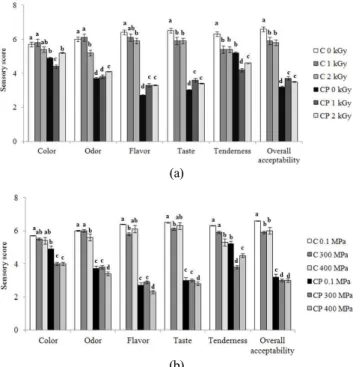
We found no difference in the sensory qualities after treat- ment with both EB (1 and 2 kGy) and HP (300 and 400 MPa).
However, the addition of CPE reduced all the sensory qualities tested (Fig. 1). Sensory panelists commented that the sample with CPE was not in the “rejection” category but was “unfa- miliar” in case of chicken breast meat. In particular, generation of offensive odors was detected in the samples, following the
Table 2. TBARS values of marinated chicken meat added with citrus peel extract in marinade solution with electron-beam irradiation and high pressure
Treatment Storage period (day)
SEM1)
0 3 7
Control
0 kGy 0.47bc 0.54b 0.47d 0.022
1 kGy 0.45bcz 0.57by 0.72cx 0.028
2 kGy 0.58aby 0.50bz 0.66cx 0.014
Citrus peel
0 kGy 0.44cy 0.54by 0.71cx 0.039
1 kGy 0.65a 0.80a 0.82b 0.065
2 kGy 0.53abcz 0.83ay 1.01ax 0.045
SEM2) 0.040 0.047 0.027
Control
0.1 MPa 0.47d 0.54c 0.47c 0.021
300 MPa 0.52cdy 0.51cy 0.63bx 0.031
400 MPa 0.56bcxy 0.50cy 0.66bx 0.032
Citrus peel
0.1 MPa 0.44dy 0.54cy 0.71bx 0.040
300 MPa 0.64a 0.66b 0.68b 0.040
400 MPa 0.61abz 0.81ay 0.95ax 0.024
SEM2) 0.025 0.031 0.038
1) Standard errors of the mean (n=9), 2) (n=18).
a∼d Values with different letters within the same column differ significantly (P<0.05).
x∼z Values with different letters within the same row differ significantly (P<0.05).
(a)
(b)
Fig. 1. Sensory evaluation of marinated chicken meat added with citrus peel extract in marinade solution with electron-beam irra- diation (a) and high pressure (b).
addition of CPE. During irradiation, free radicals are produ- ced, and these free radicals consequently trigger lipid and/or protein oxidation (Kim et al., 2013). Rivas-Canedo et al. (2008) showed that pressure treatment (400 MPa) of minced beef and chicken breast significantly changed the levels of some volatile compounds; for example, the levels of some alcohols and al- dehydes decreased. Kruk et al. (2011) reported that sensory panelists detected changes in the flavor, aroma, and juiciness of chicken breast meat after HP treatment at 300 MPa.
Several recent studies have proved that certain flavors such as mint, citrus, and barbecue are not influenced by irradiation;
in fact, they masked the offensive flavor produced by irradi- ation. This method was successfully applied to the production of gamma-irradiated ice cream and EB-irradiated pork jerky without any offensive flavor (Kim et al., 2007; Kim et al., 2012). Accordingly, further studies in this field need to focus on the development of a new technology capable of masking the different tastes and offensive flavors generated by lipid oxidation occurring during the course of irradiation with EB
and HP treatment.
CONCLUSION
Treatment with EB (2 kGy) and HP (400 MPa) was effec- tive in prolonging the shelf life of marinated chicken breast meat. The use of CPE in marinade solution may synergistically increase the microbiological safety; however, it is necessary to develop an appropriate formulation to ensure that the sensory qualities are maintained.
ACKNOWLEDGMENT
This work was supported from Radiation Technology R&D program (2014M2A2A6045051) through the National Resear- ch Foundation of Korea funded by the Ministry of Science, ICT & Future Planning.
REFERENCES
Alahakoon, AU, Bae YS, Kim HJ, Jung S, Jayasena DD, Yong HI, Kim SH, Jo C 2013 The effect of citrus and onion peel extracts, calcium lactate, and phosvitin on microbial quality of seasoned chicken breast meat. CNU J Agric Sci. 40:
131-137.
Anagnostopoulou A, Maria KP, Papageorgiou P., Assimopoulou NA, Boskou D 2006 Radical scavenging activity of va- rious extracts and fractions of sweet orange peel (Citrus sinensis). Food Chem. 94:19-25.
Bjorkroth J 2005 Microbiological ecology of marinated meat products. Meat Sci. 70:477-480.
Cheah PB, Ledward DA 1996 High pressure effects on lipid oxidation in minced pork. Meat Sci. 43:123-134.
Du M, Ah DU, Mendoca AF, Wesley IV 2002 Quality charac- teristics of irradiated ready-to-eat breast rolls from turkeys fed conjugated linoleic acid. Poultry Sci. 81:1378- 1384.
Fernandez-Lopez J, Fernandez-Gines JM, Aleson-Carbonell L, Sendra E, Sayas-Barbera E, Perez-Alvarez JA 2004 Application of functional citrus by-products to meat pro- ducts. Trends Food Sci Tech. 15:176-185.
Fuentes V, Ventanas J, Morcuende D, Estevez M, Ventanas S 2010 Lipid and protein oxidation and sensory properties
of vacuum-packaged dry-cured ham subjected to high hy- drostatic pressure. Meat Sci. 85:506-514.
Garcia-Marquez I, Cambero MI, Ordonez JA, Cabeza MC 2012 Shelf-life extension and sanitation of fresh pork loin by e- beam treatment. J Food Prot. 75:2179-2189.
Hampson JW, Fox JB, Lakritz L, Thayer DW 1996 Effect of low dose gamma irradiation on lipids in five different meats.
Meat Sci. 42:271-276.
Hoover DG, Metrick C, Papineau AM, Farkas DF, Knorr D 1989 Biological effects of high hydrostatic pressure on food microorganisms. Food Technol. 43:99-107.
Jung S, Yun H, Kim HJ, Ham JS, Kim IS, Lee M, Jo C 2012a Inactivation of Escherichia coli and Listeria monocytogenes in ground pork by combination of natural food ingredients and high pressure processing. Korean J Food Sci An. 32:
1-5.
Jung S, Jo C, Kang M, Ahn DU, Nam KC 2012b Elucidation of antioxidative activity of phosvitin extracted from egg yolk using ground meat. Korean J Food Sci An. 32:162- 167.
Kanatt SR, Chawla SP, Chander R, Sharma A 2006 Develop- ment of shelf-stable, ready-to-eat (RTE) shrimps (Panaeus indicus) using γ-irradiation as one of the hurdles. LWT- Food Sci Technol. 39:621-626.
Kang HJ, Chawla SP, Jo C, Kwon JH, Byun MW 2006 Stu- dies on the development of functional powder citrus peel.
Bioresource Technol. 97: 614-620.
Kim HJ, Jang A, Ham JS, Jeong SG, Ahn JN, Byun MW, Jo C 2007 Development of ice cream with improved micro- biological safety and acceptable organoleptic quality using irradiation. J Anim Sci Technol. 49:515-522.
Kim HJ, Kang M, Jo C 2012 Combined effects of electron beam irradiation and addition of onion peel extracts and flavoring on microbial and sensorial quality of pork jerky.
CNU J Agric Sci. 39:341-347.
Kim HJ, Kang M, Yong HI, Bae YS, Jung S, Jo C 2013 Sy- nergistic effects of electron-beam irradiation and leek extract on the quality of pork jerky during ambient storage. Asian- Aust J Anim Sci. 26:596-602.
Kruk ZA, Yun H, Rutley DL, Lee EJ, Kim YJ, Jo C 2011 The effect of high pressure on microbial population, meat quality and sensory characteristics of chicken breast fillet. Food
Control. 22:6-12.
Leistner L 1995 Principles and applications of hurdle techno- logy. In GW Gould (Ed.), New Methods of Food Preservation (pp. 1-21). London: Balckie Academic and Professional.
Marcos B, Jofré A, Aymerich T, Monfort JM, Garriga M 2008 Combined effect of natural antimicrobials and high pre- ssure processing to prevent Listeria monocytogenes growth after a cold chain break during storage of cooked ham.
Food Control. 19:76-81.
Medina M, Cabeza MC, Bravo D, Cambero I, Montiel R, Or- dóñez JA, Nuñez M, Hoz L 2009 A comparison between E-beam irradiation and high pressure treatment for cold- smoked salmon sanitation: Microbiological aspects. Food Microbiol. 26:224-227.
Mexis SF, Chouliara E, Kontominas MG 2012 Shelf life ex- tension of ground chicken meat using an oxygen absorber and a citrus extract. LWT-Food Sci Technol. 49:21-27.
Rastogi NK, Raghavarao KSMS, Balasubramaniam VM, Ni- ranjan K, Knorr D 2007 Opportunities and challenges in high pressure processing of foods. Crit Rev Food Sci Nutr.
47:69-112.
Rivas-Canedo A, Fernandez-Garcia E, Nunez M 2008 Volatile compounds in fresh meats subjected to high pressure pro- cessing: Effect of the packaging materials. Meat Sci. 81:
321-328.
Shan B, Cai YZ, Brooks JD, Corke H 2007 The in vitro
antibacterial activity of dietary spice and medicinal herb extracts. Int J Food Microbiol. 117:112-119.
Sheard PR, Tali A 2004 Injection of salt, tripolyphosphate and bicarbonate marinade solutions to improve the yield and tenderness of cooked pork loin. Meat Sci. 68:305-311.
Song BS, Park JG, Kim WG, Kim JH, Choi JI, Yoon Y, Byun MW, Kim CJ, Lee JW 2009 Comparison of the quality of gamma ray- or electron beam-irradiated minced pork and pork patties. Korean J Food Sci An. 29:194-202.
Thippareddi H, Lambert DD, Phebus RK, Marsden JL, Kastner CL, Boyle EE, Hunt MC, Fung DYC 2000 Salmonella risk assessment for blade tenderized, immersion marinated, nee- dle injected and fibrinogen processed pork cuts during processing, storage and cooking. Final report for Grant No.
1998/99 for National Pork Producers Council, USA.
Wu T, Cheng D, He M, Pan S, Yao X, Xu X 2014 Antifungal action and inhibitory mechanism of polymethoxylated fla- vones from Citrus reticulata Blanco peel against Aspergillus niger. Food Chem. 35:354-359.
Xu G, Ye X, Chen J, Liu D 2007 Effect of heat treatment on the phenolic compounds and antioxidant capacity of citrus peel extract. J Agric Food Chem: 55:330-335.
Received Aug. 19, 2015, Revised Aug. 31, 2015, Accepted Sep. 22, 2015