The effect of citrus and onion peel extracts, calcium lactate, and phosvitin on microbial quality of seasoned chicken breast meat
Amali U. Alahakoon, Young Sik Bae, Hyun Joo Kim, Samooel Jung, Dinesh D. Jayasena, Hae In Yong, Sun Hyo Kim, Cheorun Jo*
Department of Animal Science and Biotechnology, Chungnam National University, Daejeon 305-764, Republic of Korea Received on 11 April 2013, revised on 2 May 2013, accepted on 2 May 2013
Abstract : The inhibitory effect of citrus peel extract, onion peel extract, calcium lactate and phosvitin on microbial growth was investigated in seasoned chicken breast meat during aerobic storage at 4℃, 10℃ and 20℃. Citrus peel and onion peel extract significantly improved (p<0.05) the microbial quality of the sample by reducing the initial counts of the microbial flora compared to control and other two treatments. Data clearly revealed that the counts of the total aerobic bacteria significantly increased with the increase in storage temperature. The shelf life of all samples stored under 20℃
was less than 6 days, while the shelf life of citrus and onion treatment can be extended more than 9 days at 4℃ and more than 6 days at 10℃ in aerobic storage condition. These results indicated that citrus and onion peel extracts are efficient treatment methods to prevent microbial spoilage of seasoned chicken products during storage at 4℃. However, there was an adverse effect of addition of citrus and onion peel extract on several sensory attributes which need to be improved by reformulation of seasoning.
Key words : Citrus peel extract, Onion peel extract, Calcium lactate, Phosvitin, Seasoned chicken
*Corresponding author: Tel: +82-42-821-5774 E-mail address: [email protected]
I. Introduction
The popularity of the ready-to-cook (RTC) and ready-to-eat (RTE) meat products is growing all over the world due to its convenience (Lee et al., 2005).
However, microbial contamination of RTE and RTC meat products occurs during processing such as slicing, packaging, and other handling activities (Lin et al., 2006). It is important to store these products under frozen temperature to prevail the microbiological quality. However, freezing is a costly method together with some adverse effects on texture and consumer acceptance (Fallah et al., 2010). Even though the use of chemical preservatives can effectively prevent the growth of most foodborne microorganisms, there is a growing concern over safety problems related to chemical preservatives. Hence, searching for new
types of effective and non-toxic natural antimicrobial compounds is essential (Chun-Lin et al., 2013).
Citrus peel is a natural antimicrobial and antioxidant
source rich in polyphenol compounds, mainly flavonoids
including hesperidin, naringin, nobiletin, anthocyanins,
and coumarins located in the cell vacuoles of the
citrus peel albedo tissue (Elisa et al., 2013). Large
quantity of citrus peel is generated as a by-product
of juice industry in many countries (Bocco et al.,
1998). In Korea, about 40,000 tons of citrus peel
by-products out of 150,000 tons of citrus have been
produced annually during citrus juice processing
(Kang et al., 2006). Isolation of functional compounds
such as dietary fiber from citrus peel can be of great
interest to the food industry (Fernandez-Lopez et al.,
2004). Citrus essential oils have been found to inhibit
Gram-positive and Gram-negative bacteria as well as
yeasts, molds and food poisoning bacteria (Chun-Lin
et al., 2013). Furthermore, flavonoids present in citrus
possess antioxidant activity owing to their free radical scavenging ability (Anagnostopoulou et al., 2006).
Simultaneously, onions (Allium cepa L) are endowed with several biological properties, such as antibacterial, antimutagenic and antioxidant activities. Phytomolecules such as phenolic acids, flavonoids, cepaenes, thiosulfinates, and anthocyanins are the major biologically active compounds in onion whereas organosulfur-containing compounds play a major role in medicinal value (Chun-Lin et al., 2013; Goldman et al., 1996). Two major groups of flavonoids found in onions are anthocyanins (cyanidin and peonidin glycosides) and flavonols (quercetin, isorhamnetin, kaempferol and their glycosides). The most abundant flavonol in onions is quercetin usually found in higher concentration in the outer dry skin (Gulsen et al., 2007: Zill-e-Huma et al., 2011). Moreover, it is rich in other bioactive compounds such as fructooligosaccharides and sulfur compounds (Eduvigis et al., 2008).
Lactate has been widely used in the fresh meat industry as a non-meat ingredient. Injection of lactate in to fresh meat increases the shelf-life of meat by suppressing microbial growth (Brewer et al., 1995) and minimizing oxidative quality defects, such as meat discoloration and off-flavor development mainly due to myoglobin- and lipid-oxidation (Kim et al., 2010). In addition, egg yolk phosvitin is a heavily phosphorylated protein which can be used in meat industry as a strong metal chelating agent due to its unique primary structure (Jung et al., 2012a:
Vieira, 2007). High iron binding capacity conveys the bactericidal and antioxidant properties of phosvitin (Jung et al., 2012b: Lee et al., 2002: Sattar et al., 2000).
Chicken breasts are one of the most popular and easiest items to grill. Therefore, those are used in seasoned meat industry with different recipe modifications all over the world. In the present study, the inhibitory effects of citrus peel extract (CPE), onion peel extract
(OPE), calcium lactate and phosvitin on the growth of microorganisms in seasoned chicken breast fillets were determined in order to evaluate their potential use in bacterial inactivation and control of seasoned chicken products under aerobic packaging state at different storage temperatures.
II. Materials and Method
1. Sample preparation
Chicken breast meat and all necessary ingredients required for the production of seasoned chicken breast were obtained from a local market (Daejeon, Korea). Five formulations of seasoned chicken meat were prepared (control, control with 2% citrus peel extract, 2% onion peel extract, 2% calcium lactate, and 0.1% phosvitin). The ingredients used for seasoned chicken breast were corn syrup, sugar, soy sauce, onion, welsh onion, pears, sesame oil, garlic, NaCl, monosodium glutamate, sesame, caramel, and ginger.
The ingredients were mixed with the chicken breast and mixed thoroughly by hand massaging. The final product were divided in to small portions (approxi- mately 25 g) and packaged in aerobic condition at 4, 10 and 20℃ until analysis at 0, 3, 6 and 9 days.
The citrus peel and onion peel extracts were obtained by treating respective peels with 70% ethyl alcohol for 72 h at room temperature, followed by evaporating the solvent (Kim et al., 2013). Thereafter, the extracts were lyophylized using a freeze drier (Il Shin Lab. Co.
Ltd., Korea). The extraction of phosvitin was done according to the method as described by Ko et al.
(2011) and commercially available calcium lactate (ES Food Industry, Korea) was used for this study.
2. Microbial analysis
Microbial analysis was carried out at 0, 3, 6 and
9 day of storage. When the number of total aerobic
bacteria counts reached higher than 107 log CFU/g, microbial analysis and pH determination were terminated.
Each sample (5 g) was cut into small pieces and homogenized for 2 min in a sterile stomacher bag containing 45 mL of sterile saline (0.85%) using a stomacher (bag mixer 400; Interscience Co., St. Nom la Breteche, France). Then, those were serially diluted in sterile saline (0.85%), and each diluent (0.1 mL) was spread on respective bacterial media. Plate count agar and eosine methylene blue agar (Difco Laboratories, NJ, USA) were used for total bacterial flora and E.coli, respectively. The plates were incubated at 37℃ for 48 hrs, and microbial counts were expressed as log CFU/g.
3. pH
Each sample (1 g) was homogenized with 10 mL of distilled water using a mechanical homogenizer (IKA Laboratory Equipment, Seoul, Korea) and filtered (Whatman No.4). The pH value of filtrate was measured using an electronic pH meter (Mettler Toledo Process Analytics, USA)
4. Sensory evaluation
In the present study, seasoned chicken samples were evaluated at the first day of sampling with three repeated sessions. These samples were pan-fried for 4 min to achieve their core temperature to approximately 72℃. Each sample was randomly coded with 3 digit number and provided for evaluation. The cooked samples were evaluated for color, odor, flavor, taste, tenderness and overall acceptability by seven semi-trained panelists who have experiences in sensory evaluation of chicken meat more than 1 year. A 9 point hedonic scale was used (9-like extremely, 1-dislike extremely). Water was provided between samples to cleanse the oral cavity.
5. Statistical analysis
Statistical analysis was performed using one-way analysis of variance. The differences among the mean values were identified using Duncan’s multiple range tests with SAS software (SAS Institute, 2004) at a confidence level of p<0.05. Mean values and standard errors of the mean are reported.
III. Results and Discussion
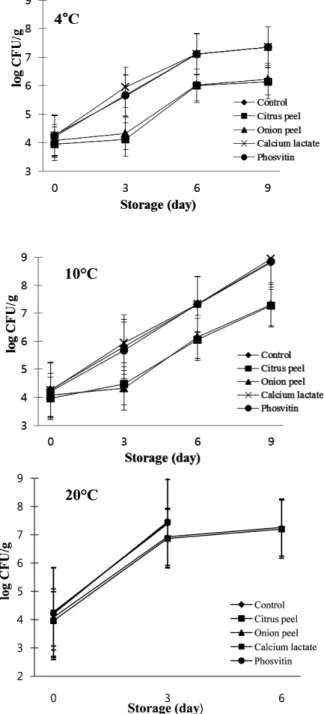
The changes in total aerobic bacterial counts in the seasoned chicken breast meat samples at different temperatures during aerobic storage are shown in Fig. 1.
The data clearly revealed that total aerobic bacterial counts significantly increased by the increase of both storage time and temperature. Treating the samples with CPE and OPE significantly improved the microbial quality of the initial product compared to other treatments. However, CPE was more effective than OPE in reducing initial counts of the product.
The total bacterial counts increased (p<0.05) in all samples during the storage despite of storage temperature (Fig. 1). After 9 days of storage, total aerobic bacterial populations in samples treated with CPE and OPE were lower when compared with other samples. The microbial population was increased by 2.17 and 2.15 log CFU/g in the samples with CPE and OPE, respectively, during 9 days of storage period at 4℃ while 3.07 log CFU/g for control samples.
Total aerobic bacterial counts in all samples increased beyond the maximum permissible level (107 CFU/g) (Kim and Song, 2004), except for samples treated with CPE and OPE on 6-day storages at 4 and 10℃, and 3-day storage at 20℃. Even at 9-day storage, samples treated with CPE and OPE did not exceed this critical limit under refrigerated storage (4℃), but, those showed higher than 107 CFU/g at 10 and 20℃.
Calcium lactate and phosvitin had no significant (p>
0.05) effect on the inhibition of microbial growth in
Fig. 1. Effects of different additives on the number of total
aerobic bacteria in seasoned chicken breast during storage at different temperatures.
Fig. 2. Effects of different additives on pH in seasoned chicken
breast during storage at different temperatures .
seasoned chicken meat during 9 days of storage at different storage temperatures.
The significant effects of CPE and OPE on microbial growth inhibition during storage at different tem- peratures in this study was in agreement with the previous studies. Allium cepa essential oil showed a moderate antimicrobial activity against some bacterial
strains and also possessed an interesting antioxidant activity (Chun-Lin et al., 2013). It is likely that antimicrobial activity of onion could be mainly due to the presence of organosulfur containing compounds, such as methyl 5-methylfuryl sulfide (18.30%), methyl 3,4-dimethyl-2-thienyl disulfide (11.75%) and 1-propenyl propyl disulfide (9.72%) (Hughes and Lawson, 1991).
Mexis et al. (2012) reported that the addition of the
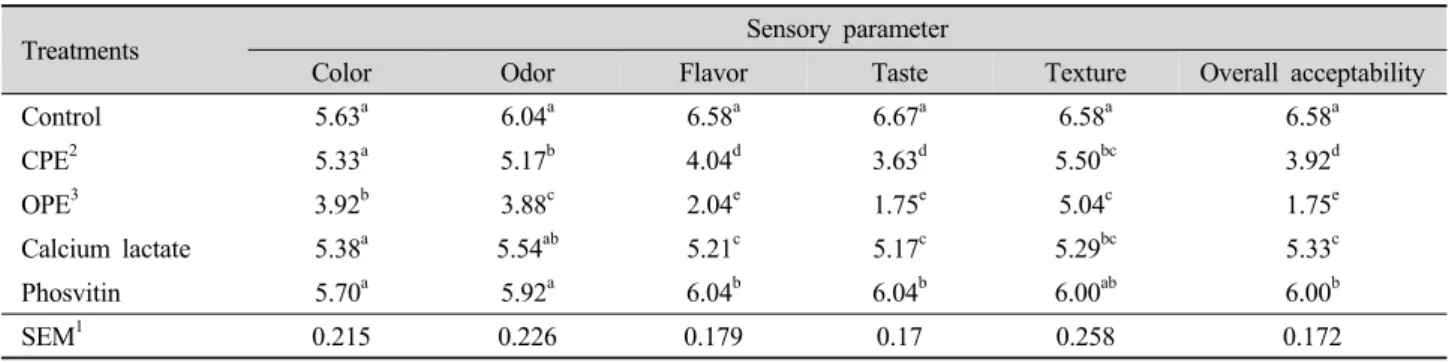
Table 1. Sensory scores of seasoned chicken breast meat treated with different additives.
Treatments Sensory parameter
Color Odor Flavor Taste Texture Overall acceptability
Control 5.63
a6.04
a6.58
a6.67
a6.58
a6.58
aCPE
25.33
a5.17
b4.04
d3.63
d5.50
bc3.92
dOPE
33.92
b3.88
c2.04
e1.75
e5.04
c1.75
eCalcium lactate 5.38
a5.54
ab5.21
c5.17
c5.29
bc5.33
cPhosvitin 5.70
a5.92
a6.04
b6.04
b6.00
ab6.00
bSEM
10.215 0.226 0.179 0.17 0.258 0.172
1
Standard error of the means (n=15).
2
CPE: Citrus peel extract
3
OPE: Onion peel extract
a-e