Research Article
Arsenic-Induced Differentially Expressed Genes Identified in Medicago sativa L. roots
Md. Atikur Rahman, Sang-Hoon Lee, Ki-Yong Kim, Hyung Soo Park, Tae Young Hwang, Gi Jun Choi and Ki-Won Lee*
Grassland & Forages Division, National Institute of Animal Science, Rural Development Administration, Cheonan, 330-801, Republic of Korea
ABSTRACT
Arsenic (As) is a toxic element that easily taken up by plants root. Several toxic forms of As disrupt plant metabolism by a series of cellular alterations. In this study, we applied annealing control primer (ACP)-based reverse transcriptase PCR (polymerase chain reaction) technique to identify differentially expressed genes (DEGs) in alfalfa roots in response to As stress. Two-week-old alfalfa seedlings were exposed to As treatment for 6 hours. DEGs were screened from As treated samples using the ACP-based technique. A total of six DEGs including heat shock protein, HSP 23, plastocyanin-like domain protein162, thioredoxin H-type 1 protein, protein MKS1, and NAD(P)H dehydrogenase B2 were identified in alfalfa roots under As stress. These genes have putative functions in abiotic stress homeostasis, antioxidant activity, and plant defense. These identified genes would be useful to increase As tolerance in alfalfa plants.
(Key words : Arsenic, Metal toxicity, Gene, Alfalfa)
. INTRODUCTION
Arsenic (As) contamination is an environmental hazard that occurs naturally in ground water or in soil. Moreover, this As contaminated ground water is being frequently used for irrigation. As a result, increasing high As level in soil.
The normal growth, development, and productivity of plants are greatly affected by this high level of As in several plants including alfalfa (Azizur Rahman et al., 2007; Porter and Sheridan, 1981). Legumes are dietary supplement and important fodder crops. Legume can be grown in aerobic field response to As, found the agronomic yields are significantly decreased (Takahashi et al., 2004). It has been reported that nitrogen fixation, nodulation in alfalfa are greatly reduced by As response (Lafuente et al., 2010). The metalloid arsenic found to be existed in soil, water, and food. The level at which arsenic is exist in soils varies normally from 0.2~40 mg kg
1, while in urban region the concentration in atmospheric air is about 0.02 mg m
3(Mandal and Suzuki 2002). In cultivated soil, 20 mg/kg
1As is considered as highest acceptable level (Kabata-Pendias
and Pendias, 1992). However, the level of As in contaminated soil is greater than the acceptable in several South-Asian countries (Moreno-Jiménez et al., 2012).
In soil, metallic As can exist in several chemical forms including arsenate (AsV), arsenite (AsIII), mono-methyl arsenic acid (MMAA), and dimethyl arsenic acid (DMAA). Among these states, AsV is the major phytoavailable form in aerobic soils. It frequently enter or accumulated by roots through the phosphate transporter that be transported to the aerial parts of plants (Moreno-Jiménez et al., 2012). Moreover, it has been reported that after transportation into the cells AsV can be rapidly reduced to AsIII/ other states (Pickering et al., 2000). Though, AsIII is usually considered as most phototoxic form of As. Numerous stresses including salinity, drought, and heat induced differentially expressed proteins/ genes have been documented in alfalfa (Rahman et al., 2016; Rahman et al., 2015; Li et al., 2013). Unfortunately, As induced differentially induced genes/proteins in alfalfa roots are poorly documented.
Several molecular techniques have been used for the profiling of gene expression. Annealing control primer (ACP)-
* Corresponding author : Ki-Won Lee, National Institute of Animal Science, Cheonan 31000, Korea. Tel: +82-41-580-6757, E-mail:
based system is one of the simple and rapid methods that frequently used for identification of distinct expressed genes in plants (Lee et al., 2012c). This technique provides high annealing specificity to the template and allows only accurate products to be amplified during PCR (Kim et al., 2004). To gain better understanding in genes/proteins profile response in a root following exposure to As stress. The present study was carried out using ACP-based PCR technique. The aim of this study was to isolate and identify DEGs/DEPs upon exposure to As stress, and to provide their biological functions related to metal stress in root biology in alfalfa plant.
. MATERIALS AND METHODS 1. Plant growth and treatments
Alfalfa (Medicago sativa L. cv. Vernal) seeds were collected from Grassland and Forages Division, National Institute of Animal Science (NIAS), Rural Development Administration (RDA), Cheonan, 330-801, Korea. Plants were grown in plastic pots containing Nursery Medium (Biomedia, Korea).
Culture condition was maintained at 25°C with a light intensity of 400 mol m
2s
1and 14-h photoperiod. Two- week-old alfalfa seedlings were irrigated with sodium arsenate (Na
2HAsO
4.7H
2O, 500 µM) solutions for 6 hours.
Roots were harvested then quickly frozen in liquid nitrogen and kept at 80°C until use.
2. RNA Isolation and cDNA synthesis
Total RNA was isolated from root tissue of alfalfa plants by gentle homogenization using Trizol® reagent. The RNA sample was used for the first stand cDNA synthesis by reverse transcriptase. The reserve transcription was performed about 2 h at 42°C using 20 l containing 3 μ μ g of the purified total RNA, 4 l of 5 μ reaction buffer (Promega, USA), 5 l of dNTPs μ (2 mmol each) ; 2 µl of 10 M dT- ACP1 [5´-CTGTGAATGCTGCGACTACGA TIIIIIT(18)-3´];
0.5 µl of RNasin® RNase Inhibitor (40 U/µl; Promega); and 1 µl of Moloney murine leukemia virus reverse transcriptase (200 U/µl; Promega). After completion of first-strand cDNAs synthesis, all samples were diluted individually by the
addition of 80 µl of ultra-purified water subsequently prepared for GeneFishing
TMPCR technique.
3. ACP-based GeneFishing
TMreverse transcription chain reaction
Differentially expressed genes (DEGs) were isolated and amplified by annealing control primer (ACP)-based PCR technique using GeneFishing TM kit (Seegene, Korea). Brifly second strand cDNA synthesis was performed using PCR protocol and experimental method of Lee et al. (2012c). The amplified PCR products were separated using 2% agarose gel and stained with RedSafe
TM(nucleic acid staining solution; ABC Scientific, USA).
4. Cloning of gene and sequencing
Targeting DEGs were extracted from the gel by using the GENCLEAN II Kit (Q-BIO gene, USA), subsequently cloned into a TOPO TA cloning vector (Invitrogen, USA) according to the manufacturer’s instructions. The sequences of cloned plasmids were completed by ABI PRISM 3100 Genetic Analyzer (Applied Biosystems, USA) using the M13 forward primer (5’-CGCCAGGGTTTTCCCAGTCACGA-3’) and M13 reverse primer (5’-AGCGGATAACAATTTCACAC AGGA-3’). The sequenced data were confirmed from GenBank database using Blast X program (http://www.ncbi.
nlm.nih.gov/BLAST/).
. RESULTS AND DISCUSSION
We have conducted our research in order to identify
differentially expressed genes through ACP-based PCR
approach. Among several GeneFishing primers (GPs), total 9
GPs showed differentially expressed DNA bands, with 6
bands increased in intensity in the treated sample compared
to the control. The sizes of the bands varied from 501 to
901 bp (Table 1). Among the DEGs, GPs 4, 66, 77, 92, 99
and 106 were significantly increased or newly synthesized
band in As- treated samples. A typical agarose gel
electrophoresis image showing the PCR products which
were amplified using ACPs for control and As-treated
samples, whereas showed some induced DNA bands (Fig.
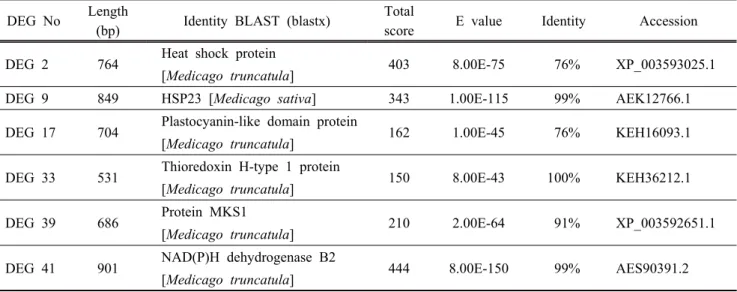
1). Subsequently, these induced DNA bands were purified from the agarose gels and cloned into TOPO TA cloning vectors. However, the clones were sequenced then the similarities and identification of these DEGs are presented in Table 1.
In this study, we have identified 6 DEGs including Heat shock protein (DEP2), HSP23 (DEG 9), plastocyanin-like domain protein 162 (DEG17), thioredoxin H-type 1 (DEG 33), protein MKS1 (DEG39), NAD(P)H dehydrogenase (DEG 41). According to their putative molecular functions, these identified genes are involved in several processes and/or pathways including abiotic stress homeostasis, antioxidant and plant defense. We identified two genes of heat shock
protein family including heat shock protein (DEP2) and HSP23 (DEG 9). HSPs are induced by several abiotic stimuli (Lee et al., 2012a; Lee et al., 2012b). In our study we, we observed plant heat shock protein (DEP2) and HSP23 (DEG 9) were induced by As stress. The up- regulation of DEP2 and DEG 9 in alfalfa roots suggested enhances tolerance to As in alfalfa plants.
We identified plastocyanin-like domain protein (DEG 17) belongs to the blue copper proteins family, which function as electron transporter in bacteria and plants (Giri et al., 2004). In addition to this function, this protein may involve in stress responses that contributes to osmotic stress tolerance (Wu et al., 2011). Moreover, other researcher suggested that
Fig. 1. Annealing control primer (ACP) based technique. Agarose gel image shows differentially expressed genes (DEGs) response to arsenic (As) stress. Arrows indicating the DEGs compare to non-treatment. Mw, molecular weight size marker; Nt, non-treatment; As, arsenic treatment; ACP, annealing control primer.
Table 1. Arsenic (As)-stress induced differentially expressed genes (DEGs) in alfalfa roots identified by ACP-based RT-PCR technique. The DEGs are searched by BLASTP (http://www.ncbi.nlm.nih.gov/BLAST/).
DEG No Length
(bp) Identity BLAST (blastx) Total
score E value Identity Accession DEG 2 764 Heat shock protein
[Medicago truncatula] 403 8.00E-75 76% XP_003593025.1
DEG 9 849 HSP23 [Medicago sativa] 343 1.00E-115 99% AEK12766.1
DEG 17 704 Plastocyanin-like domain protein
[Medicago truncatula] 162 1.00E-45 76% KEH16093.1
DEG 33 531 Thioredoxin H-type 1 protein
[Medicago truncatula] 150 8.00E-43 100% KEH36212.1
DEG 39 686 Protein MKS1
[Medicago truncatula] 210 2.00E-64 91% XP_003592651.1 DEG 41 901 NAD(P)H dehydrogenase B2
[Medicago truncatula] 444 8.00E-150 99% AES90391.2
it inhibits aluminum absorption and protects cell from aluminum toxicity (Ezaki et al., 2005). According to previous report indicated that plastocyanin genes can induce by salt and drought stresses. Overall, this gene showed potential response to abiotic stresses (Ma et al., 2011).
Thioredoxin (TRX) is a small ubiquitous and multifunctional protein having role as master regulator in TCA cycle in plants (Daloso et al., 2015). Moreover, TRX induced by variety of oxidative stimuli played a pivotal role as redox homeostasis in plant. In our research, our identified thioredoxin H-type 1 (DEG 33) was up-regulated by As stress, indicating this protein played a pivotal role to protect oxidative stress damage in alfalfa plant during As toxicity.
We reported regarding an MPK4 substrate that was designated as MAP kinase substrate 1 (MKS1;DEG 39).
MKS1 acts downstream of MPK4 in the salisalic acid (SA) dependent pathway. MKS1 interacts with the transcription factors that also required for full SA-dependent resistance.
Overexpression of MKS1 in Arabidopsis plants played role to SA-dependent resistance as well as plant defense (Andreasson et al., 2005). NAD(P)H dehydrogenase B2 (NDB2;DEG 41) was involved in oxidation-reduction process in plants (Barh et al., 2015). We found NDB2 was up- regulated response to As stress in alfalfa roots. However, it has been reported that homologs NDA1 alternative NAD(P)H dehydrogenase was induced at the transcript level by both AsV and AsIII in rice seedlings (Chakrabarty et al., 2009). Therefore, we expected that our identified NDB2 homologue possibly contribute in plant defense during As stress in alfalfa plant.
. CONCLUSION
In this current study, we have screened several genes including heat shock protein, HSP 23, plastocyanin-like domain protein162, thioredoxin H-type 1 protein, protein MKS1 and NAD(P)H dehydrogenase B2 response to As stress in alfalfa roots by ACP-based approach. These identified proteins are involved numerous cellular functions including abiotic stress homeostasis, antioxidant and plant defense. We expected that this study provides the role of DEGs in arsenic stress tolerance in alfalfa plants.
. ACKNOWLEDGMENTS
This work was supported by the “Cooperative Research Program for Agriculture Science & Technology Development (Project No. PJ01193504)” and Postdoctoral Fellowship Program of 2016, National Institute of Animal Science, Rural Development Administration, Republic of Korea.
. REFERENCES
Andreasson, E., Jenkins, T., Brodersen, P., Thorgrimsen, S., Petersen, N.H.T., Zhu, S., Qiu, J.-L., Micheelsen, P., Rocher, A., Petersen, M., Newman, M.-A., Bjørn Nielsen, H., Hirt, H., Somssich, I., Mattsson, O. and Mundy, J. 2005. The MAP kinase substrate MKS1 is a regulator of plant defense responses. The EMBO Journal. 24:2579-2589.
Azizur Rahman, M., Hasegawa, H., Mahfuzur Rahman, M., Nazrul Islam, M., Majid Miah, M.A. and Tasmen, A. 2007. Effect of arsenic on photosynthesis, growth and yield of five widely cultivated rice (Oryza sativa L.) varieties in Bangladesh.
Chemosphere 67:1072-1079.
Barh, D., Khan, M.S. and Davies, E. 2015. Plant omics: the omics of plant science. Spinger, New Delhi-India, 598 p
Chakrabarty, D., Trivedi, P.K., Misra, P., Tiwari, M., Shri, M., Shukla, D., Kumar, S., Rai, A., Pandey, A., Nigam, D., Tripathi, R.D. and Tuli, R. 2009. Comparative transcriptome analysis of arsenate and arsenite stresses in rice seedlings. Chemosphere. 74:
688-702.
Daloso, D.M., Müller, K., Obata, T., Florian, A., Tohge, T., Bottcher, A., Riondet, C., Bariat, L., Carrari, F., Nunes-Nesi, A., Buchanan, B.B., Reichheld, J.-P., Araújo, W.L. and Fernie, A.R.
2015. Thioredoxin, a master regulator of the tricarboxylic acid cycle in plant mitochondria. Proceedings of the National Academy of Sciences of the United States of America. 112:
E1392-E1400.
Ezaki, B., Sasaki, K., Matsumoto, H. and Nakashima, S. 2005.
Functions of two genes in aluminium (Al) stress resistance:
repression of oxidative damage by the AtBCB gene and promotion of e ux of Al ions by the NtGDI1 gene. Journal of ffl Experimental Botany. 56:2661-2671.
Giri, A.V., Anishetty, S. and Gautam, P. 2004. Functionally specified protein signatures distinctive for each of the different blue copper proteins. BMC Bioinformatics. 5:127
Kabata-Pendias, A. and Pendias, H. 1992. Trace Element in Soil and Plants, 2nd ed. CRC, London, UK.
Kim, Y.-J., Kwak, C.-I., Gu, Y.-Y., Hwang, I.-T. and Chun, J.-Y.
2004. Annealing control primer system for identification of differentially expressed genes on agarose gels. Biotechniques. 36:
424-426, 428, 430 passim.
Lafuente, A., Pajuelo, E., Caviedes, M.A., and Rodríguez-Llorente, I.D. 2010. Reduced nodulation in alfalfa induced by arsenic correlates with altered expression of early nodulins. Journal of Plant Physiology.167:286-291.
Lee, K.-W., Choi, G.J., Kim, K.-Y., Ji, H.J., Park, H.S., Kim, Y.-G., Lee, B.H. and Lee, S.-H. 2012a. Transgenic Expression of MsHsp23 confers enhanced tolerance to abiotic stresses in tall fescue. Asian-Australasian Journal of Animal Sciences. 25:818- 823.
Lee, K.-W., Cha, J.-Y., Kim, K.-H., Kim, Y.-G., Lee, B.-H. and Lee, S-H. 2012b. Overexpression of alfalfa mitochondrial HSP23 in prokaryotic and eukaryotic model systems confers enhanced tolerance to salinity and arsenic stress. Biotechnology Letters. 34:
167-174.
Lee,K.-W., Kim, K.-H., Kim, Y.-G, Lee, B.H. and Lee, S.-H. 2012c.
Identification of MsHsp23 gene using annealing control primer system. Acta Physiologiae Plantarum. 34:807-811.
Li, W., Wei, Z., Qiao, Z., Wu, Z., Cheng, L. and Wang, Y. 2013.
Proteomics analysis of alfalfa response to heat stress. PLoS ONE 8(12): e82725.
Ma, H., Zhao, H., Liu, Z. and Zhao J. 2011. The phytocyanin gene family in rice (Oryza sativa L.): genome-wide identification, classification and transcriptional analysis. PLoS ONE 6:e25184.
Mandal, B.K. and Suzuki, K.T. 2002. Arsenic round the world: a review. Talanta. 58:201-235.
Moreno-Jiménez, E., Esteban, E. and Peñalosa, J.M. 2012. The fate of arsenic in soil-plant systems. In: Whitacre MD (ed) Reviews of Environmental Contamination and Toxicology. Springer New York, New York, NY. pp 1-37.
Pickering, I.J., Prince, R.C., George, M.J., Smith, R.D., George, G.N.
and Salt, D.E. 2000. Reduction and coordination of arsenic in Indian mustard. Plant Physiology. 122:1171-1178.
Porter, J.R. and Sheridan, R.P. 1981. Inhibition of nitrogen fixation in alfalfa by arsenate, heavy metals, fluoride, and simulated acid rain. Plant Physiology. 68:143-148.
Rahman, M.A., Alam, I., Kim, Y.-G., Ahn, N.-Y., Heo, S.-H., Lee, D.-G., Liu, G. and Lee, B.-H. 2015. Screening for salt-responsive proteins in two contrasting alfalfa cultivars using a comparative proteome approach. Plant Physiology and Biochemistry 89:
112-122.
Rahman, M.A., Kim Y.-G., Alam, I., Liu, G., Lee, Hyoshin, Lee, J.J.
and Lee, B.-H. 2016. Proteome analysis of alfalfa roots in response to water deficit stress. Journal of Integrative Agriculture. 15:1275-1285.
Takahashi, Y., Minamikawa, R., Hattori, K.H., Kurishima, K., Kihou, N. and Yuita, K. 2004. Arsenic behavior in paddy fields during the cycle of flooded and non-flooded periods. Environ mental Science & Technology. 38:1038-1044.
Wu, H.Y., Shen, Y., Hu, Y.L., Tan, S.J. and Lin, Z.P. 2011. A phytocyaninrelated early nodulin-like gene, BcBCP1, cloned from Boea crassifolia enhances osmotic tolerance in transgenic tobacco. Journal of Plant Physiology. 168:935-943.
(Received August 15, 2016 / Revised September 5, 2016 / Accepted September 5, 2016)