• 검색 결과가 없습니다.

Precise Orbit Determination of GRACE-A Satellite with Kinematic GPS PPP

N/A
N/A
Protected

Academic year: 2021

Share "Precise Orbit Determination of GRACE-A Satellite with Kinematic GPS PPP"

Copied!
6
0
0

로드 중.... (전체 텍스트 보기)

전체 글

(1)

1. INTRODUCTION

The Gravity Recover y And Climate E xperiment (GRACE) satellite was developed as part of the combined project carried out by National Aeronautics and Space Administration of the US and Deutsches Zentrum fur Luft und Raumfahrt of Germany. Major duties of the GRACE satellite include the precise mapping process for the gravity field of the Earth, and the measuring process for the related time changes (Tapley et al. 2004). For such a purpose, two units of the GRACE satellite have been arranged and put on the same orbit with the distance of about 200 km both them.

For the precise calculation of the satellite orbit and the measurement of the gravity field of the Earth, the GRACE satellites are equipped with the BlackJack GPS Receiver, the Super STAR Accelerometer, the Star Sensor (Star Tracker), the K-band Ranging System, and the Satellite Laser Ranging Reflector. The BlackJack GPS receiver installed on the GRACE satellites can be used up to 16 channels. The twelve

Precise Orbit Determination of GRACE-A Satellite with Kinematic GPS PPP

Byung-Kyu Choi

1†

, Kyoung-Min Roh

1

, Sung-Moon Yoo

1

, Jung-Hyun Jo

2

, Sang-Jeong Lee

3

1

Astronomy and Space Technology R&D Division, Korea Astronomy and Space Science Institute, Daejeon 305-348, Korea

2

Astronomy and Space Program Division, Korea Astronomy and Space Science Institute, Daejeon 305-348, Korea

3

Department of Electronics Engineering, Chungnam National University, Daejeon 305-764, Korea

ABSTRACT

Precise Point Positioning (PPP) has been widely used in navigation and orbit determination applications as we can obtain precise Global Positioning System (GPS) satellite orbit and clock products. Kinematic PPP, which is based on the GPS measurements only from the spaceborne GPS receiver, has some advantages for a simple precise orbit determination (POD).

In this study, we developed kinematic PPP technique to estimate the orbits of GRACE-A satellite. The comparison of the mean position between the JPL’s orbit product and our results showed the orbit differences 0.18 cm, 0.54 cm, and 0.98 cm in the Radial, in Along-track, and Cross-track direction respectively. In addition, we obtained the root mean square (rms) values of 4.06 cm, 3.90 cm, and 3.23 cm in the satellite coordinate components relative to the known coordinates.

Keywords: GRACE-A, kinematic, PPP, POD

channels are used for the measurement of the precise orbit, while the remaining four are used for the measurement of the occultation for the GPS satellite. The GPS measurements of GRACE satellites are obtained with 10-second intervals.

The orbit estimation of the low earth orbit (LEO) satellite largely is classified into kinematic, dynamic, and reduced- dynamic methods. They can be applied in the orbit determination based on different types of observation data and data-processing strategies. The ‘dynamic’ method is the most general method of the orbit determination.

All factors of the physical acceleration which affects the satellite and every related model parameters should be considered. Since the ‘kinematic’ method requires only the GPS measurements without using the orbital equation, it can be applied to the orbit determination in a simple way (Montenbruck 2003). However, this could reveal different performances for the orbit of the satellite based on the level of accuracy given by the measurement model and the quality of the observation data. The ‘reduced-dynamic’

method applies the geometrical correction to the orbit of the satellite, which is obtained by using the typical ‘dynamic’

method, by using the GPS measurement. The well-known GIPSY/OASIS II developed by Jet Propulsion Laboratory (JPL) of the US can be regarded as the most representative Received Aug 30, 2012 Revised Oct 20, 2012 Accepted Oct 21, 2012

Corresponding Author E-mail: [email protected]

Tel: +82-42-865-3237 Fax: +82-42-862-5610

(2)

software which is used to the orbit determination of the satellite with the ‘reduced-dynamic’ method (Webb &

Zumberge 1995).

In recent studies, Li et al. (2010) obtained the root mean squares (RMS) value within the error of 3-5 cm along the radial direction of the GRACE-B satellite with the Kinematic PPP for seven days. Choi & Lee (2011) also precisely determined the GRACE-A orbit by using the Bernese 5.0 software which is developed by Bern university in Swiss.

They presented that the orbit error in the solution is typically within 3-5 cm RMS.

In this study, the dynamic models were not applied for the orbit determination of GRACE-A satellite. We used the

‘kinematic’ method with the dual-frequency GPS data.

For the ‘kinematic’ POD, the precise point positioning (PPP) technique was also applied (Kouba & Héroux 2001, Bisnath et al. 2002, Geng et al. 2010). In addition, this study described the strategies for the pre-processing of the GPS data, the composition of the measurement equation, and the orbit determination. In order to verify the results obtained with our software, the results were compared to the ‘reduced-dynamic’ method of JPL.

2. MEASUREMENT EQUATION AND ORBIT DETERMINATION STRATEGIES

In general, the onboard GPS receivers at the LEO satellite receive dual-frequency GPS code and carrier phase observations. The measurement equation of carrier phase for the LEO satellite is as the following Eq. (1) (Kouba &

Héroux 2001).

( )

IF

ρ c t δ δ T δ pco λ n ε

Φ = + − + + ⋅ + (1) where ρ is the geometric distance between the GPS receiver and the satellite, δt and δT are the clock errors related to the satellite and the receiver respectively, c is the speed of light, δpco is the antenna phase centers and the related changes of the satellite and the receiver, λ is the wavelength, and n is the linear combined float ambiguities, є is the system noise including multi-path. Ionosphere error can effectively be removed more than 99% by forming a linear combination of dual-frequency observables. In case of the low-orbit satellite, the tropospheric delay is not considered (Hofmann-Wellenhof et al. 2008).

The pre-processing process step of the GPS data contains the outlier detection, the cycle-slip detection and the calculation of initial ambiguities. The main purpose of the pre-processing step is to obtain the reliable GPS

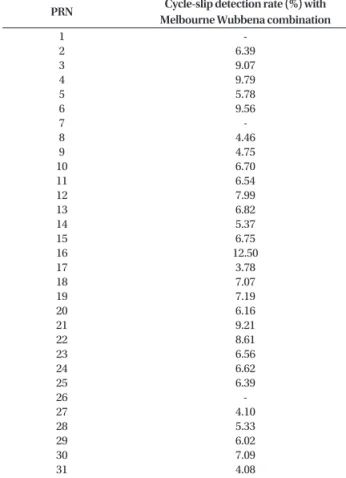
measurements ahead for the orbit determination. Table 1 shows the cycle-slip occurrence rate given by the Melbourne Wubbena combination. When any value exceeds the marginal value (2 sigma) which is established in advance through the pre-processing process, the state is regarded as the cycle-slip. As the GRACE-A satellite moves very fast (7 km/sec) and is exposed on severe environment in the space, the cycle-slip occurrence rate was revealed to be about 6.9%.

This means that 6.9% of the total amount of the GPS data is not used for the orbit determination of the satellite.

Table 1. Cycle-slip occurrence rate with the Melbourne Wubbena combination of all GPS satellites with in the data pre-processing (%).

PRN Cycle-slip detection rate (%) with Melbourne Wubbena combination

1

2 3 4 5 6 7 8 9 10 11 12 13 14 15 16 17 18 19 20 21 22 23 24 25 26 27 28 29 30 31 32

- 6.39 9.07 9.79 5.78 9.56 - 4.46 4.75 6.70 6.54 7.99 6.82 5.37 6.75 12.50 3.78 7.07 7.19 6.16 9.21 8.61 6.56 6.62 6.39 - 4.10 5.33 6.02 7.09 4.08 9.58

Total 6.91

Table 2. Orbit determination strategy for the LEO satellite with the kinematic PPP.

Item Description

LEO satellite Estimation period Processing intervals Position mode Estimated parameters Cutoff angle Tropospheric model Receiver antenna model Phase wind-up Processing filter Estimation Strategy

GRACE-A

2008.10.09. - 2008.10.13.

60 seconds Kinematic

Position, Receiver clock & clock drift 0 degrees

None

GRACE-A antenna offset (Level 1B) On

EKF

PPP

(3)

Table 2 gives information about the orbit estimation of the GRACE-A satellite. The Extended Kalman Filter (EKF) was applied in our software for the orbit estimation of the GRACE-A satellite. The parameters estimated in a process are consisted of the receiver position, the clock error of the receiver, and the drift of the clock error.

The phase center offset value of the GPS antenna mounted on a face of the GRACE-A satellite is represented

in Table 3. As the Earth observing satellites including the GRACE-A satellite maintain the local vertical local horizontal coordinate in the normal operation, we assumed Table 3. Phase center offset of the GPS Receiver onboard on the GRACE-A Satellite (Jäggi 2006).

GRACE-A antenna offset East (m) North (m) Up (m)

GPS L1

GPS L2

0.0004 0.0004

0.0004 0.0004

0.45142 0.47565

0 5 10 15 20

−0.25

−0.2

−0.15

−0.1

−0.05 0 0.05 0.1 0.15 0.2 0.25

UT (hour)

Position Err. R/A/C (m)

mean: 0.05cm −0.62cm 1.51cm rms : 3.79cm 3.51cm 2.97cm

Radial Along−track Cross−track

0 5 10 15 20

−0.25

−0.2

−0.15

−0.1

−0.05 0 0.05 0.1 0.15 0.2 0.25

UT (hour)

Position Err. R/A/C (m)

mean: 0.13cm −0.67cm 1.09cm rms : 4.57cm 4.49cm 4.45cm

Radial Along−track Cross−track

0 5 10 15 20

−0.25

−0.2

−0.15

−0.1

−0.05 0 0.05 0.1 0.15 0.2 0.25

UT (hour)

Position Err. R/A/C (m)

mean: −0.44cm −0.90cm −1.20cm rms : 4.81cm 4.97cm 3.71cm

Radial Along−track Cross−track

0 5 10 15 20

−0.25

−0.2

−0.15

−0.1

−0.05 0 0.05 0.1 0.15 0.2 0.25

UT (hour)

Position Err. R/A/C (m)

mean: −0.22cm −0.66cm −1.46cm rms : 4.63cm 4.66cm 3.87cm

Radial Along−track Cross−track

0 5 10 15 20

−0.25

−0.2

−0.15

−0.1

−0.05 0 0.05 0.1 0.15 0.2 0.25

UT (hour)

Position Err. R/A/C (m)

mean: 0.12cm −0.42cm −0.04cm rms : 3.80cm 3.85cm 2.94cm

Radial Along−track Cross−track
D E

F

H

G

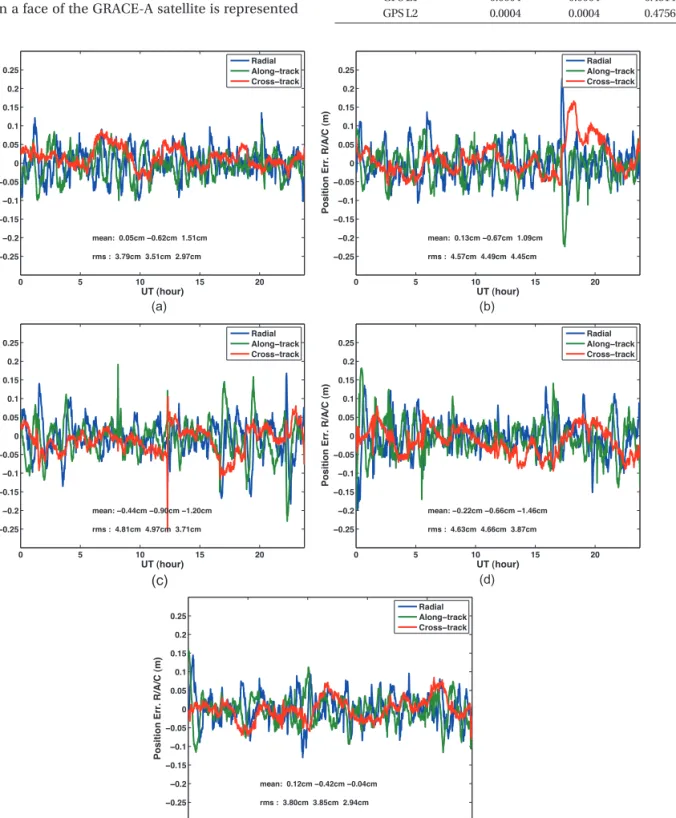
Fig. 1. Orbit errors of the GRACE-A Satellite on the satellite coordinate system: (a) October 9, (b) October 10, (c) October 11, (d) October

12, (e) October 13.

(4)

that the GPS antenna of the GRACE-A satellite set in the zenith direction.

3. RESULTS AND VERIFICATION

Choi et al. (2012) developed the kinematic PPP method.

In this study, the kinematic PPP was applied to the precise orbit determination for the GRACE-A satellite. We processed the GPS data obtained from the GRACE-A satellite for 5 days from October 9 to October 13, 2008. The data-processing has been carried out on a daily basis. The orbit of the GRACE-A satellite was calculated in 60 second intervals. For the verification of the results, we compared these results with the orbit product provided by the JPL. The final results were shown in the mean value and the RMS value for the errors of the satellite orbit. Figs. 1a-e show the results obtained by processing the GPS data received at the GRACE-A satellite for 5 days.

Fig. 1a shows the results obtained by processing the GPS data received by the GRACE-A satellite on October 9, 2008.

The mean position errors of the GRACE-A satellite in total were 0.05 for the radial direction (towards the center of the Earth), -0.62 m for the along-track direction (towards the moving direction of the satellite), and 1.51 m for the cross-track direction (towards the crossing direction of the moving direction of the satellite). The RMS values of the position error were 3.79 m for the radial direction, 3.51 m for the along-track direction, and 2.97 m for the cross- track direction. The mean position error of the cross-track direction was relatively larger than those of other directions, whereas the RMS value of the cross-track direction was relatively stable compared to those of the radial and the along-track directions. Fig. 1b shows the results of the data- processing on October 10. Similar to the results obtained from on October 9, the mean position error of the cross- track direction was 1.09 m which was relatively larger than those of other directions. However, the RMS value of the cross-track direction was relatively stable compared to the radial direction (4.57 m) and the along-track direction (4.49 m). Figs. 1c-e show the processing results of the data obtained from October 11 to October 13, 2008. The mean position error of the GRACE-A satellite, which was calculated for the three days, was less than 1.5 cm for each component. The mean position error of the cross-track direction was relatively larger than those of the radial and the along-track directions. With respect to the RMS values about the position error of the GRACE-A satellite the one of the cross-track direction was the smallest, whereas the ones of the radial and the along-track directions were relatively

large. In general, when processed the data received by the GPS reference stations, the position error of the horizontal direction becomes small and stable. The position error of the upward direction is considerably larger. The RMS value of it is large. The orbit results of the GRACE-A satellite with the kinematic PPP showed a small error at the horizontal direction. The RMS value of the radial direction was revealed to be large. As the kinematic method uses the GPS measurements only, the orbit accuracy of the GRACE-A satellite was similar to the results of the GPS reference stations.

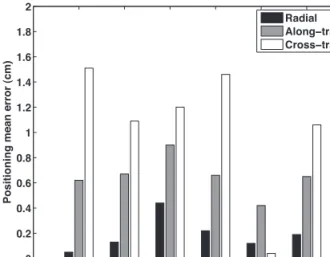
Fig. 2 shows the mean position error of the GRACE-A satellite with the kinematic PPP on a daily basis. As seen in Fig. 2, the position error of the GRACE-A satellite with the kinematic PPP was less than 2 m. By combining all the data-processing results for five days, the mean position errors for the radial, along-track and cross-track directions

Fig. 3. The RMS values for the position error of the GRACE-A satellite.

Fig. 2. The mean position errors of the GRACE-A satellite estimated by

the Kinematic PPP.

(5)

of the GRACE-A satellite were 0.19 cm, 0.65 cm, and 1.06 cm respectively. As a result, it suggested that the kinematic PPP method applied in the study can produce a very precise orbit and reliable results.

Fig. 3 shows the RMS values of the position errors for the GRACE-A satellite. Like the results of Fig. 2, by combining the results on a daily basis, the RMS values of the radial, along-track, and cross-track directions on the satellite coordinate system were 4.32 m, 4.29 cm and 3.58 cm respectively. The radial direction of the GRACE-A satellite was calculated to be the most unstable, whereas the cross- track direction of it was the most stable. The radial direction has relatively large error that is affected by the geometry of the GPS satellites. On the other hand, the error of the cross- track direction of the satellite was relatively small. These results are similar to the data processing results of the GPS reference stations.

With respect to the position errors of the GPS reference stations, the error in the north direction on the navigation coordinate system is the most stable and the smallest. Since the north direction of the GPS reference station is subject to the cross-track direction on the satellite coordinate system, the error for the cross-track direction of the GRACE-A satellite would be small.

We compared the estimated results with the results of the JPL for the same periods. The mean position error of the cross-track direction was estimated to be relatively greater than those of other directions. On the other hand, the RMS value of the cross-track direction was estimated to be small.

The mean position error of the cross-track direction was relatively greater. We assume that it would be caused by the satellite attitude, an inconsistency of the phase center offset of the GPS antenna onboard, and the phase wind-up effect.

4. SUMMARY AND CONCLUSION

In this study, the kinematic PPP method was applied to determine the precise orbit of the GRACE-A satellite. In order to estimate the stable orbit of the GRACE-A satellite, the pre-processing step was implemented. We also provided the cycle-slip occurrence rates for all GPS satellites with the Melbourne Wubbena combination. The dual-frequency GPS data, which obtained from the BlackJack GPS receiver onboard on the GRACE-A satellite, were processed for 5 days from October 9 to October 13, 2008. The GRACE-A satellite orbit was estimated in 60 second intervals. For the verification of the satellite orbit, we compared our results with the orbit product provided by the JPL. When compared two results, the mean position errors for the radial, along-

track and cross-track direction of the GRACE-A satellite showed the differences of 0.19 cm, 0.65 cm, and 1.06 cm respectively. The RMS values for the radial, along-track and cross-track direction showed the differences of 4.32 cm, 4.29 cm, and 3.58 cm respectively. From a detailed comparison, our results indicate that the radial direction error of the GRACE-A satellite is the most unstable, whereas the cross- track direction of the GRACE-A satellite is the most stable.

As a result, when we compared our results with the previous studies (Li et al. 2010, Choi & Lee 2011), our software for the orbit determination of the GRACE-A satellite can provide very precise results.

ACKNOWLEDGMENTS

We would like to thank three referees for helping to improve the quality of this study. This study was supported by the 2012 Leading Core Technology Project funded by Korea Astronomy and Space Science Institute (KASI) [Project Name: Development of high accuracy GNSS data analysis engine].

REFERENCES

Bisnath, S. N., Beran, T., & Langley, R. 2002, Precise platform positioning with a single GPS receiver, GPS World, 13, 42-49

Choi, B. K., Roh, K. M., Cho, S. K., Park, J. U., Park, P. H., &

Lee, S. J. 2012, Development of the Kinematic Global Positioning System Precise Point Positioning Method Using 3-Pass Filter, JASS, 29, 269-274. http://dx.doi.

org/10.5140/JASS.2012.29.3.269

Choi, J. Y., & Lee, S. J. 2011, Precision Assessment of Near Real Time Precise Orbit Determination for Low Earth Orbiter, JASS, 28, 55-62. http://dx.doi.org/10.5140/

JASS.2011.28.1.055

Geng, J., Teferle, F., Meng, X., & Dodson, A. 2010, Kinematic precise point positioning at remote marine platforms, GPS Solutions, 14, 343-350

Hofmann-Wellenhof, B., Lichtenegger, H., & Wasle, E.

2008, GNSS-global navigation satellite systems: GPS, GLONASS, Galileo, and more (Wien: Springer), pp.420- 426

Jäggi, A. 2006, Pseudo-Stochastic Orbit Modeling of Low Earth Satellites Using the Global Positioning System, PhD Dissertation, Bern University

Kouba, J., & Héroux, P. 2001, GPS precise point positioning

using IGS orbit products, GPS Solutions, 5, 12-28

(6)

Li, J., Zhang, S., Zou, X., & Jiang, W. 2010, Precise orbit determination for GRACE with zero-difference kinematic method, Chinese Science Bulletin, 55, 600- 606

Montenbruck, O. 2003, Kinematic GPS Positioning of LEO Satellites using Ionosphere-free Single Frequency Measurements, Aerospace Science and Technology, 7, 396-405. http://dx.doi.org/10.1016/S1270-9638(03) 00034-8

Tapley, B. D., Bettadpur, S., Watkins, M., & Reigber, C. 2004, The gravity recovery and climate experiment: Mission overview and early results, GRL, 31, L09607. http://

dx.doi.org/10.1029/2004GL019920

Webb, F. H., & Zumberge, J. F. 1995, An Introduction to

GIPSY-OASIS II, Jet Propulsion Laboratory User

Manual, JPL Technical Document D-11099, California

Institute of Technology

수치

Table 1.  Cycle-slip occurrence rate with the Melbourne Wubbena combination  of all GPS satellites with in the data pre-processing (%)
Table 2 gives information about the orbit estimation of  the GRACE-A satellite. The Extended Kalman Filter (EKF)  was applied in our software for the orbit estimation of the  GRACE-A satellite
Fig. 1a shows the results obtained by processing the GPS  data received by the GRACE-A satellite on October 9, 2008

참조

관련 문서

MP Yousef Al-Fadalah, Supervisor of Parliament Business Environment Committee declared that the Public Institution for Housing Care intends to dedicate nearly 150

The main objective of the Bi Regional Center for SMES Development is oriented towards generating the conditions of cooperation among the countries which

Current Tokyo is rich in green compared to other metro cities. In some parts, the greenery has been contributed by the many inherited gardens from the Edo era to today which

q March 28, 1906: County Magistrate Shim Heung-taek of Uldo-gun[Uldo County] heard this news from the Japanese survey team, he reported to the Korean central government

In a statement to Kuwait News Agency (KUNA) on the sidelines of a meeting of the Arab Parliament's Foreign Affairs Political and National Security

The meeting was attended by Assistant Foreign Minister for GCC Affairs, Ambassador, Nasser Al-Muzayyen, and Deputy Assistant Foreign Minister for the Office of the

“ Sheikh Nasser has a written message from HH the Amir, Sheikh Sabah Al-Ahmad Al-Jaber Al-Sabah to the Chinese President, Chi Gen Beng related to enhancing mutual

On his part, CEO of Express Roads Authority, Saud Al-Naqqi said that the heavy rains of the previous day led to clogging parts of the express