http://dx.doi.org/10.5625/lar.2014.30.3.112
13-week subchronic toxicity study of a novel ginsenoside composition from ginseng leaves in rats
Won-Ho Shin
1#, Yu Ri
1#, Seon-Gil Do
2, Young-Chul Lee
2, Sang-Joon Park
1*
1
Department of Histology, College of Veterinary Medicine, Kyungpook National University, Daegu, Korea
2
Unigen Inc., Cheonan, Korea
UG0712 is a new ginsenoside extract processed from ginseng leaves. A subchronic toxicity study of UG0712 was conducted in male and female SD rats. Rats were treated with UG0712 at doses of 100, 400 and 1,600 mg/kg/day for 13 weeks, and observed followed by 4-week recovery period at a highest dose.
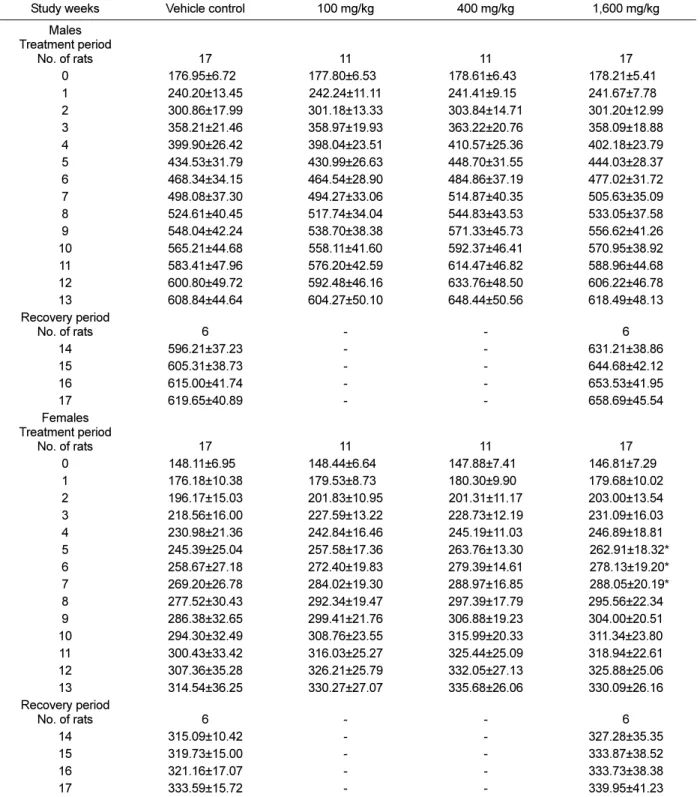
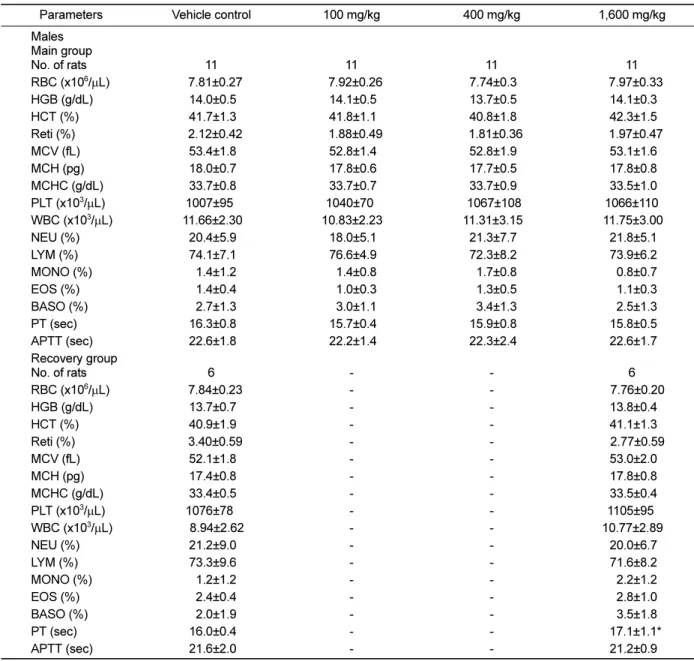
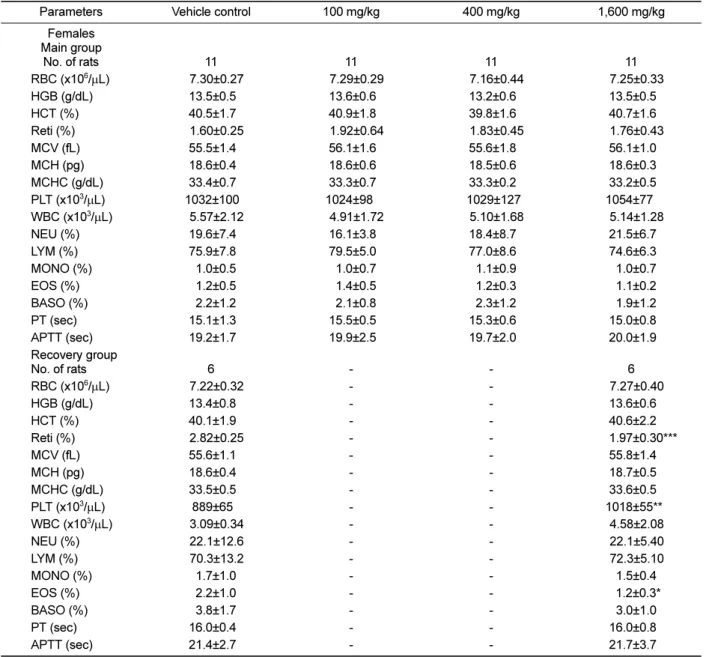
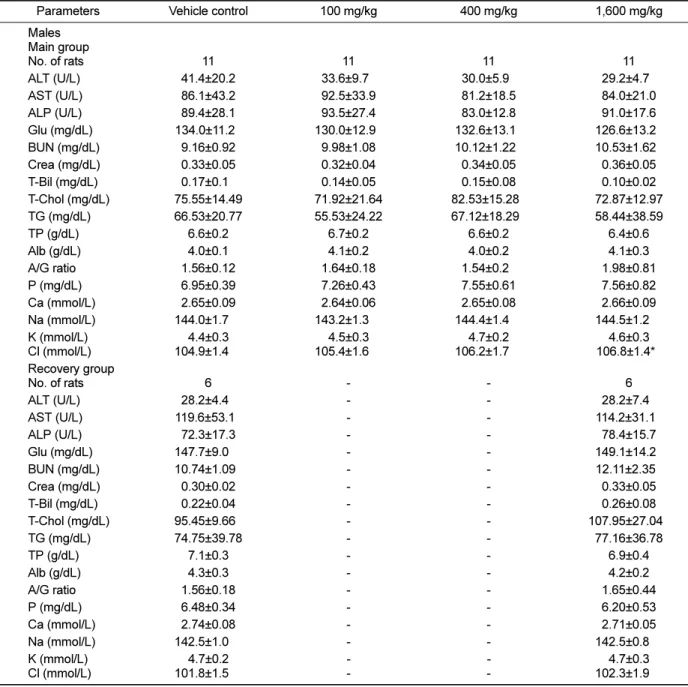
No-treatment-related effects were observed regarding the mortality, ophthalmic examination, urinalysis and histopathology. Although the changes in clinical sign, body weight, organ weight, hematology, and serum biochemistry were observed, they were temporal and pharmacological effects. Based on the present experiment conditions, the no observed adverse effect level was considered to be more than 1,600 mg/kg/day in both sexes of rats.
Keywords: UG0712, ginsenoside extract, ginseng leaf, subchronic toxicity, SD rats
Received 8 July 2014; Revised version received 19 August 2014; Accepted 1 September 2014
Ginseng has been used as an adaptogen in traditional medicine for several thousand years [1]. Although ginseng has pharmacological effects on psychologic fuction, immune system, and diabetes, some adverse effects including nausea, diarrhea, euphoria, headaches, hypertension, hypotension, mastalgia and vaginal bleeding are also existed [2].
Pharmacologically, the main active compounds of ginseng are ginsenosides which are named as ‘Rx’ and classified into the 20(S)-protopanaxadiol (PPD) (Rb1, Rb2, Rb3, Rc, Rd, Rg3, Rh2, Rs1) and the 20(S)- protopanaxatriol (Re, Rf, Rg1, Rg2, Rh1) [3]. Ginseno- sides show anti-cancer [4], anti-inflammatory [5], and neuroprotective effects [6-8]. In our previous study, we also reported that oral administration of a novel Rd and Rg3 extract improves exercise capacity and fatigue recovery [9].
Previous studies have reported that ginseng extract or
ginsenosides are not toxic, but they used extract from root of ginseng [10] or single ginsenoside [11-13] for chronic and subchronic studies. Furthermore, ginsenoside contents and amounts of root and leaf from ginseng were quite different [14,15], and one of most merit in the use of ginseng leaf is much cheaper than its root and particularly its leaf could be harvested yearly.
In this study, we have examined the potential subchronic toxicity of UG0712, a new ginsenoside extract processed from ginseng leaves (Rg3 derivatives: ~10% and total ginsenosides: ~70%) by repeated oral administration in Sprague-Dawley (SD) rat.
Materials and Methods
This study was conducted under Good Laboratory Practice (GLP) of the Korea Food and Drug Administration (KFDA) and performed in compliance with Testing
#