THE CONVERGENCE OF FINITE DIFFERENCE APPROXIMATIONS FOR SINGULAR
TWO-POINT BOUNDARY VALUE PROBLEMS H. Y. LEE, J. M. SEONG, AND J. Y. SHIN
ABSTRACT. We consider two finite difference approximations to a singular boundary value problem arising in the study of a nonlinear circular membrane under normal pressure. It is shown that the rates of convergence areO(h) andO(h2 ),respectively. An iterative scheme is introduced which converges to the solution of the finite difference equations. Finally the numerical experiments are given
1. Introduction
In the study of a nonlinear circular membrane under normal pressure [3,4], the following singular boundary value problem arises:
(1.1)
" 3 , 2
- y - -y - - =0, 0< x < 1,
X y2
y'(O) =0, y'(1)+(1 - v)y(1) =0, 0 < v < 1,
where v, 0 < v < 1, is a constant. The existence of a unique positive solution of (1.1) has been discussed by [2,3,4,9]. Numerical solutions of this problem can be obtained by the iterative method [2] and nu- merical techniques [4] on the integral equation equivalent to (1.1). It is mentioned in [4] that because of singularity and the nonlinearity, diffi- culties are encountered if numerical solutions of (1.1) are attempted by finite difference methods. In [8], a finite difference method to a class of singular boundary value problem is introduced.
When the boundary condition at x = 1 is y(1) = A(> 0) instead. of y'(1)+(1-v)y(1) =0, the unique existence of a positive solution and a
Received March 28, 1998.
1991 Mathematics Subject Classification: 65L12, 65LlO.
Key words and phrases: A finite difference approximation, a singular boundary value problem, a rate of convergence.
numerical solution are studied by [2,3,4,7,8,9]. In [7], a finite difference approximation to (1.1)isintroduced whose rate of convergenceisO(h2)
and which may avoid the above difficulties stated in[4]. And the global error estimateO(h2) is better than one in [8].
Inthis paper, motivated by the method in [7], two finite difference approximations to (1.1), scheme I and scheme II, are considered. The rates of convergence areO(h)andO(h2), respectively and both meth- ods may avoid the difficulties stated in [4]. To obtain the solution of each finite difference equation, an iterative technique is introduced which converges monotonically to the solution of the finite difference equation. Insection 2, some preliminaries are given. In section 3, two finite difference approximations, scheme I and scheme II, are intro- duced, and an iterative techniqueis given which converges monotoni- cally to the solution of the finite difference equations. Insection 4, we prove analytically that the rates of convergence of the scheme I and the schemeII are O(h) and O(h2), respectively. The rates of convergence of schemeI and schemeII are verified numerically in section 5.
2. Preliminaries
To discuss the behavior of the solution of (1.1) at x = 0, we begin with the following lemma whose proofis·straightforward.
LEMMA 2.1. Let f E C[O,l] and f' E C(O,l]. If tim f'(x) exists,
x-tO+
then
f' (0) = tim f(x)- f(O) = tim f'(x),
+ x-tO+ X x-tO+
which implies that f'(x) contmuousatx =O.
Itwas shown in[9]that there exists a unique solutionYEC2(0,1]n
Cl[0, 1] of (1.1). Thus the following lemma is obtained from Lemma 2.1 and the fact that
1 [X 283
Y'(x) = - x3lo y2(S) ds.
LEMMA 2.2 [7]. Let Y be a positive solutionof(1.1). Then (1) Y~(O) existsandY"(x) is continuousat x = O.
(3.1.1)
(2) Y+(3)(0)(= 0) existsand y(3)(x) is continuousatx = o.
(3) Y+(4)(0) existsand y(4)(x) is continuousat x = o.
REMARK. Lemma 2.2 implies thatifY isa positive solution of (1.1) thenY EC4[0, 1].
3. Finite difference approximations 3.1. Scheme I
LetN be a positive integer, h= ~, Xi = i-h, i = 0,1,2, _. -,N,and let Yi be the approximation ofY(Xi), i = 0, 1, 2, ... , N. Consider the following finite difference approximation (scheme I):
_ 8 .Y1 - Yo - ~ = 0
h2 Y5 '
_ 4. Y2 - 2Y1+Yo _ ~ = 0
h2 Y f '
Yi+1 - 2Yi+Yi-1 3 Yi+1 - Yi-1 2 -""2=0,
h2 Xi 2h Yi
i = 2, 3, ... , N - 1, YN-1 - YN + (1 ) 0
- h -v YN = .
Let
8 -8 0 0
-4 8 -4 0 0
0 3h 3h
- 1 + - 2 - 1 - -
2X2 2X2
£1= 0
0 0 - 1+ 3h 2 -1- 3h
2XN-1 2XN-1
0 0 -1 1+ h(1-v)
y= (Yo, Yl, ... , YN-l, YN)t,
and
N1y-= (_2h2 _ 2h2 ••. _ 2h2
O)t
2 ' 2 ' , 2 ' ,
Yo Y1 YN-1
whereN1yandyare column vectors. Now we have a nonlinear system (3.1.2)
where 0 isthe zero vector. To solve the nonlinear system (3.1.2), we use Newton's method. So, for m = 0, 1, 2, "', we have
(3.1.3) y(Tn+l) = y(Tn) _ (L1+N1'y(Tn»)-1 . (L1y(Tn) +N 1y(Tn») ,
h N ,-. h di al . di [4h2 4h2 4h2 0]
were 1 YISt e agon matrIX, ag - 3i - 3 ,'" ' - 3 - - ' .
Yo Y1 YN-1
Therefore, from (3.1.3), we derive
and
(3.1.5)
L 1y(Tn+1)+N 1y(Tn+1)
= N1y(Tn+1) _ N1y(Tn) _ N 1'y(Tn) [y(Tn+1) _ y(Tn)]
= ~N1I/e(Tn) ( (yjTn+1) _ yJTn»)
2) ,
h N 1 / - ' h di al . di [12h2 12h2 12h2 ]
were 1 YISt e agon matrIX, ag - -4-" - -4-' .. " - -4--,0 ,
Yo Yl YN-l
and ejTn) is between yJTn+1) and yjTn).
THEOREM 3.1.1 [1].
(i) The M-matrix L1 is an inverse positive matrix.
(ii) The matrix L1+ N1'y is an inverse positive matrix for any
y>O.
Proof (i) Let Di be the (i +1)-th leading principal minor of L1 . Then we obtain
Do =
8,
D 1= 32, D2 =(1
+ :~) D 1,DN-l =
(1
+2
XN-13h ) D N- 2, D N = h(1 - v)(1
+2
XN-l3h ) D N - 2,which imply that the M-matrix L1 is an inverse positive matrix.
(ii) Since L1 is an M-matrix and N{y is a nonnegative diagonal matrix for' anyy >0, L1+N1'y is an inverse positive matrix. 0
LEMMA 3.1.1. Ifu satisfies L1u +NIU 2:: °and 1satisfies L11+
NIl::; 0, then
1 ::; u,
where
°
< Ui and°
< li for i =0, 1, 2, ... , N.Proof. From the assumptions on u and 1, we have 0::; L1U+N1u - L11-NIl
= L1(U-1)+N1(u-1)
=(L1+N1'e)(u-1),
where ei lies between li and Ui. Since L1 +N1'e is inverse positive,
u -12:: 0, which completes the proof. 0
LEMMA 3.1.2. Ifu satisfies L1u +N1u 2:: 0, yCO) > 0, L1y(O) +
N1Y(O) ::; 0, and {yCrn)} is given by (3.1.3) or (3.1.4), then
yCO) ::; y(1) ::;y(2) ::; ... ::;y(m) ::; •.. ::; u for m =0, 1, 2, where 0< Ui for i =0, 1, 2, ... , N.
Proof It is obvious from (3.1.3), (3.1.5) and Lemma 3.1.1. 0 Let
lex) = _[ (1 - v)2 ]i(x2 _ 2 - v) 4(2-v)2 1 - v ' li =l(ih),i= 0,1,2,'" ,N, 1=(lo,It,l2,', IN)t,
where h = k. Then it is easy to show that 1 satisfies L11+N11 ::; O.
And let
( )_ [(1 - v)2].!( 2 3 - v)
U X - - 3 X - - -
16 1-v '
Ui =u(ih),i=0,1,2"" ,N,
U = (Uo,Ul,U2,', UN)t.
Then it is alsoeasy to show that u satisfiesL1u +N1U ~ O.
THEOREM 3.1.2. The system ofequations (3.1.2) has a unique pos- itive solution.
Proof The system of equations (3.1.2) has a positive solution from Lemma3.1.2 and the above remark. Suppose that y andw are positive solutions of the system of equations (3.1.2) and z = y - w. Then we have
So we obtain
where ei is betweenYi and Wi. Since L1+N1/eis an inverse positive
matrix, Z = 0 and hencey = w. 0
3.2. Scheme 11
Using the same notationsas given in the beginnig of Section3.1, we consider the following finite difference approximation (scheme II):
_ 8. Y1 - Yo - ~ =0
h2 Y5 '
_ 4. Y2 - 2Y1 +Yo _ ~ =0
h2 YI'
(3.2.1) _ Yi+1 - 2Yi +Yi-1 _ ~ . Yi+1 - Yi-1 _ ~ - 0
h2 Xi 2h Yt - ,
i =2, 3, ". , N - 1,
2YN-1-2YN 2 3 2
- +-(1-V)YN+-(1-v)YN--=O.
h2 h XN YFv
Let L 2 be the same matrix as the matrix L1 in section 3.1 except the n-th row and let the n-th row ofL2 be0,0, ... ,0, -2,2+2h(1-v) +3h2(1-v). Let
and
N2Y-= (_2h2 _ 2h2 ••• _ 2h2 _ 2h2) t
2' 2' , 2 ' 2 '
Yo Y1 YN-1 YN
where N2Y and y are column vectors. Now we have a nonlinear system (3.2.2)
where 0 isthe zero vector. So, for m = 0, 1, 2, "., we have
where N2'y is the diagonal matrix, diag[~2,
Yo Therefore; from (3.2.3), we derive
and
(3.2.5)
L2y(m+1)+N2y(m+l)
= N2y(m+l) _ N2y(m) _ N2'y(m) [y(m+l) _ y(m)]
=~N2,,{(m) ((y~m+l)-
yjm)f) ,
h l\T , , - . h di al . d· [12h2 12h2 12h2]
w erelV'2 Ylst e agon matrIX, Jag - - - ... - - -4 ' 4 ' , 4 '
Yo Y1 YN
and {~m)is betweeny~m+l) and y~m).
THEOREM 3.2.1 [1].
(i) The M-matrixL2 isan inverse positivematrix.
(ii) The matrix L2 +N2'y is an inverse positive matrix for any
y> 0.
Proof. (i) Let Di be the (i +1)-th leading principal minor of L2 • Then we obtain
Do =
8,
Dl =32, D2 =(1
+::2)
Dl'D N-l =
(1
+2
XN-l3h ) DN-2,DN = {2h(1-v)+3h2(1-vH·
(1
+2
XN-l3h ) DN - 2 ,which imply that theM-matrixL2 isan inverse positive matrix.
(ii) The proofis the same as that of Theorem 3.1.1. 0 LEMMA 3.2.1. Ifu satisfies L2U+N2U ;;:::
°
and 1satisfies L21+N21SO, then
1S u,
where0 <Ui and 0 < h fori =0, 1, 2, ... , N.
Proof. The proof is similar to that of Lemma 3.1.1. o
LEMMA 3.2.2. H u satisfies L2u +N2u ;;::: 0, yCO) > 0, L2yCO) +
N2yCO) So, and{yCm)} is given by (3.2.3) or (3.2.4), then
yCO) S yCl) S y(2) S ... S yCm) S ... S u, for m = 0, 1, 2, ... ,
l(x) = _[ (1-v)2 ]!(x2 _ 2 - v) 4(2 - v)2 1-v ' li=l(ih),i=0,1,2,'" ,N, 1= (lo,Lt,b, "IN)t,
where h = 1. Then it is easy to show that 1 satisfies L21+N21~ O.
Andlet
u(x) = -
[(1
~6V)']' (x2 _ ~=:) ,
Ui = u(ih),i= 0,1,2,·,N,
u = (UO,Ul,U2,'" ,UN)t.
T~enit is also easy to show that u satisfies L2U+N2U 2:O.
THEOREM 3.2.3. The system of equations (3.2.2) has a unique pos- itive solution.
Proof The proof is similar to that of Theorem 3.1.3. o
4. The convergence of finite difference approximations 4.1. Scheme I
LEMMA 4.1.1 [5,7]. Let Q(Xi) = Qi and E(Xi) = E i be dis- crete functions defined on xo, Xl, X2, " . , X N. Assume that there exists an w >
°
such thatQi ~ -w< 0, i = 0, 1, 2, ... , N - 1.
Set C = max(~,1~v). At the grid points Xo, Xl, X2, XN define a difference operatorLq by
h El-Eo
(4.1.1) LIEo= 8· h2 +QoEo, ( 1 2) L hE - 4. E2 - 2EI+Eo Q E
4. . I I - h2 + I 1,
(4.1.3)
(4.1.4) Then
Proof. Note that C ~ 1. IfmaxIEiIoccurs for i =N, then
IENI ~ 1~vIL~ENI.
Suppose that maxIEil occurs for one ofi = 0, 1, 2,'" , N - 1. Then from the proof of Lemma 4.1 in (7), we have
4 h
o<~~_IIEjl ~_3_ w .O<~~_IILIEjl·_3_
Thus the proofiscompleted. o
THEOREM 4.1.1. Let Y(x) E C4[0,1) be an analytic solution of the boundary value problem (1.1). Let Yi, i = 0, 1, 2, ... , N, be numerical solutions ofLIy+NIy =0 and Ei =Y(Xi) - Yi be errors.
Then
where
M4 =sup
I
dfdx~I
andC is a constant.[O,l}
(4.1.5)
Proof. By the mean value theorem and Taylor theorem, we obtain
" ( ) 2
0=4Y Xo + 2
[Y(xo)}
=8.Y(XI) - Y(xo) 2 _ y(4)(~ ) . h2
h2 + [Y(xO))2 0 3'
whereXo < ~o< Xl. ForXl, we have
(4.1.6)
" ( ) 3 ' ( . ) . 2
0= Y Xl + - .Y Xl + 2
Xl (y(XI))
= 4Y"(XI)+3(ylI(~O) - y"(XI)) + [Y(:I))2
=4.y(X2) - 2Y~:I)+Y(xo) _ ~ [y(4)(1]O) +y(4)(1]I)]
+3y(4)(~2)'~I(~O-Xl)+ 2 2,
[y(Xl))
whereXi-1 <170 < Xi <171 < XH!, Xi-1 < eo < e2 < Xi < ea < e1 <
Xi+!, Xo <e4 < Xi . And for XN, we obtain 0=Y/(XN) +(1-V)Y(XN)
(4.1.8) = Y(XN)-hY(XN-1) +(1 - V)Y(XN) + ~Y"(eo).
whereXN-1 <eo < XN. From (3.1.1), (4.1.1), and (4.1.5) we obtain
h El - Eo (4) h2
L1EO= 8· h2 +QoEo= Y (eo)· 3·
From (4.1.2) and (4.1.6), we get LhE = 4. E2 - 2E1+Eo Q E
1 1 h2 + 1 1
= ~2 [y(4)(170)+y(4)(171)] - 3y(4)(6)6(eo - Xl).
And, from (4.1.3) and (4.1.7), we have
Lhg EH 1 - 2Ei +E i - 1 ~. E i+1 - Ei-l Q.g
1 Z h2 +Xi 2h + Z Z
=h2 [2y(4)(€4)+ y(4)(€2)(€o _ Xi) +y(4)(€3) (€l - Xi)]
2 Xi Xi
+ ~: [y(4)(1]0) +y(4)(1Jl)] , i =2, 3, ... , N-1.
From (4.1.4) and (4.1.8)
where F(y) = 22, Qi = F'(J-Li) = - ~ ::; -w < 0, and J-Li lies
y \d4';Z\"
betweenY(Xi) andYi· Let M4 =sup - d4 • Then we obtain
[0,1] X
h2 ILhEol::; 3 M4'
h2
ILhE11 ::; 3 M4+3h2M4 ,
h2
ILhEil ::; 12M4+2h2M4 , i = 2, 3, ... , N-1 ILhENI ::; 2"hM4.
Thus,by Lemma 4.1.1, we have
IEil ::; CM4h, for i =0, 1, 2, ... , N,
which completes the proof. 0
4.2. Scheme 11
LEMMA 4.2.1. -"et Q(Xi) =Qi, E(Xi) =E i be discrete functions defined on Xo, Xl, X2, ... , XN. Assume that there exists anw >
°
such that
Qi ~ -w < 0, i = 0, 1, 2, ... , N.
SetC=max(~, 2(1~V)). At thegridpointsxo, Xl, X2, " ' , XN define a difference operatorL~ by
(4.2.1) L~Ei =L}Ei , i = 0, 1, 2, ... , N -1,
h 2EN - 1 - 2EN 2 3
(4.2.2) L 2EN = h 2 -;;,(1-v)EN - XN (l-v)EN+QNEN.
Then
IEil ~C· max [ ~ax IL~Ejl, hIL~ENI], i = 0, 1, 2, ... , N.
0'5.J'5.N-1
Proof. Note that C 2:: 1. IfmaxIEil occurs for i =N, then
h h
jENI ~ 2(1 _ v) IL2EN)'
Suppose that maxIEiIoccurs for one ofi =0, 1, 2, ... , N - 1. Then sinceLqEi = L~Ei, i = 0, 1, 2,;" N - 1, the remaining part of the
proof is the same as that of Lemma 4.1.1. 0
Since Y(x) E C4[0,1] and Y(l) > 0, we may extend the positive solution of (1.1) to the interval [0,1+8], for sufficiently smallD> 0.
So we have the following theorem whose proof is the same as that of Theorem 4.1.1.
THEOREM 4.2.1. Let Y(x) E C4[0,1+<5], be an analytic solution ofthe boundary value problem (1.1) for sufficiently small <5 > 0. Let Yi be numerical solutions of L 2y+N2Y = 0 and E i = Y(Xi) - Yi be errors, wherei = 0, 1, 2, .. , , N. Then
- 2
IEil ~ CM4h, where
- \d4
y\
M4= sup - -
[0,1+6] dx4 and C isa constant.
(4.2.3)
Proof. From (1.1), by the mean value theorem and Taylor theorem, we obtain
"( ) 3 ' ( ) 2
0=Y XN + - .Y XN + 2
XN [Y(XN)]
= Y(XN+1) - 2Y(XN)+Y(XN-1) _ (1- V)~Y(XN)
h2 XN
+ [Y(:N)]2 - ~: [y(4)(17O)+y(4)(111)] ,
where XN-1 <110 < XN <711 < XN+1. And we obtain (4.2.4)
Y(XN+l)~Y(XN-1) +(1-V)Y(XN) - ~ [y(3)(~0)+y(3)(6)] = 0, where XN-1 < ~o < XN < 6 < XN+l. By substituting (4.2.4) into (4.2.3), we get
0= 2Y(XN-1~;2Y(XN) _ ~(1-V)Y(XN)+~[2y(4)(~4)
(4.2.5) +y(4)(~2)(~0 - XN)+y(4)(6)(~1 - XN)] + [Y(:N)]2
_ h 2
[y(4)(110) +y(4)(11t)] - (1-v)~Y(XN)'
24 XN
where XN < 6 <XN+l, XO < ~4 < XN. Therefore we have
h 2EN- 1 -2EN 2 3
L2EN - -(1-v)EN - - ( 1 -V)EN +QNEN
h2 h XN
= - ~ [2y(4)(~4)+y(4)(~2)(~0 - XN) +y(4)(6)(6 - XN)]
h2
+ 24[y(4)(110)+y(4)(111)],
where F(y) = 22, Qi = F'(JLi) = - 43 ::; -w < 0, JLi lies between
y JLi
Y(Xi) and Yi. Since L~Ei = L~Ei, i = 0, 1, 2, ., N - 1, we obtain from the proof of Theorem 4.1.1
IL2Ei ::;h I CM-4h2,i = 0, 1, 2, ... , N -1
and from (4.2.5) we get
_ I
d4Y
where M4 = sup d 4 Ifor sufficiently small 8>0. Thus, by Lemma
[0,1+6) x 4.2.1, we have
- 2
IEil ~ CM4h, for i = 0, 1, 2, ... , N,
which completes the proof. 0
5. Numerical experiments 5.1. Scheme I
The scheme I, proposed in section 3.1, has been implemented on an
mM pc.Inthe computation, we use
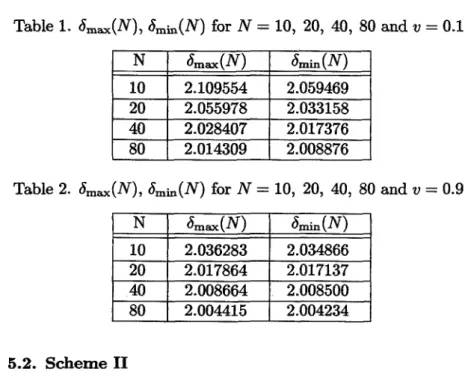
to stop the iteration when we solve the nonlinear system (3.1.2) by Newton's method (3.1.3) or (3.1.4). Intable 1, we report the values of 8max{N) and 8min{N) for N =10, 20, 40, 80 andv =0.1, where
andYN represents the solution of the nonlinear system (3.1.2) for the given N. And in table 2, the value of 8max{N) and 8min{N) are given for N =10, 20, 40, 80 andv =0.9. From table 1 and table 2, we see numerically that Theorem 4.1.1 is valid.
Table 1. dmax(N), dmin(N) for N = 10, 20, 40, 80 andv= 0.1
N dmax(N) dmin(N)
10 2.109554 2.059469 20 2.055978 2.033158 40 2.028407 2.017376 80 2.014309 2.008876
Table 2. dmax(N), dmin(N) for N = 10, 20, 40, 80 and v= 0.9
N dmax(N) dmin(N)
10 2.036283 2.034866 20 2.017864 2.017137 40 2.008664 2.008500 80 2.004415 2.004234
5.2. Scheme 11
The scheme Il, proposed insection 3.2, has also been implemented on anmMPC.Inthe computation, we use
j=O,e~N_1Iy(k+1)(Xj)- y(k)(Xj)
I
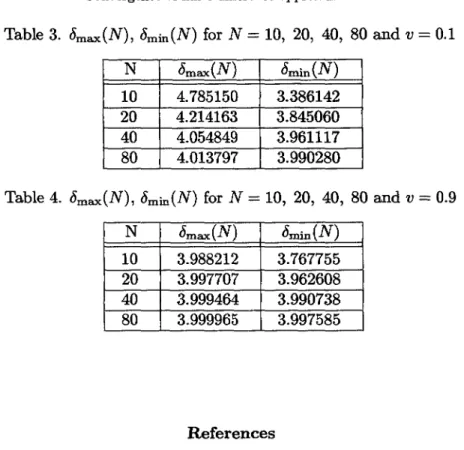
~TOL=1.0x 10⁻¹²to stop the iteration when we solve the nonlinear system (3.2.2) by Newton's method (3.2.3) or (3.2.4). Intable 3 we report the values of dmax(N) and dmin(N) for N =10, 20, 40, 80 andv =0.1, where
~ (N) _ IY2N(Xj) - YN(Xj)I
Qmax - max ,
j=O,l,···,N IY4N(Xj) - Y2N(Xj)I
dmin(N) = min IY2N(Xj) - YN(Xj)I
j=O,l,···,N IY4N(Xj) -Y2N(Xj)1
and YN represents the solution of the nonlinear system (3.2.2) for the givenN. Andin table 4 the value ofdmax(N) and dmin(N) are given for N = 10, 20, 40, 80 andv = 0.9. From table 3 and table 4, we see numerically that Theorem 4.2.1 isvalid.
Table 3. tSmax (N), tSmin (N) for N =10, 20, 40, 80 andv =0.1
N tSmax(N) tSmin(N)
10 4.785150 3.386142 20 4.214163 3.845060 40 4.054849 3.961117 80 4.013797 3.990280
Table 4. tSmax(N), tSmin(N) for N =10, 20, 40, 80 and v=0.9
N tSmax(N) tSmin(N) 10 3.988212 3.767755 20 3.997707 3.962608 40 3.999464 3.990738 80 3.999965 3.997585
References
[1] A. Berman & R. J. Plemmons, Nonnegative Matrices in the Mathematical Sciences, SIAM, Philadelphia, 1994.
[2] E. Bohl, On two boundary value problems in nonlinear elasticity from a nu- merical viewpoint (R. Ansorge, W. Toring, 1-14, ed.), In: Lecture Notes in Mathematics No. 676, Springer, Berlin, 1974.
[3] A.J. Calligari& E. L. Reiss, Nonlinear boundary value problems for the circular membrane, Arch. Rat. Mech. Anal. 31 (1970),390-400.
[4] R. W. Dickey, The plane circular elastic surface under normal pressure, Arch.
Rat. Mech. Anal. 26 (1967), 219-236.
[5] D. Greenspan& V. Casulli, Numerical Analysis for Applied Mathematics, Sci- ence, and Engineering, Addison-Wesley Publishing Company, New York, 1988.
[6] B. Gustafsson, A numerical method for solving singular boundary value prob- lems, Numer. Math 21 (1973),328-344.
(7] H. Y. Lee, M. R. Ohm and J. Y. Shin, A finite difference approximation of a singular boundary value problem, Bull. Korean Math. Soc. (accepted).
[8] R. N. Sen & Md. B. Hossain, Finite difference methods for certain singular two-point boundary value problems, Journal of Computational and Applied Mathematics 70 (1996), 33-50.
[9] J. Y. Shin, A singular nonlinear boundary value problem in the nonlinear cir- cular membrane under normal pressure,J.Korean Math. Soc. 32 (1995), no. 4, 761-773.
H. Y. Lee, J. M. Seong Department of Mathematics Kyungsung University Pusan 608-736, Korea J. Y. Shin
Division of Mathematical Sciences Pukyong National University Pusan 608-737, Korea