J. Korean Math. Soc. 45 (2008), No. 3, pp. 631–644
SOLVING SINGULAR NONLINEAR TWO-POINT BOUNDARY VALUE PROBLEMS IN THE REPRODUCING
KERNEL SPACE
Fazhan Geng and Minggen Cui
Reprinted from the
Journal of the Korean Mathematical Society Vol. 45, No. 3, May 2008
c
°2008 The Korean Mathematical Society
SOLVING SINGULAR NONLINEAR TWO-POINT BOUNDARY VALUE PROBLEMS IN THE REPRODUCING
KERNEL SPACE
Fazhan Geng and Minggen Cui
Abstract. In this paper, we present a new method for solving a nonlin- ear two-point boundary value problem with finitely many singularities.
Its exact solution is represented in the form of series in the reproduc- ing kernel space. In the mean time, the n-term approximation un(x) to the exact solution u(x) is obtained and is proved to converge to the ex- act solution. Some numerical examples are studied to demonstrate the accuracy of the present method. Results obtained by the method are compared with the exact solution of each example and are found to be in good agreement with each other.
1. Introduction
In this paper, we consider the following nonlinear second order ordinary differential equation with finitely many singularities in the reproducing kernel space
(1.1)
H(u(x))u00(x) +p(x)1 u0(x) +q(x)1 N (u(x)) = f (x), 0 < x < 1, u(0) = 0,
u(1) = 0,
where u(x) ∈ W23[0, 1], f (x) ∈ W21[0, 1], p(x), q(x) are continuous and may be equal to zero at {xi}mi=1 ∈ [0, 1], H and N are continuous functions of u. It is easy to see that the problem may have singularities not only at points {xi}mi=1, but also at u = 0. The singular boundary value problem arises in a variety of differential applied mathematics and physics such as gas dynamics, nuclear physics, chemical reaction, studies of atomic structures and atomic calculations.
Therefore, the problem has attracted much attention and has been studied by many authors. The existence and uniqueness of the equation have been widely investigated (see [1, 3, 5, 6, 10–12]). In general, classical numerical methods fail to produce good approximations for the equations. Hence one has to go for
Received August 29, 2006.
2000 Mathematics Subject Classification. 34B16, 46E22, 47B32.
Key words and phrases. exact solution, singular nonlinear boundary value problem, re- producing kernel.
c
°2008 The Korean Mathematical Society 631
non-classical method. Mohan and Vivek treated the homogeneous equation via Chebyshev polynomial and B-spline (see [2]). Kanth and Reddy studied a particular singular boundary value problem u00(x) +kxu0(x) + q(x)u(x) = r(x) by applying higher order finite difference method and cubic spline method (see [8, 9]). Mohchty and his co-workers considered such an singular boundary value problem u00(x) + axu0(x) + xa2u(x) = r(x) using a four order accurate cubic spine method (see [7]). However, in most of the present references, the problems discussed only have singularities at boundary points, not at interior points, and there are few valid methods of solving the equation (1.1).
In this paper, we will give the representation of exact solution to the equa- tion (1.1) and approximate solution in the reproducing kernel space under the assumption that the solution to the equation (1.1) is unique.
After multiplying the equation (1.1) by p(x)q(x), we find that
p(x)q(x)H(u(x))u00(x) + q(x)u0(x) + p(x)N (u(x))
= p(x)q(x)f (x), 0 < x < 1, u(0) = 0,
u(1) = 0.
(1.2)
Clearly, the solution of the equation (1.2) is the solution of the equation (1.1). So we only need to obtain the solution of the equation (1.2).
Put Lu ≡ q(x)u0(x) and write
F (x, u(x), u00(x)) = p(x)q(x)f (x) − p(x)q(x)H(u(x))u00(x) − p(x)N (u(x)) simply. Then the equation (1.2) can further be converted into the following
form
Lu = F (x, u(x), u00(x)), x ∈ [0, 1]
u(0) = 0, u(1) = 0, (1.3)
where u ∈ W23[0, 1], F (x, u(x), u00(x)) ∈ W21[0, 1]. W21[0, 1] and W23[0, 1] are defined in the following section.
2. Several reproducing kernel spaces 1. The reproducing kernel space W23[0, 1].
The inner product space W23[0, 1] is defined as W23[0, 1] = {u(x) | u, u0, u00 are absolutely continuous real valued functions, u, u0, u00, u(3)∈ L2[0, 1], u(0) = 0, u(1) = 0}. The inner product in W23[0, 1] is given by
(2.1) (u(y), v(y))W3
2 = Z 1
0
(36uv + 49u0v0+ 14u00v00+ u(3)v(3))dy, and the norm k u kW3
2 is denoted by k u kW3
2= q
(u, u)W3
2, where u, v ∈ W23[0, 1].
Theorem 2.1. The space W23[0, 1] is a reproducing kernel space. That is, there exists Rx(y) ∈ W23[0, 1] for any u(y) ∈ W23[0, 1] and each fixed x ∈ [0, 1], y ∈ [0, 1], such that (u(y), Rx(y))W3
2 = u(x). The reproducing kernel Rx(y) can be denoted by
(2.2) Rx(y) =
½ c1ey+ c2e−y+ c3e2y+ c4e−2y+ c5e3y+ c6e−3y, y ≤ x, d1ey+ d2e−y+ d3e2y+ d4e−2y+ d5e3y+ d6e−3y, y > x.
The coefficients of the reproducing kernel Rx(y) and the proof of Theo- rem 2.1 are given in section 5.
2. The reproducing kernel space W21[0, 1].
The inner product space W21[0, 1] is defined by W21[0, 1] = {u(x) | u is absolutely continuous real valued function, u, u0∈ L2[0, 1]}. The inner product and norm in W21[0, 1] are given respectively by
(u(x), v(x))W1
2 = Z 1
0
(uv + u0v0)dx, k u kW1
2= q
(u, u)W1
2,
where u(x), v(x) ∈ W21[0, 1]. In [4], the authors proved that W21[0, 1] is a complete reproducing kernel space and its reproducing kernel is
Rx(y) = 1
2 sinh(1)[cosh(x + y − 1) + cosh(|x − y| − 1)].
3. The solution of the equation (1.3)
In this section, we will give the representation of exact solution of the equation (1.3) and implementation method in the reproducing kernel space W23[0, 1].
In the equation (1.3), it is clear that L : W23[0, 1] → W21[0, 1] is a bounded linear operator. Put ϕi(x) = Rxi(x) and ψi(x) = L∗ϕi(x), where L∗ is the adjoint operator of L . The orthonormal system {ψi(x)}∞i=1 of W23[0, 1] can be derived from Gram-Schmidt orthogonalization process of {ψi(x)}∞i=1,
ψi(x) = Xi k=1
βikψk(x), (βii> 0, i = 1, 2, . . .).
(3.1)
Theorem 3.1. For the equation (1.3), if {xi}∞i=1 is dense on [0, 1], then {ψi(x)}∞i=1 is the complete system of W23[0, 1] and ψi(x) = LyRx(y)|y=xi. Proof. We have
ψi(x) = (L∗ϕi)(x) = ((L∗ϕi)(y), Rx(y))
= (ϕi(y), LyRx(y)) = LyRx(y)|y=xi.
The subscript y by the operator L indicates that the operator L applies to the function of y.
Clearly, ψi(x) ∈ W23[0, 1].
For each fixed u(x) ∈ W23[0, 1], let (u(x), ψi(x)) = 0, (i = 1, 2, . . .), which means that,
(u(x), (L∗ϕi)(x)) = (Lu(·), ϕi(·)) = (Lu)(xi) = 0.
(3.2)
Note that {xi}∞i=1 is dense on [0, 1], hence, (Lu)(x) = 0. It follows that u ≡ 0 from the existence of L−1. So the proof of the Theorem 3.1 is complete. ¤ Theorem 3.2. If {xi}∞i=1 is dense on [0, 1] and the solution of the equation (1.3) is unique, then the solution of the equation (1.3) satisfies the form
u(x) = X∞ i=1
Xi k=1
βikF (xk, u(xk), u00(xk))ψi(x).
(3.3)
Proof. Applying Theorem 3.1, it is easy to see that {ψi(x)}∞i=1 is the complete orthonormal basis of W23[0, 1].
Note that (v(x), ϕi(x)) = v(xi) for each v(x) ∈ W21[0, 1], hence we have u(x) = P∞
i=1
(u(x), ψi(x))ψi(x)
= P∞
i=1
Pi k=1
βik(u(x), L∗ϕk(x))ψi(x)
= P∞
i=1
Pi k=1
βik(Lu(x), ϕk(x))ψi(x)
= P∞
i=1
Pi k=1
βik(F (x, u(x), u00(x)), ϕk(x))ψi(x)
= P∞
i=1
Pi k=1
βikF (xk, u(xk), u00(xk))ψi(x) (3.4)
and the proof of the theorem is complete. ¤
The implementation method
(3.3) can be denoted byu(x) = X∞ i=1
Aiψi(x), (3.5)
where Ai= Pi
k=1
βikF (xk, u(xk), u00(xk)). Let x1= 0, it follows that F (x1, u(x1), u00(x1))
is known. Considering the numerical computation, we put u0(x1) = u(x1), u000(x1) = u00(x1) and define the n-term approximation to u(x) by
un(x) = Xn i=1
Biψi(x), (3.6)
where
B1 = β11F (x1, u0(x1), u000(x1)), u1(x) = B1ψ1(x),
B2 = P2
k=1
β2kF (xk, uk−1(xk), u00k−1(xk)), u2(x) = P2
i=1
Biψi(x), ...
un−1(x) = n−1P
i=1
Biψi(x),
Bn = Pn
k=1
βnkF (xk, uk−1(xk), u00k−1(xk)).
(3.7)
Next, the convergence of un(x) will be proved.
Now, two lemmas are given first.
Lemma 3.1. If u(x) ∈ W23[0, 1], then |u(x)| ≤ √
3 k u(x) kW3
2, |u0(x)| ≤
√3 k u(x) kW3
2 and |u00(x)| ≤√
3 k u(x) kW3
2. Proof. Noting that
u(x) − u(y) = Z x
y
u0(t)dt, we get
|u(x)|2≤ |u(y)|2+ ( Z 1
0
|u0(t)|dt)2+ 2|u(y)|
Z 1
0
|u0(t)|dt.
(3.8)
Integrating (3.8) with respect to y from 0 to 1 and by H¨older’s inequality, then
|u(x)|2 ≤ R1
0 |u(y)|2dy +R1
0 |u0(t)|2dt + 2R1
0 |u0(t)|dtR1
0 |u(y)|dy
≤ k u k2W3
2[0,1]+2 k u kW3
2k u kW3
2
= 3 k u k2W3 2
≤ 3 k u k2W3 2 . That is, |u(x)| ≤√
3 k u(x) kW3
2 . In the same way, we obtain that
|u0(x)| ≤√
3 k u(x) kW23, |u00(x)| ≤√
3 k u(x) kW23 .
¤ By Lemma 3.1, it is easy to obtain the following Lemma 3.2.
Lemma 3.2. If un
−→ u(n → ∞), k uk·k n k is bounded, that is, Pn
i=1
Bi2 < ∞, xn→ y(n → ∞) and F (x, u(x), u00(x)) is continuous, then
F (xn, un−1(xn), u00n−1(xn)) → f (y, u(y), u00(y))(n → ∞).
Theorem 3.3. Suppose that k unk is bounded in (3.6) and the equation (1.3) has a unique solution. If {xi}∞i=1is dense on [0, 1], then the n-term approximate solution un(x) derived from the above method converges to the exact solution u(x) of the equation (1.3) and
u(x) = X∞ i=1
Biψi(x), (3.9)
where Bi is given by (3.7).
Proof. First of all, we will prove the convergence of un(x). From (3.6), we infer that
un+1(x) = un(x) + Bn+1ψn+1(x).
(3.10)
The orthonormality of {ψi}∞i=1 yields that
k un+1k2=k unk2+(Bn+1)2= · · · =
n+1X
i=1
(Bi)2. (3.11)
In terms of (3.11), it holds that k un+1 k≥k un k. Due to the condition that k unk is bounded, k unk is convergent and there exists a constant c such that
X∞ i=1
(Bi)2= c.
This implies that
{Bi}∞i=1∈ l2. If m > n, then
k um− un k2=k um− um−1+ um−1− um−2+ · · · + un+1− unk2. In view of (um− um−1)⊥(um−1− um−2)⊥ · · · ⊥(un+1− un), it follows that
k um− unk2=k um− um−1k2+ · · · + k un+1− unk2. Furthermore
k um− um−1k2= (Bm)2. Consequently,
k um− unk2= Xm l=n+1
(Bl)2→ 0 as n → ∞.
The completeness of W23[0, 1] shows that un → u as n → ∞ in the sense of k · kW3
2.
Secondly, we will prove that u is the solution of the equation (1.3). Taking limits in (3.6), we get
u(x) = X∞ i=1
Biψi(x).
(3.12)
Note here that
Lu(x) = X∞ i=1
BiLψi(x) and
(Lu)(xn) = P∞
i=1
Bi(Lψi, ϕn)
= P∞
i=1
Bi(ψi, L∗ϕn)
= P∞
i=1
Bi(ψi, ψn).
Therefore,
Pn j=1
βnj(Lu)(xj) = P∞
i=1
Bi(ψi,Pn
j=1
βnjψj)
=P∞
i=1Bi(ψi, ψn)
= Bn. (3.13)
If n = 1, then
(Lu)(x1) = F (x1, u0(x1), u000(x1)).
If n = 2, then
β21(Lu)(x1) + β22(Lu)(x2)
= β21F (x1, u0(x1), u000(x1)) + β22F (x2, u1(x2), u001(x2)).
It is clear that
(Lu)(x2) = F (x2, u1(x2), u001(x2)).
Moreover, it is easy to see by induction that
(Lu)(xj) = F (xj, uj−1(xj), u00j−1(xj)), j = 1, 2, . . . . (3.14)
Since {xi}∞i=1 is dense on [0, 1] for ∀ Y ∈ [0, 1], there exists a subsequence {xnj}∞j=1such that
xnj → Y as j → ∞.
From (3.14), it is easy to see that (Lu)(xnj) = F (xnj, unj−1(xnj), u00nj−1(xnj)).
Let j → ∞, by Lemma 3.2 and the continuity of F (x, u(x), u00(x)), we have (Lu)(Y ) = F (Y, u(Y ), u00(Y )).
(3.15)
From (3.15), it follows that u(x) satisfies the equation (1.3).
Since ψi(x) ∈ W23[0, 1]. Clearly, u(Y ) satisfies the boundary conditions of the equation (1.3).
That is, u(x) is the solution of the equation (1.3). The application of the uniqueness of solution to the equation (1.3) then yields that
u(x) = X∞ i=1
Biψi(x).
(3.16)
The proof is complete. ¤
4. Numerical example
In this section, some numerical examples are studied to demonstrate the ac- curacy of the present method. The examples are computed using Mathematica 4.2. Results obtained by the method are compared with the exact solution of each example and are found to be in good agreement with each other.
Example 1. Consider the singular equation
u2(x)u00(x) + 20u0(x)
x3(1 − x)2.5(x − 0.4)2 +sin(u(x)) x√
1 − x = f (x), 0 < x < 1, u(0) = 0, u(1) = 0,
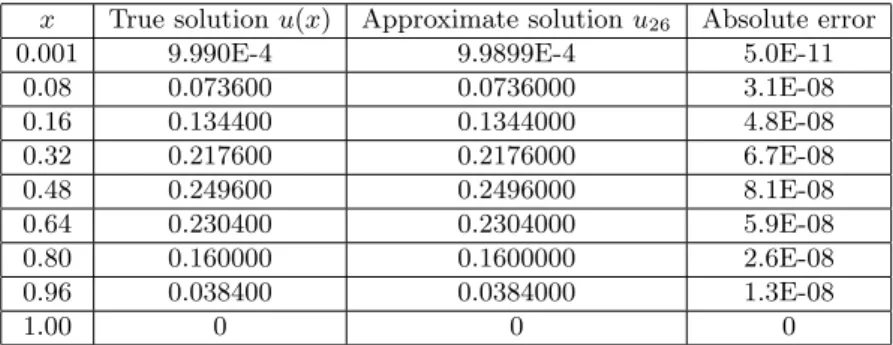
where f (x) = 20−40 x−2 (1−x)2.5(−1+x)2(−0.4+x)2x5+(−1+x)4(−0.4+x)2x4sin(x−x2) (1−x)52(−0.4+x)2x3 . The true solution is x − x2. Using our method, we choose 26 points on [0, 1].
The numerical results are given in the following table 1.
Example 2. Consider the singular equation ( pu(x)u00(x) +sin(x)3(1−x)30u2.2(x−0.4)0(x) 2(x−0.6)+
√u(x)
1−x = f (x), 0 < x < 1, u(0) = 0, u(1) = 0,
where
f (x) = {csc(x)3 ³
30 π cos(π x) + (1 − x)1.2 (−0.6 + x) (−0.4 + x)2sin(x)3
× sin(π x) − π2(1 − x)2.2 (−0.6 + x) (−0.4 + x)2sin(x)3sin(π x)1.5´ } /{(1 − x)2.2 (−0.6 + x) (−0.4 + x)2}.
The true solution is sin(πx). Using our method, we choose 26 points on [0, 1].
The numerical results are given in the following table 2.
Example 3. Consider the singular equation
u(x)u00(x) + u0(x)
x2(1 − x)3 +u2(x)
1 − x = f (x), 0 < x < 1, u(0) = 0, u(1) = 0,
where
f (x) = −1.1752 + cosh(x) + (1 − x)3x2sinh(x) (−1.1752x + sinh(x)) (1 − x)3x2
+(1 − x)2x2(−1.1752 x + sinh(x))3 (1 − x)3x2 .
The true solution is sinh(x) − sinh(1)x. Using our method, we choose 26 points on [0, 1]. The numerical results are given in the following table 3.
Table 1. Numerical results for example 1(n = 26).
x True solution u(x) Approximate solution u26 Absolute error
0.001 9.990E-4 9.9899E-4 5.0E-11
0.08 0.073600 0.0736000 3.1E-08
0.16 0.134400 0.1344000 4.8E-08
0.32 0.217600 0.2176000 6.7E-08
0.48 0.249600 0.2496000 8.1E-08
0.64 0.230400 0.2304000 5.9E-08
0.80 0.160000 0.1600000 2.6E-08
0.96 0.038400 0.0384000 1.3E-08
1.00 0 0 0
Table 2. Numerical results for example 2(n = 26).
x True solution u(x) Approximate solution u26 Absolute error
0.001 0.0031415 0.0031414 1.7E-07
0.08 0.2486900 0.2486450 4.4E-05
0.16 0.4817540 0.4817060 4.7E-05
0.32 0.8443280 0.8442490 4.8E-05
0.48 0.9980270 0.9979780 4.8E-05
0.64 0.9048270 0.9047790 4.8E-05
0.80 0.5877850 0.5877370 4.8E-05
0.96 0.1253330 0.1252720 6.0E-05
1.00 0 0 0
Table 3. Numerical results for example 3(n = 26).
x True solution u(x) Approximate solution u26 Absolute error
0.001 -1.7520E-4 -1.7519E-4 1.0E-08
0.08 -0.0139307 -0.0139391 9.4E-06
0.16 -0.0273486 -0.0273614 1.2E-05
0.32 -0.0505750 -0.0505831 8.0E-06
0.48 -0.0654511 -0.0654407 1.0E-05
0.64 -0.0675345 -0.0675128 2.1E-05
0.80 -0.0520550 -0.0520382 1.6E-05
0.96 -0.0137914 -0.0137858 5.5E-06
1.00 0 0 0
5. Appendix
Appendix A. The coefficients of the reproducing kernel Rx(y)
∆1= 48(−1 + e)e3 x(57121 + 171363e + 287970e2+ 409502e3+ 283644e4 +283644e5+ 409502e6+ 287970e7+ 171363e8+ 57121e9)
∆2= 60 (−1 + e) e3 x(57121 + 114242 e + 173728 e2+ 235774 e3+ 47870 e4 +235774 e5+ 173728 e6+ 114242 e7+ 57121 e8)
∆3= 5∆1
c1= ∆1
1(−6318 e4− 19548 e5− 19548 e6− 19548 e7− 6318 e8− 55926 e4 x
−7648 e5 x+ 6453 e6 x+ 7488 e3+x+ 30816 e4+x+ 30816 e5+x
+57121 e2 (5+x)+ 30816 e6+x+ 30816 e7+x+ 7488 e8+x+ 54756 e2+2 x +108232 e3+2 x+ 165353 e4+2 x+ 222474 e5+2 x+ 39495 e6+2 x
+229764 e7+2 x+ 171363 e8+2 x+ 114242 e9+2 x− 111852 e1+4 x
−167778 e2+4 x− 223704 e3+4 x− 37080 e4+4 x− 223704 e5+4 x
−167778 e6+4 x− 111852 e7+4 x− 55926 e8+4 x− 15296 e1+5 x
−22944 e2+5 x− 46272 e3+5 x− 46272 e4+5 x− 22944 e5+5 x
−15296 e6+5 x− 7648 e7+5 x+ 12906 e1+6 x+ 19359 e2+6 x +32724 e3+6 x+ 19359 e4+6 x+ 12906 e5+6 x+ 6453 e6+6 x) c2= ∆1
1(6453 e4+ 12906 e5+ 19359 e6+ 32724 e7+ 19359 e8+ 12906 e9 +6453 e10+ 57121 e4 x− 7648 e3+x− 15296 e4+x− 22944 e5+x
−55926 e2 (5+x)− 46272 e6+x− 46272 e7+x− 22944 e8+x− 15296 e9+x
−7648 e10+x− 55926 e2+2 x− 111852 e3+2 x− 167778 e4+2 x
−223704 e5+2 x− 37080 e6+2 x− 223704 e7+2 x− 167778 e8+2 x
−111852 e9+2 x+ 114242 e1+4 x+ 171363 e2+4 x+ 229764 e3+4 x +39495 e4+4 x+ 222474 e5+4 x+ 165353 e6+4 x+ 108232 e7+4 x
+54756 e8+4 x+ 7488 e2+5 x+30816 e3+5 x+30816 e4+5 x+30816 e5+5 x +30816 e6+5 x+ 7488 e7+5 x− 6318e2+6 x− 19548 e3+6 x
−19548 e4+6 x− 19548 e5+6 x− 6318 e6+6 x) c3= −∆2
1(1080e4− 105840e5+ 1080e6+ 9560e4x− 118305e5x+ 51624e6x
−1280 e3+x+ 243745 e4+x+ 55841 e5+x+ 60766 e6+x+ 59486 e7+x +57121 e8+x+ 57121 e9+x− 9360 e2+2 x− 29160 e3+2 x− 9360 e4+2 x
−29160 e5+2 x− 9360 e6+2 x+ 9560 e1+4 x+ 19120e2+4 x+ 38720e3+4 x +19120 e4+4 x+ 9560 e5+4 x+ 9560 e6+4 x− 118305 e1+5 x
−121950 e2+5 x− 121950 e3+5 x− 118305 e4+5 x− 118305 e5+5 x +51624 e1+6 x+ 52704 e2+6 x+ 51624 e3+6 x+ 51624 e4+6 x) c4= −∆1
2(51624e5+ 51624e6+ 52704e7+ 51624e8+ 51624e9+ 57121e5x
−118305e4+x−118305e5+x−121950e6+x− 121950e7+x− 118305e8+x
−118305e9+x+ 9560e3+2x+ 9560e4+2x+ 19120e5+2x+ 38720e6+2x +19120e7+2x+ 9560e8+2x+ 9560e9+2x− 9360e3+4x− 29160e4+4x
−9360e5+4x− 29160e6+4x− 9360e7+4x+ 57121e1+5x+ 59486e2+5x +60766e3+5x+ 55841e4+5x+ 243745e5+5x− 1280e6+5x+ 1080e3+6x
−105840e4+6x+ 1080e5+6x) c5= ∆1
3e−3x(3645e4− 179334e5− 122213e6+ 121532e7+ 116607e8 +114242e9+ 57121e10+ 32265e4x− 206496e5x+ 117110e6x
−4320e3+x+ 419040e5+x− 4320e6+x− 31590e2+2x− 97740e3+2x
−97740e4+2x− 97740e5+2x− 31590e6+2x+ 64530e1+4x+ 96795e2+4x +163620e3+4x+ 96795e4+4x+ 64530e5+4x+ 32265e6+4x
−412992e1+5x− 417312e2+5x− 417312e3+5x− 412992e4+5x
−206496e5+5x+ 234220e1+6x+ 235500e2+6x+ 234220e3+6x+ 117110e4+6x) c6= ∆1
3e−3x(117110e6+ 234220e7+ 235550e8+ 234220e9+ 117110e10 +57121e6x− 206496e5+x+ 32265e10+2x− 412992e6+x− 417312e8+x
−412992e9+x−206496e10+x+32265e4+2x+ 64530e5+2x+ 96795e6+2x +163620e7+2x+96795e8+2x+64530e9+2x− 31590e4+4x− 97740e7+4x
−31590e8+4x− 4320e4+5x+ 419040e5+5x+ 419040e6+5x− 4320e7+5x +114242e1+6x+ 116607e2+6x+ 121532e3+6x− 122213e4+6x
−179334e5+6x+ 3645e6+6x) d1= ∆1
1(−6318e4− 19548e5− 19548e6− 19548e7− 6318e8+ 57121e2x
−55926e4x− 7648e5x+ 6453e6x+ 7488e3+x+ 30816e4+x
+30816e5+x+ 30816e6+x+ 30816e7+x+ 7488e8+x+ 114242e1+2x +171363e2+2x+ 229764e3+2x+ 39495e4+2x+ 222474e5+2x +165353e6+2x+ 108232e7+2x+ 54756e8+2x− 111852e1+4x
−167778e2+4x− 223704e3+4x− 37080e4+4x− 223704e5+4x
−167778e6+4x− 111852e7+4x− 55926e8+4x− 15296e1+5x
−22944e2+5x− 46272e3+5x− 46272e4+5x− 22944e5+5x
−15296e6+5x− 7648e7+5x+ 12906e1+6x+ 19359e2+6x +32724e3+6x+ 19359e4+6x+ 12906e5+6x+ 6453e6+6x) d2= ∆1
1e2−3 x(6453 e2+ 12906 e3+ 19359 e4+ 32724 e5+ 19359 e6 +12906 e7+ 6453 e8− 55926 e2 x+ 54756 e4 x+ 7488 e5 x− 6318 e6 x
−7648 e1+x− 15296 e2+x− 22944 e3+x− 46272 e4+x− 46272e5+x
−22944e6+x− 15296e7+x− 7648e8+x− 111852e1+2 x− 167778e2+2 x
−223704e3+2 x− 37080e4+2 x− 223704 e5+2 x− 167778 e6+2 x
−111852 e7+2 x− 55926 e8+2 x+ 108232 e1+4 x+ 165353 e2+4 x +222474 e3+4 x+ 39495 e4+4 x+ 229764 e5+4 x+ 171363 e6+4 x +114242 e7+4 x+ 57121 e8+4 x+ 30816 e1+5 x+ 30816 e2+5 x +30816 e3+5 x+ 30816 e4+5 x+ 7488 e5+5 x− 19548e1+6 x
−19548 e2+6 x− 19548 e3+6 x− 6318 e4+6 x) d3= −∆1
2(1080e4− 105840e5+ 1080e6+ 57121ex+ 9560e4x− 118305e5 x +51624e6x+ 57121 e1+x+ 59486 e2+x+ 60766 e3+x+ 55841 e4+x +243745 e5+x− 1280 e6+x− 9360 e2+2 x− 29160 e3+2 x− 9360 e4+2 x
−29160 e5+2 x− 9360 e6+2 x+ 9560 e1+4 x+ 19120 e2+4 x +38720 e3+4 x+ 19120 e4+4 x+ 9560 e5+4 x+ 9560 e6+4 x
−118305 e1+5 x− 121950 e2+5x− 121950 e3+5 x− 118305 e4+5 x
−118305 e5+5 x+ 51624 e1+6 x+ 52704 e2+6 x+ 51624 e3+6 x +51624 e4+6 x)
d4= −∆1
2e3−3 x(51624 e2+ 51624 e3+ 52704 e4+ 51624 e5+ 51624 e6 +9560 e2 x− 9360 e4 x− 1280 e5 x+ 1080 e6 x− 118305 e1+x
−118305 e2+x− 121950 e3+x− 121950 e4+x− 118305 e5+x
−118305 e6+x+ 9560 e1+2 x+ 19120 e2+2 x+ 38720 e3+2 x +19120 e4+2 x+ 9560 e5+2 x+ 9560 e6+2 x− 29160 e1+4 x
−9360 e2+4 x− 29160 e3+4 x− 9360 e4+4 x+ 243745 e1+5 x +55841 e2+5 x+ 60766 e3+5 x+ 59486 e4+5 x+ 57121 e5+5 x
+57121 e6+5 x− 105840 e1+6 x+ 1080 e2+6 x) d5= ∆1
3e−3x(57121 + 114242e + 116607e2+ 121532e3− 122213e4
−179334e5+ 3645e6+ 32265e4x− 206496e5x+ 117110e6x
−4320e3+x+ 419040e4+x+ 419040e5+x− 4320e6+x− 31590e2+2x
−97740e3+2x− 97740e4+2x− 97740e5+4x− 31590e6+2x +64530e1+4x+ 96795e2+4x+ 163620e3+4x+ 96795e4+4x +64530e5+4x+ 32265e6+4x− 412992e1+5x− 417312e2+5x
−417312e3+5x− 412992e4+5x− 206496e5+5x+ 234220e1+6x +235550e2+6x+ 234220e3+6x+ 117110e4+6x)
d6= ∆1
3e4−3x(117110e2+ 234220e3+ 235500e4+ 234220e5+ 117110e6 +32265e2x− 31590e4x− 4320e5x+ 3645e6x− 206496e1+x
−412992e2+x− 417312e3+x− 417312e4+x− 412992e5+x
−206496e6+x+ 64530e1+2x+ 96795e2+2x+ 163620e3+2x +96795e4+2x+ 64530e5+2x+ 32265e6+2x− 97740e1+4x
−97740e2+4x− 97740e3+4x− 31590e4+4x+ 419040e1+5x +419040e2+5x− 4320e3+5x− 179334e1+6x− 122213e2+6x +121532e3+6x+ 116607e4+6x+ 114242e5+6x+ 57121e6+6x)
Appendix B. The proof of Theorem 2.1 Through several integrations by parts for (2.1), then (B.1)
(u(y), Rx(y))W3 2
= R1
0 u(y)(36Rx(y) − 49R(2)x (y) + 14R(4)x (y) − R(6)x (y))dy + u(y)(49R0x(y)
−14R(3)x (y) + R(5)x (y))|10+ u0(y)(14R(2)x (y) − R(4)x (y))|10+ u00(y)R(3)x (y)|10. Since Rx(y) ∈ W23[0, 1], it follows that
Rx(0) = 0, Rx(1) = 0.
(B.2)
Since u ∈ W23[0, 1], u(0) = u(1) = 0. If (B.3)
14R(2)x (0) − R(4)x (0) = 0, 14Rx(2)(1) − R(4)x (1) = 0, R(3)x (0) = 0, R(3)x (1) = 0, then (B.1) implies that
(u(y), Rx(y))W3
2 =
Z 1
0
u(y)(36Rx(y) − 49R(2)x (y) + 14R(4)x (y) − R(6)x (y))dy.
For ∀x ∈ [0, 1], if Rx(y) also satisfies
(B.4) 36Rx(y) − 49R(2)x (y) + 14R(4)x (y) − R(6)x (y) = δ(y − x), then
(u(y), Rx(y))W3
2 = u(x).
Characteristic equation of (B.4) is given by
λ6− 14λ4+ 49λ2− 36 = 0,
then we can obtain characteristic values λ1= 1, λ2= −1, λ3= 2, λ4= −2, λ5= 3, and λ6= −3. So, let
Rx(y) =
½ c1ey+ c2e−y+ c3e2y+ c4e−2y+ c5e3y+ c6e−3y, y ≤ x, d1ey+ d2e−y+ d3e2y+ d4e−2y+ d5e3y+ d6e−3y, y > x.
On the other hand, for (B.4), let Rx(y) satisfy
(B.5) R(k)x (x + 0) = R(k)x (x − 0), k = 0, 1, 2, 3, 4.
Integrating (B.4) from x − ε to x + ε with respect to y and let ε → 0, we have the jump degree of R(5)x (y) at y = x
(B.6) R(5)x (x − 0) − R(5)x (x + 0) = 1.
From (B.2), (B.3), (B.5), (B.6), the unknown coefficients of (2.2) can be ob- tained.
References
[1] R. P. Agarwal and D. O’Regan, Second-order boundary value problems of singular type, J. Math. Anal. Appl. 226 (1998), no. 2, 414–430.
[2] M. K. Kadalbajoo and V. K. Aggarwal, Numerical solution of singular boundary value problems via Chebyshev polynomial and B-spline, Appl. Math. Comput. 160 (2005), no. 3, 851–863.
[3] P. Kelevedjiev, Existence of positive solutions to a singular second order boundary value problem, Nonlinear Anal. 50 (2002), no. 8, Ser. A: Theory Methods, 1107–1118.
[4] C. Li and M. Cui, The exact solution for solving a class nonlinear operator equations in the reproducing kernel space, Appl. Math. Comput. 143 (2003), no. 2-3, 393–399.
[5] Y. Liu and A. Qi, Positive solutions of nonlinear singular boundary value problem in abstract space, Comput. Math. Appl. 47 (2004), no. 4-5, 683–688.
[6] Y. Liu and H. Yu, Existence and uniqueness of positive solution for singular boundary value problem, Comput. Math. Appl. 50 (2005), no. 1-2, 133–143.
[7] R. K. Mohanty, P. L. Sachdev, and N. Jha, An O(h4) accurate cubic spline TAGE method for nonlinear singular two point boundary value problems, Appl. Math. Com- put. 158 (2004), no. 3, 853–868.
[8] A. S. V. Ravi Kanth and Y. N. Reddy, Higher order finite difference method for a class of singular boundary value problems, Appl. Math. Comput. 155 (2004), no. 1, 249–258.
[9] , Cubic spline for a class of singular two-point boundary value problems, Appl.
Math. Comput. 170 (2005), no. 2, 733–740.
[10] J. Wang, W. Gao, Z. Zhang, Singular nonlinear boundary value problems arising in boundary layer theory, J. Math. Anal. Appl. 233 (1999), no. 1, 246–256.
[11] X. Xu and J. Ma, A note on singular nonlinear boundary value problems, J. Math.
Anal. Appl. 293 (2004), no. 1, 108–124.
[12] X. Zhang and L. Liu, Positive solutions of superlinear semipositone singular Dirichlet boundary value problems, J. Math. Anal. Appl. 316 (2006), no. 2, 525–537.
Fazhan Geng
Department of Mathematics Harbin Institute of Technology Weihai, Shandong, P. R. China Minggen Cui
Department of Mathematics Harbin Institute of Technology Weihai, Shandong, P. R. China E-mail address: [email protected]