• 검색 결과가 없습니다.

Regulation Mechanism of Long Noncoding RNAs in Colon Cancer Development and Progression

N/A
N/A
Protected

Academic year: 2022

Share "Regulation Mechanism of Long Noncoding RNAs in Colon Cancer Development and Progression"

Copied!
7
0
0

로드 중.... (전체 텍스트 보기)

전체 글

(1)

INTRODUCTION

Colorectal cancer (CRC) is one of the most common malig- nancies worldwide, and ranks the second most common cause of cancer-related death for both sexes.

1

The morbidity and mortality of CRC have increased in the past few years, es- pecially in developing counties in Asia, such as China.

2

De- spite advances in the prevention, diagnosis, and treatment of CRC, effective treatment strategies for this disease have yet to be developed.

3

Metastasis and relapse are the main causes of failure in the treatment of CRC.

4

Therefore, elucidating the molecular mechanisms underlying CRC progression and me-

tastasis is important. Recent evidence supports the involve- ment of various signaling pathways in the pathogenesis and development of CRC.

5

Activation of the Wnt/β-catenin cas- cade is a common phenomenon in CRC,

6

and its downstream target genes can promote tumorigenesis by inducing cell cycle progression and abnormal proliferation.

7,8

The Wnt/β-catenin signaling pathway is involved in the regulation of epithelial- mesenchymal transition (EMT) and cell proliferation, inva- sion, and migration in CRC. This pathway also plays a vital role in regulating epithelial stem cell self-renewal, and the self-renewal ability of CRC stem cells is important for the initi- ation of CRC.

9

Alterations in the Wnt/β-catenin signaling pathway affect CRC, providing a potential target for treatment.

The Janus kinase/signal transducers and activators of tran- scription (JAK/STAT) signaling pathway, the PI3K/AKT sig- naling pathway, the MAPK cascade, the p53 pathway, Notch signaling, nuclear factor κB (NF-κB) signaling, and other path- ways have also been shown to affect the development of CRC.

Increasing evidence indicates that noncoding RNAs (ncRNAs) play important regulatory roles in various biological processes, including cancer development.

10

Long noncoding RNAs (lncRNAs) are ncRNAs longer than 200 nucleotides in length that are not translated into proteins.

11,12

Recent studies have reported that various lncRNAs act as modulators of car- cinogenesis and progression in human CRC.

13

LncRNAs are required for CRC cell proliferation and migration,

14

are associ-

Regulation Mechanism of Long Noncoding RNAs in Colon Cancer Development and Progression

Xiaohuan Tang, Xiaofang Qiao, Chao Chen, Yuanda Liu, Jiaming Zhu, and Jingjing Liu

Department of Gastrointestinal Nutrition and Hernia Surgery, The Second Hospital of Jilin University, Changchun, China.

Colorectal cancer (CRC) is the second most common cause of cancer-related death worldwide, and its high rates of relapse and metastasis are associated with a poor prognosis. Despite extensive research, the underlying regulatory mechanisms of CRC re- main unclear. Long noncoding RNAs (lncRNAs) are a major type of noncoding RNAs that have received increasing attention in the past few years, and studies have shown that they play a role in many biological processes in CRC. Here, we summarize recent studies on lncRNAs associated with CRC and the signaling pathways and mechanisms underlying this association. We show that dysregulated lncRNAs may be new prognostic and diagnostic biomarkers or therapeutic targets for clinical application. This re- view contributes not only to our understanding of CRC, but also suggests novel signaling pathways associated with lncRNAs that can be targeted to block or eradicate CRC.

Key Words: Colorectal cancer, lncRNA, signaling pathway

pISSN: 0513-5796 · eISSN: 1976-2437

Received: November 19, 2018 Revised: January 23, 2019 Accepted: January 24, 2019

Co-corresponding authors: Jiaming Zhu, PhD, Department of Gastrointestinal Nutrition and Hernia Surgery, The Second Hospital of Jilin University, No. 218 Ziq- iang Street, 130041 Changchun, China.

Tel: 86-431-81136210, Fax: 86-431-81136210, E-mail: [email protected] and Jingjing Liu, PhD, Department of Gastrointestinal Nutrition and Hernia Surgery, The Second Hospital of Jilin University, No. 218 Ziqiang Street, 130041 Changchun, China.

Tel: 86-431-81136210, Fax: 86-431-81136210, E-mail: [email protected]

•The authors have no potential conflicts of interest to disclose.

© Copyright: Yonsei University College of Medicine 2019

This is an Open Access article distributed under the terms of the Creative Com- mons Attribution Non-Commercial License (https://creativecommons.org/licenses/

by-nc/4.0) which permits unrestricted non-commercial use, distribution, and repro- duction in any medium, provided the original work is properly cited.

Yonsei Med J 2019 Apr;60(4):319-325

https://doi.org/10.3349/ymj.2019.60.4.319

(2)

ated with a poor prognosis in CRC,

15

and promote colon tu- morigenesis.

16

LncRNAs exert these effects by regulating vari- ous signaling pathways.

17

For example, the lncRNA CCAL promotes CRC progression by regulating the Wnt/β-catenin signaling pathway.

18

These studies provide new insights with which to improve our understanding of the mechanisms un- derlying CRC development. Herein, we summarize the latest findings on lncRNAs associated with CRC and highlight asso- ciated regulatory mechanisms and signaling pathways that may lead to the development of lncRNA-based approaches in the treatment of CRC.

UNDERLYING MECHANISMS OF

LNCRNAS IN THE REGULATION OF CRC

LncRNAs exert effects on gene expression at the transcrip- tional and post-transcriptional levels via various mechanisms.

LncRNAs can bind to DNA, RNA, and proteins to influence transcriptional initiation, RNA stability, or the activity of sig- naling pathways. LncRNAs serve as a scaffold for the recruit- ment of transcriptional factors to the promoter region to affect gene expression. Several lncRNAs are involved and play criti- cal roles in the development of cancers, such as malignant proliferation, metastasis, invasion, anti-apoptosis effects, and therapeutic resistance (Table 1). Recent studies have focused on the regulation of lncRNAs in CRC cells through signaling pathways. The underlying mechanisms are addressed in the following paragraphs.

LncRNAs regulate CRC cells through the Wnt/

β-catenin cascade

β-catenin affects both carcinogenesis and development.

Overexpression of Wnt/β-catenin pathway members is a com- mon feature in CRC.

6,19

Studies suggest that β-catenin plays a role as a transcription factor in concert with TCF1 and LEF1 to activate downstream target genes.

20

When Wnt ligands bind to the receptor FZD or LRPs, β-catenin is released from the β-catenin destructive complex, which consist of Axin, APC, and GSK3β. The activation of the Wnt cascade may be in- duced by mutations of APC.

21

Then, β-catenin accumulates and is translocated into the nucleus to activate the down- stream genes of the Wnt/β-catenin pathway through hcCF/

LEF, and it may continue to induce the process of EMT through increasing the expression of key proteins.

22,23

Over the past few years, an increasing number of studies have shown that EMT plays a vital role in cancer cell metastasis and invasion.

24

Some lncRNAs have proven to affect EMT by or not by Wnt/β-catenin pathway.

23-29

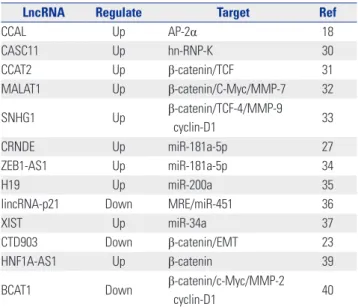
Several lncRNAs affect the Wnt/β-catenin cas- cade to regulate CRC (Table 2), and the regulatory mecha- nisms are listed in Fig. 1.

Some lncRNAs, such as CCAL, CASC11, and CCAT2, can bind to proteins or microRNAs (miRNAs) to affect the Wnt/

β-catenin pathway indirectly. The lncRNA CCAL can bind to activator protein 2α (AP-2α), which can combine with β-catenin and APC to form a complex, thereby weakening β-catenin/

TCF-4 interactions in CRC. The lncRNA CASC11 may activate the Wnt/β-catenin cascade by binding to hnRNP-K, which can form a complex with GSK3β, TCF4, β-catenin, and AXIN to inhibit the degradation of β-catenin. The physical interac- tion between TCF7L2 and the lncRNA CCAT2 can increase

Table 1. Signaling Pathways of LncRNAs Participating in the Regulation of Colorectal Cancer

LncRNA Signaling pathway Effect Ref

CCAL Wnt/β-catenin Oncogene 18

CASC11 Wnt/β-catenin Oncogene 30

CCAT2 Wnt/β-catenin Oncogene 31

MALAT1 Wnt/β-catenin Oncogene 32

SNHG1 Wnt/β-catenin Oncogene 33

CRNDE Wnt/β-catenin Oncogene 27

ZEB1-AS1 Wnt/β-catenin Oncogene 34

H19 Wnt/β-catenin Oncogene 35

lincRNA-p21 Wnt/β-catenin Anti-oncogene 36

XIST Wnt/β-catenin Oncogene 37

CTD903 Wnt/β-catenin Anti-oncogene 23

HNF1A-AS1 Wnt/β-catenin Oncogene 39

BCAT1 Wnt/β-catenin Anti-oncogene 40

AB073614 JAK/STAT Oncogene 17

SBDSP1 JAK/STAT Anti-oncogene 44

GACAT3 JAK/STAT Oncogene 45

CASC2 JAK/STAT Oncogene 46

AB073614 PI3K/PTEN/AKT/mTOR Oncogene 51

DUXAP10 PI3K/PTEN/AKT/mTOR Oncogene 52

RP11-708H21.4 PI3K/PTEN/AKT/mTOR Anti-oncogene 53 lncRNA-422 PI3K/PTEN/AKT/mTOR Anti-oncogene 54

PlncRNA-1 PI3K/PTEN/AKT/mTOR Oncogene 50

CRNDE MAPK Oncogene 58

NNT-AS1 MAPK Oncogene 59

PURPL p53 Oncogene 62

lncRNA-ROR p53 Oncogene 63

SNHG1 p53 Oncogene 64

ZFAS1 p53 Oncogene 65

HNF1A-AS1 p53 Oncogene 66

FAM83H-AS1 Notch Oncogene 70

FOXD2-AS1 Notch Oncogene 69

lnc-GNAT1-1 NF-κB Anti-oncogene 74

GAS5 NF-κB Oncogene 75

HOTAIR NF-κB Oncogene 76

loc554202 Caspase cleavage Anti-oncogene 77

MALAT1 Chemokine Oncogene 79

DILC IL Anti-oncogene 82

GAS5 IL Oncogene 75

lncRNA, long noncoding RNA; JAK, Janus kinase; STAT, signal transducers

and activators of transcription; IL, interleukin; NF-κB, nuclear factor κB.

(3)

whereas the lncRNAs GACAT3 and CASC2 act as ceRNAs for specific miRNAs to indirectly up-regulate SP1 and STAT3 ex- pression.

45,46

LncRNAs regulate CRC cells by affecting the PI3K/

PTEN/AKT/mTOR signaling pathway

The PI3K/PTEN/AKT/mTOR signaling pathway regulates var- ious biological processes in cells, such as gene expression, metabolism, cell growth, and metastasis.

47

Although the ef- fects of PTEN are frequently mediated by the negative regula- tion of the PI3K/PTEN/AKT/mTOR signaling pathway, it can also function as a suppressor independently.

48

Recent studies have demonstrated that lncRNAs regulate cancer progression through the PI3K/PTEN/AKT/mTOR cascade, which plays important roles in CRC cell proliferation and EMT.

49-51

Ap- proximately 40% of malignant tumors are related to altera- tions of the PI3K/PTEN/AKT/mTOR cascade, which under- scores the potential of the PI3K/PTEN/AKT/mTOR pathway as a target for clinical treatment. LncRNAs mainly affect the expression of related proteins to modulate signaling path- ways, such as AB073614, DUXAP10, RP11-708H21.4, and ln- cRNA-422.

51-54

In addition, PlncRNA-1 regulates the phos- phorylation of PI3K and AKT.

50

LncRNAs affect CRC cells through MAPK cascade Studies have demonstrated that most human cancers are re- lated to a biomolecular event, the activation of Ras/MAPK signaling.

55

Activation of the Ras/MAPK pathway promotes cell proliferation, migration, and differentiation.

56,57

Converse- ly, inhibition of this pathway in CRC cells suppresses tumor development. The lncRNA CRNDE is important in the regula- tion of Ras/MAPK pathways. In addition, hnRNPUL2 can in- crease the stability of CRNDE to act as a vital mediator, there- by activating the Ras/MAPK cascade.

58

Wang, et al.

59

showed that the activity of the MAPK/Erk signaling pathway is regulat- ed by the lncRNA NNT-AS1 and that activation of the MAPK/

Erk signaling pathway can induce EMT in CRC cells, increas- ing CRC cell proliferation, invasion, and migration.

LncRNAs affect CRC cells through the p53 pathway P53 is a well-known tumor suppressor that is associated with CRC. Overexpression of p53 promotes cell cycle arrest, apop- tosis, and tumor suppression.

60,61

LncRNAs are regulators and mediators of the p53 cascade, and the effect of many lncRNAs is mediated by regulating the expression of p53. For example, the lncRNAs PURPL, ROR, SNHG1, and ZFAS1 promote tu- morigenicity in CRC by suppressing basal p53 levels.

62-65

Fur- thermore, HNF1A-AS1 can repress the miR-34a/SIRT1/p53 feedback loop to down-regulate p53 and promote the metas- tasis of colon cancer.

66

Table 2. The Regulation of LncRNAs in Wnt/β-Catenin Cascade

LncRNA Regulate Target Ref

CCAL Up AP-2α 18

CASC11 Up hn-RNP-K 30

CCAT2 Up β-catenin/TCF 31

MALAT1 Up β-catenin/C-Myc/MMP-7 32

SNHG1 Up β-catenin/TCF-4/MMP-9

cyclin-D1 33

CRNDE Up miR-181a-5p 27

ZEB1-AS1 Up miR-181a-5p 34

H19 Up miR-200a 35

lincRNA-p21 Down MRE/miR-451 36

XIST Up miR-34a 37

CTD903 Down β-catenin/EMT 23

HNF1A-AS1 Up β-catenin 39

BCAT1 Down β-catenin/c-Myc/MMP-2

cyclin-D1 40

lncRNA, long noncoding RNA; AP-2α, activator protein 2α; EMT, epithelial- mesenchymal transition.

Wnt/β-catenin signaling pathway activity.

18,30,31

Some lncRNAs promote the nuclear localization of β-catenin to upregulate the Wnt/β-catenin cascade, such as MALAT1 and SNHG1.

32,33

MiRNAs are also important targets that help lncRNAs exert ef- fects on signaling pathways by binding to a complex. For ex- ample, the lncRNAs CRNDE, ZEB1-AS1, H19, lincRNA-p21, and XIST affect the Wnt/β-catenin signaling pathway by sponging or binding to miRNAs.

34-38

In addition, lncRNAs can change the expression of certain vital proteins to affect the ac- tivation of the Wnt/β-catenin cascade. The lncRNA CTD903 may downregulate Wnt/β-catenin signaling and then de- crease the expression of TCF, Snail, and Twist to suppress the EMT process, which is closely associated with the develop- ment of CRC. The lncRNA HNF1A-AS1 can induce CRC cell growth, invasion, and migration mediated by the Wnt/β-catenin cascade by up-regulating the expression of β-catenin, cyclin D1, and c-Myc. LncRNA-BCAT1 overexpression inhibits β-catenin expression in CRC cells.

23,39,40

LncRNAs regulate CRC cells by affecting the JAK/STAT signaling pathway

JAKs and STATs are essential molecules in cytokine signal

transduction pathways.

41

Despite their long-recognized pivot-

al roles in immunological responses, recent studies have

shown that JAKs and STATs play important roles in cancer ini-

tiation and progression.

42

The activated JAK/STAT pathway

can inhibit cell apoptosis and promote the proliferation and

invasion of tumor cells.

43

Certain lncRNAs play a role in CRC

by modulating the JAK/STAT pathway, acting as competing

endogenous RNAs (ceRNAs) or by changing the expression of

phosphorylated STAT3. The lncRNAs AB073614 and SBDSP1

contribute to the suppression of STAT3 phosphorylation,

17,44

(4)

LncRNAs affect CRC cells by modulating the Notch signaling pathway

The Notch signaling pathway is involved in the tumorigenesis of various cancers including CRC.

67,68

The cascade is observed in the processes of CRC cell proliferation, invasion, and me- tastasis. In addition, Notch signaling regulates EMT.

69

The ln- cRNA FAM83HAS1 is overexpressed in CRC cell lines and tis- sues concomitant with the up-regulation of two Notch signaling molecules, Notch1 and Hes1, thereby regulating the progression of CRC.

70

FOXD2-AS1 also regulates Notch signal- ing, acting as a tumor promoter in CRC.

69

LncRNAs affect CRC through the NF-κB signaling pathway The transcription factor NF-κB was identified as a nuclear fac- tor in 1986 and later shown to bind to enhancer elements to exert tumorigenic effects.

71,72

Under physiological conditions, NF-κB is inhibited by many proteins. When these proteins are phosphorylated, NF-κB is activated and translocated to the

nucleus to promote the initiation and progression of CRC.

73

Most lncRNAs regulate this cascade by directly or indirectly modulating NF-κB. For example, lnc-GNAT1-1 exerts sup- pressive functions in CRC through the RKIP-NF-κB-Snail cir- cuit, and lnc-GNAT1-1 knockdown downregulates PKIP and increases NF-κB expression.

74

The lncRNA GAS5 can decrease the phosphorylation of NF-κB to activate NF-κB signaling.

75

In addition, the NF-κB cascade is associated with 5-fluoropyrim- idine resistance caused by lncRNA HOTAIR in CRC.

76

LncRNAs affect CRC cells by several other mechanisms Caspase cleavage cascade

Apoptosis signaling can induce caspase expression, which may affect the progression of CRC. The overexpression of ln- cRNA loc554202 can promote G1 arrest and cause apoptosis to inhibit CRC cell proliferation, mainly via caspase cleavage cascade.

77

Fig. 1. The diverse regulatory mechanisms of lncRNAs on the Wnt signaling pathway. CCAL can activate Wnt/β-catenin signaling pathway by down-reg-

ulating activator protein 2α (AP-2α), which can attenuate β-catenin/TCF-4 interactions and increase β-catenin. CASC11 can interact with hnRNP-K to in-

duce the degradation of β-catenin and activate the Wnt/β-catenin signaling pathway. MALAT1 can increase the nuclear localization of β-catenin and ac-

tivate the pathway. SNHG1 can increase TCF-4 and β-catenin expression, leading to the nuclear accumulation of β-catenin and activation of the

β-catenin pathway. CRNDE and ZEB1-AS1 can activate the Wnt/β-catenin signaling pathway through sponging miR-181a-5p. LincRNA-p21 and CTD903

can reduce the levels of β-catenin in CRC cells. H19 competitively binds to miR-200a and indirectly increases β-catenin expression in CRC. CCAT2 over-

expression inhibits β-catenin expression in CRC cells. HNF1A-AS1 can up-regulate the expression of β-catenin, cyclinD1, and c-Myc. LncRNA XIST binds

to miR-34a, which can rescue the dysregulation of WNT1 and β-catenin. lncRNA, long noncoding RNA; CRC, colorectal cancer.

(5)

Chemokine signaling

Chemokines play an important role in promoting CRC inva- sion and metastasis.

78

The lncRNA MALAT1 promotes the progression of colon cancer through tumor-associated den- dritic cells (TADCs), and using neutralizing antibodies or siR- NA transfection to block chemokine ligand 5 could diminish the promotion of colon cancer induced by TADCs.

79

Interleukin pathway

Interleukins (ILs) are related to the development of cancer.

80,81

The lncRNA DILC has been found to be negatively associated with the proliferation and metastasis of CRC via the IL-6/

STAT3 cascade.

82

IL-10 is associated with CRC cell prolifera- tion and colony formation in relation to lncRNA GAS5.

75

PERSPECTIVES

LncRNAs account for more than 80% of ncRNAs and generally have a lower transcriptional level than that of chromosome modification, transcriptional regulation, post-transcriptional processing, epigenetic, and nuclear import.

11

Recent studies focusing on signaling pathways involved in cellular transfor- mation have identified many cascades as potential treatment targets.

47

Several lncRNAs associated with the regulation of signaling pathways have been identified, and lncRNAs have become ideal biomarkers for early diagnosis, therapeutic evaluation, and prognostic prediction in cancer.

83

An exten- sive body of research has demonstrated that a number of cel- lular signaling pathways initiate and induce the progression of CRC, including the Wnt/β-catenin pathway, the JAK/STAT pathway, the p53 pathway, the MAPK pathway, the PI3K/

PTEN/AKT/mTOR pathway, the Notch signaling pathway, and the NF-κB signaling pathway.

84

We investigated the effects of lncRNAs on signaling pathways and found that many ln- cRNAs control CRC properties by targeting different compo- nents thereof. Some components of signaling pathways have become attractive therapeutic targets because of their impor- tant functions in cancer. For instance, resveratrol can inhibit invasion and metastasis of CRC through MALAT1 because MALAT1 upregulates β-catenin and triggers its transfer to the nucleus.

32

However, there are still no candidates for clinical application because of serious side effects, as proper signaling pathway activity is essential to sustaining normal cell survival.

How to precisely regulate signaling pathways is challenging.

Targeting these regulatory lncRNAs may be an alternative ap- proach with which to achieve precise modulation of signaling pathways.

CONCLUSION

We summarized multiple functions and signaling pathways re-

lated to lncRNAs in CRC cells and highlighted their potential clinical applications as novel diagnostic and prognostic bio- markers and therapeutic targets. Our review provides new in- sights with which to better understand CRC and points toward the potential for lncRNA-based therapeutic strategies for CRC.

ACKNOWLEDGEMENTS

This study was supported by the Research Fund of Develop- ment and Reform Commission of Jilin Province (2016C051-2).

AUTHOR CONTRIBUTIONS

Conceptualization: Jiaming Zhu. Data curation: Chao Chen. Formal analysis: Yuanda Liu. Funding acquisition: Jiaming Zhu. Investiga- tion: Xiaohuan Tang. Methodology: Jingjing Liu. Project administra- tion: Jiaming Zhu. Resources: Xiaofang Qiao. Software: Chao Chen.

Supervision: Jingjing Liu. Validation: Xiaofang Qiao. Visualization:

Xiaohuan Tang. Writing—original draft: Xiaohuan Tang. Writing—

review & editing: Jingjing Liu.

ORCID iDs

Xiaohuan Tang https://orcid.org/0000-0001-9526-6984 Xiaofang Qiao https://orcid.org/0000-0001-6134-5270 Chao Chen https://orcid.org/0000-0001-9092-2460 Yuanda Liu https://orcid.org/0000-0002-5095-8466 Jiaming Zhu https://orcid.org/0000-0002-8637-5406 Jingjing Liu https://orcid.org/0000-0003-3112-0147

REFERENCES

1. Bray F, Ferlay J, Soerjomataram I, Siegel RL, Torre LA, Jemal A.

Global cancer statistics 2018: GLOBOCAN estimates of incidence and mortality worldwide for 36 cancers in 185 countries. CA Can- cer J Clin 2018;68:394-424.

2. Chen W, Zheng R, Zhang S, Zhao P, Zeng H, Zou X. Report of can- cer incidence and mortality in China, 2010. Ann Transl Med 2014;

2:61.

3. Elias D, Faron M, Iuga BS, Honoré C, Dumont F, Bourgain JL, et al.

Prognostic similarities and differences in optimally resected liver metastases and peritoneal metastases from colorectal cancers.

Ann Surg 2015;261:157-63.

4. D’Andrea V, Panarese A, Tonda M, Biffoni M, Monti M. Cancer stem cells as functional biomarkers. Cancer Biomark 2017;20:

231-4.

5. Abetov D, Mustapova Z, Saliev T, Bulanin D. Biomarkers and sig- naling pathways of colorectal cancer stem cells. Tumour Biol 2015;

36:1339-53.

6. Samuels Y, Velculescu VE. Oncogenic mutations of PIK3CA in hu- man cancers. Cell Cycle 2004;3:1221-4.

7. Kim M, Suh YA, Oh JH, Lee BR, Kim J, Jang SJ. KIF3A binds to β-arrestin for suppressing Wnt/β-catenin signalling indepen- dently of primary cilia in lung cancer. Sci Rep 2016;6:32770.

8. Lee W, Yun JM. Suppression of β-catenin signaling pathway in human prostate cancer PC3 cells by delphinidin. J Cancer Prev 2016;21:110-4.

9. Sebio A, Kahn M, Lenz HJ. The potential of targeting Wnt/β-catenin

in colon cancer. Expert Opin Ther Targets 2014;18:611-5.

(6)

10. Bhan A, Soleimani M, Mandal SS. Long noncoding RNA and can- cer: a new paradigm. Cancer Res 2017;77:3965-81.

11. Cao J. The functional role of long non-coding RNAs and epigenetics.

Biol Proced Online 2014;16:11.

12. Rinn JL, Chang HY. Genome regulation by long noncoding RNAs.

Annu Rev Biochem 2012;81:145-66.

13. Nissan A, Stojadinovic A, Mitrani-Rosenbaum S, Halle D, Grin- baum R, Roistacher M, et al. Colon cancer associated transcript-1:

a novel RNA expressed in malignant and pre-malignant human tissues. Int J Cancer 2012;130:1598-606.

14. Chen X, Liu B, Yang R, Guo Y, Li F, Wang L, et al. Integrated analy- sis of long non-coding RNAs in human colorectal cancer. Onco- target 2016;7:23897-908.

15. Sun J, Ding C, Yang Z, Liu T, Zhang X, Zhao C, et al. The long non- coding RNA TUG1 indicates a poor prognosis for colorectal can- cer and promotes metastasis by affecting epithelial-mesenchy- mal transition. J Transl Med 2016;14:42.

16. Taniue K, Kurimoto A, Sugimasa H, Nasu E, Takeda Y, Iwasaki K, et al. Long noncoding RNA UPAT promotes colon tumorigenesis by inhibiting degradation of UHRF1. Proc Natl Acad Sci U S A 2016;

113:1273-8.

17. Xue J, Liao L, Yin F, Kuang H, Zhou X, Wang Y. LncRNA AB073614 induces epithelial-mesenchymal transition of colorectal cancer cells via regulating the JAK/STAT3 pathway. Cancer Biomark 2018;

21:849-58.

18. Ma Y, Yang Y, Wang F, Moyer MP, Wei Q, Zhang P, et al. Long non- coding RNA CCAL regulates colorectal cancer progression by ac- tivating Wnt/ β-catenin signalling pathway via suppression of acti- vator protein 2α. Gut 2016;65:1494-504.

19. Kim SH, Park KH, Shin SJ, Lee KY, Kim TI, Kim NK, et al. CpG is- land methylator phenotype and methylation of Wnt pathway genes together predict survival in patients with colorectal cancer.

Yonsei Med J 2018;59:588-94.

20. MacDonald BT, Tamai K, He X. Wnt/beta-catenin signaling: com- ponents, mechanisms, and diseases. Dev Cell 2009;17:9-26.

21. Faber C, Kirchner T, Hlubek F. The impact of microRNAs on colorectal cancer. Virchows Arch 2009;454:359-67.

22. Clevers H, Nusse R. Wnt/β-catenin signaling and disease. Cell 2012;149:1192-205.

23. Yuan Z, Yu X, Ni B, Chen D, Yang Z, Huang J, et al. Overexpression of long non-coding RNA-CTD903 inhibits colorectal cancer inva- sion and migration by repressing Wnt/β-catenin signaling and predicts favorable prognosis. Int J Oncol 2016;48:2675-85.

24. Thiery JP, Acloque H, Huang RY, Nieto MA. Epithelial-mesenchy- mal transitions in development and disease. Cell 2009;139:871-90.

25. Zhou J, Li X, Wu M, Lin C, Guo Y, Tian B. Knockdown of long non- coding RNA GHET1 inhibits cell proliferation and invasion of colorectal cancer. Oncol Res 2016;23:303-9.

26. Chen DL, Chen LZ, Lu YX, Zhang DS, Zeng ZL, Pan ZZ, et al.

Long noncoding RNA XIST expedites metastasis and modulates epithelial-mesenchymal transition in colorectal cancer. Cell Death Dis 2017;8:e3011.

27. Li Z, Tang Y, Xing W, Dong W, Wang Z. LncRNA, CRNDE pro- motes osteosarcoma cell proliferation, invasion and migration by regulating Notch1 signaling and epithelial-mesenchymal transi- tion. Exp Mol Pathol 2018;104:19-25.

28. Lin J, Shi Z, Yu Z, He Z. LncRNA HIF1A-AS2 positively affects the progression and EMT formation of colorectal cancer through reg- ulating miR-129-5p and DNMT3A. Biomed Pharmacother 2018;

98:433-9.

29. Wu ZH, Wang XL, Tang HM, Jiang T, Chen J, Lu S, et al. Long non- coding RNA HOTAIR is a powerful predictor of metastasis and poor prognosis and is associated with epithelial-mesenchymal

transition in colon cancer. Oncol Rep 2014;32:395-402.

30. Zhang Z, Zhou C, Chang Y, Zhang Z, Hu Y, Zhang F, et al. Long non-coding RNA CASC11 interacts with hnRNP-K and activates the WNT/ β-catenin pathway to promote growth and metastasis in colorectal cancer. Cancer Lett 2016;376:62-73.

31. Ling H, Spizzo R, Atlasi Y, Nicoloso M, Shimizu M, Redis RS, et al.

CCAT2, a novel noncoding RNA mapping to 8q24, underlies met- astatic progression and chromosomal instability in colon cancer.

Genome Res 2013;23:1446-61.

32. Ji Q, Liu X, Fu X, Zhang L, Sui H, Zhou L, et al. Resveratrol inhibits invasion and metastasis of colorectal cancer cells via MALAT1 mediated Wnt/ β-catenin signal pathway. PLoS One 2013;8:

e78700.

33. Zhu Y, Li B, Liu Z, Jiang L, Wang G, Lv M, et al. Up-regulation of lncRNA SNHG1 indicates poor prognosis and promotes cell pro- liferation and metastasis of colorectal cancer by activation of the Wnt/β-catenin signaling pathway. Oncotarget 2017;8:111715-27.

34. Han P, Li JW, Zhang BM, Lv JC, Li YM, Gu XY, et al. The lncRNA CRNDE promotes colorectal cancer cell proliferation and chemo- resistance via miR-181a-5p-mediated regulation of Wnt/ β-catenin signaling. Mol Cancer 2017;16:9.

35. Lv SY, Shan TD, Pan XT, Tian ZB, Liu XS, Liu FG, et al. The lncRNA ZEB1-AS1 sponges miR-181a-5p to promote colorectal cancer cell proliferation by regulating Wnt/ β-catenin signaling. Cell Cycle 2018;17:1245-54.

36. Yang W, Ning N, Jin X. The lncRNA H19 promotes cell prolifera- tion by competitively binding to miR-200a and derepressing β-catenin expression in colorectal cancer. Biomed Res Int 2017;

2017:2767484.

37. Wang J, Lei ZJ, Guo Y, Wang T, Qin ZY, Xiao HL, et al. miRNA-reg- ulated delivery of lincRNA-p21 suppresses β-catenin signaling and tumorigenicity of colorectal cancer stem cells. Oncotarget 2015;6:37852-70.

38. Sun N, Zhang G, Liu Y. Long non-coding RNA XIST sponges miR- 34a to promotes colon cancer progression via Wnt/β-catenin sig- naling pathway. Gene 2018;665:141-8.

39. Zhang X, Xiong Y, Tang F, Bian Y, Chen Y, Zhang F. Long noncod- ing RNA HNF1A-AS1 indicates a poor prognosis of colorectal cancer and promotes carcinogenesis via activation of the Wnt/

β-catenin signaling pathway. Biomed Pharmacother 2017;96:877-83.

40. Xie F, Xiang X, Huang Q, Ran P, Yuan Y, Li Q, et al. Reciprocal con- trol of lncRNA-BCAT1 and β-catenin pathway reveals lncRNA- BCAT1 long non-coding RNA acts as a tumor suppressor in colorec- tal cancer. Oncotarget 2017;8:23628-37.

41. Akira S. Functional roles of STAT family proteins: lessons from knockout mice. Stem Cells 1999;17:138-46.

42. Costa-Pereira AP, Bonito NA, Seckl MJ. Dysregulation of janus ki- nases and signal transducers and activators of transcription in can- cer. Am J Cancer Res 2011;1:806-16.

43. Teng Y, Ross JL, Cowell JK. The involvement of JAK-STAT3 in cell motility, invasion, and metastasis. JAKSTAT 2014;3:e28086.

44. Shi D, Liang L, Zheng H, Cai G, Li X, Xu Y, et al. Silencing of long non-coding RNA SBDSP1 suppresses tumor growth and invasion in colorectal cancer. Biomed Pharmacother 2017;85:355-61.

45. Zhou W, Wang L, Miao Y, Xing R. Novel long noncoding RNA GA- CAT3 promotes colorectal cancer cell proliferation, invasion, and migration through miR-149. Onco Targets Ther 2018;11:1543-52.

46. Huang G, Wu X, Li S, Xu X, Zhu H, Chen X. The long noncoding RNA CASC2 functions as a competing endogenous RNA by sponging miR-18a in colorectal cancer. Sci Rep 2016;6:26524.

47. Fresno Vara JA, Casado E, de Castro J, Cejas P, Belda-Iniesta C, González-Barón M. PI3K/Akt signalling pathway and cancer.

Cancer Treat Rev 2004;30:193-204.

(7)

48. Milella M, Falcone I, Conciatori F, Cesta Incani U, Del Curatolo A, Inzerilli N, et al. PTEN: multiple functions in human malignant tumors. Front Oncol 2015;5:24.

49. Rodgers SJ, Ferguson DT, Mitchell CA, Ooms LM. Regulation of PI3K effector signalling in cancer by the phosphoinositide phos- phatases. Biosci Rep 2017;37:BSR20160432.

50. Song W, Mei JZ, Zhang M. Long noncoding RNA PlncRNA-1 pro- motes colorectal cancer cell progression by regulating the PI3K/

Akt signaling pathway. Oncol Res 2018;26:261-8.

51. Wang Y, Kuang H, Xue J, Liao L, Yin F, Zhou X. LncRNA AB073614 regulates proliferation and metastasis of colorectal cancer cells via the PI3K/AKT signaling pathway. Biomed Pharmacother 2017;

93:1230-7.

52. Lian Y, Xu Y, Xiao C, Xia R, Gong H, Yang P, et al. The pseudogene derived from long non-coding RNA DUXAP10 promotes colorec- tal cancer cell growth through epigenetically silencing of p21 and PTEN. Sci Rep 2017;7:7312.

53. Sun L, Jiang C, Xu C, Xue H, Zhou H, Gu L, et al. Down-regulation of long non-coding RNA RP11-708H21.4 is associated with poor prognosis for colorectal cancer and promotes tumorigenesis through regulating AKT/mTOR pathway. Oncotarget 2017;8:27929- 42.

54. Shao Q, Xu J, Deng R, Wei W, Zhou B, Yue C, et al. Long non-cod- ing RNA-422 acts as a tumor suppressor in colorectal cancer. Bio- chem Biophys Res Commun 2018;495:539-45.

55. Donninger H, Schmidt ML, Mezzanotte J, Barnoud T, Clark GJ.

Ras signaling through RASSF proteins. Semin Cell Dev Biol 2016;

58:86-95.

56. Cidre-Aranaz F, Grünewald TG, Surdez D, García-García L, Carlos Lázaro J, Kirchner T, et al. EWS-FLI1-mediated suppression of the RAS-antagonist Sprouty 1 (SPRY1) confers aggressiveness to Ew- ing sarcoma. Oncogene 2017;36:766-76.

57. Huang X, Schwind S, Santhanam R, Eisfeld AK, Chiang CL, Lan- kenau M, et al. Targeting the RAS/MAPK pathway with miR-181a in acute myeloid leukemia. Oncotarget 2016;7:59273-86.

58. Jiang H, Wang Y, Ai M, Wang H, Duan Z, Wang H, et al. Long non- coding RNA CRNDE stabilized by hnRNPUL2 accelerates cell proliferation and migration in colorectal carcinoma via activating Ras/MAPK signaling pathways. Cell Death Dis 2017;8:e2862.

59. Wang Q, Yang L, Hu X, Jiang Y, Hu Y, Liu Z,et al. Upregulated NNT-AS1, a long noncoding RNA, contributes to proliferation and migration of colorectal cancer cells in vitro and in vivo. Onco- target 2017;8:3441-53.

60. Levine AJ. p53, the cellular gatekeeper for growth and division.

Cell 1997;88:323-31.

61. Budanov AV. The role of tumor suppressor p53 in the antioxidant defense and metabolism. Subcell Biochem 2014;85:337-58.

62. Li XL, Subramanian M, Jones MF, Chaudhary R, Singh DK, Zong X, et al. Long noncoding RNA PURPL suppresses basal p53 levels and promotes tumorigenicity in colorectal cancer. Cell Rep 2017;

20:2408-23.

63. Li H, Jiang X, Niu X. Long non-coding RNA reprogramming (ROR) promotes cell proliferation in colorectal cancer via affecting P53.

Med Sci Monit 2017;23:919-28.

64. Zhao Y, Qin ZS, Feng Y, Tang XJ, Zhang T, Yang L. Long non-cod- ing RNA (lncRNA) small nucleolar RNA host gene 1 (SNHG1) promote cell proliferation in colorectal cancer by affecting P53.

Eur Rev Med Pharmacol Sci 2018;22:976-84.

65. Thorenoor N, Faltejskova-Vychytilova P, Hombach S, Mlcochova J, Kretz M, Svoboda M, et al. Long non-coding RNA ZFAS1 interacts with CDK1 and is involved in p53-dependent cell cycle control and apoptosis in colorectal cancer. Oncotarget 2016;7:622-37.

66. Fang C, Qiu S, Sun F, Li W, Wang Z, Yue B, et al. Long non-coding RNA HNF1A-AS1 mediated repression of miR-34a/SIRT1/p53 feedback loop promotes the metastatic progression of colon can- cer by functioning as a competing endogenous RNA. Cancer Lett 2017;410:50-62.

67. Badenes M, Trindade A, Pissarra H, Lopes-da-Costa L, Duarte A.

Erratum to: delta-like 4/notch signaling promotes Apc

Min/+

tumor initiation through angiogenic and non-angiogenic related mech- anisms. BMC Cancer 2017;17:205.

68. Fujiki K, Inamura H, Miyayama T, Matsuoka M. Involvement of Notch1 signaling in malignant progression of A549 cells subjected to prolonged cadmium exposure. J Biol Chem 2017;292:7942-53.

69. Yang X, Duan B, Zhou X. Long non-coding RNA FOXD2-AS1 functions as a tumor promoter in colorectal cancer by regulating EMT and Notch signaling pathway. Eur Rev Med Pharmacol Sci 2017;21:3586-91.

70. Lu S, Dong W, Zhao P, Liu Z. lncRNA FAM83H-AS1 is associated with the prognosis of colorectal carcinoma and promotes cell pro- liferation by targeting the Notch signaling pathway. Oncol Lett 2018;15:1861-8.

71. Hoesel B, Schmid JA. The complexity of NF-κB signaling in in- flammation and cancer. Mol Cancer 2013;12:86.

72. Sen R, Baltimore D. Multiple nuclear factors interact with the im- munoglobulin enhancer sequences. Cell 1986;46:705-16.

73. Vaiopoulos AG, Athanasoula KCh, Papavassiliou AG. NF-κB in colorectal cancer. J Mol Med (Berl) 2013;91:1029-37.

74. Ye C, Shen Z, Wang B, Li Y, Li T, Yang Y, et al. A novel long non- coding RNA lnc-GNAT1-1 is low expressed in colorectal cancer and acts as a tumor suppressor through regulating RKIP-NF-κB-Snail circuit. J Exp Clin Cancer Res 2016;35:187.

75. Li Y, Li Y, Huang S, He K, Zhao M, Lin H, et al. Long non-coding RNA growth arrest specific transcript 5 acts as a tumour suppressor in colorectal cancer by inhibiting interleukin-10 and vascular en- dothelial growth factor expression. Oncotarget 2017;8:13690-702.

76. Li P, Zhang X, Wang L, Du L, Yang Y, Liu T, et al. lncRNA HOTAIR contributes to 5FU resistance through suppressing miR-218 and activating NF-κB/TS signaling in colorectal cancer. Mol Ther Nu- cleic Acids 2017;8:356-69.

77. Ding J, Lu B, Wang J, Wang J, Shi Y, Lian Y, et al. Long non-coding RNA Loc554202 induces apoptosis in colorectal cancer cells via the caspase cleavage cascades. J Exp Clin Cancer Res 2015;34:100.

78. Itatani Y, Kawada K, Inamoto S, Yamamoto T, Ogawa R, Taketo MM, et al. The role of chemokines in promoting colorectal cancer invasion/metastasis. Int J Mol Sci 2016;17:643.

79. Kan JY, Wu DC, Yu FJ, Wu CY, Ho YW, Chiu YJ, et al. Chemokine (C-C Motif) ligand 5 is involved in tumor-associated dendritic cell-mediated colon cancer progression through non-coding RNA MALAT-1. J Cell Physiol 2015;230:1883-94.

80. Chen YY, Li CF, Yeh CH, Chang MS, Hsing CH. Interleukin-19 in breast cancer. Clin Dev Immunol 2013;2013:294320.

81. Zhou B, Shu B, Yang J, Liu J, Xi T, Xing Y. C-reactive protein, inter- leukin-6 and the risk of colorectal cancer: a meta-analysis. Cancer Causes Control 2014;25:1397-405.

82. Gu LQ, Xing XL, Cai H, Si AF, Hu XR, Ma QY, et al. Long non-cod- ing RNA DILC suppresses cell proliferation and metastasis in colorectal cancer. Gene 2018;666:18-26.

83. Evans JR, Feng FY, Chinnaiyan AM. The bright side of dark mat- ter: lncRNAs in cancer. J Clin Invest 2016;126:2775-82.

84. Walther A, Johnstone E, Swanton C, Midgley R, Tomlinson I, Kerr

D. Genetic prognostic and predictive markers in colorectal can-

cer. Nat Rev Cancer 2009;9:489-99.

수치

Table 1. Signaling Pathways of LncRNAs Participating in the Regulation  of Colorectal Cancer
Table 2. The Regulation of LncRNAs in Wnt/β-Catenin Cascade
Fig. 1. The diverse regulatory mechanisms of lncRNAs on the Wnt signaling pathway. CCAL can activate Wnt/β-catenin signaling pathway by down-reg- down-reg-ulating activator protein 2α (AP-2α), which can attenuate β-catenin/TCF-4 interactions and increase β

참조

관련 문서