Prostate-Specific Antigen Kinetics Following
5 α-Reductase Inhibitor Treatment May Be a Useful Indicator for Repeat Prostate Biopsy
Ji Eun Heo
1, Kyo Chul Koo
1, Sung Joon Hong
2, Sang Un Park
3, Byung Ha Chung
1, and Kwang Suk Lee
11Department of Urology, Gangnam Severance Hospital, Yonsei University College of Medicine, Seoul;
2Department of Urology, Severance Hospital, Yonsei University College of Medicine, Seoul;
3Department of Urology, National Health Insurance Service Ilsan Hospital, Goyang, Korea.
Purpose: To evaluate parameters for determining repeat prostate biopsy in patients with 5α-reductase inhibitor (5ARI) treatment after initial negative biopsy.
Materials and Methods: From January 2007 to December 2015, patients who underwent a repeat prostate biopsy after an initial negative biopsy were enrolled from multiple institutions. Serial prostate-specific antigen (PSA) levels after the initial biopsy were analyzed for PSA kinetics. Clinicopathologic variables were evaluated according to the use of 5ARIs after the initial negative biopsy.
Results: Of 419 patients with initial negative biopsies (median age=67.0 years, median PSA=6.31 ng/mL), 101 patients (24.1%) were diagnosed with prostate cancer at the repeat biopsy. An increase in PSA level at 18 months, compared to that at 6 months, was a predictor of a positive repeat biopsy. However, the use of 5ARIs was not identified as a predictor. Of 126 patients receiving 5ARI treatment after the initial biopsy, 30 (23.8%) were diagnosed with prostate cancer at the repeat biopsy. Increase in PSA level at more than two time points after 6 months of 5ARI treatment (odds ratio=4.84, p=0.005) was associated with cancer detection at the repeat biopsy. There were no significant 5ARI group-related differences in the detection rates of prostate and high-grade can- cers (Gleason score ≥7).
Conclusion: The effects of 5ARIs on prostate cancer detection and chemoprevention remain uncertain. However, more than two increases in PSA level after 6 months of 5ARI treatment may indicate the presence of prostate cancer.
Key Words: Prostate biopsy, prostate-specific antigen, 5α-reductase inhibitors
INTRODUCTION
Although prostate-specific antigen (PSA) levels are generally used in practice and are a serum marker that revolutionized the early detection and management of prostate cancer, its use is fraught with challenges due to a relative lack of cancer speci-
ficity.1,2 PSA levels can be elevated for numerous reasons, in- cluding a large prostate volume, severe voiding symptoms, urinary retention, infection, recent instrumentation, ejacula- tion, and trauma. On the other hand, 20−30% of cancers may be missed at the initial prostate biopsy.3 Furthermore, the in- terpretation of regular follow-up PSA levels in patients with an initial negative biopsy requires a different approach from that used for the general population, potentially resulting in an in- tervening repeat biopsy in individuals persistently suspected for prostate cancer.
In addition, treatment with 5α-reductase inhibitors (5ARIs), such as dutasteride and finasteride, may be considered for re- ducing voiding symptoms in patients with an initial negative biopsy. However, the interpretation of PSA level in terms of discriminating prostate cancer is more complex in patients treated with 5ARIs than in those who have not been treated with 5ARIs.4 For example, the serum PSA level decreases by about Received: September 12, 2017 Revised: December 25, 2017
Accepted: December 28, 2017
Corresponding author: Dr. Kwang Suk Lee, Department of Urology, Gangnam Severance Hospital, Yonsei University College of Medicine, 211 Eonju-ro, Gang- nam-gu, Seoul 06273, Korea.
Tel: 82-2-2019-3470, Fax: 82-2-3462-8887, E-mail: [email protected]
•The authors have no financial conflicts of interest.
© Copyright: Yonsei University College of Medicine 2018
This is an Open Access article distributed under the terms of the Creative Com- mons Attribution Non-Commercial License (http://creativecommons.org/licenses/
by-nc/4.0) which permits unrestricted non-commercial use, distribution, and repro- duction in any medium, provided the original work is properly cited.
pISSN: 0513-5796 · eISSN: 1976-2437 Yonsei Med J 2018 Mar;59(2):219-225
https://doi.org/10.3349/ymj.2018.59.2.219
50% within 6−12 months of 5ARI treatment.5 Thus, informa- tion on the use and duration of 5ARI treatment should be ad- ditionally considered in deciding on a repeat prostate biopsy.
Unfortunately, there are no guidelines specifying the parame- ters to be considered for repeat prostate biopsy in men taking 5ARIs. As an attempt to overcome these limitations, the use of several parameters, including PSA density, percentage of free PSA, PSA velocity (PSAV), magnitude of PSA change, and the number of PSA increases after 6 months of 5ARI treatment, has been suggested in prior studies.4,6-9
Clinicians face a dilemma when deciding to use 5ARIs or not in patients with an initial negative biopsy, as controversy exist.
In cases of missed prostate cancer at the initial prostate biop- sy, the use of 5ARIs might be feasible, considering the effects of chemoprevention on prostate cancer. However, patients us- ing 5ARIs have been reported to have high-grade features (Glea- son score ≥7) at diagnosis of prostate cancer, which is prob- lematic for urologists.10-13 The aim of the present multi-insti- tutional study was to identify the parameters that recommend repeat biopsy in persistent suspected prostate cancer patients undergoing 5ARI treatment.
MATERIALS AND METHODS
Patients and data collection
Approval was obtained from the Institutional Review Boards at each institution (IRB No. 2017-0524-001) for the collection of data on all patients who underwent a repeat prostate biopsy after an initial negative biopsy. From January 2007 to Decem- ber 2015, 431 patients (Severance Hospital, n=144; Gangnam Severance Hospital, n=182; and National Health Insurance Service Ilsan Hospital, n=105) were enrolled. The following clinicopathological data were collected: age, body mass index, prostate volume, PSA level during follow-up after the initial negative prostate biopsy, and pathologic results after repeat prostate biopsy. Twelve patients with a history of 5ARI with- drawal, transurethral resection of the prostate, a pathological diagnosis of prostatic intraepithelial neoplasia or atypical small acinar proliferation, or those who underwent another protocol, such as an MRI-based targeted biopsy, were excluded. The re- maining 419 patients were divided into two groups based on the use of 5ARIs within 3 months after the initial negative biopsy.
Follow-up and outcomes
Follow-up, including physical examination and PSA testing, was performed every 3−6 months. A transrectal ultrasound was performed every 1−2 years or at the time of the repeat biopsy.
PSA levels for 2 years after the initial negative biopsy were an- alyzed for PSA kinetics. PSAV (expressed as ng/mL/year) was calculated as the real-time PSA level minus the level 6 months prior, divided by the elapsed time between the two measure- ments. The indication for the initial prostate biopsy was an el-
evated PSA level ≥4 ng/mL, consecutive PSA elevations, or an abnormal digital rectal examination. The indication for repeat biopsy depended on the clinicians’ decision-making with con- sideration of the PSA kinetics. The number of PSA increases after 6 months of 5ARI treatment was defined as the number of times the PSA level increased from the nadir, which was the minimum PSA level attained after 6 months of treatment.
Statistical analysis
We compared the clinicopathologic variables in prostate can- cer patients diagnosed at repeat biopsy between the groups.
Categorical variables are reported as the number of occur- rences and frequencies. Continuous variables are expressed as a median (interquartile range). Student’s t-test and the Pear- son chi-square test were used to evaluate differences in con- tinuous and categorical variables, respectively. Simple and multiple logistic regressions were used, with a forward step- wise procedure. Statistical analyses were performed using SPSS, version 23.0 (IBM Corp., Armonk, NY, USA). All p-values <0.05 were considered indicative statistical significance.
RESULTS
The baseline characteristics of the 419 patients with an initial negative biopsy (median age=67.0 years, median PSA level=
6.31 ng/mL) are presented in Table 1. A total of 101 patients (24.1%) were diagnosed with prostate cancer at the repeat bi- opsy (median duration between the initial and repeat prostate biopsies=23.0 months), and 126 patients (30.1%) had received 5ARI treatment. The median PSA level at the repeat prostate biopsy was 6.12 ng/mL. Compared to those with a negative re- peat biopsy, patients diagnosed with prostate cancer at the re- peat biopsy were older, had lower prostate volume at the initial and repeat prostate biopsies, and had a higher proportion of patients who showed an increase in PSA levels during follow- up (compared to that at 6 months prior) (p=0.007, p<0.001, p<
0.001, p=0.047, respectively). However, there were no signifi- cant differences between those with and without cancer diag- nosed at the repeat biopsy in terms of receiving 5ARI treat- ment and PSA levels at initial and repeat biopsies. In addition, PSAVs were not statistically different at any period.
In a multivariate analysis, age [odds ratio (OR)=1.07, 95% con- fidence interval (CI)=1.007−1.143, p=0.029], initial prostate volume (OR=0.96, 95% CI=0.929−0.983, p=0.002), and an in- crease in PSA at 18 months, compared to that at 6 months (OR=
3.30, 95% CI=1.358−8.025, p=0.008), were found to be predic- tive factors of a positive repeat biopsy. However, the use of 5ARIs was not a significant predictor of prostate cancer detec- tion (Table 2).
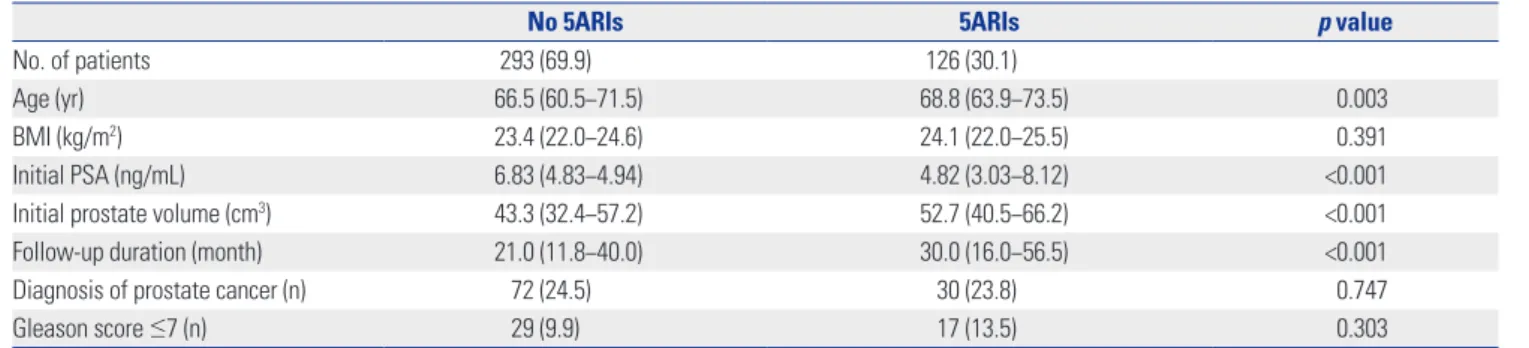
Table 3 summarizes the clinical variables according to the use of 5ARIs. Patients taking 5ARIs were older, had lower PSA levels, and had larger prostate volumes at the initial biopsy,
Table 1. Baseline Patient Characteristics
Total No cancer Prostate cancer p value
No. of patients 419 318 (75.9) 101 (24.1)
Age (yr) 67.0 (61.7−72.2) 66.7 (60.5−71.8) 68.2 (63.6−73.7) 0.007
BMI (kg/m2) 23.5 (22.0−25.0) 23.5 (22.0−25.1) 23.7 (21.9−25.1) 0.775
Receiving 5ARI treatment (n) 126 (30.1) 96 (30.2) 30 (29.4) 0.745
Initial PSA (ng/mL) 6.31 (4.48−9.33) 6.4 (4.57−9.36) 5.69 (4.33−9.04) 0.464
Initial prostate volume (cm3) 46.1 (34.9−61.7) 49.2 (36.4−64.1) 37.4 (29.3−49.1) <0.001
Follow-up duration (month) 23.0 (13.0−43.0) 23.0 (12.5−46.0) 23.0 (13.8−41.5) 0.107
PSA at repeat biopsy (ng/mL) 6.12 (3.91−9.58) 5.98 (3.65−9.20) 6.77 (4.46−11.91) 0.091
Prostate volume at repeat biopsy (cm3) 43.0 (33.7−57.1) 46.2 (35.5−60.8) 35.9 (29.0−45.1) <0.001
Any increase in PSA* (n) 51 (12.1) 34 (10.7) 17 (16.7) 0.047
Increased PSA* at 12 months (n) 88 (21.0) 65 (20.4) 23 (22.5) 0.239
Increased PSA* at 18 months (n) 61 (14.5) 40 (12.6) 21 (20.6) 0.066
Increased PSA* at 24 months (n) 53 (12.6) 35 (11.0) 18 (17.6) 0.106
PSAV at 12 months (ng/mL/yr) 0.07 (-1.85−2.05) -0.02 (-1.92−1.88) 0.62 (-1.29−3.56) 0.754
PSAV at 18 months (ng/mL/yr) 0.00 (0.00−0.65) 0.00 (0.00−0.46) 0.00 (0.00−2.27) 0.817
PSAV at 24 months (ng/mL/yr) 3.56 (-0.13−10.24) 3.90 (-0.37−10.25) 2.72 (0.69−10.24) 0.920
BMI, body mass index; PSA, prostate-specific antigen; PSAV, prostate-specific antigen velocity; 5ARI, 5α-reductase inhibitor.
Data are shown as n (%) or median (interquartile range).
*Compared to that at 6 months.
Table 3. Patient Characteristics According to the Use of 5ARIs
No 5ARIs 5ARIs p value
No. of patients 293 (69.9) 126 (30.1)
Age (yr) 66.5 (60.5−71.5) 68.8 (63.9−73.5) 0.003
BMI (kg/m2) 23.4 (22.0−24.6) 24.1 (22.0−25.5) 0.391
Initial PSA (ng/mL) 6.83 (4.83−4.94) 4.82 (3.03−8.12) <0.001
Initial prostate volume (cm3) 43.3 (32.4−57.2) 52.7 (40.5−66.2) <0.001
Follow-up duration (month) 21.0 (11.8−40.0) 30.0 (16.0−56.5) <0.001
Diagnosis of prostate cancer (n) 72 (24.5) 30 (23.8) 0.747
Gleason score ≤7 (n) 29 (9.9) 17 (13.5) 0.303
BMI, body mass index; PSA, prostate-specific antigen; 5ARIs, 5α-reductase inhibitors.
Data are shown as n (%) or median (interquartile range).
Table 2. Univariate and Multivariate Analyses for Predictive Factors of Prostate Cancer
Univariate Multivariate
OR (95% CI) p value OR (95% CI) p value
Age 1.04 (1.008−1.067) 0.011 1.07 (1.007−1.143) 0.029
BMI 1.02 (0.929−1.122) 0.670
Receiving 5ARI treatment 0.96 (0.591−1.571) 0.882
Initial PSA 0.99 (0.948−1.026) 0.494
Initial prostate volume 0.97 (0.956−0.983) <0.001 0.96 (0.929−0.983) 0.002
PSA at repeat biopsy 1.02 (0.997−1.046) 0.088
Prostate volume at repeat biopsy 0.97 (0.952−0.982) <0.001 1.06 (0.958−1.175) 0.259
Any increase in PSA* 2.15 (1.107−4.158) 0.024 1.27 (0.294−5.462) 0.752
Increased PSA* at 12 months 1.67 (0.790−3.523) 0.018 1.36 (0.554−3.329) 0.504
Increased PSA* at 18 months 1.80 (1.006−3.229) 0.048 3.30 (1.358−8.025) 0.008
Increased PSA* at 24 months 1.73 (0.934−3.216) 0.082
PSAV at 12 months 1.01 (0.975−1.035) 0.762
PSAV at 18 months 1.00 (0.972−1.037) 0.827
PSAV at 24 months 1.00 (0.979−1.018) 0.832
BMI, body mass index; OR, odds ratio; CI, confidence interval; PSA, prostate-specific antigen; PSAV, prostate-specific antigen velocity; 5ARI, 5α-reductase inhibitor.
*Compared to that at 6 months.
compared to that in the non-5ARI group (p=0.003, p<0.001, p<0.001, p<0.001, respectively). However, there were no sig- nificant differences in prostate cancer diagnosis rate (23.8% vs.
24.5%, p=0.747) and the proportion of patients with high-grade cancer (Gleason score ≥7) (13.5% vs. 9.9%, p=0.303).
Table 4 shows the serum PSA levels and number of patients who underwent repeat prostate biopsy in 6-month intervals, according to the use of 5ARIs. In the non-5ARI group, the me- dian PSA level during follow-up gradually decreased. Although the median PSA level in the 5ARI group also decreased, the value at 24 months was higher than that at the previous visit.
At 24 months, 57.5% of the patients in the non-5ARI group and 68.3% of the patients in the 5ARI group had undergone a re- peat biopsy.
In multivariate sub-analysis of the non-5ARI group, age (OR=
1.06, 95% CI=1.020−1.110, p=0.003) and PSA level at repeat bi- opsy (OR=0.96, 95% CI=0.946−0.982, p<0.001) were associated
with the diagnosis of prostate cancer. In addition, a multivariate analysis showed that age (OR=1.12, 95% CI=1.008−1.249, p=0.035) and increase in the PSA level at more than two time points after 6 months of 5ARI treatment (OR=4.84, 95% CI=
2.150−6.205, p=0.005) were significant predictors of prostate cancer detection in the 5ARI group. However, PSAV was a not significant predictor at any period in either group (Table 5).
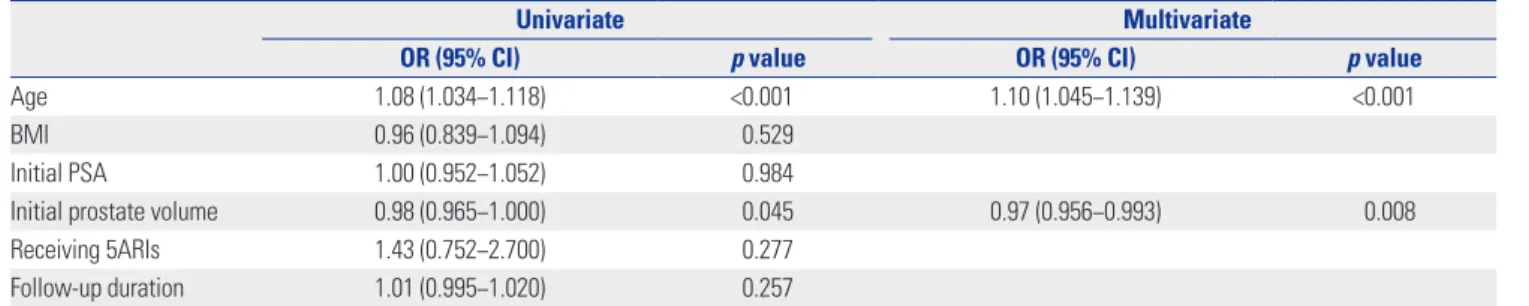
Finally, age (OR=1.10, 95% CI=1.045−1.139, p<0.001) and ini- tial prostate volume (OR=0.97, 95% CI=0.956−0.993, p=0.008) were significant predictors of a diagnosis of high-grade pros- tate cancer, while the use of 5ARIs was not (Table 6).
DISCUSSION
Several studies have reported that prostate cancer detection, chemoprevention, and high-grade prostate cancer are associ-
Table 6. Univariate and Multivariate Analysis for the Prediction of High-Grade Prostate Cancer (Gleason score ≥7)
Univariate Multivariate
OR (95% CI) p value OR (95% CI) p value
Age 1.08 (1.034−1.118) <0.001 1.10 (1.045−1.139) <0.001
BMI 0.96 (0.839−1.094) 0.529
Initial PSA 1.00 (0.952−1.052) 0.984
Initial prostate volume 0.98 (0.965−1.000) 0.045 0.97 (0.956−0.993) 0.008
Receiving 5ARIs 1.43 (0.752−2.700) 0.277
Follow-up duration 1.01 (0.995−1.020) 0.257
BMI, body mass index; OR, odds ratio; CI, confidence interval; PSA, prostate-specific antigen; 5ARIs, 5α-reductase inhibitors.
Table 5. Multivariate Analyses for Predictive Factors of Prostate Cancer According to the Use of 5ARIs
No 5ARIs 5ARIs
OR (95% CI) p value OR (95% CI) p value
Age 1.06 (1.020−1.110) 0.003 1.12 (1.008−1.249) 0.035
Initial PSA 1.08 (0.840−1.397) 0.539
Initial prostate volume 0.95 (0.901−1.008) 0.096
PSA at repeat biopsy 0.96 (0.946−0.982) <0.001 1.14 (0.877−1.490) 0.332
Prostate volume at repeat biopsy 0.99 (0.919−1.071) 0.833
PSA reduction ≤35.0% at 6 months 5.21 (0.877−30.965) 0.700
Increased PSA* at 24 months 2.50 (0.322−19.388) 0.381
Increased PSA* at more than two time points 4.84 (2.150−6.205) 0.005
OR, odds ratio; CI, confidence interval; PSA, prostate-specific antigen; 5ARIs, 5α-reductase inhibitors.
*Compared to that at 6 months.
Table 4. PSA Level and Repeat Biopsy at 6-month Intervals According to the Use of 5ARIs
No 5ARIs 5ARIs
p value PSA (ng/mL) Repeat biopsy (n) Cancer (n) PSA (ng/mL) Repeat biopsy (n) Cancer (n)
Initial 6.83 (4.94−9.95) 4.82 (2.92−8.11) <0.001
At 6 months 7.11 (5−9.93) 23 4 3.51 (2.19−5.68) 5 2
At 12 months 6.59 (4.74−10.3) 55 12 2.87 (1.7−4.93) 21 7
At 18 months 6.38 (4.91−10.2) 46 14 3.07 (1.77−5.44) 14 3
At 24 months 5.94 (4.44−8.1) 169 42 3.83 (1.98−5.51) 86 18
Overall 293 72 126 30
PSA, prostate-specific antigen; 5ARIs, 5α-reductase inhibitors.
Data are shown as median (interquartile range).
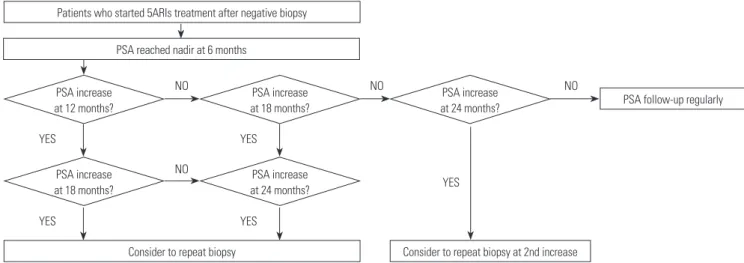
ated with the use of 5ARIs.8,12-14 These results are based on a randomized controlled trial in which 5ARI was used for the purpose of relieving voiding symptoms. However, the results were controversial, as differences were present in the analysis in the same group for the risk of high-grade prostate cancer, according to the researchers.10,15 Furthermore, participants in this randomized controlled trial differed from those who re- ceive 5ARIs after an initial negative prostate biopsy in clinical practice. Without data from the actual clinical field, clinicians might be reluctant to prescribe 5ARIs to patients with large prostate volumes, which may limit the relief of voiding symp- toms achieved via a synergistic effect with an α-blocker. There- fore, the present study collected data reflecting clinical prac- tice from multiple institutions. Although the evaluation of the effects of the use of 5ARIs on prostate cancer detection and chemoprevention may not be meaningful in the present study, we can suggest an algorithm for the indication of repeat pros- tate biopsy to clinicians who are hesitant to prescribe 5ARIs in patients with worsening voiding symptoms. Fig. 1 presents the algorithm to recommend repeat biopsy according to PSA kinetics in patients with 5ARI treatment, based on the results of the present study.
The PSAV and an increase in the PSA level have been re- ported as significant predictors of a positive repeat biopsy.16-22 However, the definitions of these parameters were not consis- tent among the previous studies in terms of the regular inter- val for the monitoring of the PSA level. In the present study, the PSAVs calculated at 6-month intervals between the initial and repeat prostate biopsies were not predictors of prostate cancer among all patients and in the sub-groups. Instead, an increase in the PSA level at 18 months, compared to that at 6 months, was a significant predictor of positive repeat biopsy among all patients.
The influence of 5ARIs on PSA secretion by benign and ma- lignant tissue can lead to a reduction in serum PSA levels, rais- ing concerns about the potential of 5ARIs to interfere with de-
tection of prostate cancer.23 5ARIs have been shown to reduce serum PSA levels by about 50% during a 6-month course.5 Al- though PSA level at 6 months of 5ARI treatment does not al- ways represent the nadir, a change in PSA level at 6 months from the initial value provides an insight into the usefulness of the PSA level in prostate cancer diagnosis.14,24 In the Reduc- tion by Dutasteride of Prostate Cancer Events (REDUCE) study and the Prostate Cancer Prevention Trial (PCPT), the percent- age change at 6 months from the baseline PSA level distin- guished men with prostate cancer from those without cancer during a 4-year treatment period (42% vs. 57% and 37.2% vs.
59.5%, respectively). However, the PSA level at 6 months did not reach the nadir in all patients receiving 5ARI treatment.
Brawer, et al.25 reported that only 35% of the men undergoing 5ARI treatment had the expected 40−60% reduction in the PSA level. In the present study, a significant difference in the per- centage change at 6 months of 5ARI treatment from the initial PSA level was found in men with and without prostate cancer (29.1% vs. 34.2%, p=0.026, data not shown), but the value among all patients was 32.4%. Thus, NCCN guidelines advise that the commonly employed method of doubling the mea- sured PSA value to obtain an adjusted value may result in un- reliable cancer detection. Kravchick, et al.26 suggested that a PSA level decline of <40% after 1 year of treatment should be con- sidered as an indicator for repeat biopsy in patients receiving dutasteride. However, a multivariate analysis in the present study found that a PSA level decrease less than 35.0% at 6 month of 5ARI treatment was not a significant predictor for the detec- tion of prostate cancer (p=0.700). In the present cohort, PSA level at 6 months of 5ARI treatment did not reach the nadir and the change was lower than that in previous studies. This may be related to variations in testosterone metabolism by ethnicity: Asian men have lower total serum testosterone and hormone-binding levels, reduced 5α-reductase levels, and low- er testosterone production, compared to that in Western men.27 Several previous studies have suggested that an increase in
PSA reached nadir at 6 months
Consider to repeat biopsy Consider to repeat biopsy at 2nd increase
PSA follow-up regularly Patients who started 5ARIs treatment after negative biopsy
PSA increase at 12 months?
PSA increase at 18 months?
PSA increase at 24 months?
PSA increase at 18 months?
PSA increase at 24 months?
YES YES
YES YES
YES
NO NO NO
NO
Fig. 1. Algorithm to recommend repeat prostate biopsy in patients undergoing 5ARI treatment. 5ARIs, 5α-reductase inhibitors; PSA, prostate-specific antigen.
serum PSA from the nadir in men receiving 5ARIs treatment should be considered as suspicious for prostate cancer. Andri- ole, et al.24 reported that the optimal combination of sensitivity and specificity was achieved with a PSA increase of 0.8 ng/mL as the threshold for prostate biopsy in patients using dutaste- ride. Marks, et al.28 reported that a PSA increase of 0.3 ng/mL from the nadir is a trigger for biopsy in men using dutasteride.
The use of any increase in PSA with dutasteride as a reason for repeat biopsy resulted in a lower specificity than that achieved when attempting to confirm the nadir value and any subse- quent increase in men with a previous negative biopsy.20 In the present study, an increase in the PSA level at more than two time points after 6 months of 5ARI treatment was associated with the detection of prostate cancer at repeat biopsy (OR=
4.84, p=0.005). However, a multivariate analysis showed that increase in PSA level at 24 months, compared with that at 6 months, was not a significant predictor for the diagnosis of prostate cancer in patients undergoing 5ARI treatment (p=
0.381).
The effect of 5ARIs on preventing or delaying the appear- ance of prostate cancer remains controversial. In PCPT, finas- teride reduced the incidence of prostate cancer by 24.8%, compared to that with placebo. This reduction was almost ex- clusively for low-grade (Gleason score 6) tumors; an increased proportion of aggressive tumors (Gleason score ≥7) was ob- served.10 The REDUCE trial showed a relative risk reduction of 22.8% with dutasteride over a 4-year study period, as well as the detection of more high-grade tumors (Gleason score ≥8) in the dutasteride arm.29 The Combination of Avodart (dutasteride) and Tamsulosin (CombAT) trial also showed a 40% lower in- cidence of prostate cancer with dutasteride plus tamsulosin (an α-blocker agent), compared to that with tamsulosin alone.
Unlike previous studies, the proportion of detected high-grade cancers (Gleason score ≥7) was not increased in the CombAT trial.13 In the present study, there were no differences between patients receiving 5ARI treatment and those who did not in the detection rates for prostate and high-grade cancers. More- over, the use of 5ARIs was not associated with the prediction of high-grade cancer detection in multivariate analysis. In prac- tice, the criteria of selecting patients for 5ARI treatment and the recommendation of repeat biopsy could be different.
Although the present study was retrospectively designed, our cohort reflected clinical practice: patients taking 5ARIs had lower PSA values and larger prostate volume than that of pa- tients in the non-5ARI group. The cancer detection rate in pa- tients with PSA levels of 4−10 ng/mL are 25% for the second biopsy and 24% for the third biopsy.30 The present cohort con- sisted of patients who underwent a second prostate biopsy, and the detection rate in patients taking 5ARIs (24.1%) was simi- lar to that in previous studies. Furthermore, there was no dif- ference between patients with and without 5ARI treatment in terms of the detection rate (p=0.747).
The present study has several limitations. First, the study was
non-randomized, and certain data elements were obtained retrospectively. Therefore, heterogeneity was present in pa- tients who underwent repeat prostate biopsy. Multiple factors, such as PSA kinetics, age, performance status, and patient com- pliance, affected clinical decision-making for the determina- tion of the repeat biopsy. Second, although there is less chance of missing a cancer after performing two biopsies in 2 years, we do not know how many cancers were missed, as a lack of PSA increase was found in approximately 4% of cancers with a Gleason score of 7−10.29 Lastly, the cohort was relatively small.
Thus, further studies with a larger number of patients are re- quired to determine the clinical relevance of our findings.
In conclusion, the present study evaluated predictors for prostate cancer detection on a second prostate biopsy in pa- tients with an initial negative biopsy who underwent 5ARI treatment. In practice, 5ARI treatment tended to be recom- mended for patients with a low PSA level and large prostate volume. The effects of 5ARIs on cancer detection and chemo- prevention are beyond the scope of the present study. However, the present results suggest that repeat prostate biopsy should be considered for patients with more than two PSA increases after 6 months of 5ARI treatment.
ORCID
Ji Eun Heo https://orcid.org/0000-0002-4184-8468 Kwang Suk Lee https://orcid.org/0000-0002-7961-8393
REFERENCES
1. Schröder FH. Landmarks in prostate cancer screening. BJU Int 2012;110 Suppl 1:3-7.
2. Basch E, Oliver TK, Vickers A, Thompson I, Kantoff P, Parnes H, et al. Screening for prostate cancer with prostate-specific antigen testing: American Society of Clinical Oncology Provisional Clini- cal Opinion. J Clin Oncol 2012;30:3020-5.
3. Presti JC Jr, O’Dowd GJ, Miller MC, Mattu R, Veltri RW. Extended peripheral zone biopsy schemes increase cancer detection rates and minimize variance in prostate specific antigen and age related cancer rates: results of a community multi-practice study. J Urol 2003;169:125-9.
4. Koo KC, Lee DH, Lee SH, Chung BH. Peripheral zone prostate- specific antigen density: an effective parameter for prostate can- cer prediction in men receiving 5α-reductase inhibitors. Prostate Int 2013;1:102-8.
5. Choi YH, Cho SY, Cho IR. The different reduction rate of prostate- specific antigen in dutasteride and finasteride. Korean J Urol 2010;
51:704-8.
6. Aganovic D, Prcic A, Kulovac B, Hadziosmanovic O. Influence of the prostate volume, prostate specific antigen density and number of biopsy samples on prostate cancer detection. Med Arh 2012;66:
41-4.
7. Qi TY, Chen YQ, Jiang J, Zhu YK, Yao XH, Wang XJ. Utility of the transition zone index for identification of prostate cancer in Chi- nese men with intermediate PSA levels. Int Urol Nephrol 2012;44:
807-15.
8. Vickers AJ, Sjoberg DD. Decision analysis of dutasteride use for patients with negative prostate biopsy. Urology 2015;85:337-41.
9. Oderda M, Zitella A, Richiardi L, Tizzani A, Gontero P. Effect of fi- nasteride on the sensitivity of PSA to detect prostate cancer in re- biopsy series. Arch Ital Urol Androl 2010;82:135-8.
10. Thompson IM, Goodman PJ, Tangen CM, Lucia MS, Miller GJ, Ford LG, et al. The influence of finasteride on the development of prostate cancer. N Engl J Med 2003;349:215-24.
11. Thompson IM Jr, Goodman PJ, Tangen CM, Parnes HL, Minasian LM, Godley PA, et al. Long-term survival of participants in the prostate cancer prevention trial. N Engl J Med 2013;369:603-10.
12. Pinsky PF, Black A, Grubb R, Crawford ED, Andriole G, Thompson I, et al. Projecting prostate cancer mortality in the PCPT and RE- DUCE chemoprevention trials. Cancer 2013;119:593-601.
13. Roehrborn CG, Andriole GL, Wilson TH, Castro R, Rittmaster RS.
Effect of dutasteride on prostate biopsy rates and the diagnosis of prostate cancer in men with lower urinary tract symptoms and enlarged prostates in the Combination of Avodart and Tamsulo- sin trial. Eur Urol 2011;59:244-9.
14. Andriole GL, Guess HA, Epstein JI, Wise H, Kadmon D, Crawford ED, et al. Treatment with finasteride preserves usefulness of pros- tate-specific antigen in the detection of prostate cancer: results of a randomized, double-blind, placebo-controlled clinical trial.
PLESS Study Group. Proscar Long-term Efficacy and Safety Study.
Urology 1998;52:195-201.
15. Redman MW, Tangen CM, Goodman PJ, Lucia MS, Coltman CA Jr, Thompson IM. Finasteride does not increase the risk of high- grade prostate cancer: a bias-adjusted modeling approach. Can- cer Prev Res (Phila) 2008;1:174-81.
16. Kim SJ, Jeong TY, Yoo DS, Park J, Cho S, Kang SH, et al. Can pros- tate-specific antigen kinetics before prostate biopsy predict the malignant potential of prostate cancer? Yonsei Med J 2015;56:
1492-6.
17. Celhay O, de la Taille A, Salomon L, Doré B, Irani J. Fluctuating prostate-specific antigen levels in patients with initial negative bi- opsy: should we be reassured? BJU Int 2007;99:1028-30.
18. Carter HB, Kettermann A, Ferrucci L, Landis P, Metter EJ. Pros- tate-specific antigen velocity risk count assessment: a new concept for detection of life-threatening prostate cancer during window of curability. Urology 2007;70:685-90.
19. Ulmert D, Serio AM, O’Brien MF, Becker C, Eastham JA, Scardino PT, et al. Long-term prediction of prostate cancer: prostate-spe- cific antigen (PSA) velocity is predictive but does not improve the predictive accuracy of a single PSA measurement 15 years or more before cancer diagnosis in a large, representative, unscreened
population. J Clin Oncol 2008;26:835-41.
20. Marberger M, Freedland SJ, Andriole GL, Emberton M, Pettaway C, Montorsi F, et al. Usefulness of prostate-specific antigen (PSA) rise as a marker of prostate cancer in men treated with dutasteride:
lessons from the REDUCE study. BJU Int 2012;109:1162-9.
21. van Leeuwen PJ, Kölble K, Huland H, Hambrock T, Barentsz J, Schröder FH. Prostate cancer detection and dutasteride: utility and limitations of prostate-specific antigen in men with previous neg- ative biopsies. Eur Urol 2011;59:183-90.
22. Lee KS, Koo KC, Cho KS, Lee SH, Han WK, Choi YD, et al. Indica- tions for a second prostate biopsy in patients suspected with pros- tate cancer after an initial negative prostate biopsy. Prostate Int 2017;5:24-8.
23. Andriole GL, Humphrey P, Ray P, Gleave ME, Trachtenberg J, Thomas LN, et al. Effect of the dual 5alpha-reductase inhibitor dutasteride on markers of tumor regression in prostate cancer. J Urol 2004;172:915-9.
24. Andriole GL, Marberger M, Roehrborn CG. Clinical usefulness of serum prostate specific antigen for the detection of prostate can- cer is preserved in men receiving the dual 5alpha-reductase in- hibitor dutasteride. J Urol 2006;175:1657-62.
25. Brawer MK, Lin DW, Williford WO, Jones K, Lepor H. Effect of fin- asteride and/or terazosin on serum PSA: results of VA Coopera- tive Study #359. Prostate 1999;39:234-9.
26. Kravchick S, Lobik L, Cytron S, Kravchenko Y, Dor DB, Peled R.
Patients with persistently elevated PSA and negative results of TRUS-Biopsy: does 6-month treatment with dutasteride can indi- cate candidates for re-biopsy. what is the best of saturation schemes:
transrectal or transperineal approach? Pathol Oncol Res 2015;21:
985-9.
27. van Houten ME, Gooren LJ. Differences in reproductive endocri- nology between Asian men and Caucasian men--a literature re- view. Asian J Androl 2000;2:13-20.
28. Marks LS, Andriole GL, Fitzpatrick JM, Schulman CC, Roehrborn CG. The interpretation of serum prostate specific antigen in men receiving 5alpha-reductase inhibitors: a review and clinical rec- ommendations. J Urol 2006;176:868-74.
29. Andriole GL, Bostwick DG, Brawley OW, Gomella LG, Marberger M, Montorsi F, et al. Effect of dutasteride on the risk of prostate cancer. N Engl J Med 2010;362:1192-202.
30. Welch HG, Fisher ES, Gottlieb DJ, Barry MJ. Detection of prostate cancer via biopsy in the Medicare-SEER population during the PSA era. J Natl Cancer Inst 2007;99:1395-400.