http://e-nrp.org
Estimation of curcumin intake in Korea based on the Korea National Health and Nutrition Examination Survey (2008-2012)
Youngjoo Kwon
§Department of Food Science and Engineering, Ewha Womans University, 52, Ewhayeodae-gil, Seodaemun-gu, Seoul 120-750, Korea
BACKGROUND/OBJECTIVES: Turmeric and its active component curcumin have received considerable attention due to their many recognized biological activities. Turmeric has been commonly used in food preparation and herbal remedies in South Asia, leading to a high consumption rate of curcumin in this region. However, the amount of curcumin in the Korean diet has not yet been estimated, where turmeric is not a common ingredient.
SUBJECTS/METHODS: This study utilized the combined data sets obtained from the Korea National Health and Nutrition Examination Survey conducted from 2008 to 2012 in order to estimate the curcumin intake in the Korean diet. The mean intake of curcumin was estimated from the amount of curcumin-containing foods (curry powder and ready-made curry) consumed using reported curcumin content in commercial turmeric and curry powders.
RESULTS: Only 0.06% of Koreans responded that they consumed foods containing curcumin in a given day, and 40% of them were younger than 20 years of age. Curcumin-containing foods were largely prepared at home (72.9%) and a significant proportion (20.4%, nearly twice that of all other foods) was consumed as school and workplace meals. The estimated mean turmeric intake was about 0.47 g/day corresponding to 2.7-14.8 mg curcumin, while the average curry powder consumption was about 16.4 g, which gave rise to curcumin intake in the range of 8.2-95.0 mg among individuals who consumed curcumin. The difference in estimated curcumin intake by using the curcumin content in curry powder and turmeric may reflect that curry powder manufactured in Korea might contain higher amounts of other ingredients such as flour, and an estimation based on the curcumin content in the turmeric might be more acceptable.
CONCLUSIONS: Thus, the amount of curcumin that can be obtained from the Korean diet in a day is 2.7-14.8 mg, corresponding to nearly one fourth of the daily curcumin intake in South Asia, although curcumin is rarely consumed in Korea.
Nutrition Research and Practice 2014;8(5):589-594; doi:10.4162/nrp.2014.8.5.589; pISSN 1976-1457 eISSN 2005-6168 Keywords: Curcumin mean intake, curry powder, KNHANES, Korean diet, turmeric
INTRODUCTION 16)
Curcumin [1,7-bis(4-hydroxy-3-methoxyphenyl)-1,6-heptadien -3,5-dione] is a polyphenolic compound that gives a strong yellow color to the spice turmeric. Turmeric is the powdered rhizome of Curcuma longa, a member of the ginger family and has been commonly used for flavor and color in food prepa- ration in South Asia [1]. In addition, it has been traditionally used as an herbal medicine to treat inflammatory and other disease conditions [1].
The biological activities of curcumin have been studied extensively. Curcumin has exhibited a wide range of biological activities, including anti-inflammation, lipid-lowering effects, and anticancer properties [2-7]. Furthermore, recent epidemio- logical and clinical studies indicate that curcumin can also improve cognitive function and cardiovascular health, as well as insulin sensitivity [8-13]. Therefore, curcumin has received a great deal of attention due to its potential usefulness to prevent and improve many disease conditions.
In order to achieve the beneficial health effects of curcumin, however, high consumption of curcumin is necessary, although the required dose may vary depending on disease conditions.
High doses of curcumin (1.5-4 g/day) are required for the effective treatment of some cancer types including lung and pancreatic cancers [14-16], whereas less than 0.5 g of curcumin is effective in treating some inflammatory conditions [17,18].
Turmeric extract was approved by the Korea Food and Drug Administration as a functional food ingredient for its joint health potential at the dose of 1 g/day. No toxicity has been observed during the long history of high curcumin intake in the diet.
In South Asian countries, such as India, where curcumin consumption is very high, the estimated average daily intake of turmeric is 1-2 g or higher [19]. Furthermore, clinical studies demonstrated that curcumin at high doses (4-8 g/day) does not give rise to any toxic effect or adverse outcome, and oral intake of 8 g curcumin daily for several months is well-tolerated in treated patients [8].
Curcumin consumption in Korea has not yet been estimated.
§
Corresponding Author: Youngjoo Kwon, Tel. 82-2-3277-3103, Fax. 82-2-3277-4213, Email. [email protected] Received: April 2, 2014, Revised: May 11, 2014, Accepted: June4, 2014
This is an Open Access article distributed under the terms of the Creative Commons Attribution Non-Commercial License (http://creativecommons.org/licenses/by-nc/3.0/)
which permits unrestricted non-commercial use, distribution, and reproduction in any medium, provided the original work is properly cited.
Curcumin may be consumed in the diet at fairly low levels in most countries including Korea where turmeric is not commonly used in their cooking. However, in Korea, curry that contains turmeric as the main ingredient is popular, and both curry powders and ready-made curries from multiple manufacturers are available in the market. Curry dishes are conveniently prepared at home and frequently included in lunch meal menus offered by schools and workplaces. In addition, owing to the recognized potential health effect of curcumin, turmeric- enhanced curry products have been popular. Therefore, Koreans may consume curcumin higher than one may speculate. It will be informative to estimate how much curcumin can be consumed from the Korean diet with an increasing interest in products having higher turmeric content, as well as the potential health-beneficial effects of curcumin. In this study, the mean intake of curcumin that can be consumed from the Korea diet was estimated from the datasets of the Korean National Health and Nutrition Examination Survey (KNHANES) conducted from 2008 to 2012. This study will estimate how much curcumin can be consumed from the ordinary Korean diet. The obtained information could presumably be utilized to evaluate whether the consumption of curcumin in the general Korean diet could exert any health-promoting effects derived from curcumin.
SUBJECTS AND METHODS Study design
This study is a cross-sectional analysis of the nutritional survey data sets obtained from the KNHANES 2008-2012. KNHANES is a nationwide survey program conducted by the Korea Centers for Disease Control and Prevention to access the health and nutritional status of Koreans. KNHANES takes place yearly, since the fourth KNHANES was conducted in 2007. The KNHANES sampling involves a multi-stage clustered probability design that includes about 10,000 non-institutionalized Korean citizens aged 1 year and older in each survey year to represent the entire Korean population [20]. The nutritional survey component of the KNHANES assesses dietary behaviors, food frequency, and food intake by face to face interview questions. In this nutritional survey, food intake information is collected using the 24-hour recall interview that is conducted by well-trained staff members aided by various measuring devices [20].
Selection of curcumin-containing food sources
The 24-hour recall data sets of the KNHANES were examined in terms of the variables “diet name”, “coded food name”, and
“other food names or remarks reported by interviewees” to identify food sources that contain curcumin. Turmeric, a major spice in curry and curry powder, is a major dietary source of curcumin. In the KNHANES, turmeric is classified into “ginger”, and its consumption was only recognizable by the variable,
“other food names or remarks reported by interviewees”, which was only recorded if available. The consumption of turmeric (in the form of powder or balls of paste) was reported but was very rare, with no occurrences in 2008 or 2009, and only one case each in 2011 and 2012. Even in 2010, a year when the recorded turmeric intake was the highest, only 7 individuals derived from 3 households reported consumption. Due to the
paucity of responders and the difficulty of retrieving information on turmeric consumption, turmeric was not included in the estimation of curcumin intake. Any “coded food name” relating to curry foods was selected to estimate the curcumin intake in the Korean diet.
Dietary assessment and estimation of curcumin consumption Information on consumption was assessed using all “coded food names” related to curry foods. There are a total of 31 different food codes that correspond to curry foods according to the curry type (powder or ready-made) or commercial name.
In fact, when the KNHANES from 2008 to 2012 was examined, a total of 9 food codes (6 of powder and 3 of ready-made types) were relevant to curry foods. The actual amount of curcumin- containing food consumption was obtained for each of the 9 individual “coded food names” using the 24-hour recall data sets combined from 2008 to 2012. Those consumptions were then converted into that of curry powder and turmeric to estimate the mean curcumin intake using the reported curcumin content in commercial turmeric and curry powders, as described in the Results section.
Statistical analysis
Data preparation and statistical analyses were performed using SAS software (version 9.3, SAS Institute Inc., Cary, NC).
Five years of nutritional survey data sets derived from KNHANES were combined to assess the characteristics of curcumin consumers and to estimate the amount of curcumin that can be consumed in the Korean diet. A multi-stage sampling design was considered for data generation and analysis. Chi-squared tests and t-tests were performed to determine the differences in demographic characteristics and eating behaviors between curcumin consumers and non-consumers. The resulting estimates were weighted to account for the multi-stage sampling design that was considered to represent the entire Korean population.
RESULTS
Demographic characteristics and eating behavior of curcumin consumers
The demographic characteristics and eating behaviors of individuals who consumed curcumin are described in Table 1.
The frequency of curcumin intake in a given day was fairly low
(0.06%) and those who did not consume curcumin represented
the entire population well. Curcumin consumers were younger
compared to the non-consumers; about 40% were less than 20
years of age. They more frequently lived in urban areas (87.6%)
and resided in non-apartment residences (48.8%) in comparison
to 81.4% and 38.9% in individuals who did not consume
curcumin, respectively. Curcumin-containing foods (curry powder
and ready-made curry) were more often consumed at home
(72.9%) or provided at schools or workplaces as lunch meals
(20.4%) rather than purchased at restaurants (6.7%) compared
to foods that do not contain curcumin. Curry foods were more
often consumed as processed food (45.2%) compared to all
other foods (7.2%).
Characteristic All (n = 2,216,996)
Consumers (n = 1,406)
Non-consumers (n = 2,215,590)
P-value1)Age (yrs) 38.3 ± 0.19
2)28.2 ± 0.71 38.3 ± 0.19 < 0.0001
n (%) n (%) n (%)
1-9 280,906 (8.4) 397 (19.7) 280,509 (8.4) 10-19 260,507 (12.3) 298 (20.1) 260,209 (12.3) 20-29 169,299 (13.4) 125 (15.4) 169,174 (13.4) 30-39 328,410 (17.5) 232 (18.0) 328,178 (17.5) 40-49 330,088 (18.7) 152 (12.9) 329,936 (18.7) 50-59 321,554 (14.9) 86 (7.0) 321,468 (14.9) 60-69 288,987 (8.4) 69 (4.6) 288,918 (8.4)
70+ 237,245 (6.3) 47 (2.2) 237,198 (6.3)
Sex 0.4633
Male 1,015,169 (52.2) 650 (51.0) 1,014,519 (52.2) Female 1,201,827 (47.8) 756 (49.0) 1,201,071 (47.8)
Residential area 0.0004
Urban 1,755,502 (81.4) 1228 (87.6) 1,754,274 (81.4) Rural 461,494 (18.6) 178 (12.4) 461,316 (18.6)
Residential type < 0.0001
High-rise apartment 1,126,984 (61.1) 526 (51.2) 1,126,458 (61.1) Non-apartment
residence 1,090,012 (38.9) 880 (48.8) 1,089,132 (38.9)
Household income quartile 0.0329
Lowest 345,752 (13.6) 114 (8.9) 345,638 (13.6) Medium lowest 554,134 (26.3) 339 (25.8) 553,795 (26.3) Medium highest 643,089 (30.4) 489 (33.3) 642,600 (30.4) Highest 640,424 (29.7) 456 (31.9) 639,968 (29.7)
Meal type
3)< 0.0001
Home cooking 1,282,300 (54.7) 1024 (72.9) 1,281,276 (54.6) Purchased foods 663,266 (34.6) 74 (6.7) 663,192 (34.6) Meal provision 238,845 (10.8) 285 (20.4) 238,560 (10.8)
Food processing < 0.0001
Unprocessed 2,047,038 (92.8) 730 (54.8) 2,046,308 (92.8) Processed 169,918 (7.2) 676 (45.2) 169,242 (7.2)
1)
The significance of differences in frequencies and means between curcumin consumers and non-consumers was tested using t -tests and chi-squared tests, respectively.
2)
Mean ± SE.
3)
Home cooking, foods prepared at residential home; purchased foods, foods purchased at restaurants; meal provision, foods provided in preschool, school, or work place as lunch meals.
Table 1. Demographic and eating behavioral characteristics of individuals who consumed curcumin in a given day
Curry Type Powder (n = 927) Ready-made (n = 479) Combined (n = 1,406) Age (yrs) n (%) mean
1)± SE n (%) mean ± SE n (%)
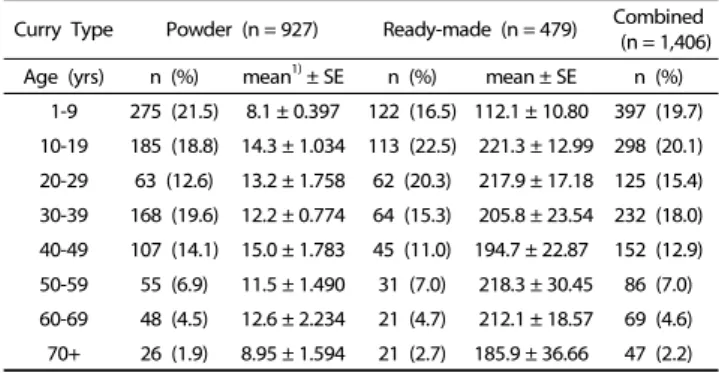
1-9 275 (21.5) 8.1 ± 0.397 122 (16.5) 112.1 ± 10.80 397 (19.7) 10-19 185 (18.8) 14.3 ± 1.034 113 (22.5) 221.3 ± 12.99 298 (20.1) 20-29 63 (12.6) 13.2 ± 1.758 62 (20.3) 217.9 ± 17.18 125 (15.4) 30-39 168 (19.6) 12.2 ± 0.774 64 (15.3) 205.8 ± 23.54 232 (18.0) 40-49 107 (14.1) 15.0 ± 1.783 45 (11.0) 194.7 ± 22.87 152 (12.9) 50-59 55 (6.9) 11.5 ± 1.490 31 (7.0) 218.3 ± 30.45 86 (7.0) 60-69 48 (4.5) 12.6 ± 2.234 21 (4.7) 212.1 ± 18.57 69 (4.6) 70+ 26 (1.9) 8.95 ± 1.594 21 (2.7) 185.9 ± 36.66 47 (2.2)
1)
Mean, g
Table 2. Frequency of consumption and average intake of curry powder and ready-made curry among curcumin consumers in each age group
Reference Curcumin content in
curry powder (%) Curcumin content in turmeric (%)
Dixit et al. [21] 0.03-0.19 0.65-3.64
Tayyem et al. [22] 0.05-0.58 0.58-3.14
Table 3. Curcumin content of commercial curry powder and turmeric
Curry Type Content of curry powder (%)
Content of turmeric (%)
Regular curry powder 100 2.8
Turmeric enhanced curry powder 100 4.2
Retort curry (ready-made) 10 0.28
Table 4. Estimation of curry powder and turmeric content from curry products
Curry consumption for different age groups
Curcumin-containing foods were consumed mainly in two types, curry powder and ready-made curry. In each curry type consumed, the frequency of consumption and average intake among curcumin consumers in each age group are described in Table 2. Regardless of curry type, the frequency of consumption was higher in younger age groups (1-9 and 10-19 years of age) compared to older age groups (over 50 years). However, the average curry consumption was similar (12-15 g for curry powder and about 200 g for ready-made curry) for all age groups except the youngest (less than 10 years) and the oldest (over 70 years) groups.
Estimation of curcumin consumption
Table 3 summarizes the curcumin content analyzed from turmeric and commercial curry powders in the previous studies [21,22]. The curcumin content varies in curry powder ranging from less than 0.05% to over 0.5%, while turmeric contains a higher amount of curcumin in a relatively narrower range (0.6-3.6%) compared to curry powder (Table 3). The consumption of curry powder and turmeric were derived from the actual consumption amount of curcumin-containing foods (curry powder and ready-made curry) retrieved from the KNHANES 24-hour recall data sets as described below. The mean curcumin intake among individuals who consumed curcumin was then estimated using the curcumin content analyzed from commercial turmeric and curry powders manufactured in different countries including India, Japan, and the United States of America [22]
(Table 3).
Approximate curry powder contents was calculated for ready- made curry, which is cooked with vegetables and/or meats and processed by retort sterilization in order to convert the consumption of ready-made curry into that of curry powder.
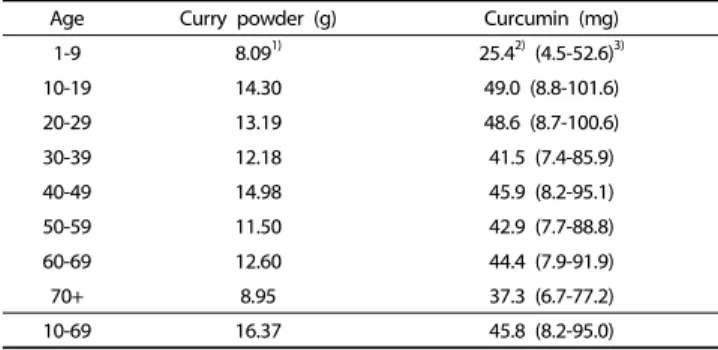
Ready-made curry contains about 10% of curry powder by weight when powder and ready-made products from the same manufacturer were compared (Table 4). The resulting mean intake of curry powder was 16.4 g which corresponds to 8.2-95.0 mg curcumin per day in curcumin consumers aged 10-69 years based on the curcumin content of curry powder (Table 5).
For the estimation of turmeric consumption, first, each “coded
food name” corresponding to curry related foods was categorized
by turmeric content into three categories: regular curry powder,
Age Curry powder (g) Curcumin (mg)
1-9 8.09
1)25.4
2)(4.5-52.6)
3)10-19 14.30 49.0 (8.8-101.6)
20-29 13.19 48.6 (8.7-100.6)
30-39 12.18 41.5 (7.4-85.9)
40-49 14.98 45.9 (8.2-95.1)
50-59 11.50 42.9 (7.7-88.8)
60-69 12.60 44.4 (7.9-91.9)
70+ 8.95 37.3 (6.7-77.2)
10-69 16.37 45.8 (8.2-95.0)
1)
Mean intake of curry powder estimated from consumption amount of curcumin- containing foods according to the calculation described in Table 4.
2)
Mean intake of curcumin estimated by the average of curcumin contents analzyed from various commercial curry powders [22]
.3)
Mean intake of curcumin estimated in the range of the highest and lowest curcumin content from various commercial curry powders [22]
.Table 5. Curcumin intake among curcumin consumers estimated by the reported curcumin content of commercial curry powder
Age Turmeric (g) Curcumin (mg)
1-9 0.27
1)4.1
2)(1.6-8.5)
3)10-19 0.51 7.6 (2.9-15.9)
20-29 0.49 7.4 (2.8-15.4)
30-39 0.44 6.6 (2.6-13.8)
40-49 0.47 7.1 (2.7-14.7)
50-59 0.44 6.6 (2.5-13.7)
60-69 0.45 6.8 (2.6-14.1)
70+ 0.37 5.7 (2.2-11.8)
10-69 0.47 7.1 (2.7-14.8)
1)
Mean intake of turmeric estimated from consumption amount of curcumin- containing foods according to the calculation described in Table 4.
2)
Mean intake of curcumin estimated by the average of curcumin contents analzyed from various commercial turmeric [22]
.3)