125 http://dx.doi.org/10.4196/kjpp.2012.16.2.125
ABBREVIATIONS: ALT, alanine aminotransferase; AST, aspartate aminotransferase; TG, triglyceride; DB, direct bilirubin; TB, total bilirubin; TBARS, thiobarbituric acid reactive substances; GSH, reduced glutathione; ROS, reactive oxygen species.
Received February 10, 2012, Revised March 21, 2012, Accepted April 4, 2012
Corresponding to: Arshad Ali Noorani, Department of Pharmacology, Mandsaur Institute of Pharmacy, Rajiv Gandhi Proudyogiki Vish- wavidyalaya University, MIT Campus, Rewas Dewda Road, Mand- saur 458-001, Madhya Pradesh, India. (Tel) 91-8085009461, (Fax) 07422-239111, (E-mail) [email protected]
This is an Open Access article distributed under the terms of the
Creative Commons Attribution Non-Commercial License (http://
creativecommons.org/licenses/by-nc/3.0) which permits unrestricted non-commercial
use, distribution, and reproduction in any medium, provided the original work
is properly cited.
Pretreatment of Albino Rats with Methanolic Fruit Extract of Randia Dumetorum (L.) Protects against Alcohol Induced Liver Damage
Arshad Ali Noorani
1, and Mohan K. Kale
2
1
Department of Pharmacology, Mandsaur Institute of Pharmacy, MIT Campus, Mandsaur 458-001, Madhya Pradesh,
2Department of Pharmacology, Sharad Pawar College of Pharmacy, Nagpur 441-110, Maharashtra, India
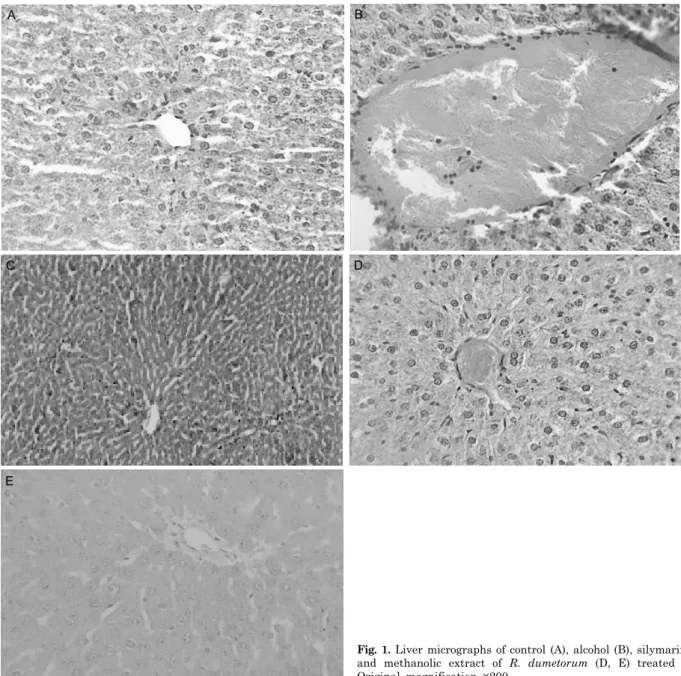
Alcohol abuse and its medical and social consequences are a major health problem in many areas of the world. The present study was conducted to evaluate the protective effect of methanolic fruit extract of Randia dumetorum (L.) on alcohol-induced liver damage in rats. Rats were divided into five different groups (n=6), group I served as a control, group II received ethanol (3 ml/100 g/day p.o.), group III served as standard group and received silymarin (50 mg/kg p.o.), group IV and V served as extract treatment groups and received 50 & 100 mg/kg methanolic extract of R. dumetorum. All the treatment protocols followed 30 days and after rats were sacrificed blood and liver were used for biochemical and histological studies, respectively. The activities serum alanine aminotransferase (ALT), aspartate aminotransferase (AST), triglyceride (TG), direct bilirubin (DB), total bilirubin (TB) and lipid peroxidation were statistically increased in rats exposed to alcohol while total protein and glutathione decreased compared to control rats. Treatment with R. dumetorum significantly decreased the elevated levels of ALT, AST, TG, DB, TB and lipid peroxidation compared to the group exposed to alcohol only.
R. dumetorum significantly resulted in increased levels of total protein and reduced glutathione compared to the group that received alcohol only. Histology of the liver section of the animals treated with R. dumetorum improved the hepatotoxicity caused by alcohol. Hence the study concluded that R. dumetorum has potential hepatoprotective activity.
Key Words: Randia dumetorum, Alcohol, Lipid peroxidation, Reduced glutathione, Biochemical para- meters
INTRODUCTION
Liver disease is a common condition in which major amounts of parenchyma cells are replaced by fibrous con- nective tissue. It is one of the serious health problems throughout the world. Liver is the typical detoxifying organ of the body and is profoundly affected by external chemicals [1]. Alcohol is a well-established hepatotoxicant that in- duces a diffuse type of liver injury closely resembling hu- man viral hepatitis [2]. Oxidative stress plays a vital role in the patho-genesis of alcohol associated liver injury. The peroxidation of endogenous lipids has been shown to be a
major factor in the cytotoxic action of alcohol [3,4].
Chronic alcohol consumption increases the capacity of cy-
tochrome P450 2E1 (CYP2E1) to oxidize ethanol up to
10-fold which consequently increases the prooxidative
burden. Reactive oxygen species (ROS) generated during
ethanol oxidation via CYP2E1 contributes to ethanol in-
duced liver injury [5]. Although the pathogenesis of alco-
hol-induced liver disease remains the subject of debate [6],
one factor that has been suggested as playing a central role
in many pathways of alcohol-induced damage, and which
has been the focus of much research is the excessive gen-
eration of these free radicals, which can result in a state
called oxidative stress [7]. Numerous studies have indicated
that excessive ethanol intake induces the mass production
of free radicals in the body, which are considered to be asso-
ciated with alcoholic liver disease [8]. The most important
characteristic of toxic free radicals either in vivo or in vitro
is peroxidation of lipids resulting in tissue damage and
death of affected cells [9]. Several reports have implicated
free radical-induced lipid peroxidation in the pathogenesis
of alcohol induced liver toxicity [10,11]. Antioxidants play