ABSTRACT
Purpose: Raloxifene is a selective estrogen receptor modulator (SERM), and raloxifene treatment for osteoporosis is reimbursable under the Korean National Health Insurance.
Evidence suggests that SERMs use reduces the risk of breast cancer in Asian population.
Herein, we retrospectively investigated the protective effect of raloxifene on breast cancer rates in Korean population.
Methods: Using the Health Insurance Review and Assessment Service database, we selected women with osteoporosis aged 50 years and above. Patients treated for at least 2 years with raloxifene were assigned to the user group, whereas the remaining patients were assigned to the non-user group. The effect on breast cancer risk was assessed using the Cox proportional- hazards model with a time-dependent covariate to adjust for immortal time bias.
Results: A total of 322,870 women who were registered between 2010 and 2011 were included.
The user group comprised 0.7% (n = 2,307) of the total population. The mean age was 65.7 ± 8.0 years and 67.2 ± 8.6 years in the user and non-user groups, respectively (p < 0.001). There was no difference in the previous use of estrogen replacement between the 2 groups (p = 0.087).
The incidence of breast cancer per 1,000 person-years was 0.49 (n = 8) and 0.68 (n = 1,714) in the user and non-user groups, respectively (hazard ratio [HR], 0.63, 95% confidence interval [CI], 0.32–1.27). HR decreased with increase in the treatment duration, but this change was not statistically significant (HR, 1.00, 95% CI, 0.32–3.11 in 2–3 years; HR, 0.63, 95% CI, 0.20–1.94 in 3–4 years; and HR, 0.41, 95% CI, 0.10–1.65 in 4–5 years).
Conclusion: Long-term treatment with raloxifene in women with osteoporosis was not significantly associated with a reduction in breast cancer rates. However, further investigation is required for a conclusive proof.
Keywords: Breast neoplasms; Chemoprevention; Osteoporosis; Postmenopause;
Raloxifene hydrochloride
Original Article
Received: Mar 4, 2021 Revised: Apr 14, 2021 Accepted: May 10, 2021 Correspondence to Sungmin Park
Department of Breast Surgery, Chungbuk National University Hospital, College of Medicine, Chungbuk National University, 776, 1sunhwan-ro, Seowon-gu, Cheongju 28644, Korea.
E-mail: [email protected]
*Jihyoun Lee and Ji Sung Lee equally contributed to this paper as first authors.
© 2021 Korean Breast Cancer Society This is an Open Access article distributed under the terms of the Creative Commons Attribution Non-Commercial License (https://
creativecommons.org/licenses/by-nc/4.0/) which permits unrestricted non-commercial use, distribution, and reproduction in any medium, provided the original work is properly cited.
ORCID iDs Jihyoun Lee
https://orcid.org/0000-0003-0041-8717 Ji Sung Lee
https://orcid.org/0000-0001-8194-3462 Jong Eun Lee
https://orcid.org/0000-0003-2938-4960 Zisun Kim
https://orcid.org/0000-0002-1413-2800 Sun Wook Han
https://orcid.org/0000-0002-0671-1212 Sung Mo Hur
https://orcid.org/0000-0001-8547-5635 Young Jin Choi
https://orcid.org/0000-0003-1030-4211 Sungmin Park
https://orcid.org/0000-0003-1162-4639
Jihyoun Lee
1,*, Ji Sung Lee
2,*, Jong Eun Lee
3, Zisun Kim
4, Sun Wook Han
3, Sung Mo Hur
4, Young Jin Choi
5, Sungmin Park
51
Department of Surgery, Soonchunhyang University Seoul Hospital, Seoul, Korea
2
Clinical Research Center, Asan Institute for Life Sciences, Asan Medical Center, University of Ulsan College of Medicine, Seoul, Korea
3
Department of Surgery, Soonchunhyang University Cheonan Hospital, Cheonan, Korea
4
Department of Surgery, Soonchunhyang University Bucheon Hospital, Bucheon, Korea
5
Department of Breast Surgery, Chungbuk National University Hospital, College of Medicine, Chungbuk National University, Cheongju, Korea
A Nationwide Study on the Incidence of Breast Cancer in Korean Women with Osteoporosis Receiving
Raloxifene Treatment
Funding
This work was supported by the research grant of the Chungbuk National University Hospital and the Soonchunhyang University Research Fund.
Conflict of Interest
The authors declare that they have no competing interests.
Author Contributions
Formal analysis: Lee JS; Funding acquisition:
Park S; Methodology: Lee JS; Resources: Lee JS, Park S; Supervision: Lee JE, Kim Z, Han SW, Hur SM, Choi YJ; Writing - original draft: Lee J, Park S; Writing - review & editing: Lee J, Lee JS, Park S.
INTRODUCTION
A large clinical trial have shown that tamoxifen can reduce the risk of breast cancer; hence, most guidelines recommend the use of risk-reducing agents in women with a high risk of breast cancer development [1-4]. Along with lifestyle modification, risk-reducing agents are recommended for women at advanced age and having unfavorable histology such as lobular carcinoma in situ or atypical hyperplasia in the breast biopsy, or based on the risk prediction models.
Besides tamoxifen, other selective estrogen receptor modulators (SERMs) have also been evaluated for their efficacy in reducing the risk of breast cancer [5-7]. Raloxifene acts as an estrogen agonist in bone and lipids, and Cauley et al. [8] evaluated its use as a risk-reducing agent in a clinical trial involving patients with osteoporosis. During the four years of
observation in this trial, a 72% reduction in the risk of developing breast cancer was observed in the raloxifene group. In another trial involving patients with congestive heart failure (RUTH trial) [7], raloxifene treatment was found to be associated with decreased breast cancer incidence. Moreover, in a head-to-head comparison of tamoxifen and raloxifene, raloxifene showed comparable efficacy at an estimated 50% risk reduction, but the toxicity profiles differed between the two drugs [9]. Tamoxifen was associated with an increased risk of endometrial cancer, uterine sarcoma, cataracts, deep vein thrombosis, and stroke. Although raloxifene was also associated with an increased risk of endometrial cancer, thromboembolic events, and cataracts, the incidence of developing these conditions was lower.
Despite the robust efficacy of risk-reducing agents, there is limited data on Asian population, and therefore, the use of these agents is not yet widely accepted in Asian countries [10].
Currently, raloxifene treatment in patients with osteoporosis has been approved for reimbursement under the Korean National Health Insurance. Therefore, we conducted a retrospective analysis using the nationwide healthcare claims data to investigate the risk reduction effect of raloxifene on breast cancer development.
METHODS
The Health Insurance Review and Assessment Service (HIRA) database records reimbursement information from national health insurance claims in Korea. Almost all individuals in Korea are insured by the Korean National Health Insurance; therefore, the HIRA database can be used to design a nationwide cohort study. HIRA claims data include age, sex, diagnoses, medical costs claimed, procedures, prescribed drugs, and a unique anonymous number for each patient [11]. Using the HIRA database, female osteoporotic patients aged 50 years or above who received raloxifene prescriptions were identified.
Considering that the observation period is expected to be more than five years, osteoporosis
patients newly diagnosed between January 1, 2010 and December 31, 2011, were included
in this study, and observation data were obtained until July 31, 2019. Osteoporosis was
defined using the diagnostic code from claim data, which was based on the International
Classification of Diseases 10th revision (ICD-10), and was categorized as M80, M81, and
M82. Osteoporosis treatment (bisphosphonate or raloxifene) records were also collected. We
also reviewed the diagnostic codes and prescriptions of patients enrolled between January
1, 2009 and December 31, 2009, and removed the subjects who had already been treated for
osteoporosis or had a history of any malignancy, including invasive or noninvasive breast
cancer. Based on economic status, the subjects were divided into the low-income group from
the Medical Aid Program or the lower rank in the National Health Insurance and the high- income group. The Charlson Comorbidity Index (CCI) was calculated using ICD-10 diagnosis claim records within one year before the osteoporosis diagnosis to assess comorbidities.
Raloxifene prescription records were retrieved using the drug code, and individuals whose prescriptions were maintained for more than two years were assigned to the raloxifene user group, whereas others were assigned to the non-user group. New claim records with a diagnosis code of C50 (invasive cancer) or D05 (noninvasive cancer) were considered as new diagnoses of breast cancer. Noninvasive cancer was defined as newly created D05 code claims with V193 code. To remove cases that were upstaged from noninvasive cancer to invasive cancer after surgery and to prevent duplication of enrollment, new C50 claims within six months from the first claim of D05 were removed from the D05 population. These data were again screened to find whether the individuals were given another claim code of V193, which indicates patients with malignant neoplasm. If C50 or D05 codes were found within two years of raloxifene treatment, it was considered as an outcome in the non-user group. Since information regarding the date of death cannot be obtained from the HIRA database, we defined surrogate censoring or date of death as the last claim date among those who did not have claim records between July 31, 2017, and the final observation date. Endocrine treatment (SERMs or aromatase inhibitors) records within one year of breast cancer diagnosis were also reviewed to indirectly screen for hormone receptor-positive tumors.
Baseline characteristics are expressed as mean (± standard deviation) or percentage (%).
Differences in the distribution of baseline characteristics between raloxifene user and non- user groups were identified using the Student's t-test or χ
2test, as appropriate. The study exposure was the use of raloxifene, considered as a time-varying variable. We then compared the incidence of breast cancer between raloxifene user and non-user groups. The person- years (PY) for each patient in both groups were calculated from the index date to the end of follow-up. The crude incidence rates (IRs) of breast cancer were calculated as the number of breast cancer cases per 1,000 PY. We calculated hazard ratios (HRs) for developing breast cancer with 95% confidence interval (CI) using the Cox proportional hazard model with time-dependent covariates adjusted for age, previous use of hormone therapy, economic status, and CCI (0, 1, 2, 3, 4, ≥ 5). To account for competing risks due to mortality, we fitted a proportional sub-distribution hazards regression model with death as the competing event. All analyses were performed using SAS version 9.4 (SAS Institute Inc., Cary, USA) and p-values < 0.05 were considered statistically significant.
Ethical approval
This study was performed with approval from the institutional review board of Chungbuk National University Hospital (approval number: 2020-04-014). All procedures performed in studies involving human participants were in accordance with the ethical standards of the institutional and/or national research committee and with the 1964 Helsinki Declaration and its later amendments or comparable ethical standards.
RESULTS
Baseline characteristics
Of the 333,781 patients who had been newly diagnosed with osteoporosis between 2010 and
2011, 322,870 were enrolled in this study with an observation period of more than two years.
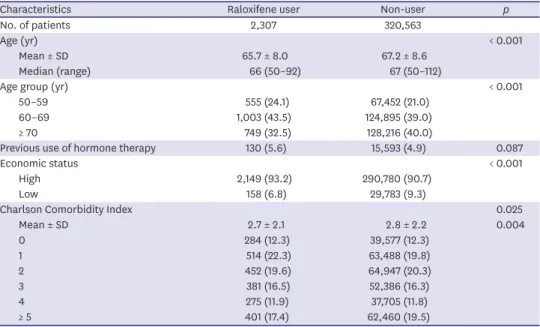
Among all patients, 2,307 (0.7%) were raloxifene users, whereas 320,563 (99.3%) were non- users. Figure 1 shows the patient enrollment criteria and the follow-up period. Raloxifene users were younger than non-users (mean age = 65.7 ± 8.0 years vs. 67.2 ± 8.6 years, p <
0.001), and the proportion of patients aged 50 to 69 years was high among raloxifene users.
There was no difference between the two groups in terms of previous estrogen replacement use (p = 0.087). The proportion of subjects in the low-income group from the Medical Aid Program or those in the lower rank of the National Health Insurance was lower among raloxifene users. Moreover, raloxifene users had fewer comorbidities than non-users (CCI 2.7
± 2.1 vs. 2.8 ± 2.2; p = 0.004). The baseline characteristics are shown in Table 1. The median duration of follow-up was 8.1 years (interquartile range = 7.5–8.6 years) in both groups (the total patient-years of follow-up are presented by treatment group in Supplementary Table 1).
Raloxifene user Raloxifene use longer
than 2 years (n = 2,307)
Raloxifene non-user Raloxifene use less
than 2 years (n = 320,563)
Previous history of malignancies (n = 2,181) Age < 50 (n = 1,056)
Unavailable to follow-up during the first 2 years (n = 7,674) Newly diagnosed osteoporosis in women
2010.1.1–2011.12.31 (n = 333,781)
Retrospective cohort observed until 2019.7.31 (n = 322,870)
Figure 1. Enrollment, treatment, and grouping of the study population.
Table 1. Baseline characteristics
Characteristics Raloxifene user Non-user p
No. of patients 2,307 320,563
Age (yr) < 0.001
Mean ± SD 65.7 ± 8.0 67.2 ± 8.6
Median (range) 66 (50–92) 67 (50–112)
Age group (yr) < 0.001
50–59 555 (24.1) 67,452 (21.0)
60–69 1,003 (43.5) 124,895 (39.0)
≥ 70 749 (32.5) 128,216 (40.0)
Previous use of hormone therapy 130 (5.6) 15,593 (4.9) 0.087
Economic status < 0.001
High 2,149 (93.2) 290,780 (90.7)
Low 158 (6.8) 29,783 (9.3)
Charlson Comorbidity Index 0.025
Mean ± SD 2.7 ± 2.1 2.8 ± 2.2 0.004
0 284 (12.3) 39,577 (12.3)
1 514 (22.3) 63,488 (19.8)
2 452 (19.6) 64,947 (20.3)
3 381 (16.5) 52,386 (16.3)
4 275 (11.9) 37,705 (11.8)
≥ 5 401 (17.4) 62,460 (19.5)
Values are presented as number (%).
SD = standard deviation.
Breast cancer incidence
During the follow-up period, nine raloxifene users and 1,714 non-users were diagnosed with breast cancer. The IR per 1,000 PY for invasive and non-invasive cancer among raloxifene users was 0.43 (0.20–0.89) and 0.06 (0.01–0.43), respectively. Among non-users, the IR for invasive and non-invasive cancer per 1,000 PY was 0.64 (0.61–0.67) and 0.05 (0.04–0.06), respectively. There was no significant difference in the incidence of invasive breast cancer between the two groups when competing risk was considered (adjusted HR, 0.63, 95% CI, 0.32–1.27, p = 0.198; Table 2, Figure 2A). Lower incidence of breast cancer was observed in patients with longer treatment duration; however, the difference was not statistically significant (Table 3, Figure 2B). In the 2–3 years, 3–4 years, and 4–5 years treatment
durations, the adjusted HR was 1.00 (95% CI, 0.32–3.11, p = 0.997), 0.63 (95% CI, 0.20–1.94, p = 0.418), and 0.41 (0.10–1.65) (95% CI, 0.10–1.65, p = 0.212), respectively.
Among raloxifene users, 37.5% of patients underwent endocrine treatment compared to 62.0% in the non-user group; however, the difference was not statistically significant (p = 0.272; Supplementary Table 2).
Table 2. Incidence of breast cancer by treatment group
Breast cancer type Raloxifene Control Unadjusted Adjusted
*No. of
events Follow-up duration
(yr)
IR per 1,000 PY No. of
events Follow-up duration
(yr)
IR per 1,000 PY HR (95% CI) p HR (95% CI) p
All breast cancer 8 16,441 0.49 (0.24–0.97) 1,714 2,502,569 0.68 (0.65–0.72) 0.67 (0.34–1.34) 0.261 0.63 (0.32–1.27) 0.198 Invasive breast cancer 7 16,441 0.43 (0.20–0.89) 1,591 2,502,569 0.64 (0.61–0.67) 0.63 (0.30–1.33) 0.228 0.60 (0.29–1.26) 0.177 Noninvasive breast cancer 1 16,441 0.06 (0.01–0.43) 123 2,502,569 0.05 (0.04–0.06) 1.17 (0.16–8.38) 0.874 1.07 (0.15–7.68) 0.948 IR = incidence rate; PY = person-years; HR = hazard ratio; CI = confidence interval.
*
Adjusted by age, previous use of hormone therapy, economic status, and Charlson Comorbidity Index.
Time to follow-up (yr) A
Ev ent -fr ee survival pr obability
0 2 4 6 8
0.98 1.00
0.99
0.97 Non-users
Raloxifene
Time to follow-up (yr) B
Ev ent -fr ee survival pr obability
0 2 4 6 8
0.98 1.00
0.99
0.97
0.96 0.96
3–4 years 4–5 years Non-users 2–3 years
Figure 2. Breast cancer development in the study groups. (A) Event-free survival probability in raloxifene users and non-users; (B) Event-free survival probability following different treatment periods.
Table 3. Incidence of breast cancer by duration of treatment (type: all breast cancer)
Duration of treatment (yr) No. of events Rate per 1,000 Unadjusted Adjusted
*HR (95% CI) p HR (95% CI) p
Control 1,714 0.68 (0.65–0.72) 1.00 (Ref.) 1.00 (Ref.)
2–3 3 0.90 (0.29–2.80) 1.03 (0.33–3.18) 0.966 1.00 (0.32–3.11) 0.997
3–4 3 0.48 (0.15–1.49) 0.68 (0.22–2.10) 0.499 0.63 (0.20–1.94) 0.418
4–5 2 0.29 (0.07–1.16) 0.44 (0.11–1.75) 0.243 0.41 (0.10–1.65) 0.212
HR = hazard ratio; CI = confidence interval.
*
Adjusted by age, previous use of hormone therapy, economic status, and Charlson Comorbidity Index.
DISCUSSION
In this study, we retrospectively reviewed the effect of raloxifene on reducing the risk of breast cancer in women with osteoporosis. Although we observed that the incidence of breast cancer was lower in patients treated with raloxifene for longer durations, the difference was not statistically significant.
Raloxifene has been approved for the treatment of postmenopausal osteoporosis under the Korean National Health Insurance. However, a previous study showed that in Korea, the use of raloxifene is lower compared to that of bisphosphonates (3.2% vs. 96.8% of osteoporosis patients) [11]. In this previous study, the authors also observed that raloxifene users had more comorbidities including chronic gastritis or gastroesophageal reflux disease, lipid disorders, rheumatic diseases, hot flashes, and coronary artery diseases, suggesting that the adverse effect profiles of raloxifene users might affect the choice of drugs for osteoporosis treatment. Herein, we found that only 0.7% of patients with osteoporosis received raloxifene treatment during the study period. Moreover, the prescription rate of raloxifene was higher in the US claims data (17,983 received raloxifene, whereas 79,891 received bisphosphonate under Medicare from 2003 to 2004) [12] and in the Taiwan claim data (9,534 raloxifene users vs. 19,840 alendronate users from 2003 to 2007) [13]. Contrary to the American or European guidelines, the use of raloxifene is not approved for breast cancer risk reduction in Korea, which might be one of the reasons why clinicians are reluctant to prescribe raloxifene instead of bisphosphonates.
In the RUTH trial, it was observed that raloxifene treatment reduced the risk of breast cancer, and only 1.2 cases of invasive breast cancer were found out of 1,000 women treated for one year [7]. In the present study, the HR was 0.41 in patients treated with raloxifene for 4–5 years; however, compared to groups with lower treatment duration, the difference in HR was not statistically significant. Despite a sufficient number of cases and long follow-up period, we could not draw a robust conclusion regarding the effect of raloxifene on breast cancer development because of the low incidence of this cancer in our study cohort. Females with osteoporosis or low bone mineral density are at a lower risk of breast cancer than those with high bone mineral density, possibly because bone mineral density directly reflects the duration of exposure to estrogen during the patients' lifetime [14-17]. Our study included patients with osteoporosis, which might explain the low incidence of breast cancer in these subjects.
A previous study showed that the incidence of invasive breast cancer is significantly reduced in females taking raloxifene for two or more years. However, the interaction between the treatment duration and the effect of treatment on invasive breast cancer incidence was not statistically significant [18]. Considering the risk-reducing effects of raloxifene, we included patients who were taking raloxifene for more than two years. Although we observed that the incidence of breast cancer decreased with longer raloxifene treatment duration, this finding was not statistically significant.
Another study on chemoprevention showed that only 23% of women who were at a high
risk of breast cancer used risk-reducing agents [19], and the fear of adverse effects was the
greatest concern among the study participants. The use of chemopreventive drugs is low
in both trial and non-trial settings. However, a systemic review highlighted that factors
including abnormal biopsy, physicians' recommendation, and advanced age affected the use
of chemopreventive agents, highlighting the importance of communication with patients
[20]. In the Korean guidelines, there is no definite recommendation regarding the use of
tamoxifen or aromatase inhibitors for breast cancer risk reduction, and the guidelines only allow tamoxifen use as a risk-reducing agent in BRCA mutation carriers. The present study did not have any clinical data because we used the insurance claims database to evaluate the actual risk in individuals. However, if physicians consider adverse effects and patient comorbidities when choosing agents for osteoporosis management, breast cancer risk should also be considered.
Several studies have confirmed that raloxifene reduces the risk of invasive breast cancer in postmenopausal women with osteoporosis [8,18,21]. Although there is clear evidence regarding the benefits of raloxifene use, only a few patients with osteoporosis have used raloxifene in Korea because of clinicians' preference or due to paucity of evidence in Korean population.
Nevertheless, we may consider using raloxifene in postmenopausal women with osteoporosis.
The limitations of this study include small sample size in the raloxifene user group. Since raloxifene treatment for breast cancer risk reduction is not reimbursable in Korea, the use of chemopreventive agents is low. Second, fewer cancer events in the study population that prevented us from drawing a statistically significant conclusion.Third, we could not ascertain the menopausal status of the patients based on the information present in the database. In the absence of detailed information, we considered age alone as a crude proxy for menopausal status based on an epidemiologic study [22]. HIRA is a claims database that does not contain clinical data; hence, we were unable to consider other factors that could influence the risk of breast cancer development such as a family history or previous biopsy results.
Despite its limitations, this study is a rare overview on the use of raloxifene for breast cancer risk reduction in Korean population. Our nationwide analysis showed no significant association between the use of raloxifene in women with osteoporosis and reduction of the breast cancer risk. Further observational studies are required to determine the protective effects of SERMs on breast cancer development in Asian women.
ACKNOWLEDGEMENTS
This study used research data (M20200330421) from the Health Insurance Review &
Assessment Service (HIRA). The views expressed are those of the authors and not necessarily reflect those of the HIRA and the Ministry of Health and Welfare (MOHW).
SUPPLEMENTARY MATERIALS
Supplementary Table 1 The patient-years of follow-up Click here to view
Supplementary Table 2
Use of endocrine treatment
Click here to view
REFERENCES
1. Fisher B, Costantino JP, Wickerham DL, Cecchini RS, Cronin WM, Robidoux A, et al. Tamoxifen for the prevention of breast cancer: current status of the National Surgical Adjuvant Breast and Bowel Project P-1 study. J Natl Cancer Inst 2005;97:1652-62.
PUBMED | CROSSREF
2. Visvanathan K, Chlebowski RT, Hurley P, Col NF, Ropka M, Collyar D, et al. American society of clinical oncology clinical practice guideline update on the use of pharmacologic interventions including tamoxifen, raloxifene, and aromatase inhibition for breast cancer risk reduction. J Clin Oncol 2009;27:3235-58.
PUBMED | CROSSREF
3. Kreienberg R, Albert US, Follmann M, Kopp IB, Kühn T, Wöckel A. Interdisciplinary GoR level III guidelines for the diagnosis, therapy and follow-up care of breast cancer: short version - AWMF Registry No.: 032-045OL AWMF-Register-Nummer: 032-045OL - Kurzversion 3.0, Juli 2012. Geburtshilfe Frauenheilkd 2013;73:556-83.
PUBMED | CROSSREF
4. National Comprehensive Cancer Network (NCCN). NCCN clinical practice guidelines in oncology. Breast cancer. Plymouth Meeting: NCCN; 2021.
5. LaCroix AZ, Powles T, Osborne CK, Wolter K, Thompson JR, Thompson DD, et al. Breast cancer incidence in the randomized PEARL trial of lasofoxifene in postmenopausal osteoporotic women. J Natl Cancer Inst 2010;102:1706-15.
PUBMED | CROSSREF
6. Powles TJ, Diem SJ, Fabian CJ, Neven P, Wickerham DL, Cox DA, et al. Breast cancer incidence in postmenopausal women with osteoporosis or low bone mass using arzoxifene. Breast Cancer Res Treat 2012;134:299-306.
PUBMED | CROSSREF
7. Barrett-Connor E, Mosca L, Collins P, Geiger MJ, Grady D, Kornitzer M, et al. Effects of raloxifene on cardiovascular events and breast cancer in postmenopausal women. N Engl J Med 2006;355:125-37.
PUBMED | CROSSREF
8. Cauley JA, Norton L, Lippman ME, Eckert S, Krueger KA, Purdie DW, et al. Continued breast cancer risk reduction in postmenopausal women treated with raloxifene: 4-year results from the MORE trial.
Multiple outcomes of raloxifene evaluation. Breast Cancer Res Treat 2001;65:125-34.
PUBMED | CROSSREF
9. Vogel VG, Costantino JP, Wickerham DL, Cronin WM, Cecchini RS, Atkins JN, et al. Effects of tamoxifen vs raloxifene on the risk of developing invasive breast cancer and other disease outcomes: the NSABP Study of Tamoxifen and Raloxifene (STAR) P-2 trial. JAMA 2006;295:2727-41.
PUBMED | CROSSREF
10. Aihara T, Toyama T, Takahashi M, Yamamoto Y, Hara F, Akabane H, et al. The Japanese Breast Cancer Society clinical practice guideline for systemic treatment of breast cancer, 2015 edition. Breast Cancer 2016;23:329-42.
PUBMED | CROSSREF
11. Kim L, Kim JA, Kim S. A guide for the utilization of Health Insurance Review and Assessment Service National Patient SamplesEpidemiol Health 2014;36:e2014008.
PUBMED | CROSSREF
12. Kim J, Shin JY, Lee J, Song HJ, Choi NK, Park BJ. Comparison of the prescribing pattern of
bisphosphonate and raloxifene in Korean women with osteoporosis: from a national health insurance claims database. PLoS One 2015;10:e0127970.
PUBMED | CROSSREF
13. Lin TC, Yang CY, Yang YH, Lin SJ. Comparative effectiveness of osteoporosis drugs in preventing secondary nonvertebral fractures in Taiwanese women. J Clin Endocrinol Metab 2013;98:4717-26.
PUBMED | CROSSREF
14. Foster SA, Foley KA, Meadows ES, Johnston JA, Wang S, Pohl GM, et al. Characteristics of patients initiating raloxifene compared to those initiating bisphosphonates. BMC Womens Health 2008;8:24.
PUBMED | CROSSREF
15. Cauley JA, Lucas FL, Kuller LH, Vogt MT, Browner WS, Cummings SR. Bone mineral density and risk of breast cancer in older women: the study of osteoporotic fractures. JAMA 1996;276:1404-8.
PUBMED | CROSSREF
16. Zhang Y, Kiel DP, Kreger BE, Cupples LA, Ellison RC, Dorgan JF, et al. Bone mass and the risk of breast cancer among postmenopausal women. N Engl J Med 1997;336:611-7.
PUBMED | CROSSREF
17. Cauley JA, Lucas FL, Kuller LH, Stone K, Browner W, Cummings SR. Elevated serum estradiol and testosterone concentrations are associated with a high risk for breast cancer. Ann Intern Med 1999;130:270-7.
PUBMED | CROSSREF
18. Grady D, Cauley JA, Geiger MJ, Kornitzer M, Mosca L, Collins P, et al. Reduced incidence of invasive breast cancer with raloxifene among women at increased coronary risk. J Natl Cancer Inst 2008;100:854-61.
PUBMED | CROSSREF
19. Flanagan MR, Zabor EC, Stempel M, Mangino DA, Morrow M, Pilewskie ML. Chemoprevention uptake for breast cancer risk reduction varies by risk factor. Ann Surg Oncol 2019;26:2127-35.
PUBMED | CROSSREF
20. Smith SG, Sestak I, Forster A, Partridge A, Side L, Wolf MS, et al. Factors affecting uptake and adherence to breast cancer chemoprevention: a systematic review and meta-analysis. Ann Oncol 2016;27:575-90.
PUBMED | CROSSREF
21. Martino S, Cauley JA, Barrett-Connor E, Powles TJ, Mershon J, Disch D, et al. Continuing outcomes relevant to Evista: breast cancer incidence in postmenopausal osteoporotic women in a randomized trial of raloxifene. J Natl Cancer Inst 2004;96:1751-61.
PUBMED | CROSSREF
22. Hill K. The demography of menopause. Maturitas 1996;23:113-27.
PUBMED | CROSSREF