https://doi.org/10.20909/kopast.2020.26.1.1
Evaluation of Deodorization Capabilities, Morphologies, and Thermal Stabilities of Baking Soda, Charcoal, Coffee,
and Green Tea for Kimchi Packaging Application
Suyeon Jeong and Seung Ran Yoo*
Industrial Technology Research Group, Research and Development Division, World Institute of Kimchi, Gwangju 61755, Republic of Korea
Abstract We evaluated the applicability of baking soda, charco‘al, coffee, and green tea as a natural deodorant in Kim- chi packaging. Moreover, to evaluate the potential usage of these deodorants in packaging materials and confirm their applicability in high-temperature melt-extrusion processing, the thermal stabilities of the deodorants were investigated, and heat-treated deodorants were evaluated in terms of the deodorizing function compared with non-treated deodorants.
Aroma patterns were decreased after deodorizing treatment with all-natural deodorants. Dimethyl disulfide, methyl tri- sulfide, and diallyl disulfide, the most significant odorous Volatile organic compounds (VOCs) of Kimchi, decreased after treatment with the deodorants. In particular, baking soda and charcoal showed the highest efficiency in removing odorous compounds and VOCs from Kimchi, even after high-temperature processing. The acetic acid removal rates for both bak- ing soda and charcoal were 99.9±0.0%. The heating process increases the deodorizing effects of baking soda. Sensory evaluation results showed that there is a significant increase (p < 0.05) in the overall preference for Kimchi samples pack- aged with charcoal and baking soda. This study provides useful information for the deodorization effects of natural deodorants for Kimchi smell and their applicability for packaging materials.
Keywords Active packaging, adsorption, packaging, sensory analysis, volatile components.
Introduction
Kimchi is a traditional fermented Korean side dish mainly composed of leaf and root vegetables with seasonings such as garlic, ginger, onion, red pepper powder, green onion, fer- mented shrimp, and anchovies.1,2) It has gained popularity as a functional food because of its touted anticancer activity3,4) and antitumor effects3) as well as health-promoting effects, includ- ing improved fasting blood glucose, serum lipid profiles, and total antioxidant status5). However, when Kimchi is well-aged, microbiological and enzymatic activities continue, leading to a sour and bitter taste, CO2 production, off-odors, and softening.
These effects are mainly due to the lactic acid bacteria and yeasts naturally present in the raw materials.3,6,7) The smell of Kimchi, which is caused by several functional groups, is a well-known undesirable characteristic.8) The volatile organic compounds (VOCs) released from Kimchi contribute to the strong sour taste and smell of Kimchi, which is strongly dis-
liked by foreigners. Hence, increasing the consumption of Kim- chi requires the development of products that can reduce its smell.9,10)
The principle roles of food packaging are to protect food products from outside influence and damage, to contain food, and to provide consumers with ingredients and nutritional information.11 In recent times, functional food packaging has been developed using diverse functional materials with features such as absorption, gas control, humidity adjustment, and anti- bacterial and deodorizing effects to maintain the quality and freshness of food.12,13,14)
In packages, odor removers have the potential to scavenge malodorous constituents such as volatile package ingredients, chemical metabolites of food products, microbial metabolites, respiration products, and the off-flavors in raw foods.13) One reason for odor removal from the interior of packages would be to obviate the potentially adverse effects of these “confinement odors”.13) A second reason for incorporating odor removers into packages is to obviate the effects of odors developed in the package materials themselves.13) Deodorizing systems, typi- cally available as films, sachets, labels, and trays, eliminate odors via mass-transfer mechanisms.8,13,15) Food packaging with odor absorbers such as carbon, silica, alumina, zeolites, α- tocopherol, and charcoal has been investigated.8,16) Phenols
*Corresponding Author : SeungRan Yoo
Industrial Technology Research Group, Research and Development Division, World Institute of Kimchi, Gwangju 61755, Republic of Korea Tel : +82-62-610-1738, Fax : +82-62-610-1850
E-mail : [email protected] (S.R. Yoo)
such as gallate and sesamol have also been actively studied.8,16) Of these potential adsorbents, the use of synthetic active compounds in food packaging has been questioned owing to their possible toxic effects and consequently many consumers do not prefer such packaging components.17) Sodium bicar- bonate (NaHCO3), commonly known as baking soda, is a widely used food ingredient and is considered one of the most effective adsorbents for eliminating undesirable substances such as volatiles and toxic compounds.18,19,20) Charcoal can be used as an adsorbent with high deodorization performance owing to the high surface area of the material.16,21,22,23)
Recently, the deodorizing effects of coffee beans were reported;
coffee has been used in several applications to eliminate unpleasant odors.24) In Asian countries, in recent decades, the deodorizing activity of green tea has been empirically demon- strated. Tea catechins exhibit deodorizing activity against methyl mercaptan, and a mechanism has been proposed for its deodorizing action.25,26)
Thus, the objective of this study was to examine the deodor- izing effects of natural deodorants such as baking soda, char- coal, coffee, and green tea on Kimchi flavor (particularly acetic acid), and to evaluate the potential applications of natural deodorants in Kimchi packaging.
Materials and Methods
1. Materials
Baking soda (99% sodium bicarbonate and 1% potash alum) was purchased from Recipia (Chungen F&B, Gyeonggi-do, Korea). Charcoal was purchased from Hansae Co., Ltd. Coffee was purchased from Lottee Shopping Co., Ltd. An extracted coffee powder was prepared by pouring boiling water over the coffee powder to extract coffee, followed by drying. Green tea powder was purchased from Dong Suh Food Co., Ltd (Seoul, Korea).
2. Scanning electron microscopy (SEM)
The scanning electron microscopy (SEM) images were obtained from a Quanta FEG 250 SEM system (FEI Co., Ltd., Oregon, USA) to characterize the deodorant morphologies.
Before imaging, the samples were coated with a thin platinum layer.
3. Particle size analysis
A particle size analyzer was employed to determine size dis- tribution. The particle sizes of the deodorants were determined using an LS 13 320 laser diffraction particle size analyzer (Beckman Coulter, USA) according to ISO 13320 (particle size analysis by laser diffraction).
4. Thermogravimetric analysis (TGA)
The thermal stabilities of the deodorants were investigated
using a thermogravimetric and differential scanning calorimetric 1 analyzer (Mettler Toledo, USA) at a heating rate of 10 °C/
min under nitrogen atmosphere.
5. Electronic nose analysis
Flavor patterns were analyzed using a fast gas chroma- tography (GC) analyzer (Electronic Nose, Model 7100; Elec- tronic Sensor Technology). For electronic nose analysis, Kimchi and deodorant samples were contained in small sep- arate dishes inside the same packaging container. The ratio of Kimchi to deodorants was set at 8:2. Briefly, 1 g of Kimchi was placed in a 20-mL vial at 50oC for 15 min. Next, 2.5 mL of the gas was extracted with an injection speed of 250 μL/s and injected into an electronic nose sensor array room. The elec- tronic nose was set at 25, 40, 270, and 240oC as the trap, col- umn, detector, and trap final temperatures, respectively. The results of the flavor pattern with Kimchi were analyzed using the Vapor Print program.
6. Gas chromatography–mass spectrometry (GC–MS) Kimchi samples treated with deodorants were analyzed using gas chromatography–mass spectrometry (GC–MS) using an Agilent 6890N-series GC system interfaced with a LECO Peg- asus IV (Leco, MI, USA) time-of-flight mass spectrometer and an Agilent J&W GC column DB-5ms (30 m × 0.25 mm × 0.25 µm) to identify the chemical constituents. For GC–MS, samples of Kimchi and deodorants were contained in small separate dishes in the same package. The ratio of Kimchi to deodorants was set to 8:2. A 1-mL volume of the sample was injected with a split ratio of 30:100 and carrier gas of H2 at the injection tem- perature of 70oC. The temperature of the oven was increased from 30 to 100oC at 5°C/min and from 100 to 200oC at 25oC/
min. Then, GC–MS was performed using a mass spectrometry detector. The mass spectrometer was used for the peak analysis of the volatile components.
7. Acetic acid removal rate measurement (%) The detector tube method was used to investigate the deodorizing effects of the natural deodorants. Briefly, 1.0 g of each specimen was placed in a 5 L plastic bag, and 3 L of the master gas (acetic acid) was then introduced at standard atmo- spheric pressure at 25oC. The initial concentration of acetic acid was 50 ppm. The concentration of the residual master gas in the plastic bag was detected with a No. 81 detector tube (GASTEC, Seoul, Korea) after maintaining the bag stationary for 30, 60, 90, 120, and 150 min.
Reduction rate (%) = ((Cb– Cs) / Cb) × 100
*Cb: Concentration of acetic acid in the plastic bag (blank) after 30, 60, 90, 120, and 150 min
*Cs: Concentration of acetic acid in the plastic bag with sam- ple after 30, 60, 90, 120, and 150 min
8. Sensory evaluation
The sample is prepared in a plastic bag (polyester, 25 cm × 25 cm, 3 L volume, 20µm) by filling it with 100 g of Kimchi and 1 g of natural deodorants and closed with silicone rubber stoppers to investigate the sensory properties of the deodorants.
A sniffing mask nose shaped cover was made of PET and connected to the pipe of the odor bag. The deodorant was attached to the sampling pipe of the odor bag (Figure 1). After the samples were prepared, it was coded with three-digit ran- dom numbers and presented to a panel. The sensory quality of the deodorants was evaluated by a sensory panel comprising 15 trained people. Nine-point scales were described for the sen- sory evaluation (hedonic test), and each sample was rated from 1 (strongly dislike) to 9 (strongly like) in order to assess the sta- tistical significance of the test; higher scores indicated a higher preference. The Kimchi packaged with deodorants was eval- uated for the Kimchi smell, off-odors, and overall preference.
9. Statistical analysis
The obtained data were analyzed using the SPSS IBM SPSS Statistics 19 (SPSS Inc., 2011, Chicago, IL, USA) software.
Two-way analyses of variance (ANOVA) with mean values separated using Duncan’s multiple-range tests were used. Dif-
ferences with p values of less than 0.05 were considered sig- nificant.
Results and Discussion
1. Particle size distribution and morphology The particle size and shape are the main characteristics of powders.27) The technological properties of powders (bulk den- sity, flow, and surface area) and their potential application both depend on these characteristics.27,28) Moreover, with decreasing particle size, the surface-to-volume ratio increases; hence, the surface properties become more meaningful.29) The dispers- ibility of the fillers affects various physical properties of the packaging materials, particularly their thermal stability, mechan- ical strength, and barrier properties.28)
The form and size of a deodorant are crucial factors for improving the properties of a film.28) Therefore, to investigate the particle size and morphology of the tested deodorants par- ticle size analysis and SEM analysis were used. As shown in Table 1, the average sizes of baking soda, charcoal, and green tea are approximately 50–140 µm; this size range is suitable for dispersibility and processing in film manufacturing. Especially, in Table 1, it shows charcoal and green tea had a fairly narrow range of particle size with a D50 of 14.0 and 13.4 μm and size range between 29.0 and 2.8 μm (D10) and 86.2 and 35.3 μm (D90), respectively. The most commonly used metrics when describing particle size distributions are D-Values (D10, D50 &
D90) that are the intercepts for 10%, 50% and 90% of the cumulative mass.30) The parameter D90 signifies the point in the size distribution, up to and including wherein, 90% of the total volume of material in the sample is ‘contained’30) How- ever, the average particle size of coffee is approximately 670.0 mm, and size range between 383.0 μm (D10) and 949.5 μm (D90) which is not appropriate for packaging because of the difficulty in obtaining an even film surface during manufac- turing.
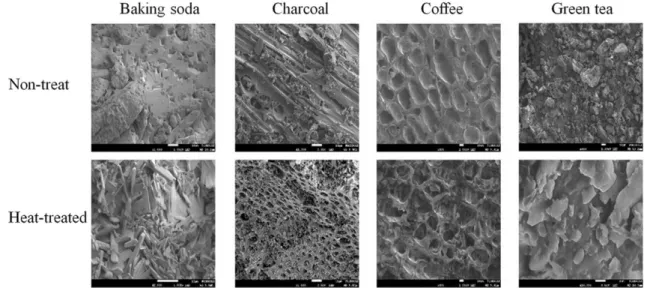
The morphology of a powder is generally characterized by the particle shape (i.e., spherical, angular, dendritic, disc, or cir- cular) or in a quasi-quantitative manner (i.e., geometrical shape parameters).27) Qualitative descriptions of the visual appear- ance of particles, such as “rounded,” “semi-angular,” or “angu- lar,” can be used to classify and differentiate different particle groups.27) The results showed that charcoal and coffee have similar morphology with honeycomb-shaped structures. They Table 1. Average particle size distributions of baking soda, charcoal, coffee, and green tea (mean±S.D., n = 3)
Baking soda Charcoal Coffee Green tea
Average particle size 137.5±0.7 29.0±0.1 676.0±36.8 17.0±0.1
D10 24.9±0.0 2.4±0.3 383.0±35.4 2.8±0.0
D50 105.5±0.7 14.0±0.1 684.0±32.5 13.4±0.1
D90 301.0±2.8 86.2±1.0 949.5±123.7 35.3±0.2
*D-Values (D10, D50 & D90) that are the intercepts for 10%, 50% and 90% of the cumulative mass Fig. 1. Sample bag and location of deodorants. (part of the red
circle ring)
can absorb odorous compounds and VOCs from Kimchi because they possess high surface areas and large pore vol- umes. Some of the natural materials are lost at high tem- peratures, causing structural changes. However, no real structural difference is apparent between coffee and heat- treated coffee. Baking soda and green tea particles have irreg- ular shapes with rough surfaces, along with some adhered fine microparticles (Figure 2).
2. Thermal stability
Nobile et al. (2009) found that the processing temperatures play a major role in determining the efficiency of the inves- tigated active films.31) The choices of active materials are often limited owing to their low thermal stability and volatility during extrusion or injection molding or the incompatibility of the component with the matrix polymer materials.31,32) There- fore, to investigate the thermal decomposition of the natural deodorants and confirm their applicability in high-temperature
melt-extrusion processing, TGA was performed. As shown in Figure 3, charcoal exhibits good thermal stability at tem- peratures exceeding 200oC. In case of coffee and green tea, there is a gradual decrease in the mass without significant deg- radation. Baking soda shows a two-step decomposition pattern, with decomposition occurring at approximately 90–100oC and 120–200oC, as shown in Figure 3. The decomposition reaction of sodium bicarbonate is shown in Equation 1 and is both time- and temperature-dependent.19,20) The heat-treated baking soda decomposes to sodium carbonate (Na2CO3), as shown in Equa- tion 1.
2NaHCO3→ Na2CO3 (s) + CO2 (g)↑ + H2O (l) (1) These results indicate that charcoal has the best thermal sta- bility among the tested samples.
3. Electronic nose analysis
An electronic nose is a device that identifies specific com- ponents of an odor and analyzes its chemical constituents using pattern recognition software33), mimicking the olfactory senses of human beings. Instead of analyzing the product by sep- arating the components, as in GC, the electronic nose detects the entire odor of the product in a manner similar to that expe- rienced by human beings.33,34) The electronic nose comprises an array of electronic sensors that react with volatile substances to provide a distinctive scent pattern (fingerprint of scent);
therefore, it is feasible to compare the patterns and hence dis- tinguish the products.33)
Figure 4 shows the results obtained from the Vapor Print image analysis in the form of polar frequency patterns. From the obtained Vapor Print images, a large diversity in odor is observed. The flavor patterns shown in Figure 4 correspond with the peaks obtained from various odor-producing volatile compounds in Kimchi samples.
Fig. 2. SEM images of baking soda, charcoal, coffee, and green tea.
Fig. 3. TGA thermograms of baking soda, charcoal, coffee, and green tea.
The Kimchi samples treated with natural deodorants tend to exhibit different patterns, which correspond to decreased smell intensity. In the case of all of the deodorants used, intensity changes are observed. The charcoal-treated Kimchi exhibits the highest intensity change, while green tea-treated Kimchi exhib- its the lowest. To evaluate the effect of thermal decomposition sustained during extrusion on the deodorizing effects of the dif- ferent agents, natural and heat-treated deodorants are com- pared. The image (blank) on the far right shown in Figure 4 depicts the peaks in a control Kimchi sample. A comparison of the data corresponding to the four deodorants and heat-treated deodorants with that of the blank clearly indicates decreased smell intensities in the former. However, no significant change in the intensity of the scent ingredients is observed, confirming that heating does not affect the overall deodorizing effect.
4. GC/MS of volatile compounds
The volatile odor-producing ingredients in Kimchi are the
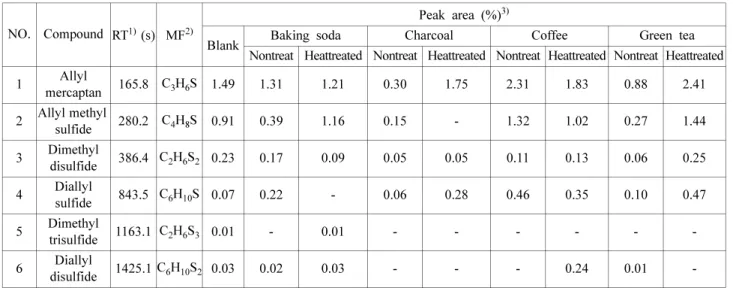
main factors affecting its taste and functional characteristics.9) Approximately 40 types of volatile ingredients have been iden- tified in Kimchi, with the majority constituting sulfides10) such as alkyl, allyl, or alkyl allyl sulfides.10) These compounds are assumed to be generated from their precursors such as sulf- oxides, thioglucosides, sulfur-containing amino acids, and sul- fonium compounds.1,10,35) Volatile compounds (allyl mercaptan, methyl allyl sulfide, dimethyl disulfide, diallyl sulfide, methyl trisulfide, and diallyl disulfide) are mainly responsible for the odor associated with the fermentation of Kimchi.9,10,35)
Table 2 summarizes the changes in the major volatile smell- producing compounds and other ingredients after treating with different natural deodorants. The differences among the sam- ples are compared in terms of the peak areas divided by those of the standard substances (benzene and fluoro-). Blank means non-treated Kimchi sample. The results showed that the peak areas of allyl mercaptan and allyl methyl sulfide, which orig- inate from garlic, are reduced after treatment with the all Fig. 4. Polar frequency patterns of the flavors in Kimchi after the addition of natural deodorants.
Table 2. Changes in the volatile composition of Kimchi treated with natural deodorants by GC–MS analysis
NO. Compound RT1) (s) MF2)
Peak area (%)3)
Blank Baking soda Charcoal Coffee Green tea
Nontreat Heattreated Nontreat Heattreated Nontreat Heattreated Nontreat Heattreated
1 Allyl
mercaptan 165.8 C3H6S 1.49 1.31 1.21 0.30 1.75 2.31 1.83 0.88 2.41
2 Allyl methyl
sulfide 280.2 C4H8S 0.91 0.39 1.16 0.15 - 1.32 1.02 0.27 1.44
3 Dimethyl
disulfide 386.4 C2H6S2 0.23 0.17 0.09 0.05 0.05 0.11 0.13 0.06 0.25
4 Diallyl
sulfide 843.5 C6H10S 0.07 0.22 - 0.06 0.28 0.46 0.35 0.10 0.47
5 Dimethyl
trisulfide 1163.1 C2H6S3 0.01 - 0.01 - - - - - -
6 Diallyl
disulfide 1425.1 C6H10S2 0.03 0.02 0.03 - - - 0.24 0.01 -
1) Retention time and 2) Molecular formula 3) Peak area/peak area of fluorobenzene
deodorants. The contents of dimethyl disulfide and dimethyl trisulfide also significantly decreased with all types deodorants.
The most effective treatment in decreasing the VOCs content was charcoal. However, new odors are generated by the addi- tion of the natural deodorants, particularly in case of green tea and coffee. Therefore, green tea and coffee are not suitable for packaging Kimchi because they create other strong smells.
Thus, baking soda and charcoal are the optimum deodorants among the four materials tested. In particular, heat-treated bak- ing soda was considerably effective for removal of the num- bers of off-odor compounds.
5. Acetic acid removal rate (%)
Upon ripening, Kimchi emits a unique odor and becomes sour because of the increased amounts of organic acids.2,35) Before ripening, most of the organic acids in Kimchi are pres- ent as salts rather than as free acids. In addition, the amount of free acids in Kimchi increases with fermentation.6) Among the various volatile organic acids in Kimchi, acetic acid is pro- duced by Leuconostoc mesenteroides and Lactobacillus brevis as well as by heterofermentative lactic acid bacteria.6,10,35)
With fermentation, the amounts of the major acids of lactic acid and acetic acid increase among the identified organic acids.1,3,35) The deodorizing effects of the natural deodorants were extensively investigated by an indicator tube method using acetic acid as the carrier gas for 150 min at 30-min inter- vals.
Regardless of the heat treatment, the acetic acid removal rates (%) of the natural deodorants increased with the mea- surement time. As summarized in Table 3, the deodorization rates of baking soda gradually increased: 31.3% (30 min), 61.3% (60 min), 70.0% (90 min), 81.3% (120 min), and 86.3%
(150 min). Charcoal exhibits an outstanding deodorization rate of 99.9% for the removal of acetic acid after 30 min. The deodorization rate of coffee increased slightly: 19.2% (30 min), 24.0% (60 min), 32.7% (90 min), 36.5% (120 min), and 47.1%
(150 min); that of green tea also increased gradually: 58.0%
(30 min), 71.0% (60 min), 79.0% (90 min), 80.0% (120 min), and 82.0% (150 min).
High deodorization rates (≥ 99.9%) are observed for char- coal, regardless of the heat treatment. However, the deodor- ization rates of baking soda, coffee, and green tea changed after heating. The deodorizing function of green tea and coffee decreased upon heating. The range of usable natural additives is often limited by the low thermal stability of the additive components under high-temperature shear polymer processing, e.g., extrusion and injection molding, and by the incompat- ibility of the components with the matrix polymer materials.1,
12, 36, 37) Conversely, heating increases the deodorizing effects of baking soda. Heat-treated baking soda deodorizes a sig- nificant amount of acetic acid in the first 30 min before the deodorization rate decreases; hence, heat-treated baking soda is more effective than the untreated one.
Further, baking soda chemically reacts with acetic acid, which causes off-odors in Kimchi. The reactions between bak- ing soda, heat-treated baking soda, and acetic acid are sum- marized as follows18,19:
CH3COOH + NaHCO3→ CH3COONa + H2O + CO2 (2) 2CH3COOH + Na2CO3 → 2CH3COONa + H2O + CO2 (3) Baking soda exhibits a high acetic acid removal rate even when heated, implying that baking soda could be used as an additive in general melt-extrusion processes. This result demonstrates that the irregular, rough, and aggregated particle structure of baking soda described in Section 3.1 and shown in Figure 2 does not hinder its deodorizing efficiency.
6. Sensory evaluation
The smell index of Kimchi, the off-odor index, and the over- all preferences were evaluated to investigate the sensory prop- erties of baking soda, charcoal, coffee, and green tea as deodorants. (Table 4). The non-treated Kimchi sample showed a Kimchi smell intensity of 5.5 ± 1.38. The Kimchi smell inten- sities of the samples that were packaged with deodorants were significantly reduced (p < 0.05), as noted by the panelists for all tested deodorants. Among the deodorants, packaging with baking soda and charcoal was the most effective way to reduce Table 3. Acetic acid removal rates of baking soda, charcoal, coffee, and green tea (mean±S.D., n = 3)
Sample code Acetic acid removal rate (%)
0 min 30 min 60 min 90 min 120 min 150 min
Baking soda Non-treat 0 31.3±1.3 61.3±3.8 70.0±5.0 81.3±1.3 86.3±1.3
Heat-treated 0 95.0±0.0 97.5±2.9 >99.9±0.0 >99.9±0.0 >99.9±0.0 Charcoal Non-treat 0 >99.9±0.0 >99.9±0.0 >99.9±0.0 >99.9±0.0 >99.9±0.0 Heat-treated 0 >99.9±0.0 >99.9±0.0 >99.9±0.0 >99.9±0.0 >99.9±0.0
Coffee Non-treat 0 19.2±2.0 24.0±1.0 32.7±0.0 36.5±2.0 47.1±1.0
Heat-treated 0 15.2±3.2 24.3±4.3 30.4±6.4 32.3±6.4 38.4±0.4
Green tea Non-treat 0 58.0±2.0 71.0±1.0 79.0±1.0 80.0±0.0 82.0±2.0
Heat-treated 0 60.4±0.4 68.3±1.7 74.3±1.8 78.2±1.8 80.2±0.2
the Kimchi smell intensity. The Kimchi smell intensities of the samples treated with baking soda and charcoal were decreased from 5.5 to less than 3. There was no significant difference between the four samples regardless of the heat treatment.
Although deodorants may absorb the unpleasant smell of Kimchi, their application may be undesirable if the sensory properties of the packaged Kimchi products are negatively affected because of the strong and characteristic smells of the deodorants themselves. Therefore, the off-odor intensity of the samples was evaluated, and the panelists failed to differentiate the off-odors between the blank and deodorant-treated product.
That means that the four type natural deodorants do not affect the sensory properties by their strong and characteristic odors.
A sensory evaluation of packaged Kimchi with a deodorant treatment is critical to determine the influence of natural deodorants on consumer preferences. The subjective panelist preferences for the deodorant-treated Kimchi samples are pre- sented in Table 4. The overall preference for the samples is in the following order: blank < heat-treated green tea < green tea (untreated) < coffee (untreated) < heat-treated coffee < baking soda < heat-treated charcoal < charcoal < heat-treated baking soda. There is a significant increase (p < 0.05) in the overall preference for the Kimchi samples packaged with charcoal and baking soda as deodorants. As a result of the sensory eval- uation, Kimchi packaged with baking soda and charcoal showed the highest score for the overall preference.
Conclusion
This study investigates the effects of baking soda, charcoal, coffee, and green tea as a natural deodorant in Kimchi pack- aging in order to remove Kimchi flavor. To determine the suit- ability of these deodorants for incorporation in Kimchi packaging, they were subjected to high-temperature processing (i.e., a high temperature during extrusion and injection mold-
ing) to assess the changes in their deodorizing effects. More- over, through electronic nose, GC/MS, detector tube method, and sensory evaluation, we found that baking soda and char- coal have excellent deodorization activities against Kimchi smell, especially acetic acid, and they are also suitable for high- temperature processing. In particular, after heat treatment, both baking soda and charcoal exhibited acetic acid removal rates of 99%. Moreover, Kimchi packaged with baking soda and char- coal demonstrated the highest preference from a sensory eval- uation, regardless of the heat treatment. Based on these findings, we concluded that baking soda and charcoal have potential applications in Kimchi deodorizing packaging.
Acknowledgements
This research was supported by High Value-added Food Technology Development Programs (114008-03), the Ministry of Agriculture, Food and Rural Affairs, and a research grant (KE2002-2-1) from World Institute of Kimchi, Republic of Korea.
Declaration of Conflicting Interests
The authors declare that there is no conflict of interest.
References
1. Choi, S.M., Choi, J.H., Choi, Y.S., Kim, H.W., Kim, H.Y., Lee, M.A., Hwang, K.E., Lee, J.W. and Kim, C.J. 2011.
Effects of kimchi powder on the quality properties of emul- sion type sausage made with irradiated pork meat. Korean Journal for Food Science of Animal Resources. 31(5): 649- 657.
2. Jung, J.Y., Lee, S.H., Lee, H.J., Seo, H.Y., Park, W.S. and Jeon, C.O. 2012. Effects of Leuconostoc mesenteroides starter cultures on microbial communities and metabolites Table 4. Sensory evaluation of packaged Kimchi with deodorants
Kimchi smell intensity Off-odor intensity Overall preference
Blank 5.50±1.38A 2.83±1.34ABCD 3.17±0.94A
Baking soda Non-treat 2.83±2.21CD 2.08±1.08CD 5.42±2.11BC
Heat-treated 2.00±1.04BCD 1.67±1.44D 6.17±2.33C
Charcoal Non-treat 1.75±0.97D 1.58±1.16D 6.08±2.39C
Heat-treated 2.92±1.83BCD 2.17±1.59BCD 6.00±1.65C
Coffee Non-treat 4.08±1.62B 3.42±1.73ABC 4.33±0.98AB
Heat-treated 3.67±1.61B 3.25±1.06ABC 4.42±1.51AB
Green tea Non-treat 3.17±1.59BCD 3.58±2.02A 4.17±2.04AB
Heat-treated 3.33±2.15BC 3.50±1.73AB 3.75±1.71A
All values are means ± SDs.
A–DMeans sharing different letters in the same column are significantly different (p < 0.05).
during Kimchi fermentation. International Journal of Food Microbiology. 153: 378-387.
3. Kang, J.H., Lee, J.H., Min, S. and Min, D.B. 2003. Changes of volatile compounds, lactic acid bacteria, pH, and head- space gases in kimchi, a traditional Korean fermented vege- table product. Journal of Food Science. 68(3): 849-854.
4. Kim, B., Song, J.L., Ju, J.H., Kang, S.A. and Park, K.Y.
2015. Anticancer effects of kimchi fermented for different times and with added ingredients in human HT-29 colon can- cer cells. Food Science and Biotechnology. 24(2): 629-633.
5. Choi, I.H., Noh, J.S., Han, J.S., Kim, H.J., Han, E.S. and Song, Y.O. 2013. Kimchi, a fermented vegetable, improves serum lipid profiles in healthy young adults: Randomized clinical trial. Journal of Medicinal Food. 16(3): 223-229.
6. Kim, J.H., Park, J.G., Lee, J.W., Kim, W.G., Chung, Y.J. and Byun, M.W. 2008. The combined effects of N2-packaging, heating and gamma irradiation on the shelf-stability of kim- chi, Korean fermented vegetable. Food Control. 19: 56-61.
7. Ko, J.A., Kim, W.Y. and Park, H.J. 2012. Effects of micro- encapsulated allyl isothiocyanate (AITC) on the extension of the shelf-life of kimchi. International Journal of Food Micro- biology. 153: 92-98.
8. Jo, S.H., Kim, K.H., Kim, Y.H., Lee, M.H., Kim, B.W. and Ahn, J.H. 2015. Deodorization of food-related nuisances from a refrigerator: The feasibility test of photocatalytic sys- tem. Chemical Engineering Journal. 277: 260-268.
9. Ha, J.H. 2002. Analysis of volatile organic compounds in Kimchi absorbed in SPME by GC-AED and GC-MSD. Jour- nal of the Korean Society of Food Science and Nutrition.
31(3): 543-545.
10. Jeong, H.S. and Ko, Y.T. 2010. Major odor components of raw Kimchi materials and changes in odor components and sensory properties of Kimchi during ripening. Journal of the Korean Society of Food Culture. 25(5): 607-614.
11. Marsh, K. and Bugusu, B. 2007. Food packaging-Roles, mate- rials, and environmental issues. Journal of Food Science. 72(3):
39-55.
12. Appendini, P. and Hotchkiss, J.H. 2002. Review of antimi- crobial food packaging. Innovative Food Science and Emerg- ing Technologies. 3: 113-126.
13. Brody, A.L., Bugusu, B., Han, J.H., Sand, C.K. and McHugh, T.H. 2008. Innovative food packaging solutions. Journal of Food Science. 73: 107-116.
14. Suppakul, P., Miltz, J., Sonneveld, K. and Bigger, S.W.
2003. Active packaging technologies with an emphasis on antimicrobial packaging and its applications. Journal of Food Science. 68: 408-420.
15. Lee, K.H., Yun, H., Lee, J.W., Ahn, D.U., Lee, E.J. and Jo, C. 2012. Volatile compounds and odor preferences of ground beef added with garlic and red wine, and irradiated with charcoal pack. Radiation Physics and Chemistry. 81: 1103- 1106.
16. Sohn, S.H., Jang, A., Kim, J.K., Song, H.P., Lee, M. and Jo, C. 2009. Reduction of irradiation off-odor and lipid oxida- tion in ground beef by α-tocopherol addition and the use of
a charcoal pack. Radiation Physics and Chemistry. 78: 141-146.
17. Noronha, C. M., Carvalho, S. M., Lino, R. C & Barreto, P.
L. M. 2014. Characterization of antioxidant methylcellulose film incorporated with α-tocopherol nanocapsules. Food Chemis- try 159: 529-535.
18. Hang, Y.D. and Woodams, E.E. 2003. Control of Fusarium oxysporum by baking soda. Lebensmittel-Wissenschaft &
Technologie - Food Science and Technology. 36: 803-805.
19. Heda, P.K., Dollimore, D., Alexander, K.S., Chen, D., Law, E. and Bicknell, P. 1995. A method of assessing solid state reactivity illustrated by thermal decomposition experiments on sodium bicarbonate. Thermochimica Acta. 255: 255-272.
20. Qamaruz-Zaman, N., Kun, Y. and Rosil, R.N. 2015. Prelimi- nary observation on the effect of baking soda volume on con- trolling odour from discarded organic waste. Waste Manage- ment. 35: 187-190.
21. Iyobe, T., Asada, T., Kawata, K. and Oikawa, K. 2004.
Comparison of removal efficiencies for ammonia and amine gases between woody charcoal and activated carbon. Jour- nal of Health Science. 50(2): 148-153.
22. Opara, C.C., Oyom, A.L. and Okonkwo, M.C. 2013. Deodori- zation of kerosene using activated carbon as adsorbent.
Greener Journal of Physical Sciences. 3(2): 70-75.
23. Oya, A. and Iu, W.G. 2002. Deodorization performance of charcoal particles loaded with orthophosphoric acid against ammonia and trimethylamine. Carbon. 40: 1391-1399.
24. Oiwa, Y. and Okuzawa, F. 2015. Deodorant effect of coffee beans. Thailand-Japan student fair. 1-4.
25. Kang, S.M., Kim, T.S., Song, M.H., Kwon, I.K., Cho, S.H., Park, B.Y. and Lee, S.K. 2012. Effect of addition level of green tea extract on the lactic acid bacteria, oxidative stabil- ity, and aroma in Kimchi-fermented sausage. Korean Jour- nal for Food Science of Animal Resources. 32(4): 457-475.
26. Kida, K., Suzuki, M., Takagaki, A. and Nanjo, F. 2002. Deodori- zing effects of tea catechins on amines and ammonia. Bio- science, Biotechnology, and Biochemistry. 66(2): 373-377.
27. Mikli, V., Kaerdi, H., Kulu, P. and Besterci, M. 2001. Char- acterization of powder particle morphology. Proceedings of the Estonian Academy of Sciences: Engineering. 78(1): 22-34.
28. Adams, J.M. 1993. Particle size and shape effects in materi- als science: Examples from polymer and paper systems.
Clay Minerals. 28: 509-530.
29. Hanemann, T. and Szabo, D.V. 2010. Polymer-nanoparticle composites: From synthesis to modern applications. Materi- als. 3: 3468-3517.
30. Blott, S. J. and Pye, K. 2001. Gradistat: A grain size distri- bution and statistics package for the analysis of unconsoli- dated sediments. Earth Surface Processes and Landforms.
26: 1237-1248.
31. Nobile, M. A. D., Conte, A., Buonocore, G. G., Incoronato, A. L., Massaro, A & Panza, O. 2009. Active packaging by extrusion processing of recyclable and biodegradable poly- mers. Journal of Food Engineering. 93: 1-6.
32. Jeong, S. Y., Kim, D. W & Seo, J. C. 2015. Preparation and antimicrobial properties of LDPE composite films melt-
blended with polymerized urushiol powders (YPUOH) for packaging applications. Progress in Organic Coatings. 85:
76-83.
33. Ryu, H.J., Choi, E.J. and Oh, M.S. 2004. Changes in qual- ity characteristics of chopped garlic with various storage method. Family and Environment Research. 42(1): 167–180.
34. Park, P.H., Yae, B.W., Kim, M.S., Lee, Y.R., Park, P.M. and Lee, D.S. 2011. Fragrance analysis using GC/MS and elec- tronic nose in Phalaenopsis. Flower Research Journal. 19(4):
219-224.
35. Cha, Y.J., Kim, H. and Cadwallader, K.R. 1998. Aroma-active compounds in kimchi during fermentation. Journal of Agri- cultural and Food Chemistry. 46: 1944-1953.
36. Quintevalla, S. and Vicini, L. 2002. Antimicrobial food pack- aging in meat industry. Meat Science. 62: 373-380.
37. Selke, S.M.E., Culter, J.D. and Hernandez, R.Z. 2004. Plas- tics Packaging; Properties, Processing, Applications, and Regu- lations. (3rd ed.) Munich, Germany: Carl Hanser Verlag.
투고: 2020.01.08 / 심사완료: 2020.03.15 / 게재확정: 2020.04.02