https://doi.org/10.20909/kopast.2016.22.3.41
Kimchi Packaging Technology: An Overview
Suyeon Jeong and SeungRan Yoo*
World Institute of Kimchi, 86 Kimchi-ro, Gwangju, Korea
Abstract This paper provides an overview of kimchi packaging technology, focusing on packaging materials, package design, and active/intelligent packaging technology for kimchi. From a packaging-material standpoint, although various materials have been used to ensure customer satisfaction and convenience, plastic is the most widely used material, in the form of bags, trays, pouches, and rigid containers. Additionally, recent efforts in the kimchi packaging industry have allowed companies to differentiate their products by using different packaging materials and technologies, while simul- taneously improving product safety and quality. On the other hand, the biggest problem in kimchi packaging is excess CO
2production, leading to package expansion and leakage. To alleviate this problem, the use of CO
2absorbers, high CO
2-permeable films, and degassing valves, in addition to the use of different packaging systems, has been investigated.
Active and/or intelligent packaging systems have been developed, to include active functions beyond simply inert, passive containment and protection of the kimchi product. However, most such approaches are not yet adequately effective to be useful on a commercial scale. Therefore, further studies are needed to resolve the limitations of each technology.
Keywords Kimchi, Fermentation, Packaging, Technology
Introduction
Kimchi is the most well-known, traditional Korean food prepared from lactic acid fermentation of brined vegetables with the addition of various kinds of seasoning, giving it a unique flavor that is sour, spicy, salty, and carbonic. Kimchi has recently been demonstrated to promote health, by enhanc- ing immunity as well as exhibiting anti-carcinogenic and anti- oxidative activities. Kimchi was listed among the “World’s Healthiest Foods” in 2006
1), resulting in a rapid increase in kimchi popularity and consumption worldwide
2).
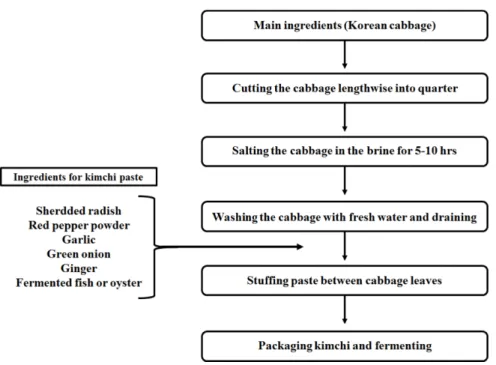
Preparing kimchi involves several complicated processes as shown in Fig. 1, including salting in brine for a couple of hours. Of note, the scarcity of ingredients in winter poses a challenge to the preparation of kimchi during this season.
Therefore, a large amount of kimchi is prepared before the onset of winter and stored in kimchi jars buried in the ground, which is the traditional method for its long-term storage.
The concept of kimchi packaging and distribution began with its commercialization. The first commercial kimchi app- eared in local grocery stores in the mid-1980s and quickly became a favorite of consumers because, despite its place as
an essential part of the cuisine in Korean households, prepa- ration of high-quality kimchi requires significant effort, time, and good quality ingredients. Since 2010, Korea annually ex- ports approximately 100 million USD worth of kimchi to over 60 countries. With the growth of the commercial kimchi mar- ket, kimchi packaging has gained importance. Today, com- mercial kimchi is packaged in plastic film bags or rigid plastic trays with a film lid for domestic consumption and export.
Fermentation of kimchi is brought about by various micro- organisms and enzymes associated with the ingredients/raw materials, producing a unique, fresh sour flavor by generating various organic acids
3). Thus, the taste and texture of kimchi are affected over time by microorganisms during storage
4). Additionally, these microbiological and enzymatic activities continue even in well-aged kimchi, producing excess acid that results in a sour and bitter taste, offensive odor, and softening due to the deterioration of kimchi
3,5). Excess acid production also leads to CO
2accumulation in the packaging headspace, as shown in Fig. 2
4), which may cause damage owing to bloating and result in leakage
6). Therefore, in addition to its limited shelf life, the number one priority for kimchi manufacturers is a quick turnover to prevent kimchi package damage from CO
2accu- mulation
3). Hence, the control of metabolic processes is key to preserving the quality of kimchi and extending its shelf life.
To solve the leakage problem, various processing methods such as canning, bottling, pasteurization, adding preservatives, use of food additives, irradiation, pinhole packaging systems,
*Corresponding Author : SeungRan Yoo
World Institute of Kimchi, 86 Kimchi-ro, Gwangju, Korea Tel : +82-62-610-1738, Fax: +82-62-610-1850
E-mail : [email protected]