An Experimental Study on the Convection Heat Transfer of Al-Mg/water Micro Fluid in a Circular Tube with Swirl
Tae-Hyun Chang†․Chiwon Kim
1․Sang-Cheol Kil
2․Chang-Hoan Lee
3(Received October 11, 2012; Revised November 7, 2012; Accepted November 27, 2012)
Abstract: In the past decades, extensive studies on convection heat transfer on internal flow have been conducted by using high specific surface area, by increasing heat transfer coefficient and swirl flow, and by improving the transport properties. In this study, we applied a tangential slot swirl generator to improve heat transfer in a horizontal circular copper tube. The Al-Mg particles (approximately 100μm to 130μm) were employed for this experimental work. The copper tube was heated uniformly by winding a heating coil with a resistance of 9 ohm per meter for heat transfer. Using Al-Mg particles, experiments were performed in the Reynolds number range of 5,000 to 13,130, with and without swirl. Experimental data transfers or comparisons between Nusselt numbers with and without swirl along the test tube and Reynolds numbers are presented. The Nusselt number is improved by increasing Reynolds numbers or swirl intensities along the test tube.
Key words :Micro fluid, Swirl, Tangential slot, Bulk temperature, Nusselt number
† Corresponding author (Reseat Korea Institute of Science and Technology Information, E-mail: [email protected], Tel: 055-246-1279
1 Kyungnam Univ. E-mail: [email protected], Tel: 055-249-2612
2 Korea Institute of Science and Technology Information, E-mail: [email protected], Tel: 02-3299-6012 3 Korea Institute of Science and Technology Information, E-mail: [email protected], Tel: 02-3299-6015
NOMENCLATURE
C
f: Specific heat of base fluid(J/kg ℃) Pr : Prandtl number
C
nf: pecific heat of macroparticle(J/kg ℃)
: Dynamic viscosity(kg/m․s) C
p: specific heat of particle(J/kg ℃)
: Density(kg/m
3)
h : Convective heat transfer coefficient(W/m
2K)
: Volume concentration of microparticles(%) k
nf: Thermal conductivity of microparticle(W/m℃) b
f: Base fluid
k
bf: Thermal conductivity of base fluids(W/m℃) n
f: Micro-fluid
k
p: Thermal conductivity of microparticles(W/m℃) w : Water
: Mass flow rate of fluids(kg/s) p : Microparticles
1. INTRODUCTION
The characteristics of turbulent swirl flow have been studied extensively because of its great technological and scientific importance. Swirl flow improves heat in pipe flow. Recently, Saidur et al.
[1] reviewed applications and challenges of
nanofluids, and found that the improved thermal
conductivities of nanofluids increased by up to
150% with an increase in temperature. Depsite
studies on the topic, the exact mechanism of
enhanced heat transfer for nanofluids remains
unclear. Moreover, many challenges must be
identified and overcome to ensure the success of different applications.
Ravikanth et al. [2] analyzed the influence of temperature and concentration of nanofluid on thermophical properties and found that the addition of nanoparticles to any liquid significantly increases viscosity while moderately increasing thermal conductivity. Specific heat and density also changed slightly. Zoubidaet et al. [3] studied the natural convective heat transfer of nanofluids, and concluded that these have great potential for heat transfer enhancement and are highly suitable for various applications.
For forced convection heat transfer, Mohammed et al. [4] and Sohelet et al. [5] studied convective heat transfer with fluid flow and boiling with nanofluid. Mohammedet et al. [4] also studied the fluid flow and heat transfer behaviors of different types of single-phase fluid flow over backward facing step; they found that Nusselt number increases along with an increase in velocity, Prandtl number, and aspect ratio. Sohelet et al. [5] studied boiling heat transfer with nanofluids in carbon tubes, and found that it is possible to enhance boiling heat flux depending on the concentration of surfactants.
Much attention has been paid in recent years to swirl flow with energy problems. The problem has practical importance given that swirl atomizers, dust extractors, and enhancement of heat transfer coefficient are widely applied. In using swirling flow, Govarthan et et al. [6] conducted CFD simulation of the heat transfer of nanofluids in a circular tube fitted with twisted inserts under constant heat flux, which is explained using Fluent version 6.326 in laminar flow. The heat transfer increased with Reynolds number and decreased with twist ratio with maximum of 2.93 for the twist ratio.
Using numerical and experimental methods, Adrian et al. [7] used a micro fluid channel consisting of two T-Junctions with vibration.
Svetlanaet et al. [8] employed twisted tape as turbulence promoters in the microfiltration of milk.
Using the twisted tapes, both reversible and irreversible fouling are reduced and the permeate fluxes are remarkably increased. Syam et al. [9]
also measured heat transfer and friction factor of Al
2O
3nanofluid in circular tubes with twisted tape.
The heat transfer coefficient and friction factor of 0.5% and volume concentration of Al
2O
3nanofluid are 33.51% and 1.096 times higher, respectively, compared with theflow of water in a tube.
In this study, Al-Mg/water micro fluid is used to measure bulk temperatures and then Nusselt numbers are calculated with and without swirl flow in a horizontal circular copper tube.
2. Experimental Apparatus
2.1 Swirl generator
We use a swirl generator with two parts, namely, the swirl chamber and the swirl generator. The swirl generator has 30 holes with a diameter of 2.5mm each along the generator tube, allowing the sequential circulation of the working fluid through the swirl chamber. The swirl intensities are adjusted by L/D in the swirl chamber. Where L and D are the length of swirl generator and the dia metre of the test tube, respectively.
2.2 The test tube
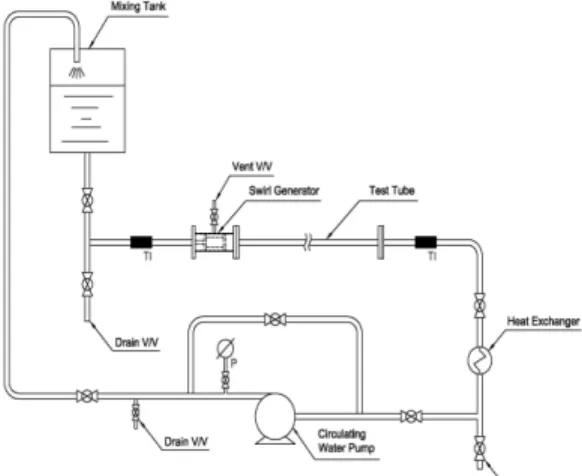
Figure 1 is a schematic diagram of experimental
test tube, which is manufactured by copper tube,
which has 7.7mm in diameter, 1,000mm in length
and 0.8mm in thickness. The wall of test tube is
uniformly heated by electrical power to 0.36kW(120
voltage, 3 Amp). The heating coil is uniformly
wound 7mm distance along the test tube. In
addition, voltage regular is employed to adjuster
heat flux. K-type thermocouples are employed to measure bulk and wall temperatures with 32 channel LaView system.0.36kW (120 voltage, 3 Amp). Two becraite flanges are used the end of test tube to protect the loss of electric power. A water pump is used to circulate microfluid this system using rpm control which has 1,600c.c per miniature pumping capacity. The mass flow are measured the pump exhaust port and then the mean velocities are calculated to decide for the Reynolds number. Al-Mg particles are dispersed some refined water in a beaker with an agitator and then pour it into the mixing water tank.
Figure 1: Experimental rig
Figure 2: Heating coil winding on the test tube
2.3 Evolution of the thermo-physical properties of micro fluid
Al-Mg microparticles (approximately 100μm to 130μm) are supplied by a Korean company.
Distilled water is used to disperse these particles with 0.25% volume concentration. The properties of micro fluid, such as viscosity, specific heat and thermal conductivity, are measured using VISCOMRETER (DV-II+Pro, BROOKFIELD), differential scanning calorimeter (DSC) (Q2000, TAInstruments) and TPA-501 (Hot Disk Company, Sweden), respectively.
The equations below are used to calculate these properties. The density of the micro fluid is derived using the following equation (1):
(1)
The following Einstein equation is used to determine viscosity of this micro fluid:
(2)
where
is the viscosity of the base liquid, and is the volume fraction of the micro fluid (0.25%).
The following equation proposed by Hamilton et al.
[16] is used to calculate thermal conductivity:
(3)
where K
nf, K
bf, and K
pthe thermal conductivities of the micro fluid, the base fluids and the microparticles, respectively. Here, n is the space factor of the micro fluid, and 3 refers to spherical micro fluid. The following more accurate equation is modified by Buongiorno [15]:
(4)
Figure 3: Specific heat of Al-Mg(MAB-60) and Al
2O
3(AAL-100S) particles
Figure 3 shows the specific heat of Al-Mg and Al
2O
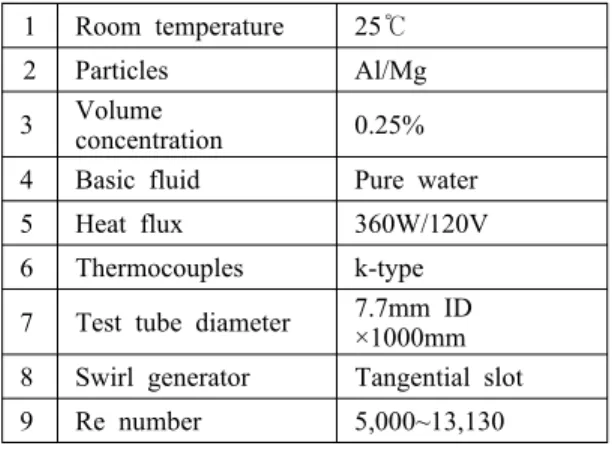
3particles measured by DSC. These values are chosen in order to decide the specific heat of micro fluid for each temperature. Table 1 depicts the experimental conditions for this work
Table 1: Experimental conditions 1 Room temperature 25℃
2 Particles Al/Mg
3 Volume concentration 0.25%
4 Basic fluid Pure water
5 Heat flux 360W/120V
6 Thermocouples k-type 7 Test tube diameter 7.7mm ID
×1000mm 8 Swirl generator Tangential slot 9 Re number 5,000~13,130
3. Results and Discussion
The wall and fluid temperatures are measured along the test tube using k-type thermocouples.
Then, the bulk temperatures and Nusselt numbers are calculated with and without swirl flow using the following equations:
×
×
(5)
(6)
where Nu is the Nusselt number, h is the heat transfer coefficient, and Re and Pr are the Reynolds and Prantl numbers, respectively. As and Tw are indicate the surface area and the wall temperature.
Nu=
(7)
Equation (7) below is the Dittus-Boelter equation [10] given as follows:
Nu=0.23Re
nPr
m.
(8) Figure 4 shows the comparisons of the bulk temperatures with and without swirl for Re=5,000–
13,130. The bulk temperatures with swirl are 7.3%
to 9.7% higher than those without swirl flow.
Where, Tb is the bulk temperature and Tr room temperature (25℃) for the test section.
The bulk temperatures are decreased with the decline in Reynolds number and swirl intensity.
These occurrences could be attributed to strong tangential velocities.
Using these bulk temperatures and the wall temperatures, the Nusselt numbers are calculated for several Reynolds numbers with and without swirl.
Figure 4: Bulk temperature distributions for the
Reynolds numbers with and without swirl flow
5000 6000 7000 8000 9000 10000 11000 12000 40
50 60 70 80 90
Non Swirl Dittus Boelter
Nu
Re
Figure 5: Comparisons of Nusselt numbers without swirl flow and the Dittus-Boelter equation
Figure 5 compares the Nusselt numbers of Al-Mg/water micro fluid without swirl with those obtained using the Dittus-Boelter equation along the test tube for Re=5000 to 12,000. The Nusselt number without swirl is approximately 1.25% to 3.7% higher than that obtained using the Dittus-Boelter equation. The bulk temperature of Al-Mg/water micro fluid is considered based on the particle conductivity.
5000 6000 7000 8000 9000 10000 11000 12000 13000 40
50 60 70 80 90 100
Nu
Re Non-Swirl Swirl Dittus-Boelter