†Corresponding Author: Dept. of Computer Engineering, Korea Maritime and Ocean University, 727 Taejong-ro, Yeongdo-gu, Busan 606-791, Republic of Korea, e-mail: [email protected], Tel: 051-410-4574
1 Dept. of Computer Engineering, Korea Maritime and Ocean University, e-mail: [email protected], Tel: 051-410-4896 2 Dept. of Computer Engineering, Korea Maritime and Ocean University, e-mail: [email protected], Tel: 051-410-4896
Extended pivot-based approach for bilingual lexicon extraction
Hyeong-Won Seo1 ․ Hong-Seok Kwon2 ․ Jae-Hoon Kim†
(Received January 15, 2014; Revised March 12, 2014;Accepted March 26, 2014)
Abstract: This paper describes the extended pivot-based approach for bilingual lexicon extraction. The basic features of the approach can be described as follows: First, the approach builds context vectors between a source (or target) language and a pivot language like English, respectively. This is the same as the standard pivot-based approach which is useful for extracting bilingual lexicons between low-resource languages such as Korean-French. Second, unlike the standard pivot-based approach, the approach looks for similar context vec- tors in a source language. This is helpful to extract translation candidates for polysemous words as well as lets the translations be more confident. Third, the approach extracts translation candidates from target context vectors through the similarity between source and target context vectors. Based on these features, this paper describes the extended pivot-based approach and does various experiments in a language pair, Korean-French (KR-FR). We have observed that the approach is useful for extracting the most proper translation candidate as well as for a low-resource language pair.
Keywords: Bilingual lexicon extraction, Pivot language, Rated Recall
1. Introduction
Bilingual lexicon is an important resource used for various research domains such as natural language processing (NLP), machine translation (MT), in- formation retrieval (IR) [1], sentiment classification [2] and so on. Bilingual corpora, comparable or paral- lel, are a key to extract it, but so far, a bilingual lex- icon for a low-resource language pair like Korean-French has suffered from a difficulty to get it because constructing the bilingual corpora is time-consuming process.
In spite of such a problem, many researchers stud- ied to collect the lexicon in various ways. Some re- searchers represent words by a context vector based on its lexical context [3]-[5]. In fact, they achieve 80 to 91% accuracy for single terms, even though the
performance drops to 60% when specialized small corpora are used by some researchers [6][7]. Other researchers [8]-[10], on the other hand, focused on a size of an initial seed dictionary (basically, bilingual lexicon extraction needs an initial bilingual seed dic- tionary to translate context vectors). Some researchers [11][12] focused on similar words sharing similar lex- ical circumstances and one of the approaches [11]
will be denoted as the extended context-based ap- proach in the rest of the paper. Alternatively, Seo et al. [13] proposed the standard pivot-based approach that is useful for only a low-resource language pair, and extracts bilingual lexicons using a pivot language such as English.
To evaluate these approaches, usually the accuracy or the mean reciprocal rank (MRR) is used [9][13].
These measures focus on finding correct translation candidates (equivalences). Even though rare words as unknown words are much more founded by far than frequent words from a system, we cannot judge whether the system is good or not. To understand easily this problem, this paper also discuss about Rated Recall [14] that considers how many times translation candidates appears in the system. In this paper, we will evaluate the related recall as well as the accuracy and the MRR of the proposed system.
The rest of the paper is organized as follows:
Section 2 discusses related works, the standard piv- ot-based approach and the extended context-based approach. Section 3 represents a extended pivot-based approace and Section 4 reports and discusses some experiments. Finally, Section 5 concludes and ad- dresses future works.
2. Related Work
All approaches described in this section are based on the context-based approach that is represented by Rapp [4]. The first motivated work, the standard pivot-based approach, uses a high-resource language like English as a pivot language to extract bilingual lexicons from two sets of parallel corpora (e.g., English-*). Another work, the extended context-based approach, uses comparable corpora in deference to the coverage of the initial bilingual dictionary which is used to translate a source language into a target language [11].
2.1 Standard Pivot-Based Approach
The standard pivot-based approach aims to extract a bilingual lexicon from a low-resource language pair such as Korean-French without any external resource like an initial bilingual dictionary and a parallel cor- pus between two languages. This approach was pro- posed by some researchers [13][15] to improve some disadvantages of the context-based approach that builds context vectors and then compares them to
identify correct translation candidates from com- parable corpora [4]. The context-based approach, in particular, uses comparable corpora and an initial bi- lingual dictionary to translate all words, , in a source text into target words, ″ . In this case, the performance of the system may depend on a coverage of the initial bilingual dictionary. To overcome this problem, some researchers have proposed various studies [8] for the dictionary coverage.
The standard pivot-based approach, however, uses a pivot language to represent words in a common language. As a result, the dimension of two vectors becomes as same, and are comparable each other. For this reason, the initial bilingual dictionary is no lon- ger needed for the translation task. On the other hand, just parallel corpora of a high-resource lan- guage pair like English-* should be needed. The standard pivot-based approach follows the next three steps:
I. Building the context vectors from two sets of par- allel corpora (Korean-English and French-English;
hereinafter KR-EN and FR-EN, respectively). All context vector values are represented with associa- tion scores, and these values show how much they are related to each other. To calculate the associa- tion scores, co-occurrence counts are collected in a source text (resp. a target text) by source-pivot word matrix (resp. target-pivot word matrix). The co-occurrence counts come from a frequencies of parallel sentences that contain both source (resp.
target) and pivot words together. In this case, all sentences are treated as documents. The association scores can be measured as a point-wise mutual in- formation, a chi-square score.
II. Calculating similarity scores between each source context vector, , and all target context vectors, , on the basis of vector distance measures such as a cosine similarity and a weighted Jaccard coefficient.
III. Sorting the top translation candidates based on
their similarity scores.
The approach is useful where a public parallel cor- pus between two languages are directly unavailable but a corpus for some language pairs like English-*
is publically available. Furthermore, the approach is very simple because any linguistic resource such as an initial bilingual dictionary or a word alignment tool is not required.
2.2 Extended Context-Based Approach
Déjean and Gaussier (2002) [11] have proposed an extended method (hereinafter, the extended con- text-based approach) to the fundamental con- text-vector approach reported earlier by few re- searchers [3][16]. The goal of the approach is a less dependency for the coverage on the initial bilingual dictionary. The approach also identifies the sec- ond-order affinities [17, p. 280] in a source language as follows:
“Second-order affinities show which words share the same environments. Words sharing sec- ond-order affinities need never appear together themselves, but their environments are similar.”
The main ideas of the extended approach [18] can be described as follows:
I. The nearest words in a source text according to the similarity score, sim′ between two words, and ′ , are identified.
II. The similarity score, sim″ for each word, , in a target language with the respect to the trans- lated nearest words, ″ , is calculated.
This extended context-based approach is motivated to the extended pivot-based approach, and it will be described in more details in the next section.
3. Extended Pivot-Based Approach
As described in the previous section, the extended pivot-based approach is pretty motivated from the ex- tended context-based approach represented by Déjean and Gaussier (2002) [11]. That is, a base system is
same with the standard pivot-based approach, but the conceptual idea from the extended context-based ap- proach is added. The idea is finding the nearest words in a source text to identify more confident translation candidates as described in the previous section.
The big question is how the extended con- text-based approach can be apply to the standard piv- ot-based approach. As we mentioned before, the step that is finding nearest words from the extended context-based approach is conducted where all words are from comparable corpora. To compare all context vectors, therefore, nearest words, ′ , in a source text should be translated into target words, ′′ , with an initial bilingual dictionary. As a result of the translation task, all words (e.g., ′′ and ) are repre- sented in a common target language so the di- mensions of the context vectors are changed to be equal.
However, on the other hand, the situation of the standard pivot-based approach is little bit different.
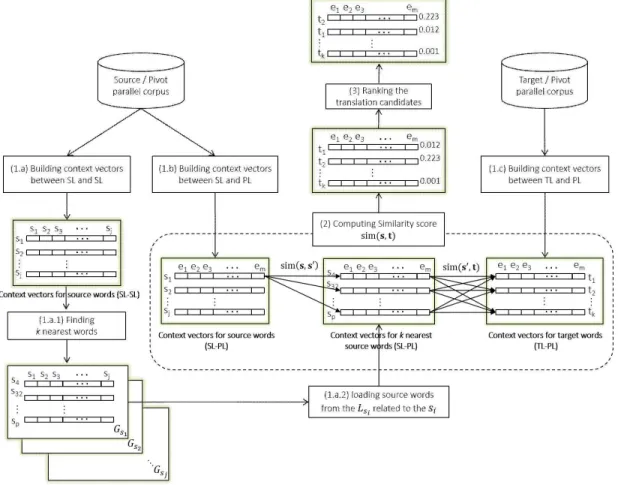
There is a pivot language that connect two different languages (e.g., source and target) so the step for cal- culating similarity scores can be conducted in much simpler way. The overall structure of the extended pivot-based approach is described in Figure 1.
As you can see Figure 1, two sets of parallel cor- pora consists of three different language, source lan- guage (SL), target language (TL), and pivot language (PL), are used to build context vectors. An important thing of the overall structure for the extended piv- ot-based approach is that the SL-SL context vectors are indirectly used when the similarity score sim(s, t) is calculated. The overall structure can be describe in more details as follows:
Three types of context vectors, SL-SL (1.a), SL-PL (1.b) and TL-PL (1.c), are built by parallel corpora, respectively. All context vector values are represented with association scores like a point-wise mutual in- formation (PMI) or a chi-square score.
Figure 2: An example of the calculation for the similarity score sim(s1, t3) Figure 1: Overall structure of the extended pivot-based approach
1.a.1. Let be a word in a source language, and then the group
, a set of nearest words related to a source word , is collected based on vector dis- tance measures such as a cosine similarity. With these similarity scores, all words include a source word itself are then grouped and filtered out by a
threshold.
1.a.2. A bunch of nearest source words ′ from
with respect to the source word is extracted to compute the similarity score sim . In this case, only words ′ in the group
are loaded but context vectors are from (1.b).
2. Two similarity scores, sim′ and sim′, are calculated for the sim. The sim- ilarity score, sim , can be described as the for- mula (1).
sim s t s∈k nlw
sim s s′ × sim s′ t (1)The similarity score, sim , is the sum of all possible (collectable) similarity scores sharing near- est words (called klw), ′ , related with two words, and . The example of the formula (1) is represented in Figure 2 in more details. This example assumes that the word, , in a target language is the closest translation candidate with the Korean word, , ‘상 승’ (means rise; ascension). In general, all context vectors, s, only related with should be considered to measure the similarity score. If two nearest words,
′ ‘증가’ (means augmentation; gain; rise) and ′
‘급등’ (means jump; a sudden rise), for the are closely related to the word , the similarity score, sim(s1, t3), should be measured as follows:
sim sim ′ × sim ′
sim ′ × sim ′ After measuring all the similarity scores, all target context vectors, t, are then sorted based on the final similarity scores. This job is recursively conducted as much as the size of the source context vectors, s.
4. Experiments and Discussions
In order to evaluate the performance of the ex- tended pivot-based approach, we use the KR-EN par- allel corpus (433,151 sentences) [13] and the EUROPARL parallel corpus (500,000 sub-sentences) [19] for the language pair FR-EN. On the average, each sentence contains 42.36(KR of KR-EN), 36.02(EN of KR-EN), 31.17(FR from FR-EN), 28.68(EN from FR-EN) words per sentence. All con- tent words (nouns, main verbs, adjectives and ad- verbs) are POS-tagged and all stop-words fitted to
each language (EN, KR and FR) are eliminated.
Moreover the same KR-FR bilingual lexicon is used for the evaluation. Each language set (e.g., KR or FR) contains 100 frequent words (denoted as High) and 100 rare words (denoted as Low).
In order to measure the performance, three differ- ent measures, the accuracy, MRR (Mean Reciprocal Recall) and RR (Rated Recall), are considered in this paper. Especially, MRR [20] accentuates translation candidates at higher ranks more than the others at lower ranks, so that the correct translation candidates at higher ranks could be treated as more important.
The RR, one of the other measuring method, means that how many correct translation candidates treated as IMPORTANT (as much important as it occurs in a document) are extracted by a system, while the basic recall means that how many correct translation candi- dates treated as NORMAL (each candidate has a same weight) are extracted by a system. The RR can be represented as the formula (2).
i f otherwise∈(2)
means the total number of the lexical unit, , in a source text and (and also denoted as ) means the number of correct translations in a bilingual lexicon. It goes without saying that each lexical unit,
, has the different number of correct translations or senses. is also known as the Kronecker delta function. If -th lexical unit, , in a source text has the -th translation candidate, , the is 1 or 0.
is the rate means how many times occurs in a target text. The sum of all properties related with
should be 1 (e.g.,
∈
). An example
about how to calculate the RR is described in more details as below.
Translations
(Romanization) Gloss Freq.
결정(Gyeol-jung) decision;
conclusion 6,007 0.752
결심(Gyeol-sim) determination;
resolution 173 0.022
결의(Gyeol-ui) a resolution;
a decision;
a vote
369 0.046
결단(Gyeol-dan) determination;
resolution;
determine
130 0.016
결단력 (Gyeol-dan-ryuk)
the strength of one's mind;
resolution
10 0.001
재정(Jae-jung) finance(s);
financial affairs 880 0.110
판정(Pan-jung) Judgment;
decision; judge 414 0.052
Total 7,983 1.000
Table 1: Correct Korean translations of the French word “décision” (e.g., source: FR, target:
KR)
Rank RR (Rated Recall) Recall
1 0.752 1/7 = 0.143
3 0.752 + 0.016 = 0.768 2/7 = 0.286 7 0.768 + 0.052 = 0.820 3/7 = 0.429 15 0.820 + 0.022 = 0.842 4/7 = 0.571 Table 3: Rated Recall and Recall at each rank
Rank Translation
candidate Gloss
1 (Gyeol-jung)결정
decision;
conclusion 0.752
2 (Gyeol-sim)통합
Unification;
unity; combination 3 (Gyeol-dan)결단
determination;
resolution; determine 0.016
4 여부(Yeo-bu) yes or no;
whether or not; if
…
7 (Pan-jung)판정 Judgment;
decision; judge 0.052
… 15 (Gyeol-sim)결심
determination;
resolution 0.022
…
Table 2: The system output: Translation candi- dates
As you can see Table 1, all translations occur at least 10 times, and especially ‘결정’ is the word that appears the most times (6,007) in a target text. Each translation in a bilingual dictionary has the rate, . It means that other senses are eliminated unless it oc- curs in a target text.
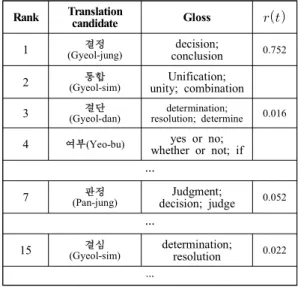
Table 2 describes the example of Korean trans- lation candidates of French word “décision” (e.g., system’s output). All translation candidates occurs in a target text but some of them would not in a bilin- gual dictionary (e.g., it is an incorrect translation can- didate). The correct translation candidates have the right as well. In such a case, RR and recall can be calculated as Table 3.
As you can see Table 3, RR represents how much important translation candidate occurs in a target text.
If the most frequent word is yielded by a system, it would be better than a case of a lower frequent word (rare word). In order to compare the extended piv- ot-based approach and the standard pivot-based ap- proach, this paper represents three different evaluation
results in this section.
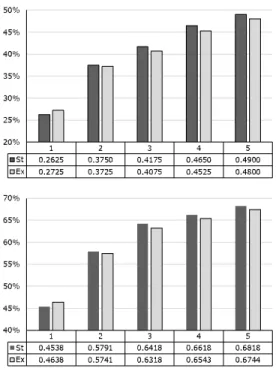
Firstly, Figure 4 shows the accuracy of the per- formance for two approaches, the standard and ex- tended pivot-based approach. All graphs describe the average score of two experimental cases, KR to FR and FR to KR. As you can see Figure 4, the ex- tended approach slightly yields higher performance at Low, and especially at top 1 in case of both Low and High. Besides, the entire slope for the accuracy de- creases when top 20 is considered. Nevertheless, it can be interpreted as finding nearest words helps the performance to have a higher score practically.
Actually, these figures are hard to persuade us to see the huge advantage of the extended approach.
Secondly, Figure 5 shows the MRR scores within
Figure 4: Accuracy at Low and High (High is at bottom)
top 5 for two approaches. Showing only within top 5 can explain how much frequent translation candidates appear in higher ranks. As you can see the figure, the extended pivot-based approach slightly surpasses the standard pivot-based approach, especially at the top 1.
Therefore we can say that the most frequent words appear at higher rank, and it explains how much the extended approach can affect the performance. The third evaluation measure, RR, also proves this.
Thirdly, Figure 6 shows the RR scores within top 5 for two approaches. This figure also shows results only within top 5. As you can see, only the top 1 at the high rank slightly surpasses for the extended piv- ot-based approach. On the other hand, the RR scores of the extended pivot-based approach within top 3 at the low rank surpasses the standard pivot-based approach. This result explains that the extended piv- ot-based approach can extract better outcomes for rare frequent words than the standard pivot-based approach. Finding nearest words, ′ , can be con
Figure 5: MRR at Low and High (High is at bottom)
sidered as reinforcing some rare words, , in a source text to be noticed. Even though the extended pivot-based approach could not cover the whole rank sections, the approach is useful when low frequent words are considered.
5. Conclusion and Future work
In this paper, we evaluate the extended pivot-based approach for improving the performance of the stand- ard pivot-based approach by finding nearest words sharing similar contexts. Sometimes these nearest words can help rare words but frequently appears in a document to be noticed. The three different evalua- tion results have shown that the extended pivot-based approach had a good effect on the final results as well.
For the future works, a little more various experi- ments should be conducted for highly frequent words.
Furthermore, the way to improve the performance for rarely frequent words also should be executed. This is
Figure 6: Rated Recall scores within the top 5 for four cases: Low and High, Extended and Standard
caused by our experimental results for rare words. In the other hand, automatic marine terminology ex- traction using bilingual lexicons can be considered as a future work. Finally, comparable corpora for do- main problem and more translation equivalences in bilingual lexicons should be considered for a large coverage.
Acknowledgement
This work was supported by the IT R&D program of MSIP/KEIT. [10041807, Development of Original Software Technology for Automatic Speech Translation with Performance 90% for Tour/International Event focused on Multilingual Expansibility and based on Knowledge Learning]
Reference
[1] P. Fung, “A statistical view on bilingual lexicon extraction: from parallel corpora to non-parallel corpora”, In Proceedings of the 3rd Conference of the Association for Machine Translation in the Americas, pp. 1-16, 1998.
[2] K.-J. Lee, J.-H. Kim, H.-W. Seo, and K.-S.
Ryu, "Feature weighting for opinion classi- fication of comments on news articles", Journal of the Korean Society of Marine Engineering, vol. 34, no. 6, pp. 871-879, 2010.
[3] P. Fung and K. McKeown, “Finding terminol- ogy translations from non-parallel corpora”, Proceedings of the 5th Annual Workshop on Very Large Corpora, pp. 192-202, 1997.
[4] R. Rapp, “Automatic identification of word translations from unrelated English and German corpora” Proceedings of the 37th Annual Meeting of the Association for Computational Linguistics, pp. 519-526, 1999.
[5] Y. Cao and H. Li, “Base noun phrase trans- lation using web data and the EM algorithm”
Proceedings of the 19th International Conference on Computational Linguistics, pp. 127-133, 2002.
[6] Y. Chiao and P. Zweigenbaum, “Looking for candidate translational equivalents in specialized, comparable corpora”, Proceedings of the 19th International Conference on Computational Linguistics, pp. 1208-1212, 2002.
[7] H. Déjean and E. Gaussier, “Une nouvelle ap- procheà léxtraction de lexiques bilingues à partir de corpus comparables”, Lexicometrica, Alignement Lexical Dans les Corpus Multilingues, pp. 1-22, 2002.
[8] P. Koehn and K. Knight, “Learning a trans- lation lexicon from monolingual corpora”, Proceedings of the Association for Computational Linguistic on Unsupervised Lexical Acquisition, pp. 9-16, 2002.
[9] T. Tsunakawa, N. Okazaki, and J. Tsujii,
“Building a bilingual lexicon using phrase-based statistical machine translation via a pivot lan- guage”, Proceeding of the 22nd International Conference on Computational Linguistics, Posters Proceedings, pp. 18-22, 2008.
[10] P. Koehn, F. Och, and D. Marcu, “Statistical
phrase-based translation”, Proceedings of the Conference of the North American Chapter of the Association for Computational Linguistics on Human Language Technology, pp. 48-54, 2003.
[11] H. Déjean, F. Sadat, and E. Gaussier, “An ap- proach based on multilingual thesauri and model combination for bilingual lexicon ex- traction”, Proceedings of the 19th International Conference on Computational Linguistics, pp.
218-224, 2002.
[12] B. Daille and E. Morin, “French-English termi- nology extraction from comparable corpora”, Proceedings of the 2nd International Joint Conference on Natural Language Processing, pp. 707-718, 2005.
[13] H.-W. Seo, H.-S. Kwon, and J.-H. Kim,
“Context-based bilingual lexicon extraction via a pivot language”, Proceedings of the Conference of the Pacific Association for Computational Linguistics, 2013.
[14] H.-W. Seo, H.-S. Kwon, and J.-H. Kim,
“Rated recall: Evaluation method for construct- ing bilingual lexicons”, Proceedings of the 25th Annual Conference on Human and Cognitive Language Technology, pp. 146-151, 2013.
[15] J.-H. Kim, H.-W. Seo, and H.-S. Kwon,
“Bilingual lexicon induction through a pivot language”, Journal of the Korean Society of Marine Engineering, vol. 37, no. 3, pp.
300-306, 2013.
[16] R. Rapp, “Identify word translations in non-parallel texts”, Proceedings of the 35th Annual Meeting of the Association for Computational Linguistics, pp. 320-322, 1995.
[17] G. Grefenstette, “Corpus-derived first, second and third-order word affinities”, Proceedings of the 6th Congress of the European Association for Lexicography, pp. 279-290, 1995.
[18] A. Hazem, E. Morin, and S. Saldarriaga,
“Bilingual lexicon extraction from comparable corpora as metasearch”, Proceeding of the 4th workshop on Building and Using Comparable Corpora, pp. 35-43, 2011.
[19] P. Koehn, “Europarl: A parallel corpus for statistical machine translation”, Proceedings of the Conference on the 10th Machine Translation Summit, pp. 79-86, 2005.
[20] E. Voorhees, “The TREC-8 question answering track report”, Proceedings of the 8th Text Retrieval Conference, pp. 77-82, 1999.