Pressure Distribution in Stump/Socket Interface in Response to Socket Flexion Angle Changes in Trans-Tibial Prostheses
With Silicone Liner
Pil Kang, M.Sc., C.P.O.
Dept. of Prosthetics and Orthotics, Korean National College of Rehabilitation and Welfare Jang-hwan Kim, M.P.H., C.P.O.
Dept. of Prosthetics and Orthotics, Hanseo University Jung-suk Roh, M.Sc., P.T.
Dept. of Physical Therapy, Hanseo University
Abstract
1)This study examined the effects of socket flexion angle in trans-tibial prosthesis on stump/socket in- terface pressure. Ten trans-tibial amputees voluntarily participated in this study. F-socket system was used to measure static and dynamic pressure in stump/socket interface. The pressure was measured at anterior area (proximal, middle, and distal) and posterior area (proximal, middle, and distal) in different socket flexion angles (5°, 0°, and 10°). Paired t-test was used to compare pressure differences in conven- tional socket flexion angle of 5° with pressures in socket flexion angles of 0° and 10° (α=.05). Mean pressure during standing in socket flexion angle of 10° decreased significantly in anterior middle area (19.7%), posterior proximal area (10.4%), and posterior distal area (16.3%) compared with socket flexion angle of 5°. Mean pressure during stance phase in socket flexion angle of 0° increased significantly in anterior proximal area (19.3%) and decreased significantly in anterior distal area (19.7%) compared with socket flexion angle of 5°. Mean pressure during stance phase in socket flexion angle of 10° decreased significantly in anterior proximal area (19.6%) and increased significantly in anterior distal area (8.2%) compared with socket flexion angle of 5°. Peak pressure during gait in socket flexion angle of 0° in- creased significantly in anterior proximal area (23.0%) compared with socket flexion angle of 5° and peak pressure during gait in socket flexion angle of 10° decreased significantly in anterior proximal area (22.7%) compared with socket flexion angle of 5°. Mean pressure over 80% of peak pressure (MP80+) dur- ing gait in socket flexion angle of 0° increased significantly in anterior proximal area (23.9%) and de- creased significantly in anterior distal area (22.5%) compared with socket flexion angle of 5°. MP80+ dur- ing gait in socket flexion angle of 10° decreased significantly in anterior distal area (34.1%) compared with socket flexion angle of 5°. Asymmetrical pressure change patterns in socket flexion angle of 0° and 10° were revealed in anterior proximal and distal region compared with socket flexion angle of 5°. To provide comfortable and safe socket for trans-tibial amputee, socket flexion angle must be considered.
Key Words: Interface pressure; Socket flexion angle; Socket/stump interface; Trans-tibial prostheses.
Introduction
Comfort is one of the most important consid- erations in designing lower-limb prostheses (Legro et al, 1999; Nielsen, 1991). Discomfort may result from
high stresses applied onto the limb region, which is not particularly tolerant to loading (Zhang et al, 1998). In an attempt to design a comfortable pros- thesis fitting, it is important to understand the stress distribution at the stump/socket interface as well as
Corresponding author: Pil Kang [email protected]
This research was supported by the Korea Research Foundation Grant funded by the Korean Government (MOEHRD, Basic Research Promotion Fund) (KRF-2005-E00211)
the pain-tolerance ability of different stump region for externally applied stress (Zhang and Lee, 2006).
Soft tissues of the residual limb within a pros- thetic socket are subjected to a special environment.
First, pressures and shear forces are applied by the socket on the residual limb even if socket is snugly fitted. Additionally, dynamic and repetitive loads are applied to stump/socket interface during locomotion.
Second, skin rubbing against the socket edge and interior surface may happen, resulting in intermittent skin deformation and biomechanical irritations. If ex- cessive slip exists between the skin and the socket, tissue abrasion can occur and heat will be generated (Levy, 1980; Seelen et al, 2003).
Patients with a trans-tibial amputation are fitted with a prosthesis providing both stability and flexibility. Appropriate alignment and total tissue contact are needed for an adequate fitting of the prosthesis to the stump. The risk of developing a degenerative tissue ulcer induced by either sustained or intermittent (local) peak pressure in stump/socket interface is high. Approximately 30% of lower limb amputees develop complications from their prosthesis, such as pain, pressure ulcers and infections that pre- vent them from wearing their prosthesis for a pro- longed period, severely disabling them in their daily activities and reducing quality of life (Chan and Tan, 1990; Rommers, 2000; Seelen et al, 2003).
Using a reliable computer software, research on pressure distribution measurements became a reality.
Stump/socket interface stresses can be measured ac- curately, quickly, and easily by a computer based measurement, and collected data were used for pros- thetic fitting purposes. These methods allow the prosthetist to determine regions of high and low pressure at the stump/socket interface (Sewell et al, 2000). The objectives of interface stress investigations were to improve the level of understanding of the stump/socket system, to evaluate the influence of prosthetic design parameters and alignment variations on the interface stress distribution, and to assess the quality of prosthetic fit (Silver-Thorn et al, 1996).
Pressure monitoring at several sites at the stump/socket interface during a dynamic gait con- ditions over a prolonged period has not been carried out yet. Furthermore, the effects of change in pros- thesis socket flexion angle on the alleviation of load- ing at local tissue and pressure change in stump/socket interface has not been studied systematically.
In assembling lower limb prosthesis, alignment of prosthesis can be affected by characteristics of used component and prosthestic socket flexion angle is an important factor during prosthesis design. Socket flexion angle is an angle between a longitudinal axis of socket and a longitudinal axis of shank and 5° of socket flexion angle is used as a standard.
It can be expected that pressure in stump/socket interface is changed in response to different socket flexion angles. Therefore, this study investigated the pressure distribution patterns in anterior and posterior areas (proximal, mid, and distal respectively) of stump/socket interface when socket flexion angle was changed to 0° and 10° from standard angle of 5°.
Methods
Subjects
The subjects were recruited from following cri- teria: 1) the cause of amputation was vascular dis- eases such as trauma and diabetes mellitus, 2) there were no trauma and pain on skin, 3) subjects were able to ambulate for 20 minutes without assistive device, 4) subjects were wearing endoskeletal trans-tibial prosthesis with TSB (total surface bear- ing) socket, single axis foot-ankle assembly, and sil- icone liner. General characteristics of subjects were shown in Table 1.
Measurement
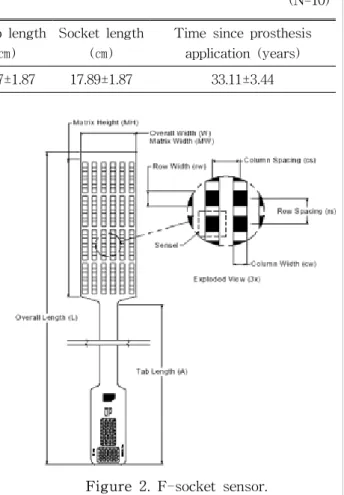
To measure pressure in stump/socket interface, F-socket sensor of F-socket system was used dur- ing static standing and gait (Figure 1). F-socket
Figure 2. F-socket sensor.
Figure 1. Sensors inserted in socket.
Age (years)
Weight (㎏)
Height (㎝)
Stump length (㎝)
Socket length (㎝)
Time since prosthesis application (years) Mean±SD 59.78±5.43 167.44±4.25 68.67±10.25 15.67±1.87 17.89±1.87 33.11±3.44
Table 1. General characteristics of the subjects (N=10)
system was developed by Tekscan Inc. and consisted of 96 cells. Sixteen cells were arranged in 6 rows.
Thus it is possible to separate cells in different row.
There were 4 sensors in square inches (4 sen- sors/in2, size of sensor was 20.3 ㎝ x 7.6 ㎝) meas- uring the pressure between 1 and 75 PSI, thickness was .15 ㎜ (Figure 2).
Anthropometric data including height, weight, leg length and past medical history were collected.
F-socket sensor was stabilized in anterior and poste- rior area of socket, and silicone liner was applied before wearing prosthesis. Static pressure was meas- ured during standing with prosthesis, and then, dy- namic pressure was measured during gait.
Standard alignment of prosthesis is 5° flexion of socket and 0° of ankle joint. Pressure at the stump/socket interface was measured with 0°, 5°, and 10° flexion with a random order.
All subjects were asked to walk with their own prosthesis at their own comfortable walking speed.
Walking condition was an indoor-flat-surface. The subjects walked a walkway which was approximately 20 m at least twice per measurement.
Data Analysis
Dependant variable was pressures measured in stump/socket interface. Pressure was measured at anterior area (proximal, middle, and distal) and pos- terior area (proximal, middle, and distal).
Mean pressure in standing (MP standing), mean pressure in stance phase (MP stance), peak pressure (PP), and mean pressure over 80% of peak pressure (MP80+) were calculated in each subject. An example of the parameter calculation is depicted in Figure 3.
Paired t-test was used to compare pressure in con- ventional socket flexion angle of 5° with pressures in socket flexion angles of 0° and 10° with a signi- gicant level of .05.
Figure 3. Example of parameter calculation.
PP80%: 80% of peak pressure.
Condition
Sensor placement Anterior
proximal
Anterior middle
Anterior distal
Posterior proximal
Posterior middle
Posterior distal Socket flexion 5° 88.3(9.6)a 89.3(12.7) 86.4(15.7) 86.8(8.8) 93.0(9.9) 76.6(11.4) Socket flexion 0° 105.4(9.6)† 86.5(13.7) 69.4(11.8)† 84.1(8.4) 81.8(7.5) 69.8(8.7) Socket flexion 10° 71.0(9.1)† 86.6(13.5) 93.5(16.3† 85.9(9.0) 89.3(9.3) 71.3(10.0)
aMean (SD).
†Significant difference compared with socket flexion 5° condition.
Table 3. Mean pressure during stance phase (unit=kPa) Condition
Sensor placement Anterior
proximal
Anterior middle
Anterior distal
Posterior proximal
Posterior middle
Posterior distal Socket flexion 5° 91.3(22.2)a 100.7(6.5) 93.7(9.1) 92.5(14.5) 112.1(17.3) 87.3(15.2) Socket flexion 0° 98.5(28.6) 86.2(15.3) 79.5(8.5) 96.3(14.7) 102.0(17.2) 77.3(14.6) Socket flexion 10° 85.9(24.3) 80.9(14.9)† 81.3(8.6) 82.9(17.7)† 103.3(21.7) 73.1(13.5)†
aMean (SD).
†Significant difference compared with socket flexion 5° condition.
Table 2. Mean pressure during standing (unit=kPa)
Results
Mean pressures during standing
Mean pressures during standing are shown in Table 2. Pressure measured in socket flexion angle of 10° decreased significantly in anterior middle area, posterior proximal area, and posterior distal area compared with socket flexion angle of 5° (19.7%,
10.4%, and 16.3% decrement respectively).
Mean pressures during stance phase
Mean pressures during stance phase are shown in Table 3. Pressure measured in socket flexion angle of 0° increased significantly in anterior proximal area and decreased significantly in anterior distal area compared with socket flexion angle of 5° (19.3% in- crement and 19.7% decrement). Pressure in socket flexion angle of 10° decreased significantly in ante- rior proximal area and increased significantly in an- terior distal area compared with socket flexion angle of 5° (19.6% decrement, 8.2% increment).
Peak pressure during gait
Peak pressures during gait are shown in Table 4.
Peak pressure in socket flexion angle of 0° increased significantly in anterior proximal area compared with socket flexion angle of 5° (23.0% increment) and peak pressure in socket flexion angle of 10° decreased sig- nificantly in anterior proximal area compared with socket flexion angle of 5° (22.7% decrement).
Condition
Sensor placement Anterior
proximal
Anterior middle
Anterior distal
Posterior proximal
Posterior middle
Posterior distal Socket flexion 5° 170.9(16.5)a 116.5(17.8) 123.5(25.2) 100.7(10.5) 103.6(17.9) 101.3(18.2) Socket flexion 0° 211.8(22.7)† 125.5(21.5) 81.4(13.0)† 101.7(10.5) 105.5(12.1) 93.9(11.7) Socket flexion 10° 132.5(13.2)† 108.4(16.4) 130.2(25.4) 102.3(10.4) 106.3(11.5) 90.8(13.5)
aMean (SD).
†Significant difference compared with socket flexion 5° condition.
Table 5. MP80+ during gait (unit=kPa) Condition
Sensor placement Anterior
proximal
Anterior middle
Anterior distal
Posterior proximal
Posterior middle
Posterior distal Socket flexion 5° 187.4(17.7)a 127.3(19.0) 134.9(27.6) 111.7(11.2) 125.5(15.1) 111.1(19.0) Socket flexion 0° 230.6(25.0)† 127.8(25.4) 99.6(15.4) 112.5(11.8) 114.8(13.0) 102.9(13.2) Socket flexion 10° 144.8(13.9)† 119.0(18.7) 143.9(28.3) 114.8(11.3) 118.2(12.9) 98.9(14.3)
aMean (SD).
†Significant difference compared with socket flexion 5° condition.
Table 4. Peak pressure during gait (unit=kPa)
MP80+ during stance phase
MP80+ values (kPa) during gait are shown in Table 5. MP80+ in socket flexion angle of 0° in- creased significantly in anterior proximal area and decreased significantly in anterior distal area com- pared with socket flexion angle of 5° (23.9% incre- ment and 22.5% decrement). MP80+ in socket flexion angle of 10° decreased significantly in anterior prox- imal area compared with socket flexion angle of 5°
(34.1% decrement).
Discussion
This study investigated the effects of socket flex- ion angle on pressure change in stump/socket inter- face during static standing and gait since pressure distribution in response to socket flexion angle is important clinically.
Since Mueller and Hettinger (1954) studied pres- sure in socket, Appoldt et al (1968), Burgess and Moore (1977), and Convery and Buis (1998) con- tinued the similar studies on pressure in socket. The
aims of study on pressure in socket were to assess pressure distribution in stump/socket interface, to in- vestigate the effect of socket design and prosthesis alignment on pressure, and to evaluate prosthesis fit- ting qualitatively (Silver-Thorn et al, 1996). There were also previous studies about pressure change caused by prosthesis alignment in ankle joint and applied wedge degree into shoes (Seelen et al, 2003).
However, the effect of changing socket angle on pressure was not conducted extensively.
This study investigated the effects of socket flex- ion angle on static and dynamic pressure at stump/socket interface by recruiting ten trans-tibial amputees. The results of our study can provide clin- ical assistance during prosthesis fitting procedure, especially when changing pressure is required at the specific stump/socket interface.
Assessing the change in stump/socket interface pressure in response to socket alignment is critical during prosthesis manufacturing process. Techniques used in recent studies are useful in evaluating and confirming pressure in stump/socket interface in trans-tibial amputees with sensitive stump surface
(Seelen et al, 2003).
In measuring pressure in stump/socket interface, extraneous variables were stump length difference, thickness of soft tissue, ambulation pattern difference, experiment setting, and inter-measurer difference (Mark et al, 2001). In this study, subjects with 14~
18 ㎝ stump length were recruited to minimize stump length difference. Subjects whose soft tissue was too thick or thin were excluded from the study. All sub- jects were instructed to were liner to minimize soft tissue abrasion. Additionally, subjects who were ca- pable to ambulate independently at least 20 minutes were included to minimize the difference of ambula- tion pattern, and measurement was performed in the same laboratory setting by the same experimenter.
Seelen et al (2003) revealed that forefoot and rear- foot wedging inserted in shoe caused a significant difference in pressure measured in socket. Thus it is indicated that alignment angle change in ankle joint and shoes can affect pressure in socket.
Mean pressure during standing in socket flexion angle of 10° decreased significantly in anterior middle area (19.7%), posterior proximal area (10.4%), poste- rior distal area (16.3%) and, in general, decreased in other areas. These findings indicated that the pres- sure was distributed more widely. Thus increase of socket flexion angle can decrease pressure in stump/socket interface during static standing.
However, excessive socket flexion provides an ad- verse effect on knee joint stability inducing in- appropriate weight bearing. It is suggested that socket flexion angle over 10° be avoided.
Mean pressure during stance phase in socket flex- ion angle of 0° increased significantly in anterior proximal area (19.3%) and decreased significantly in anterior distal area (19.7%). However, mean pressure during stance phase in socket flexion angle of 10°
decreased significantly in anterior proximal area (19.6%) and increased significantly in anterior distal area (8.2%). At initial contact of stance phase, the ground reaction force vector is behind the axis of ankle joint, therefore prosthetic leg and foot move
forward rapidly. Berke (2000) found that as the sub- ject resists the progression of forward socket, pres- sure between anterior distal area and posterior prox- imal area will be increased. The increased pressure in anterior distal area at the socket flexion angle of 10° and decreased pressure in anterior distal area at the socket flexion angle of 0° are consistent with the results of previous study. The inverse relationship between decreased pressure in anterior proximal area at the socket flexion angle of 0° and increased pres- sure in anterior proximal area at the socket flexion angle of 10° was observed. It should be remembered that area for pressure increment and decrement should be expected when socket flexion angle is changed. Especially area for pressure increment should be determined and checked for preventing detrimental effect.
Peak pressure during gait in socket flexion angle of 0° increased significantly in anterior proximal area (23.0%) and decreased significantly in anterior proximal area (22.7%). However, peak pressure in socket flexion angle of 0° decreased in anterior distal area (26.2%) and increased in anterior distal area (6.6%). These findings were similar to mean pressure in stance and the same mechanism can explain these results.
Meirer et al (1973) reported that maximum peak pressure was 400 kPa in stump/socket interface pressure. Recent studies reported that maximum peak pressure was less than 220 kPa in stump/socket in- terface pressure (Engusberg et al, 1992; Sanders et al, 1993; Zhang et al, 1998). Peak pressure in our study was consistent with previous studies except for 230.6 kPa in anterior proximal area in socket flexion angle of 0°.
MP80+ in socket flexion angle of 0° increased sig- nificantly in anterior proximal area and decreased significantly in anterior distal area compared with socket flexion angle of 5° (23.9% increment and 22.5% decrement). MP80+ in socket flexion angle of 10° decreased significantly in anterior distal area compared with socket flexion angle of 5° (34.1% dec- rement) and increased in anterior distal area (5.4%).
Even though pressure is known as cause of pain, abrasion, and ulcer, it is not known how these com- plications are induced. However, a force applied in small area rather than large is likely to induce high pressure causing more damage (Husain, 1953).
Additionally, the higher pressure is applied for pro- longed period, the more damage can be caused (Akbarzadeh, 1991; Daniel et al, 1981). Thus not only the magnitude of peak pressure, but duration of applied pressure also should be considered. The measurement of pressure change in stump/socket interface would of- fer the clinicians an insight in stump/socket interface pressure changes in each trans-tibial amputation patient. If pressure needs to be decreased during gait, socket flexion angle should be increased for anterior proximal area and decreased for anterior distal area.
However, this study has several limitations. First, sample size was small. Second, the effect of flexion angle was investigated in only sagittal plane. Third, since measurement was performed in laboratory set- ting, pressure changes in stair climbing and different terrain could not be revealed. Fourth, the reliability was not measured for the method of assessing stump/socket interface pressure. Fifth, prosthetic foot used in our study was a single axis foot.
Symmetrical pressure change was not observed in proximal and distal in response to socket flexion an- gle change in our study. It is thought that asym- metrical pressure change can be induced by single axis foot. Considering that the movement in single axis foot was limited compared with normal ankle joint, and then, asymmetrical pressure change in an- terior proximal and anterior distal area was observed.
Future studies are required to evaluate pressure distribution related with medio-lateral socket align- ment angle and to assess pressure distribution pat- tern in stump/socket interface during stairs and ramp climbing and ambulation on uneven terrains. In addi- tion, effect of duration of peak pressure induced in stump/socket interface and effect of prolonged pres- sure on stump ulcer should be investigated.
Conclusion
In general, the results show that antero-posterior realignment of the socket does affect stump/socket interface pressure distribution in trans-tibial ampu- tees in systematic, consistent manner. Asymmetrical pressure change patterns in socket flexion angle of 0° and 10° were revealed in anterior proximal and distal region compared with socket flexion angle of 5°.
The findings of this study revealed that change of socket flexion angle induced change of pressure in stump/socket interface. Significant pressure changes were especially measured in subpatellar region with less soft tissue (anterior proximal) and tibial end re- gion (distal). Therefore, this study will help clinicians understand pressure change in stump/socket interface during socket flexion angle is changed and check pos- sible problems caused by socket flexion angle change.
References
Akbazadeh MR. Behaviour for relieving pressure. In:
Webster JG, ed. Prevention of Pressure Sores:
Engineering and clinical aspects. Bristol, IOP Pub Ltd., 1991:175-190.
Appoldt FA, Bennett L, Contini R. Stump-socket pressure in lower extremity prosthesis. J Biomech. 1968;1:247-257.
Berke GM. Transtibial prosthetics. In: Lusardi MM, Nielsen CC, eds. Orthotics and Prosthetics in Rehabilitation, Butterworth Heinemann, 2000:437-466.
Burgess EM, Moore EJ. A study of interface pres- sure in the below-knee prosthesis. Bull Prosthet Res. 1977;10(28):58-70.
Chan KM, Tan ES. Use of lower limb prosthesis among elderly amputees. Ann Acad Med Sigapore. 1990;19:811-16.
Convery P, Buis AWP. Conventional pa- tellar-tendon-bearing (PTB) socket/stump inter- face dynamic pressure distributions recorded
This article was received October 10, 2006, and was accepted October 25, 2006.
during the prosthetic stance phase of gait of a trans-tibial amputee. Prosthet Orthot Int.
1998;22:193-198.
Daniel RK, Priest DL, Wheatley DC. Etiologic factors in pressure sores: An experimental model. Arch Phys Med Rehabil. 1981;61:492-498.
Engusberg JR, Springer MJN, Harder JA.
Quantifying interface pressure in below-knee amputee socket. J Assoc Child Prosthet Orthot Clin. 1992;27(3):81-88.
Husain T. An experimental study of some pressure effects on tissues with reference to the bed-sore problem. J Pathol Bacteriol. 1953;66:347-358.
Legro MW, Reiber G, Aguila MD, et al. Issues of impotance reported by persons with lower limb amputations and prosthesis. J Rehabil Res Dev.
1999;36:155-163.
Levy SW. Skin problems of the leg amputee.
Prosthet Orthot Int. 1980;4:37-44.
Mark AF, Zhang M, Boone DA. State-of-the-art re- search in lower-limb prosthetic bio- mechanics-socket interface: A review. J Rehabil Res Dev. 2001;38(2):161-174.
Meirer RH, Meeks Ed, Herman RM. Stump-socket fit of below-knee prostheses: Comparison of three methods of measurement. Arch Phys Med Rehabil. 1973;54:553-558.
Mueller EA, Hettinger TH. Measuring pressure dis- tribution in the socket of prostheses. Orthop Tech. 2000;9:222-225.
Nielsen CC. A survey of amputees: Functional level and life satisfaction, information needs, and prosthetist's role. J Prosthet Orthot.
1991;3:125-129.
Rommers GM. The elderly amputee. Rehabilitation and functional outcome. PhD Thesis. Groningen, Rijksuniversiteit Gromingen, 2000.
Sanders JE, Daly CH, Burgess EM. Clinical meas- urement of normal and shear stresses on trans- tibial stump: Characteristics of wave-form shapes during walking. Prosthet Orthot Int.
1993;17:38-48.
Seelen HAM, Anemaat S, Janssen HMH, et al.
Effects of prosthesis alignment on pressure dis- tribution at the stump/socket interface in trans-tibial amputees during unsupported stance and gait. Clin Rehabil. 2003;17:787-796.
Sewell P, Noroozi S, Vinney J, et al. Developments in the trans-tibial prosthetic socket fitting proc- ess: A review of past and present research.
Prosthet Orthot Int. 2000;24(2):97-107.
Silver-Thorn MB, Steege JW, Childress DS. A re- view of prosthetic interface stress investigations.
J Rehabil Res Dev. 1996;33:253-266.
Zhang M, Lee WC. Quantifying the regional load-bearing ability of trans-tibial strumps.
Prosthet Orthot Int. 2006;30(1):25-34.
Zhang M, Mak AF, Roverts VC. Finite element modeling of a residual lower-limb in prosthetic socket: A survey of the development in the first decade. Med Eng Phys. 1998;20:360-373.