APOE Polymorphism Is Associated with C-reactive Protein Levels but Not with White Blood Cell Count: Dong-gu Study and
Namwon Study
We evaluated the association of the APOE polymorphism with serum C-reactive protein levels and white blood cell count in two large population-based studies in Korean. The datasets included the Dong-gu study (n = 8,893) and the Namwon Study (n = 10,032).
APOE genotypes were identified by polymerase chain reaction-restriction fragment length polymorphism. Multivariable linear regression analysis was performed to evaluate the relationship of APOE genotypes with C-reactive protein levels and white blood cell count with adjustments for age, sex, body mass index, smoking, diabetes, hypertension, and serum lipids. In the multivariate model, carriers of E3E4 or E4E4 genotype had significantly lower C-reactive protein levels compared with carriers of E3E3 genotype group (0.50 mg/L vs. 0.67 mg/L; 0.37 mg/L vs. 0.67 mg/L, respectively, for the Dong-gu Study and 0.47 mg/L vs. 0.66 mg/L; 0.45 mg/L vs. 0.66 mg/L, respectively, for the Namwon Study).
However, there was no difference in white blood cell count among APOE genotypes. We found that the APOE E4 allele is associated with lower C-reactive protein levels, but not white blood cell count. Our results suggest that APOE genotype may influence C-reactive protein levels through non-inflammatory pathway.
Keywords: C-reactive Protein; Apolipoprotein E; Polymorphism, Genetic; Inflammation Yong-Woon Yun,1 Sun-Seog Kweon,2,3
Jin-Su Choi,2 Jung-Ae Rhee,2 Young-Hoon Lee,4 Hae-Sung Nam,5 Seul-Ki Jeong,6 Kyeong-Soo Park,7 So-Yeon Ryu,8 Seong-Woo Choi,8 Hee Nam Kim,9 Jane A. Cauley,10 and Min-Ho Shin2,9
1Gwangju-Jeonnam Regional Cardiocerebrovascular Center, Chonnam National University Hospital, Gwangju; 2Department of Preventive Medicine, Chonnam National University Medical School, Gwangju; 3Jeonnam Regional Cancer Center, Chonnam National University Hwasun Hospital, Hwasun; 4Department of Preventive Medicine &
Institute of Wonkwang Medical Science, Wonkwang University College of Medicine, Iksan; 5Department of Preventive Medicine, Chungnam National University Medical School, Daejeon; 6Department of Neurology & Research Institute of Clinical Medicine, Chonbuk National University-Biomedical Institute of Chonbuk National University Hospital, Jeonju;
7Department of Preventive Medicine, Seonam University College of Medicine, Namwon;
8Department of Preventive Medicine, Chosun University Medical School, Gwangju; 9Center for Creative Biomedical Scientists, Chonnam National University, Gwangju; 10Department of Epidemiology, Graduate School of Public Health,University of Pittsburgh, Pittsburgh, USA
Received: 19 August 2014 Accepted: 17 February 2015 Address for Correspondence:
Min-Ho Shin, MD
Department of Preventive Medicine, Chonnam National University Medical School, 160 Baekseo-ro, Dong-gu, Gwangju 501-746, Korea
Tel: +82.62-220-4166, Fax: +82.62-233-0305 E-mail: [email protected]
Funding: This study was supported by a grant (CRI11020-1) Chonnam National University Hospital Biomedical Research Institute.
http://dx.doi.org/10.3346/jkms.2015.30.7.860 • J Korean Med Sci 2015; 30: 860-865
INTRODUCTION
C-reactive protein (CRP) is a sensitive and nonspecific systemic marker of inflamma- tion (1). Increased CRP levels are associated with mortality, coronary heart disease, and stroke (2, 3). Serum CRP levels are substantially influenced by genetic factors, with a heritability of 35% to 40% (4). White blood cell count (WBC) is also a marker of sys- temic inflammation and higher WBC count has been associated with cardiovascular disease incidence and mortality (5, 6). WBC count is also moderately influenced by heritable factors, with heritability estimates ranging from 14% to 40% across the WBC subtypes (7).
Apolipoprotein E (apoE = protein, APOE = gene) has a central role in the metabo- lism of cholesterol and triglycerides (8-10). APOE gene has three common alleles (E2, E3, and E4) arising from two single nucleotide polymorphisms (rs429358 and rs7412) in exon 4 that give six possible genotypes (E2E2, E2E3, E2E4, E3E3, E3E4, and E4E4) (11). APOE genotypes have been associated with ischemic cerebrovascular disease (12) and coronary heart disease (13). Differences among APOE genotypes in the risk of car- diovascular disease have traditionally been explained by lipid metabolism. In previous our study of the same data set, APOE genotypes was associated with carotid athero- sclerosis and this association was partly mediated through blood lipid (14). However, APOE genotype may also affect the risk of cardiovascular disease through anti-inflam- matory and antioxidant properties of apoE protein (15, 16).
Since Manttari and colleagues first described the association of APOE E4 allele with low CRP levels in 2001, many studies have investigated relationships between APOE genotype and CRP levels. Most studies have reported that E4 allele is associated with Human Genetics & Genomics
low levels of CRP (17-26). However, there is little research on the relationship between other markers of inflammation and APOE genotype. In addition, most studies were carried out in Caucasians, and few studies have been carried out in Asians.
Therefore, we evaluated the association of the APOE genotype with serum CRP levels and WBC in two large population-based studies in South Korea.
MATERIALS AND METHODS Subjects
The Dong-gu Study and Namwon Study are ongoing prospec- tive studies designed to investigate the prevalence, incidence, and risk factors for chronic disease in urban and rural popula- tions, respectively. Details of the study subjects and measure- ments have been published previously (27).
In the Dong-gu Study, 9,260 subjects aged 50 yr and older were recruited in the baseline survey between April 2007 and June 2010 in the Dong-gu district of Gwangju Metropolitan City in South Korea. Of these, 101 subjects were excluded because of missing data on APOE genotype, CRP, WBC, blood lipids and medical history and smoking. Subjects with WBC counts of less than 2,000 cells/μL or more than 12,000 cells/μL and/or CRP ≥ 10 mg/L were excluded because of a high probability of acute inflammation and other medical disorders, which left 8,893 (3,525 men and 5,368 women) for analysis.
In the Namwon Study, 10,667 participants (4,201 men and 6,466 women) were recruited in the baseline survey between January 2004 and February 2007 in Namwon city of Jeollabuk- do province in South Korea. Of these, 225 subjects were exclud- ed because of missing data on APOE genotype, CRP, WBC, blood lipids and medical history and smoking. Subjects with WBC counts of less than 2,000 cells/μL or more than 12,000 cells/μL and/or CRP ≥ 10 mg/L were excluded, which left 10,032 (3,909 men and 6,123 women) for analysis.
APOE genotyping
Genomic DNA was extracted from peripheral blood with an AccuPrep Genomic DNA Extraction Kit (Bioneer, Seoul, Korea) or a QIAamp DNA Mini Kit (Qiagen Inc., Chatsworth, CA, USA) according to the manufacturer’s protocol. APOE genotypes were determined as described by Hixson and Vernier, with slight mod- ifications (28). Our APOE genotyping method has been report- ed previously (29). The genotyping method was validated by di- rect sequencing (ABI PRISM 3100 Genetic Analyzer, Applied Biosystems) of 96 subjects with 100% concordance.
Other clinical variables
Demographic characteristics, lifestyle and medical history were obtained by standardized questionnaires. Smoking status was classified into non-smoker and current smoker. Height was mea-
sured to the nearest 0.1 cm, and weight to the nearest 0.1 kg.
Body mass index (BMI) was calculated as weight in kilograms divided by height in meters squared.
Diabetes was defined by a fasting plasma glucose ≥ 126 mg/
dL or use of antidiabetic medication. Blood pressure was mea- sured in the right upper arm using a mercury sphygmomano- meter (Baumanometer; WA Baum Co, Inc, Copiague, NY, USA) with an appropriately sized cuff after subjects rested at least 5 min while seated. Three consecutive measurements of systolic and diastolic blood pressures were performed at 1-min intervals, and the average was used in the analysis. Hypertension was de- fined by systolic blood pressure ≥ 140 or diastolic blood pres- sure ≥ 90 mmHg, or use of antihypertensive medication.
Blood samples were drawn from an antecubital vein in the morning after a 12-hr overnight fast. Serum was separated with- in 30 min and stored at -70°C until analyzed. Serum total cho- lesterol, high-density lipoprotein cholesterol (HDL), triglycer- ides, and fasting blood glucose levels were measured using en- zymatic methods. All samples were analyzed using an automat- ic analyzer (model 7600 chemical analyzer; Hitachi Ltd, Tokyo, Japan). CRP level was determined by means of particle-enhan- ced immunonephelometry using BN II nephelometer (Dade Behring, Marburg, Germany). The lower detection limit for CRP was 0.2 mg/L. White blood cell (WBC) count was determined using a cell counter (Micro 60, ABX, Montpellier, France).
Statistical analysis
Data are presented as mean ± standard deviation (SD) or per- centage for categorical variables. Because the distribution of triglycerides and CRP levels was skewed, triglycerides and CRP values were logarithmically transformed, and geometric means with 95% confidence intervals are presented. The APOE geno- types were categorized into E2E2, E2E3, E2E4, E3E3, E3E4, and E4E4. The APOE genotype was also categorized into three groups for analytical purposes: APOE E2 (E2E2 and E2E3), APOE E3 (E3E3), and APOE E4 (E3E4 and E4E4). Subjects with the E2E4 genotype were excluded because of the opposing biological ef- fects of the E2 and E4 alleles. Multivariable linear regression analysis was performed to evaluate the association between APOE genotypes and CRP levels and white blood cell count af- ter adjusting for age, sex, BMI, smoking, diabetes and hyperten- sion, total cholesterol, HDL cholesterol, and log-transformed triglycerides. The Bonferroni method was used to correct mul- tiple comparisons. Hardy-Weinberg equilibrium was tested by use of a chi-square goodness of fit test. Statistical analyses were performed using the SPSS version 21.0 (SPSS, Inc., an IBM Com- pany, Chicago, IL, USA).
Ethics statement
This study was conducted in accordance with the Declaration of Helsinki guidelines. The study protocol was approved by the
institutional review board of Chonnam National University Hos- pital (Dong-gu Study, IRB No. I-2008-05-056; Namwon Study, IRB No. I-2007-07-062), and informed consent was obtained from each subject.
RESULTS
The baseline characteristics of the study subjects are presented in Table 1. The mean age was 65.1 ± 8.2 yr in the Dong-gu Study, and 61.6 ± 8.0 yr in the Namwon Study. The APOE genotype frequencies were consistent with Hardy-Weinberg equilibrium (P = 0.86 for the Dong-gu Study, P = 0.91 for the Namwon Study) and not significantly different. The frequency of APOE geno- types for E2E2, E2E3, E2E4, E3E3, E3E4, and E4E4 was 0.4, 10.7, 1.3, 71.0, 15.6, and 1.0%, respectively in the Dong-gu Study and 0.4, 10.2, 1.1, 72.6, 14.9, and 0.9%, respectively in the Namwon Study.
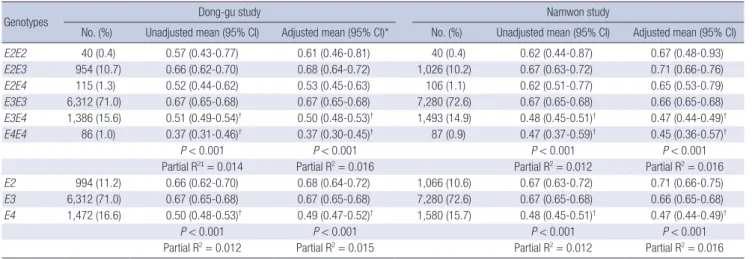
The associations of APOE genotypes and allele with CRP are shown in Table 2. There was significant difference in CRP across
the APOE genotypes and alleles in both studies in all Models.
Carriers of E3E4 or E4E4 genotype had significantly lower CRP levels compared with carriers of APOE E3E3 genotype group in both studies (0.51 mg/L vs. 0.67 mg/L; 0.37 mg/L vs. 0.67 mg/L, respectively, for the Dong-gu Study and 0.48 mg/L vs. 0.67 mg/
L; 0.47 mg/L vs. 0.67 mg/L, respectively, for the Namwon Study).
This association was not attenuated after adjustment for age, sex, BMI, smoking, diabetes and hypertension, total cholester- ol, HDL cholesterol, and log-transformed triglycerides (0.50 mg/L vs. 0.67 mg/L; 0.37 mg/L vs. 0.67 mg/L, respectively, for the Dong-gu Study and 0.47 mg/L vs. 0.66 mg/L; 0.45 mg/L vs.
0.66 mg/L, respectively, for the Namwon Study).
Carriers of E4 allele had significantly lower CRP levels com- pared with carriers of APOE E3 allele in both studies (0.50 mg/L vs. 0.67 mg/L for the Dong-gu Study and 0.48 mg/L vs. 0.67 mg/
L for the Namwon Study). This association was not attenuated after adjustment for potential confounders (0.49 mg/L vs. 0.67 mg/L for the Dong-gu Study and 0.47 mg/L vs. 0.66 mg/L for the Namwon Study). There was no difference in CRP levels be-
Table 1. Baseline characteristics of the study subjects
Parameters Dong-gu study (n = 8,893) Namwon study (n = 10,032) P value
Age (yr) 65.1 ± 8.2 61.6 ± 8.0 < 0.001
Men (%) 3,525 (39.6) 3,909 (39.0) 0.344
Body mass index (kg/m²) 24.4 ± 2.9 24.4 ± 3.1 0.617
Current smoking (%) 962 (10.8) 1,512 (15.1) < 0.001
Hypertension (%) 3,960 (44.5) 3,945 (39.3) < 0.001
Diabetes mellitus (%) 1,662 (18.7) 1,205 (12.0) < 0.001
Total cholesterol (mg/dL) 201.3 ± 39.9 189.3 ± 37.0 < 0.001
HDL cholesterol (mg/dL) 51.6 ± 11.9 47.6 ± 12.0 < 0.001
Triglycerides (mg/dL)* 118.0 (84.0-172.0) 130.0 (89.0-193.0) < 0.001
C-reactive protein (mg/L)* 0.60 (0.30-1.20) 0.60 (0.30-1.30) 0.104
White cell blood count (× 103/µL) 5.81 ± 1.53 6.20 ± 1.60 < 0.001
Myocardial infarction (%) 114 (1.3) 37 (0.4) < 0.001
Stroke (%) 369 (4.1) 352 (3.5) 0.022
Data are means ± SD, medians (interquartile range)* or n (%). HDL, high density lipoprotein.
Table 2. Adjusted geometric means and 95% confidence intervals for C-reactive protein (mg/L) in different APOE genotypes or alleles
Genotypes Dong-gu study Namwon study
No. (%) Unadjusted mean (95% CI) Adjusted mean (95% CI)* No. (%) Unadjusted mean (95% CI) Adjusted mean (95% CI)
E2E2 40 (0.4) 0.57 (0.43-0.77) 0.61 (0.46-0.81) 40 (0.4) 0.62 (0.44-0.87) 0.67 (0.48-0.93)
E2E3 954 (10.7) 0.66 (0.62-0.70) 0.68 (0.64-0.72) 1,026 (10.2) 0.67 (0.63-0.72) 0.71 (0.66-0.76)
E2E4 115 (1.3) 0.52 (0.44-0.62) 0.53 (0.45-0.63) 106 (1.1) 0.62 (0.51-0.77) 0.65 (0.53-0.79)
E3E3 6,312 (71.0) 0.67 (0.65-0.68) 0.67 (0.65-0.68) 7,280 (72.6) 0.67 (0.65-0.68) 0.66 (0.65-0.68)
E3E4 1,386 (15.6) 0.51 (0.49-0.54)† 0.50 (0.48-0.53)† 1,493 (14.9) 0.48 (0.45-0.51)† 0.47 (0.44-0.49)†
E4E4 86 (1.0) 0.37 (0.31-0.46)† 0.37 (0.30-0.45)† 87 (0.9) 0.47 (0.37-0.59)† 0.45 (0.36-0.57)†
P < 0.001 P < 0.001 P < 0.001 P < 0.001
Partial R2‡= 0.014 Partial R2= 0.016 Partial R2= 0.012 Partial R2= 0.016
E2 994 (11.2) 0.66 (0.62-0.70) 0.68 (0.64-0.72) 1,066 (10.6) 0.67 (0.63-0.72) 0.71 (0.66-0.75)
E3 6,312 (71.0) 0.67 (0.65-0.68) 0.67 (0.65-0.68) 7,280 (72.6) 0.67 (0.65-0.68) 0.66 (0.65-0.68)
E4 1,472 (16.6) 0.50 (0.48-0.53)† 0.49 (0.47-0.52)† 1,580 (15.7) 0.48 (0.45-0.51)† 0.47 (0.44-0.49)†
P < 0.001 P < 0.001 P < 0.001 P < 0.001
Partial R2= 0.012 Partial R2= 0.015 Partial R2= 0.012 Partial R2= 0.016 Values are geometric mean (95% confidence interval). *Adjusted for age, sex, BMI, smoking, hypertension, diabetes mellitus, total cholesterol, HDL cholesterol, and log triglyc- erides. †P < 0.05 compared with E3/E3 or E3 with a Bonferroni multiple comparisons test; ‡Variance explained by APOE genotype after adjustment for covariates.
tween carriers of E2 allele and carriers of E3 alleles.
The variance of CRP explained by the APOE genotype after adjustment for covariates was 1.6% in both studies. However, there was no difference in WBC among APOE genotypes in both studies (Table 3).
DISCUSSION
In this population based study, we observed that the E3E4 and E4E4 genotypes were associated with lower C-reactive protein compared with the E3E3 genotype group, while WBC count was not associated with APOE genotype. To our knowledge, this is the largest population-based study on the association of the APOE genotype and CRP levels and WBC count.
Our results that E3E4 and E4E4 genotype are associated with lower CRP levels are in agreement with previous studies (17- 26). In a few studies, there was no association between APOE E4 allele and low CRP levels (30, 31). The small sample size of these studies might have contributed to the negative findings.
Recently, Hubacek et al. (25) observed the lowest CRP levels in carriers of the APOE E3E4 and E4E4 genotypes in a large gener- al population sample of 6,230 aged 45-69 yr. In a meta-analysis in Asians including a Korean cohort and two Filipino cohorts, APOE E4 haplotype was significantly associated with decreased CRP levels compared to the APOE E3 haplotype (32).
There is still limited research on the association of APOE gen- otype with pro- and anti-inflammatory markers except for CRP in humans. In the present study, APOE genotype was not asso- ciated with WBC count. There was only one study that reported an association between APOE genotype and WBC count (18), which is in accordance with our study. This study showed that the APOE genotype is associated with CRP levels, but not white blood cells. However, a limitation of this study is the small sam- ple number of participants who had undergone coronary angi- ography. Tziakas et al. (33) reported that E3E4 carriers were not only associated with lower levels of IL-10, an anti-inflammatory
cytokine, but also with lower CRP levels, an inflammatory mark- er in patients with acute coronary syndrome and chronic stable angina. Tziakas et al. (33) speculated that in E4 carriers, the del- eterious effects of low IL-10 levels may outweigh the protective effects of low CRP levels found in these patients, and that an imbalance between anti- and pro-inflammatory forces may be responsible for the increased CAD risk associated with the E4 allele. Drabe et al. (34) reported that the presence of the E4 al- lele is associated with increased release of IL-8 and TNF-alpha in 22 patients receiving standard coronary artery bypass graft- ing. Further studies are needed to clarify the association of APOE genotype and inflammation markers.
The underlying mechanisms by which APOE genotype af- fects CRP levels are poorly understood. This mechanism may not be related to inflammation for following reasons. First, the negative association between E4 allele and CRP levels is in con- tradiction to the observation that E4 allele is a risk factor for CVD and Alzheimer’s disease (13, 35) and has been associated with increased brain and macrophage inflammation (36). Second, in our study, there was no association between APOE genotype and WBC count, an important cellular marker of systemic in- flammation. März et al. (18) postulated that the metabolism of CRP could be related to the activity of the mevalonate pathway in the liver, since in E4 carriers, the mevalonate pathway that produces cholesterol in vivo is downregulated, which could also lead to low production of CRP. This postulation can be support- ed by the findings that statins, the inhibitor of the mevalonate pathway, cannot only reduce the cholesterol biosynthesis but also CRP levels (18, 37). However, this hypothesis has not been verified and the possible biological mechanisms are not entire- ly clear. It may be necessary to see whether the APOE genotype would modify the association between CRP and inflammation- related disease. Because of the two opposing effects of APOE E4 on inflammation, APOE E4 allele may influence atherosclerosis in a positive or negative way and using CRP as the biomarker in assessing CVD risk could underestimate the CVD risk in the car- Table 3. Adjusted means and 95% confidence intervals for white blood cell count in different APOE genotypes or alleles
Genotypes Dong-gu study Namwon study
No. (%) Unadjusted mean (95% CI) Adjusted mean (95% CI)* No. (%) Unadjusted mean (95% CI) Adjusted mean (95% CI)
E2E2 40 (0.4) 5.60 (5.13-6.07) 5.56 (5.11-6.01) 40 (0.4) 5.70 (5.21-6.20) 5.82 (5.35-6.28)
E2E3 954 (10.7) 5.82 (5.72-5.92) 5.83 (5.73-5.92) 1,026 (10.2) 6.21 (6.11-6.31) 6.22 (6.12-6.31)
E2E4 115 (1.3) 5.72 (5.44-6.00) 5.72 (5.46-5.99) 106 (1.1) 6.04 (5.73-6.34) 6.07 (5.79-6.36)
E3E3 6,312 (71.0) 5.80 (5.76-5.84) 5.80 (5.77-5.84) 7,280 (72.6) 6.20 (6.17-6.24) 6.20 (6.17-6.24)
E3E4 1,386 (15.6) 5.88 (5.80-5.96) 5.87 (5.79-5.94) 1,493 (14.9) 6.16 (6.08-6.25) 6.16 (6.08-6.23)
E4E4 86 (1.0) 5.75 (5.43-6.07) 5.73 (5.42-6.03) 87 (0.9) 6.18 (5.84-6.51) 6.11 (5.8-6.43)
P = 0.412 P = 0.512 P = 0.328 P = 0.414
E2 994 (11.2) 5.81 (5.72-5.91) 5.82 (5.73-5.91) 1,066 (10.6) 6.19 (6.1-6.29) 6.20 (6.11-6.29)
E3 6,312 (71.0) 5.80 (5.76-5.84) 5.80 (5.77-5.84) 7,280 (72.6) 6.20 (6.17-6.24) 6.21 (6.17-6.24)
E4 1,472 (16.6) 5.88 (5.80-5.95) 5.86 (5.78-5.93) 1,580 (15.7) 6.16 (6.09-6.24) 6.16 (6.08-6.23)
P = 0.204 P = 0.415 P = 0.667 P = 0.493
Values are arithmetic mean (95% confidence interval) for white blood cell count ( × 103/µL). *Adjusted for age, sex, BMI, smoking, hypertension, diabetes mellitus, total choles- terol, HDL cholesterol, and log triglycerides.
riers of E4 allele (36).
The strengths of this study are its very large sample size and adequate statistical power to assess whether APOE genotype is associated with CRP levels. Our study has some limitations. First, we measured the CRP levels and WBC count only once in this study, which may have affected the results. However, the with- in-person biologic variation of CRP is low (38) and so there may be little bias. Second, we did not measure other inflammatory markers such as interleukin-6, tumor necrosis factor-α, and fi- brinogen which might have helped us to better clarify the rela- tionship between APOE genotype and inflammation.
In conclusion, our data demonstrated that the APOE E4 allele is associated with lower CRP levels, but not WBC count. Our re- sults suggest that APOE genotype may influence CRP levels thr- ough a non-inflammatory pathway.
DISCLOSURE
The authors have no conflicts of interest to disclose.
AUTHOR CONTRIBUTION
Conception and design: Shin MH, Kweon SS. Acquisition of data: Yun YW, Kweon SS, Choi JS, Rhee JA, Lee YH, Nam HS, Jeong SK, Park KS, Ryu SY, Choi SW, Kim HN, Shin MH. Analy- sis and interpretation of data: Yun YW, Shin MH. Preparation, critical revision and final approval of manuscript approval: all authors.
ORCID
Yong-Woon Yun http://orcid.org/0000-0001-6715-1768 Sun-Seog Kweon http://orcid.org/0000-0003-2378-8550 Jin-Su Choi http://orcid.org/0000-0001-9001-0365 Jung-Ae Rhee http://orcid.org/0000-0003-1610-1001 Young-Hoon Lee http://orcid.org/0000-0003-1367-025X Hae-Sung Nam http://orcid.org/0000-0003-0911-4576 Seul-Ki Jeong http://orcid.org/0000-0002-9868-621X Kyeong-Soo Park http://orcid.org/0000-0001-8838-4894 So-Yeon Ryu http://orcid.org/0000-0001-5006-1192 Seong-Woo Choi http://orcid.org/0000-0002-6150-3934 Hee Nam Kim http://orcid.org/0000-0002-6153-2612 Jane A. Cauley http://orcid.org/0000-0003-0752-4408 Min-Ho Shin http://orcid.org/0000-0002-2217-5624 REFERENCES
1. Pepys MB, Hirschfield GM. C-reactive protein: a critical update. J Clin Invest 2003; 111: 1805-12.
2. Kaptoge S, Di Angelantonio E, Lowe G, Pepys MB, Thompson SG, Col- lins R, Danesh J; Emerging Risk Factors Collaboration. C-reactive pro-
tein concentration and risk of coronary heart disease, stroke, and mor- tality: an individual participant meta-analysis. Lancet 2010; 375: 132- 40.
3. Danesh J, Wheeler JG, Hirschfield GM, Eda S, Eiriksdottir G, Rumley A, Lowe GD, Pepys MB, Gudnason V. C-reactive protein and other circu- lating markers of inflammation in the prediction of coronary heart dis- ease. N Engl J Med 2004; 350: 1387-97.
4. Pankow JS, Folsom AR, Cushman M, Borecki IB, Hopkins PN, Eckfeldt JH, Tracy RP. Familial and genetic determinants of systemic markers of inflammation: the NHLBI family heart study. Atherosclerosis 2001; 154:
681-9.
5. Kannel WB, Anderson K, Wilson PW. White blood cell count and car- diovascular disease. Insights from the Framingham Study. JAMA 1992;
267: 1253-6.
6. Lee CD, Folsom AR, Nieto FJ, Chambless LE, Shahar E, Wolfe DA. White blood cell count and incidence of coronary heart disease and ischemic stroke and mortality from cardiovascular disease in African-American and White men and women: atherosclerosis risk in communities study.
Am J Epidemiol 2001; 154: 758-64.
7. Keller MF, Reiner AP, Okada Y, van Rooij FJ, Johnson AD, Chen MH, Smith AV, Morris AP, Tanaka T, Ferrucci L, et al.; CHARGE Hematology;
COGENT; BioBank Japan Project (RIKEN) Working Groups. Trans-eth- nic meta-analysis of white blood cell phenotypes. Hum Mol Genet 2014;
23: 6944-60.
8. Eichner JE, Dunn ST, Perveen G, Thompson DM, Stewart KE, Stroehla BC. Apolipoprotein E polymorphism and cardiovascular disease: a HuGE review. Am J Epidemiol 2002; 155: 487-95.
9. Mahley RW. Apolipoprotein E: cholesterol transport protein with expand- ing role in cell biology. Science 1988; 240: 622-30.
10. Song Y, Stampfer MJ, Liu S. Meta-analysis: apolipoprotein E genotypes and risk for coronary heart disease. Ann Intern Med 2004; 141: 137-47.
11. Davignon J, Gregg RE, Sing CF. Apolipoprotein E polymorphism and atherosclerosis. Arteriosclerosis 1988; 8: 1-21.
12. McCarron MO, Delong D, Alberts MJ. APOE genotype as a risk factor for ischemic cerebrovascular disease: a meta-analysis. Neurology 1999;
53: 1308-11.
13. Bennet AM, Di Angelantonio E, Ye Z, Wensley F, Dahlin A, Ahlbom A, Keavney B, Collins R, Wiman B, de Faire U, et al. Association of apolipo- protein E genotypes with lipid levels and coronary risk. JAMA 2007; 298:
1300-11.
14. Shin MH, Choi JS, Rhee JA, Lee YH, Nam HS, Jeong SK, Park KS, Kim HY, Ryu SY, Choi SW, et al. APOE polymorphism and carotid atheroscle- rosis in Korean population: the Dong-gu Study and the Namwon Study.
Atherosclerosis 2014; 232: 180-5.
15. Bellosta S, Mahley RW, Sanan DA, Murata J, Newland DL, Taylor JM, Pitas RE. Macrophage-specific expression of human apolipoprotein E re- duces atherosclerosis in hypercholesterolemic apolipoprotein E-null mice.
J Clin Invest 1995; 96: 2170-9.
16. Thorngate FE, Rudel LL, Walzem RL, Williams DL. Low levels of extra- hepatic nonmacrophage ApoE inhibit atherosclerosis without correcting hypercholesterolemia in ApoE-deficient mice. Arterioscler Thromb Vasc Biol 2000; 20: 1939-45.
17. Mänttäri M, Manninen V, Palosuo T, Ehnholm C. Apolipoprotein E poly- morphism and C-reactive protein in dyslipidemic middle-aged men. Ath- erosclerosis 2001; 156: 237-8.
18. Marz W, Scharnagl H, Hoffmann MM, Boehm BO, Winkelmann BR.
The apolipoprotein E polymorphism is associated with circulating C-re- active protein (the Ludwigshafen risk and cardiovascular health study).
Eur Heart J 2004; 25: 2109-19.
19. Judson R, Brain C, Dain B, Windemuth A, Ruaño G, Reed C. New and confirmatory evidence of an association between APOE genotype and baseline C-reactive protein in dyslipidemic individuals. Atherosclerosis 2004; 177: 345-51.
20. Eiriksdottir G, Aspelund T, Bjarnadottir K, Olafsdottir E, Gudnason V, Launer LJ, Harris TB. Apolipoprotein E genotype and statins affect CRP levels through independent and different mechanisms: AGES-Reykjavik Study. Atherosclerosis 2006; 186: 222-4.
21. Chasman DI, Kozlowski P, Zee RY, Kwiatkowski DJ, Ridker PM. Qualita- tive and quantitative effects of APOE genetic variation on plasma C-re- active protein, LDL-cholesterol, and apoE protein. Genes Immun 2006;
7: 211-9.
22. Berrahmoune H, Herbeth B, Siest G, Visvikis-Siest S. Heritability of se- rum hs-CRP concentration and 5-year changes in the Stanislas family study: association with apolipoprotein E alleles. Genes Immun 2007; 8:
352-9.
23. Grönroos P, Raitakari OT, Kähönen M, Hutri-Kähönen N, Marniemi J, Viikari J, Lehtimäki T. Association of high sensitive C-reactive protein with apolipoprotein E polymorphism in children and young adults: the Cardiovascular Risk in Young Finns Study. Clin Chem Lab Med 2008;
46: 179-86.
24. Haan MN, Aiello AE, West NA, Jagust WJ. C-reactive protein and rate of dementia in carriers and non carriers of Apolipoprotein APOE4 geno- type. Neurobiol Aging 2008; 29: 1774-82.
25. Hubacek JA, Peasey A, Pikhart H, Stavek P, Kubinova R, Marmot M, Bo- bak M. APOE polymorphism and its effect on plasma C-reactive protein levels in a large general population sample. Hum Immunol 2010; 71:
304-8.
26. Ukkola O, Kunnari A, Jokela M, Päivänsalo M, Kesäniemi YA. ApoE phe- notype is associated with inflammatory markers in middle-aged subjects.
Inflamm Res 2009; 58: 54-9.
27. Kweon SS, Shin MH, Jeong SK, Nam HS, Lee YH, Park KS, Ryu SY, Choi SW, Kim BH, Rhee JA, et al. Cohort Profile: The Namwon Study and the Dong-gu Study. Int J Epidemiol 2014; 43: 558-67.
28. Hixson JE, Vernier DT. Restriction isotyping of human apolipoprotein E by gene amplification and cleavage with HhaI. J Lipid Res 1990; 31: 545-8.
29. Shin MH, Kim HN, Cui LH, Kweon SS, Park KS, Heo H, Nam HS, Jeong SK, Chung EK, Choi JS. The effect of apolipoprotein E polymorphism on lipid levels in Korean adults. J Korean Med Sci 2005; 20: 361-6.
30. Mooijaart SP, Berbée JF, van Heemst D, Havekes LM, de Craen AJ, Slag- boom PE, Rensen PC, Westendorp RG. ApoE plasma levels and risk of cardiovascular mortality in old age. PLoS Med 2006; 3: e176.
31. Austin MA, Zhang C, Humphries SE, Chandler WL, Talmud PJ, Edwards KL, Leonetti DL, McNeely MJ, Fujimoto WY. Heritability of C-reactive protein and association with apolipoprotein E genotypes in Japanese Americans. Ann Hum Genet 2004; 68: 179-88.
32. Hong EP, Kim DH, Suh JG, Park JW. Genetic risk assessment for cardio- vascular disease with seven genes associated with plasma C-reactive pro- tein concentrations in Asian populations. Hypertens Res 2014; 37: 692-8.
33. Tziakas DN, Chalikias GK, Antonoglou CO, Veletza S, Tentes IK, Kort- saris AX, Hatseras DI, Kaski JC. Apolipoprotein E genotype and circulat- ing interleukin-10 levels in patients with stable and unstable coronary artery disease. J Am Coll Cardiol 2006; 48: 2471-81.
34. Drabe N, Zünd G, Grünenfelder J, Sprenger M, Hoerstrup SP, Bestmann L, Maly FE, Turina M. Genetic predisposition in patients undergoing car- diopulmonary bypass surgery is associated with an increase of inflam- matory cytokines. Eur J Cardiothorac Surg 2001; 20: 609-13.
35. Verghese PB, Castellano JM, Holtzman DM. Apolipoprotein E in Alzhe- imer’s disease and other neurological disorders. Lancet Neurol 2011; 10:
241-52.
36. Jofre-Monseny L, Minihane AM, Rimbach G. Impact of apoE genotype on oxidative stress, inflammation and disease risk. Mol Nutr Food Res 2008; 52: 131-45.
37. Rontu R, Ojala P, Hervonen A, Goebeler S, Karhunen PJ, Nikkilä M, Kun- nas T, Jylhä M, Eklund C, Hurme M, et al. Apolipoprotein E genotype is related to plasma levels of C-reactive protein and lipids and to longevity in nonagenarians. Clin Endocrinol (Oxf) 2006; 64: 265-70.
38. Carlson CS, Aldred SF, Lee PK, Tracy RP, Schwartz SM, Rieder M, Liu K, Williams OD, Iribarren C, Lewis EC, et al. Polymorphisms within the C- reactive protein (CRP) promoter region are associated with plasma CRP levels. Am J Hum Genet 2005; 77: 64-77.