Utilization of Western and Traditional Korean Medicine for
Children and Adolescents with Mental Disorders: A Nationwide Population-based Study from 2010 to 2012
When in need of medical treatment, Korean citizens have a choice of practitioners of western medicine (WM) or Traditional Korean Medicine (TKM). However, the two branches frequently conflict with one another, particularly with regard to mental disorders. This study was designed to compare the utilization of WM and TKM, focusing on child/
adolescent patients with mental disorders. We analyzed F-code (Mental and behavioral disorders) claims from the Korean Health Insurance Review and Assessment Service, including data from 0-18-year-old patients from 2010 to 2012. Slightly more men than women utilized WM, while TKM use was almost evenly balanced. WM claims increased with advancing age, whereas utilization of TKM was common for the 0-6 age group. In WM and TKM, the total number of claims relying on the National Health Insurance Service (NHIS) was 331,154 (92.78%) and 73,282 (97.85%), respectively, and the number of claims relying on medical aid was 25,753 (7.22%) and 1,610 (2.15%), respectively. The most frequent F-coded claim in WM was F90 (Hyperkinetic disorders), with 64,088 claims (17.96%), and that in TKM was F45 (Somatoform disorders), with 28,852 claims (38.52%).
The prevalence of a single disorder without comorbidities was 168,764 (47.29%) in WM and 52,615 (70.25%) in TKM. From these data, we conclude that WM takes prevalence over TKM in cases of attention deficit/hyperactivity disorder (ADHD), as well as in psychological problems such as depression and anxiety. On the other hand, patients utilizing TKM more commonly present with physical health problems including somatoform problems, sleep, and eating disorders.
Keywords: Western Medicine; Traditional Korean Medicine; Child and Adolescent Psychiatry
Su Jin Kim,1 Bongseog Kim,1 Young Sik Lee,2 and Geon Ho Bahn3
1Department of Psychiatry, College of Medicine, Inje University, Sanggye Paik Hospital, Seoul, Korea;
2Department of Psychiatry, Chung-Ang University College of Medicine, Chung-Ang University Hospital, Seoul, Korea; 3Department of Psychiatry, Kyung Hee University School of Medicine, Seoul, Korea Received: 30 September 2015
Accepted: 17 February 2016 Address for Correspondence:
Bongseog Kim, MD
Department of Psychiatry, College of Medicine, Inje University, Sanggye Paik Hospital, 1342 Dongil-ro, Nowon-gu, Seoul 01757, Korea
E-mail: [email protected]
Funding: This study was supported by the ADHD task force fund of the Korean Academy of Child and Adolescent Psychiatry.
http://dx.doi.org/10.3346/jkms.2016.31.5.770 • J Korean Med Sci 2016; 31: 770-776
INTRODUCTION
Child and adolescent psychiatry is a still-developing field, and in Korea is a salient public issue. Previous research investigat- ing the prevalence of mental disorders among children and ad- olescents under 18 years old living in Seoul suggested that 25%
of them contend with mental health problems, and that these are sufficiently severe in about 10% of this population to require treatment (1). Child psychiatry in western medicine (WM) meets a significant part of patients’ needs, while in Korea, psychiatric practices in Traditional Korean Medicine (TKM) also meet those needs. Korea has a unique dual medical system. Patients in Korea can access both WM and TKM, as needed. Further- more, WM and TKM have different approaches to illnesses (2).
The diagnostic framework and treatments of TKM are based on ancient texts, which emphasize that disharmony or imbalance of one’s internal energy (chi) causes illness. Thus, the goal of treatment in TKM is to re-balance vital energy. Treatment mo- dalities of TKM include acupuncture, moxibustion, herbology,
and cupping (3,4). In general, patients choose WM or TKM de- pending on their preferences and individual experiences. The relationship between WM and TKM is rife with ideological and economic conflict.
In WM, child and adolescent psychiatry is a subspecialty of general psychiatry focusing on the mental health of youths un- der 18. In 1980, Korea launched a child and adolescent psychia- try fellowship program. After this, the Korean Academy of Child and Adolescent Psychiatry was established in 1983 for the pro- motion of scholarly exchanges (5). General psychiatrists can now be board-certified in child and adolescent psychiatry through additional coursework fellowship and exams as of 1997, allow- ing for the systemic education and training of child and adoles- cent psychiatrists. The number of board-certified child and ad- olescent psychiatrists is 235 as of April 2015. In TKM, the Kore- an Society of Oriental Neuropsychiatry was established in 1970, followed by introduction of a specialty board system and estab- lishment of the associated law in 1999-2000. The TKM psychia- try board certification exam has been given since 2003, and Psychiatry & Psychology
thus far, 159 practitioners of TKM who specialize in psychiatry have been certified (2,6). However, there is no branch of child and adolescent psychiatry in TKM, and so treatment in these cases is through TKM-based general psychiatrists or pediatri- cians.
In 2010, the Korean standard classification of diseases-Ori- ental medicine (KCDO) and the Korean standard classification of diseases (KCD) were integrated into a system called the KCD- 6 (7). The KCD-6 has led to the objective comparison of WM and TKM, through analysis of Korean health insurance claims data. The aim of this study was to compare utilization of WM and TKM in mental disorders of children and adolescents. We analyzed the claim frequency of F-codes - the KCD-6 category
“Mental and behavioral disorders” - among 0-18 year-old pa- tients from 2010 to 2012.
MATERIALS AND METHODS Data collection
We assembled nationwide, population-based claims data of the Health Insurance Review and Assessment Service (HIRA) of Korea between 2009 and 2012. NHIS is a Korean public in- surance service that is compulsory for all residents of Korea.
Thus, NHIS covers approximately 98% of the Korean popula- tion, and the claims data from HIRA represent about 90% of the total population in Korea (8). Healthcare service providers sub- mit claims to HIRA for purposes of reimbursement. Specifical- ly, we examined the data for F-codes (Mental and behavioral disorders, F00-F99). Data prior to 2009 was excluded to prevent misclassification or confusion related to the pre-KCD-6 sepa- rate classification systems (9).
Ultimately, we selected 431,799 subjects (ages 0-18 years) from the HIRA database.
Variables and statistical analysis
Rates of mental disorder diagnoses in WM or TKM are affected by confounding factors, including age, gender, health insurance type as a measure of socioeconomic status, and comorbidities of psychiatric disorders. We classified samples into three age groups, age 0-7, 7-12, and 13-18 years old. We counted psychi- atric comorbidities by counting the additional F-codes inserted in an individual’s claim, in the range of 1 to 5.
We compared the Top 10 highest frequency F-codes in chil- dren and adolescents for both WM and TKM, then calculated the Top 5 highest frequency differences of F-codes by age.
We then used χ2 tests to analyze significant differences in the utilization of WM and TKM, according to claimants’ character- istics. All statistical tests were considered significant at P < 0.05, and were conducted using commercially available software (Enterprise Guide ver. 4.3, SAS Institute Inc., Cary, NC, USA).
Ethics statement
This study protocol was approved by the institutional review board (IRB) of the Inje University Sanggye Paik Hospital of Ko- rea (IRB No. 2015-02-001). Claims data were provided and ana- lyzed anonymously, and the research had no risk of identifica- tion of claimants in the sample, and the board waived the re- quirement of informed consent.
RESULTS
The total number of claimants with F-codes was 431,799 from 2010 to 2012. Of these, 161,935 claims were made in 2010, 138,232 claims in 2011, and 131,632 claims in 2012. Further, in that total, 356,907 (82.66%) utilized WM and 74,892 (17.34%) used TKM.
The claim frequency of F-codes declined yearly. In WM, there were 127,667 claims in 2010, 115,837 claims in 2011, and 113,403 claims in 2012. In TKM, there were 34,268 claims in 2010, 22,395 Table 1. The incidence of mental disorders (F codes of ICD-10) by age and sex between 2010 and 2012
Age, yr
2010
No. (%) 2011
No. (%) 2012
No. (%) Total
WM TKM WM TKM WM TKM
0-6 M 18,413 (64.88) 8,777 (55.67) 17,826 (64.66) 5,258 (55.60) 16,998 (64.39) 3,963 (54.00) 71,235 (61.99) F 9,965 (35.12) 6,989 (44.33) 9,741 (35.34) 4,199 (44.40) 9,401 (35.61) 3,376 (46.00) 43,671 (38.01) Total 28,378 (64.29) 15,766 (35.71) 27,567 (74.46) 9,457 (25.54) 26,399 (78.25) 7,339 (21.75) 114,906
χ2 363.76* 246.50* 263.45*
7-12 M 29,538 (68.58) 4,626 (54.89) 25,410 (67.86) 3,181 (55.28) 23,789 (67.68) 2,598 (55.37) 89,142 (66.26) F 13,531 (31.42) 3,802 (45.11) 12,035 (32.14) 2,573 (44.72) 11,362 (32.32) 2,094 (44.63) 45,397 (33.74) Total 43,069 (83.63) 8,428 (16.37) 37,445 (86.68) 5,754 (13.31) 35,151 (88.22) 4,692 (11.78) 134,539
χ2 592.00* 352.47* 280.26*
13-18 M 29,517 (52.50) 4,786 (47.51) 26,751 (52.63) 3,433 (47.79) 25,849 (49.85) 3,007 (48.52) 93,343 (51.19) F 26,703 (47.50) 5,288 (52.49) 24,074 (47.37) 3,751 (52.21) 26,004 (50.15) 3,191 (51.48) 89,011 (48.81) Total 56,220 (84.80) 10,074 (15.20) 50,825 (87.62) 7,184 (12.38) 51,853 (89.32) 6,198 (10.68) 182,354
χ2 85.33* 59.24* 3.94†
Total 127,667 (78.84) 34,268 (21.16) 115,837 (83.80) 22,395 (16.20) 113,403 (86.15) 18,229 (13.85) 431,799 No., number; WM, western medicine; TKM, traditional Korean medicine; M, male; F, female.
*P < 0.001; †P < 0.05.
claims in 2011, and 18,229 claims in 2012. Because the claim frequency of TKM declined more rapidly than that of WM, the ratio of WM to TKM increased (Table 1).
Of the total claimants, 58.76% (n = 253,720) were men. The male-to-female ratio was 1.63 in the 0-6 age group, 1.96 in the 7-12 age group, and 1.04 in the 13-18 age group. In WM, the over- all male-to-female ratio was 1.50, and in TKM it was 1.12. In WM, the male-to-female ratios in the 0-6, 7-12, and 13-18 age groups were 1.83, 2.13, and 1.07 respectively. In TKM, the male- to-female ratios in the 0-6, 7-12, and 13-18 age groups were 1.24, 1.23, and 0.92, respectively (Fig. 1).
From 2010 through 2012, the number of claims increased with age. There were 114,906 claims (26.61%) in the 0-6 age group, 134,539 claims (31.16%) in the 7-12 age group, and 182,354 claims (42.24%) in the 13-18 age group. In WM, the number of claims was 82,344 (23.07%) in the 0-6 age group, 115,665 (32.41%) in the 7-12 age group, and 115,665 (44.52%) in the 13-18 age group.
WM was utilized most frequently in the 13-18 age group. In TKM, the number of claims was 32,562 (43.48%) in the 0-6 age group, 18,874 (25.20%) in the 7-12 age group, and 23,456 (31.32%) in the 13-18 age group. Utilization of TKM was most frequent in the 0-6 age group, followed by the 13-18 age group and the 7-12 age group (Fig. 2).
Subjects were divided into two socioeconomic status groups
by health insurance type. NHIS represents the higher status, while medical aid, which is supported by the government, rep- resents the lower group. In WM and TKM, the total number of claims relying on the National Health Insurance Service (NHIS) was 331,154 (92.78%) and 73,282 (97.85%), respectively, and the number of claims relying on medical aid was 25,753 (7.22%) and 1,610 (2.15%), respectively (Table 2). The number of claims to medical aid by using TKM was relatively low.
From 2010 to 2012, the highest frequency F-code claims in children and adolescents using WM were F90 (Hyperkinetic disorders) at 17.96%, and F43 (Reaction to severe stress and ad- justment disorders) at 9.98%. The most frequent F-code claims in TKM were F45 (Somatoform disorders) at 38.52%, and F98 (Other behavioral and emotional disorders with onset usually occurring in childhood and adolescence) at 17.50%. The remain- der of the highest 10 frequency claims, broken down by year and type of medicine utilized, are provided in Table 3. Note that there was little overlap in the high-frequency F-codes between WM and TKM.
When broken down by age group, F90, the most frequent claim code in WM, was commonly found in the 7-12 age group. Codes F43, F32 (Depressive episode), and F41 (Other anxiety disorders) were frequently noted in the 13-18 age group. Finally, code F98 was commonly cited in the 0-6 age group. Code F45, the most
Table 2. The incidence of mental disorders (F codes of ICD-10) by medical insurance type between 2010 and 2012
Insurance type
2010
No. (%) 2011
No. (%) 2012
No. (%) Total (%)
WM TKM WM TKM WM TKM
Insurance 117,928 (92.37) 33,562 (97.94) 107,512 (92.81) 21,924 (97.90) 105,714 (93.22) 17,796 (97.62) 404,436 (93.66)
Medical aid 9,739 (7.63) 706 (2.06) 8,325 (7.19) 471 (2.10) 7,689 (6.78) 433 (2.38) 27,363 (6.34)
Total 127,667 (78.84) 34,268 (21.16) 115,837 (83.80) 22,395 (16.20) 113,403 (86.15) 18,229 (13.85) 431,799
χ2 1,388.18* 813.99* 526.32*
Insurance, national health insurance service.
WM, western medicine; TKM, traditional Korean medicine. *P < 0.001.
Fig. 1. The incidence of mental disorders (F codes of ICD-10) by sex between 2010 and 2012. M, male; F, female; TKM, traditional Korean medicine; WM, western medi- cine.
0 2010 2011 2012
90,000 80,000 70,000 60,000 50,000 40,000 30,000 20,000 10,000 0
WM, M WM, F TKM, M TKM, F
Fig. 2. The incidence of mental disorders (F codes of ICD-10) by age between 2010 and 2012. TKM, traditional Korean medicine; WM, western medicine; yr, year-old.
0 2010 2011 2012
60,000
50,000
40,000
30,000
20,000
10,000
0
WM, 0-6 yr WM, 7-12 yr WM, 13-18 yr TKM, 0-6 yr TKM, 7-12 yr TKM, 13-18 yr
WM TKM WM TKM WM TKM
Table 3. The incidence of the top 10 of F codes of ICD-10 between 2010 and 2012
Order of incidence
2010 2011 2012
WM TKM WM TKM WM TKM
F code No. (%) F code No. (%) F code No. (%) F code No. (%) F code No. (%) F code No. (%)
1 F90 23,241 (14.35) F45 12,619 (7.79) F90 20,880 (15.10) F45 8,912 (6.45) F90 19,967 (15.17) F45 7,321 (5.56) 2 F43 12,588 (7.77) F98 6,996 (4.32) F43 11,151 (8.07) F98 3,836 (2.78) F32 12,524 (9.51) F51 2,664 (2.02) 3 F32 11,877 (7.33) F51 5,358 (3.31) F32 10,347 (7.49) F51 2,829 (2.05) F43 11,883 (9.03) F98 2,271 (1.73) 4 F98 10,017 (6.19) F48 1,642 (1.01) F98 9,218 (6.67) F48 1,238 (0.90) F98 8,705 (6.61) F95 1,085 (0.82) 5 F93 8,306 (5.13) F95 1,471 (0.91) F93 8,272 (5.98) F95 1,091 (0.79) F41 8,548 (6.49) F48 1,013 (0.77) 6 F41 8,301 (5.13) F41 1,386 (0.86) F41 8,007 (5.79) F41 1,056 (0.76) F93 7,714 (5.86) F41 998 (0.76) 7 F80 7,957 (4.91) F50 1,171 (0.72) F80 7,810 (5.65) F50 992 (0.72) F80 7,323 (5.56) F43 874 (0.66)
8 F95 7,094 (4.38) F43 966 (0.60) F95 6,251 (4.52) F43 893 (0.65) F95 6,222 (4.73) F50 592 (0.45)
9 F45 4,480 (2.77) F93 671 (0.41) F45 5,002 (3.61) F93 411 (0.30) F45 4,675 (3.55) F93 386 (0.29)
10 F84 3,527 (2.18) F32 452 (0.28) F84 3,056 (2.21) F17 283 (0.20) F48 2,689 (2.04) F17 315 (0.24)
Total (%) 97,388 (60.14) 32,732 (20.21) 89,994 (65.10) 21,541 (15.58) 90,250 (68.56) 17,519 (13.31)
ICD-10, International Classification of Disease and Health Problems 10th Edition; WM, western medicine; TKM, traditional Korean medicine; F code, Code for Mental and behav- ioural disorders in ICD-10; No., number; %, percentage of the total F-code claims in the year; F17, disorders due to use of tobacco; F32, depressive episode; F41, other anxiety disorders; F43, reaction to severe stress and adjustment disorders; F45, somatoform disorders; F48, other neurotic disorders; F50, eating disorders; F51, nonorganic sleep disorders; F80, specific developmental disorders of speech and language; F84, pervasive developmental disorders; F90, hyperkinetic disorders; F93, emotional disorders with onset specific to childhood; F95, Tic disorders; F98, other behavioral and emotional disorders with onset usually occurring in childhood and adolescence.
Table 4. The incidence of the top 5 of F codes of ICD-10 by age between 2010 and 2012 Age, yr
Top 5 0-6
No. (%) 7-12
No. (%) 13-18
No. (%) Total
No. (%)
1 WM F90 7,096 (1.64) 38,897 (9.00) 18,095 (4.19) 64,088 (14.84)
TKM F45 5,149 (1.19) 8,696 (2.01) 15,007 (3.48) 28,852 (6.68)
2 WM F43 2,993 (0.69) 7,654 (1.77) 24,975 (5.78) 35,622 (8.25)
TKM F98 11,224 (2.60) 1,711 (0.40) 168 (0.04) 13,103 (3.03)
3 WM F32 363 (0.08) 4,081 (0.95) 30,304 (7.02) 34,748 (8.05)
TKM F51 9,040 (2.09) 1,182 (0.27) 629 (0.15) 10,851 (2.51)
4 WM F98 12,361 (2.86) 11,300 (2.62) 4,279 (0.99) 27,940 (6.47)
TKM F48 494 (0.11) 934 (0.22) 2,465 (0.57) 3,893 (0.90)
5 WM F41 2,765 (0.64) 5,411 (1.25) 16,680 (3.86) 24,856 (5.76)
TKM F95 706 (0.16) 2,302 (0.53) 639 (0.15) 3,647 (0.84)
ICD-10, International Classification of Disease and Health Problems 10th Edition; WM, western medicine; TKM, traditional Korean medicine; F32, depressive episode; F41, other anxiety disorders; F43, reaction to severe stress and adjustment disorders; F45, somatoform disorders; F48, other neurotic disorders; F51, nonorganic sleep disorders; F90, hyperkinetic disorders; F95, tic disorders; F98, other behavioral and emotional disorders with onset usually occurring in childhood and adolescence.
Table 5. The incidence of mental disorders (F codes of ICD-10) by the number of comorbidity between 2010 and 2012
No. of comorbidity
2010
No. (%) 2011
No. (%) 2012
No. (%)
WM TKM WM TKM WM TKM
1 61,286 (48.00) 25,428 (74.20) 54,248 (46.83) 15,529 (69.34) 53,230 (46.94) 11,658 (63.95)
2 30,524 (23.91) 3,889 (11.35) 26,320 (22.72) 2,134 (9.53) 24,736 (21.81) 1,592 (8.73)
3 14,350 (11.24) 1,053 (3.07) 11,898 (10.27) 725 (3.24) 10,078 (8.89) 595 (3.26)
4 6,565 (5.14) 437 (1.28) 5,136 (4.43) 318 (1.42) 3,822 (3.37) 298 (1.63)
5 3,009 (2.36) 160 (0.47) 2,146 (1.84) 169 (0.75) 1,518 (1.34) 203 (1.11)
Total 115,734 (90.65) 30,967 (90.37) 99,748 (86.11) 18,875 (84.28) 93,384 (82.34) 14,346 (78.70)
χ2 8,806.40* 5,121.30* 3,110.40*
No., number; %, percentage of the total claims in WM or TKM in the year.
WM, western medicine; TKM, traditional Korean medicine. *P < 0.001.
frequent claim code in TKM, and F48 (Other neurotic disorders), the 4th-ranked code, were most common in the 13-18 age group.
F98 and F51 (Nonorganic sleep disorders), the 2nd- and 3rd- ranked codes, respectively, were most frequent in the 0-6 age group. F95 (Tic disorders), the 5th-ranked code, was common
in the 7-12 age group (Table 4).
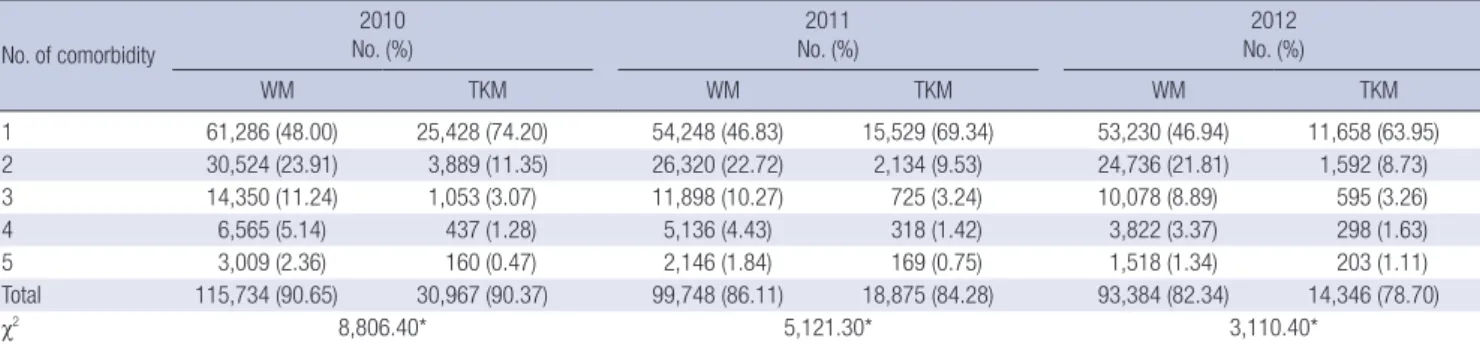
As seen in Table 5, almost half the claims (47.29%) using WM had only one F-code, and the number with more than one code dropped sharply, with only 1.87% having 5 codes. The same trend was seen using TKM, in which 70.25% of claims had one
code, but only 0.71% had 5 codes. The prevalence of a single disorder without comorbidities was high in both WM and TKM, and particularly in TKM. Overall utilization of TKM was rela- tively low in patients who had comorbidities.
DISCUSSION
We compared the demographic characteristics and frequency of diagnosis of patients who utilized WM and TKM for child and adolescent psychiatry. We identified trends in the utilization of WM and TKM child and adolescent psychiatric care by exam- ining 3 years of HIRA data.
One of the strengths of this study is the analysis of data on the nationwide population in Korea. To our knowledge, this is the first study to compare WM and TKM in child and adolescent psychiatry using nationwide data. The large sample size provid- ed high statistical power. The comparative study of WM and TKM has been rare, because WM and TKM have different ap- proaches and diagnoses. Having no standardization, it is diffi- cult to compare WM and TKM objectively. This type of com- parison has been enabled by using the KCD-6 integrated diag- nostic classification system.
Claims for child and adolescent psychiatry in both medicinal systems declined yearly, contrary to the expectation that claims would increase with the increasing need for mental healthcare of children and adolescents. It is, however, consistent with pre- vious studies which noted that Koreans are reluctant to visit psy- chiatrists. Patients and their families have negative attitudes to psychiatry because they perceive mental illness as a stigma (10, 11). They are concerned that a medical record of a mental dis- order may interfere with their careers. Thus, they tend to hide mental problems and dismiss them as personal problems in- stead of seeking appropriate treatment (12).
Some patients pay in full, and in these cases psychiatrists do not make claims to HIRA. Patients also choose therapies such as cognitive behavioral therapy (CBT), play therapy, or learning therapy, rather than pharmacotherapy which requires an F-code record. Furthermore, government support is inclined towards these therapies and non-medical institutions. These reasons could shed light on the decline of F-code claims (13,14).
Several hypotheses may explain the higher rate of decline of F code claims in TKM. First, our other data indicate that chil- dren and adolescents needing psychiatric care visit WM psy- chiatrists psychological counseling centers primarily. Second, TKM practitioners prescribe Hanyak, herbal medicine, which is not covered by health insurance. In addition, practitioners in TKM do not need to claim F-codes. According to a previous study, but inconsistent with our data, psychotherapy in TKM increased annually. This suggests that the actual utilization of TKM could be increasing (15). Frequently, TKM practitioners advertise to potential patients that they can treat their mental
illnesses without psychiatric medical records.
In WM, F-code claims increased by age. This finding is incon- sistent with previous studies (16,17). Adolescents in Korea ex- perience pressure to compete with each other for higher aca- demic achievement, which causes additional pressure to study.
Problems at school such as school violence and bullying also affect adolescents’ mental health. Indeed, the rate of suicide in adolescents (10-19 year olds) has increased gradually from 3.8%
in 2000 to 5.2% in 2010 (18). School-age children’s mental health has become a public issue, and now includes intervention ef- forts by families, teachers, and friends necessary to manage (or at least self-monitor) their mental health. These trends could explain the increased F-code claims in this age group (19,20).
In TKM, claims in 0-6 age group were the most frequent. Most likely, the parents of younger children may have a more nega- tive attitude toward psychiatrists in WM, or to psychiatric medi- cation. Further, when children experience mental distress or trauma, they tend to display externalized symptoms such as change in appetite, sleep, toilet habits and somatic symptoms (21) which may not be recognized as mental health issues. Thus, parents take their younger children to TKM practitioners first, for hanyak or acupuncture.
The different male-to-female ratios in WM age groups may be related to the different F-codes most frequently found in each group. For example, in the 0-12 age group, F90 and F98 were frequently claimed codes. F90 is the code for Attention Deficit/
Hyperactivity Disorder (ADHD), which is significantly more common in boys than girls (up to 9:1). F98 includes diagnoses like enuresis, which is about 1.5 times more prevalent in boys, and encopresis, which is three to six times more likely to occur in boys than girls (3).
In contrast, the frequently diagnosed F43, F32, and F41 in the 13-18 age group in WM are equally prevalent, or more preva- lent in females. These codes include conditions such as acute stress disorder, PTSD and adjustment disorder. They also in- clude trauma-related disorders, which are more prevalent in females (3). There is no significant sex difference in the preva- lence of adjustment disorder or in major depressive disorder in school-age boys and girls (22). However, in adolescents, major depressive disorder is two to three times more prevalent in fe- males than males (3). Together, these conditions probably cause the male-to-female ratio to be more balanced in the older age group. Although the data on the 13-18 age group in WM sug- gests a higher utilization rate for females, our results suggest the ratio was about equal. This result suggests that female adoles- cents may not visit clinics despite the need for treatment.
There was less of a difference by sex in TKM than in WM. The disorders within codes F98 and F51 are mostly gender-neutral, though sleepwalking in persistent parasomnias is more preva- lent in males than females (23). This prevalence may explain the lower gender difference in TKM overall, but the higher utili-
zation ratio of males restricted to the 0-6 age group.
The F45 code related to somatoform disorders was overwhelm- ingly frequent compared to the other codes. Because research of somatic symptom disorders in children has been limited, its prevalence in children is unclear. One report showed an equal prevalence in prepubertal males and females, though the fe- male incidence increases after puberty, while the male incidence falls at this time (24). Therefore, the minimal gender differences in TKM and slightly increased female ratio in the 13-18 age group might be associated with somatoform disorders.
As medical aid supports lower income and socially disadvan- taged groups, the insurance type reflects patient’s socioecono- mic status. Medical aid patients are free or almost free of cost- sharing, but because many TKM procedures and treatments are not covered, they would be required to pay in full. Thus, low income/medical aid patients may prefer WM over the costs as- sociated with TKM.
This large scale study demonstrated that F45 claims are much more frequent in TKM. This result is consistent with previous studies that somatization patients account for a high percent- age of utilization of TKM neuropsychiatry services (25-27). Fur- thermore, in WM, F90 (Hyperkinetic disorders) were common, a result also supported by previous studies (13).
In WM, F43 and F32 codes followed F90 in rank order. Pati- ents in WM who visit psychiatrists tend to have emotional prob- lems caused by psychological distress. In TKM, however, beha- vioral problems in codes F98 and F51 ranked high. This result suggests that internalized psychological problems are treated more often with WM, and externalized physical/behavioral prob- lems are treated more often with TKM. These trends suggest that patients perceive psychiatry in WM as treating mental problems through psychotherapy or medicine, while psychiatric medi- cine and psychiatry in TKM treat abnormal behavior and so- matic symptoms whose cause is unknown.
There are less comorbidities in TKM than in WM. This result suggests that there are more patients who have multifaceted problems and a complex pathology in WM. Alternatively, prac- titioners of psychiatry in TKM may lack the training to properly assess comorbidities.
The major limitation of this study is that patient attitudes to- ward either WM or TKM could be affected by many factors, in- cluding patients’ residential location, first episode or recurrence.
Other variables such as hospitalization and medication use re- flecting severe mental disorders also remain to be investigated in further studies. It would also be helpful to compare the time courses of utilization of both WM and TKM, to determine the direction of patient flow between WM and TKM.
TKM interprets and manages mental problems of children and adolescents according to their own theory and mechanism, and diagnose based on the ICD-10. Practitioners of TKM who specialize in psychiatry tend to refer to the DSM-5 and report F-
codes. However, there are very few of these certified practitio- ners, so diagnosis based on the DSM-5 may not be accurate or complete. Because of the different approaches and diagnostic flow between WM and TKM, it is difficult to see F-code claims as matching identically. Therefore, child and adolescent psy- chiatry in TKM should develop a more specialized training sys- tem and further evidence-based research to improve its mental health diagnostics.
A significant number of patients who have ADHD use WM, which also frequently receives cases of psychological problems such as depression and anxiety. On the other hand, patients who visit TKM are more commonly seen for physical health-re- lated problems such as somatoform disorder, sleep disorder, and eating disorder.
WM and TKM need to complement each other to maximize the treatment benefits for mental disorders, and minimize the medical expense of patients. Psychiatrists in WM should inform the public that somatic symptoms could be caused by psychiat- ric problems, and thus relieve patients’ somatic concerns. As well, practitioners in TKM should be acquainted with formal diagnostic systems such as the DSM-5 to better correlate their code reports with those of WM.
DISCLOSURE
The authors have no potential conflicts of interest to disclose.
AUTHOR CONTRIBUTION
Study concept and design of article: Kim SJ, Kim B. Data collec- tion and analysis: Kim SJ, Kim B, Lee YS, Bahn GH. Writing draft:
Kim SJ, Kim B. Revision: Kim SJ, Kim B, Lee YS, Bahn GH. Ap- proval of final manuscript and agreement of submission: all au- thors.
ORCID
Su Jin Kim http://orcid.org/0000-0003-4899-9741 Bongseog Kim http://orcid.org/0000-0002-2534-6986 Young Sik Lee http://orcid.org/0000-0003-2161-8232 Geon Ho Bahn http://orcid.org/0000-0002-3550-0422
REFERENCES
1. Ahn DH. Mental disorders in adolescents. J Korean Med Assoc 2009; 52:
745-57.
2. Kim SY, Erm T, Park S, Hong JP, Han OS, Yoo HK. Education, clinical prac- tice, and research on psychiatric illnesses in Korean traditional medicine.
J Korean Neuropsychiatr Assoc 2007; 46: 151-8.
3. Sadock BJ, Sadock VA, Ruiz P. Kaplan and Sadock’s Synopsis of Psychia- try: Behavioral Sciences/Clinical Psychiatry. 11th ed. Philadelphia, PA:
Wolters Kluwer, 2014.
4. Kim M, Han HR, Kim KB, Duong DN. The use of traditional and western medicine among Korean American elderly. J Community Health 2002;
27: 109-20.
5. Hong K. Korean child and adolescent psychiatry: a review of the past, the present and the future. J Child Adolesc Psychiatry 2003; 14: 139-49.
6. The Korean Society of Oriental Neuropsychiatry. Available at http://www.
onp.or.kr [accessed on 1 September 2015].
7. Statistics Korea. Korean Standard Classification of Disease (KCD), 6th ver. Available at: http://kostat.go.kr [accessed on 6 July 2010].
8. Kim L, Kim JA, Kim S. A guide for the utilization of Health Insurance Re- view and Assessment Service National Patient Samples. Epidemiol Health 2014; 36: e2014008.
9. Choi SM, Park GM, Shin MK, Shin HK. The research on the disease clas- sification of the traditional medicine in Korea. Korean J Orient Prev Med 2000; 4: 93-107.
10. Krajewski C, Burazeri G, Brand H. Self-stigma, perceived discrimination and empowerment among people with a mental illness in six countries:
Pan European stigma study. Psychiatry Res 2013; 210: 1136-46.
11. Park JE, Cho SJ, Lee JY, Sohn JH, Seong SJ, Suk HW, Cho MJ. Impact of stigma on use of mental health services by elderly Koreans. Soc Psychia- try Psychiatr Epidemiol 2015; 50: 757-66.
12. de Girolamo G, Dagani J, Purcell R, Cocchi A, McGorry PD. Age of onset of mental disorders and use of mental health services: needs, opportuni- ties and obstacles. Epidemiol Psychiatr Sci 2012; 21: 47-57.
13. Jung KH, Ahn DH, Kim JY, Kim HJ, Bang YW. A practice patterns of child and adolescent psychiatrists in South Korea. J Korean Acad Child Ado- lesc Psychiatry 2014; 25: 6-13.
14. Woo JM, Son MH, Kim GM, Chae KC. Future of clinical practice in psy- chiatry. J Korean Neuropsychiatr Assoc 2014; 53: 144-53.
15. Jang JS, Hwang WW, Cho SH. The current status and medical fee propri- ety of psychotherapy and neuropsychological test for dementia in Kore- an medicine. J Orient Neuropsychiatry 2014; 25: 411-21.
16. Lee H, Hwang ST. Clinical study of child and adolescent pyschiatric out- patients. J Child Adolesc Psychiatry 1996; 7: 14-22.
17. Eun KS, Ryu SY, Jung CH. Distributional change of child and adolescent psychiatric outpatients at a university hospital in Daegu. J Korean Soc Biol Ther Psychiatry 2005; 11: 78-88.
18. Park J, Chung I. Adolescent suicide triggered by problems at school in Korea: analyses focusing on depression, suicidal ideation, plan, and at- tempts as four dimensions of suicide. Child Indic Res 2014; 7: 75-88.
19. Ahn SY, Baek HJ. Academic achievement-oriented society and its rela- tionship to the psychological well-being of Korean adolescents. In: Yi C, editor. The Psychological Well-Being of East Asian Youth: 2 (Quality of Life in Asia). Dordrecht: Springer, 2013, p265-79.
20. Bhang SY, Yoo HK, Kim JH, Kim B, Lee YS, Ahn D, Suh DS, Cho SC, Hwang JW, Bahn GH. Victims of bullying among Korean adolescents: prevalence and association with psychopathology evaluated using the adolescent mental health and problem behavior screening questionnaire-II stan- dardization study data. J Korean Acad Child Adolesc Psychiatry 2012; 23:
23-30.
21. Son MJ, Han JK, Kim YH. A clinical study of the children and adolescents inpatients admitted to the oriental medical hospital. J Korean Orient Pe- diatr 2011; 25: 55-72.
22. Kim JW. Mood disorder. In: Hong KE, editor. Korean Textbook of Child Psychiatry. Seoul: Hakjisa, 2014, p233-52.
23. Petit D, Touchette E, Tremblay RE, Boivin M, Montplaisir J. Dyssomnias and parasomnias in early childhood. Pediatrics 2007; 119: e1016-25.
24. Mohapatra S, Deo SJ, Satapathy A, Rath N. Somatoform disorders in chil- dren and adolescents. Ger J Psychiatry 2014; 17: 19-24.
25. Choi BY, Park JU, Jung IC, Lee SR. A clinical study and an analysis of symp- tom check list-90-revision on psychiatric patients visiting the emergency room in an oriental medicine hospital. J Orient Neuropsychiatry 2003;
14: 155-67.
26. Kim JW, Shin HK, Chu CN, Lee JW, Park SJ, Kim KH, Seo JH. A clinical study on outpatients in oriental neuropsychiatry clinic of an oriental med- icine hospital. J Orient Neuropsychiatry 2007; 18: 123-34.
27. Lee GE, Park JH, Lyu YS, No DJ, Park IS, Kang HW. A study on difference of somatization psychological mechanism among Sasang Constitution (Four type Constitution). J Orient Neuropsychiatry 2011; 22: 23-42.