www.kjpp.net 227 Korean J Physiol Pharmacol 2021;25(3):227-237
Author contributions: H.B. performed all experiments. T.K. contributed to the study conception and analysis. H.B. and I.L. wrote the manuscript. I.L. supervised and coordinated the study.
This is an Open Access article distributed under the terms of the Creative Commons Attribution Non-Commercial License, which permits unrestricted non-commercial use, distribution, and reproduction in any medium, provided the original work is properly cited. Copyright © Korean J Physiol Pharmacol, pISSN 1226-4512, eISSN 2093-3827
INTRODUCTION
Carbon monoxide (CO), a biological gas, is known to have highly toxic and detrimental effects on the heart [1,2]. CO ex-posure can induce arrhythmia [3,4] and myocardial cell death, leading to cardiac fibrosis [5]. However, CO is now established as an important, biologically active signaling molecule gener-ated through the heme oxygenase (HO)-catalyzed degradation of heme [6,7]. Atrial and ventricular cardiomyocytes constitutively express HO-2, and various stress factors, including myocardial infarction [8], can increase the levels of inducible HO-1 [9]. En-dogenously synthesized CO is being increasingly recognized as a potential therapeutic with important signaling functions in
vari-ous diseases [10]. HO-derived CO protects the heart from trans-plant-associated ischemia-reperfusion injury [11]. The remarkable cardioprotective effects of HO-1 are best evidenced by its ability to regulate inflammatory processes, cellular signaling, and mi-tochondrial function, ultimately mitigating myocardial tissue injury and the progression of vascular proliferative disease [7].
Cardiac fibroblasts are the largest cell population in the perma-nent cellular constituents of the heart, which include cardiomyo-cytes, endothelial cells, and vascular smooth muscle cells [12]. Human cardiac fibroblasts (HCFs) have numerous functions, in-cluding the synthesis and deposition of extracellular matrix, and they play a relevant role in myocardial structuring and cell signal-ing in healthy and diseased myocardium [13]. HCFs have cell-cell
Original Article
Carbon monoxide activates large-conductance calcium-activated
potassium channels of human cardiac fibroblasts through various
mechanisms
Hyemi Bae1, Taeho Kim2, and Inja Lim1,*
1
Department of Physiology, College of Medicine, Chung-Ang University, Seoul 06974, 2
Department of Internal Medicine, College of Medicine, Chung-Ang University Hospital, Seoul 06973, Korea
ARTICLE INFO Received November 17, 2020 Revised February 8, 2021 Accepted February 9, 2021 *Correspondence Inja Lim E-mail: [email protected] Key Words
Calcium-activated potassium channel Carbon monoxide
Nitric oxide Protein kinases
ABSTRACT Carbon monoxide (CO) is a cardioprotectant and potential cardiovascular therapeutic agent. Human cardiac fibroblasts (HCFs) are important determinants of myocardial structure and function. Large-conductance Ca2+
-activated K+
(BK) channel is a potential therapeutic target for cardiovascular disease. We investigated whether CO modulates BK channels and the signaling pathways in HCFs using whole-cell mode patch-clamp recordings. CO-releasing molecules (CORMs; 2 and CORM-3) significantly increased the amplitudes of BK currents (IBK ). The CO-induced stimulating effects on IBK were blocked by pre-treatment with specific nitric oxide synthase (NOS) blockers (L-NG
-monomethyl arginine citrate and L-NG
-nitroarginine methyl ester). 8-bromo-cyclic GMP increased IBK. KT5823 (inhibits PKG) or ODQ (in-hibits soluble guanylate cyclase) blocked the CO-stimulating effect on IBK.Moreover, 8-bromo-cyclic AMP also increased IBK, and pre-treatment with KT5720 (inhibits PKA) or SQ22536 (inhibits adenylate cyclase) blocked the CO effect. Pre-treatment with N-ethylmaleimide (a thiol-alkylating reagent) also blocked the CO effect on IBK, and DL-dithiothreitol (a reducing agent) reversed the CO effect. These data suggest that CO activates IBK through NO via the NOS and through the PKG, PKA, and S-nitrosylation pathways.
communication with cardiomyocytes and other cells [14], and the cardiomyocyte–cardiac fibroblast interactions are important in normal heart function and in the development of diseases such as cardiac arrhythmia and fibrosis [15].
It has been reported that cardiac fibroblasts can interact elec-trically with cardiomyocytes through gap junctions [16] and direct electrical coupling of these two types of cells has also been observed [16-18]. There is now increasing evidence that cardiac fibroblasts may play a direct role in modulating the electrophysi-ological substrate in healthy and diseased hearts [19]. In addition, cardiac injury results in significant electrophysiological changes that enhance fibroblast-myocyte interactions and could contrib-ute to a greater incidence of arrhythmias observed in fibrotic hearts [20].
Although cardiac fibroblasts are non-excitable, they ex-press multiple ion channels and the activity of ion channels in HCFs [21,22] contributes to the functional activities of heart cells through the transfer of electrical signals between these two cell types [23]. However, the distribution and properties of their ion channels are quite distinct from those of cardiomyocytes [24].
The large-conductance Ca2+-activated K+ (BK) channel is the main K+
channel in HCFs [22,25]. The BK channel contributes to the resting membrane potential of cardiac fibroblasts [26] and the electrical coupling of cardiomyocytes-fibroblasts [23]. BK channels are also mainly expressed in vascular smooth muscle cells [27] and in the inner mitochondrial membranes of the car-diomyocytes [28]. Activation of these channels in these locations results in cardioprotection against cardiac ischemia that induces arrhythmogenesis [29].
CO is rapidly emerging as an important cellular messenger, regulating a wide range of physiological processes. The investiga-tion of ion channels as effectors of CO signaling is in its infancy, with regard to both the physiologic and the toxic activities of this gas. Various ion channels have recently been discovered to be ef-fectors of CO signaling, and they play key roles in the mediation of beneficial effects of CO [30,31]. CO also modulates various ion channels via diverse signaling pathways [2,32,33].
Among them, CO activates BK channels in human endothelial cells directly as well as via a cGMP-dependent pathway [34] and in vascular smooth muscle cells directly but not mediated by a cGMP dependent pathway [35].
However, the effect of CO on the BK channel of HCFs and the underlying mechanism remains unclear. Therefore, we explored the effect of CO, using CORMs, on BK current through the chan-nels and their intracellular signaling pathways.
METHODS
Cell culture and reagents
Adult human cardiac ventricular fibroblasts were obtained
from the ScienCell Research Laboratory (Cat #6310; San Diego, CA, USA). The cells were cultured in Dulbecco’s modified Eagle’s medium (Welgene, Gyeongsan, Korea) with 10% fetal bovine serum (Welgene) and a penicillin-streptomycin solution (100×; Welgene) in an incubator with a humidified atmosphere of 5% CO2 and 95% air at 37°C. Experiments were performed with cells
from passage 4–7 (passage is the number of times the cells are processed with trypsin and transferred to another flask).
CO was applied to cells using the commercially available CO-donors, carbon monoxide releasing molecules; CORM-2 (tricar-bonyldichlororuthenium [II] dimer, [Ru(CO3)Cl2]2), CORM-3
(tricarbonylchloro‐glycinate‐ruthenium [II], [Ru(CO)3
Cl‐glyci-nate]), paxilline (a BK channel blocker), and all other chemicals were purchased from Sigma-Aldrich (St. Louis, MO, USA).
Electrophysiological recordings
Membrane ionic currents were recorded using the whole-cell patch-clamp technique, as described previously, using the Axo-patch 200B Patch Clamp Amplifier (Axon Instruments, Union City, CA, USA).
The recording patch pipettes were prepared from filament-con-taining borosilicate tubes (TW150F-4; World Precision Instru-ments, Sarasota, FL, USA) using a 2-stage microelectrode puller (PC-10; Narishige, Tokyo, Japan) and were fire-polished using a microforge (MF-830; Narishige).
The pipettes for whole-cell currents exhibited a resistance of 2–3 M when filled with the internal pipette solution. The re-corded membrane currents were filtered at 2 kHz and digitized at 10 kHz. pCLAMP 9.0 software (Axon Instruments) was used for data acquisition and analysis of the whole-cell currents. All electrophysiological experiments were performed at room tem-perature.
For BK current recording, the cells were perfused with Tyrode solution containing 142 mM NaCl, 5 mM KCl, 1 mM CaCl2,1
mM MgCl2, 5 mM glucose, and 5 mM HEPES (pH-adjusted to
7.35 with NaOH). The pipette solution contained 145 mM KCl, 1.652 mM CaCl2 (pCa 6.0),1.013 mM MgCl2, 10 mM HEPES, 2
mM EGTA, and 2 mM K-ATP (pH 7.3 with KOH). All chemicals were purchased from Sigma-Aldrich. To record only IBK in the cells, we added 4-aminopyridine (1 mM) into the bath solution to exclude the influence of delayed rectifier K+
channels, which are another source of the prominent K+ currents in HCFs.
Statistical analysis
The results are presented as means ± standard errors of the mean (SEM). Statistical analysis was performed using SPSS ver-sion 22.0 software (IBM Corp., Armonk, NY, USA). The paired Student’s t-test was used to evaluate differences between the means of the 2 groups, whereas one-way analysis of variance was used for multiple groups. The p-values < 0.05 were considered
statistically significant.
RESULTS
Effects of CO on large-conductance Ca
2+-activated K
+currents of HCFs
To determine the effect of CO on the BK channels in HCFs,
we used whole-cell mode patch clamp recordings with a voltage protocol that consisted of depolarizing steps (from −80 mV to +50 mV) in 10-mV increments for 400-ms with a holding potential of −80 mV. The recorded macroscopic K+
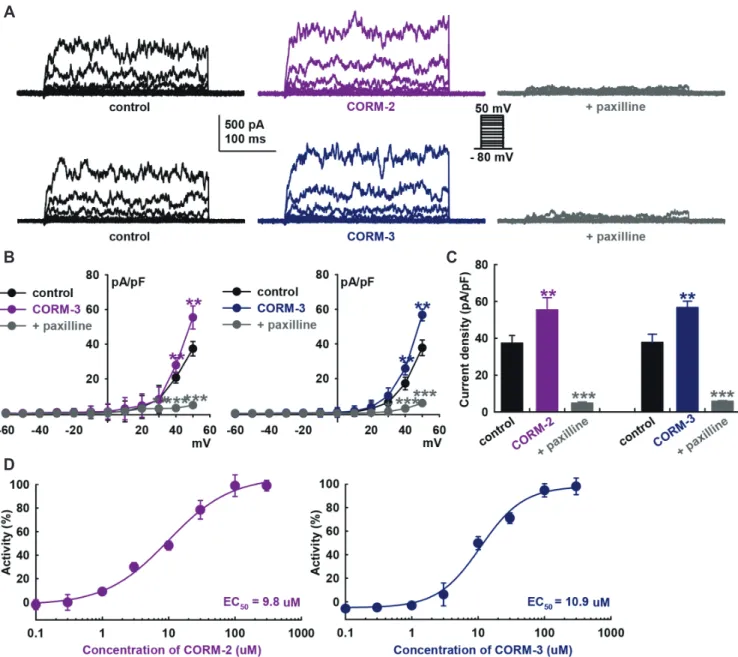
currents of HCFs exhibit behaviors typical of BK currents (IBK): activated at 10 mV, in-creased in voltage-dependent manner, and strongly oscillated in response to strong depolarization, well maintained throughout the test pulse without marked inactivation during depolarizing voltage increments (Fig. 1A). The average cell capacitance was
Fig. 1. Effects of carbon monoxide (CO) on large-conductance Ca2+-activated K+currents of HCFs. (A) Original recordings of K+ outward currents
were obtained by repeated voltage step depolarization from −80 to +50 mV for 400 ms (holding potential, –80 mV) before (control) and after the application of CO-releasing molecules (CORMs; CORM-2 or CORM-3, 10 M, each) in whole-cell mode patch-clamp recordings. Paxilline (10 M) was added to confirm IBK. (B) Summarized current–voltage (I–V) curves for the effects of CO donors and paxilline show a strong outward rectification that characterizes IBK. Values are mean ± SEM. **p < 0.01, ***p < 0.001 compared to control (n = 10, each). (C) Bar graphs showing the summary of the current density changes at +50 mV regarding the effects of CORM-2, CORM-3, and paxilline (n = 10, each). (D) Concentration-dependent activation curves of IBK by CORM-2 and CORM-3 are shown. The solid line shows the fit based on a standard dose-response relationship, which yielded an esti-mated half maximal effective concentration (EC50) of 9.8 M for CORM-2 and 10.9 M for CORM-3.
B C
D A
23.44 ± 0.46 pF (n = 289). CO donors significantly increased the amplitude of the K+ currents (10 M CORM-2, +48.2 ± 16.0%
of control; CORM-3, +50.1 ± 7.6% of control, at +50 mV, n = 10, each, p < 0.01).
We then added 10 M paxilline, a specific BK channel blocker, to confirm IBK and that the currents were blocked (CORM-2, –87.0 ± 1.6% of control; CORM-3, –84.4 ± 3.3 % of control, at +50 mV, n = 10, p < 0.001). In addition, their current–voltage (I– V) curves showed strong outward rectification, a characteristic of IBK (Fig. 1B). The bar graphs show the summary of the current density changes of these currents at +50 mV stimulation voltage (CORM-2, from 37.4 ± 4.2 to 55.4 ± 6.7 pA/pF; CORM-3, from 37.8 ± 4.5 to 56.7 ± 3.4 pA/pF; at +50 mV, n = 10, p < 0.01, Fig. 1C). Paxilline (10 M) significantly inhibited CO-induced IBK activa-tion (CORM-2, 4.9 ± 0.7; CORM-3, 5.9 ± 0.3 pA/pF, at +50 mV, n = 10, p < 0.001). Concentration–response curves of the CO donors showed steady-state currents normalized to the control data were fitted with the Hill equation (Fig. 1D), with the half maximal ef-fective concentration (EC50) value of 9.8 M for CORM-2
activa-tion of IBK (EC50 of CORM-3; 10.9 M).
Effects of NOS blockers on CO-induced IBK activation
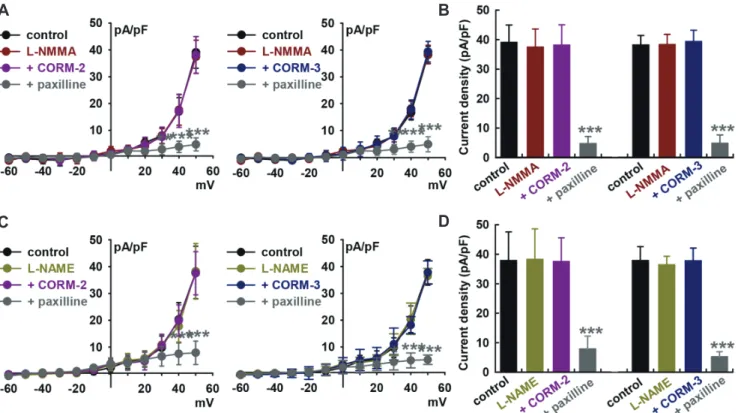
CO can regulate ion channels via the modulation of numerous signaling pathways. To investigate the signaling mechanism un-derlying the regulation of BK channels by CO, we first explored the involvement of nitric oxide (NO) because CO is known to activate nitric oxide synthase (NOS) and soluble guanylate cyclase (sGC) [36], and crosstalk between CO and NO have also been re-ported [37]. Fig. 2 indicates that the ability of CORM-2 (10 M) to activate IBK was significantly suppressed by pre-treatment with an NOS inhibitor, L-NG-monomethyl arginine citrate (L-NMMA, 100 M, –2.4 ± 11.7% of control, Fig. 2A and B). L-NMMA by itself did not affect the amplitude of IBK (–4.1 ± 10.4% of control, n = 10). Similarly, L-NMMA pre-treatment inhibited CORM-3-induced IBK activation (10 M, +3.1 ± 11.9% of control, n = 10). IBK was confirmed, which was significantly attenuated by 10 M paxilline (CORM-2; –87.9 ± 4.1% of control, CORM-3; –87.3 ± 8.8% of control, n = 12, p < 0.001). Pre-treatment of cells with another NOS blocker, L-NG-nitroarginine methyl ester (L-NAME, 100 M), also attenuated the CO-induced IBK activation. After 20 min of L-NAME pre-treatment, CORM-2 (–0.8 ± 8.3% of con-trol, n = 12, Fig. 2C and D) or CORM-3 (–0.2 ± 9.1% of control, n = 12) could not increase IBK, and successive addition of paxillineFig. 2. Effect of nitric oxide synthase (NOS) blockers on CO-releasing molecule (CORM)-induced IBK activation. (A) Summarized current–volt-age (I–V) curves for the effects of CORM-2 or CORM-3 after L-NG-monomethyl arginine citrate (L-NMMA, an NOS blocker, 100 M) pre-treatments. IBK
was confirmed by 10 M paxilline. (B) Bar graphs show the summary of the current density changes regarding the effects of CORM-2 or CORM-3 (10 M, each) after L-NMMA (100 M) pre-treatments at +50 mV. ***p < 0.001 paxilline vs. control (n = 10, each). (C) Summarized I–V curves for the effects of CORM-2 or CORM-3 after L-NG-nitroarginine methyl ester (L-NAME, an NOS blocker, 100 M) pre-treatments. (D) Bar graphs showing the summary of the current density changes regarding the effects of CORM-2 or CORM-3 after L-NAME pre-treatments at +50 mV (n = 12, each).
A B
after CO donors blocked the currents (CORM-2, –79.2 ± 4.5% of control; CORM-3, –86.1 ± 3.6% of control, p < 0.001). These data suggest that CO could activate IBK through NO formation via NOS.
Effect of cGMP signaling pathway on CO-induced IBK
activation in HCFs
Binding of NO to the heme group of sGC leads to increased conversion of GTP to cGMP, which in turn activates PKG. The
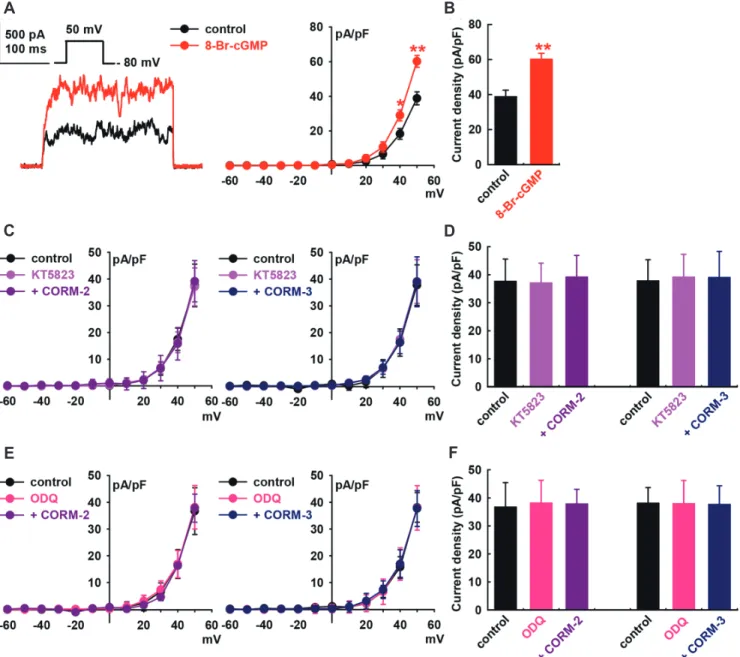
cGMP signaling pathway are the main mechanisms for mediat-ing the effects of NOon IBK in HCFs [25]. Therefore, we assessed the effects of cGMP on IBK of HCFs. Addition of 8-bromo-cGMP (a membrane-permeable cGMP analogue, 300 M) increased the IBK to +55.1 ± 9.2% of the control at +50 mV (p < 0.01, n = 8, Fig. 3A and B).
When we pre-treated the cells with a PKG inhibitor, KT5823 (1 M), the CO donors failed to increase IBK (CORM-2, +4.1 ± 9.7% of the control at +50 mV, n = 8; CORM-3, +3.3 ± 12.3% of control, n = 8, Fig. 3C and D). Similarly, pre-treatment of the cells
Fig. 3. Effect of cGMP signaling pathways on carbon monoxide (CO)-induced IBK activation in human cardiac fibroblasts (HCFs). (A) Represen-tative currents and current–voltage (I–V) curves show the summarized current density changes for the effect of 300 M 8-Br-cGMP on IBK, n = 8, **p < 0.01 vs. the control. (B) Bar graphs show the summary of the current density changes regarding the effect of 8-Br-cGMP (300 M) at +50 mV. Values are mean ± SEM. (C) I–V curves and (D) bar graphs also showing the summarized current density changes for the effect of pre-treatment with KT5823 (1 M, a PKG blocker) for 20 min for IBK activation induced by CO-releasing molecule (CORM)-2 (10 M, n = 12) or CORM-3 (10 M, n = 8). (E) I–V curves and (F) bar graphs also showing the summarized current density changes for the effect of 10 M CORM-2 (n = 12) or 10 M CORM-3 (n = 8) on IBK af-ter pre-treatment with 1 M ODQ, a specific soluble guanylate cyclase (sGC) blocker.
A B
C D
with 1H-[1,-2,-4] oxadiazolo-[4,-3-a] quinoxalin-1-one (ODQ; 10 M, a membrane-permeable sGC inhibitor) inhibited the CO-induced activation of IBK (CORM-2, +3.1 ± 6.0% of the control at +50 mV, n = 8; CORM-3, –1.2 ± 12.1% of control, n = 8, Fig. 3E and F). KT5823 (1 M) or ODQ (10 M) alone did not increase the IBK of HCFs.
Effect of cAMP signaling pathways on CO-induced IBK
activation of HCFs
To determine whether the cAMP signaling pathways are also
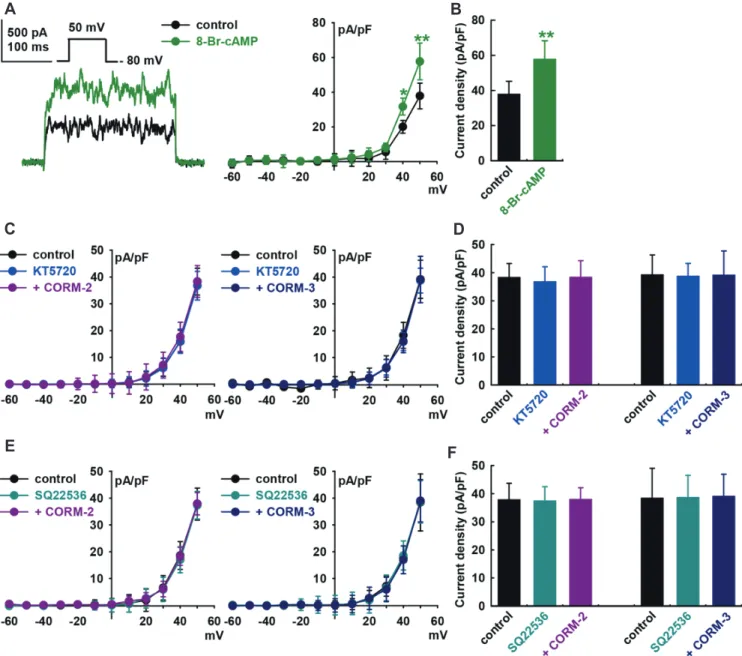
involved in CO-induced IBK activation, 8-bromo-cyclic AMP (8-Br-cAMP, a cyclic AMP analog, 300 M) was added into the bath solution, which increased IBK to +52.7 ± 14.3% of the control at +50 mV (p < 0.01, n = 8, Fig. 4A and B). Pre-treatment of the cells with KT5720 (1 M, a PKA blocker) for 20 min blocked CO-induced IBK activation (CORM-2, +0.2 ± 11.9% of the control, at +50 mV, n = 8; CORM-3, –0.2 ± 12.2% of the control, n = 8, Fig. 4C and D). Pre-treatment with SQ22536 (1 M, an adenylate cy-clase blocker) also inhibited CO-induced IBK activation (CORM-2, control, +0.4 ± 7.0% of the control, n = 8; CORM-3, +1.7 ± 7.4% of the control, n = 8, Fig. 4E and F). KT5720 (1 M) or SQ22536 (1
Fig. 4. Effect of the cAMP signaling pathway on the carbon monoxide (CO)-induced IBK activation of human cardiac fibroblasts (HCFs). (A) Representative currents and current–voltage (I–V) curves showing the summary of the current density changes regarding the effect of 8-Br-cAMP (300 M) on IBK (n = 8, *p < 0.05, **p < 0.01 vs. the control). (B) Bar graphs at +50 mV show the summarized current density changes by 8-Br-cAMP (300 M, n = 8) on the IBK. (C) I–V curves and (D) bar graphs show the summarized current density changes for the effect of 10 M CO-releasing molecule (CORM)-2 (n = 8) or 10 M CORM-3 (n = 8) on IBK after pre-treatment with KT5720 (1 M) for 20 min. (E) I–V curves and (F) bar graphs show the sum-marized current density changes for the effect of 10 M CORM-2 (n = 8) or 10 M CORM-3 (n = 8) on IBK after pre-treatment with SQ22536 (1 M) for 20 min.
B
C D
E F
M) alone did not increase the IBK of HCFs.
Influence of S-nitrosylation on CO-induced IBK
activation
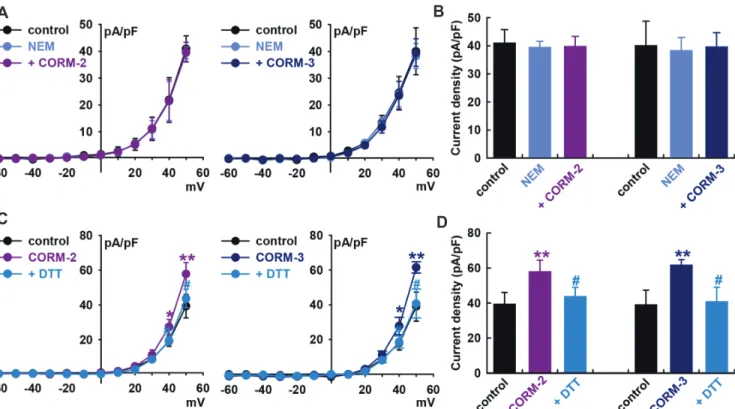
To establish S-nitrosylation as a mechanism for CO-mediated activation of IBK, we ptreated cells with a thiol-alkylating re-agent, N-ethylmaleimide (0.5 mM, NEM), for 20 min and then applied the CO donors. In the presence of NEM, CO donors could not increase IBK compared to the value in the presence of NEM alone (2, –3.0 ± 7.6% of the control, n = 6; CORM-3, –1.2 ± 5.9% of the control, n = 6, Fig. 5A and B).
When DL-dithiothreitol (DTT, a reducing agent; 5 mM) was applied after IBK had been increased by CORM-2, it reversed the effect of CORM-2 on IBK (CORM-2, +47.0 ± 9.8% of the control, n = 6, **p < 0.01 vs. control; DTT, +11.0 ± 7.8% of the control, n = 6,
#
p < 0.05 vs. CORM-2, Fig. 5C and D). In case of CORM-3, DTT also reversed the CORM-3-induced increase of IBK (CORM-3, +57.9 ± 3.9% of the control, n = 6, **p < 0.01 vs. control; DTT, +4.5 ± 9.9% of the control, n = 6, #
p < 0.05 vs. CORM-3). These find-ings further suggest that S-nitrosylation is one of the mechanisms behind CO-induced IBK activation in HCFs, and a thiol residue could be the ultimate target of CO.
DISCUSSION
CO activation of the BK currents of HCF
In our results, CO produced a concentration-dependent activa-tion of IBK (Fig. 1). This result is consistent with the results for BK channels in human endothelial cells [34], in vascular smooth muscle cells [35], and in the mitochondrial BK channels of car-diomyocytes [38].
Previously, we have shown that the presence of the BK chan-nel in the plasma membrane of HCFs by RT-PCR and Western blotting [21] and here confirmed its presence functionally by applying an electrophysiological method with paxilline, a spe-cific BK channel blocker that exclusively uses a closed-channel block mechanism [39]. BK channels of the plasma membrane share multiple biophysical similarities with the BK channels in the inner mitochondrial membrane [38]. The protective effects of mitochondrial BK channel activation against ischemia were demonstrated by using BK channel openers [40] and BK channel knockout mice [41]. Therefore, considering the electrical coupling of cardiomyocytes-fibroblasts [23], BK channels of the plasma membrane of HCF could also be a potential target for cardiovas-cular diseases [42], and CO as a BK channel activator could be employed as a cardioprotectant.
Fig. 5. Effect of S-nitrosylation on carbon monoxide (CO)-induced IBK activation. (A) Current–voltage (I–V) curves from –60 to +50 mV and (B) bar graphs at +50 mV showing the summarized current density changes by CO-releasing molecule (CORM)-2 (10 M, n = 6) or CORM-3 (10 M, n = 6) on IBK after pre-treatment with N-ethylmaleimide (NEM, a thiol-alkylating reagent, 0.5 mM). (C) I–V curves and (D) bar graphs showing the summarized current density changes for the effect of CORM-2 (n = 6) or CORM-3 (n = 6) on IBK after pre-treatment with DL-dithiothreitol (DTT, a reducing agent; 5 mM). *p < 0.05, **p < 0.01 vs. the control, #p < 0.05 vs. CORMs.
B
C D
For studies on CO signaling, cells and channels have been exposed to CO by the application of CO-releasing molecules (CORMs) that are a group of compounds capable of carrying and liberating controlled quantities of CO into cellular systems [6]. CORMs are fully water soluble, allow for intravenous administra-tion, and rapidly liberate CO and hence have been used as CO donors to overcome the limitations of using CO gas [43]. In addi-tion, CORMs are valuable experimental tools and potential thera-peutic agents [6]. They have the potential for vasodilatory, anti-ischemic, and anti-inflammatory effects [44,45] and they could protect adult cardiomyocytes against hypoxia-reoxygenation [46]. Therefore, the use of CORMs to investigate the signaling proper-ties of CO has provided many new applications and treatments as pharmacologic approaches to cardiovascular diseases [6].
However, some of their actions can occur independently of CO release [47] or they show different activities. CO has positive inotropic activity in the perfused rat heart by CORM-3 but not by CORM-2 [48]. Judicial use of appropriate control compounds, as well as a comparison of their effects with those of CO diluted directly into a solution, should be performed wherever experi-mentally possible. When we tested two frequently used two types of CORMs of different structures to confirm the CO effect on BK channels, CORM-2 and CORM-3 showed similar activating effects on IBK of HCFs; the EC50 value was 9.8 M for CORM-2
and 10.9 M for CORM-3.
CO activation of BK currents of HCF through NO
To investigate the mechanism of the regulation of BKchannels by CO, we first explored the involvement of NO because CO and NO are two endogenously produced gases that can act as second messenger molecules and it is becoming increasingly clear that these two gases do not always work independently, but rather can modulate each other's activity [37]. CO induces NO release [49] and NO increases the expression of HO-1 in endothelial cells [50] or vascular smooth muscle cells [51].Our results also demonstrated that the activation of IBK by CO in HCFs was abolished by treatment with L-NMMA or L-NAME, NOS blockers (Fig. 2). These results are consistent with the find-ing that CO activates L-type calcium channels in HEK cells and in human intestinal smooth muscle cells [36], and it stimulates BK channels in human endothelial cells [34] through NOS activa-tion. The NO donor also stimulates IBK of HCFs [25].
Signaling pathways involved in the effects of CO on
BK currents of HCFs
CO is an endogenous modulator of the NO-cyclic GMP signal-ing system [52] and activates L-type calcium channels through NO- and cGMP dependent pathways [36]. Both CO [49] and NO [25] activate ion channels via the activation of sGC, which generates cGMP.
Our results demonstrated that 8-bromo-cGMP increased IBK (Fig. 3) and the CO-induced IBK stimulation effect in HCFs was blocked by the presence of a sGC blocker (ODQ) or a PKG blocker (KT5823). These results suggest that the stimulatory effects of CO are dependent on the sGC/cGMP/PKG signaling pathway. These results are consistent with that of a previous study on the effect of CO in human endothelial cells [34] and NO in HCFs [25].
CO is a weak stimulator of sGC compared with NO because CO binds to the sGC heme group with a lower affinity and can only weakly increase cyclic activity. The binding only results in a four- to six-fold activation of the enzyme. Unlike CO, NO in-creases the sGC activity 100–400-fold [37]. In previous reports, CO amplifies NO-induced cGMP levels seen with either CO or NO alone [53] and potentiates the elevation of NO-mediated cGMP [52]. Therefore, it seems that CO can function as a partial agonist to facilitate NO-mediated activation of sGC.
NO can exert many of its effects through cGMP-independent mechanisms: the c-AMP dependent pathways and S-nitrosyl-ation. NO modulates BK channels through cAMP-dependent pathways in HCFs [25] and in rat cardiac fibroblasts [54]. NO also blocks Kv1.5 channels by S-nitrosylation [55]. Our results also demonstrated that the stimulating effects of CO of HCFs were mediated by cGMP-independent mechanisms; cAMP-dependent pathways and S-nitrosylation.
In our study, pre-treatment with a PKA blocker (KT5720) or an adenylate cyclase blocker (SQ22536) inhibited the effect of CO on the IBK in HCFs and cell membrane permeable cAMP, 8-bromo-cAMP treatment increased IBK (Fig. 4), which means that the cAMP-dependent pathway is also involved in the stimulating effect of CO on IBK in HCFs. These results are similar to the finding that NO increases IBK through PKG- and PKA-related pathways in HCFs [25] and cAMP-dependent vasodilators cross-activate the cGMP-dependent protein kinase pathway to stimu-late BK channels in coronary artery smooth muscle cells [56].
We also found that CO could activate IBK in HCFs through S-nitrosylation, since a thiol-alkylating reagent, NEM, prevented CO stimulation effects on IBK and a reducing agent, DTT re-versed the effect of CORMs on IBK (Fig. 5). This is the first report that an S-nitrosylation mechanism is involved in CO effects on IBK in a cardiac system and that a thiol residue could be the ulti-mate target of CO.
S-nitrosylation has emerged as an important and ubiquitous post-translational modification system, participating in cellular signaling (reviewed in Gonzalez et al.) [57]. Several reports ex-ist on the effect of NO mediated through S-nitrosylation being implicated in all major functions of NO in the cardiovascular sys-tem [57-59]. Since S-nitrosylation signaling is involved in multiple physiological processes, it is expected that altered S-nitrosylation of specific ion channels may be relevant in some pathologic states, arrhythmia and heart failure.
Cardiac ion channels involved in excitation-contraction cou-pling are potentially regulated by S-nitrosylation [57]. In cardiac
myocytes, S-nitrosylation is coupled to NOS activity for Nav1.5 channel activation [60]. NO inhibits L-type calcium channels by S-nitrosylation [61] and the 1-subunit of L-type calcium channels is constitutively S-nitrosylated in the mouse heart [62]. S-nitrosylation increases the slowly activating component of de-layed rectifier K+
currents in a manner dependent on NOS [63,64] and Kv4.3 channels, which generates a transient outward K+ cur-rent [65].
Although BK channels are not expressed in the plasma mem-brane of cardiomyocytes, recent works showed that BK channels might localize at the sinoatrial node in the heart and contribute to the regulation of sinoatrial node cell automaticity. Application of paxilline significantly reduced the action potential firing of sinoatrial node cells and lengthened the diastolic depolarization phase of the action potential [66].
Considering fibroblast-myocyte electrotonic coupling [67], BK channels of HCFs and the CO effects on this the channel may lead to the discovery of novel therapeutic targets and the develop-ment of agents for improving outcomes of heart diseases.
In summary, the present study showed for the first time that CO stimulates BK channels of HCFs, which involves the activa-tion of NO by NOS and the sGC/cGMP/PKG, adenylate cyclase/ cAMP/PKA, and S-nitrosylation pathways.
ACKNOWLEDGEMENTS
This research was supported by the Basic Science Research Program through the National Research Foundation of Korea (NRF) funded by the Ministry of Education (NRF-2018R1D-1A1B07048607).
CONFLICTS OF INTEREST
The authors declare no conflicts of interest.
REFERENCES
1. Marchewka J, Gawlik I, Dębski G, Popiołek L, Marchewka W, Hy-dzik P. Cardiological aspects of carbon monoxide poisoning. Folia Med Cracov. 2017;57:75-85.
2. Peers C, Steele DS. Carbon monoxide: a vital signalling mol-ecule and potent toxin in the myocardium. J Mol Cell Cardiol. 2012;52:359-365.
3. André L, Gouzi F, Thireau J, Meyer G, Boissiere J, Delage M, Abdel-laoui A, Feillet-Coudray C, Fouret G, Cristol JP, Lacampagne A, Ob-ert P, Reboul C, Fauconnier J, Hayot M, Richard S, Cazorla O. Car-bon monoxide exposure enhances arrhythmia after cardiac stress: involvement of oxidative stress. Basic Res Cardiol. 2011;106:1235-1246.
4. Dallas ML, Yang Z, Boyle JP, Boycott HE, Scragg JL, Milligan CJ,
Elies J, Duke A, Thireau J, Reboul C, Richard S, Bernus O, Steele DS, Peers C. Carbon monoxide induces cardiac arrhythmia via induction of the late Na+ current. Am J Respir Crit Care Med.
2012;186:648-656.
5. Gandini C, Castoldi AF, Candura SM, Locatelli C, Butera R, Priori S, Manzo L. Carbon monoxide cardiotoxicity. J Toxicol Clin Toxicol. 2001;39:35-44.
6. Motterlini R, Foresti R. Biological signaling by carbon monoxide and carbon monoxide-releasing molecules. Am J Physiol Cell Physi-ol. 2017;312:C302-C313.
7. Otterbein LE, Foresti R, Motterlini R. Heme oxygenase-1 and carbon monoxide in the heart: the balancing act between danger signaling and pro-survival. Circ Res. 2016;118:1940-1959.
8. Lakkisto P, Siren JM, Kytö V, Forsten H, Laine M, Pulkki K, Tik-kanen I. Heme oxygenase-1 induction protects the heart and modu-lates cellular and extracellular remodelling after myocardial infarc-tion in rats. Exp Biol Med (Maywood). 2011;236:1437-1448. 9. Ewing JF, Raju VS, Maines MD. Induction of heart heme
oxygen-ase-1 (HSP32) by hyperthermia: possible role in stress-mediated elevation of cyclic 3':5'-guanosine monophosphate. J Pharmacol Exp Ther. 1994;271:408-414.
10. Ling K, Men F, Wang WC, Zhou YQ, Zhang HW, Ye DW. Carbon monoxide and its controlled release: therapeutic application, detec-tion, and development of carbon monoxide releasing molecules (CORMs). J Med Chem. 2018;61:2611-2635.
11. Akamatsu Y, Haga M, Tyagi S, Yamashita K, Graça-Souza AV, Ollinger R, Czismadia E, May GA, Ifedigbo E, Otterbein LE, Bach FH, Soares MP. Heme oxygenase-1-derived carbon monoxide pro-tects hearts from transplant associated ischemia reperfusion injury. FASEB J. 2004;18:771-772.
12. Souders CA, Bowers SL, Baudino TA. Cardiac fibroblast: the renais-sance cell. Circ Res. 2009;105:1164-1176.
13. Kohl P. Heterogeneous cell coupling in the heart: an electrophysi-ological role for fibroblasts. Circ Res. 2003;93:381-383.
14. Villarreal FJ, Kim NN. Regulation of myocardial extracellular ma-trix components by mechanical and chemical growth factors. Car-diovasc Pathol. 1998;7:145-151.
15. Pellman J, Zhang J, Sheikh F. Myocyte-fibroblast communication in cardiac fibrosis and arrhythmias: mechanisms and model systems. J Mol Cell Cardiol. 2016;94:22-31.
16. Camelliti P, Green CR, LeGrice I, Kohl P. Fibroblast network in rab-bit sinoatrial node: structural and functional identification of ho-mogeneous and heterogeneous cell coupling. Circ Res. 2004;94:828-835.
17. Cartledge JE, Kane C, Dias P, Tesfom M, Clarke L, Mckee B, Al Ayoubi S, Chester A, Yacoub MH, Camelliti P, Terracciano CM. Functional crosstalk between cardiac fibroblasts and adult cardio-myocytes by soluble mediators. Cardiovasc Res. 2015;105:260-270. 18. Gaudesius G, Miragoli M, Thomas SP, Rohr S. Coupling of cardiac
electrical activity over extended distances by fibroblasts of cardiac origin. Circ Res. 2003;93:421-428.
19. Vasquez C, Benamer N, Morley GE. The cardiac fibroblast: func-tional and electrophysiological considerations in healthy and dis-eased hearts. J Cardiovasc Pharmacol. 2011;57:380-388.
20. Vasquez C, Mohandas P, Louie KL, Benamer N, Bapat AC, Morley GE. Enhanced fibroblast-myocyte interactions in response to car-diac injury. Circ Res. 2010;107:1011-1020.
21. Bae H, Lee D, Kim YW, Choi J, Lee HJ, Kim SW, Kim T, Noh YH, Ko JH, Bang H, Lim I. Effects of hydrogen peroxide on voltage-dependent K+ currents in human cardiac fibroblasts through protein
kinase pathways. Korean J Physiol Pharmacol. 2016;20:315-324. 22. Li GR, Sun HY, Chen JB, Zhou Y, Tse HF, Lau CP. Characterization
of multiple ion channels in cultured human cardiac fibroblasts. PLoS One. 2009;4:e7307.
23. Wang YJ, Sung RJ, Lin MW, Wu SN. Contribution of BKCa-channel
activity in human cardiac fibroblasts to electrical coupling of car-diomyocytes-fibroblasts. J Membr Biol. 2006;213:175-185.
24. Mahoney VM, Mezzano V, Morley GE. A review of the literature on cardiac electrical activity between fibroblasts and myocytes. Prog Biophys Mol Biol. 2016;120:128-133.
25. Bae H, Lim I. Effects of nitric oxide on large-conductance Ca2+
-ac-tivated K+ currents in human cardiac fibroblasts through PKA and
PKG-related pathways. Clin Exp Pharmacol Physiol. 2017;44:1116-1124.
26. Chilton L, Ohya S, Freed D, George E, Drobic V, Shibukawa Y, Maccannell KA, Imaizumi Y, Clark RB, Dixon IM, Giles WR. K+
currents regulate the resting membrane potential, proliferation, and contractile responses in ventricular fibroblasts and myofibroblasts. Am J Physiol Heart Circ Physiol. 2005;288:H2931-H2939.
27. Hu XQ, Zhang L. Function and regulation of large conductance Ca2+-activated K+ channel in vascular smooth muscle cells. Drug
Discov Today. 2012;17:974-987.
28. Balderas E, Zhang J, Stefani E, Toro L. Mitochondrial BKCa channel.
Front Physiol. 2015;6:104.
29. Kim HH, Choi S. Therapeutic aspects of carbon monoxide in car-diovascular disease. Int J Mol Sci. 2018;19:2381.
30. Kapetanaki SM, Burton MJ, Basran J, Uragami C, Moody PCE, Mitcheson JS, Schmid R, Davies NW, Dorlet P, Vos MH, Storey NM, Raven E. A mechanism for CO regulation of ion channels. Nat Commun. 2018;9:907.
31. Wilkinson WJ, Kemp PJ. Carbon monoxide: an emerging regulator of ion channels. J Physiol. 2011;589(Pt 13):3055-3062.
32. Peers C. Modulation of ion channels and transporters by carbon monoxide: causes for concern? Front Physiol. 2012;3:477.
33. Peers C, Boyle JP, Scragg JL, Dallas ML, Al-Owais MM, Het-tiarachichi NT, Elies J, Johnson E, Gamper N, Steele DS. Diverse mechanisms underlying the regulation of ion channels by carbon monoxide. Br J Pharmacol. 2015;172:1546-1556.
34. Dong DL, Zhang Y, Lin DH, Chen J, Patschan S, Goligorsky MS, Nasjletti A, Yang BF, Wang WH. Carbon monoxide stimulates the Ca2+-activated big conductance k channels in cultured human
en-dothelial cells. Hypertension. 2007;50:643-651.
35. Wang R, Wu L, Wang Z. The direct effect of carbon monoxide on KCa channels in vascular smooth muscle cells. Pflugers Arch.
1997;434:285-291.
36. Lim I, Gibbons SJ, Lyford GL, Miller SM, Strege PR, Sarr MG, Chat-terjee S, Szurszewski JH, Shah VH, Farrugia G. Carbon monoxide activates human intestinal smooth muscle L-type Ca2+ channels through a nitric oxide-dependent mechanism. Am J Physiol Gastro-intest Liver Physiol. 2005;288:G7-G14.
37. Hartsfield CL. Cross talk between carbon monoxide and nitric ox-ide. Antioxid Redox Signal. 2002;4:301-307.
38. Rotko D, Bednarczyk P, Koprowski P, Kunz WS, Szewczyk A, Ku-lawiak B. Heme is required for carbon monoxide activation of
mito-chondrial BKCa channel. Eur J Pharmacol. 2020;881:173191.
39. Zhou Y, Lingle CJ. Paxilline inhibits BK channels by an almost exclusively closed-channel block mechanism. J Gen Physiol. 2014;144:415-440.
40. Xu W, Liu Y, Wang S, McDonald T, Van Eyk JE, Sidor A, O'Rourke B. Cytoprotective role of Ca2+- activated K+ channels in the cardiac
inner mitochondrial membrane. Science. 2002;298:1029-1033. 41. Singh H, Lu R, Bopassa JC, Meredith AL, Stefani E, Toro L.
Mi-toBKCa is encoded by the Kcnma1 gene, and a splicing sequence
defines its mitochondrial location. Proc Natl Acad Sci U S A. 2013;110:10836-10841.
42. Dong DL, Bai YL, Cai BZ. Calcium-activated potassium channels: potential target for cardiovascular diseases. Adv Protein Chem Struct Biol. 2016;104:233-261.
43. Decaluwé K, Pauwels B, Verpoest S, Van de Voorde J. Divergent mechanisms involved in CO and CORM-2 induced vasorelaxation. Eur J Pharmacol. 2012;674:370-377.
44. Bihari A, Chung KA, Cepinskas G, Sanders D, Schemitsch E, Lawendy AR. Carbon monoxide-releasing molecule-3 (CORM-3) offers protection in an in vitro model of compartment syndrome. Microcirculation. 2019;26:e12577.
45. Motterlini R. Carbon monoxide-releasing molecules (CO-RMs): vasodilatory, anti-ischaemic and anti-inflammatory activities. Bio-chem Soc Trans. 2007;35(Pt 5):1142-1146.
46. Portal L, Morin D, Motterlini R, Ghaleh B, Pons S. The CO-releasing molecule CORM-3 protects adult cardiomyocytes against hypoxia-reoxygenation by modulating pH restoration. Eur J Phar-macol. 2019;862:172636.
47. Wilkinson WJ, Kemp PJ. The carbon monoxide donor, CORM-2, is an antagonist of ATP-gated, human P2X4 receptors. Purinergic Signal. 2011;7:57-64.
48. Musameh MD, Fuller BJ, Mann BE, Green CJ, Motterlini R. Positive inotropic effects of carbon monoxide-releasing molecules (CO-RMs) in the isolated perfused rat heart. Br J Pharmacol. 2006;149:1104-1112.
49. Al-Owais MM, Hettiarachchi NT, Boyle JP, Scragg JL, Elies J, Dallas ML, Lippiat JD, Steele DS, Peers C. Multiple mechanisms mediating carbon monoxide inhibition of the voltage-gated K+ channel Kv1.5. Cell Death Dis. 2017;8:e3163.
50. Polte T, Abate A, Dennery PA, Schröder H. Heme oxygenase-1 is a cGMP-inducible endothelial protein and mediates the cyto-protective action of nitric oxide. Arterioscler Thromb Vasc Biol. 2000;20:1209-1215.
51. Durante W, Kroll MH, Christodoulides N, Peyton KJ, Schafer AI. Nitric oxide induces heme oxygenase-1 gene expression and carbon monoxide production in vascular smooth muscle cells. Circ Res. 1997;80:557-564.
52. Ingi T, Cheng J, Ronnett GV. Carbon monoxide: an endogenous modulator of the nitric oxide-cyclic GMP signaling system. Neuron. 1996;16:835-842.
53. Cao L, Blute TA, Eldred WD. Localization of heme oxygenase-2 and modulation of cGMP levels by carbon monoxide and/or nitric oxide in the retina. Vis Neurosci. 2000;17:319-329.
54. Gustafsson AB, Brunton LL. Attenuation of cAMP accumulation in adult rat cardiac fibroblasts by IL-1beta and NO: role of cGMP-stimulated PDE2. Am J Physiol Cell Physiol. 2002;283:C463-471. 55. Núñez L, Vaquero M, Gómez R, Caballero R, Mateos-Cáceres P,
Macaya C, Iriepa I, Gálvez E, López-Farré A, Tamargo J, Delpón E. Nitric oxide blocks hKv1.5 channels by S-nitrosylation and by a cy-clic GMP-dependent mechanism. Cardiovasc Res. 2006;72:80-89. 56. White RE, Kryman JP, El-Mowafy AM, Han G, Carrier GO.
cAMP-dependent vasodilators cross-activate the cGMP-cAMP-dependent protein kinase to stimulate BKCa channel activity in coronary artery smooth
muscle cells. Circ Res. 2000;86:897-905.
57. Gonzalez DR, Treuer A, Sun QA, Stamler JS, Hare JM. S-Nitrosyl-ation of cardiac ion channels. J Cardiovasc Pharmacol. 2009;54:188-195.
58. Lima B, Forrester MT, Hess DT, Stamler JS. S-nitrosylation in car-diovascular signaling. Circ Res. 2010;106:633-646.
59. Martínez-Ruiz A, Lamas S. S-nitrosylation: a potential new para-digm in signal transduction. Cardiovasc Res. 2004;62:43-52. 60. Ahern GP, Hsu SF, Klyachko VA, Jackson MB. Induction of
persis-tent sodium current by exogenous and endogenous nitric oxide. J Biol Chem. 2000;275:28810-28815.
61. Yue ZJ, Xu PT, Jiao B, Chang H, Song Z, Xie MJ, Yu ZB. Nitric oxide protects L-type calcium channel of cardiomyocyte during long-term isoproterenol stimulation in tail-suspended rats. Biomed Res Int. 2015;2015:780814.
62. Sun J, Picht E, Ginsburg KS, Bers DM, Steenbergen C, Murphy E.
Hypercontractile female hearts exhibit increased S-nitrosylation of the L-type Ca2+ channel alpha1 subunit and reduced ischemia/
reperfusion injury. Circ Res. 2006;98:403-411.
63. Bai CX, Namekata I, Kurokawa J, Tanaka H, Shigenobu K, Furu-kawa T. Role of nitric oxide in Ca2+ sensitivity of the slowly
acti-vating delayed rectifier K+ current in cardiac myocytes. Circ Res.
2005;96:64-72.
64. Bai CX, Takahashi K, Masumiya H, Sawanobori T, Furukawa T. Nitric oxide-dependent modulation of the delayed rectifier K+
cur-rent and the L-type Ca2+ current by ginsenoside Re, an ingredient
of Panax ginseng, in guinea-pig cardiomyocytes. Br J Pharmacol. 2004;142:567-575.
65. Gómez R, Núñez L, Vaquero M, Amorós I, Barana A, de Prada T, Macaya C, Maroto L, Rodríguez E, Caballero R, López-Farré A, Tamargo J, Delpón E. Nitric oxide inhibits Kv4.3 and human car-diac transient outward potassium current (Ito1). Cardiovasc Res. 2008;80:375-384.
66. Lai MH, Wu Y, Gao Z, Anderson ME, Dalziel JE, Meredith AL. BK channels regulate sinoatrial node firing rate and cardiac pacing in vivo. Am J Physiol Heart Circ Physiol. 2014;307:H1327-H1338. 67. Kohl P, Gourdie RG. Fibroblast-myocyte electrotonic coupling: does