pISSN 2288-9272 eISSN 2383-8493 J Oral Med Pain 2020;45(1):1-11 https://doi.org/10.14476/jomp.2020.45.1.1
The Effect of Psychological Factors on Sleep Disturbances in Young Adults
Hye Sook Park
Department of Dental Technology, Shingu College, Seongnam, Korea
Received February 11, 2020 Revised March 15, 2020 Accepted March 16, 2020
Purpose: The purpose of this study was to assess influences of psychological factors on sleep disturbances in young adults through the revised version of the Minnesota Multipha- sic Personality Inventory (MMPI-2).
Methods: Two hundred and ninety nine college students in Gyeonggi-do completed the MMPI-2 and a questionnaire related to sleep disturbances and collected data were analyzed by logistic regression.
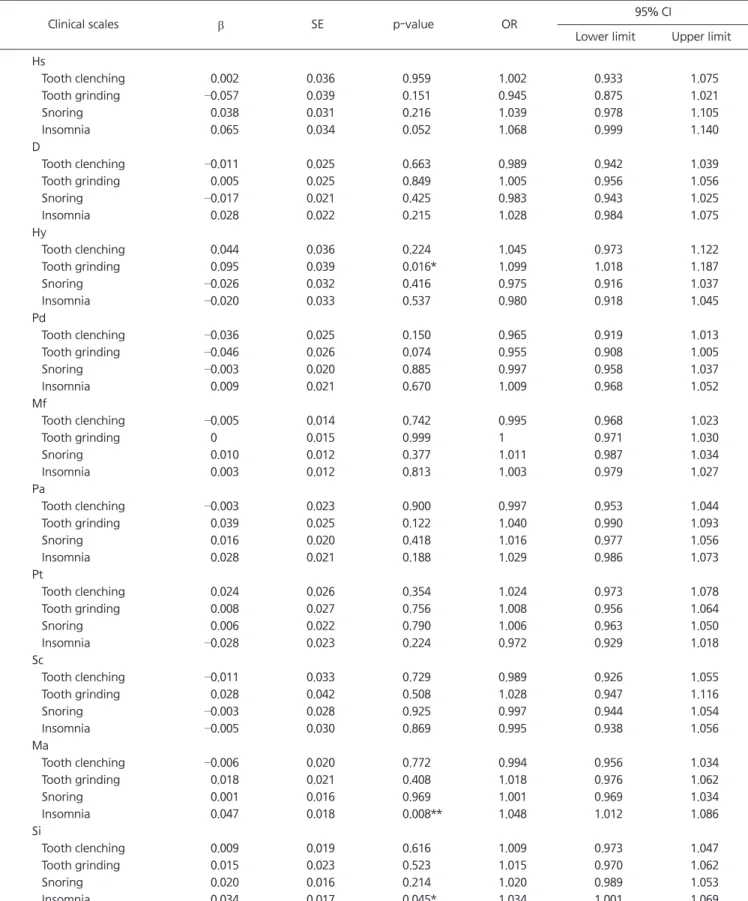
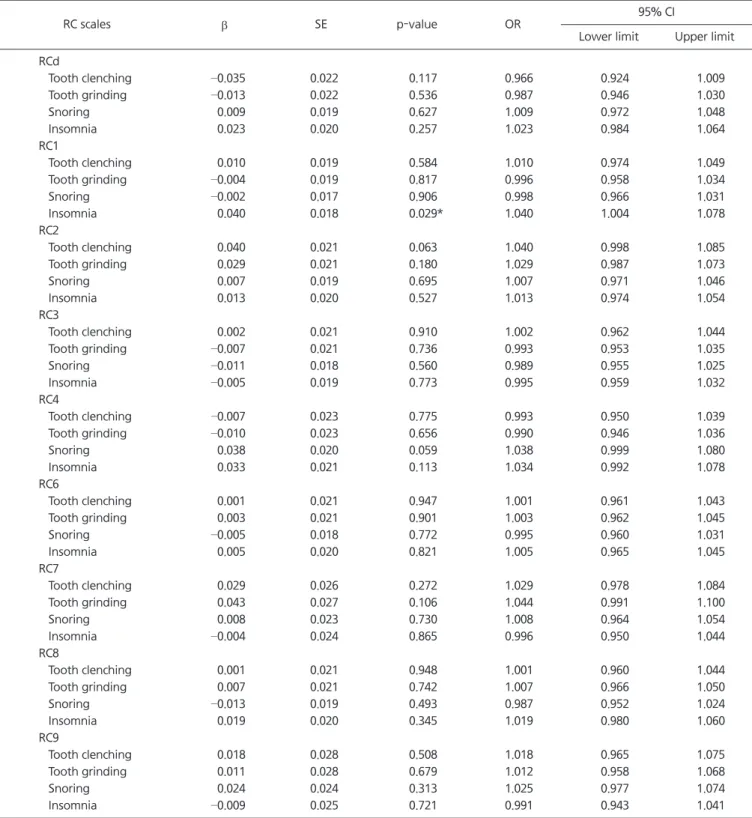
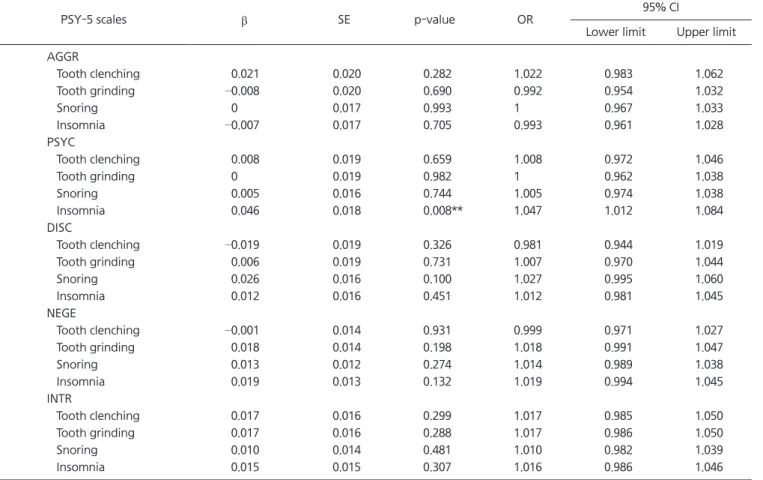
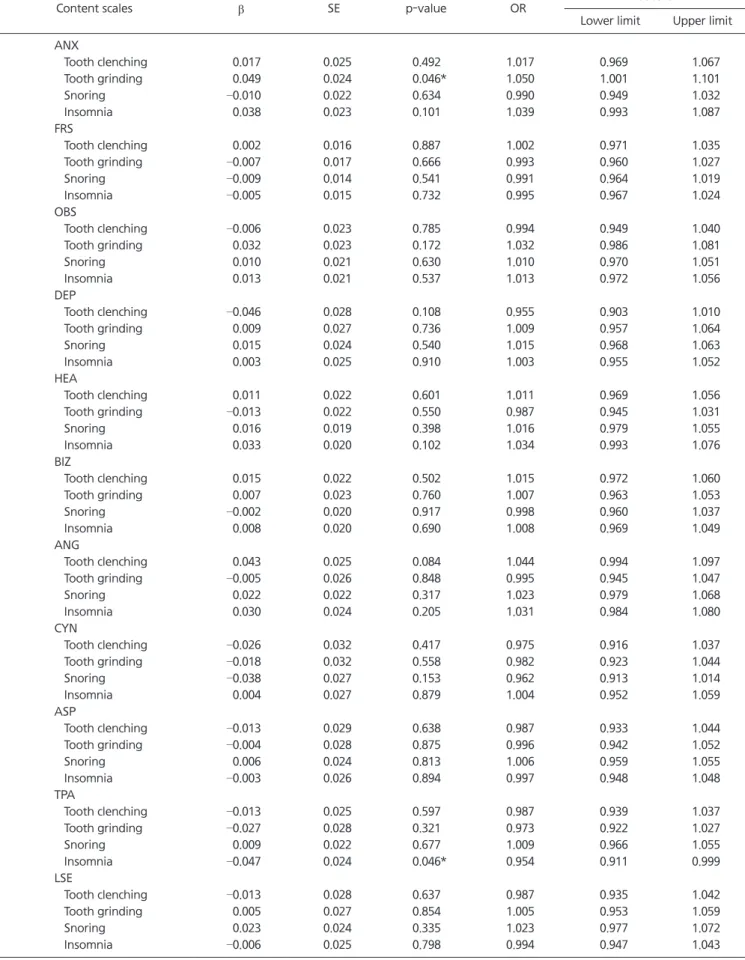
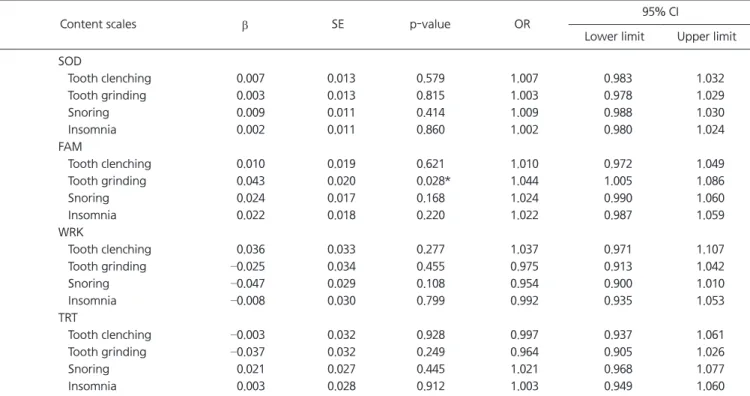
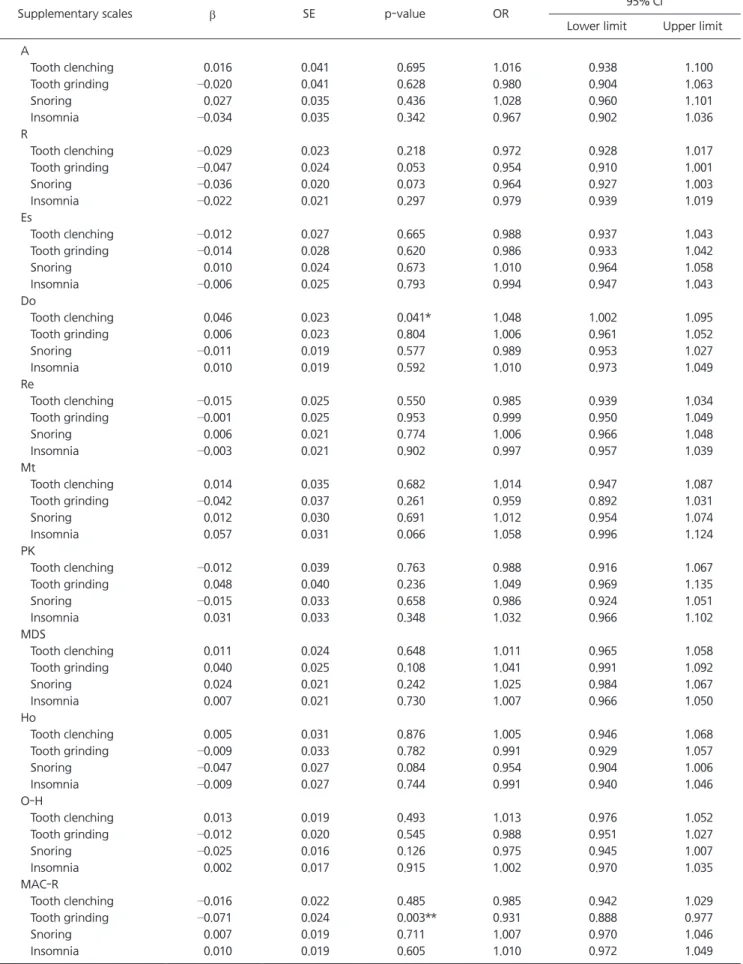
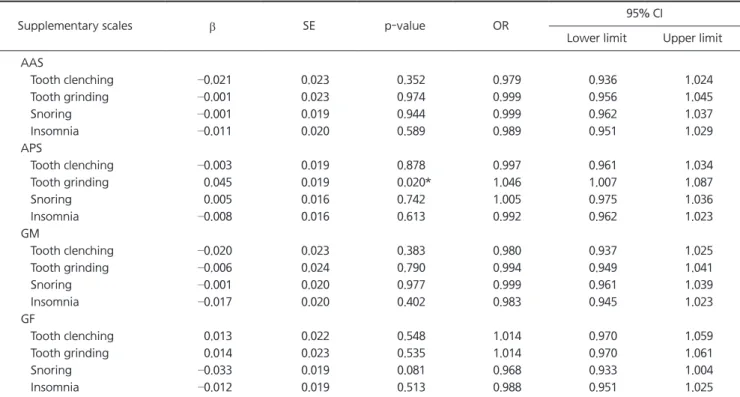
Results: The odds of tooth grinding increased significantly with the increase of T-score of hysteria (Hy) scale. The increase of T-score of hypomania (Ma) and social introversion (Si) scale significantly contributed to the risk of insomnia. The occurrence of insomnia in- creased significantly as T-score of somatic complaints (RC1) and psychoticism (PSYC) scale increased. The odds of tooth grinding increased significantly as T-score of anxiety (ANX) and family problems (FAM) scale increased. The occurrence of insomnia decreased signifi- cantly with the increase of T-score of type A behavior (TPA) scale. The increase of T-score of dominance (Do) scale significantly contributed to the risk of tooth clenching. The odds of tooth grinding decreased significantly as T-score of MacAndrew alcoholism-revised (MAC- R) scale increased, whereas it increased significantly as T-score of addiction potential scale (APS) increased. No scale of MMPI-2 significantly affected the occurrence of snoring.
Conclusions: T-scores of Hy, ANX, FAM, Do, MAC-R, and APS scales on MMPI-2 affected the risk of bruxism. T-scores of Ma, Si, RC1, PSYC, and TPA scales on MMPI-2 influenced the occurrence of insomnia. The psychometric instrument such as MMPI-2 is helpful in un- derstanding and managing bruxism and insomnia.
Key Words: Bruxism; Insomnia; Minnesota Multiphasic Personality Inventory-2; Sleep dis- turbances
Correspondence to:
Hye Sook Park
Department of Dental Technology of Shingu College, 377 Gwangmyeong-ro, Seongnam13174, Korea
Tel: +82-31-740-1575 Fax: +82-31-740-1589 E-mail: [email protected]
https://orcid.org/0000-0002-2981-3908 This study was supported by a grant from Shingu College.
JOMP
Journal of Oral Medicine and PainCopyright Ⓒ 2020 Korean Academy of Orofacial Pain and Oral Medicine. All rights reserved.
CC This is an open-access article distributed under the terms of the Creative Commons Attribution Non-Commercial License (http://creativecommons.org/licenses/by-nc/4.0/), which permits unrestricted non-commercial use, distribution, and reproduction in any medium, provided the original work is properly cited.