REVIEW ARTICLE
JMBS Journal of Metabolic and Bariatric Surgery J Metab Bariatr Surg 2016;5(1):28-35
Received: June 2, 2016, Revised: June 2, 2016, Accepted: June 12, 2016
Corresponding author: Tae Kyung Ha, 222 Wangsimni-ro, Seongdong-gu, Seoul 04763, Korea Department of Surgery, Hanyang University College of Medicine
Tel: 82-2-2290-8443, Fax: 82-2-2281-0224, E-mail: [email protected]
Can Bariatric Surgery Be a Surgical Treatment to Prevent the Progression of Chronic Kidney Disease?
1
Hanyang University College of Medicine,
2Department of Surgery, Hanyang University College of Medicine, Seoul, Korea
Sungji Choi
1, Tae Kyung Ha
2Obesity is a serious worldwide health problem causing numerous obesity-related comorbidities such as hyperlipidemia, hypertension, diabetes, and cardiovascular dysfunctions. Recently, many studies indicate that obesity is strongly related with high rate of renal lesions and reducing weight with surgical intervention can improve renal parameters in obese patients, but the effect of bariatric surgery on obesity-induced chronic kidney disease (CKD) is hardly documented. This review study shows that bariatric surgery demonstrates beneficial reduction in proteinuria and albuminuria leading to improve both glomerular hyperfiltration and chronic kidney disease in obese population. Yet, bariatric surgery is not a definite treatment of choice for the obese patients with CKD because of lack of evidence explaining the risk of complications following bariatric surgery and clarification on estimating glomerular filtration rate (eGFR) in obese patients. Future, high quality studies with a long term follow up are required to determine the effective durability of bariatric surgery on obese-related CKD patients.
Key Words: Bariatric surgery, Obesity, Chronic kidney disease
INTRODUCTION
Obesity, a worldwide health problem, not only increases the morbidity, mortality, and reduces life expectancy but also is associated with metabolic and cardiovascular comorbidities, such as diabetes mellitus, hypertension and hyperlipidemia. Along with these obesity-related comor- bidities, impaired renal parameters also have been des- cribed as relevant health risk posed by obesity [1-5].
Recently, several studies have established obesity as an independent risk factor for the development and progre- ssion of chronic kidney disease (CKD) [6].
The incidence of chronic kidney disease has been increased rapidly over the past years and this is accom-
panied by an epidemic of obesity. It was reported in many studies that compared to the non-overweight population, obese population significantly has higher risk of chronic kidney disease. The pathogenesis of cardiovascular com- plications from chronic kidney disease has been widely described in several studies, but the influence of obesity in the pathogenesis of kidney disease has been underesti- mated [7].
Many experimental and clinical data indicate that
obesity results in glomerular hyperfiltration; however, the
pathophysiologic mechanism is unknown [8]. Hyperfi-
ltration leads to the occurrence of microalbuminuria and
proteinuria and can accelerate the progression of preexi-
sting renal failure [9-12]. Therefore, reducing glomerular
hyperfiltration which can be achieved by weight loss could prevent or reverse the obesity-associated kidney disease.
Several studies support the fact that bariatric surgery on morbidly obese patients improve or stabilize their renal function and improve microalbuminuria [13-18]. However, surgical intervention has not yet been strongly recommen- ded for the obese patients with CKD. This short review will focus on the effect of bariatric surgery on renal function outcomes on obese patients with CKD, as well as patients with pre-existing glomerular hyper-filtration.
MATERIALS AND METHODS
An electronic search method using search-terms (Kidney disease, obesity, bariatric, surgery) was primarily used for the identification of the studies.
Comprehensive search of all electronic data bases (Pub Med, MEDLINE, Web of Science) was performed.
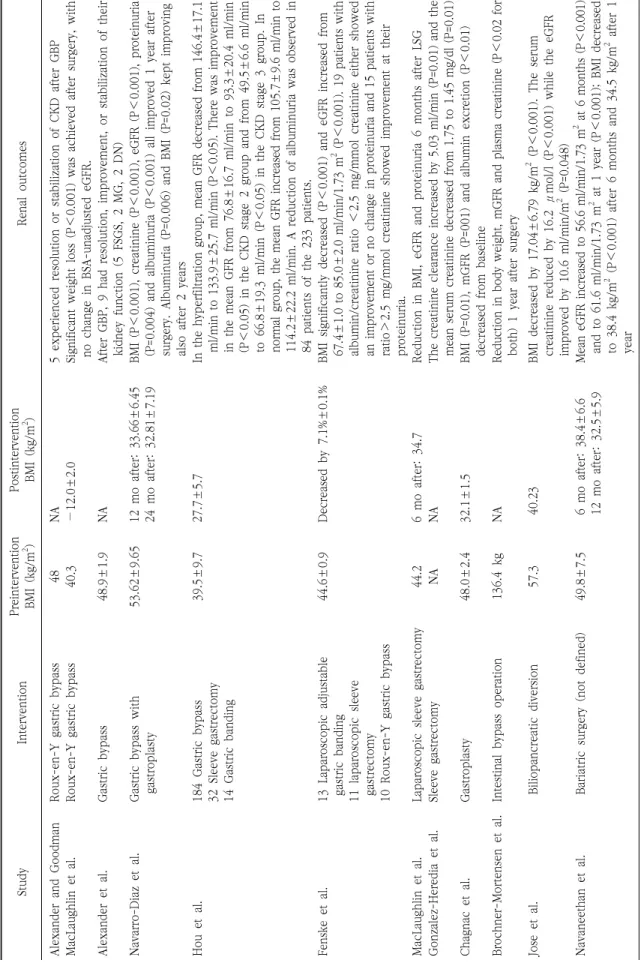
12 studies were thoroughly reviewed and characteristics of these are summarized in Table 1. We only extracted the studies clearly indicating patients diagnosed with either CKD or glomerular hyperfiltration based on GFR value but not on creatinine level. The renal outcomes include GFR value, proteinuria and albuminuria. The results of all 12 studies are summarized in Table 2.
RESULTS
Studies on bariatric surgery included collectively 773 patients with a mean BMI ranging from 39.5 kg/m
2to 57.3 kg/m
2. Baseline kidney disease included glomerular hy- perfiltration [13-15,19], overt CKD [16-24], or end-stage renal disease [16]. There are two studies [16,20] including patients on hemodialysis (HD) treatment. In the study by Alexander and Goodman [16], only the subpopulation with CKD who underwent gastric bypass without transplant was reviewed for which follow-up analysis were performed separately. The retrospective study of MacLaughlin et al.
[20] did not numerically quantify the level of eGFR and proteinuria, but the author explained that these para- meters have improved 6 months after bariatric surgery.
Both prospective studies by Alexander et al. [16,17] reported a case series of patients who had resolution, improvement,
or stabilization of their kidney function derived from obese study population after surgery. The type of surgery per- formed in these studies is heterogeneous. 4 studies con- sidered Roux-en-Y gastric bypass [15-17,23], and 2 studies [20,24] performed sleeve gastrectomy, in which Mac- Laughlin et al. [20] used laparoscopic sleeve gastrectomy, to achieve weight loss. In the study by Hou et al. [19], of 233 total patients, 184 patients underwent gastric bypass, 32 patients had sleeve gastrectomy and gastric banding was performed for 14 remaining patients. In addition, Fenske et al. [21] performed laparoscopic adjustable gastric banding for 13 patients, laparoscopic sleeve gastrectomy for 11 patients and 10 patients underwent Roux-en-Y gastric bypass. In the remaining studies [13,14,22], surgical tech- niques contained gastroplasty, intestinal bypass operation, and biliopancreatic diversion. However, in the study by Navaneethan and Yenhert [18], the type of surgery was not defined.
In all studies, BMI or body weight had been reduced significantly after bariatric surgery. In the studies with obese patients with glomerular hyperfilltation [13-15,19], GFR decreased or stabilized after undergoing bariatric surgery. Brøchner-Mortensen et al. [13] carried out a study on the effects of weight loss on renal function for the first time in 1980, and in that study GFR was reduced following intestinal bypass surgery in obese subjects [13]; however, the study did not contain data regarding renal blood flow and albuminuria. The study by Chagnac et al. [14] demon- strated that mean GFR and albumin excretion decreased from 145±14 ml/min to 110±7 ml/min (P=0.01) and from 16 μg/min to 5 μg/min (P<0.01) at least 12 months after surgery, respectively. Navarro-Díaz et al. [15] carried out a controlled prospective study of 61 extremely obese patie- nts who underwent gastric bypass and all renal function parameters including creatinine (P<0.001), proteinuria (P=0.004), albuminuria (P=0.006) and eGFR (P<0.001) considerably improved 1 year after drastic weight loss;
however, only albuminuria kept improving during the 24
month of follow-up. In this study a significant decrease in
creatinine clearance, proteinuria and microhematuria 12
months after surgery occurred in relation to a remarkable
weight loss during first year of follow-up. The reduction of
GFR after weight loss surgery in the hyperfiltration group is
Ta ble 1. B aseline charact er istics withi n i nclude d studie s for re vie w a rticle Author Y ear Countr y Typ e of stu dy Base line k idne y dise ase Number of p ati en ts Surgi cal te chnique Fo llo w -up year s Brochner- M ort en se n et a l. 19 80 D en m ar k P ro sp ec ti ve H yper fil tr at io n 25 ob es e p ati en ts Int es tin al byp ass op er ati on 7 yr Chag nac et a l. 20 03 Is rael P ros pe ct ive H yperf ilt rat io n 8 se ve re o bes ity 9 no n-obe se Gastrop las ty 17 mo Nav arro -Diaz et a l. 2006 US A Pro sp ec ti ve H ype rfilt ration 61 e xtr eme ly obe se p atien ts 24 h ea lt h y g ro u p Gastric bypass 12 m o 24 m o Alexan der and Goo dman et a l. 20 07 U SA P ro sp ec ti ve c oh or t ES R D , C K D 41 C K D ( 25 H D ) 32 C K D w h o h as G B P w ithout transplant
Roux-en-Y gast ric bypass Up to 13 y r A le x an de r e t a l. 20 09 U SA P ro sp ec ti ve C K D 45 o b es e p at ie n ts w it h C K D G astric b ypass U p to 9 y r N avan ee th an et a l. 20 09 U SA R et ros pe cti ve CK D st ag e 3 25 CK D st ag e 3 Bariatr ic surger y (no t def in ed ) 2 yr M acLaughlin et a l. 2012 Unite d Kin gd om Re tro sp ect ive C KD 9 CKD (5 H D ) Laparo scopic sl eeve gastre cto my Up to 39 m o Ho u et a l. 20 13 Ch in a R et ro sp ec ti ve H yper fil tr at io n CKD st ag e 2 CKD st ag e 3
To tal 23 3 61 Hype rfilt ration 39 C K D s ta ge 2 3 CK D s tage 3 14 G as tr ic b an di n g 32 S leev e gas trec to m y 184 Gastric b ypass (129 mini-gastric b yp as s a n d 5 5 R G B P )
12 m o Fe ns ke e t al . 2013 Uni te d K in gd om Pr os p ect iv e C KD < st age 3 34 CKD < st ag e 3 13 Laparo scopic adjust able gastr ic banding 11 lapar osco pic sleeve gastr ect omy 10 R ou x -e n -Y g as tr ic b yp as s 12 m o Jose e t al. 2013 US A R et ro sp ect iv e CKD T otal 25 7 GF R ≤ 60 m l/m in /m
218 G FR > 60 ml/ min/ m
2Biliop ancre atic di ve rsion 4 yr M acLaughlin et a l. 2014 Unite d Kin gd om Pro sp ect ive CKD st age 3 -4 5 CKD stage 3-4 6 co nt ro l Roux-en-Y gast ric bypass 12 m o Gonzalez- Heredia et al . 20 16 U SA R et ros pe cti ve CK D To tal 223 Sl eev e gas trec to m y 6 m o
Ta ble 2. R enal ou tcomes fo llowi n g bariatric su rg ery St udy Int er ve nt io n P rein terven tio n BM I (k g/m
2) P os tin te rv en ti on BMI (kg /m
2) Re nal outcome s Ale x ande r and Good man R oux-e n -Y gastric b ypass 48 N A 5 experienced re so lu ti on o r st ab ili za ti on o f C K D a ft er G B P M ac La ugh lin et a l. R oux-en -Y g ast ri c b ypa ss 40 .3 − 12. 0±2.0 Si gn ifican t weigh t los s (P < 0. 001 ) was achiev ed a ft er s ur ge ry, with n o c h an ge i n B SA -u n ad ju st ed e G FR . Ale x ande r et a l. Gastr ic bypas s 48 .9±1.9 NA Aft er GBP, 9 h ad r es ol ution, improve m en t, or st abil iz ation of their ki dn ey f u n ct io n ( 5 F SG S, 2 M G , 2 D N ) Navar ro-D iaz e t al . G astr ic b ypass with ga st ro pl asty 53 .6 2±9. 65 12 m o aft er : 33 .6 6±6. 45 24 m o af te r: 32. 81 ± 7.1 9 BMI (P < 0. 001) , cre ati ni ne ( P < 0. 00 1), eGF R ( P < 0. 00 1), pr ote inuria (P =0 .0 04 ) a n d a lb um in u ri a ( P < 0. 001 ) all impr ov ed 1 y ear aft er su rg er y. A lb um in u ri a ( P =0 .0 06 ) a n d B M I (P =0 .0 2) k ep t i m p ro vi n g al so a ft er 2 y ea rs H ou e t a l. 18 4 G as tr ic b yp as s 32 Sl ee ve gastre cto my 14 Gastr ic banding
39 .5 ±9 .7 27 .7 ±5 .7 In th e hyp erfi ltrati on group, m ean GFR d ec reas ed f rom 146. 4±1 7. 1 ml /min to 133 .9 ±25. 7 ml/ m in ( P < 0. 05 ). T her e w as i mpr ov eme nt in the mean GFR fr om 76. 8±16 .7 ml/ min to 93. 3±20 .4 ml/ min (P < 0. 05 ) i n t h e C K D s ta ge 2 g ro u p a n d f ro m 4 9. 5± 6. 6 m l/ m in to 66. 8±19 .3 ml/ min (P < 0. 05 ) in t h e C K D s ta ge 3 g ro u p . In normal g ro up , th e mean G FR i ncre ase d fro m 105. 7±9 .6 ml /min to 11 4. 2± 22 .2 m l/ m in . A r ed uc ti on o f a lb um in ur ia w as o b se rv ed i n 84 p at ie n ts o f t h e 2 33 p at ie n ts . Fe nsk e et al . 13 Lapar osco p ic ad jus table gas tr ic ban din g 11 lap aros cop ic sle ev e gas tr ectomy 10 Roux-en-Y ga stric bypass
44 .6 ±0 .9 De cre ase d by 7. 1%±0 .1 % BM I sig n if ic antly de creas ed (P < 0. 00 1) a n d eGFR in cr ea se d fr om 67.4±1. 0 to 85. 0±2.0 ml/ m in/ 1.73 m
2( P < 0.0 01). 19 patien ts w ith al bumi n/ cre ati ni ne r ati o < 2.5 mg/mmol cr eat in in e eithe r showe d an i m p ro ve m en t or n o c h an ge i n p ro te in ur ia a n d 1 5 p at ie n ts w it h ra ti o > 2.5 mg/mmol cre atinine s ho wed improvement at t hei r protei nu ri a. MacLau gh lin e t al . Lapar osco p ic sle ev e ga str ect omy 44 .2 6 mo afte r: 34. 7 R ed uction i n BM I, eGF R an d p ro te in u ri a 6 mo nths afte r LSG Go n zal ez-Hered ia et al. Sle eve g ast rec tom y N A N A T he cre ati n in e cl earance increased by 5.03 m l/m in ( P =0. 01 ) an d th e m ean se rum c reatinine decreased fro m 1 .7 5 to 1.45 m g/dl (P=0.01 ) Ch agn ac et a l. Gas troplas ty 48 .0 ±2 .4 32 .1 ±1 .5 BM I (P= 0. 01 ), mGFR (P =001) and albumin excretion (P < 0. 01 ) de cre ase d fr om b ase line Br ochne r-M ort en se n e t al. Inte st in al byp ass op eration 13 6. 4 kg NA R ed uc ti on i n b od y w ei gh t, m G FR a n d p la sm a cr ea ti n in e (P < 0. 02 fo r both) 1 year af ter su rg ery Jo se e t al. Biliopan creatic di ver sion 57 .3 40 .2 3 B MI de cre ase d b y 17. 04 ±6. 79 kg/ m
2( P < 0. 001 ). T he se rum cr eat in in e red uc ed b y 16 .2 μ m ol /l ( P < 0.0 01 ) wh ile th e eGF R imp ro ve d b y 10 .6 m l/ mi n/ m
2( P =0. 04 8) Navan ee th an et a l. Bariatr ic surger y (no t def in ed ) 49. 8±7. 5 6 mo after: 38 .4 ±6 .6 12 mo afte r: 32. 5±5 .9 M ean e GFR incr eas ed t o 56. 6 ml/ min/ 1. 73 m
2a t 6 m on th s (P < 0. 00 1) and to 61. 6 ml /min/ 1. 73 m
2at 1 year (P < 0. 00 1); BMI de cre ase d to 38. 4 kg/ m
2( P < 0. 001 ) afte r 6 mont hs a nd 34. 5 kg/ m
2a fte r 1 year
also demonstrated in the study by Hou et al. [19].
On the contrary, substantial studies over past years support that GFR increased in obese patients with CKD after bariatric surgery. In the retrospective study of 25 morbidly obese patients with CKD stage 3 who underwent bariatric surgery, patients’ estimated GFR increased after surgery from an average of 47.97 ml/min/1.73 m
2at baseline to 56.6 ml/min/1.73 m
2at 6 months and to 61.67 ml/min/1.73 m
2at 1 year [18]. Alexander et al. [16,17] pub- lished two studies reporting case series on the effect of gastric bypass in chronic kidney disease patients. The results from both demonstrate strong support for the notion that bariatric surgery can be a successful inter- vention to lead the greatest renal benefit for patients with preexisting renal disease. In the cohort study of 45 morbidly obese patients, 9 patients had resolution, stabili- zation or improvement of their renal impairment after surgery. One with glomerulonephritis had complete reso- lution after 9 years of postoperative follow-up and 2 patients undergoing dialysis for focal and segmental glomerulosclerosis were able to discontinue dialysis for 27 and 7 months, respectively. The remaining patients had stable kidney function for the rest of the follow-up years [17]. In the previous study by Alexander and Goodman [16], of 41 obese patients, 5 patients had either resolution or stabilization of their preexisting chronic kidney disease after gastric bypass surgery. Above studies mostly perfor- med Roux-en-Y gastric bypass as a surgical procedure;
however, MacLaughlin et al. [20] presented first report of performing laparoscopic sleeve gastrectomy for the treatment of obese patients. In that study, 9 patients with CKD underwent laparoscopic sleeve gastrectomy and had reduction on eGFR and proteinuria after 6 months of follow-up. This might suggest that laparoscopic sleeve gastrectomy can be an effective treatment for morbidly obese patients with CKD. Gonzalez-Heredia et al. [24] also performed sleeve gastrectomy for patients with CKD, and this study demonstrated that renal function significantly improved 6 months after that type of surgery. Regarding the type of surgical intervention, there is a retrospective study comparing the difference in the degree of GFR change between the 2 surgical procedures; of the 233 severely obese patients, 46 patients received restric-
tive-type surgery (14 adjustable gastric banding surgeries and 32 sleeve gastrectomy surgeries), and 184 patients received gastric bypass surgery (129 mini-gastric bypass surgeries and 55 Roux-en-Y gastric bypass surgeries). In the patients with CKD group, who had an increase in mean GFR after 1 year follow-up, different bariatric procedures did not produce a significant difference on the degree of GFR change [19]. Along with the increase in GFR degree, bariatric surgery also leads to a marked improvement in renal function including reduction in urinary and serum cytokine levels, which are directly correlated with body weight loss, and improvement in proteinuria [21]. Other than these two surgical intervention (Roux-en-Y gastric bypass and sleeve gastrectomy), there was a recent study on the effect of biliopancreatic diversion surgery on renal function. In this retrospective study, Jose et al. [22] had established that the mean serum creatinine value dec- reased, as well as eGFR values improved significantly. In addition, the 7 patients with GFR of ≤60 ml/min/m
2presented the greatest increase in GFR compared to those with GFR >60 ml/min/m
2(P=0.001). Several studies over past years have suggested the evidence to support the positive impact of bariatric surgery on renal function with the CKD patients; however, this has not been examined in a randomized controlled trial. MacLaughlin et al. [23] carried out a randomized controlled pilot study to investigate whether the greater weight loss after weight loss interven- tion would improve eGFR, proteinuria, insulin resistance, inflammation, and adipokine response in obese patients with CKD stages 3 to 4. In this study, eGFR was calculated with the removal of the adjustment for standardized body surface area (BSA), leading a small post-intervention eGFR increases to be reversed. Hence, while a significant weight loss account for the positive changes in adiponectin, insulin use, and insulin resistance, there was no change in BSA-unadjusted eGFRs. In all reviewed studies, a significant GFR increase suggests beneficial effects of bariatric surgery on kidney function.
DISCUSSION
The prevalence of obesity has increased dramatically.
Nearly two thirds of US adults are overweight (BMI ≥25
kg/m
2) and one half of these are obese (BMI ≥30 kg/m
2) [25]. The increase in the prevalence of CKD in Asia is not lower than that in Western countries. In South Korea, the overall prevalence of CKD was 13.7%, suggesting about 3.2 million urban Koreans age 35 years older may have CKD, and has increased remarkably recent years. The study established that the obesity may be the independent risk factor for development of CKD also in South Korea as the study indicated that higher BMIs were related to higher CKD prevalence (P<0.05) [26]. Over the past years, with the steady increase in rates, obesity emerges as major health threat in South Korea. This prevalence trends in overweight and obesity among Koreans poses at great risk for incidence or progression of CKD [27]. Therefore, weight loss can lead to prevent or stabilize preexisting renal impairment with obese patients in South Korean.
Extreme obesity (BMI ≥40 kg/m
2) usually does not respond to medical treatment, therefore, the surgical weight loss intervention has been the treatment of choice [28]. Although the mechanism involving the positive effect on renal outcomes by surgical intervention is still un- known, several studies support that glomerular hyperfi- ltration produced by obesity favors the occurrence of microalbuminuria and proteinuria, which contribute to obesity-related renal disease [14,15]. Obesity-comorbidities such as hyperlipidemia, hyperinsulinemia and leptin may lead to the state of glomerular hyperfiltration [9,29,30].
Moreover, the tubular sodium reabsorption is enhanced by the increase of angiotensin II (AngII) produced by fat tissue which activates tubule-glomerular feedback [31]. Conse- quently, the afferent arterioles are dilated resulting in increase in renal blood blow, intraglomerular pressure, and GFR [8,14]. This explains the underlying mechanism of obesity induced hyperfiltration, which is the first manife- station of progression to CKD in obese patients. Thus, the beneficial effect of reducing the weight gain by surgical intervention on progression of CKD may be strongly associated with the reversal of glomerular hyperfiltration injury. However, cause-and-effect relationship between glomerular hyperfiltration and chronic kidney disease is not clear. This implies that fact that improvement in both renal impairments occurred independently following weight loss. Further study is necessary to evaluate the
mechanism explaining cause and effect relationship between hyperfiltration and CKD.
The extracted studies mostly use estimated GFR and the creatinine clearance as the kidney function parameters.
However, some reports show that there is an association between obesity and elevated serum cystatin C levels [32-34].
A cross-sectional study of 241 hypertensive patients with stage1-2 CKD suggested that the visceral adipose tissue is more associated with reductions in glomerular filtration rate than with total and abdominal obesity in these patients. Glomerular filtration rate was calculated based on both serum creatinine and serum cystatin C. However only glomerular filtration rate based on cystatin C was asso- ciated with decreased glomerular filtration rate in hyper- tensive women with CKD [35]. Regarding the value of cystatin C as a marker for predicting GFR in obese patients, the study by Friedman et al. [36] suggested that the Chronic Kidney Disease Epidemiology Collaboration equation using both serum creatinine and cystatin C (CKD-EPI-
creat-cystC