• 검색 결과가 없습니다.

Low-Intensity Pulsed Ultrasound Promotes Healing with Increases Collagen Deposition and Collagen mRNA Expression in Skin Wound of Rat

N/A
N/A
Protected

Academic year: 2021

Share "Low-Intensity Pulsed Ultrasound Promotes Healing with Increases Collagen Deposition and Collagen mRNA Expression in Skin Wound of Rat"

Copied!
8
0
0

로드 중.... (전체 텍스트 보기)

전체 글

(1)

Research Article Open Access

Low-Intensity Pulsed Ultrasound Promotes Healing with Increases Collagen Deposition and Collagen mRNA Expression in Skin Wound of Rat

Jae-Hyoung Lee


⋅Seung-Joo Jekal 1 ⋅Pil-Seung Kwon 1

Dept. of Physical Therapy, Electrotherapy Research Laboratory for Tissue Growth & Repair, Wonkwang Health Science University,

1 Dept. of Clinical Laboratory Science, Wonkwang Health Science University

저강도 맥동초음파에의한 피부 상처 치유 촉진과 아교질 축적 및 아교질 mRNA 발현 증가

이재형 , 제갈승주 1 , 권필승 1

원광보건대학교 물리치료과, 1 원광보건대학교 임상병리과

Received: July 31, 2013 / Revised: August 14, 2013 / Accepted: August 19, 2013

ⓒ 2013 Journal of the Korean Society of Physical Medicine

| 초록 |
목적: 본 연구는 저강도 맥동 초음파적용이 흰쥐의 전층

상처 치유와 아교질 축적 및 아교질 mRNA발현에 미치

는 영향을 규명할 목적으로 시행하였다.

방법: 12마리의 Sprague-Dawley계 흰쥐를 저강도 맥동 초음파군 (n=6)과 대조군 (n=6)에 무작위 배정하고 등에 19.63 ㎟ 크기의 전층 적출 상처를 만든 다음 저강도 맥동 초음파군은 3 MHz, 순환주기 20%, SATA 강도 0.4 W/㎠

로 1일 1회, 1회 5분씩 초음파를 적용하고, 대조군은 가짜 초음파를 적용하였다. 7일간 처치 후 초음파군과 대조군 의 아교질 축적, 아교질 mRNA 발현, 상처치유율, 절반치 유시간을 비교하였다.

결과

: 초음파군의 아교질 축적 (p<05)과 아교질 mRNA

발현 (p<.01)이 대조군보다 유의하게 증가하였고, 상처 치유율 (p<.05)과 절반치유시간 (p<.01)도 초음파군의 대 조군보다 유의하게 빨랐다.

결론: 본 연구에서 전층 상처에 저강도 맥동 초음파를 적

†Corresponding Author : [email protected]

용한 결과 상처 치유가 촉진되었고 육아조직에 아교질 축적이 증가하였다. 이러한 결과는 맥동 초음파의 기계

적 자극이 제 1형 아교질 mRNA 전사활동을 촉진시키는

것으로 사료된다.

핵심단어: 저강도 맥동초음파, 상처 치유, 아교질 축적, 아교질 mRNA 발현

Ⅰ. INTRODUCTION

Therapeutic ultrasound (US) is one of the most widely used an electrophysical agents and well-accepted physical therapy modality for variety conditions(Wong et al., 2007).

In Wong and colleagues' survey, 62.2% of responding physical therapists identified ultrasound as clinically important for soft tissue inflammation, 53% for remodeling scar tissue, 47% for tissue healing, 39.4% for pain control, and 27.9% for decreasing soft tissue swelling.

Therapeutic US can be classified as continuous or pulsed

(2)

mode in physical therapy. The continuous ultrasound (CUS) has been used in treating musculoskeletal problems by thermal effects which due to rising tissue temperature, and are accepted as including increased metabolic activity, blood flow and connective tissue extensibility (Baker et al., 2001). The low intensity pulsed ultrasound (LIPUS) has been used nonthermal effect to promote skin wound healing (de Ávila Santana et al., 2013), tendon healing (Fu et al., 2010), chondrogenesis (Loyola-Sánchez et al., 2012), and osteogenesis (Schofer et al., 2010).

There are many practice guidelines and systematic reviews about the US on wound healing. High quality practice guidelines do not recommend LIPUS treatment for wound healing (SIGN, 2010). Similarly, high quality systematic reviews concluded that LIPUS has no evidence of a benefit on the wound healing in human (Cullum et al., 2010). Although, there is controversy about the effect of LIPUS on wound healing in clinical trial, many studies have been reported a positive effect of PLIUS in animal experiment.

There are some studies that LIPUS below a spatial average temporal average (SATA) of 0.5 W/㎠ can promote wound healing in animal model (Young and Dyson, 1990;

Byl et al., 1993). Many studies reported that LIPUS accelerated wound healing and increased hydroxyproline content in rat skin wound (Taşkan et al., 1997; Demir et al., 2004; Freitas et al., 2010; Guimarães et al., 2011).

In in vitro study, Webster et al. (1980) and Ramirez et al. (1997) have demonstrated that LIPUS increased the rate of hydroxyproline level in cultured fibroblast. Most studies concerning collagen content focus on hydroxyproline level in wound healing. Hydroxyproline assay allows the direct measurement of collagen content in tissue. Collagen is major extracellular matrix of the granulation tissue, and plays important roles in cell signaling and cellular activities, including cell shape and differentiation, migration during healing process (Menon et al., 2012).

Recently, some studies have been reported that LIPUS

increased type I and III collagen mRNA expression during healing process (Fu et al. 2010; Naito et al., 2010; Uenaka et al. 2010). But their results derived from the injured tendon of rat, the chondrocytes in osteoarthritis model and the cultured chondrocytes, respectively.

There are few studies that histological examination of the collagen content in the granulation tissue and at the transcriptional level of the collagen synthesis in dermal wound model. We hypothesized that LIPUS increases collagen deposition and stimulates type I collagen mRNA expression as well as increases healing in dermal wound model.

The purpose of the present study was to examine the effect of LIPUS on collagen deposition in regenerating granulation tissue in situ, type I collagen mRNA expression and wound closure rate in full-thickness excision wound of rat.

Ⅱ. METHODS

1. Animals

Twelve male Sprague-Dawley rats, weighing 260g±10 g (Koatech, Pyeongtaek, Korea), were used for this study.

Animals were adapted for a period of 3 days. Rats were housed in standard bio-clean cages (20 x 38 x 56 cm), and bred in the animal room, where environmental conditions were kept constant condition (temperature, 22±1°C; humidity, 60%; 12 hour light-dark cycle). Food and water were allowed ad libitum. The animals were handled in accordance with national guidelines for the humane treatment of laboratory animals.

2. Wounding Procedure

The hair on the back of the rat was shaved and cleaned

with povidine-iodine and alcohol. Two 19.63 ㎟ circular

full-thickness wounds including the panniculus carnosus

were created in the skin, one on either side of the back

(3)

using a 5-mm diameter of sterile biopsy punch (Stiefel Laboratories, Inc., Wächtersbach, Germany) under general anesthesia by inhalation of halothane, maintained at a concentration of 2-3%. The excisions were placed 4 cm apart. The wound was clean with a sterile gauze pad, and the rat was carefully observed until it had recovered fully from the anesthesia. Wounds were kept open throughout the entire experiment, without dressing.

3. Ultrasound Application

The rats were randomly assigned into LIPUS group (n=6) or sham LIPUS treated control group (n=6). The LIPUS group was treated with US using Sonoplus 434 (Enraf-nonius B.V., Rotterdam, Nertherland) and transducer (Enraf-Nonius B.V., Rotterdam, Nertherland) with 1 cm in diameter. The ultrasound was applied with 3 MHz, pulse ratio 2 ms: 8 ms (duty cycle 20%), SATP 2 W/㎠, SATA 0.4 W/㎠ for five minutes for seven days. The wound cavity was filled with sterile saline, and covered with a 0.1 cm thick transparent polyurethane hydrogel sheet (Hydrosorb Comfort, Paul Hartmann, Heldenheim, Germany). The coupling gel (PowerSonic, Seoul, Korea) was placed on the surface of the transducer and superficial surface of hydrogel sheet. The US applied by moving technique on the hydrogel sheet and approximately 1 cm of surrounding intact skin with slow and overlapping circular motion. For control group, wounds were received sham US without power for five minutes in a similar procedure to the LIPUS treatment group.

4. Wound Surface Area Measurement

The wound surface area (WSA) was measured by tracing and planimetry. A transparency film placed over the wound, and traced the perimeter of the wound on the film with a fine-tipped pen, The wound tracings were traced with digital planimetry (Vistrak Digital, Smith & Nephew Medical Limited., England), then the wound surface area (WSA) was determined. The wound closure rate was

calculated as a percentage of the reduction from the original wound surface area. Planimetric measurement of WSA was high interrater reliability (r=.91, p<.01).

5. Quantitative Histological Analysis

For histochemical analysis, a 6 mm diameter of full-thickness wound biopsy samples were obtained at 7 days of post-wound. Samples were fixed in 10% phosphate buffered formalin, they were paraffin embedded, sectioned 5 µm thick, and stained with hematoxylin and eosin (H&E) and Masson trichrome (MT). The deposited collagen density in regenerating granulation tissue were assessed by image analysis system(Image-Pro ® Plus, Media Cybernetics, Inc., MD, U.S.A.). The density of collagen were measured in 5 serial fields from regenerated dermis at 200 magnification. The mean density were calculated.

6. Reverse transcription-polymerase chain reaction (RT-PCR) analysis of Type I Collagen mRNA

A 6 mm diameter of full-thickness of skin biopsies were harvested at day 7 after wound. Total RNA from biopsies were prepared by the RNAzol B (Tel-Test Inc., Friendswood, TX, USA), and stored at -80℃. The RNA content was quantified using Qubit fluorometer (Life Technologies Co., Carlsbad, CA, USA). 0.5 ㎍ of isolated RNA was reverse transcribed to first strand cDNA with 20 ㎕ of CycleScript RT Mixture kit (AccuPower ® , Bioneer, Daejeon, Corea). The cDNA synthesis reactions were performed at 50℃ for 60 min and the products were stored at -20℃. A 0.5 ㎕ of the RT product in a 19.5

㎕ of PCR MasterMix (Jenotech, Daejeon, Korea) containing Taq DNA polymerase was carried out PCR amplification in a Thermal Cycler (S1000 , Bio-Rad Laboratories Inc., Richmond, CA, USA) for 30 cycles of 60 s at 94℃, 60 s at 59℃, and 60 s at 72℃ (for type I collagen) or 30 s at 94℃, 30 s at 59℃, 30 s at 72℃

(for beta-actin). The primers for type I collagen was chosen

(4)

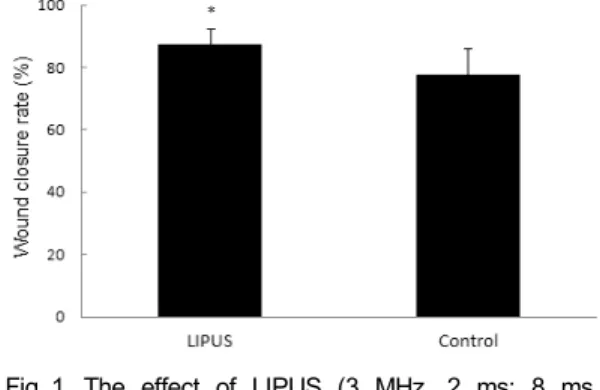
Fig 1. The effect of LIPUS (3 MHz, 2 ms: 8 ms, SATA 0.4 W/㎠, 5 minutes, 120 J/㎠) on the wound closure rate at 7 days after excision wound. A significant increase in wound closure rate in the LIPUS group compared with control group (*p<.05). Data represent the mean and standard deviation of values from 6 rats. LIPUS: low intensity pulsed ultrasound from coding region, sense 5'-TGG AGA CAG GTC AGA

CCT G-3' and antisense 5'-TAT TCG ATG ACT GTC TTG CC-3', generating a 409-bp fragment, and β-actin were also chosen from coding region, sense 5'-GTG GGC CGC CCT AGG CAC CA-3' and antisense 5'-CGG TTG GCC TTA GGG TTC AG-3', generating a 245-bp fragment.

PCR products were resolved by 2% agarose gel electrophoresis and stained with cyber green staining. The amount of mRNA was determined using a Gel Doc system and Quantity One 1-D analysis software (Bio-Rad Laboratories Inc., Richmond, CA, USA). For the relative level of type I collagen mRNA, an OD ratio of 1.00 was designated to be 1.00 arbitrary unit.

7. Data Analysis

For a comparison of the percent of wound closure rate and half healing time, the collagen density and type I collagen mRNA ratio between the LIPUS and control groups, the Mann-Whitney U-test was used. To assess interater reliability, the Pearson product-moment correlation coefficient was used. The statistical interpretation was based on a .05 significance test level. SPSS WIN (ver 12.0) software was used for the analyses.

Ⅲ. RESULTS

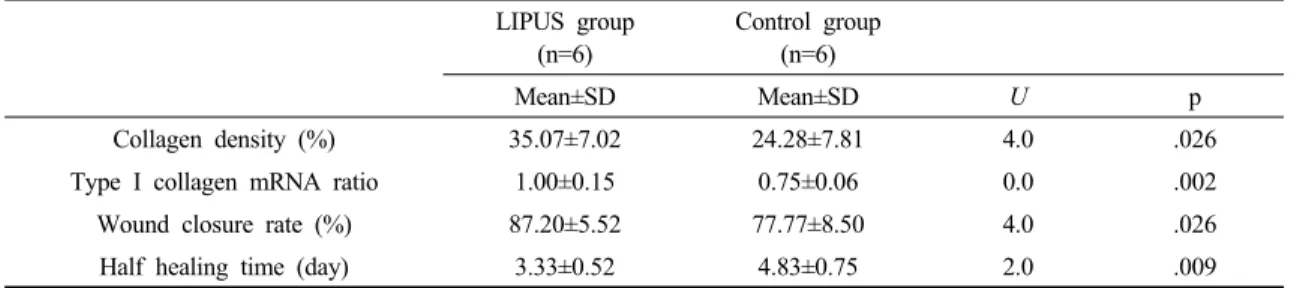
After 7 days of wound, the LIPUS group, wound closure rate increased by 12.13% compared with the sham ultrasound treated control group (p<.05) (Table 1, Fig 1).

The LIPUS group had shorten significantly the half healing time compared with the control group (p<.01) (Table 1).

Figure 2 shows collagen fibers in the regenerating granulation tissue at day 7 after the wound. The blue color stained areas corresponding to the collagen fibers. The collagen fibers were more dense and regular in the LIPUS in compared with the control group. It was observed that

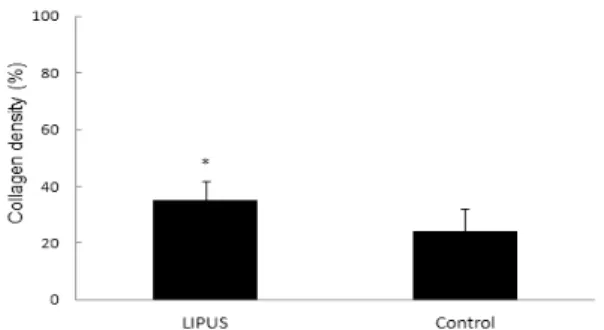
the regenerating granulation tissue of the LIPUS group presents a large amount of collagen fibers at day 7 after the wound (Fig 2). The Mann-Whitney U-test showed a significantly increased the collagen density in the granulation tissue in the LIPUS group (p<.05) (Table 1, Fig 3). In the LIPUS group, collagen density increased by 44.44% compared with the control group.

The type I collagen mRNA expression in wound tissue was more stronger and thicker in the LIPUS group than control group (Fig 4). The Mann-Whitney U-test of type I collagen mRNA ratio, there was a significantly increase in the LIPUS group than control group by 32.89% at day 7 after the wound (p<.01)(Table 1, Fig 4).

Ⅳ. DISCUSSION

This present study, LIPUS increased collagen density insitu and type I collagen mRNA expression in the regenerating granulation tissue at day 7 after the wound.

These results suggested that LIPUS may accelerate the

healing process in a proliferation stage of full-thickness

dermal wound. It is probable that LIPUS promoted an

(5)

Fig 2. The collagen fibers in the regenerating granulation tissue at day 7 after excision wound.

The blue color stained areas (arrowhead) corresponding to the collagen fibers. The collagen fibers in the LIPUS group were more dense, regular and large amount compared with control group. MT stain. Scale bar: 100 μm. LIPUS: low intensity pulsed ultrasound

increase collagen synthetic activity in the fibroblast. Our treatment protocol included 3 MHz pulsed ultrasound (duty cycle 20%, pulse ratio 2 ms : 8 ms) at a SATA dose of 0.4 W/㎠ for 5 minutes (dose of 120 J/㎠) at a frequency of for 7 days. The parameters of ultrasound treatment used in this study are based on previous studies (Young and Dyson, 1990; Byl et al., 1993).

The wound healing is a highly complex process involving inflammation, fibroplasia, neovacularization, collagen deposition, epithelialization, and wound contraction (Oberyszyn, 2007). Collagen is important ECM of the granulation tissue, and is a key component of wound healing process (Menon et al., 2012). The collagen and collagen-

derived fragments control many cellular functions, including proliferation, migration, differentiation, and synthesis of a number of proteins, as well as acting as a structural scaffold in the skin during healing process (Landsman et al., 2009). Collagen begins to be produced few hours after the wound, and deposited in granulation tissue. The pro-collagen 1 α1 and α2 chains are synthesized and secreted by the fibroblasts.

Several studies have been reported that LIPUS promoted

skin wound healing and increased collagen synthetic

activity. Young and Dyson (1990) have shown that 0.75

MHz or 3.0 MHz LIPUS (2 ms on, 8 ms off) at an SATA

of 0.1 W/㎠ accelerated healing by increasing granulation

(6)

Fig 3. The effect of LIPUS (3 MHz, 2 ms: 8 ms, SATA 0.4 W/㎠, 120 J/㎠) on the collagen density in the regenerating granulation tissue at day 7 after excision wound. Significantly increased collagen density in the LIPUS group compared with control group (*p<.05).

Data represent the mean and standard deviation of values from 6 rats. LIPUS: low intensity pulsed ultrasound

Fig 4. The effect of LIPUS (3 MHz, 2 ms: 8 ms, SATA 0.4 W/㎠ , 120 J/㎠) on the type I collagen mRNA expression in the wound tissue at day 7 after excision wound. The type I collagen mRNA expression in wound tissue was stronger and thicker in the LIPUS group than the control group (Above). Significantly increased type I collagen mRNA expression ratio in the LIPUS group compared with control group (*p<.01). Data represent the mean and standard deviation of values from 6 rats. LIPUS: low intensity pulsed ultrasound

tissue and fibroblast in full-thickness excised wound of rats.

Byl et al. (1993) have reported that 1 MHz pulsed ultrasound (20% duty cycle) at 0.5 W/㎠ for 5 minutes resulted significantly higher hydroxyproline and wound strength than high dose 1 MHz continuous US at 1.5 W/㎠

for 5 minutes in incisional wound of mini pigs. Taşkan et al. (1997) and Demir et al. (2004) also reported that pulsed US (2 ms on, 8 ms off) at 0.5 W/㎠ for 5 minutes increased the level of hydroxyproline and the number of fibroblasts in rat wound. Freitas et al. (2010) reported the 1 MHz US at 0.6 and 0.8 W/㎠ for 3 minutes increased hydroxyproline levels and decreased wound size in rat skin wound. Guimarães et al. (2011) have reported the 3 MHz continuous US at 0.1 W/㎠ for 1 minute accelerated collagen fiber synthesis and organization in the early stages of rat skin wound repair.

Our results agree with the findings from several other suggestions that LIPUS promotes wound healing by stimulates fibroblasts and collagen synthesis. In our study, 5 minutes application of LIPUS below SATA 0.5 W/㎠

increased collagen deposition in the regenerating granulation tissue. Followed by shortened healing time and increased wound closure rate. In additionally, we found that the type I collagen mRNA expression increased by LIPUS with 120 J/㎠.

Previous studies reported the collagen synthetic activity

by measurement of hydroxyproline level in the cultured

fibroblasts or in the wound tissue. Biochemical assay such

as hydroxyproline content assay of the collagen in wound

tissue is the accurate method and easy to quantify. Whereas

the histological assessment can be visualised better and

quantified the collagen density in situ. In contrast with

other previous studies, we confirmed the collagen

deposition in the regenerating granulation tissue by

histochemical examination. And also we detected the

collagen mRNA expression in the regenerating granulation

tissue.

(7)

LIPUS group (n=6)

Control group (n=6)

Mean±SD Mean±SD U p

Collagen density (%) 35.07±7.02 24.28±7.81 4.0 .026

Type I collagen mRNA ratio 1.00±0.15 0.75±0.06 0.0 .002

Wound closure rate (%) 87.20±5.52 77.77±8.50 4.0 .026

Half healing time (day) 3.33±0.52 4.83±0.75 2.0 .009

SD: standard deviation, LIPUS: low intensity pulsed ultrasound.

Table 1. Means and standard deviations of wound closure rate, half healing time, epithelial gap distance, collagen density and type I collagen mRNA ratio in the LIPUS and control groups

Cellular mechanisms for the activation of fibroblasts by ultrasound have been postulated. Non-thermal LIPUS alters in the permeability of the cell membrane and membrane transport properties. Ultrasound stimulation produces tiny gas microbubbles, it activates mechanical stretch dependent Ca ++ ion channels in cell membrane, and increases in intracellular calcium ion concentration (Chiquet et al., 2003; Wang et al., 2007; Chiquet et al., 2009). Mechanical stress of ultrasound may regulate the production of ECM proteins indirectly, by stimulating the release of a growth factor, or directly, by triggering an intracellular signalling pathway that activates the type I collagen mRNA in stretched fibroblast.

Ⅴ. CONCLUSIONS

The results of this study demonstrated that LIPUS with 3 MHz, duty cycle 20% (2 ms: 8 ms), SATA 0.4 W/㎠, 120 J/㎠ promotes collagen deposition by stimulated type I collagen mRNA expression, it may accelerate the healing process in a proliferation stage of wound healing. These results suggested that mechanical stress of LIPUS stimulated type I collagen mRNA expression in the fibroblasts at the transcriptional level.

Further studies are needed to determine the optimal parameters of LIPUS for wound healing and the effect of human wounds.

Acknowledgments

This work was supported partly by the Academic Research Fund of Wonkwang Health Science University (2013).

References

Baker KG, Robertson VJ, Duck FA. A Review of Therapeutic Ultrasound: Biophysical Effects. Phys Ther. 2001;81(7):

1351-8.

Byl NN, McKenzie A, Wong T, et al. Incisional wound healing:

a controlled study of low and high dose ultrasound.

J Orthop Sports Phys Ther. 1993;18(5):619-28.

Chiquet M, Renedo AS, Huber F, et al. How do fibroblasts translate mechanical signals into changes in extracellular matrix production? Matrix Biol.

2003;22(1):73-80.

Chiquet M, Gelman L, Lutz R, et al. From mechanotransduction to extracellular matrix gene expression in fibroblasts.

Biochim Biophys Acta. 2009;1793(5):911-20.

Cullum NA, Al-Kurdi D, Bell-Syer SE. Therapeutic ultrasound for venous leg ulcers. Cochrane Database Syst Rev.

2010;(6):CD001180.

de Ávila Santana L, Alves JM, Andrade TA, et al. Clinical

and immunohistopathological aspects of venous ulcers

treatment by Low-Intensity Pulsed Ultrasound

(8)

(LIPUS). Ultrasonics. 2013;53(4):870-9.

Demir H, Yaray S, Kirnap M, et al. Comparison of the effects of laser and ultrasound treatments on experimental wound healing in rats. J Rehabil Res Dev. 2004;

41(5):721-8.

Freitas TP, Gomes M, Fraga DB, et al. Effect of therapeutic pulsed ultrasound on lipoperoxidation and fibrogenesis in an animal model of wound healing. J Surg Res.

2010;61(1):168-71.

Fu SC, Hung LK, Shum WT, et al. In vivo low-intensity pulsed ultrasound (LIPUS) following tendon injury promotes repair during granulation but suppresses decorin and biglycan expression during remodeling.

J Orthop Sports Phys Ther. 2010;40(7):422-9.

Guimarães GN, Pires-De-Campos MS, Leonardi GR, et al.

Effect of ultrasound and dexpanthenol on collagen organization in tegumentary lesions. Rev Bras Fisioter.

2011;15(3):227-32.

Landsman A, Taft D, Riemer K. The role of collagen bioscaffolds, foamed collagen, and living skin equivalents in wound healing. Clin Podiatr Med Surg.

2009;26(4):525-33.

Loyola-Sánchez A, Richardson J, Beattie KA, et al. Effect of low-intensity pulsed ultrasound on the cartilage repair in people with mild to moderate knee osteoarthritis: a double-blinded, randomized, placebo-controlled pilot study. Arch Phys Med Rehabil. 2012;93(1):35-42.

Menon SN, Flegg JA, McCue SW, et al. Modelling the interaction of keratinocytes and fibroblasts during normal and abnormal wound healing processes. Proc Biol Sci.

2012;279(1741):3329-38.

Naito K, Watari T, Muta T, et al. Low-intensity pulsed ultrasound (LIPUS) increases the articular cartilage type II collagen in a rat osteoarthritis model. J Orthop Res.

2010;28(3):361-9.

Oberyszyn TM. Inflammation and wound healing. Front Biosci.

2007;12(8):2993-9.

Ramirez A, Schwane JA, McFarland C, et al. The effect of ultrasound on collagen synthesis and fibroblast proliferation in vitro. Med Sci Sports Exerc.

1997;29(3):326-32.

Schofer MD, Block JE, Aigner J, et al. Improved healing response in delayed unions of the tibia with low-intensity pulsed ultrasound: results of a randomized sham-controlled trial. BMC Musculoskelet Disord. 2010;11:229.

Taşkan I, Ozyazgan I, Tercan M, et al. A comparative study of the effect of ultrasound and electrostimulation on wound healing in rats. Plast Reconstr Surg.

1997;100(4):966-72.

Uenaka K, Imai S, Ando K, et al. Relation of low-intensity pulsed ultrasound to the cell density of scaffold-free cartilage in a high-density static semi-open culture system. J Orthop Sci. 2010;15(6):816-24.

Wang JH, Thampatty BP, Lin JS, et al. Mechanoregulation of gene expression in fibroblasts. Gene. 2007;391(1-2):

1-15.

Webster DF, Harvey W, Dyson M, et al. The role of ultrasound-induced cavitation in the 'in vitro' stimulation of collagen synthesis in human fibroblasts.

Ultrasonics. 1980;18(1):33-7.

Wong RA, Schumann B, Townsend R, et al. A survey of therapeutic ultrasound use by physical therapists who are orthopaedic certified specialists. Phys Ther.

2007;87(8):986-94.

Young SR, Dyson M. Effect of therapeutic ultrasound on the healing of full-thickness excised skin lesions.

Ultrasonics. 1990;28(3):175-80.

수치

Fig 1. The effect of LIPUS (3 MHz, 2 ms: 8 ms,  SATA 0.4 W/㎠, 5 minutes, 120 J/㎠) on the  wound closure rate at 7 days after excision  wound
Fig 2. The collagen fibers in the regenerating granulation tissue at day 7 after excision wound
Fig 4. The effect of LIPUS (3 MHz, 2 ms: 8 ms,  SATA 0.4 W/㎠ , 120 J/㎠) on the type I  collagen mRNA expression in the wound tissue  at day 7 after excision wound
Table 1. Means and standard deviations of wound closure rate, half healing time, epithelial gap distance,  collagen density and type I collagen mRNA ratio in the LIPUS and control groups

참조

관련 문서