ORIGINAL ARTICLE
락툴로스 호기 검사 결과에 영향을 주는 요인에 관한 연구
김진원*, 박선영*, 정진욱1, 조현아, 김동현, 윤재현, 박창환, 김현수, 최성규, 류종선
전남대학교 의과대학 소화기내과학교실, 내분비대사내과학교실1
Influencing Factors on Lactulose Breath Test Results
Jin Won Kim*, Seon-Young Park*, Jin Ook Chung1, Hyun A Cho, Dong-Hyun Kim, Jae Hyun Yoon, Chang Hwan Park, Hyun Soo Kim, Sung Kyu Choi and Jong Sun Rew
Divisions of Gastroenterology and Endocrinology1, Department of Internal Medicine, Chonnam National University Medical School, Gwangju, Korea
Background/Aims: This study aimed to identify the demographic and clinical factors associated with positive breath-test results and to assess the relationship between hydrogen and methane production in patients with suspected irritable bowel syndrome (IBS).
Methods: The demographic and clinical factors of 268 patients with suspected IBS, who had undergone a lactulose breath test, were analyzed.
Results: Of 268 patients included in this study, 143 (53.4%) were females. The median age and BMI of the patients was 58.0 years (range, 18.0-80.0 years) and 22.5 kg/m2 (range, 14.4-34.3 kg/m2), respectively. A weak positive correlation was observed between the BMI and baseline hydrogen level (rho=0.134, p=0.031). Women were significantly more likely to show a ≥20 ppm increase in hydrogen within 90 min (early hydrogen increase, p=0.049), a ≥10 ppm increase in methane within 90 min (early methane increase, p=0.001), and a ≥10 ppm increase in methane between 90 min and 180 min (late methane increase, p=0.002) compared to men.
The baseline hydrogen level was related to the baseline methane level (rho=0.592, p<0.001) and the maximal hydrogen level within 90 min was related to maximal methane level within 90 min (rho=0.721, p<0.001). Patients with an early hydrogen increase (43.8%) were more likely to show a positive result for an early methane increase compared to patients without an early increase in hydrogen (0%, p<0.001).
Conclusions: Women were associated with high rates of positive lactulose breath-test results. In addition, methane production was correlated with hydrogen production. (Korean J Gastroenterol 2020;75:23-28)
Key Words: Lactulose; Breath tests; Irritable bowel syndrome; Difference, sex
Received December 7, 2019. Revised December 22, 2019. Accepted January 3, 2020.
CC This is an open access article distributed under the terms of the Creative Commons Attribution Non-Commercial License (http://creativecommons.org/licenses/
by-nc/4.0) which permits unrestricted non-commercial use, distribution, and reproduction in any medium, provided the original work is properly cited.
Copyright © 2020. Korean Society of Gastroenterology.
교신저자: 류종선, 61469, 광주 동구 백서로 160, 전남대학교 의과대학 소화기내과학교실
Correspondence to: Jong Sun Rew, Division of Gastroenterology, Department of Internal Medicine, Chonnam National University Medical School, 160 Baekseo-ro, Dong-gu, Gwangju 61469, Korea. Tel: +82-62-220-6296, Fax: +82-62-220-8578, E-mail: [email protected], ORCID: https://orcid.org/0000-0002-6405-9656 Financial support: None. Conflict of interest: None.
* The first two authors contributed equally to this work as co-first authors of this paper.
INTRODUCTION
Breath tests can measure the levels of hydrogen and meth- ane gases in expired breath.1,2 This is a simple and non- invasive method of detecting the intestinal fermentation of carbohydrates by the intestinal flora.1 Therefore, it is used
widely in clinical practice to evaluate small intestinal bacterial overgrowth (SIBO), carbohydrate intolerance, or alterations in orocecal transit.
The results of the breath tests are associated with the gut microbial environment of the host. Changes in the gut micro- bial environment are associated with host factors, such as
sex, age, BMI, and other clinical conditions, including metabo- lism disorders, related inflammatory conditions, and auto- immune disorders.3 A recent meta-analysis showed that the predictors of SIBO diagnosed by a jejunal culture or breath tests in irritable bowel syndrome (IBS) patients were female sex, older age, and IBS-diarrhea subtypes.4 In two retro- spective cohort studies, positive breath-test results were asso- ciated with female sex, lower BMI, steroid use, and comorbid diseases, including gastrointestinal diseases, such as peptic ulcer disease, gastroesophageal reflux disease, and gastroparesis.5 On the other hand, data on the effect of host intrinsic factors, such as sex, aging, and BMI, on the breath-test results are limited and conflicting.6-8
The initial breath tests were based on the measurements of hydrogen as a reflection of gut fermentation.9 Currently, the technology has evolved to include measurements of car- bon dioxide and methane. Methane may be an important con- founder because there is an interaction between methane and hydrogen during gut fermentation.10 On the other hand, the relationship between hydrogen and methane production in patients with gastrointestinal symptoms is unclear. This study examined the demographic and clinical factors asso- ciated with positive breath-test results as well as the relation- ship between hydrogen and methane production in patients with suspected IBS.
SUBJECTS AND METHODS
1. Patients
Three hundred and seven consecutive patients with ab- dominal discomfort, abdominal bloating, gaseousness, and/or changes in bowel habits underwent a lactulose breath test between March 2011 and February 2017 at Chonnam National University Hospital. Of these 307 patients, 14 pa- tients with a history of upper gastrointestinal tract or lower gastrointestinal tract surgery were excluded. Twenty-five pa- tients, who were under 18 years of age or over 80 years.
No patients had history of inflammatory bowel diseases.
Finally, 268 patients (143 females) were included in this study. The Institutional Review Board of Chonnam National University Hospital approved this study (CNUH-2019-320).
2. Lactulose breath test
All patients were instructed to refrain from antibiotic use
for 28 days, to discontinue probiotics for 7-10 days, and not to take any other drug that could influence bowel function.
In addition, dietary avoidance of fruits, vegetables, grains, beans and bran cereals for at least 24 hours prior to the procedure was recommended.
The patients were instructed to gargle with 20 mL of 0.05%
chlorhexidine. Cigarette smoking and physical exercise were not permitted for 30 minutes before or during the test. First, a baseline breath sample was collected from each patient.
In cases of a baseline hydrogen concentration of >10 ppm or a baseline methane concentration of >10 ppm, the pa- tients were asked to gargle one more time, and the baseline breath sample was collected again. The patients then in- gested 10 g of lactulose syrup. The concentration (ppm) of hydrogen, methane, and carbon dioxide in the breath test were measured every 15 min for 180 min using a Breath Tracker SC (QuinTron, Milwaukee, WI, USA). Several modified parameters for the lactulose breath-test results were defined based on previous reports.2,11 First, in terms of the hydrogen breath test, positive results were classified as 1) baseline hy- drogen >20 ppm, 2) ≥20 ppm increase in hydrogen within 90 min (early hydrogen increase), and 3) ≥20 ppm increase in hydrogen between 90 min and 180 min (late hydrogen in- crease). In terms of the methane breath test, the positive results were classified as follows: 1) baseline methane >10 ppm, 2) ≥10 ppm increase in methane within 90 min (early methane increase), and 3) ≥10 ppm increase in methane be- tween 90 min and 180 min (late methane increase).
3. Statistical analysis
The continuous variables are expressed as the median and range, whereas the categorical variables are expressed as the number and percentage. The continuous variables were ana- lyzed using an independent t-test or Mann-Whitney U-test, whereas the categorical variables were analyzed using a chi-square test. Univariate and multivariate logistic regression analyses were performed to examine the association between the demographic factors and each parameter on the lactulose breath test. The correlation between the expiratory hydrogen levels and expiratory methane levels was performed using a non-parametric rank correlation (Spearman’s correlation). A p-value of <0.05 was considered significant. All statistical analyses were performed using SPSS version 20.0 for Windows (SPSS Inc., Chicago, IL, USA).
Table 1. Baseline Characteristics and Comorbidities in 268 Patients
Total (n=268) Patients without early hydrogen rise (n=204)
Patients with early
hydrogen rise (n=64) p-value
Age (years) 58.0 (18.0-80.0) 58.0 (18.0-78.0) 56.0 (20.0-80.0) 0.744
Body mass index (kg/m2) 22.5 (14.4-34.3) 22.6 (14.8-34.3) 22.5 (14.4-28.3) 0.837
Women 143 (53.4) 102 (50.0) 41 (64.1) 0.049*
Alcohol 29 (10.8) 21 (10.3) 8 (12.5) 0.620
Smoking 37 (13.8) 32 (15.7) 5 (7.8) 0.111
Diabetes mellitus 36 (13.4) 29 (14.2) 7 (10.9) 0.502
Hypertension 63 (23.5) 45 (22.1) 18 (28.1) 0.318
Heart problem 43 (16.0) 32 (15.7) 11 (17.2) 0.775
Gallstone 12 (4.5) 12 (5.9) 0 (0.0) 0.076
Cholecystectomy 14 (5.2) 13 (6.4) 1 (1.6) 0.199
Colonic diverticulum among 188 patients who had colonoscopy findings
28 (15.0) 21 (14.7) 7 (15.6) 0.886
Constipation 41 (14.8) 33 (16.2) 8 (12.5) 0.476
Values are presented as median (range) or n (%). Early hydrogen rise, a rise in H2 of ≥20 ppm within 90 minutes.
*Statistically significant.
Table 2. Associations between the Lactulose Breath-test Results and Age, Sex, and Body Mass Index in 268 Patients with Suspected Irritable Bowel Syndrome
Age (years) Women BMI (kg/m2)
cOR (95% CI) aOR (95% CI) cOR (95% CI) aOR (95% CI) cOR (95% CI) aOR (95% CI)
Baseline H2 >20 ppm 1.01 (0.98-1.05) 1.22 (0.47-3.13) 1.02 (0.88-1.19)
Early hydrogen rise 0.99 (0.97-1.01) 1.78 (0.99-3.18) 2.04 (1.12-3.74) 0.93 (0.85-1.02)
Late hydrogen rise 1.00 (0.98-1.02) 1.50 (0.93-2.44) 0.92 (0.85-0.99) 0.92 (0.85-0.99)
Baseline CH4 >10 ppm 1.00 (0.98-1.03) 1.16 (0.54-2.50) 1.01 (0.90-1.15)
Early methane rise 1.00 (0.97-1.02) 4.60 (1.69-12.50) 5.50 (1.84-16.46) 0.90 (0.79-1.03) Late methane rise 0.99 (0.97-1.01) 2.38 (1.35-4.21) 2.75 (1.52-4.98) 0.95 (0.87-1.04)
Early hydrogen increase, an increase in hydrogen of ≥20 ppm within 90 minutes; late hydrogen increase, an increase in hydrogen of ≥20 ppm between 90 minutes and 180 minutes; early methane increase, an increase in methane of ≥10 ppm within 90 minutes; late methane increase, an increase in methane of ≥10 ppm between 90 minutes and 180 minutes.
cOR, crude odds ratio; aOR, adjusted odds ratio; CI, confidence interval; BMI, body mass index.
RESULTS
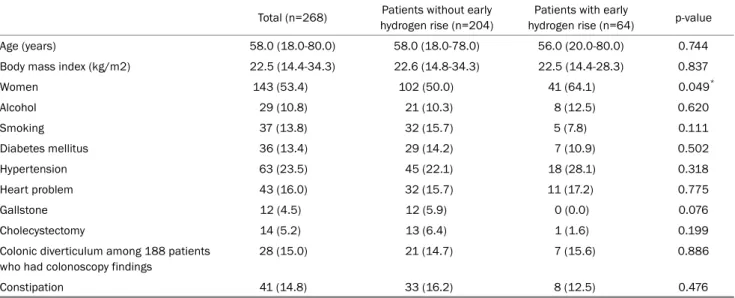
Of the 268 subjects included in this study, 143 (53.4%) were women. The median age of the patients was 58.0 years (range, 18.0-80.0 years). Table 1 lists the baseline character- istics and comorbidities of the included patients.
1. Associations between the lactulose breath-test re- sults and demographic factors
Among the 268 patients, 19 (7.1%) patients had ‘baseline hydrogen >20 ppm’. In the hydrogen gas parameter, 54 (21.1%) patients showed an early hydrogen increase, and 141 (52.6%) patients showed a late hydrogen increase. In the methane gas parameter, 28 (10.4%) patients showed an early
methane increase and 73 (27.2%) patients showed a late methane increase.
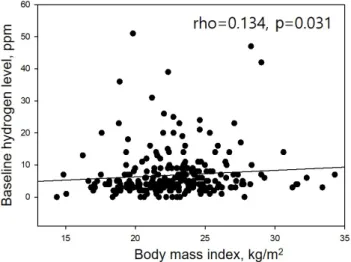
No significant differences in the comorbidities or the pres- ence of abdominal discomfort, abdominal bloating, gaseous- ness, and/or changes in bowel habits according to the sug- gested parameters, were observed (Table 1). In addition, there were no significant differences in the suggested parameters on the lactulose breath-test results according to age (Table 2). On the other hand, there was a weak positive correlation between the BMI and baseline hydrogen level (rho=0.134, p=0.031) (Fig. 1). A significant difference in the late hydrogen increase, according to the BMI, was observed (Table 2).
Women were significantly more likely to show an early hydro- gen increase (Table 1). Similarly, women were significantly
Fig. 1. Association between the body mass index (BMI) and baseline hydrogen level. A weak positive correlation was observed between the BMI and baseline hydrogen level (rho=0.134, p=0.031).
A B
Fig. 2. Associations between hydrogen production and methane production. (A) Baseline hydrogen level was related to the baseline methane level (rho=0.592, p<0.001). (B) A maximal hydrogen level within 90 min was related to the maximal methane level within 90 min (rho=0.721, p<0.001).
more likely to show an ‘early methane increase’ and a ‘late methane increase’ compared to men (Table 2 and Supplementary Table 1).
Logistic regression analysis was performed for the parame- ters that showed positive results based on sex. After adjusting for age and BMI, women were significantly more likely to show positive results for an early hydrogen increase. Furthermore, a positive early methane increase and late methane increase were observed more frequently in women. The BMI was asso- ciated with a late hydrogen increase (Table 2).
2. Associations between hydrogen production and methane production
Significant associations were observed between the hydro- gen gas analysis and methane gas analysis results. The base- line hydrogen level was related to the baseline methane level (rho=0.592, p<0.001) (Fig. 2A). A maximal hydrogen level within 90 min was related to the maximal methane level with- in 90 min (rho=0.721, p<0.001) (Fig. 2B).
Patients with a baseline hydrogen level (>20 ppm) (10/19, 52.6%) were more likely to show a positive baseline methane level (>10 ppm) than patients without a baseline hydrogen level (>20 ppm) (20/249, 8.0%, p<0.001). Patients with early hydrogen increase (28/64, 43.8%) had more positive results for an early methane increase compared to patients without an early hydrogen increase (0/204, 0%, p<0.001). Patients with a delayed hydrogen increase (72/141, 51.1%) were more likely to show a positive delayed methane increase compared to patients without a delayed hydrogen increase (1/127, 0.8%, p<0.001).
DISCUSSION
This study showed the following results. More women showed positive results for an early hydrogen increase, early methane increase, and late methane increase. In addition, in patients with IBS, the baseline hydrogen levels were related to the baseline methane levels, and the maximal hydrogen
level within 90 min was related to the maximal methane level within 90 min. Patients with an early hydrogen increase were more likely to show a positive early methane increase than patients without an early hydrogen increase.
The fermentation of carbohydrates by the gut microbiota produces hydrogen gas and methane gas. Many studies have reported conflicting results for the intestinal bacterial compo- sition, which might be explained by the sex ratio, age dis- tribution, and grade of obesity in each study group.6,12-14 Although several studies on the gut microbiota profiles in pa- tients with IBS reported conflicting results, there are several consistent trends, including the increased levels of firmicutes, decreased levels of bacteroidetes, and increased firmi- cutes/bacteroidetes ratio.12-15 Haro et al.12 reported that the gut microbiota composition differed according to sex in age- and diet-matched subjects. Age-matched study showed different distribution of Bacteriodes genus, Veillonella, Methanobrevibacter genera between men and women.12 Santos-Marcos et al.13 showed Firmicutes/Bacteroidetes ratio, a higher relative abundance of Lachnospira and Roseburia in pre-menopausal women than in men. These influences of gender on gut micro- biota may lead to differences of breath test results between men and women.
A lactulose breath test was performed to obtain indirect information on the fermentation of carbohydrates by gut flora in patients with suspected IBS. In this study, there were no significant differences in the hydrogen or methane parame- ters on the lactulose breath-test results based on age. On the other hand, there was a weak positive correlation between the BMI and baseline hydrogen level. Previous studies showed that the prevalence of SIBO is higher in women than in men.4,5,16 In addition, women were more likely to show a pos- itive early hydrogen increase, early methane increase, and late methane increase compared to men.
In this study, an early hydrogen increase was observed in 23.9% of patients, whereas an early methane increase was found in 10.4% of patients. Furthermore, 43.8% of patients with an early hydrogen increase had an early methane increase. A previous retrospective study reported that 24%, 18%, and 4% of patients had positive results for hydrogen, positive results for methane, and positive results for both hy- drogen and methane, respectively.17
Methane is produced from hydrogen and carbon dioxide during methanogenesis.18 The presence of hydrogen in the
breath comes from the gut microbiota only, whereas methane gas is produced by methanogenic flora, such as Methanobrevibacter smithii, Methanospaera stadmagnae, and Methannobrevibacter oralis, which can convert four atoms of hydrogen to one mole- cule of methane.10,19 Therefore, the methane gas levels in the breath mirror the hydrogen gas levels. Bjørneklett and Jenssen20 suggested typical patterns of hydrogen and methane production in healthy subjects, showing either high excretion of hydrogen and low excretion of methane or low excretion of hydrogen and high excretion of methane. On the other hand, this may not always be the case in patients with functional gastrointestinal diseases. Although methanogenic flora is asso- ciated with delayed colonic transit in patients with chronic constipation,21 a recent study reported that breath methane production was not associated with colonic transit and that the hydrogenogenic and hydrogenotrophic genes in the colonic mucosa and feces were correlated with constipation or colonic transit.22 Therefore, hydrogen or methane gas production by intestinal fermentation might be interrelated and complicated.
The present study showed that the baseline hydrogen levels were related to the baseline methane levels, and that the maximal hydrogen level within 90 min was related to the max- imal methane level within 90 min in patients with IBS. Patients with an early hydrogen increase tended to show positive results for an early methane increase. In addition, both hydrogen pro- ducing microbiota and methanogenic microbiota might have colonized simultaneously, or that more pathogenic microbiota can produce both hydrogen and methane.
This study had some limitations, such as a retrospective study performed in a single center. Nevertheless, the data were acquired consecutively and collected prospectively using the same standard method.
In conclusion, women were associated with high rates of positive lactulose breath-test results. In addition, methane production was correlated with hydrogen production. Future studies will be needed to evaluate the influence of sex on the gut microbiota composition associated with breath-test results and the treatment response according to the pattern of breath-test results.
REFERENCES
1. Gasbarrini A, Corazza GR, Gasbarrini G, et al. Methodology and indications of H2-breath testing in gastrointestinal diseases: the
Rome Consensus Conference. Aliment Pharmacol Ther 2009;
29 Suppl 1:1-49.
2. Rezaie A, Buresi M, Lembo A, et al. Hydrogen and methane-based breath testing in gastrointestinal disorders: the North American Consensus. Am J Gastroenterol 2017;112:775-784.
3. Vemuri R, Gundamaraju R, Shastri MD, et al. Gut microbial changes, interactions, and their implications on human lifecycle:
an ageing perspective. Biomed Res Int 2018;2018:4178607.
4. Chen B, Kim JJ, Zhang Y, Du L, Dai N. Prevalence and predictors of small intestinal bacterial overgrowth in irritable bowel syn- drome: a systematic review and meta-analysis. J Gastroenterol 2018;53:807-818.
5. Schatz RA, Zhang Q, Lodhia N, Shuster J, Toskes PP, Moshiree B.
Predisposing factors for positive D-Xylose breath test for evalua- tion of small intestinal bacterial overgrowth: a retrospective study of 932 patients. World J Gastroenterol 2015;21:4574-4582.
6. Reddymasu SC, Sostarich S, McCallum RW. Small intestinal bac- terial overgrowth in irritable bowel syndrome: are there any pre- dictors? BMC Gastroenterol 2010;10:23.
7. Newberry C, Tierney A, Pickett-Blakely O. Lactulose hydrogen breath test result is associated with age and gender. Biomed Res Int 2016;2016:1064029.
8. Mathur R, Amichai M, Chua KS, Mirocha J, Barlow GM, Pimentel M. Methane and hydrogen positivity on breath test is associated with greater body mass index and body fat. J Clin Endocrinol Metab 2013;98:E698-E702.
9. Pimentel M. Breath testing for small intestinal bacterial over- growth: should we bother? Am J Gastroenterol 2016;111:307-308.
10. Levitt MD, Furne JK, Kuskowski M, Ruddy J. Stability of human methanogenic flora over 35 years and a review of insights ob- tained from breath methane measurements. Clin Gastroenterol Hepatol 2006;4:123-129.
11. Pimentel M, Chow EJ, Lin HC. Normalization of lactulose breath testing correlates with symptom improvement in irritable bowel syndrome. a double-blind, randomized, placebo-controlled study. Am J Gastroenterol 2003;98:412-419.
12. Haro C, Rangel-Zúñiga OA, Alcalá-Díaz JF, et al. Intestinal micro-
biota is influenced by gender and body mass index. PLoS One 2016;11:e0154090.
13. Santos-Marcos JA, Rangel-Zuñiga OA, Jimenez-Lucena R, et al.
Influence of gender and menopausal status on gut microbiota.
Maturitas 2018;116:43-53.
14. Yurkovetskiy L, Burrows M, Khan AA, et al. Gender bias in auto- immunity is influenced by microbiota. Immunity 2013;39:400-412.
15. Duan R, Zhu S, Wang B, Duan L. Alterations of gut microbiota in patients with irritable bowel syndrome based on 16S rRNA-tar- geted sequencing: a systematic review. Clin Transl Gastroenterol 2019;10:e00012.
16. Lee KN, Lee OY, Koh DH, et al. Association between symptoms of irritable bowel syndrome and methane and hydrogen on lactu- lose breath test. J Korean Med Sci 2013;28:901-907.
17. Mattsson J, Minaya MT, Monegro M, et al. Outcome of breath tests in adult patients with suspected small intestinal bacterial overgrowth. Gastroenterol Hepatol Bed Bench 2017;10:
168-172.
18. Pimentel M, Lin HC, Enayati P, et al. Methane, a gas produced by enteric bacteria, slows intestinal transit and augments small in- testinal contractile activity. Am J Physiol Gastrointest Liver Physiol 2006;290:G1089-G1095.
19. Triantafyllou K, Chang C, Pimentel M. Methanogens, methane and gastrointestinal motility. J Neurogastroenterol Motil 2014;
20:31-40.
20. Bjørneklett A, Jenssen E. Relationships between hydrogen (H2) and methane (CH4) production in man. Scand J Gastroenterol 1982;17:985-992.
21. Attaluri A, Jackson M, Valestin J, Rao SS. Methanogenic flora is associated with altered colonic transit but not stool character- istics in constipation without IBS. Am J Gastroenterol 2010;
105:1407-1411.
22. Wolf PG, Parthasarathy G, Chen J, et al. Assessing the colonic mi- crobiome, hydrogenogenic and hydrogenotrophic genes, transit and breath methane in constipation. Neurogastroenterol Motil 2017;29:1-9.
Baseline hydrogen >20 ppm 8 (6.4) 11 (7.7) 0.681
Early hydrogen rise 23 (18.4) 41 (28.7) 0.049*
Late hydrogen rise 59 (47.2) 82 (57.3) 0.097
Baseline methane >10 ppm 13 (10.4) 17 (11.9) 0.700
Early methane rise 5 (4.0) 23 (16.1) 0.001*
Late methane rise 23 (18.4) 50 (35.0) 0.002*
Values are presented as n (%). Early hydrogen increase, an increase of ≥20 ppm in hydrogen within 90 minutes; late hydrogen increase, an increase in hydrogen of ≥20 ppm between 90 minutes and 180 minutes; early methane increase, an increase in methane of ≥10 ppm within 90 minutes; late methane increase, an increase in methane of ≥10 ppm between 90 minutes and 180 minutes.
*Statistically significant.