Received: Dec 31, 2019 Revised: Mar 25, 2020 Accepted: Mar 26, 2020 Published online Apr 21, 2020 Correspondence to: Omer A. Raheem https://orcid.org/0000-0001-6117-116X
Department of Urology, Tulane University School of Medicine, 1430 Tulane Ave, New Orleans, LA 70112, USA.
Tel: +1-504-988-2749, Fax: +1-504-988-5059, E-mail: [email protected] Copyright © 2021 Korean Society for Sexual Medicine and Andrology
Concurrent Penile Prosthesis and Artificial Urinary Sphincter versus Penile Prosthesis and Male Sling:
A National Multi-Institutional Analysis of National Surgical Quality Improvement Program Database Comparing Postoperative Morbidity
Mahmoud I. Khalil1,3 , Austin K. Bramwell1 , Naleen Raj Bhandari2 , Nalin Payakachat2 , Bruno Machado1 , Rodney Davis1 , Mohamed H. Kamel1,3 , Ahmed Safaan3 , Omer A. Raheem4
1Department of Urology, 2Division of Pharmaceutical Evaluation and Policy, University of Arkansas for Medical Sciences, Little Rock, AR, USA, 3Department of Urology, Faculty of Medicine, Ain Shams University, Cairo, Egypt, 4Department of Urology, Tulane University School of Medicine, New Orleans, LA, USA
Purpose:
Purpose: We aimed to assess the 30-day morbidity in patients undergoing combined insertion of penile prosthesis (PP) and artificial urinary sphincter (AUS) vs. PP and male sling (MS).
Materials and Methods:
Materials and Methods: The National Surgical Quality Improvement Program database was queried to identify patients who underwent placement of AUS or MS combined with PP. Patient demographics, postoperative morbidity including complica- tions, readmission and reoperation rates were recorded. Student t-test and chi-square or Fischer’s exact test were used as ap- propriate.
Results:
Results: Forty-one patients met selection criteria between 2010 and 2016. Overall, 26 patients received PP and AUS vs. 15 that received PP and MS. Average age was similar in both groups (64.8±6.6 years vs. 62.3±6.3 years, p=0.254). Diabetes mellitus was more prevalent in PP+MS group compared to AUS+PP group (46.7% vs. 11.5%, p=0.022). Average length of stay was higher in PP+AUS group compared to PP+MS group (2.2±0.6 days vs. 1.8±0.4 days, p=0.017). Postoperative morbidity was reported in four patients in PP+AUS group. No reported complications in PP+MS group. In PP+AUS group, complications included one patient who developed urinary tract infection, one developed surgical site infection, readmission in two for postoperative infection, and one return to the operating room. No reported prosthesis explantation or revision in either groups.
Conclusions:
Conclusions: Our results showed that 30-day morbidity was recorded in the PP+AUS group and none in the PP+MS group.
The complication and readmission rates remain comparable to the previous reports in both groups.
Keywords:
Keywords: Morbidity; Penile prosthesis; Suburethral slings; Urinary sphincter, artificial
This is an Open Access article distributed under the terms of the Creative Commons Attribution Non-Commercial License (http://creativecommons.org/licenses/by-nc/4.0) which permits unrestricted non-commercial use, distribution, and reproduction in any medium, provided the original work is properly cited.
pISSN: 2287-4208 / eISSN: 2287-4690 World J Mens Health 2021 Jan 39(1): 75-82 https://doi.org/10.5534/wjmh.190172
INTRODUCTION
Erectile dysfunction (ED) and stress urinary incon- tinence (SUI) are troublesome common complications for males following radical prostatectomy (RP). The coupling of ED and SUI presents an even greater chal- lenge, affecting quality of life and leading to substan- tial distress in both the personal and professional lives of patients [1]. The incidence of ED following RP has been reported between 20% to 88% varying widely due to the lack of control for confounding factors, such as age, preoperative baseline erectile function, timing of assessment after surgery, degree of nerve sparing and varying definitions of potency [2,3]. Meta-analyses have estimated that at 12 months, rates of ED continue to range from 6% to 37%, while the CaPSURE study re- ported only 20% of patients had returned to their pre- operative baseline potency levels [4].
Traditionally, less invasive options such as phos- phodiesterase-5 inhibitors, vacuum devices, and penile injections are initially attempted before considering surgical management in the form of penile prosthetics.
Though less invasive measures have a long history of success for many patients, they are often insufficient in the post RP population [2]. Implantable penile pros- thesis (PP) is the gold standard for management of ED in post-prostatectomy patients who are refractory to more conservative measures, with satisfaction rates superior to both medications and injections [5].
Following RP, estimates of SUI rates vary widely, having been reported as high as 20% to 40% a year fol- lowing surgery [6]. In the immediate postoperative pe- riod, nearly every patient experiences at least transient SUI; however, it typically improves or even resolves throughout the first 12 months [7]. Persistent SUI was reported in 11% of patients three years postoperatively, with other smaller series reporting even higher rates of long-term incontinence [8].
Since its development several decades ago, the ar- tificial urinary sphincter (AUS) has been the gold standard for surgical treatment for SUI in males, with modern iterations offering both effectiveness and du- rability for moderate to severe cases [9]. Recent years have shown advances in alternative surgical manage- ment of SUI, with the introduction of adjustable and non-adjustable male perineal slings. Initially, male slings (MS) were reserved for mild cases of inconti- nence in a patient with a naïve urethra, but later mod-
els are gathering interest in their ability to effectively treat moderate to severe urinary incontinence [10].
Additionally, MS placement is deemed a simpler op- eration, with reduced cost and absence of the need to operate a device when compared to AUS. Combined implantation of AUS or MS and PP provides the ad- vantages of single anesthesia administration, shorter total operative time, and quicker return to baseline functions. Despite the growing evidence supporting dual implantation to manage both ED and SUI fol- lowing RP, there are financial constraints placed upon reimbursement of two implants placed concurrently in the same patient by 3rd party payers. Many insurances and Medicare do not reimburse the whole cost of the second implant to the hospital and 50% the surgeon charge [11-13]. Because of the financial problems with doing a dual IPP+AUS implant, this study aims to as- sess the 30-day postoperative morbidity in patients un- dergoing combined placement of PP+AUS vs. PP+MS.
MATERIALS AND METHODS
1. Study design and data source
This study utilized a longitudinal, retrospective co- hort study design using the data from 2010 to 2016 of the National Surgical Quality Improvement Program (NSQIP) in the USA. The NSQIP data is an initiative by the American College of Surgeons (ACS), which is risk-adjusted and used in improving surgical pro- cedures in the USA [14]. The participant use files of NSQIP data comprises of de-identified patient demo- graphics, comorbid conditions, preoperative labs and postoperative outcomes within 30 days of the proce- dure. This data is collected from medical charts of the participating hospital institutions, often by a trained staff, which has demonstrated excellent inter-rater reliability [15]. Detailed information about the NSQIP can be obtained elsewhere [16].
2. Ethics statement
An institutional review board exemption was ac- quired since we analyzed an ethically preapproved and deidentified dataset.
3. Study cohort
The study cohort comprised male patients who re- ceived concurrent PP (CPT: 54400 for semi-rigid PP and 54405 for inflatable PP), with either primary AUS
(CPT: 53445) or primary MS (CPT: 53440) for urinary incontinence. The PP+AUS group included patients who received AUS in combination with PP and the PP+MS group included patients who received a MS in combination with PP.
4. Study measures
Patients’ demographics, smoking status, comorbidi- ties and American Society of Anesthesiologists (ASA) classification were identified. Operating time (minutes) and hospital length of stay (days), any-cause 30-day mortality, readmission, reoperation, and complications were studied. An indicator for “any complication” with- in 30 days was created if at least one complication was
reported.
5. Statistical analyses
Sample characteristics were described as frequency (and percentage) or means (and standard deviation) based on the type of variable (categorical or continu- ous). Chi-square or Fisher’s exact and student t-tests were conducted to test for unadjusted differences in characteristics between the two groups, as appropri- ate for the variable type. Proportion of postoperative deaths and complications in both groups were de- scribed and compared using descriptive statistics. All the analyses were conducted in SAS ver. 9.4 at 5% sig- nificance level (SAS Institute Inc., Cary, NC, USA).
Table 1. Demographic and preoperative characteristics
Variable Total (n=41) Procedurea
p-value PP+AUS (n=26) PP+MS (n=15)
Age (y) 63.9±6.6 64.8±6.6 62.3±6.3 0.254b
Body mass index (kg/m2) 29.5±4.4 28.9±4.5 30.6±4.3 0.245b
Race 0.548c
White 27 (65.8) 18 (69.2) 9 (60.0)
Non-white 14 (34.2) 8 (30.8) 6 (40.0)
NSQIP data (year) 0.042d
2010 1 (2.4) - 1 (6.7)
2011 5 (12.2) 1 (3.9) 4 (26.7)
2012 7 (17.1) 7 (26.9) -
2013 7 (17.1) 6 (23.1) 1 (6.7)
2014 4 (9.8) 2 (7.7) 2 (13.3)
2015 5 (12.2) 3 (11.5) 2 (13.3)
2016 12 (29.3) 7 (26.9) 5 (33.3)
Current smoker 7 (17.1) 5 (19.2) 2 (13.3) >0.99d
ASA class 0.658c
I/II 21 (51.2) 14 (53.8) 7 (46.7)
III/IV/V 20 (48.8) 12 (46.2) 8 (53.3)
Comorbidities
Hypertension 26 (63.4) 14 (53.8) 12 (80.0) 0.094c
Diabetes miletus 10 (24.4) 3 (11.5) 7 (46.7) 0.022d
Chronic steroid use 2 (4.9) 1 (3.8) 1 (6.7) >0.99d
Severe COPD 2 (4.9) 1 (3.8) 1 (6.7) >0.99d
Congestive heart failure 1 (2.4) 1 (3.8) - >0.99d
Metastatic cancer 2 (4.9) 2 (7.7) - 0.524d
Total hospital length of stay (d) 2.1±0.6 2.2±0.6 1.8±0.4 0.017b
Total operation time (min) 177.2±55.7 188.5±57.2 157.5±48.7 0.085b
Values are presented as mean±standard deviation or number (%) unless otherwise indicated. Because of rounding, there is data that has the sum of the percentages does not equal 100%.
PP: penile prosthesis, AUS: artificial urinary sphincter, MS: male sling, NSQIP: National Surgical Quality Improvement Program, ASA: American So- ciety of Anesthesiologists, COPD: chronic obstructive pulmonary disease.
aValues are presented as mean±standard deviation or number (col %). The p-values are based on: bStudent t-test, cchi-square test, and dFischer’s exact test.
RESULTS
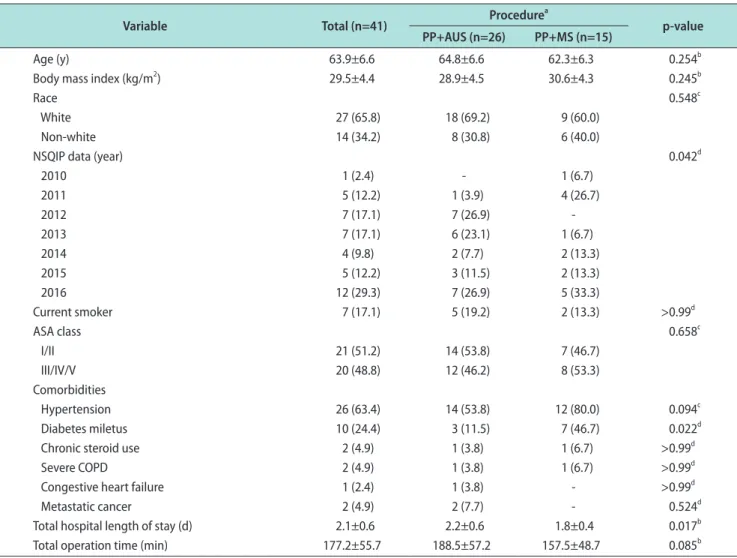
A total of 41 patients met our inclusion criteria and were included in this study. Among those, 26 cases (63.4%) received PP+AUS and 15 cases (36.6%) received PP+MS (Table 1). Overall, the average age of patients was 63.9±6.6 years and the average body mass index (BMI) was 29.5±4.4 kg/m2. A majority of patients were white (65.8%), ASA class I/II (51.2%), and received the combination procedure in the year 2016 (29.3%). The most prevalent comorbid conditions among the study cohort were hypertension (63.4%) and diabetes (24.4%).
Information about radiotherapy within the past 90 days of surgery was existed for only nine patients. All of these have not received radiation therapy before surgery.
1. Patient characteristics between groups
Patients in both groups had similar average age (p=0.254) and BMI (p=0.245). A slightly higher propor- tion of patients in PP+AUS group were current smokers compared to those in the PP+MS group (19.2% vs. 13.3%, p>0.99); however, the difference was not statistically significant (Table 1). Compared to the PP+MS group, patients in the PP+AUS group had less proportion of hypertension (53.8% vs. 80.0%, p=0.094) and diabetes (11.5% vs. 46.7%, p=0.022) (Table 1).
2. Perioperative characteristics between groups
On average, patients who received PP+AUS stayed longer in the hospital compared to those who received PP+MS (2.2±0.6 days vs. 1.8±0.4 days, p=0.017), despite
having a statistically significant difference, it was not clinically significant. The operating time was longer in the PP+AUS group compared to the PP+MS (188.5±57.2 minutes vs. 157.5±48.7 minutes, p=0.085); however, the difference was not statistically significant between the two groups (Table 1).
3. Incidence of early postoperative mortality and morbidity
We did not observe any early postoperative deaths in our study cohort. We did not observe any early post- operative complications among patients who received PP+MS (Table 2). Among patients in the PP+AUS group, the incidence of all-cause readmissions was a substantial 11.5% (n=3), reoperation was 3.9% (n=1), and any other complication was 7.7% (n=2). Specifically, these complications were superficial surgical site infec- tion (3.9%) and urinary tract infection (3.9%) (Table 2). Among those who were readmitted, the average days to readmission from the day of the surgery was 18.3±13.9 days and the cause of readmission was either superficial surgical site infection (n=1, 33.3%), other postoperative infection (n=1, 33.3%), or unknown (n=1, 33.3%).
DISCUSSION
In this study, we report on the 30-day complications following combined placement of AUS and PP vs. MS and PP. Our results show that patients who received PP+AUS had longer length of stay compared to those who received the PP+MS. Notably readmission, reop- eration, and complication events were observed only in the PP+AUS group. Urinary tract infection and surgical site infection were the specific complications encountered. Because the numbers in our two cohorts were small and because the complications of PP+AUS could also easily occur in the PP+MS group, the find- ing is doubtfully significant.
In the setting of management of patients with ED and SUI commonly following RP, there has not been a robust data supporting simultaneous placement of PP and AUS/MS vs. staged approach. Urologists who advocate for staged approach relate to the presumed decreased risk of device-associated complications, such as infection, erosion, and mechanical failure;
however, there is not much evidence supporting that rationale. The combined placement of PP+AUS/MS Table 2. Postoperative (≤30 days) complications
Variable Total (n=41)a
Procedureb
p-value PP+AUS
(n=26)
PP+MS (n=15)
Any readmissionc (n=40) 3 (7.5) 3 (11.5) - 0.539d Returned to OR 1 (2.4) 1 (3.9) - >0.99d Any complication 2 (4.9) 2 (7.7) - 0.524d Superficial SSI 1 (2.4) 1 (3.9) - >0.99d Urinary tract infection 1 (2.4) 1 (3.9) - >0.99d PP: penile prosthesis, AUS: artificial urinary sphincter, MS: male sling, OR: operating room, SSI: surgical site infection.
aValues are presented as number (%). bValues are presented as num- ber (col %). cInformation on readmission was not available in the year 2010 of National Surgical Quality Improvement Program data. The p- values are based on dFischer’s exact test.
offers a single surgical procedure and management of both problems and hence, a quick return of full func- tions. For combined PP and AUS placement, Sellers et al [17] reported cost and time benefits in their series of 15 patients with dual implants. Dual implantation time was decreased by 24.7% compared with total time for individual prosthesis, with cost savings of $7,000 as compared to staged implants. In a Mancini et al’s study [18], patients who underwent dual implantation of PP and AUS were associated with high patient sat- isfaction with similar functionality and prosthetic ma- nipulation to those who received either implants alone.
Combined PP and MS placement was first described by Rhee [19] in 2005 in a series of four post-prostatectomy patients. Results showed no perioperative complications and complete patient satisfaction and functionality at 1-year follow-up. Patients received implants through separate perineal and penoscrotal incisions. In 2010, Gorbatiy et al [20] reported outcomes of simultane- ous PP and MS placement through a single perineal incision with encouraging results. Also, the authors recorded savings of $9,000 in dual implantation com- pared with the total cost of the individual procedures.
To our knowledge, our study is the first to compare the postoperative complication rates following combined placement of PP and AUS vs. PP and MS.
In our study, we found significant difference in the year during which the procedure was done between the two groups. The majority of patients (29.3%) re- ceived the dual implant in 2016, the final year of our analysis. This is not surprising, as the adoption of the dual implantation has increased in last few years.
Also, the majority of the patients in both groups were ASA class I/II (51.2%) and non-smokers (82.9%), which may emphasize upon the substantial role of patient selection and optimization of patient’s comorbidities before proceeding with dual implantation. Compared to the PP+MS group, less proportion of patients in the PP+AUS group had diabetes (11.5% vs. 46.7%, p=0.022).
However, in a systematic review that examined the ev- idence correlating PP infections to the presence of dia- betes mellitus, encountered infection rates in patients with diabetes mellitus were not significantly different from that in the population at large [21].
With regard to mean operative time, we found it longer in the PP+AUS group compared to the PP+MS (188.5±57.2 minutes vs. 157.5±48.7 minutes, p=0.085) but it was lacking statistical significance. For the PP+AUS
group, operative time was in line with Segal et al [22]
series on 55 patients (218.1 minutes). However in his study, operative time was significantly longer in the dual implantation group when compared to placement of PP and AUS alone (145.9 and 114.7 minutes, respec- tively, p<0.0001). Compared to our study’s combined PP+MS group, operative time was similar to the Gor- batiy et al [20] series on eight patients who received combined PP+MS (177±17 minutes). Interestingly, there was no significant difference in operative time when comparing the group who received the dual implants and those who received PP and MS alone (98±24 and 86±24 minutes, p>0.05).
We observed that patients in PP+AUS group stayed longer in the hospital compared to those in PP+MS group (2.2 days vs. 1.8 days, respectively). The difference was clinically insignificant despite being statistically significant. That might be related to higher complexity of the combined placement of PP+AUS than PP+MS with dual prosthetic manipulation and the possible necessity of performing as many as three separate inci- sions to implant the two devices. Length of stay in our report was longer than what was previously reported in a similar single-surgeon study of Segal et al [22] (1.2 days for PP+AUS) and two-surgeon study of Gorbatiy et al [20] (1.1±0.5 days for PP+MS). This observation may relate to the national nature of our dataset, which may include many surgeons with different levels of experience. However, it was similar to Rolle et al’s study [11] on 15 patients who had dual PP and AUS with LOS of 2.5 days.
With regard to 30-day complications following sur- gery, no complication was recorded in the PP+MS group. That was similar to the Gorbatiy et al’s study [20] on eight patients who received PP+MS, where in only one patient had acute urinary retention, which was relieved with 5-day catheter drainage. In Christine et al [23] series on 22 patients who received PP+MS, four patients experienced urinary retention and were managed conservatively. At a mean of 22 months follow up, no infections or revisions were re- ported. The same author studied a larger cohort of 78 patients who underwent PP+MS via a two-incision technique. Results showed an infection rate of 1.2% at a mean follow-up of 16 months [24].
In our PP+AUS patient group, postoperative com- plications were recorded only in two patients (7.7%).
Specifically, they were surgical site infection and uri-
nary tract infection. Similarly, postoperative infection was the cause among patients who needed readmission (11.5%). Dual implantation through a single transcro- tal incision was first described by Wilson et al [25] in 2003. Of 12 patients (3 were recurrent) who received dual PP+AUS implants, three had urethral injury, intraoperatively in one and 6 weeks post-surgery in two. One more case of PP infection was recorded which required explantation. In Segal et al’s study [22], for a follow-up period of 1.62 years, no increased risk was identified for combined PP+AUS implantation com- pared to single implantation. Interestingly, adverse events which occurred in one device did not occur in the other device in the same patients. Authors related that to the complete separation of the surgical field of the two implants including the reservoirs and tubing.
That may advocate the dual implantation when the thought of explanting both devices in case of infection arises. In Martínez-Salamanca et al’s study [26] on 32 patients who received dual PP and AUS implantation, only one patient had a urinary tract infection during one-month follow-up. Several AUS related complication were reported on longer follow-up period. Preoperative management, such as antibiotics may play a role in the postoperative outcomes, however the American Uro- logical Association recommendations for antimicrobial prophylaxis and their duration are not based on robust data and the adherence to these recommendations vastly varies [27].
Our study presents a report on perioperative morbid- ity of two different combined procedures and at a na- tional level; however, it is not without limitations. This analysis is of a retrospective non-randomized nature.
ACS-NSQIP database does not provide information on previous surgeries, degree of preoperative ED and urinary incontinence and details about the used pros- thetic devices. It also does not quantitate the degree of improvement of incontinence after the surgery. Also, NSQIP does not allow for longer follow-up beyond 30 days, through which other long-terms complications such as erosion, late infection, and mechanical failure can occur. Nonetheless, our report represents a unique comparison of 30-day morbidity between two technical procedures that address a commonly presented prob- lem after RP. Future prospective randomized studies with long-term follow-up along with validated patient satisfaction questionnaires are warranted.
Since the rate of postoperative complications with
either PP+AUS and PP+MS were acceptable and the literature has shown patient satisfaction to be superior with dual implantation over staged implants, it seems notable that PP+MS should be preferred because of the lack of reimbursement penalty [13].
CONCLUSIONS
Our results show that 30-day complications and read- missions were recorded only in the PP+AUS group and were comparable to previous reports. Consideration of reimbursement issues in the USA would encourage physicians to prefer insertion of PP combined with MS over concurrent PP and AUS.
Conflict of Interest
Naleen Raj Bhandari was a PhD candidate at University of Arkansas for Medical Sciences when this study was conducted.
He is currently employed by Eli Lilly and Company. No other authors report any conflict of interest.
Author Contribution
Conceptualization: MIK, OAR. Data curation: OAR. Formal analysis: NRB, NP. Methodology: OAR, NRB. Software: MIK, NRB, NP. Supervision: OAR, RD, AS. Validation: MHK, BM.
Writing – original draft: MIK, AKB. Writing – review & edit- ing: RD, OAR, MHK, AS, BM.
Data Sharing Statement
The data required to reproduce these findings cannot be shared at this time due to technical and time limitations.
REFERENCES
1. Haglind E, Carlsson S, Stranne J, Wallerstedt A, Wilderäng U, Thorsteinsdottir T, et al.; LAPPRO steering committee.
Urinary incontinence and erectile dysfunction after robotic versus open radical prostatectomy: a prospective, controlled, nonrandomised trial. Eur Urol 2015;68:216-25.
2. Nelson CJ, Scardino PT, Eastham JA, Mulhall JP. Back to baseline: erectile function recovery after radical prostatec- tomy from the patients' perspective. J Sex Med 2013;10:1636- 43.
3. Ficarra V, Novara G, Ahlering TE, Costello A, Eastham JA, Graefen M, et al. Systematic review and meta-analysis of
studies reporting potency rates after robot-assisted radical prostatectomy. Eur Urol 2012;62:418-30.
4. Litwin MS, Flanders SC, Pasta DJ, Stoddard ML, Lubeck DP, Henning JM. Sexual function and bother after radical prosta- tectomy or radiation for prostate cancer: multivariate quality- of-life analysis from CaPSURE. Cancer of the Prostate Strate- gic Urologic Research Endeavor. Urology 1999;54:503-8.
5. Carson CC, Mulcahy JJ, Govier FE. Efficacy, safety and pa- tient satisfaction outcomes of the AMS 700CX inflatable pe- nile prosthesis: results of a long-term multicenter study. AMS 700CX Study Group. J Urol 2000;164:376-80.
6. Crivellaro S, Morlacco A, Bodo G, Agro' EF, Gozzi C, Pisto- lesi D, et al. Systematic review of surgical treatment of post radical prostatectomy stress urinary incontinence. Neurourol Urodyn 2016;35:875-81.
7. Abdollah F, Sun M, Suardi N, Gallina A, Bianchi M, Tutolo M, et al. Prediction of functional outcomes after nerve-sparing radical prostatectomy: results of conditional survival analyses.
Eur Urol 2012;62:42-52.
8. Saranchuk JW, Kattan MW, Elkin E, Touijer AK, Scardino PT, Eastham JA. Achieving optimal outcomes after radical prosta- tectomy. J Clin Oncol 2005;23:4146-51.
9. Lucas MG, Bosch RJ, Burkhard FC, Cruz F, Madden TB, Nambiar AK, et al.; European Association of Urology. EAU guidelines on surgical treatment of urinary incontinence. Eur Urol 2012;62:1118-29.
10. Rehder P, Haab F, Cornu JN, Gozzi C, Bauer RM. Treatment of postprostatectomy male urinary incontinence with the transobturator retroluminal repositioning sling suspension:
3-year follow-up. Eur Urol 2012;62:140-5.
11. Rolle L, Ceruti C, Sedigh O, Timpano M, Destefanis P, Lillaz B, et al. Surgical implantation of artificial urinary device and penile prosthesis through trans-scrotal incision for postpros- tatectomy urinary incontinence and erectile dysfunction: syn- chronous or delayed procedure? Urology 2012;80:1046-50.
12. Bolat D, Kozacioglu Z, Polat S, Koras O, Arslan M, Minareci S. Synchronous penoscrotal implantation of penile prosthesis and artificial urinary sphincter after radical prostatectomy.
Arch Esp Urol 2017;70:367-72.
13. Loh-Doyle JC, Martins FE, Boyd SD. Dual implantation of inflatable penile prosthesis and artificial urinary sphincter or male sling: benefits and risks. In: Martins FE, Kulkarni SB, Köhler TS, editors. Textbook of male genitourethral recon- struction. Cham: Springer; 2020.
14. American College of Surgeons. ACS National Surgical Qual- ity Improvement Program [Internet]. Chicago (IL): Ameri- can College of Surgeons [cited 2019 Jun 14]. Available from:
https://www.facs.org/quality-programs/acs-nsqip.
15. Shiloach M, Frencher SK Jr, Steeger JE, Rowell KS, Bartzokis K, Tomeh MG, et al. Toward robust information: data quality and inter-rater reliability in the American College of Surgeons National Surgical Quality Improvement Program. J Am Coll Surg 2010;210:6-16.
16. Davenport DL, Henderson WG, Khuri SF, Mentzer RM Jr.
Preoperative risk factors and surgical complexity are more predictive of costs than postoperative complications: a case study using the National Surgical Quality Improvement Pro- gram (NSQIP) database. Ann Surg 2005;242:463-8; discus- sion 468-71.
17. Sellers CL, Morey AF, Jones LA. Cost and time benefits of dual implantation of inflatable penile and artificial urinary sphincter prosthetics by single incision. Urology 2005;65:852- 3.
18. Mancini JG, Kizer WS, Jones LA, Mora RV, Morey AF. Patient satisfaction after dual implantation of inflatable penile and artificial urinary sphincter prostheses. Urology 2008;71:893- 6.
19. Rhee EY. Technique for concomitant implantation of the pe- nile prosthesis with the male sling. J Urol 2005;173:925-7.
20. Gorbatiy V, Westney OL, Romero C, Wang R. Outcomes of simultaneous placement of an inflatable penile prosthesis and a male urethral sling through a single perineal incision. J Sex Med 2010;7(2 Pt 1):832-8.
21. Christodoulidou M, Pearce I. Infection of penile prostheses in patients with diabetes mellitus. Surg Infect (Larchmt) 2016;17:2-8.
22. Segal RL, Cabrini MR, Harris ED, Mostwin JL, Bivalacqua TJ, Burnett AL. Combined inflatable penile prosthesis-artificial urinary sphincter implantation: no increased risk of adverse events compared to single or staged device implantation. J Urol 2013;190:2183-8.
23. Christine B, Wilson SK, Shamloul R, Bella AJ. 1265 Simul- taneous placement of an inflatable penile prosthesis and advance male sling for erectile dysfunction and incontinence:
robust efficacy and safety data at 2 year follow-up. J Urol 2010;183:e490.
24. Christine B, Knoll LD. 1809 Simultaneous advance male sling and an inflatable penile prosthesis: concurrent place- ment does not increase potential for implant infection. J Urol 2011;185:e726.
25. Wilson S, Delk J 2nd, Henry GD, Siegel AL. New surgical technique for sphincter urinary control system using upper transverse scrotal incision. J Urol 2003;169:261-4.
26. Martínez-Salamanca JI, Espinós EL, Moncada I, Portillo LD, Carballido J. Management of end-stage erectile dysfunction and stress urinary incontinence after radical prostatectomy by
simultaneous dual implantation using a single trans-scrotal incision: surgical technique and outcomes. Asian J Androl 2015;17:792-6.
27. Katz DJ, Stember DS, Nelson CJ, Mulhall JP. Periopera-
tive prevention of penile prosthesis infection: practice pat- terns among surgeons of SMSNA and ISSM. J Sex Med 2012;9:1705-12; quiz 712-4.