J Appl Biol Chem (2015) 58(2), 105−108 http://dx.doi.org/10.3839/jabc.2015.018
Online ISSN 2234-7941 Print ISSN 1976-0442 Short Communication: Bioactive Materials
Acaricidal Abilities and Chemical Composition of Forsythia suspense Fruit Oil against Storage and Pyroglyphid Mites
Hwa-won Lee · Hoi-Seon Lee*
Received: 4 January 2015 / Accepted: 11 January 2015 / Published Online: 30 June 2015
© The Korean Society for Applied Biological Chemistry 2015
Abstract This research is aimed at evaluating the potential abilities of the natural acaricide of F. suspense oil against Tyrophagus putrescentiae and Dermatophagoides spp. Based on the LD50 values, in contact bioassay, F. suspense oil (8.19, 3.28, and 4.35µg/cm2) showed acaricidal effects against T. putrescentiae, D. farinae, and D. pteronyssinus, respectively. Fumigant toxicities of F. suspense oil showed similar patterns as those observed with contact toxicities. GC/MS analysis showed the major components of F. suspense oil to be β-pinene (45.88%), myrtenol (13.86%), (+)-α-pinene (13.09%), (−)-trans-pinocarveol (7.34%), sabinene (6.64%) and pinocarvone (4.13%). These findings indicate that F.
suspense oil has potential as a natural acaricide.
Keywords acaricidal effect · Dermatophagoides farinae · Dermatophagoides pteronyssinus · Forsythia suspense · Tyrophagus putrescentiae
Storage and pyroglyphid mites are major allergens worldwide causing bronchial asthma, rhinitis and atopic dermatitis (Kim et al., 2003; Lee, 2004; Saad et al., 2006; Song et al., 2011).
Pyroglyphid mites found in indoor apartments belong to the genus Dermatophagoides (Lim et al., 2008). In particular, D. farinae and D. pteronyssimus are the major factors causing sudden infant death syndrome (Rim and Jee, 2006). The typical storage mite,
Tyrophagus putrescentiae, lives in preserved eggs, cheese and grain (Gulati and Mathur, 1995). Moreover, storage mites have been recognized as an etiological factor in allergic diseases affecting food workers and farmers (Song et al., 2011).
Controlling mite populations has been done mainly through the use of pirimiphos-methyl and benzene hexachloride (Wu et al., 2012). Although effective, these resulted in resistance and mammal toxicity (Kang et al., 2006). In more recent studies, natural substances of plant oils are reported to be good alternatives (Pasay et al., 2010).
Forsythia suspensa (Thunb.), a member of the Oleaceae family, is widely distributed in Asia (China, Korea and Japan) and many European nations. (Qu et al., 2008). It contains isolariciresinol, succinic acid, erythritol and wogonin-7-O-glucoside (Liu et al., 2003). Furthermore, it is reported to have biological effects including antibacterial (Bae et al., 2005; Qu et al., 2008), antioxidant (Qu et al., 2008; Wang et al., 2008) and antihypertensive (Nishibe et al., 1982). However, the acaricidal activities of F. suspense fruits against T. putrescentiae, D. farinae and D. pteronyssimus have not been reported. In this study, we aimed to look into the potent ability of F. suspensa oil against storage and pyroglyphid mites.
F. suspense fruits were ground into powder and extracted by the simultaneous steam distillation-extraction method (Boutekedjiret et al., 2003). The analysis of F. suspense fruit oil was performed using GC-Mass (6890; Agilent Technologies) (5973; Agilent) with a DB-5 (0.25 mm) fused capillary column (30 m×0.25 mm i.d.). The GC injector temperature was 210oC. The initial temperature of the column was 50oC and it was programmed to rise to 201oC at a ramp rate of 1.9oC/min and stay at this temperature for 16 min. The ion source temperature was 231oC and the helium gas flow was set at 0.81 mL/min. The GC effluent entered the mass spectra electron ionization (70 eV) chamber. The mass analyzer was set to scan from 49 to 602 amu for 2 s. Volatile constituents were identified by comparison to retention indices, retention times and mass spectra in the Wiley Registry of Mass Spectral Data.
Storage and pyroglyphid mites were sustained on yeast (1:1 by H.-W. Lee · H.-S. Lee
Department of Bioenvironmental Chemistry and Institute of Agricultural Science & Technology, College of Agriculture & Life Science, Chonbuk National University, Jeonju 561-756, Republic of Korea
*Corresponding author (H.-S. Lee: [email protected])
This is an Open Access article distributed under the terms of the Creative Commons Attribution Non-Commercial License (http://creativecommons.
org/licenses/by-nc/3.0/) which permits unrestricted non-commercial use, distribution, and reproduction in any medium, provided the original work is properly cited.
106 J Appl Biol Chem (2015) 58(2), 105−108
weight) and fry forage no. 1 (Korea Special Feed Meal Co. Ltd., Korea) in a completely dark area. They were reared in a cage (15×12×6 cm) containing the diet and kept at 74% relative humidity and 25oC. Acaricidal effect against three storage and pyroglyphid mites was evaluated using both fumigant and contact bioassays. Fumigant bioassay was modified and performed following the method described by Yang et al. (2014). Different quantities (40–1µg/cm3) of F. suspensa oil were applied to paper disks (0.8 cm diameter and 0.1 cm thick). Each treated disk was dried in a fume hood for 14 min and then placed in the top of a microtube (2 mL). Twenty mites were inoculated into each microtube, which was then sealed using the cap containing the treated disk. The acaricidal effects of F. suspensa oil were measured using contact bioassay modified as indicated by Yang et al. (2014). F. suspensa oil concentrations (20–1µg/cm2) were liquefied in pure methanol (50µL). F. suspensa oil was injected into the bottom of a petri dish (35 mm i.d.×10 mm L.) and excess solvent was dried for 13 min. Twenty mites were inoculated into a petri dish and the lid was closed. The systems were maintained at 75% relative humidity and 25±1oC in the dark for 24 h. The LD50 values were estimated and transformed to arcsine square root values for analysis of variance (SAS, 2004). The effect of each treatment was determined to be significantly different at p <0.05.
The acaricidal activities of essential oil (yield 0.36%) from F.
suspense fruits against three storage and pyroglyphid mites are shown in Table 1. To determine acaricidal effect, the potent activity of F. suspense oil was estimated using fumigant and contact bioassays against Dermatophagoides spp. and T. putrescentiae.
Compared to the LD50 values of benzyl benzoate, in fumigant bioassay, the acaricidal effects of F. suspense oil (10.63, 6.80, 9.21 µg/cm3) was more potent than those of benzyl benzoate (11.13, 12.18, 11.75µg/cm3) against T. putrescentiae, D. farinae, and D.
pteronyssinus. Contact bioassay results showed F. suspense oil (8.19, 3.28, 4.35µg/cm2) to be more active than benzyl benzoate (8.31, 8.48, 7.72µg/cm2) against T. putrescentiae, D. farinae, and D. pteronyssinus. F. suspense oil has a possibility of acting as a
natural acaricide against three storage and pyroglyphid mites. Our findings show that contact toxicities of F. suspense oil were more potent against T. putrescentiae, D. farinae, and D. pteronyssinus than fumigant toxicities. In other words, these results showed that the mode of acaricidal action of F. suspense oil was suggested by insect’s skin. Our study is the first to report the acaricidal effects of F. suspense oil against three acaridae and pyroglyphid mites.
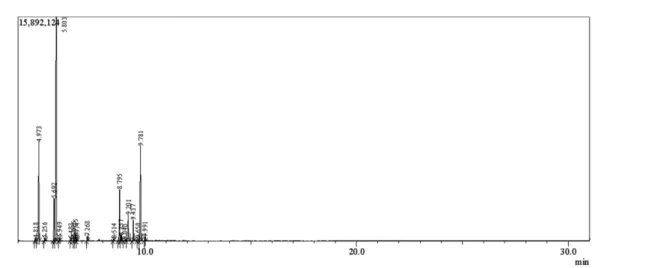
Volatile compounds of F. suspense oil were recognized by GC-MS and matched the retention indices and mass spectra of compounds in the literature (Wenlu and Benlian, 2008). As shown in Table 2 and Fig. 1, the composition (%) of the volatile constituents of F.
suspense oil was found to be: β-pinene (45.88%), myrtenol (13.86%), (+)-α-pinene (13.09%), (−)-trans-pinocarveol (7.34%), sabinene (6.64%), pinocarvone (4.13%), (−)-terpinen-4-ol (2.69%), dipentene (1.02%), (S)-cis-verbenol (0.74%), γ-terpinene (0.60%), (1S)-(−)-verbenone (0.55%), cymene (0.53%), myrcene (0.45%), α-terpineol (0.44%), α-phellandrene (0.42%), camphene (0.40%), 2,5-cyclooctadien-1-ol (0.36%), α-terpinene (0.31%), eucalyptol (0.30%) and campholenic aldehyde (0.27%). The volatile constituents were grouped as alcohols (2,5-cyclooctadien-1-ol, eucalyptol, myrtenol, (−)-trans-pinocarveol, (−)-terpinen-4-ol, α-terpineol and (S)-cis-verbenol), aldehydes (campholenic aldehyde), monoterpene hydrocarbons (camphene, o-cymene, dipentene, myrcene, (+)-α- pinene, β-pinene, α-phellandrene, sabinene, α-terpinene and γ- terpinene) and monoterpene ketones (pinocarvone and (1S)-(−)- verbenone). Compared with the previous study (Wenlu and Benlian, 2008), the major compounds of F. suspense oil were geraniol, linoleic acid, myristic acid, octacosane, β-pinene, squalene, and 1-terpinen-4-ol. Some constituents derived from plants are affected by geographic location, harvest time, extraction procedures and extracted parts of herbs (Yang and Lee, 2013).
Current results indicate that F. suspense oil could be useful in the development of plant acaricide against three acaridae and pyroglyphid mites. Further study should be conducted on human health safety of F. suspense oil to increase acaricidal potency and stability.
Table 1 Acaricidal activities of F. suspensa oil and a synthetic acaricide against D. farinae, D. pteronyssinus, and T. putrescentiaea
Samples Bioassay Mite species LD50 95% CL RTb
F. suspensa oil
Fumigant (µg/cm3)
D. farinae 06.80 6.21-7.39 1.79
D. pteronyssinus 09.21 8.60-9.82 1.28
T. putrescentiae 10.63 13.41-13.85 0.82
Contact (µg/cm2)
D. farinae 03.28 2.68-3.88 2.59
D. pteronyssinus 04.35 3.84-4.86 1.77
T. putrescentiae 08.19 8.64-9.94 0.89
Benzyl benzoate
Fumigant (µg/cm3)
D. farinae 12.18 11.15-13.21 1.00
D. pteronyssinus 11.75 11.06-12.44 1.00
T. putrescentiae 11.13 10.45-11.81 1.00
Contact (µg/cm2)
D. farinae 08.48 7.99-8.97 1.00
D. pteronyssinus 07.72 7.02-8.42 1.00
T. putrescentiae 08.31 7.78-8.84 1.00
aExposed for 24 h.
bRT, Relative toxicity=LD50 value of benzyl benzoate/LD50 value of each compound.
J Appl Biol Chem (2015) 58(2), 105−108 107
Acknowledgments This research was carried out with the support of Cooperative Research Program for Agriculture Science & Technology Development (Project title: Development of integrated pest management techniques using natural products in the grain storage, Project No:
PJ01004502), Rural Development Administration, Republic of Korea.
References
Bae JH, Kim HY, and Jang JY (2005) Antimicrobial effect of Forsythiae fructus extracts on several food-borne pathogens. Kor J Food Cookery Sci 21, 319−25.
Boutekedjiret C, Bentahar F, Belabbes R, and Bessiere JM (2003) Extraction of rosemary 358 essential oil by steam distillation and hydrodistillation.
Flavour Frag J 18, 481−4.
Gulati R and Mathur S (1995) Effect of Eucalyptus and Mentha leaves and Curcuma rhizomes on Tyrophagus putrescentiae (Schrank) (Acarina:
Acaridae) in wheat. Exp Appl Acarol 19, 511−8.
Kang SW, Kim HK, Lee WJ, and Ahn YJ (2006) Toxicity of bisabolangelone from Ostericum koreanumrRoots to Dermatophagoides farinae and Dermatophagoides pteronyssinus (Acari: Pyroglyphidae). J Agric Food Chem 54, 3547−50.
Kim EH, Kim HK, and Ahn YJ (2003) Acaricidal activity of clove bud oil compounds against Dermatophagoides farinae and Dermatophagoides pteronyssinus (Acari: Pyroglyphidae). J Agric Food Chem 51, 885−9.
Lee HS (2004) Acaricidal activity of constituents identified in Foeniculum vulgare fruit oil against Dermatophagoides spp. (Acari: Pyroglyphidae).
J Agric Food Chem 52, 2887−9.
Lim JH, Kim HW, Jeon JH, and Lee HS (2008) Acaricidal constituents isolated from Sinapis alba L. seeds and structure-activity relationships. J Agric Food Chem 56, 9962−6.
Liu Y, Song S, Xu S, and Fu X (2003) Study on the chemical constituents of the fruits of Forsythia suspensa (Thunb.) Vahl. J Shenyang Pharm Univ 20, 101−3.
Nishibe S, Okabe K, Tsukamoto H, Baku-shima A, and Hisada S (1982) The structure and antibacterial activity of suspensaside isolated from Forsythia suspensa. Chem Pharm Bull 30, 4548−53.
Pasay C, Mounsey K, Stevenson G, Davis R, Arlian L, Morgan M et al.
(2010) Acaricidal activity of eugenol based compounds against scabies mites. PLoS ONE 5, e12079.
Qu H, Zhang Y, Wang Y, Li B, and Sun W (2008) Antioxidant and antibacterial activity of two compounds (forsythiaside and forsythin) isolated from Forsythia suspense. J Pharm Pharmacol 60, 261−6.
Rim IS and Jee CH (2006) Acaricidal effects of herb essential oils against Dermatophagoides farinae and D. pteronyssinus (Acari: Pyroglyphidae) and qualitative analysis of a herb Mentha pulegium (pennyroyal). Korean J Parasitol 44, 133−8.
Saad EZ, Hussien R, Saher F, and Ahmed Z (2006) Acaricidal activities of some essential oils and their monoterpenoidal constituents against house dust mite (Acari: Pyroglyphidae). J Zhejiang Univ-Sci B 7, 957−62.
SAS (2004) SAS/STAT User’s Guide version 9; SAS Institute: USA.
Song HY, Yang JY, Suh JW, and Lee HS (2011) Acaricidal activities of apiol and its derivatives from Petroselinum sativum seeds against Dermatophagoides pteronyssinus, Dermatophagoides farinae, and Tyrophagus putrescentiae. J Agric Food Chem 59, 7759−64.
Wang L, Piao XL, Kim SW, Piao XS, Shen YB, and Lee HS (2008) Effects of Forsythia suspensa extract on growth performance, nutrient digestibility, and antioxidant activities in broiler chickens under high ambient temperature. Poultry Sci 87, 1287−94.
Wenlu D and Benlian LV (2008) Research on chemical constituents of Fig. 1 Analysis of various constituents from F. suspensa oil by GCMS.
Table 2 Analysis of various constituents from F. suspensa oil identified by GCMS
Peak number
Retention time
(min) Compound Relative area
(%)
1 4.818 α-Phellandrene 0.42
2 4.973 (+)-α-Pinene 13.09
3 5.256 Camphene 0.40
4 5.692 Sabinene 6.64
5 5.803 β-Pinene 45.88
6 5.959 Myrcene 0.45
7 6.483 α-Terpinene 0.31
8 6.626 o-Cymene 0.53
9 6.715 Dipentene 1.02
10 6.774 Eucalyptol (1,8-cineole) 0.30
11 7.268 γ-Terpinene 0.60
12 8.514 Campholenic aldehyde 0.27
13 8.795 (−)-trans-Pinocarveol 7.34
14 8.857 (S)-cis-Verbenol 0.74
15 9.040 2,5-Cyclooctadien-1-ol 0.36
16 9.201 Pinocarvone 4.13
17 9.437 (−)-Terpinen-4-ol 2.69
18 9.650 α-Terpineol 0.44
19 9.781 Myrtenol 13.86
20 9.991 (1S)-(−)-Verbenone 0.55
108 J Appl Biol Chem (2015) 58(2), 105−108
volatile oil from Forsythia suspensa (Thunb) originated in Henan. J Anhui Agric Sci 19, 6.
Wu H, Li J, Zhang F, Li L, Liu Z, and He Z (2012) Essential oil components from Asarum sieboldii Miquel are toxic to the house dust mite Dermatophagoides farinae. Parasitol Res 111, 1895−9.
Yang JY and Lee HS (2013) Verbenone structural analogues isolated from
Artemesia aucheri as natural acaricides against Dermatophagoides spp.
and Tyrophagus putrescentiae. J Agric Food Chem 61, 12292−6.
Yang JY, Kim MG, Park JH, Hong ST, and Lee HS (2014) Evaluation of benzaldehyde derivatives from Morinda officinalis as anti-mite agents with dual function as acaricide and mite indicator. Sci Rep 4, doi:
10.1038/srep07149.