ABSTRACT
School closures during the coronavirus disease 2019 (COVID-19) pandemic have been outlined in studies from different disciplines, including economics, sociology, mathematical modeling, epidemiology, and public health. In this review, we discuss the implications of school closures in the context of the current COVID-19 pandemic. Modeling studies of the effects of school closures, largely derived from the pandemic influenza model, on severe acute respiratory syndrome coronavirus 2 produced conflicting results. Earlier studies assessed the risk of school reopening by modeling transmission across schools and communities; however, it remains unclear whether the risk is due to increased transmission in adults or children. The empirical findings of the impact of school closures on COVID-19 outbreaks suggest no clear effect, likely because of heterogeneity in community infection pressure, differences in school closure strategies, or the use of multiple interventions. The benefits of school closings are unclear and not readily quantifiable; however, they must be weighed against the potential high social costs, which can also negatively affect the health of this generation.
Keywords: COVID-19; Coronavirus; School; Child
서론
세계보건기구의 공식 보고에 의하면
2021년
3월
14일 기준 코로나바이러스감염증
-19(coronavirus disease 2019, COVID-19)
감염자가
119,220,681명이었으며 그 중
2,642,826명이 사망하였다
.1) COVID-19환자 중
18세 미만의 소아청소년은
10%미만을 차지하였으며 노인들에 비하면 상대적으로 매우 적은 사망을 보였다
.2) 2020년 말
COVID-19의
3차 유행 시 연령 분포는 이전에 비해 젊은 층의 비율이 많아졌으나
,전 시기 동안 학생들은 전체
Review Article
Received: Aug 16, 2021 Accepted: Aug 22, 2021 Correspondence to Young June Choe
Department of Pediatrics, Korea University Anam Hospital, 73 Goryeodae-ro, Seongbuk-gu, Seoul 02841, the Republic of Korea.
E-mail: [email protected]
Copyright © 2021 The Korean Society of Pediatric Infectious Diseases
This is an Open Access article distributed under the terms of the Creative Commons Attribution Non-Commercial License (https://
creativecommons.org/licenses/by-nc/4.0/) which permits unrestricted non-commercial use, distribution, and reproduction in any medium, provided the original work is properly cited.
ORCID iDs Eun Young Cho
https://orcid.org/0000-0002-2286-4593 Young June Choe
https://orcid.org/0000-0003-2733-0715 This review article is published jointly by the Clinical and Experimental Pediatrics and the Pediatric Infection and Vaccine.
Conflict of Interest
No potential conflict of interest relevant to this
School Closures during Coronavirus Disease 2019 Outbreak
Eun Young Cho
1, Young June Choe
21Department of Pediatrics, Chungnam National University Hospital, Daejeon, the Republic of Korea
2Department of Pediatrics, Korea University Anam Hospital, Seoul, the Republic of Korea
코로나바이러스감염증 -19 유행과 교육기관
등교 정상화
조은영 ,
1최영준
21충남대학교병원 소아청소년과
2고려대학교 안암병원 소아청소년과
article was reported.
Author Contributions
Conceptualization: Choe YJ; Data curation:
Cho EY, Choe YJ; Formal analysis: Cho EY, Choe YJ; Resources: Choe YJ; Supervision:
Choe YJ; Writing - original draft: Cho EY, Choe YJ; Writing - review & editing: Cho EY, Choe YJ.
환자의
15%미만을 유지하였다
.더욱이
,현재까지 보고된 내용들을 종합하면 학교는 세계
각지에서
COVID-19의 지역사회 유행의 주요 경로가 아닌 것으로 보인다
.3)이러한 맥락에서
,세계적으로 여러 공중 보건 기관에서 학교와 연관된 사회적 거리두기 조치를 조정하는 것을 논의하고 있다
.4)학교 폐쇄
(school closure)는 인플루엔자 대유행에 대응하기 위하여 제안된 비약물적 중재 방
법 중 하나이다
.5)학교 폐쇄가 제안된 근거는 소아청소년이 전파의 중요한 매개체
(vector)로 작용할 수 있고
,학교에서의 높은 접촉률로 인해 소아청소년이 지역사회 인플루엔자 유행을 촉발할 수 있기 때문이다
.6)연령별 발병률 등 감염병의 특성에 따라 학교 폐쇄가 유리한 경
우가 있다
.7)그러나 현재의
COVID-19상황에서는 중증급성호흡기증후군 코로나바이러스
-2(severe acute respiratory syndrome coronavirus-2, SARS-CoV-2)
감염자의
90%이상이 성인이
며 많은 집단감염
(cluster)이 학교 밖에서 발생하여 이 논리가 적용되지 않는다
. COVID-19대
유행 초기 학교 폐쇄에 대한 연구들을 요약한 내용에 따르면
,포함된 연구 중 어느 것도 그 효 과를 구체적으로 조사할 수 있게 설계되지 않았고
,연구의 질이 상대적으로 낮은 것으로 나 타났다
.8)학교는 소아청소년의 교육 뿐 아니라 만성질환과 정신건강 등을 포함한 필수 보건 관리를 일차적으로 수행함으로써 지역사회의 건강 유지에 기여하는데
,이를 수행하지 못하 여 발생하는 피해를 감수하고 학교 폐쇄를 시행함으로써 지역사회에서
COVID-19의 전파의 고리를 효과적으로 차단할 수 있을지 논의할 가치가 있다
.이에 따라
COVID-19대유행 동안의 학교 폐쇄에 대해 경제학
,사회학
,수학적 모델링
,역학 및
공중 보건 등 다양한 학문 분야에서 논의가 이루어지고 있다
.본 종설에서는
COVID-19대유 행에 대응하기 위한 학교 폐쇄의 영향에 대해 정리하여 소개하고자 한다
.본론
1.
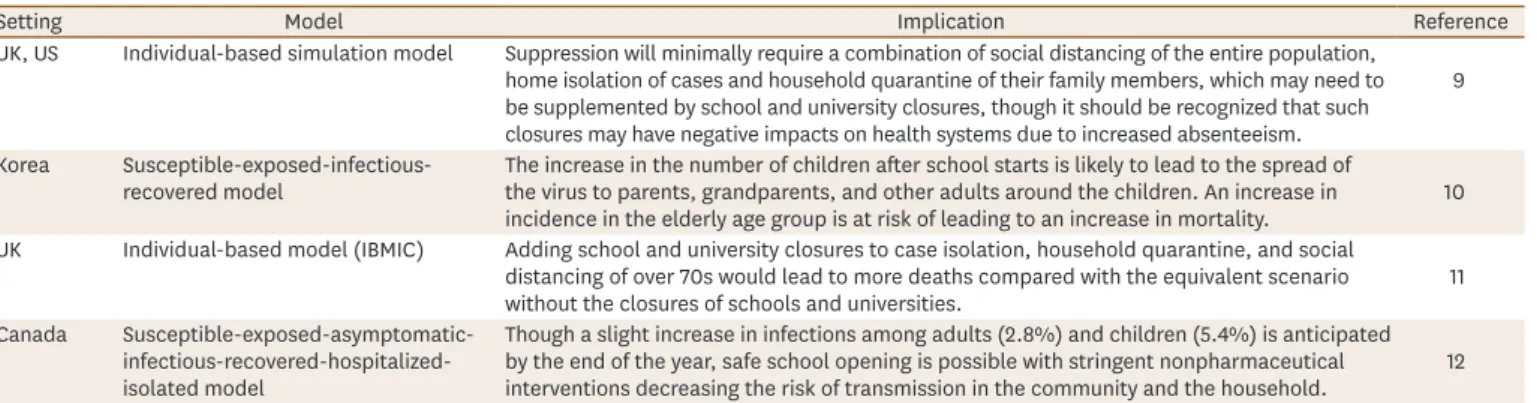
건강결과에대한수리모형(Mathematical modeling of health outcomes)
COVID-19
로 인한 학교 폐쇄에 대한 여러 모델링 연구들은 상충되는 결과를 보고하였다
(Table 1).
초기 모델 중 한 연구는 소아청소년이
SARS-CoV-2를 성인만큼 감염시킨다는
가정 하에 학교 폐쇄가
COVID-19의 전파를 감소시킬 것이라고 예측했다
.9)다만
COVID-19Table 1. Mathematical models simulating the effects of school closures on coronavirus disease-associated health outcomes
Setting Model Implication Reference
UK, US Individual-based simulation model Suppression will minimally require a combination of social distancing of the entire population, home isolation of cases and household quarantine of their family members, which may need to be supplemented by school and university closures, though it should be recognized that such closures may have negative impacts on health systems due to increased absenteeism.
9
Korea Susceptible-exposed-infectious-
recovered model The increase in the number of children after school starts is likely to lead to the spread of the virus to parents, grandparents, and other adults around the children. An increase in
incidence in the elderly age group is at risk of leading to an increase in mortality. 10 UK Individual-based model (IBMIC) Adding school and university closures to case isolation, household quarantine, and social
distancing of over 70s would lead to more deaths compared with the equivalent scenario
without the closures of schools and universities. 11
Canada Susceptible-exposed-asymptomatic- infectious-recovered-hospitalized- isolated model
Though a slight increase in infections among adults (2.8%) and children (5.4%) is anticipated by the end of the year, safe school opening is possible with stringent nonpharmaceutical
interventions decreasing the risk of transmission in the community and the household. 12 Abbreviations: UK, United Kingdom; US, United States.
의 전파 방식은 소아청소년이 유행을 주도하는 계절성 인플루엔자와 차이가 있기 때문에
,학교 폐쇄만으로
COVID-19의 유행을 완화시키기에는 불충분할 수 있다고 보고하였다
.이와 유사하게
,국내에서 수행된 한 시뮬레이션 연구에서는 개학 후 소아청소년의 전파율이
10배 증가한다고 가정한다면 학교 폐쇄가
COVID-19의 유행을 완화하기 위한 필수적인 비약물적 개입 방법이 될 것임을 보여주었다
.10)초기 연구에서는 학교와 지역사회 전반에 걸친 전파를 모델링하여
COVID-19유행에서의 개 학의 위험에 대해 평가했지만
,이 위험이 성인 또는 소아의 전파 증가 중 무엇으로 인한 것인 지 여부는 여전히 불분명하다
.한 후속 모델은 감염병에 대한 즉각적인 대응이 오히려 유행 을 연장시키고 장기적으로 더 많은 사망자를 발생시켜
,학교 폐쇄가 역설적으로 총 사망자 수를 증가시킬 것이라고 예측하였다
.11)학교 폐쇄 시 학교에서의 접촉은 감소하지만 가정에
서의 접촉 증가로 이어져
, COVID-19감염의 중증도가 낮은 어린이보다도 중증도가 높은 성인
이 더 감염될 가능성이 있다는 우려에 근거하여 학교 폐쇄를 비판하는 의견도 있다
.캐나다
의 한 연구에 따르면
2020년 가을 토론토에서 발생한
COVID-19의 재유행은 주로 지역사회 내
성인 간의 접촉률 증가로 인한 것으로 나타났다
.12)지역사회 내 확산에 의해 유행이 발생하였 고 개학이 바이러스 재유행의 주요 요인은 아니었지만
,가정 내 전파 위험이 낮을 때 단기간
의 학교 폐쇄는 감염을 줄이는 데 도움이 되었다
.13) COVID-19관련 사망률이 고령층에 크게
편향되어 있다는 점을 감안할 때
, COVID-19에 대응하는 최적의 전략은 인플루엔자의 대유행
에 기반한 예상과는 다를 것이라고 결론지을 수 있겠다
.2.
감염병유행관리활동의경험(Empirical findings in mitigating outbreaks)
관찰된 결과에 따르면
,학교 폐쇄는
SARS-CoV-2의 확산 또는 그로 인한 사망에 제한적인 효
과를 보였다
.이러한 결과가 나타나게 된 것은 지역사회에 따라
COVID-19유행의 규모가 다 르고
,학교 폐쇄 정책이 다양하며
,여러 가지 대응 전략이 함께 사용되었기 때문일 수 있다
.그러나 학교에서 많은 사람들이 긴 시간을 공유함에도 불구하고 학교를 통한
SARS-CoV-2의 전파는 상대적으로 드문 것으로 보인다
. 5개의 코호트 연구에 대한 체계적 문헌 고찰 결과
,학
교에서
3,345건의 접촉과
18건의 전파가 발생하여 전반적인 발병률
(attack rate)이
0.08% (95%신뢰 구간
[confidence interval, CI], 0.00–0.86%)이었다
.14)아일랜드에서는
6명의 지표환자로
부터 소아 접촉
1,001건이 있었으나
COVID-19의
2차 발병 사례가 없었으며
,이는 학교가 전
파의 주요 요인이 아님을 시사한다
.15)독일의 경우
2020년
5월 개학 이후 학교 및 보육 시설에
서의 소아 간 전파는 매우 드물었다
.16)연구자들은 대략적으로 감염력이 있는 수업일수
25일
당
1건의
2차 발병이 있다고 추정했다
.프랑스의
SARS-CoV-2의 지역사회 전파가 증가하고 있
는 상황에서
,개학을 유지하면서도 소아청소년 사이의 전파는 성인보다 낮은 수준을 유지했
다
.17)미국 뉴욕의 사립학교
(N=701)에서는
2020년
10월부터
12월까지 의무적으로
COVID-19에 대한 검사를 시행했고
,총
2,439건의 검사에서
3건
(학생
2명
,교직원
1명
)이 양성으로 감염
률이
0.13%이었다
.18)이러한 발견에도 불구하고
,지역사회의 전파 수준이
SARS-CoV-2의 학교 내 전파 위험에 영향 을 미칠 수 있다
.이탈리아 북부에서는
SARS-CoV-2의 지역사회 유행이 있던
2020년 후반 개
학 후 전반적인
2차 발병률이
3.2%였고
,중학교 및 고등학교에서
6.6%에 달했다
.19)이스라엘
에서는
2020년
5월 개학 이후 한 고등학교에서
COVID-19의 집단발생으로 학생
153명
(발병률
13.2%)
과 교직원
25명
(발병률
16.6%)이
COVID-19에 양성 판정을 받았다
.20)이러한 맥락에서
,대유행에 대비한 계획 수립이 안전한 개학을 보장하는 데 중요하다
.노르 웨이에서는
2020년
8월부터
11월까지 모든 학교 내 접촉에 대해 자가격리
(quarantine)기간 동안 체계적으로
2회 검사를 실시했다
.21)학교에서 예방 조치를 시행한 결과 소아 사이의 전
파가 최소화
(0.9%, 2/234)되었고
, 14세 미만의 소아가
SARS-CoV-2전파의 주 요인이 아니라
는 것을 보여주었다
.호주에서 대부분의 학교가 첫 번째
COVID-19유행 동안 등교를 유지하 였는데
, 15개 학교에 소아 또는 성인의 확진자가 발생하였고 이들이 감염력이 있는 동안 접
촉한
1,448명의 접촉자를 모니터링하였다
.22)그 중
633명
(43.7%)이 검사를 받았으며
18건의
2차 발병이 확인되어
2차 발병률이
1.2%로 낮았다
.칠레의 산티아고에서 학교 폐쇄 이후 혈청
학적 조사에서
1,009명의 학생은
9.9% (95% CI, 8.2–11.8%), 235명의 직원은
16.6% (95% CI,12.1–21.9%)
의 항체 양성율을 보였다
.23)이는 교사들이 유행 기간 동안 더 광범위하게 영향을
받았고
,어린 아이들이 교사 또는 부모인 지표환자로부터 더 높은 감염 위험에 노출되었을 가능성을 시사한다
.홍콩에서는
2020년
7월과
8월 동안 지역사회 전파가 광범위하게 발생했 음에도 불구하고
,개학 기간 동안 학교에서 엄격하게 감염 통제 조치를 시행하여 학령기 소 아의 확진 사례가 학교 내 추가 감염 발생 사례로 이어지지 않았다
.24)앞서 언급한 국가들과 마찬가지로 우리나라에서도 개학을 단계적으로 시행함으로써 소 아청소년 환자의 급격한 증가는 없었고
,전국의 전체 확진자 중 소아청소년 환자의 비율은
10%미만을 유지했다
.25)우리나라에서는
2020년
5월 개학 이후
, 2020년
7월
12일까지
127명 의 소아청소년
COVID-19확진자가 발생하였다
.26)이들의 노출 경로는 가족 또는 친척이
59명
(46%),
학원이나 개인 교습이
18명
(14%),다목적 시설이
8명
(6%)이었고 학교를 통한 전파는
3
명
(2%)이었다
.국내 및 다른 국가들의 결과를 종합할 때
,학교 등교를 유지하였을 때 지역사회에서의
SARS-CoV-2
전파에 미치는 영향은 경미하였다
. 2020년에 전 세계에서 이루어진 학교 폐쇄 및 재개
교에 대한 경험들은 감염병의 지역사회 전파가 통제되고 교육 시설에서 대유행에 대비한 계 획을 수립하고 실행한다면 교육을 지속할 수 있다는 점을 시사한다
.3.
학교폐쇄가건강의비감염성측면에미치는영향(Impact of school closures on noninfectious health outcomes)
학교 폐쇄는 건강의 비감염성 측면에 중대한 영향을 미친다
.소아청소년의 건강에는 부상
,비만
,정신 건강 및 가정 폭력 등 다양한 측면이 포함되어 있다
. COVID-19대응을 위한 봉쇄 조
치 이후 이탈리아
,27)스페인
28)및 미국
29)에서 소아응급진료의 이용 패턴이 감소했다
.국내에 서도 소아청소년의 응급실 방문이 급격히 감소하였으며
,어린 소아
(early childhood, 66.5%),시력저하
(55.2–63.8%)및 부상 이외의 증상
(noninjury complaints, 64.9%)에 의한 방문이 특히
감소하였다
.30)이 영향은 성인보다 소아에서 더 컸는데
,대구의 집단 발생 당시 응급의료를
이용한 성인 환자의 수는
46.4%감소한 반면 소아 환자는
76.9%감소했다
.31)학교 폐쇄는 전 세계 소아 비만에도 영향을 미쳤다
.미국에서는 소아의 전체 비만 유병률 이
2019년
6–12월의
13.7%에서
2020년
6–12월에는
15.4%로 증가했다
.32)프랑스의 봉쇄
(lock-down)
기간 동안 소아들이 집안에 갇혀 있었기 때문에
,신체 활동이 확연히 감소하였다
.33)국
내 한 연구에 따르면
COVID-19대유행 기간 동안 학교 폐쇄 후 기간
(number of days)과 소아 비
만이 관련이 있었다
(P=0.004).34)2020
년의
COVID-19대유행 초기 단계부터
,감염병 대유행의 완화 전략으로 학교 폐쇄를 채택 하는 것과 관련하여 소아청소년의 정신 건강에 대한 연구가 시급히 필요했다
.35)학교 폐쇄로 인해 학생들은 가족과 더 많은 시간을 보내게 되었으나
,수면 리듬
,식습관
,신체 활동에 악영 향을 초래했다
.36)최근의 체계적 문헌 고찰에 따르면 소아청소년은 대유행 기간 및 그 이후에 우울증과 불안을 경험할 가능성이 더 높은 것으로 나타났다
.37)학생들의 비감염성 질병 관련 건강 문제를 해결하고 이에 대처하는 자원을 강화하기 위해
,지역사회 전반적으로 학생들의 삶의 질을 개선할 수 있는 자원을 제공해야 한다
.4.
국내교육기관의COVID-19
대유행대응계획(School COVID-19 preparedness plans in Korea)
교육부는 유
·초
·중등 및 특수학교 코로나
19감염예방 관리 안내
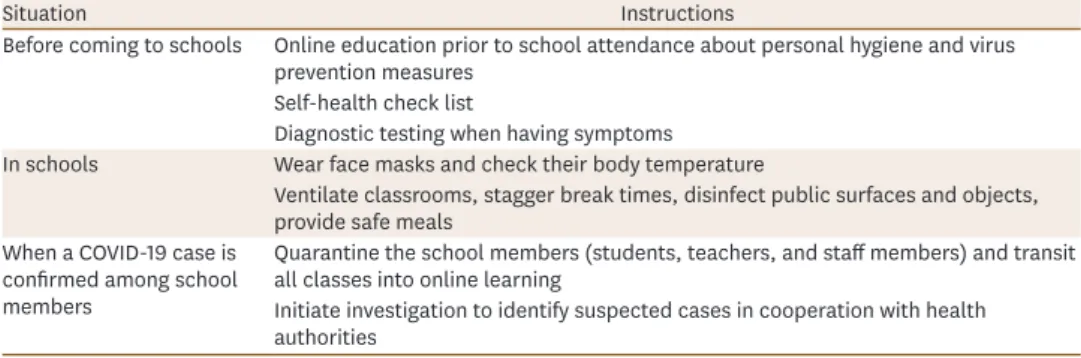
(Table 2)38)를 발표하고
'생활
속 거리두기
'에 따라 등교를 재개할 수 있다고 밝혔다
.학교의 과밀화를 피하기 위해 수업에 참석하는 학생 수를 제한했고
,학생들은 등교를 앞두고 개인위생
,바이러스 전파 예방수칙
,의심증상 발생 시 취해야 할 조치 등에 대해 온라인 교육을 받았다
.등교 전에는 자가 건강 체 크리스트에 발열
,기침
,인후통
,호흡곤란
,후각 및 미각 소실 등의
COVID-19관련 증상을 철 저히 검토하도록 했다
.학생들이
COVID-19증상을 보이면 보건소나 선별진료소를 방문하여 진단검사를 받도록 안내했다
.모든 학생과 교사는 마스크를 착용하고 하루에 두 번 체온을 측정하도록 했다
.이에 더하여 교실의 환기
,쉬는 시간의 조정
,책상이나 문 손잡이 등 공동으로 사용하는 물건과 표면의 소 독을 적극 권장했다
.안전하게 급식을 제공하기 위해 학생 간 접촉을 최소화하는 방법을 마 련하고
,매일
2회 급식종사자의 건강상태를 확인하도록 했다
.학교 내 구성원 중
COVID-19확진자가 발생하면 학생 및 교직원에 대해 귀가조치 후 일시적
으로 등교수업을 원격 수업 체제로 전환하고
,의심 사례를 발견하기 위한 역학 조사를 실시 하였다
.5.
개학및등교결정에대한고려사항(Future considerations in decision- making of school openings in Korea)
국내에서는 사회적 거리두기 수준에 따라 개학 후 등교
,온
·오프라인 수업의 정도를 달리
하고 있다
.25) 2021년
3월 국내 소아청소년의
COVID-19발병 보고가 증가했으나
,이는 주로
Table 2. School guideline on COVID-19 control and prevention by the Ministry of Education
Situation Instructions
Before coming to schools Online education prior to school attendance about personal hygiene and virus prevention measures
Self-health check list
Diagnostic testing when having symptoms In schools Wear face masks and check their body temperature
Ventilate classrooms, stagger break times, disinfect public surfaces and objects, provide safe meals
When a COVID-19 case is confirmed among school members
Quarantine the school members (students, teachers, and staff members) and transit all classes into online learning
Initiate investigation to identify suspected cases in cooperation with health authorities
Abbreviations: COVID-19, coronavirus disease 2019.
SARS-CoV-2
의 전파 예방 조치가 엄격하게 적용되지 않은 어린이집과 사설 수업 등을 통해 발생하였다
.초등학교에서의 감염 사례는 제한적이었으며 학교에서의 예방 조치가 잘 이루
어지고 있었다
.39)따라서
COVID-19의 지역사회 유행이 지속되더라도 학교의 감염병 대응 정
책을 철저하게 준수하면서 직접 등교하는 개학을 유지하거나 확대하기 위한 전국적인 계획 이 필요하다
.개학을 유지하기 위한 전략들 중 하나로 학교 구성원에게
SARS-CoV-2를 신속 검사하는 방법 을 고려할 수 있다
.교육 기관에서 학교 범위의 검사 방법으로 교직원 또는 학생 중의 감염자 선별 또는 접촉 추적을 위해 신속항원검사를 적용할 수도 있다
.신속항원검사는 검사 시간이 짧고
,적용 범위가 넓으며
,현장에서의 검사가 가능하고 비용이 저렴한 등 여러 측면의 이점 이 있다
.그러나 신속항원검사는 역전사
-중합효소연쇄반응에 비해 민감도와 특이도가 낮기 때문에 수행기준을 검증하고 전체 집단에서의
SARS-CoV-2의 유병률을 고려하여야 한다
.또 한 검체 채취
,검사 진행 및 분석 후 결과를 보고하려면 훈련된 인력이 필요하다
.40)전파력이 더 높은 변종
SARS-CoV-2가 출현하여 문제가 되고 있다
.전 세계적으로 여러 가지
새로운 변종이 등장했으며 일부는 빠르게 확산되고 있다
. 2020년
11월 영국에서 처음 발견된
B.1.1.7
변종 바이러스
(델타 변이
)에 대한 초기 자료에 따르면 그 발생 비율이 다른 연령대보
다 소아에게서 더 높아 성인보다 소아에서 더 쉽게 전파됨을 시사하였다
.41)이후의 관찰 결 과 이 변종 바이러스는 소아 뿐 아니라 모든 연령대에서 다른 바이러스 계통보다 더 효율적 으로 전파가 되는 것으로 보인다
.그러나 만약 다른 새로운 변이가 발생하고 특히 소아의 감 염률을 높인다면 학교에서의 전파 역학을 재조사해야 한다
.그럼에도 불구하고
,학교 폐쇄 는 소아청소년의 교육 박탈과 건강에 대한 잠재적인 역효과를 포함하여 사회적으로 파괴적 인 영향을 미칠 수 있다
.42)결론
COVID-19
대유행 이후 전 세계적으로 학교 폐쇄가 이루어졌지만 학교 폐쇄 정책을 계속해야
하는지에 대한 실질적인 논쟁이 계속되고 있다
.42)최근까지의 결과들을 종합하면 학교 폐쇄 로 인한 이익은 제한적이며 소아청소년의 건강에 예상치 못한 피해가 발생한다는 점이 강조 되고 있다
.학교 폐쇄의 이익은 불분명하고 정량화하기 어려운 반면
,학교 폐쇄로 인해 미래 세대의 건강에 부정적인 영향이 초래되며 이로 인해 치러야 할 잠재적인 사회적 비용이 매우 높아질 것임을 고려해야 한다
.REFERENCES
1. World Health Organization. Coronavirus (COVID-19) dashboard [Internet]. Geneva: World Health Organization; 2021 [cited 2021 Mar 21]. Available from: https://covid19.who.int.
2. World Health Organization. Coronavirus disease (COVID-19): schools [Internet]. Geneva: World Health Organization; 2021 [cited 2021 Mar 21]. Available from: https://www.who.int/news-room/q-a-detail/coro- navirus-disease-covid-19-schools.
3. Betz CL. COVID-19 and school return: the need and necessity. J Pediatr Nurs 2020;54:A7-9.
PUBMED | CROSSREF
4. World Health Organization. Considerations for school-related public health measures in the context of COVID-19 [Internet]. Geneva: World Health Organization; 2021 [cited 2021 Mar 21]. Available from:
https://www.who.int/publications/i/item/considerations-for-school-related-public-health-measures-in- the-context-of-covid-19.
5. Monto AS. The risk of seasonal and pandemic influenza: prospects for control. Clin Infect Dis 2009;48 Suppl 1:S20-5.
PUBMED | CROSSREF
6. Litvinova M, Liu QH, Kulikov ES, Ajelli M. Reactive school closure weakens the network of social interactions and reduces the spread of influenza. Proc Natl Acad Sci U S A 2019;116:13174-81.
PUBMED | CROSSREF
7. Cauchemez S, Ferguson NM, Wachtel C, Tegnell A, Saour G, Duncan B, et al. Closure of schools during an influenza pandemic. Lancet Infect Dis 2009;9:473-81.
PUBMED | CROSSREF
8. Viner RM, Russell SJ, Croker H, Packer J, Ward J, Stansfield C, et al. School closure and management practices during coronavirus outbreaks including COVID-19: a rapid systematic review. Lancet Child Adolesc Health 2020;4:397-404.
PUBMED | CROSSREF
9. Ferguson NM, Laydon D, Nedjati-Gilani G, Imai N, Ainslie K, Baguelin M, et al. Report 9: impact of non- pharmaceutical interventions (NPIs) to reduce COVID-19 mortality and healthcare demand [Internet].
London: Imperial College London; 2020 [cited 2021 Mar 21]. Available from: https://www.imperial.ac.uk/
mrc-global-infectious-disease-analysis/covid-19/report-9-impact-of-npis-on-covid-19.
10. Kim S, Kim YJ, Peck KR, Jung E. School opening delay effect on transmission dynamics of coronavirus disease 2019 in Korea: based on mathematical modeling and simulation study. J Korean Med Sci 2020;35:e143.
PUBMED | CROSSREF
11. Rice K, Wynne B, Martin V, Ackland GJ. Effect of school closures on mortality from coronavirus disease 2019: old and new predictions. BMJ 2020;371:m3588.
PUBMED | CROSSREF
12. Moghadas SM, Fitzpatrick MC, Sah P, Pandey A, Shoukat A, Singer BH, et al. The implications of silent transmission for the control of COVID-19 outbreaks. Proc Natl Acad Sci U S A 2020;117:17513-5.
PUBMED | CROSSREF
13. Yuan P, Aruffo E, Ogden N, Tan Y, Gatov E, Gournis E, et al. School and community reopening during the COVID-19 pandemic: a mathematical modeling study. medRxiv, in press 2021.
CROSSREF
14. Xu W, Li X, Dozier M, He Y, Kirolos A, Lang Z, et al. What is the evidence for transmission of COVID-19 by children in schools? A living systematic review. J Glob Health 2020;10:021104.
PUBMED | CROSSREF
15. Heavey L, Casey G, Kelly C, Kelly D, McDarby G. No evidence of secondary transmission of COVID-19 from children attending school in Ireland, 2020. Euro Surveill 2020;25:2000903.
PUBMED | CROSSREF
16. Ehrhardt J, Ekinci A, Krehl H, Meincke M, Finci I, Klein J, et al. Transmission of SARS-CoV-2 in children aged 0 to 19 years in childcare facilities and schools after their reopening in May 2020, Baden- Württemberg, Germany. Euro Surveill 2020;25:2001587.
PUBMED | CROSSREF
17. Gras-Le Guen C, Cohen R, Rozenberg J, Launay E, Levy-Bruhl D, Delacourt C. Reopening schools in the context of increasing COVID-19 community transmission: The French experience. Arch Pediatr 2021;28:178-85.
PUBMED | CROSSREF
18. Smith-Norowitz TA, Hammerschlag MR, Kohlhoff S. Coronavirus disease 2019 (COVID-19) infection rates in a private school in Brooklyn, New York. Acta Paediatr 2021;110:1569-70.
PUBMED | CROSSREF
19. Larosa E, Djuric O, Cassinadri M, Cilloni S, Bisaccia E, Vicentini M, et al. Secondary transmission of COVID-19 in preschool and school settings in northern Italy after their reopening in September 2020: a population-based study. Euro Surveill 2020;25:2001911.
PUBMED | CROSSREF
20. Stein-Zamir C, Abramson N, Shoob H, Libal E, Bitan M, Cardash T, et al. A large COVID-19 outbreak in a high school 10 days after schools' reopening, Israel, May 2020. Euro Surveill 2020;25:2001352.
PUBMED | CROSSREF
21. Brandal LT, Ofitserova TS, Meijerink H, Rykkvin R, Lund HM, Hungnes O, et al. Minimal transmission of SARS-CoV-2 from paediatric COVID-19 cases in primary schools, Norway, August to November 2020.
Euro Surveill 2021;26:2002011.
PUBMED | CROSSREF
22. Macartney K, Quinn HE, Pillsbury AJ, Koirala A, Deng L, Winkler N, et al. Transmission of SARS-CoV-2 in Australian educational settings: a prospective cohort study. Lancet Child Adolesc Health 2020;4:807-16.
PUBMED | CROSSREF
23. Torres JP, Piñera C, De La Maza V, Lagomarcino AJ, Simian D, Torres B, et al. SARS-CoV-2 antibody prevalence in blood in a large school community subject to a Covid-19 outbreak: a cross-sectional study.
Clin Infect Dis 2021;73:e458-65.
PUBMED | CROSSREF
24. Fong MW, Cowling BJ, Leung GM, Wu P. Letter to the editor: COVID-19 cases among school-aged children and school-based measures in Hong Kong, July 2020. Euro Surveill 2020;25:2001671.
PUBMED | CROSSREF
25. Yoon Y, Kim KR, Park H, Kim S, Kim YJ. Stepwise school opening and an impact on the epidemiology of COVID-19 in the children. J Korean Med Sci 2020;35:e414.
PUBMED | CROSSREF
26. Kim EY, Ryu B, Kim EK, Park YJ, Choe YJ, Park HK, et al. Children with COVID-19 after reopening of schools, South Korea. Pediatr Infect Vaccine 2020;27:180-3.
CROSSREF
27. Raucci U, Musolino AM, Di Lallo D, Piga S, Barbieri MA, Pisani M, et al. Impact of the COVID-19 pandemic on the Emergency Department of a tertiary children's hospital. Ital J Pediatr 2021;47:21.
PUBMED | CROSSREF
28. González García LG, Rodríguez Manchón S, Mata Zubillaga D, García Aparicio C, Laso Alonso AE, Corral Hospital S, et al. Impact on admittance of children on Emergency Department of a regional hospital from north of Spain during the COVID-19 State of Alarm. Pediatr Emerg Care 2021;37:e64-5.
PUBMED | CROSSREF
29. Bram JT, Johnson MA, Magee LC, Mehta NN, Fazal FZ, Baldwin KD, et al. Where have all the fractures gone? The epidemiology of pediatric fractures during the COVID-19 pandemic. J Pediatr Orthop 2020;40:373-9.
PUBMED | CROSSREF
30. Choi DH, Jung JY, Suh D, Choi JY, Lee SU, Choi YJ, et al. Impact of the COVID-19 Outbreak on trends in emergency department utilization in children: a multicenter retrospective observational study in Seoul metropolitan area, Korea. J Korean Med Sci 2021;36:e44.
PUBMED | CROSSREF
31. Jang KM, Ahn JY, Choi HJ, Lee S, Kim D, Lee DW, et al. Pediatric Emergency Department utilization and coronavirus disease in Daegu, Korea. J Korean Med Sci 2021;36:e11.
PUBMED | CROSSREF
32. Jenssen BP, Kelly MK, Powell M, Bouchelle Z, Mayne SL, Fiks AG. COVID-19 and changes in child obesity.
Pediatrics 2021;147:e2021050123.
PUBMED | CROSSREF
33. Chambonniere C, Lambert C, Fearnbach N, Tardieu M, Fillon A, Genin P, et al. Effect of the COVID-19 lockdown on physical activity and sedentary behaviors in French children and adolescents: new results from the ONAPS national survey. Eur J Integr Med 2021;43:101308.
PUBMED | CROSSREF
34. Kang HM, Jeong DC, Suh BK, Ahn MB. The impact of the coronavirus disease-2019 pandemic on childhood obesity and vitamin D status. J Korean Med Sci 2021;36:e21.
PUBMED | CROSSREF
35. Bahn GH. Coronavirus disease 2019, school closures, and children's mental health. J Korean Acad Child Adolesc Psychiatry 2020;31:74-9.
PUBMED | CROSSREF
36. Saito M, Kikuchi Y, Lefor AK, Hoshina M. Mental health in Japanese children during school closures due to the COVID-19. Pediatr Int, in press 2021.
PUBMED | CROSSREF
37. Meherali S, Punjani N, Louie-Poon S, Abdul Rahim K, Das JK, Salam RA, et al. Mental health of children and adolescents amidst COVID-19 and past pandemics: a rapid systematic review. Int J Environ Res Public Health 2021;18:3432.
PUBMED | CROSSREF
38. Ministry of Education. MOE's makes an announcement on nationwide school reopening [Internet].
Sejong: Ministry of Education; 2020 [cited 2021 Mar 21]. Available from: http://english.moe.go.kr/
boardCnts/view.do?boardID=265&boardSeq=80595&lev=0&searchType=null&statusYN=C&page=2&s=en- glish&m=0301&opType=N.
39. Korea Disease Control and Prevention Agency. Updates on COVID-19 in Republic of Korea (as of 23 March) [Internet]. Cheongju: Korea Disease Control and Prevention Agency; 2021 [cited 2021 Mar 23]. Available from: http://ncov.mohw.go.kr/en/tcmBoardView.do?brdId=12&brdGubun=125&dataGu- bun=&ncvContSeq=5015&.
40. Lewis D. What new COVID variants mean for schools is not yet clear. Nature 2021;589:503.
PUBMED | CROSSREF
41. European Centre for Disease Prevention and Control. COVID-19 in children and the role of school settings in transmission - first update. Solna: European Centre for Disease Prevention and Control; 2020.
42. UNESCO. School closures caused by coronavirus (COVID-19) [Internet]. Paris: UNESCO; 2021 [cited 2021 Mar 21]. Available from: https://en.unesco.org/covid19/educationresponse.