ISSN 2234-3806 • eISSN 2234-3814
https://doi.org/10.3343/alm.2021.41.2.225
Surveillance of Coronavirus Disease 2019 (COVID-19) Testing in Clinical Laboratories in Korea
Hee Jae Huh , M.D.1,*, Ki Ho Hong , M.D.2,*, Taek Soo Kim , M.D.3, Sang Hoon Song , M.D.3, Kyoung Ho Roh , M.D.4, Hyukmin Lee , M.D.5, Gye Cheol Kwon , M.D.6
1Department of Laboratory Medicine and Genetics, Samsung Medical Center, Sungkyunkwan University School of Medicine, Seoul, Korea; 2Department of Laboratory Medicine, Seoul Medical Center, Seoul, Korea; 3Department of Laboratory Medicine, Seoul National University College of Medicine, Seoul, Korea;
4Department of Laboratory Medicine, National Health Insurance Service Ilsan Hospital, Goyang, Korea; 5Department of Laboratory Medicine, Yonsei University College of Medicine, Seoul, Korea; 6Department of Laboratory Medicine, College of Medicine, Chungnam National University, Daejeon, Korea
In response to the ongoing coronavirus disease 2019 (COVID-19) pandemic, an online laboratory surveillance system was established to monitor severe acute respiratory syn- drome coronavirus 2 (SARS-CoV-2) real-time reverse transcription-PCR (rRT-PCR) testing capacities and results. SARS-CoV-2 rRT-PCR testing data were collected from 97 clinical laboratories, including 84 medical institutions and 13 independent clinical laboratories in Korea. We assessed the testing capacities to utilize SARS-CoV-2 rRT-PCR based on sur- veillance data obtained from February 7th to June 4th, 2020 and evaluated positive result characteristics according to the reagents used and sample types. A total of 1,890,319 SARS-CoV-2 rRT-PCR testing were performed, 2.3% of which were positive. Strong corre- lations were observed between the envelope (E) gene and RNA-dependent RNA poly- merase (RdRp)/nucleocapsid (N) genes threshold cycle (Ct) values for each reagent. No statistically significant differences in gene Ct values were observed between the paired up- per and lower respiratory tract samples, except in the N gene for nasopharyngeal swab and sputum samples. Our study showed that clinical laboratories in Korea have rapidly expanded their testing capacities in response to the COVID-19 outbreak, with a peak daily capacity of 34,193 tests. Rapid expansion in testing capacity is a critical component of the national response to the ongoing pandemic.
Key Words: Coronavirus disease 2019, Severe acute respiratory syndrome coronavirus 2, Real-time RT-PCR, Laboratory surveillance, Testing capacity, Ct value
Received: June 27, 2020 Revision received: July 20, 2020 Accepted: September 24, 2020 Corresponding author:
Hyukmin Lee, M.D.
Department of Laboratory Medicine, Yonsei University College of Medicine, 50-1 Yonsei-ro, Seodaemun-gu, Seoul 03722, Korea
Tel: +82-2-2228-2446 Fax: +82-2-313-0956 E-mail: [email protected] Co-corresponding Author:
Kyoung Ho Roh, M.D.
Department of Laboratory Medicine, National Health Insurance Service Ilsan Hospital, 100 Ilsan-ro, Ilsandong-gu, Goyang 10444, Korea
Tel: +82-31-900-0906 Fax: +82-31-900-0925 E-mail: [email protected]
* These authors contributed equally to this study.
© Korean Society for Laboratory Medicine This is an Open Access article distributed under the terms of the Creative Commons Attribution Non-Commercial License (https://creativecom- mons.org/licenses/by-nc/4.0) which permits unrestricted non-commercial use, distribution, and reproduction in any medium, provided the original work is properly cited.
The ongoing coronavirus disease 2019 (COVID-19) pandemic began in December 2019 in Wuhan, China, with more than 13,824,739 confirmed cases as of July 18th, 2020 [1]. In Ko- rea, the first COVID-19 case was confirmed on January 20th, 2020. Rapid viral transmission during the early phase of CO-
VID-19 has highlighted the importance of laboratory diagnosis [2, 3]. Molecular testing is the reference standard for COVID-19 diagnosis, and real-time reverse transcription-PCR (rRT-PCR) is the preferred one [2, 4, 5]. The ability of clinical laboratories to perform an appropriate molecular testing for severe acute respi-
2017-03-16 https://crossmark-cdn.crossref.org/widget/v2.0/logos/CROSSMARK_Color_square.svg
ratory syndrome coronavirus 2 (SARS-CoV-2) detection is criti- cal for an effective response to the ongoing pandemic. Rapid response system, including an emergency use authorization (EUA) system for emerging infectious diseases, were estab- lished by the Korean Centers for Disease Control and Prevention (KCDC), Korean Society for Laboratory Medicine (KSLM), and the Korean Association of External Quality Assessment Service [6, 7]. The first commercial rRT-PCR assay for detecting SARS- CoV-2 was granted EUA by the Ministry of Food and Drug Safety in Korea on February 4th, 2020, and SARS-CoV-2 rRT-PCR testing by clinical laboratories began by February 7th, 2020.
However, as the clinical performance of this assay reagent had not been fully evaluated, stringent and continuous quality con- trol was required [7-9]. Therefore, KSLM COVID-19 Task Force established an online laboratory surveillance system to monitor SARS-CoV-2 rRT-PCR testing capacities and results. We ana- lyzed the surveillance data obtained using this system from February 7th to June 4th, 2020.
SARS-CoV-2 rRT-PCR data were collected from 97 clinical laboratories, including 84 medical institutions and 13 indepen- dent clinical laboratories; each laboratory submitted the data to KSLM daily beginning from February 7th, 2020. Public health laboratories, such as the KCDC and local government laborato- ries, were excluded from this study. Submitted data included:
(1) the number of tests performed, including the number that gave positive, negative, and invalid/indeterminate results for SARS-CoV-2, with invalid denoting “failure of both internal con- trol and target gene amplification” and indeterminate denoting that “only some genes were amplified”; (2) detailed information on each positive result, including sample type, assay reagent and equipment used, and threshold cycle (Ct) values for each target gene; and (3) parallel test results to confirm the accept- ability of new reagent lot. We collected and reviewed the sub- mitted data once daily and checked errors to ensure data qual- ity. The Institutional Review Board (IRB) of the National Health Insurance Medical Center, Goyang, Korea (IRB No. NHIMC 2020-04-025) approved the study.
We analyzed Spearman correlation to examine the associa- tions between the Ct values of genes. We used the Wilcoxon signed-rank test to compare the Ct values of paired upper respi- ratory tract (URT) and lower respiratory tract (LRT) samples with Bonferroni correction for multiple comparisons. P <0.05 was considered significant. Statistical analyses were performed us- ing the MedCalc Statistical Software version 19.2.1 (MedCalc Software Ltd, Ostend, Belgium).
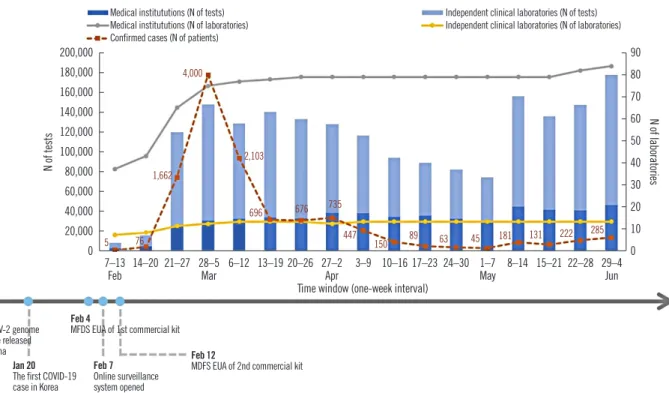
In total, 1,890,319 SARS-CoV-2 rRT-PCR testing was per- formed, 2.3% of which were positive (Table 1). The testing number and participating laboratories significantly increased by the third week of the study period (February 7th to June 4th, 2020), proportionate to the increase in confirmed cases; with over 70,000 testing being performed weekly after the initial two weeks, the daily testing capacity (34,193 tests) peaked on May 29th, 2020 (Fig. 1).
Of the positive results, 13,006 results were initially obtained from newly diagnosed COVID-19 patients. Majority of the tests were conducted using the PowerChek 2019-nCoV Real-time PCR Kit (Kogenebiotech, Seoul, Korea), targeting the envelope (E) and RNA-dependent RNA polymerase (RdRp) genes, and the Allplex 2019-nCoV Assay (Seegene, Seoul, Korea), targeting the E, RdRp, and nucleocapsid (N) genes; these were the first and second commercial assays to receive EUA, respectively (Supplemental Data Table S1). The parallel test results showed low lot‐to‐lot reagent variation (Supplemental Data Table S2).
Strong correlations were observed between the E and RdRp/N Ct values using PowerChek and Allplex (Spearman’s rho > 0.98, P <0.001), and lower Ct values were obtained for E than for the RdRp or N genes. The median Ct value difference between E and RdRp was 0.40 (95% confidence interval [CI], 0.38–0.43) for PowerChek. For Allplex, the median Ct value differences be- tween genes were 1.25 for E and RdRp (95% CI, 1.24–1.27) and 2.42 for E and N (95% CI, 2.40–2.44).
Of the initial positive results, results from paired URT and LRT samples were used to evaluate positive result characteristics ac- cording to the sample types. Results for 3,832 samples were
Table 1. Number of SARS-CoV-2 rRT-PCR testing performed by clinical laboratories in Korea from February 7th to June 4th, 2020 Medical institutions, N (%) Independent clinical laboratories, N (%) Total, N (%)
Tests 533,615 (100) 1,356,704 (100) 1,890,319 (100)
Positive results 13,772 (2.6) 29,797 (2.2) 43,569 (2.3)
Negative results 518,023 (97.1) 1,319,162 (97.2) 1,837,185 (97.2)
Invalid/indeterminate results 1,820 (0.3) 7,745 (0.6) 9,565 (0.5)
Abbreviations: rRT-PCR, real-time reverse transcription PCR; SARS-CoV-2, severe acute respiratory syndrome coronavirus 2.
obtained from 1,916 paired URT (nasopharyngeal swab [NPS]
or nasopharyngeal/oropharyngeal swab [NPS/OPS]) and LRT (sputum) samples, including 909 sets of NPS and sputum samples and 1,007 sets of NPS/OPS and sputum samples. The distributions of E, RdRp, and N gene Ct values in the paired samples are presented in Table 2. No statistically significant dif- ferences in gene Ct values were observed between the paired URT and LRT samples, except in the N gene for NPS and spu- tum samples.
Surveillance for emerging pathogens is a common practice;
however, daily surveillance is uncommon [10, 11]. The labora- tory-based SARS-CoV-2 surveillance system in our study can provide daily laboratory data for monitoring SARS-CoV-2 rRT- PCR testing results in Korea and is being used successfully in a timely fashion. Our study showed that clinical laboratories in Ko- rea responded quickly to the COVID-19 outbreak, with SARS- CoV-2 rRT-PCR testing beginning 16 days after the first con- firmed case in the country, and that the testing capacity in- Table 2. Comparison of Ct values in paired upper and lower respiratory tract samples obtained from newly diagnosed COVID-19 patients (N
=1,916) SARS-
CoV-2 target gene
NPS vs. sputum (N=909) NPS/OPS vs. sputum (N=1,007)
Ct value, Median
(IQR) Ct difference, Median
(IQR) Ct value, Median
(IQR) Ct difference, Median (IQR)
NPS Sputum Sputum-NPS P* NPS/OPS Sputum Sputum-NPS P*
E 24.61 (19.20–29.51) 24.57 (19.57–29.06) 0.22 (–0.16–0.59) >0.05 24.69 (18.59–29.65) 24.82 (19.24–29.52) 0.19 (–0.14–0.51) >0.05 RdRp 25.65 (20.33–30.42) 25.82 (20.95–30.12) 0.28 (–0.07–0.64) >0.05 25.66 (19.97–30.86) 25.89 (20.49–30.72) 0.29 (–0.03–0.61) >0.05 N 26.97 (21.58–31.29) 27.12 (22.31–31.34) 0.49 (0.11–0.88) 0.034 26.89 (21.22–31.79) 27.18 (21.97–31.95) 0.43 (0.07–0.80) >0.05
*Bonferroni-corrected P.
Abbreviations: COVID-19, coronavirus disease 2019; Ct, threshold cycle; E, envelope; IQR, interquartile range; N, nucleocapsid; NPS, nasopharyngeal swab;
OPS, oropharyngeal swab; RdRp, RNA-dependent RNA polymerase; SARS-CoV-2, severe acute respiratory syndrome coronavirus 2.
Fig. 1. Monitoring of SARS-CoV-2 rRT-PCR testing performed by clinical laboratories in Korea from February 7th to June 4th, 2020. Con- firmed case numbers were derived from the KCDC data (http://ncov.mohw.go.kr/).
Abbreviations: COVID-19, coronavirus disease 2019; EUA, emergency use authorization; KCDC, Korean Centers for Disease Control and Prevention; MFDS, Ministry of Food and Drug Safety; rRT-PCR, real-time reverse transcription PCR; SARS-CoV-2, severe acute respiratory syndrome coronavirus 2.
200,000 180,000 160,000 140,000 120,000 100,000 80,000 60,000 40,000 20,000 0
90 80 70 60 50 40 30 20 10 0
N of tests N of laboratories
7–13 14–20 21–27 28–5 6–12 13–19 20–26 27–2 3–9 10–16 17–23 24–30 1–7 8–14 15–21 22–28 29–4
Feb Mar Apr May Jun
Jan 13 SARS-CoV-2 genome sequence released from China
Jan 20 The first COVID-19 case in Korea
Feb 7 Online surveillance system opened
Feb 12
MDFS EUA of 2nd commercial kit Feb 4
MFDS EUA of 1st commercial kit
Time window (one-week interval) Medical institututions (N of tests)
Medical institututions (N of laboratories) Confirmed cases (N of patients)
Independent clinical laboratories (N of tests) Independent clinical laboratories (N of laboratories)
4,000
1,662
2,103
696 676 735
447 150 89 63
5 76 45 181 131 222 285
creased rapidly thereafter. Of note, clinical laboratories consis- tently conducted over 70,000 tests weekly during the study pe- riod, although the number of confirmed patients sharply de- creased since the peak in the first week of March 2020.
Recent studies have reported that SARS-CoV-2 detection sen- sitivity is greater for LRT samples than for URT samples [12-15].
Using paired sample analysis, Lin, et al. [14] demonstrated that the detection rates of SARS-CoV-2 for sputum samples were sig- nificantly higher than those for throat swabs. In our study, paired sample analysis, with positive results from both URT and LRT samples, showed that the Ct value differences between sample types were generally not significant. Although the N gene Ct value differences between NPS and sputum were significant, the median Ct difference (0.49) was low. As these results were de- rived from initial positive results from newly diagnosed COVID-19 patients, it is possible that several patients were paucisymptom- atic or asymptomatic, without productive sputum.
This study has several limitations. We have reported not the number of COVID-19 patients but the number of SARS-CoV-2 rRT-PCR testing. Additionally, we did not collect clinical informa- tion, as the study was based on laboratory surveillance data re- garding testing capacities and positive result details. In addition, detailed information, such as sample type, was not available for all negative results.
In summary, this laboratory surveillance report for SARS- CoV-2 rRT-PCR testing provided a timely assessment of testing capacities of clinical laboratories and positive result characteris- tics, according to sample type and assays, for the first few months of the COVID-19 outbreak in Korea. Clinical laboratories rapidly expanded their testing capacity in response to the CO- VID-19 outbreak, with a peak daily testing capacity of 34,193 tests. This rapid expansion in testing capacity is a critical com- ponent of the national response to the ongoing pandemic.
ACKNOWLEDGEMENTS
We thank the clinical laboratories that participated in the pro- spective surveillance program.
AUTHOR CONTRIBUTIONS
TSK, SHS, and GCK were involved in study organization and data collection; HJH and KHH interpreted the data and wrote the first draft of the manuscript; and HL and KHR designed the study and composed the final draft of the manuscript. All authors have read the final manuscript and approved this submission.
CONFLICTS OF INTEREST
No potential conflicts of interest relevant to this article were re- ported.
RESEARCH FUNDING
None declared.
ORCID
Hee Jae Huh https://orcid.org/0000-0001-8999-7561 Ki Ho Hong https://orcid.org/0000-0002-5700-9036 Taek Soo Kim https://orcid.org/0000-0002-2093-1721 Sang Hoon Song https://orcid.org/0000-0002-5084-1137 Kyoung Ho Roh https://orcid.org/0000-0002-6291-9229 Hyukmin Lee https://orcid.org/0000-0002-8523-4126 Gye Cheol Kwon https://orcid.org/0000-0002-4886-0590
REFERENCES
1. World Health Organization. Coronavirus disease (COVID-19) pandemic.
https://www.who.int/emergencies/diseases/novel-coronavirus-2019 (Up- dated on 18 Jul 2020).
2. Cheng MP, Papenburg J, Desjardins M, Kanjilal S, Quach C, Libman M, et al. Diagnostic testing for severe acute respiratory syndrome-related coronavirus 2: a narrative review. Ann Intern Med 2020;172:726-34.
3. Rothe C, Schunk M, Sothmann P, Bretzel G, Froeschl G, Wallrauch C, et al. Transmission of 2019-nCoV infection from an asymptomatic con- tact in Germany. N Engl J Med 2020;382:970-1.
4. Tang YW, Schmitz JE, Persing DH, Stratton CW. Laboratory diagnosis of COVID-19: current issues and challenges. J Clin Microbiol 2020;58:
e00512-20.
5. Kim YJ, Sung H, Ki CS, Hur M. COVID-19 testing in South Korea: cur- rent status and the need for faster diagnostics. Ann Lab Med 2020;40:
349-50.
6. Sung H, Yoo CK, Han MG, Lee SW, Lee H, Chun S, et al. Preparedness and rapid implementation of external quality assessment helped quickly increase COVID-19 testing capacity in the Republic of Korea. Clin Chem 2020;66:979-81.
7. Hong KH, Lee SW, Kim TS, Huh HJ, Lee J, Kim SY, et al. Guidelines for laboratory diagnosis of coronavirus disease 2019 (COVID-19) in Korea.
Ann Lab Med 2020;40:351-60.
8. Lee YJ, Lim Y, Hur KW, Sung H, Kim MN. Quality of ribonucleic acid extraction for real-time reverse transcription-PCR (rRT-PCR) of SARS- CoV-2: importance of internal control monitoring. Ann Lab Med 2020;
40:490-2.
9. Sung H, Roh KH, Hong KH, Seong MW, Ryoo N, Kim HS, et al. COV- ID-19 molecular testing in Korea: practical essentials and answers from experts based on experiences of emergency use authorization assays.
Ann Lab Med 2020;40:439-47.
10. Lee MK, Kim S, Kim MN, Kweon OJ, Lim YK, Ki CS, et al. Survey of clinical laboratory practices for 2015 Middle East Respiratory Syndrome coronavirus outbreak in the Republic of Korea. Ann Lab Med 2016;36:
154-61.
11. Zhao H, Green H, Lackenby A, Donati M, Ellis J, Thompson C, et al. A new laboratory-based surveillance system (Respiratory DataMart Sys- tem) for influenza and other respiratory viruses in England: results and experience from 2009 to 2012. Euro Surveill 2014;19:20680.
12. Wang W, Xu Y, Gao R, Lu R, Han K, Wu G, et al. Detection of SARS- CoV-2 in different types of clinical specimens. JAMA 2020;323:1843-4.
13. Pan Y, Zhang D, Yang P, Poon LLM, Wang Q. Viral load of SARS-CoV-2
in clinical samples. Lancet Infect Dis 2020;20:411-2.
14. Lin C, Xiang J, Yan M, Li H, Huang S, Shen C. Comparison of throat swabs and sputum specimens for viral nucleic acid detection in 52 cases of novel coronavirus (SARS-CoV-2)-infected pneumonia (COV- ID-19). Clin Chem Lab Med 2020;58:1089-94.
15. Mohammadi A, Esmaeilzadeh E, Li Y, Bosch RJ, Li JZ. SARS-CoV-2 de- tection in different respiratory sites: a systematic review and meta-anal- ysis. EBioMedicine 2020;59:102903.