pISSN 2288-6575 • eISSN 2288-6796 https://doi.org/10.4174/astr.2021.100.5.276 Annals of Surgical Treatment and Research
Comparing postoperative pain in various pressure
pneumoperitoneum of laparoscopic cholecystectomy:
a double-blind randomized controlled study
Wonbin Chang, Tae Yoo, Won Tae Cho, Giyuon Cho
Department of Surgery, Hallym University College of Medicine, Hwaseong, Korea
INTRODUCTION
Laparoscopic cholecystectomy (LC) is a standard and safe treatment for gallbladder diseases. There is an increasing interest in improving patient satisfaction with LC, rather than its therapeutic outcomes [1]. Postoperative pain is one of the most critical factors associated with patient dissatisfaction.
Less pain allows for an early recovery, fewer hospitalization days, and less operative morbidity. Therefore, patients prefer single-port or robotic surgery over general laparoscopic
surgery. Several reasons are reported for pain occurring after laparoscopic surgery [2,3]. Reducing pneumoperitoneum (PP) is one technique for reducing postoperative pain. Though intraoperative PP’s pathophysiology is not well elucidated, a promising hypothesis is that the carbon dioxide (CO2) gas that maintains intraabdominal pressure stretches the peritoneum and irritates the diaphragm to cause pain [4,5].
Several randomized controlled trials (RCTs) have shown significantly less postoperative pain following LC performed under low and standard PP [6-8]. However, the effect of low
Received November 23, 2020, Revised February 3, 2021, Accepted March 9, 2021
Corresponding Author: Tae Yoo
Department of Surgery, Hallym University College of Medicine, 7 Keunjaebong-gil, Hwaseong 18450, Korea
Tel: +82-31-8086-2430, Fax: +82-31-8086-2029 E-mail: [email protected]
ORCID: https://orcid.org/0000-0003-3834-7125
Copyright ⓒ 2021, the Korean Surgical Society
cc Annals of Surgical Treatment and Research is an Open Access Journal. All articles are distributed under the terms of the Creative Commons Attribution Non- Commercial License (http://creativecommons.org/licenses/by-nc/4.0/) which permits unrestricted non-commercial use, distribution, and reproduction in any medium, provided the original work is properly cited.
Purpose: This study aims to evaluate the effect of different pneumoperitoneum pressures on postoperative pain, especially by subcategorizing the pressures into 3 groups during laparoscopic cholecystectomy (LC).
Methods: We conducted a prospective randomized, double-blinded study of 150 patients with benign and uncomplicated gallbladder disease. They were categorized into 3 groups. Each group (50 patients) underwent LC with different pneumoperitoneum methods: group VLP, very-low pressure (6–8 mmHg); group LP, low pressure (9–11 mmHg); and group SP, standard pressure (12–14 mmHg). The 3 groups were compared for pain intensity, duration, analgesic requirement, and complications.
Results: The characteristics of the patients were similar among all groups. Postoperative pain scores at each time point (1, 2, 4, 6, 12, 24, and 48 hours) were not significantly different among the 3 groups. Further, operation time, hospital stay, the number of analgesic consumption doses, and postoperative complications were not significantly different among the 3 groups.
Conclusion: This study demonstrates no difference in postoperative pain among various pneumoperitoneum pressures during LC. Therefore, routine use of lower-pressure pneumoperitoneum is not recommended unless in selected patients who require low-pressure pneumoperitoneum surgery.
[Ann Surg Treat Res 2021;100(5):276-281]
Key Words: Laparoscopic cholecystectomy, Pneumoperitoneum, Postoperative pain
PP on postoperative pain remains a controversial topic, with other studies reporting no difference in postoperative pain levels between the 2 pressures [2,9,10]. Thus, this study was conducted to investigate the effects of low intraabdominal pressure on pain after LC. Patients were divided into 3 groups varying in intraoperative PP, and differences in their pain levels were examined.
METHODS
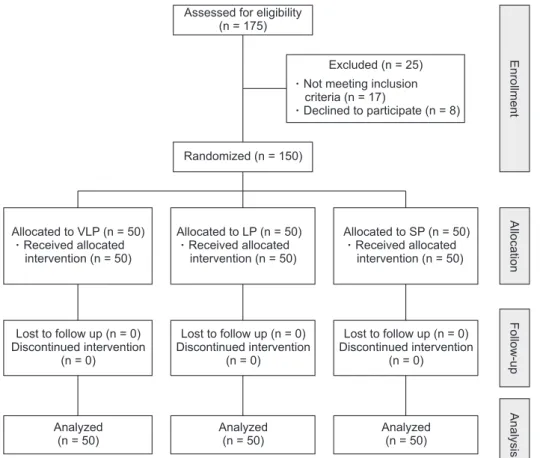
This prospective, randomized, double-blinded comparative study included 150 patients (aged 20–70 years) diagnosed with simple gallbladder disease and underwent LC at the Hallym University Medical Center between November 2014 and March 2017 (Fig. 1). This study was approved by the Institutional Review Board of the Hallym University Medical Center (No.
HUMC 2014-114). Informed consent was obtained from all patients. Patients were assessed for eligibility to participate in this study by a surgical team and were excluded if (1) they had an American Society of Anesthesiologists physical status grade III or above, (2) were pregnant, (3) previously underwent upper abdominal surgery, (4) had severe acute cholecystitis for which they received an interventional treatment, or (5) had severe underlying diseases. Patients were randomly categorized using a computer-generated chart and scheduled for 1 of the
following 3 procedures; standard-pressure PP (SP group, 12–14 mmHg), low-pressure PP (LP group, 9–11 mmHg), and very-low- pressure PP (VLP group, 6–8 mmHg). A piece of paper showing the name of a procedure was placed inside an envelope, and a number was written on each envelope according to the arrays of numbers in the chart.
Surgical procedures
All patients were under general anesthesia during surgery.
The PP was set according to the pressure information written on the paper inside the envelope. The screen of the PP monitor was hidden from the operator. A standard 4-port cholecystectomy was performed. After inserting a 10-mm port at the umbilicus, the initial insufflation rate was maintained at 3 L/min. The intraabdominal pressure was set to 12–14 mmHg in the SP group, 9–11 mmHg in the LP group, and 6–8 mmHg in the VLP group. After adequately performing insufflation, a 10- mm port was additionally inserted below the xiphoid, and 2 of 5-mm ports were inserted at the mid-clavicular and the anterior axillary line approximately 2.5 cm below the costal margin. If deemed necessary by the operator, a closed suction drain was placed at the anterior axillary port site. After the procedure was over, the intraabdominal gas was allowed to escape completely by opening the ports, and the surgeon ensured that the abdomen became flat. The gallbladder was removed through
EnrollmentAllocationFollow-upAnalysis
Allocated to VLP (n = 50) Received allocated intervention (n = 50)
Allocated to LP (n = 50) Received allocated intervention (n = 50)
Allocated to SP (n = 50) Received allocated intervention (n = 50)
Lost to follow up (n = 0) Discontinued intervention
(n = 0)
Lost to follow up (n = 0) Discontinued intervention
(n = 0)
Lost to follow up (n = 0) Discontinued intervention
(n = 0)
Analyzed (n = 50)
Analyzed (n = 50)
Analyzed (n = 50) Randomized (n = 150)
Excluded (n = 25) Not meeting inclusion criteria (n = 17)
Declined to participate (n = 8) Assessed for eligibility
(n = 175)
Fig. 1. CONSORT (Consolidated Standards of Reporting Trials) flow diagram. VLP, very-low pressure (6−8 mmHg pneumoperitoneum);
LP, low pressure (9–11 mmHg pneumoperitoneum); SP, stan- dard pressure (12–14 mmHg pneumoperitoneum).
an incision on the umbilicus. The fascial layer of the abdominal wall at the incision site was sutured using an absorbable suture.
Postoperative pain assessment and management
Patients were hospitalized for at least 48 hours after surgery, following which 75-mg diclofenac was administered at the patients’ request. Intravenous metoclopramide or ondansetron was administered in case of nausea and vomiting. Patient- controlled analgesia was used at patients’ request. To assess the pain, patients were educated on the visual analog scale (VAS:
0, no pain; 10, severe pain) before the surgery and were asked to complete a questionnaire 1, 2, 4, 6, 12, 24, and 48 hours after surgery.
Statistical analysis
The sample size was determined after reviewing related literature [9,10]. The number of patients required for the study was calculated based on an 80% power to detect a 30%–50%
difference in the pain score at the 5% significance level.
Therefore, the sample size was computed as 50 per group.
Statistical analysis was performed using PASW Statistics ver.
18 (IBM Corp., Armonk, NY, USA). Two-way repeated-measures ANOVA was used for VAS scores obtained 1–48 hours after surgery. Other continuous variables were compared with 2-way ANOVA, and categorical variables were compared using the chi- square test or Fisher exact test.
RESULTS
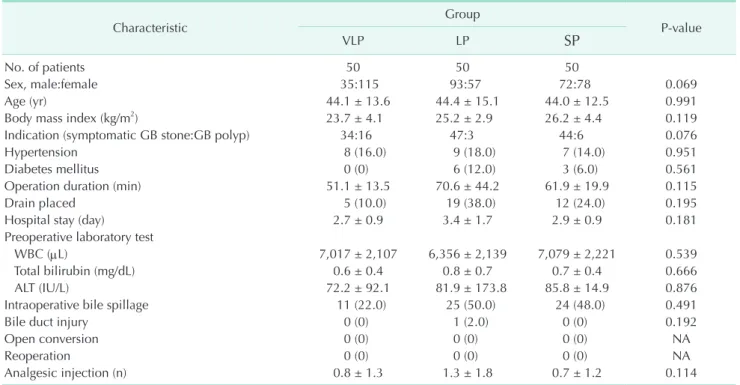
During 28 months, 150 consecutive patients were randomized into 3 equal-sized groups (n = 50). With respect to patient characteristics (Table 1), the 3 groups had similar age, body mass index, preoperative whole blood count, bilirubin, and ALT. However, the VLP group had a higher number of female patients (VLP:LP:SP = 115:57:78, P = 0.067) and patients with gallbladder polyps (VLP:LP:SP = 16:3:6, P = 0.071) than other groups, though not significant.
No open conversion surgery or reoperation was performed in any of the groups. No significant differences in the operation time, rate of placing a drainage tube, or frequency of intraoperative bile leaks from the gallbladder were found between the 3 groups. The 3 groups also had a similar length of postoperative hospitalization and rate of wound complications.
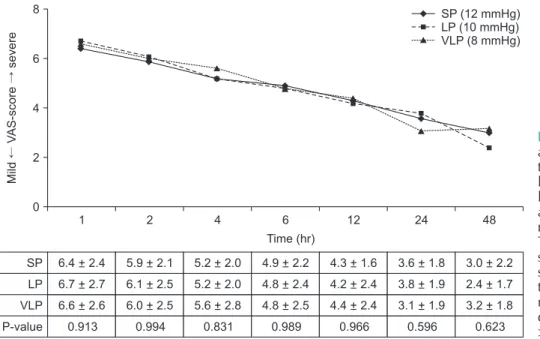
While there was one case of intraoperative bile duct injury in the LP group, its incidence was not significant. The injury occurred during the dissection of the common bile duct attached to the gallbladder owing to chronic cholecystitis. A primary suture was placed using a laparoscopic technique while maintaining the original intraabdominal pressure, and no serious problems occurred after surgery. The pain status at each postoperative time point (1, 2, 4, 6, 12, 24, and 48 hours) and its mean intensity were assessed using the VAS scale; there were no significant differences among the 3 groups (Fig. 2). No
Table 1. Patients’ and operative characteristics
Characteristic Group
P-value
VLP LP SP
No. of patients 50 50 50
Sex, male:female 35:115 93:57 72:78 0.069
Age (yr) 44.1 ± 13.6 44.4 ± 15.1 44.0 ± 12.5 0.991
Body mass index (kg/m2) 23.7 ± 4.1 25.2 ± 2.9 26.2 ± 4.4 0.119
Indication (symptomatic GB stone:GB polyp) 34:16 47:3 44:6 0.076
Hypertension 8 (16.0) 9 (18.0) 7 (14.0) 0.951
Diabetes mellitus 0 (0) 6 (12.0) 3 (6.0) 0.561
Operation duration (min) 51.1 ± 13.5 70.6 ± 44.2 61.9 ± 19.9 0.115
Drain placed 5 (10.0) 19 (38.0) 12 (24.0) 0.195
Hospital stay (day) 2.7 ± 0.9 3.4 ± 1.7 2.9 ± 0.9 0.181
Preoperative laboratory test
WBC (µL) 7,017 ± 2,107 6,356 ± 2,139 7,079 ± 2,221 0.539
Total bilirubin (mg/dL) 0.6 ± 0.4 0.8 ± 0.7 0.7 ± 0.4 0.666
ALT (IU/L) 72.2 ± 92.1 81.9 ± 173.8 85.8 ± 14.9 0.876
Intraoperative bile spillage 11 (22.0) 25 (50.0) 24 (48.0) 0.491
Bile duct injury 0 (0) 1 (2.0) 0 (0) 0.192
Open conversion 0 (0) 0 (0) 0 (0) NA
Reoperation 0 (0) 0 (0) 0 (0) NA
Analgesic injection (n) 0.8 ± 1.3 1.3 ± 1.8 0.7 ± 1.2 0.114
Values are presented as number only, mean ± standard deviation, or number (%).
VLP, very-low pressure (6−8 mmHg pneumoperitoneum); LP, low pressure (9–11 mmHg pneumoperitoneum); SP, standard pressure (12–14 mmHg pneumoperitoneum); GB, gallbladder; NA, not applicable.
significant differences in the rate of analgesic use after surgery were found among the 3 groups.
DISCUSSION
LC is performed as a standard treatment for gallbladder diseases owing to its superiority over existing laparotomy in terms of complication rates, pain, and recovery. Studies are continuously being conducted to minimize the pain and recovery period following LC. These include research on maintaining low PP by injecting CO2 during surgery. Though the mechanism by which intraoperative PP causes pain is unknown, it is hypothesized that peritoneal irritation due to a high rate of insufflation and overstretching of the abdominal muscles and peritoneum cause pain [4]. Studies are still underway to confirm this hypothesis. However, the reported results, so far, are conflicting [6,10]. In this RCT, patients were categorized into 3 groups with varying PP to investigate the differences in postoperative pain levels according to intraabdominal pressure.
In this study, no significant differences in the postoperative pain levels were found at any of the studied time points among the 3 groups (Fig. 2). Previous studies mostly compared the pain level between groups undergoing LC with low and standard pressure [2,6-10]. We observed no difference in the pain level between the 3 groups varying by intraoperative PP. The cause of pain after LC is multifactorial [2,3]. Patient characteristics, underlying diseases, wound site, PP, and site of cholecystectomy may affect it. Pre- and postoperative confounding factors may also affect the pain level. Intraoperative gallbladder perforation leading to bile leaks that irritate the peritoneum and drainage tube placement can also cause pain [11]. Vijayaraghavan et al. [12]
reported that a drainage tube alone could cause pain and mask the pain caused by PP. In this study, no significant differences in the pain levels were observed owing to drainage tube placement and intraoperative bile leaks. Additionally, analgesics may be associated with differences in pain levels. In this study, no significant difference in pain level was found owing to the postoperative use of analgesics. Since postoperative pain levels may also differ according to the preoperative severity of the cholecystitis, LC was performed in patients with uncomplicated gallbladder diseases, and no significant differences in pain level were found according to surgical indications.
One of the major concerns for low PP laparoscopic surgery is whether sufficient vision can be secured during surgery. It is believed among surgeons that a higher PP makes it easier to secure vision during surgery. Low PP may not only impair vision but also limit the use of surgical tools, consequently prolonging the operation time and increasing the risk of postoperative complications. However, no significant differences in the rate of postoperative complications were found between the 3 groups in this study, and the 3 groups also had similar operation times and lengths of hospital stay. Several studies have reported no differences in the rate of postoperative complications and operation times between patients with low- and standard-pressure PP LC [4,13,14]. A study investigating surgeon satisfaction for the surgical field also reported no significant differences between the 2 types of LC. However, a recent RCT by Neogi et al. [10] reported that 20% of the patients who underwent low-pressure PP LC were later treated with standard-pressure PP LC or underwent open conversion surgery (8 cases, conversion to standard PP; 1 case, conversion to open surgery) and that the low-pressure group scored lower on the ease of port insertion, visibility, manipulation of the port, and
1
MildVAS-scoresevere
Time (hr) 8
6
4
2
0
SP LP VLP P-value
2 4 6 12 24 48
6.4 + 2.4 6.7 + 2.7 6.6 + 2.6 0.913
5.9 + 2.1 6.1 + 2.5 6.0 + 2.5 0.994
5.2 + 2.0 5.2+ 2.0 5.6 + 2.8 0.831
4.9 + 2.2 4.8 + 2.4 4.8 + 2.5 0.989
4.3 + 1.6 4.2 + 2.4 4.4 + 2.4 0.966
3.6 + 1.8 3.8 + 1.9 3.1 + 1.9 0.596
3.0 + 2.2 2.4 + 1.7 3.2 + 1.8 0.623 SP (12 mmHg) LP (10 mmHg) VLP (8 mmHg)
Fig. 2. Postoperative pain score after laparoscopic cholecys- tectomy performed using very- low pressure (VLP, 6−8 mmHg), low pressure (LP, 9–11 mmHg), and standard pressure (SP, 12–14 mmHg) of pneumoperitoneum.
The visual analog scale (VAS) score is presented as mean ± standard deviation at different time points. Comparing VAS results, there was no significant difference among the 3 groups (P
> 0.05).
ease of dissection. They explained that some of the surgeons who performed low-pressure PP LC for the first time overcame the learning curve of low PP surgery after treating 20 cases and performed it without much difficulty despite the conversion to the standard-pressure PP LC. Low-pressure PP LC requires surgical experience and is thus recommended to be performed by an experienced surgeon.
Low-pressure PP laparoscopic surgery is reported to positively affect certain factors besides pain. Studies have reported that it causes hemodynamic changes such as reduced blood pressure, heart rate, end-tidal CO2, and intracranial pressure [15,16]. One study reported that low PP reduces catecholamine release by pheochromocytomas and gastric mucosal oxygen saturation in patients undergoing laparoscopy [17]. Therefore, low PP may be useful during LC for patients with underlying diseases that require special care.
This study has certain limitations. The sample size was small, surgeon satisfaction with the operation field was not validated, and the questionnaire for postoperative pain was not used during follow-up to report on return to normal activity.
During the intraoperative course, fentanyl was administered at the anesthesiologist’s discretion; this may have caused some errors in postoperative pain analysis. We could have analyzed that no significant difference was found among the 3 groups.
We realized this error while analyzing the data, and future studies should avoid this same error.
In conclusion, LC was safely performed using low PP without any difference in the complication rate when compared with LC performed using standard pressure. No differences were
found in the pain levels among the 3 groups, suggesting that intraabdominal pressure does not affect visceral pain. However, as low-pressure LC may have other physiological benefits, it is recommended that the procedure be performed on selected patients with certain underlying diseases by an experienced surgeon who can secure a clear vision during the procedure.
ACKNOWLEDGEMENTS
Fund/Grant Support
This research was supported by Hallym University Research Fund (HURF-2015-25).
Conflict of Interest
No potential conflict of interest relevant to this article was reported.
ORCID iD
Wonbin Chang: https://orcid.org/0000-0003-1938-5572 Tae Yoo: https://orcid.org/0000-0003-3834-7125 Won Tae Cho: https://orcid.org/0000-0003-3282-076X Giyuon Cho: https://orcid.org/0000-0002-2447-5970
Author Contribution
Conceptualization, Formal Analysis, Methodology: WC, TY Investigation, Project Administration: All authors
Writing – Original Draft: WC, TY Writing – Review & Editing: All authors
REFERENCES
1. Kim MK, Choi IS, Moon JI, Lee SE, Yoon DS, Kwon SU, et al. Evolution of the Konyang Standard Method for single incision laparoscopic cholecystectomy:
the result from a thousand case of a single center experience. Ann Surg Treat Res 2018;95:80-6.
2. Sandhu T, Yamada S, Ariyakachon V, Chakrabandhu T, Chongruksut W, Ko- iam W. Low-pressure pneumoperitoneum versus standard pneumoperitoneum in laparoscopic cholecystectomy, a prospective randomized clinical trial.
Surg Endosc 2009;23:1044-7.
3. Wills VL, Hunt DR. Pain after laparoscopic cholecystectomy. Br J Surg 2000;87:273-
84.
4. Bhattacharjee HK, Jalaludeen A, Bansal V, Krishna A, Kumar S, Subramanium R, et al. Impact of standard-pressure and low-pressure pneumoperitoneum on shoulder pain following laparoscopic cholecystectomy: a randomised controlled trial. Surg Endosc 2017;31:1287-95.
5. Chung JW, Kang KS, Park SH, Kim CS, Chung JH, Yoo SH, et al. Effect of intraperitoneal CO2 concentration on postoperative pain after laparoscopic cholecystectomy. Ann Surg Treat Res 2017;93:181-5.
6. Gurusamy KS, Vaughan J, Davidson BR.
Low pressure versus standard pressure
pneumoperitoneum in laparoscopic cholecystectomy. Cochrane Database Syst Rev 2014;(3):CD006930.
7. Hua J, Gong J, Yao L, Zhou B, Song Z.
Low-pressure versus standard-pressure pneumoperitoneum for laparoscopic cholecystectomy: a systematic review and meta-analysis. Am J Surg 2014;208:143-50.
8. Sarli L, Costi R, Sansebastiano G, Trivelli M, Roncoroni L. Prospective randomized trial of low-pressure pneumoperitoneum for reduction of shoulder-tip pain following laparoscopy. Br J Surg 2000;87:1161-5.
9. Perrakis E, Vezakis A, Velimezis G, Savanis G, Deverakis S, Antoniades J, et al. Randomized comparison between
different insufflation pressures for laparoscopic cholecystectomy. Surg Laparosc Endosc Percutan Tech 2003;13:
245-9.
10. Neogi P, Kumar P, Kumar S. Low-pressure pneumoperitoneum in laparoscopic cholecystectomy: a randomized controlled trial. Surg Laparosc Endosc Percutan Tech 2020;30:30-4.
11. Yasir M, Mehta KS, Banday VH, Aiman A, Masood I, Iqbal B. Evaluation of post operative shoulder tip pain in low pressure versus standard pressure pneumoperitoneum during laparoscopic cholecystectomy. Surgeon 2012;10:71-4.
12. Vijayaraghavan N, Sistla SC, Kundra P, Ananthanarayan PH, Karthikeyan VS, Ali SM, et al. Comparison of standard-pressure and low-pressure pneumoperitoneum in
laparoscopic cholecystectomy: a double blinded randomized controlled study.
Surg Laparosc Endosc Percutan Tech 2014;24:127-33.
13. Singla S, Mittal G, Raghav, Mittal RK.
Pain management after laparoscopic cholecystectomy: a randomized pros- pective trial of low pressure and standard pressure pneumoperitoneum. J Clin Diagn Res 2014;8:92-4.
14. Chok KS, Yuen WK, Lau H, Fan ST.
Prospective randomized trial on low- pressure versus standard-pressure pneu- moperitoneum in outpatient laparoscopic cholecystectomy. Surg Laparosc Endosc Percutan Tech 2006;16:383-6.
15. Yashwashi T, Kaman L, Kajal K, Dahiya D, Gupta A, Meena SC, et al. Effects of low- and high-pressure carbon
dioxide pneumoperitoneum on intra- cranial pressure during laparoscopic cholecystectomy. Surg Endosc 2020;34:
4369-73.
16. Goel A, Gupta S, Bhagat TS, Garg P.
Comparative analysis of hemodynamic changes and shoulder tip pain under standard pressure versus low-pressure pneumoperitoneum in laparoscopic cholecystectomy. Euroasian J Hepato- gastroenterol 2019;9:5-8.
17. Schwarte LA, Scheeren TW, Lorenz C, De Bruyne F, Fournell A. Moderate increase in intraabdominal pressure attenuates gastric mucosal oxygen saturation in patients undergoing laparoscopy.
Anesthesiology 2004;100:1081-7.