S. Jin ・ S. Bang ・ M.-A. Ahn ・ T. K. Hyun ()
Department of Industrial Plant Science and Technology, College of Agricultural, Life and Environmental Sciences, Chungbuk National University, Cheongju 28644, Republic of Korea e-mail: [email protected]
K. Lee ・ K. Kim
School of Biological Sciences, College of Natural Sciences, Chungbuk National University, Cheongju 28644, Republic of Korea
Overproduction of anthocyanin in ginseng hairy roots enhances their antioxidant, antimicrobial, and anti-elastase activities
Sora Jin ・ Seounggun Bang ・ Min-A Ahn ・ Kyubin Lee ・ Kyunghwan Kim ・ Tae Kyung Hyun
Received: 14 May 2021 / Revised: 28 May 2021 / Accepted: 28 May 2021
ⓒ Korean Society for Plant Biotechnology
This is an Open-Access article distributed under the terms of the Creative Commons Attribution Non-Commercial License (http://creativecommons.org/licenses/by-nc/4.0) which permits unrestricted non-commercial use, distribution, and reproduction in any medium, provided the original work is properly cited.
Abstract Genetic engineering is a potential approach to improve secondary metabolism in plants. In order to elucidate the effect of production of anthocyanin pigment 1 (PAP1) overexpression on the bioactivity of ginseng, we analyzed its antioxidant, antimicrobial, and anti-elastase activities in this study. Our results showed that PAP1 overexpression increased the production of polyphenolic compounds including antho- cyanins. The antioxidant, antimicrobial, and anti-elastase activities were stronger in anthocyanin-overproducing ginseng hairy roots (AOX) than in wild ginseng hairy roots. Using a different solvent system (0, 30, 70, and 100% (v/v) EtOH), we revealed that variations in the contents of the polyphenolic compounds were highly correlated with changes in the anti- oxidant and antimicrobial activities of AOX. The antioxidant, antimicrobial, and anti-elastase effects of AOX highlight genetic engineering as a powerful approach to enhance the therapeutic properties of plants. Our results show that AOX could potentially have various functional applications in the cosmetic and pharmaceutical industries.
Keywords Antioxidant activity, Anthocyanin, Antimicrobial activity, Ginseng hairy root
Introduction
Anthocyanins are glycosylated polyphenolic compounds synthesized in the cytoplasm and stored in vacuoles (Chanoca
et al. 2015). Although anthocyanins are well known as water-soluble flavonoid pigments with colors ranging from orange and red to purple and blue in flowers, seeds, fruits, and vegetation, they are important in attracting pollinators, seed dispersal by promoting fruit consumption, as well as plant protection against biotic and abiotic stresses owing to their antioxidant properties (Liu et al. 2018). There are numerous papers regarding the health benefits of anthocyanins because of their antioxidant, anti-inflammatory, and anti- cancer effects (Alappat and Alappat 2020), indicating that they are integrally involved interactions between humans and nature. In higher plants, anthocyanin biosynthesis is modulated by the transcriptional complex MYB-bHLH-WD40 (MBW complex) comprising DNA-binding R2R3 MYB transcription factors, basic helix-loop-helix (bHLH) proteins, and WD40 repeat proteins (Xu et al. 2015). Of the three proteins that form the MBW complex, R2R3 MYB tran- scription factors act as a master regulator of the entire set of anthocyanin biosynthesis genes including chalcone syn- thase, chalcone isomerase, flavanone 3-hydroxylase, and flavonol synthase (Mehrtens et al. 2005), indicating that the R2R3-MYB transcription factors could be significant in increasing anthocyanin in crops for value‐added traits.
Ginseng (Panax ginseng C.A. Meyer) is the most widely
consumed herbal plant because of its various pharmacological
benefits such as neuroprotective, internal secretion adjustment,
protective cardiovascular, anti-aging, anti-tumor, and immu-
nomodulatory effects (Choi et al. 2013; Kim 2018). Although
ginsenosides, triterpene saponins, are well known as major
bioactive ingredients of ginseng, anthocyanins in ginseng
berry have been reported to directly inhibit the activity of
tyrosinase in α-melanocyte-stimulating hormone-stimulated
B16F10 cells (Jin et al. 2019). Moreover, the whitening
activity of ginseng has been shown to be improved by
Production of Anthocyanin Pigment 1 (PAP1, Arabidopsis
R2R3-MYB type transcription factor)-dependent anthocyanin
accumulation in ginseng hairy roots (Jin and Hyun 2020),
Research Article
indicating that the accumulation of anthocyanins in ginseng roots can improve its pharmaceutical properties.
In this study, we examined the antioxidant, antimicrobial, and anti-elastase activities of PAP1-overexpressing ginseng hairy roots to understand the effect of anthocyanins on the pharmaceutical properties of ginseng. This study is expected to garner further interest in the use of anthocyanin- overproducing ginseng roots as a novel functional resource in the cosmetic and pharmaceutical industries.
Materials and methods Plant materials and extraction
In a previous study, we generated PAP1-overexpressing ginseng hairy roots using Agrobacterium rhizogenes R1601 (Jin and Hyun 2020). The anthocyanin-overproducing ginseng hairy roots (AOX) and transgenic controls (TC) were cultured on agar-solidified B5 medium at 22 °C in the dark. Four- week-old AOX and TC were harvested, ground, and freeze- dried. The materials were then soaked in different extraction solvents including water, 30, 70, and 100% (v/v) EtOH for 24 h and sonicated in an ultrasonic bath. Each solvent extract was evaporated to produce a dried powder extract.
Determination of total phenolic and flavonoid content In order to determine total phenolic content (TPC), each extract was mixed with 2 N Folin–Ciocalteu reagent and incubated with 20% Na 2 CO 3 for 15 min. The absorbance of the resultant blue colored solution was recorded at a wavelength of 725 nm. The TPC for each extract was calculated using the equation obtained from the standard gallic acid graph and expressed in milligram gallic acid equivalents (µg GAE/mg extract).
Total anthocyanin content (TAC) for each extract was quantified as described by Jin and Hyun (2020). The absorbance was determined at 530 and 657 nm and the TAC was calculated as (A530 – 0.25*A657) / mg of dry weight.
Chemical-based assays to quantify antioxidant activity The antioxidant activities of various extracts were determined by monitoring the disappearance of 1,1-dephenyl-2-picryl- hydrazyl (DPPH) at 520 nm and the reducing power assay at 750 nm, as described by Jin et al. (2019). The concen- tration of sample required to reduce DPPH absorbance by
50% (RC 50 ) was calculated for each sample.
In order to determine the ferric reducing antioxidant power (the ability to reduce Fe 3+ to Fe 2+ ), different concentrations of samples were mixed with sodium phosphate buffer (0.2 M, pH 6.6) and potassium ferricyanide (1%, w/v). After incubation at 50 ℃ for 20 min, the reaction was stopped by adding 10% trichloroacetic acid. Then, 0.5 ml of reaction mixture was mixed with same volume of distilled water and 0.1 ml of 0.1% (w/v) ferric chloride. The absorbance of the sample was measured at 750 nm.
The final assay solution contained 150 μl of 0.08 μM fluorescein, 25 μl of phosphate buffer (blank), Trolox standard (6.25 ~ 50 μM), and each extract. After incubation at 37 °C for 10 min in the dark, 25 μl of 0.12 g/ml fresh 2,2'-azobis(isobutyramidine) dihydrochloride was added. A SpectraMax Gemini EM microplate reader was used with fluorescence filters (excitation at 485 nm and emission at 525 nm). The fluorescence of the mixture solution was recorded every minute for 90 min. Area under the curve was calculated for each sample by integrating the relative fluorescence curve. ORAC values were expressed as μM of Trolox equivalents (μM TE).
Determination of antimicrobial activity
The antimicrobial activity of each extract was tested against eight bacterial species: gram-positive Kocuria rhizophila (KACC 14744), Micrococcus luteus (KACC 14819), Listeria monocytogenes (KACC 19115), and Staphylococcus aureus (KACC 1916) as well as gram-negative Enterobacter cloacae (KACC 11958), Salmonella enteritidis (KACC 12021), Salmonella enterica subsp. enterica (KACC 10769), and Pseudomonas aeruginosa (KACC 2004). The minimum inhibitory concentration (MIC) was determined by an anti- bacterial assay performed with the two-fold serial dilution method using 96 U-bottom microtiter plates. The lowest concentration showing growth inhibition in comparison with the control was defined as MIC.
Neutrophil elastase inhibition assay
In vitro inhibitory effects of each sample against neutrophil elastase were determined using Neutrophil Elastase Inhibitor Screening Kit (BioVision, Milpitas, CA, USA) according to the manufacturer’s instructions.
Statistical analysis
The results were presented as mean ± standard error (SE)
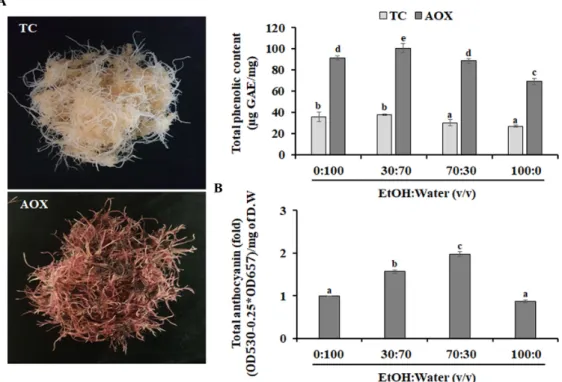
Fig. 1 Effects of PAP1 on total phenol (A) and total anthocyanin contents (B) in ginseng hairy roots. Anthocyanin-overproducing ginseng hairy roots: AOX; Transgenic control ginseng hairy roots: TC. Different letters denote significant differences (p < 0.05, Duncan’s test)
of the indicated number of experiments (n ≥ 3). One-way analysis of variance (ANOVA) followed by Duncan’s multiple- range test was used to determine statistically significant differences between the groups. P < 0.05 was considered statistically significant.
Results and discussion
Influence of ethanol concentration on the extraction of phenolic and anthocyanin compounds
Selecting the solvent is one of the most important steps in extraction of bioactive compounds from plant materials.
Among pigments, chlorophylls and carotenoids are hydro- phobic or nonpolar, whereas anthocyanins are polar molecules (Mattioli et al. 2020; Pérez-Gálvez et al. 2020). Therefore, polar solvents including ethanol and methanol are frequently used for extraction of polyphenolic compounds such as anthocyanins. Considering safety and final potential use in the industry (Wendakoon et al. 2012), we used different concentration of EtOH to compare the extraction efficiency of polyphenolic compounds from AOX and TC. As shown in Figure 1A, the 30% EtOH extract of AOX contained the highest TPC of 100.71 ± 4.17 μg GAE/mg of extract, whereas the lowest TPC of 27.10 ± 0.89 μg GAE/mg of
extract was observed in the 100% EtOH extract of TC.
Furthermore, TAC was only detected in AOX samples in the following order: 70% EtOH > 30% EtOH > 0% EtOH (water) > 100% EtOH (Fig. 1B). This indicates that a binary- solvent system (EtOH/water) is more effective than a mono-solvent system (water or EtOH) in the extraction of polyphenolic compounds from ginseng hairy roots. It is known that the solvent polarity significantly affects the extraction yield of phytochemicals from plant tissues (Kim 2020). The TPC and TAC changed based on solvent polarity (Fig. 1), indicating that ginseng hairy roots contain diverse polyphenolic compounds with varying polarity.
Antioxidant properties of AOX
Although reactive oxygen species (ROS) play an important
role as intracellular signalling molecules, an imbalance
between ROS-generating and ROS-scavenging systems
causes oxidative stress, which induces lipid peroxidation,
and disrupts DNA, RNA, as well as protein functions (Dar-
bandi et al. 2018). Therefore, antioxidant therapy using
free radical scavengers, such as polyphenolic compounds,
has been receiving increasing attention as a useful strategy
to restore the impaired balance between ROS and anti-
oxidant systems. We hypothesised that that an increase in
polyphenolic compounds caused by PAP1 overexpression
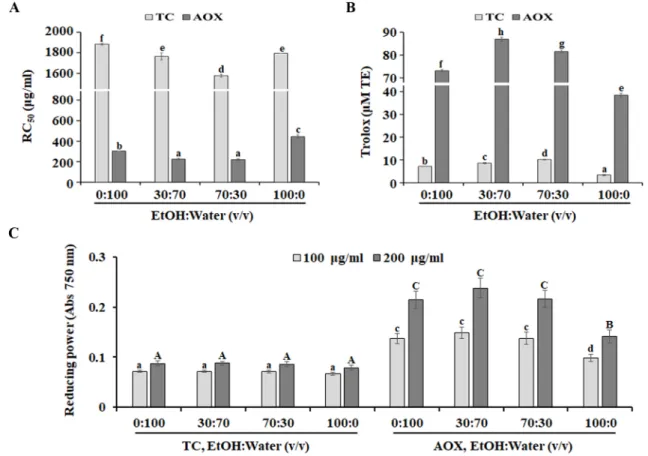
Fig. 2 Antioxidant activity of anthocyanin-overproducing ginseng hairy roots. The antioxidant activity was measured based on DPPH-free radical scavenging activity (A), ORAC assay (B), and reducing power (C). DPPH-radical scavenging activities were expressed as RC
50values (μg/ml). ORAC values for each extract are calculated in μM of Trolox equivalents. Values are averaged from triplicate experiments and represented as mean ± SE. Different letters denote significant differences (p < 0.05, Duncan's test).
Anthocyanin-overproducing ginseng hairy roots: AOX; Transgenic control ginseng hairy roots: TC influences the antioxidant properties of ginseng hairy
roots. As shown in Figure 2A, AOX extracts exhibited a higher level of DPPH-free radical scavenging activity (RC 50 between 220.9 and 444.5 µg/ml) compared with that exhibited by TC (RC 50 between 1577.8 and 1883.9 µg/ml).
Furthermore, AOX and TC extracts at 40 µg/ml exhibited ORAC values of 38.5 ~ 87.0 µM TE and 3.3 ~ 10.2 µM TE, respectively (Fig. 2B). Moreover, 200 µg/ml of AOX extracts had OD700 values ranging from 0.14 to 0.24, which were higher than those of TC (0.08 to 0.09) indicating stronger activity of AOX extracts. AOX extracts that were extracted with 30 and 70% EtOH exhibited strong DPPH- free radical scavenging activity and high ORAC values, whereas those extracted with 100% EtOH exhibited the lowest antioxidant activity (Fig. 2). These results indicate that the polyphenolic constituents are responsible for the antioxidant activities of plants, thereby validating our hypothesis that PAP1 overexpression can improve the antioxidant properties of ginseng hairy roots.
Antimicrobial activity of anthocyanin-overproducing ginseng hairy roots
Despite advancements in modern medicine, infectious diseases remain a major public health problem (Cos et al. 2006).
The emergence and dissemination of multidrug-resistant
human pathogens have also become a significant public
health hazard. The World Health Organization has recognized
medicinal plants as a potential source to obtain various
antimicrobial agents (Cheesman et al. 2017). Therefore,
there has been revived interest in phytochemicals with
antimicrobial activities to treat infectious diseases. In order
to investigate the antimicrobial activity of ginseng hairy
roots, we determined the MIC of each extract using the
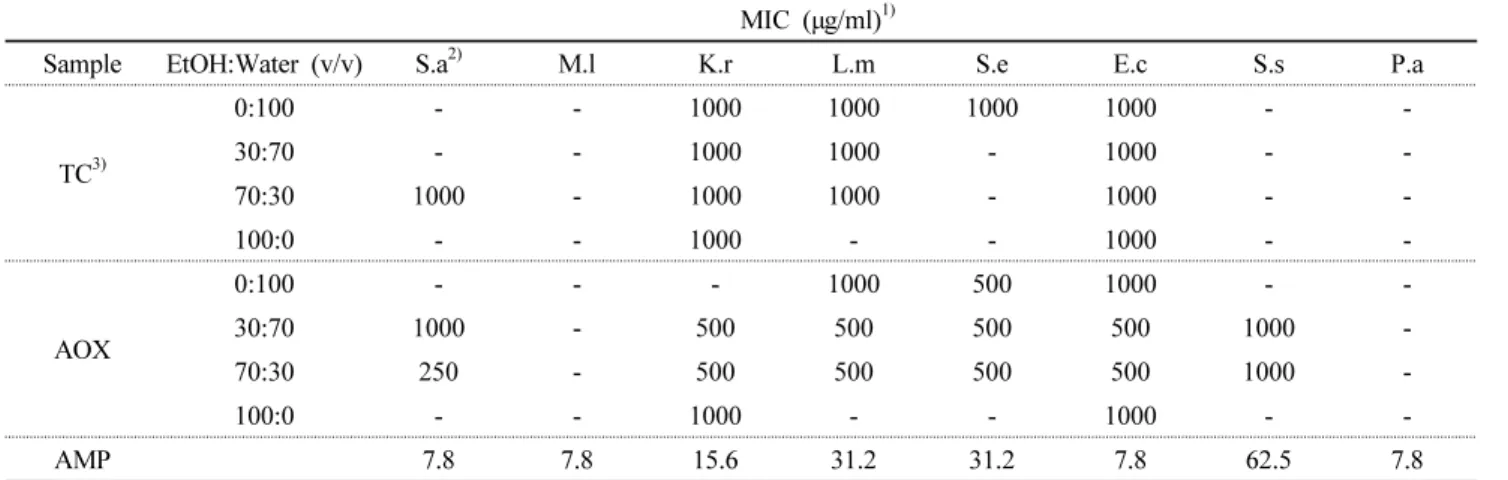
serial two-fold dilution method (Table 1). Overall, the 30
and 70% EtOH AOX extracts were more effective than
the others. The 70% EtOH AOX extract was most active
against Staphylococcus aureus (MIC = 250 µg/ml) compared
to all the bacteria tested. S. aureus is the causative agent
of multiple infectious human diseases such as bacteremia,
skin, prosthetic device, and pulmonary infections (Tong et
Table 1 Antimicrobial activity of anthocyanin-overproducing ginseng hairy roots MIC (μg/ml)
1)Sample EtOH:Water (v/v) S.a
2)M.l K.r L.m S.e E.c S.sP.a
TC
3)0:100 - - 1000 1000 1000 1000 - -
30:70 - - 1000 1000 - 1000 - -
70:30 1000 - 1000 1000 - 1000 - -
100:0 - - 1000 - - 1000 - -
AOX
0:100 - - - 1000 500 1000 - -
30:70 1000 - 500 500 500 500 1000 -
70:30 250 - 500 500 500 500 1000 -
100:0 - - 1000 - - 1000 - -
AMP 7.8 7.8 15.6 31.2 31.2 7.8 62.5 7.8
1)
MIC values against bacteria were determined using the two-fold serial dilution method.
2)
S.a.: Staphylococcus aureus 1916; M.l.: Micrococcus luteus 14819; K.r.: Kocuria rhizophila 14744; L.m.: Listeria monocytogenes 19115; E.c.: Enterobacter cloacae 11958; S.e.: Salmonella enteritidis 12021; S.s.: Salmonellaentrica sub sp.enterica 10769; P.a.:
Pseudomonas aeruginosa 2004
3)