대구지역병원에서 분리된 Acinetobacter baumannii와 Pseudomonas aeruginosa의 항생제 내성현황
대구보건대학 임상병리과1, 세명대학교 임상병리학과2 김 수 정1․이 재 식2
Antibiotic Resistance Patterns of Acinetobacter baumannii and Pseudomonas aeruginosa from a Hospital in Daegu City Area
Su-Jung Kim
1and Jae-Sik Lee
2Department of Clinical laboratory Science, Daegu Health college, Daegu 702-722, Korea
1Department of Clinical Laboratory Science, Semyung University, Jecheon 390-711, Korea
286 clinical isolates of Acinetobacter baumannii and 116 clinical isolates of Pseudomonas aeruginosa strains isolated from clinical specimens were collected from a hospital in Daegu city area. We investigated the Antimicrobial susceptibility patterns of A. baumannii and P. aeruginosa isolated from sputum, urine, wound, blood, nasal swab, body fluid. The antimicrobial resistance of A. baumannii were shown 96% for piperacillin, carbenicillin 82%. cefotaxime 78%, ciprofloxacin 77%, sulfamethoxazole/trimethoprime 76%, ceftazidime 75%, tobramycin 72%. For P. aeruginosa, the resistance of cefotaxime and sulfamethoxazole/
trimethoprime were 100%, carbenicillin 49%, piperacillin 47%, ticarcillin 45%, ticarcillin/ clavulanic acid 40%.
Key Words : Acinetobacter baumannii, Pseudomonas aeruginosa, Antimicrobial susceptibility, β-lactams
I. 서 론
Acinetobacter baumannii와 Pseudomonas aeruginosa는 포도당 비발효성 그람음성간균으로 폐렴, 요도염, 균혈증 을 포함한 원내감염의 중요 원인균으로 알려져 있다 (Yoshihara 등 1991; 오 등, 2006).
포도당 비발효 그람음성간균의 내성경로는 세포외막
교신저자 : 김수정, (우)702-722, 대구시 북구 태전동 산7번지 TEL : 053-320-1303, 016-531-4238
E-mail : [email protected]
porin 과 염색체성 β-lactamase 생성으로 인해 이루어진 다(오 등, 2006; Jiang 등, 2006). 최근에 extened-spectrum β-lactamase(ESBL) 등의 생성균주의 출현으로 여러 항 균제에 대해 다제내성을 가지는 A. baumannii와 P.
aeruginosa의 출현빈도도 증가하고 있는 추세이다(Gootz
와 Marra, 2008; Sinha 등, 2007). P. aeruginosa에서
ESBLs은 monobactam 계열인 aztreonam(ATM), 광범위
cephalosporine 계열의 ceftriaxone, cefotaxime(CTX)에 대
해서도 내성빈도가 점차 증가하였다. 따라서 P. aeru-
ginosa에서도 ESBL생성균주가 보고되고 있다(Jiang 등,
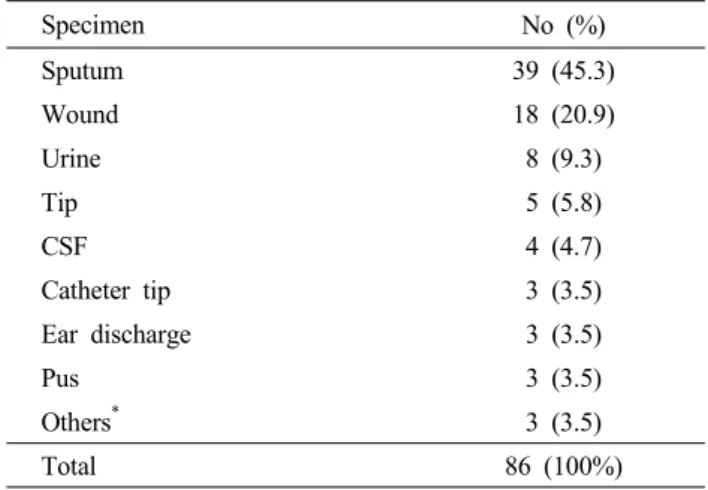
Specimen No (%)
Sputum 39 (45.3)
Wound 18 (20.9)
Urine 8 (9.3)
Tip 5 (5.8)
CSF 4 (4.7)
Catheter tip 3 (3.5)
Ear discharge 3 (3.5)
Pus 3 (3.5)
Others* 3 (3.5)
Total 86 (100%)
* Throat, bronchial aspiration, blood each
Table 1. Distribution of specimen for isolation of Acinetobacter baumannii
2006). 김 등(2004)에 의하면 녹농균이 중환자실에서 포 도알 구균과 함께 가장 흔한 원내 감염균으로써 많은 항 생제에 대해 자연 내성과 획득내성을 가지며 최근에는 imipenem 내성 녹농균이 증가하고 있다고 보고하였다.
Imipenem과 meropenem 등은 carbapenem 계열의 항균제 로서 penicillin-binding protein(PBP)에 친화력이 매우 우 수하며 대부분의 β-lactamase에 안정하여 다른 β-lactam 제에 비해 β-lactam 내성인 그람음성간균의 감염증 치료 에 유용하게 사용되어 왔다. 그러나 김 등(2004)에 의하 면 carbapenem 계열 내성 녹농균의 분리율이 17.4%로 보 고되었고 내성원인으로는 분자적 분류에 의해 class B(metallo-β-lacatamases) 유전자를 가지고 있으며 그 비 율이 총 116 균주 중 20 균주로 17.2%를 차지한다고 보 고되었다.
본 연구에서는 대구지역에서의 A. baumannii와 P.
aeruginosa의 검체별, 연령별 분리율 및 항균제 내성 추 이를 살펴보고 궁극적으로는 항균제 내성을 보이는 A.
baumannii와 P. aeruginosa의 증가 추세를 둔화시킬 수 있는 기본 자료를 제시하고자 대구지역의 한 대학병원에 서 2007년 6, 7, 8월에 분리 동정된 A. baumannii 86 균주 와 P. aeruginosa 116 균주를 이용하여 항생제 내성 및 감 수성현황, 검체별 분리빈도 및 연령별 분리율을 조사하고 자 하였다.
II. 재료 및 방법
1. 균주 수집
2007년 6월에서 8월사이 3 개월간 대구지역 3차 의료 기관의 환자로부터 분리된 A. baumannii와 P. aeruginosa 를 대상으로 하였다. 분리된 균주는 생화학적 방법과 미 생물동정기기인 Vitek2 system(BioMerleux Vitek Inc., Hazelwood, Mo., USA)을 이용하여 동정 확인하였다.
2. 항균제 감수성 시험
항균제 감수성 시험은 Vitek2 system을 이용하여 감수 성검사를 실시하였다. 항균제 종류로는 amikacin, car- benicillin, ceftazidime, ciprofloxacin, cefepime, cefotaxime, gentamycin, imipenem, meropenem, piperacillin, ampicillin/
sulbactam, sulfamethoxazole/trimethoprime, ticarcillin, to- bramycin, ticarcillin/clavulanic acid 등을 이용하였다. 정 도관리는 표준균주를 사용하여 항균제 감수성검사를 실 시하고 CLSI(Clincial and Laboratory Standards Institute) 에 의해 규정하였다. 그람음성 표준균주는 Escherichia coli ATCC25922, Klebsiella oxytoca ATCC700324, Pseudomonas aeruginosa ATCC27853이며, 그람양성 표 준균주는 Staphylococcus aureus ATCC29213를 사용하여 검사를 실시하였다.
III. 결 과
1. Acinetobacter baumannii와 Pseudomonas aeru- ginosa의 검체별 분리율
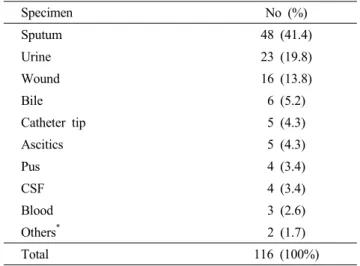
대구시 지역 3차 의료기관에서 3 개월간 분리된 A.
baumannii 86 균주와 P. aeruginosa 116 균주를 이용하여 검체별 분리분포를 조사 결과 A. baumannii 86 균주에서 는 객담, 창상, 소변 등의 순으로 나타났고, P. aeruginosa 116 균주에서는 객담, 소변, 창상 등의 순서로 나타났다.
일반적으로 객담에서의 분리빈도가 가장 높은 것으로 나
타났다(Table 1, Table 2).
Specimen No (%)
Sputum 48 (41.4)
Urine 23 (19.8)
Wound 16 (13.8)
Bile 6 (5.2)
Catheter tip 5 (4.3)
Ascitics 5 (4.3)
Pus 4 (3.4)
CSF 4 (3.4)
Blood 3 (2.6)
Others* 2 (1.7)
Total 116 (100%)
* Ear discharge, foley, PCN each
Table 2. Distribution of specimens for isolation of Pseudomonas aeruginosa
Age groups No. of isolates (%)
A. baumannii P. aeruginosa
1~10 - 1 (0.9)
11~20 1 (1.2) 1 (0.9)
21~30 2 (2.3) 2 (1.7)
31~40 3 (3.5) 4 (3.5)
41~50 13 (15.1) 12 (10.3)
51~60 7 (8.1) 19 (16.4)
61~70 28 (32.6) 35 (30.2)
71~80 28 (32.6) 26 (22.4)
81~90 4 (4.7) 16 (14.8)
Total 86 (100%) 116 (100%)
Table 3. Distribution of age of Acinetobacter baumannii and Pseudomonas aeruginosa
Antimicrobial agents Susceptibility (%)
R I S
Amikacin 64 5 31
Carbenicillin 82 9 9
Ceftazidime 75 2 22
Ciprofloxacin 77 - 23
Cefepime 10 38 52
Cefotaxime 78 19 3
Genamicin 76 - 24
Imipenem - 1 99
Meropenem 1 3 96
Piperacillin 96 - 4
Ampicillin/sulbactam - - 100
Sulfamethoxazole/trimethoprime 76 - 24
Ticarcillin 41 35 24
Tobramycin 72 1 27
Ticarcillin/clavulanic acid 35 37 29
Abbreviations : R, resistant, I, intermediate, S, susceptible