pISSN 1598-642X eISSN 2234-7305
Characterization of Plasmids from Multiple Antibiotic Resistant Vibrio sp. Isolated from Molluscs and Crustaceans
Manjusha, Sayd* and Ganabhat Bhat Sarita
Microbial Genetics Laboratory, Department of Biotechnology, Cochin University of Science and Technology, Kerala 682022, India
Received : May 4, 2012 / Revised : July 17, 2012 / Accepted : July 23, 2012
This study investigated the role of plasmids and their relationship with the multiple antibiotic resistance of 30 Vibrios sp. isolated from molluscs and crustaceans sampled from the Kerala coastal waters of India. The bio- chemical identification and antibiotic resistance profiles were determined, followed by the plasmid profiles, conjugation and transformation efficiencies. The results showed a considerable difference in the level of bac- terial resistance to various antibiotics; while all 30 strains were found to be MAR Vibrios sp. and their resis- tance patterns varied. All the strains were resistant to amoxycillin, ampicillin and carbeniciliin. 87% were resistant to rifampicin; 74% to cefuroxime; 67 to streptomycin; 53% to norfloxacin and ciprofloxacin and 47%
to furazolidone and nalidixic acid. In addition to their antibiotic resistance, the plasmid DNA of the MAR Vibrios strains isolated from the molluscs and crustaceans was also studied. Nine strains isolated from crusta- ceans and molluscs were found to harbor 1-3 plasmids with sizes varying from 5. 98 kb to 19. 36 kb. The aver- age transformation efficiency was about 5×10 -8 and the conjugation efficiency varied from 2. 1×10⁻³ to 10-9. A further study of antibiotic resistance patterns may be useful to test the extent of drug resistance in seafoods and help to devise a nationwide antibiotic policy.
Keywords: Multiple antibiotic resistance (MAR), plasmids, molluscs, crustaceans, Vibrios
Introduction
Members of the Vibrionaceae family represent a signi- ficant component of microflora including more than 30 species, and many are pathogenic to humans and have been associated with food-borne diseases [10]. Among these species, Vibrio cholerae is not only the most feared but also the most extensively studied, being associated with epidemics and pandemic diarrhoea outbreaks in many parts of the world [10]. However, several other species of Vibrios capable of causing disease in humans have also received attention over the last decade, including Vibrio parahaemolyticus, Vibrio vulnificus, Vibrio alginolyticus, Vibrio damsela, Vibrio fluvialis, Vibrio furnissii, Vibrio hollisae, Vibrio metschnikovii
and Vibrio mimicus [10]. Marine Vibrios are of great interest in coastal and estuarine waters because of their high salt tolerance. Some Vibrio strains are pathogenic and can cause Vibriosis, a serious infectious disease in both wild and cultured finfish and shellfish [5]. In recent years, Vibriosis has become one of the most important bacterial diseases in maricultured organisms, affecting many species of fish and shellfish [44, 45].
The extensive use and misuse of antibiotics in medica- tions, veterinary practice, agriculture and aquaculture, have caused antibiotic-resistant bacteria to become wide-spread [19]. However, according to Nogueira [28], evaluation of the risks associated with the use of antibiotics in seafoods is difficult due to the lack of quantitative data from most countries involved in this activity. Over time Vibrios exposed to antibiotics inside or outside the shrimp farming environment can acquire antimicrobial resistance transferable by mobile genetic elements and horizontal gene transfer [35]. Thus, due to the presence of R-factors in the population, the resistance developed through gene regulation of plasmids
*Corresponding author Tel: +94-95559605
E-mail: [email protected]
Current address: Centre for Marine Living Resources and Ecol- ogy, Ministry of Earth Sciences, Kendriya Bhavan, Kakkanadu, Cochin, Kerala - 682037, India
and chromosomes can be transferred vertically (by heredity) or horizontally [24]. Plasmids have been found in hetero- trophic bacteria [10] and in Vibrios [26], and in most cases their involvement in resistance to many antibiotics has been proven [10]. To our knowledge there has been no previous report on the occurrence of plasmid occurrence and their relationship with the multiple antibiotic resistances of Vibrio strains isolated from seafoods sampled from Kerala coastal waters.
A study of antibiotic sensitivity was carried out, to detect the antibiotic resistance patterns of individual Vibrio strains when exposed to particular antibiotic concentrations. Anti- biotics are frequently used against different terrestrial organisms, however, the presence of antimicrobial agents at low concentrations through leaching or continued usage may lead to the development of drug-resistant strains and multiple antibiotic resistance (MAR) in bacteria, which ultimately results in the transfer of resistance to pathogenic bacteria and reduced efficacy of antibiotic treatments for human and animal diseases. Thus, it was considered important to evaluate the possibility that aquatic environments may behave as a reservoir of antibiotic multi-resistant bacteria, increasing the risk of their transfer into shellfish, molluscs and then human pathogens. Furthermore, many species of halophilic Vibrios have already been recognized as potential human pathogens causing serious gastroenteritis or severe wound infections upon exposure to contaminated seafood and/or seawater. Therefore, the present study was undertaken to assess the multiple antibiotic resistance and characteri- zation of resistant plasmids in Vibrio sp. from different aquatic samples.
With this background, the present study was designed to investigate the occurrence of multiple antibiotic resistance in Vibrio sp. and assess the presence of plasmids and their relationship to multiple antibiotic resistance of Vibrio strains isolated from certain molluscs and crustaceans sampled from the Kerala coastal waters.
Materials and Methods
Sampling site
Molluscan (Perna virdis & Sepia) and Crustacean (Shrimp) samples collected from the coastal waters of Kerala (8o18'N 74o52E to 12o48' N 72o22'E) were used as the seafood samples for the study. The seafood samples were collected in sterile polythene bags and transported aseptically
to the laboratory within 2-6 h.
Bacterial isolation and storage
The bacteria contained in the tissue samples were serially diluted after homogenization and a Thiosulfate Citrate Bile Sucrose Agar (Himedia Laboratories, Mumbai) used to grow isolates of Vibrios with a spread plate technique. A nutrient broth culture with 20% glycerol and 2% sodium chloride was prepared and stored at -80oC as the stock culture.
Identification of Vibrio
Isolated pure cultures of bacteria were grown on the nutrient agar plates and identified using identified conven- tional biochemical tests [23, 43]. The gram stain reaction and cell morphology were observed as described earlier.
The isolates were identified based on the standard scheme available for environmental Vibrios [4].
Antibiotic sensitivity test
The antibiotic resistance of the bacteria was determined based on a disc diffusion using a Mueller Hinton Agar, according to the Buer Kirby method [3]. The bacteria were multiplied on agar slants (ZB) at 20oC. The turbidity of the bacterial suspension was then compared with MacFarland’s barium sulfate standard solution corresponding to 1.5~10 cfu/mL. Any increase in turbidity was compared with the standard and adjusted with normal saline. The standardized bacterial suspension was then swab inoculated on to the Muller Hinton Agar using sterile cotton swabs and left to dry for 10 min before adding the antimicrobial sensitivity discs. Antibiotic impregnated discs 8 mm in diameter were used for the test. Disks containing the following antibacterial agents were plated on the plate and incubated overnight:
Amoxycillin (Am, 10 µg), Ampicillin (A, 10 µg), Carbeni- cillin (Cb, 100 µg), Cefuroxime (Cu, 30 µg), Chloram- phenicol (C, 30 µg), Ciprofloxacin (Cf, 5 µg), Chlortetra- cycline (Ct, 30 µg), Cotrimaxazole (Co, 25 µg), Doxycy- clinehydrochloride (Do, 30 µg), Furazolidone (Fr, 50 µg), Gentamycin (G, 10 µg), Meropenem (M, 10 µg), Netilmicin (N, 30 µg), Nalidixic acid (Na, 30 µg), Norfloxacin (Nx, 10 µg), Rifampicin (R, 5 µg), Streptomycin (S, 10 µg), Sul- phafurazole (Sf, 300 µg), Trimethoprim (Tr, 5 µg), Tetracy- cline (T, 30 µg), Neomycin (Ne, 5 µg) and Amikacin (Ak, 10 µg). After incubation, the diameter of the inhibition zone was measured and compared with a zone diameter in-
terpretative chart to determine the sensitivity of the isolates to the antibiotics. The results were interpreted based on the recommendations of the National Committee for Clinical Laboratory Standards for antimicrobial susceptibility tests [14]. In this study, the Vibrio strains were considered as MAR strains, if they showed resistance against more than three antibiotics [14]. This procedure is intended for the in vitro susceptibility testing of common rapidly growing and certain fastidious bacterial pathogens. V. cholerae that has multiple-antibiotic-resistance and E. coli DH5 α that is susceptible to all the tested antibiotics were used as the positive and negative controls, respectively.
Plasmid isolation
The plasmid extraction from the bacterial strains was performed using the mini-prep alkali lysis method [8] with minor modifications. A Luria-Bertani (HiMedia, India) broth supplemented with 2% NaCl was used to cultivate all the strains. The extracted DNA was electrophoresed in a 0.
7% agarose gel at 80 V for 1-3 hours and photographed using a gel documentation system (Amersham Pharmacea).
Transformation
The plasmids extracted from the isolates were used for the transformation experiment using bacterial strain E. coli DH5α as the recipient [34]. The transformation efficiency was calculated from the ratio of the number of transformants to the number of competent cells used for transformation.
Conjugation
The conjugation was performed using Vibrio containing the plasmid encoded resistance as the donor cells and the E.
coli HB 101 strain with a selectable streptomycin marker as the recipient [21]. Thus the purpose of the E. coli HB101 experiment was to investigate the conjugative ability of the plasmids carrying the resistance markers, since the HB 101 strain only included a selectable Streptomycin as its marker, and this strain has been specifically used in almost all previous conjugaton studies. This could also help to understand the inter-generic conjugation between plasmids of Vibrio strains and E. coli. Hence, after the conjugation, only those ex- conjugant strains incluing the plasmid resistance marker and the E. coli HB 101 with the streptomycin resistance could survive in a selection medium containing streptomycin (recipient character) and ampicillin. The donor and recipient cells were inoculated in a LB broth and incubated overnight at
37oC. Thereafter, the donor and recipient cells were mixed in a 1:3 proportion in a sterile bottle and the mixture was filtered through 0.2 µm filter paper. The filter paper con- taining the bacteria was then placed onto a MacConkey agar containing the antibiotics ampicillin and streptomycin at a rate of 50 µg/mL and 25 µg/mL, respectively and incu- bated overnight at 37oC for 48 h. Following the incubation, the filter papers containing the bacteria were washed with normal saline and the conjugated bacterial suspensions were plated onto MacConkey agar containing ampicillin and streptomycin. The inoculated plates were then incubated for 48 h at 37oC. The exconjugants that grew in the medium containing ampicillin and streptomycin were checked for their antibiogram pattern and plasmid content. The conjuga- tion efficiency was calculated from the ratio of the number of exconjugants to the number of donor cells used for conjugation.
Results
A total of thirty strains were segregated as Vibrios as a result of morphological and biochemical identification of the strains isolated from the molluscs and crustaceans.
Among these isolates fifteen Vibrios were isolated from the mollusks: V. parahaemolyticus, V. costicola, V. alginolyticus, V. mimicus (2), V. proteolyticus (2), V. splendidus (3), V.
marinus, V. nereis, V. orientalis, V. carchariae, and V. medi- terranei; and fifteen from the crustaceans: V. parahaemoly- ticus (2), V. hollisae, V. pelagius, V. carchariae, V. splendi- dus, V. cholera (5), V. cincinnatiensis, V. vulnificus (2), and V. costicola.
When thirty Vibrio isolates were tested for their suscep- tibility to antimicrobial agents, 100% of the isolates showed
Fig. 1. Occurrence of antibiotic resistance in Vibrios isolated from molluscs and crustaceans (percentage).
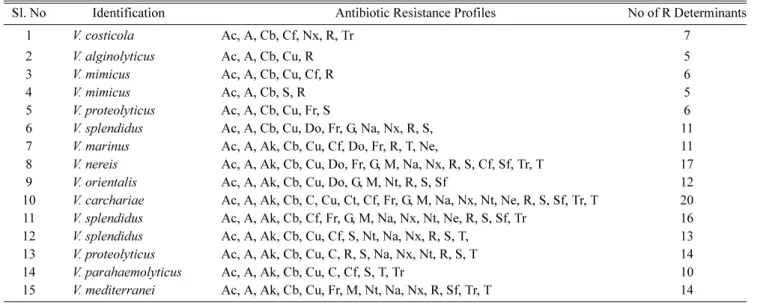
antibiotic resistance (MAR) to at least one of the 22 tested antibiotics (Fig. 1) Tables 1 & 2 present the antibiotic profiles of the Vibrio isolates. The bacteria were tested for susceptibility to 22 antimicrobials representing 15 antimicro- bial drug classes, and when the data were analyzed taking into account the source from which the samples were ob-
tained, 100% of the isolates from the molluscs and crustaceans were found to be resistant to at least one antimicrobial agent.
Resistance to amoxycillin, ampicilln and carbenicillin was found in Vibrio isolates from both the crustaceans and the molluscs while resistance to nalidixic acid was detected Table 1. Antibiotic resistance profile of Vibrios isolated from molluscs.
Sl. No Identification Antibiotic Resistance Profiles No of R Determinants
1 V. costicola Ac, A, Cb, Cf, Nx, R, Tr 7
2 V. alginolyticus Ac, A, Cb, Cu, R 5
3 V. mimicus Ac, A, Cb, Cu, Cf, R 6
4 V. mimicus Ac, A, Cb, S, R 5
5 V. proteolyticus Ac, A, Cb, Cu, Fr, S 6
6 V. splendidus Ac, A, Cb, Cu, Do, Fr, G, Na, Nx, R, S, 11
7 V. marinus Ac, A, Ak, Cb, Cu, Cf, Do, Fr, R, T, Ne, 11
8 V. nereis Ac, A, Ak, Cb, Cu, Do, Fr, G, M, Na, Nx, R, S, Cf, Sf, Tr, T 17
9 V. orientalis Ac, A, Ak, Cb, Cu, Do, G, M, Nt, R, S, Sf 12
10 V. carchariae Ac, A, Ak, Cb, C, Cu, Ct, Cf, Fr, G, M, Na, Nx, Nt, Ne, R, S, Sf, Tr, T 20 11 V. splendidus Ac, A, Ak, Cb, Cf, Fr, G, M, Na, Nx, Nt, Ne, R, S, Sf, Tr 16
12 V. splendidus Ac, A, Ak, Cb, Cu, Cf, S, Nt, Na, Nx, R, S, T, 13
13 V. proteolyticus Ac, A, Ak, Cb, Cu, C, R, S, Na, Nx, Nt, R, S, T 14
14 V. parahaemolyticus Ac, A, Ak, Cb, Cu, C, Cf, S, T, Tr 10
15 V. mediterranei Ac, A, Ak, Cb, Cu, Fr, M, Nt, Na, Nx, R, Sf, Tr, T 14
(No. of R=Number of antibiotics to which Vibrio isolates were resistant)
(The abbreviations are as indicated by the manufacturer, and according to NCCLS, 2001)
Ac-Amoxycillin, A-Ampicillin, Ak-Amikacin, Co-Cotrimaxazole, Cb-Carbenicillin, Cu-Cefuroxime, C-Cholramphenicol, Cf-Ciprofloxacin, Ct-Chlortetracycline, Do-Doxycycline hydrochloride, Fr-Furazolidone, G-Gentamycin, M-Meropenem, Na-Nalidixic acid, Nt-Netilmycin, Nx-Norfloxacin, Ne-Neomycin, R-Rifampicin, S-Streptomycin, Sf-Sulfafurxazole, Tr-Trimethoprim, T-Tetracycline.
Table 2. Antibiotic resistance profile of Vibrios isolated from crustaceans.
Sl. no Identification Antibiotic Resistance Profile No of R Determinants
1 V. hollisae Ac, A, Cb, Cu 4
2 V. pelagius Ac, A, Cb, Cu, C, M, Nt, R, S 9
3 V. carchariae Ac, A, Cb, Cu, C, M, Nt, R, S 9
4 V. splendidus Ac, A, Cb, Cu, Cf, Ct, M, Na, Nt, R S, 11
5 V. cholera Ac, A, Ak, Cb, Cu, C, Cf, Do, Na, Nt, Nx, R, S, Tr 14
6 V. cholera Ac, A, Cb, Cu, M, Nt, R, T, Tr 9
7 V. vulnificus Ac, A, Cb, Cu, C, Cf, Ct, Na 8
8 V. cincinnatiensis Ac, A, Cb, Cu, C, Co, Cf, Ct, Na, R 10
9 V. parahaemolyticus Ac, A, Cb, Cu, C, Cf, M, Na, Nt, R, S, T 12
10 V. parahaemolyticus Ac, A, Cb, Na 4
11 V. cholerae Ac, A, Cb 3
12 V. parahaemolyticus Ac, A, Cb, Cu, C, R, S 7
13 V. vulnificus Ac, A, Cb, Cu, C, Cf, Ct 7
14 V. costicola Ac, A, Cb, Cu, Cf, M, Nt, R, S 9
15 V. vulnificus Ac, A, Cb, Cu, R, C, M, S 8
(No. of R=Number of antibiotics to which Vibrio isolates were resistant)
(The abbreviations are as indicated by the manufacturer, and according to NCCLS, 2001)
Ac-Amoxycillin, A-Ampicillin, Ak-Amikacin, Co-Cotrimaxazole, Cb-Carbenicillin, Cu-Cefuroxime, C-Chloramphenicol, Cf-Ciprofloxacin, Ct-Chlortetracycline, Do-Doxycycline hydrochloride, Fr-Furazolidone, G-Gentamycin, M-Meropenem, Na-Nalidixic acid, Nt-Netilmycin, Nx-Norfloxacin, Ne-Neomycin, R-Rifampicin, S-Streptomycin, Sf-Sulfafurxazole, Tr-Trimethoprim, T-Tetracycline.
in seven isolates from the molluscs and five isolates from the crustaceans. Most of the isolates were resistant to amoxycillin, ampicillin, carbenicillin and amikacin plus 87% were resistant to rifampicin, 74% to cefuroxime, 67%
to streptomycin, 53% to norfloxacin and ciprofloxacin and 47% to furazolidone and nalidixic acid (Figs. 2 and 3).
The most frequently expressed resistance phenotypes in the Vibrio isolates from the molluscs and crustaceans were found to be amoxycillin, ampicilln, carbenicillin, amikacin and amoxycillin, ampicillin, carbenicillin, cefuroxime re- spectively. The results also showed that over 50% of the Vibrio isolates were resistant to clinically used antibiotics, amoxycillin, norfloxacin, rifampicin and ciprofloxacin.
Some of the isolates (7/15 and 9/15) even exhibited resistance to fourth generation antibiotics such as chloramphenicol
and doxycycline hydrochloride, which raises serious concern.
The bacterial isolates from the molluscs showed the highest frequency of resistance determinants >10 resistance factors, (10/15), followed by those form the crustaceans (4/
15). The antibiotic resistance profiles for the Vibrio isolates were also varied (Tables 1 and 2), indicating that the anti- microbial resistance patterns were not related to specific species. In general, evident differences in the antimicrobial resistance patterns were observed among the isolates from the seafood samples. The occurrence of simultaneous resist- ance to multiple antimicrobial drugs was also observed in all thirty Vibrio isolates.
The commonly occurring resistance profiles identified among the multiresistant isolates were: Ac+A+Cb; Ac+
A+Cb+Ak; Ac+A+Cb+Ak+Cu; Ac+A+Cb+Cu; Ac+A+Cb +Cu+C; and Ac+A+Cb+Na.
The plasmid frequency was 40% in the molluscs and 20% in the crustaceans (Fig. 4). Among the 15 multiple antibiotic resistant (MAR) Vibrios strains isolated from the molluscs, four contained single plasmids, while, the Vibrio orientalis strain contained two plasmids. Moreover among the Vibrio strains isolated from the crustaceans, three strains harbored single plasmids while the Vibrio mediterranei strain harbored three plasmids with sizes of 5.98, 8.27 and 16.08 kb respectively. The sizes of the plasmids extracted from the Vibrios strains isolated from both the molluscs and crustaceans varied from 5.98 kb to 19.36 kb (Fig. 5 and Table 3).
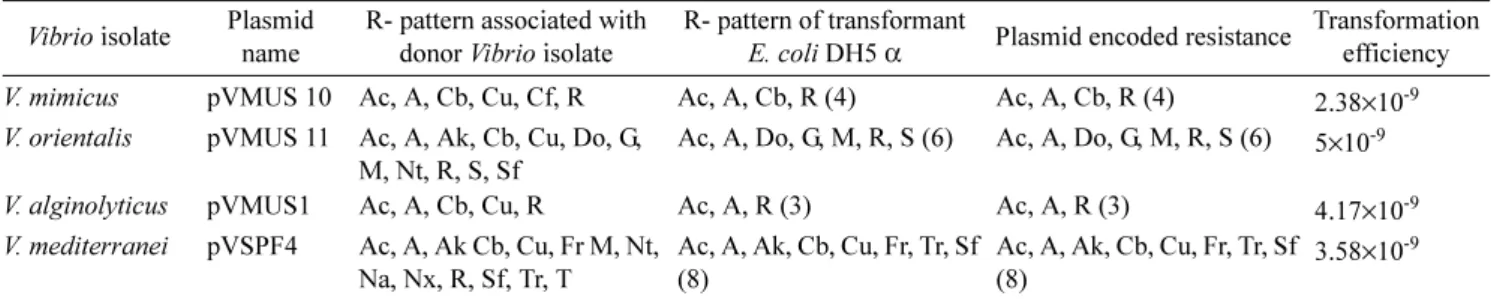
The changes in the antibiotic resistance patterns and transformation efficiency of the plasmids from multiple antibiotic resistant MAR Vibrio isolates when using E. coli DH5α are shown in Table 4. The average transformation efficiency was about 5×10⁻⁸ (Table 4).The plasmids and Fig. 2. Resistance to different antibiotics among Vibrios isolated
from molluscans from Kerala Coastal waters (percentage)
Fig. 3. Resistance to different antibiotics among Vibrios isolated from crustaceans from Kerala Coastal waters (percentage).
Fig. 4. Percentage of plasmids in Vibrios isolated from seafood samples.
associated antimicrobial resistances were all transformed into the recipient E. coli DH5α, which is sensitive to all the antibiotics tested. The plasmid associated antibiotic resist-
ance pattern of the Vibrio strains was then obtained from the transformed E. coli DH5α strain. The resistance phenotypes encoded in the plasmids were transferred to the E. coli transformant as well as being expressed in the trans- formant. From the transformation studies of the plasmids, it became evident that the plasmid encoded resistance markers Fig. 5. Profile of single/double plasmids in MAR-Vibrios iso-
lated from molluscs and crustaceans. Plasmids isolated from dif- ferent Vibrio species: Lanes 3, 4, 6, 7, 8, 10, 11, 12 and 13 have pVMUS10, pVMUS15, pVMUS1, pVMUS7, pVSPF4, pVSY3, pVSY1, pVSY6 and pVMUS 11 respectively and Lane M Marker.
Table 4. R-pattern of Vibrio plasmids and their transformation efficiency.
Vibrio isolate Plasmid name
R- pattern associated with donor Vibrio isolate
R- pattern of transformant
E. coli DH5 α Plasmid encoded resistance Transformation efficiency V. mimicus pVMUS 10 Ac, A, Cb, Cu, Cf, R Ac, A, Cb, R (4) Ac, A, Cb, R (4) 2.38×10⁻⁹ V. orientalis pVMUS 11 Ac, A, Ak, Cb, Cu, Do, G,
M, Nt, R, S, Sf
Ac, A, Do, G, M, R, S (6) Ac, A, Do, G, M, R, S (6) 5×10⁻⁹
V. alginolyticus pVMUS1 Ac, A, Cb, Cu, R Ac, A, R (3) Ac, A, R (3) 4.17×10⁻⁹
V. mediterranei pVSPF4 Ac, A, Ak Cb, Cu, Fr M, Nt, Na, Nx, R, Sf, Tr, T
Ac, A, Ak, Cb, Cu, Fr, Tr, Sf (8)
Ac, A, Ak, Cb, Cu, Fr, Tr, Sf (8)
3.58×10⁻⁹ The numbers in parenthesis indicate the number of antibiotic resistance genes in the plasmid.
Ac-Amoxycillin, A-Ampicillin, Ak-Amikacin, Co-Cotrimaxazole, Cb-Carbenicillin, Cu-Cefuroxime, C-Chlramphenicol, Cf-Ciprofloxacin, Ct-Chlortetracycline, Do-Doxy cyclinehydrochloride, Fr-Furazolidone, G-Gentamycin, M-Meropenem, Na-Nalidixic acid, Nt-Netilmycin, Nx-Norfloxacin, Ne-Neomycin, R-Rifampicin, S-Streptomycin, Sf-Sulfafurxazole, Tr-Trimethoprim, T-Tetracycline
(The abbreviations are as indicated by the manufacturer, and according to NCCLS, 2001)
Table 5. R pattern of Vibrio plasmids and conjugation efficiency.
Vibrio isolate Plasmid name
Plasmid encoded antibiotic resistance pattern (Donor)
R- resistance pattern of exconjugant E. coli HB 101
Conjugation efficiency
V. costicola pVMUS 7 Ac, A, Cb, Cf, Nx, R, Tr Ac, A, Cf, Cb, R, S 2.18×10⁻⁹
V. alginolyticus pVMUS 1 Ac, A, Cb, Cu, R Ac, A, R, S 2.14×10⁻³
V. mimicus pVMUS10 Ac, A, Cb, Cu, Cf, R Ac, A, Cb, R, S 2.07×10⁻⁶
V. marinus pVMUS 15 Ac, A, Ak Cb, Cu, Cf, Do, Fr, R, S, T, Ne Ac, Ak, A, Cu, Cf, R, S 2.1×10⁻³ V. orientalis pVMUS 11 Ac, A, Ak, Cb, Cu, Do, G, M, Nt, R, S, Sf Do, G, M, R, S, Sf, 2.28×10⁻³ V. mediterranei pVSPF4 Ac, A, Ak Cb, Cu, Fr M, Nt, Na, Nx, R, Sf, T, Tr Ac, A, Ak, Cb, Cu, Fr, S, Sf, Tr, T 1.5×10⁻⁶
V. pelagius pVSY1 Ac, A, Cb, Cu, C, M, Nt, R, S Ac, A, Cb, R, M, S 11.66×10⁻⁷
V. costicola pVSY3 Ac, A, Cb, Cu, Cf, M, Nt, R, S Ac, A, Cb, M, S 5.83×10⁻¹⁰
V. cincinnatiensis pVSY6 Ac, A, Cb, Cu, C, Co, Cf, Ct, Na, R Ac, Cb, Na, R, S 6.83×10⁻⁹ Ac-Amoxycillin, A-Ampicillin, Ak-Amikacin, Co-Cotrimaxazole, Cb-Carbenicillin, Cu-Cefuroxime, C-Chlramphenicol, Cf-Ciprofloxacin, Ct-Chlortetracycline, Do-Doxy cyclinehydrochloride, Fr-Furazolidone, G-Gentamycin, M-Meropenem, Na-Nalidixicacid, Nt-Netilmycin, Nx-Norfloxacin, Ne-Neomycin, R-Rifampicin, S-Streptomycin, Sf-Sulfafurxazole, Tr-Trimethoprim, T-Tetracycline
(The abbreviations are as indicated by the manufacturer, and according to NCCLS, 2001)
Table 3. Profile of single/ double plasmids in MAR-Vibrios iso- lated from molluscs and crustaceans.
Sl.
No Vibrio Plasmid Approximate
plasmid size in kb
No. of plasmids
1 V. mimicus pVMUS10 14.93 1
2 V. mediterranei pVMUS15 14.38 1
3 V. alginolyticus pVMUS1 19.36 1
4 V. costicola pVMUS7 16.69 1
5 V. mediterranei pVSPF4 16.08, 8.27, 5.98 3
6 V. costicola pVSY3 13.38 1
7 V. carchariae pVSY1 15.36 1
8 V. cincinnatiensis pVSY6 14.3 1
9 V. orientalis pVMUS11 14.3, 6.44 2
are betalactamase (Ac, A and Cb), amikacin, cephalosporin, doxycycline, rifampicin, furzolidone, trimothoprim and sulphamethoxazole.
The conjugation studies also revealed that the plasmid encoded genes were transferable to the recipient E. coli HB101, as the exconjugants showed the resistance patterns of the plasmids. The conjugation efficiency varied from 2 1×10⁻³ to 10-9 (Table 5).
Discussion
By their nature, coastal environments present a theatre of ecological diversity and evolutionary adaptation. Vibrio species occur widely in aquatic environments and are a normal part of the flora occurring in coastal seawaters, estuarine and brackish waters. However, the abundance of Vibrios in crustaceans and mollusks highlights a potential risk of increased seafood borne illness. Moreover, the presence of multiple antibiotic resistance (MAR) in these Vibrios would pose impediments in the treatment of such illnesses. High incidences of resistant bacteria in response to antibiotic usage have already been reported in coastal maricultural areas [17, 25, 26]. Large scale marine aqua- culture has been associated with environmental issues worldwide as a consequence of accelerated development and high stocking density, where chemicals and antibiotics are widely used to prevent or treat such infections.
Among the 30 strains tested, all showed multiple antibiotic resistance. The results indicated that the majority of the Vibrio sp. showed antibiotic resistance to one or more antibiotics. Similar results have also been reported from our previous studies of Vibrio sp. from clinical samples [1], shrimp pond waters [14] and shrimp tissue samples [21].
As such the very rapid adaptation of bacterial populations would seem to be a commonly observed phenomenon.
The highest incidence of antibiotic resistance was evident against amoxycillin, ampicillin, carbenicillin, cefuroxime, streptomycin, rifampicin, furazolidine and meropenem. These antibiotics are all commonly used to prevent diseases in human beings. Therefore, terrestrial bacteria entering seawater with antibiotic resistant plasmids may have contributed to the prevalence of the gene resistances in the marine environment, which is concurrent with earlier reports [9].
However, few reports are available on the acquired antibiotic resistance to ampicillin (44%) in Vibrios from different sources, for e.g. [20, 32], carbenicillin resistance
(27%) in penaeid shrimp in Mexico [32, 33], and cefuroxime (66%), amikacin (55%), kanamycin (58%) and trimethoprim (76%) resistance in Sparus sarba in China [21]. Inter- estingly, in our studies, the antibiotic resistance was also against chloramphenicol, tetracycline, chlortetracycline, nalidixicacid, gentamycin, sulphafurazole and trimethoprim, all of which are commonly used by aquaculture farms in feeds during the culture and hatchery production of seeds.
The results of our studies are comparable to other similar reports available on the resistances to chloramphenicol and tetracycline in Sparus sarba in China [21]. In the Kerala region, most cases of Vibrio sp. with multiple antimicrobial resistance come from molluscs (100%), where resistance to amoxycillin, ampicillin, and carbenicillin is the most fre- quent. Thus, [11] the multiple antimicrobial resistances in 15.4% of their Vibrio isolates was reported to be found from pond water and farmed shrimp.
It has become increasingly apparent that a variety of important properties of microorganisms are plasmid-mediated.
The best-known examples among the plasmid pool in bacteria are plasmid-mediated antibiotic resistance deter- minants, so called R-plasmids. The discovery of plasmid containing antibiotic resistant bacteria in polluted and relatively unpolluted areas prompted the present research team to investigate the distributional limit of transferable resistance in coastal waters. Vibrio sp. occur widely in aquatic environments and are a normal part of the flora in coastal seawaters. Hence, the presence of plasmids in Vibrio sp. collected from various seafood samples were examined to determine the plasmid encoded antibiotic resistance profile, the extent of antibiotic resistance and the distribution capability, as revealed by assessing the trans- formation efficiency. As a result, nine strains isolated from crustaceans and molluscs were found to harbor 1-3 plasmids with various sizes ranging from 5.98 kbs to 19.36 kbs. Among the strains isolated from the molluscs, four contained a single plasmid, while one contained multiple plasmids. Among the strains isolated from the crustaceans, three harbored a single plasmids while one harbored three plasmids. Similar results have also been reported in [21, 27, 36, 42]. This suggests that antibiotic resistance is encoded in multiple high molecular weight plasmids, and can easily spread through food generally consumed by human. Similar plasmid profiles in Vibrio sp. have been reported in earlier studies:
Vibrio sp. from cultured silver sea bream, Sparus sarba in China [21], V. ordalli [40], V. vulnificus [32], V. salmonicida
[38] and most extensively in V. anguillarum [29] where the plasmids were higher than those reported in [36, 42].
However in the present study, while a large number of strains were devoid of plasmids, they exhibited resistance to all the antibiotics indicating that the resistance to these antibiotics is chromosomal. Notwithstanding the presence of plasmids in these isolates did seem to increase their antibiotic resist- ance [31]. According to Qureshi et al. [30], the adaptive responses of bacterial communities to several antibiotics observed in the present investigation may have possible implications for public health. This risk to public health is further stressed by the occurrence of (70%) frequency of strains that were typically resistant to more than one antibiotic.
Therefore the present results indicates that antibiotics are a significant selection factor and likely play an important role in regulating the composition of bacterial communities in marine environments. Thus further studies on establishing the role of antibiotics and the distribution of antibiotic resistance in seafoods are needed. However the presence of plasmids in these isolates seemed to increase their antibiotic resistance. In view of these results, it is evident that the Vibrio strains isolated from seafoods were able to grow in the presence of antibiotics. As such this property of anti- biotic resistance in Vibrios may be an important for seafood industry polluted by antibiotics. This is the first report from Kerala including a comprehensive study on the plasmids present in Vibrios isolated from seafoods. Resistance to antibiotics is widespread in Vibrios and their relationship with transferable plasmids should be further studied.
From the results of the transformation experiment using the Vibrio plasmids, the plasmid mediated bacterial resistance in the Vibrio sp. was shown to be transferable to other bacterial genera (E. coli). Similar results from previous trans- formation experiments have been reported for plasmids in Vibrio sp. isolated from Sparus sarba [21] and penaeid shrimp [27, 37] found antibiotic resistant bacteria in most samples, including those collected 100 miles offshore and from depths of 8200 meters. When isolates considered auto- chthonous to the marine environment were examined for plasmids and used in mating experiments, several were able to transfer plasmids to E. coli [37], which is con- current with the present findings. The mobilization of the resistance plasmids into E. coli DH5α suggests that these plasmids have a broad host range. Similar findings were also previously reported for plasmids isolated from Pseu- domonas sp. [36]. In the present study most of the Vibrio
isolates from the molluscs and crustaceans were resistant to at least one of the tested antibiotics, and a significant per- centage exhibited simultaneous resistance to multiple anti- biotics, indicating a serious risk to public and animal health.
Previous conjugation experiments have shown that resist- ance plasmids can be transferred in vitro from E. coli to V.
parahaemolyticus [15]. The results of the present conju- gation using Vibrio sp. containing resistance plasmids as the donor and the E. coli HB101 as the recipient, indicated that the majority of the plasmid associated resistant markers were transferred to the E. coli strain. Large sized plasmids were detected in almost all the plasmid positive Vibrio isolates. Bacterial antibiotics resistance patterns are sometimes associated with the presence of large plasmids and the ability of plasmids to conjugate. Generally, plasmids that can be transconjugated have a high molecular weight. Thus the presence of plasmids harbouring antibiotic resistance genes in Vibrio isolates from seafoods may increase their capacity to threaten human consumers since Vibrio strains carrying resistant genes qualify them as potential human pathogens [46] Moreover, the NCBI GenBank database, which currently lists some 1600 plasmid genomes (as of January 2009), shows that plasmids can be as small as 0.85 Kb. The smallest known conjugative plasmid currently is approximately 34 kb in size. Smaller plasmids, which do not possess conju- gation machineries, often rely on mobilization or conduction (piggybacking on a transmissible plasmid by co-integration) for horizontal transfer [2]. Kim et al. previously found the genes for resistance to drugs in the tetracycline group to be ubiquitous in aquatic organisms and seawater, suggesting that marine aquaculture environments may serve as a reser- voir for such genes [18].
R-plasmid-mediated resistance has also been observed.
The widespread resistance of Vibrio isolates to antibiotics such as oxytetracycline and ampicillin is mostly due to the careless use of drugs on shrimp farms. Yet further research is needed to clarify how the presence of microorganisms carrying drug resistance genes affects the incidence of infection in aquatic livestock and how it impacts human health and antimicrobial therapy. The surveillance of anti- microbial resistance and monitoring of drug use in aquacul- ture need to be encouraged to improve the management of antibiotics for the benefit of public health and food safety associated with the activity. A correlation between environ- mental stress, e.g. pollution, resistance to antibiotics and increased plasmid incidence in marine bacterial populations,
has already been observed [7, 16]. The basis of antibiotic resistance development is due to mobile genetic elements such as plasmids and transposons. The selection of resistant mutant strains and the transfer of mobile genetic determinants like plasmids and transposons, promotes increased antibiotic resistance [39].
The spread of antibiotic resistance among pathogenic bacteria thus presents a serious problem of therapeutic failure during the treatment of infectious diseases. The adaptation to antibiotics present in the aqueous environment is due to the acquisition and dissemination of simple antibiotic resistance genes by mobile genetic elements [12]. It is already well known that plasmids are one of the most im- portant mediators facilitating the vast spread of antibiotic resistance among bacteria [13]. Therefore, the transfer of multiple resistances by plasmids is a major concern in aquatic bacterial chemotherapy. To face this challenge, much more research is needed regarding the incidence of multiresistant isolates and the use and effect of antibiotics in shrimp and humans [25]. Research on antimicrobial resistance in Vibrios should be encouraged. Some species of the genus Vibrio are opportunistic pathogens. When infecting marine livestock they strongly impact productivity and pose a potential health risk to human consumers. In summary, the prevalence of multiple drug resistant Vibrio sp. from seafoods was quite high in the locality of the present study and the bacterial population was quite diverse based on the phenotypic and genotypic characterization of the isolates.
The overall results indicated that bacterial resistance in the seafood isolated Vibrio strains was both plasmid mediated and chromosome mediated. Furthermore, the Vibrio sp.
were found to have the ability to transfer their plasmid encoded resistance to other bacterial genera by means of transformation and conjugation. Thus, the presence of plasmids in Vibrios sp. may pose a potential health hazard, since plasmids from animals can be transferred to humans either directly or indirectly, if they are transferred to human pathogens Vibrio sp. or E. coli. To our knowledge, there have been no previous reports on the plasmid mediated multiple antibacterial resistance in Vibrio isolates from sea- foods from Kerala coastal waters. Nonpathogenic bacteria can also acquire resistance genes and serve as a continuing source of resistance for other bacteria, both in the environ- ment, and in the human gut. As the effectiveness of antibiotics for medical applications declines, the indiscriminate use of antibiotics in aquaculture and in humans can create disas-
trous conditions in the future due to horizontal gene trans- fer and the spread of resistant organisms: Therefore, it is vital to recognize and deal with the threat posed by the overuse of antibiotics. As such the isolation of Vibrio species from seafood samples in Kerala suggests a potential threat to humans, and indigenous animals.
The frequent assessment of the bacterial resistance and plasmid profiles in certain coastal waters may provide better knowledge regarding the uncanny ability of the acquired drug resistance determinants in ubiquitous bacterial flora, Vibrio sp. Thus, further detailed studies on the antibiotic resistance profile and plasmid ecology of environmental isolates of Vibrio species from seafoods will be of special importance to understand the mechanism of genetic exchanges among Gram-negative bacteria in aquatic environments.
Notwithstanding, the results of the present study of plasmids isolated from seafoods, their transformation efficiency and the conjugation experiments can serve as baseline data for future research on the effect on the ecosystem and human antibiotic resistance. Therefore, the unscrupulous use of antibiotics against diseases should be avoided and restrictions on the use of antibiotics need to be implemented based on nationwide antibiotic policy for India.
ACKNOWLEDGEMENTS
The first author would like to thank Cochin University of Science and Technology, Cochin, Kerala for providing a research fellowship during this research period.
REFERENCES
1. Abraham, T. J., R. Manley, R. Palaniappan, and K Dheven- daran. 1997. Pathogenicity and antibiotic sensitivity of lumi- nous Vibrio harveyi isolated from diseased penaeid shrimp.
J. Aquat. Trop. 12: 1-8.
2. Anders, N., H. Lars, and J. S. Soren. 2009. Conjugative plas- mids: vessels of the communal gene pool. Philos. Trans.
Royal Soci. Biol. Sci. 364: 2275-2289.
3. Arvanitodou, M., A. Tsakris, T. C. Constantindis, and V. C.
Katsouyannopulus. 1997. Transferable antibiotic resistance among Salmonella strains isolated from surface water. Water Res. 37: 1112-1116.
4. Alsina, M. and A. R. Blanch. 1994. A set of keys for bio- chemical identification of environmental Vibrio species. J.
Appl. Bacteriol. 76: 79- 85.
5. Austin, B. and Austin, D. A. 1993. Bacterial Fish Patho- gens. pp 265-307. In Ellis Horwood, Chichester.
6. Bauer, A. W., M. M. Kirby, J. C. Sherris, and Turch, M.
1966. Antibiotic susceptibility testing by standardized single disc method. American J. Clinical Path. 36: 493-496.
7. Baya, A. M., P. R. Brayton, V. L. Brown, D. J. Grimes, E.
Russek-Cohen, and R. R. Colwell. 1986. Coincident plas- mids and antimicrobial resistance in marine bacteria isolated from polluted and unpolluted Atlantic Ocean samples. Appli.
Envir. Microbiol. 51: 1285-1292.
8. Birn Boim and Doly. 1979. A rapid alkaline extraction pro- cedure for recombinant plasmid DNA. Nucle. Acid Res. 7:
1513-1523.
9. Chandrasekaran, S., B. Venkatesh, and D. Lalithakumari.
1998. Transfer and expression of multiple antibiotic resis- tance plasmid in marine bacteria. Curr. Microbiol. 37: 347- 351.
10. Chakraborty, S., G. B. Nair, and Shinoda, S. 1997. Patho- genic vibrios in the natural aquatic environment. Rev Envi- ron Health 12: 63-80.
11. Costa, R. A., G. H. F. Vieira, G. C. Silva, R. H. S. Vieira, and F. S. S. Sampaio. 2008. Susceptibilidade “in vitro” a antimi- crobianos de estirpes de Vibrio spp isoladas de camarões (Litopenaeus vannamei) e de água de criação destes animais provenientes de uma fazenda de camarões no Ceará-Nota prévia. Braz. J. Vet. Res. An. Sci. 45: 458-462.
12. Cruz, F. and J. Davies. 2000. Horizontal gene transfer and the origin of species: lessons from bacteria. Trends Micro- biol. 8: 126-128.
13. Dale, J. W. and S. Park, 2004. Molecular Genetics of Bacte- ria. 4th Edn., John Wiley and Sons Inc., Chichester, UK.
14. Eleonor, A. and Leobert, D. 2001. Antibiotic resistance of bacteria from shrimp ponds. Aquacult. 195: 193-204.
15. Guerry, P. 1975. The ecology of bacterial plasmids in Chesa- peake Bay. University of Maryland, College Park, USA:
University of Maryland, Ph.D thesis.
16. Hada, H. S. and R. K. Sizemore. 1981. Incidence of plas- mids in marine Vibrio sp. isolated from an oil field in the northwestern Gulf of Mexico. Applied Environ. Microbiol.
41: 199-202.
17. Herwig, R. P., J. P. Gray, and D. P. Weston, 1997. Antibacte- rial resistant bacteria in sediments near salmon net-cage farms in Puget Sound, Washington. Aquacult. 149: 263-283.
18. Kim, S. R., L. Nonaka, and S. Suzuki, 2004. Occurrence of tetracycline resistance genes tet(M) and tet(S) in bacteria from marine aquaculture sites. FEMS Microbiol. Lett. 237:
147-156.
19. Kummerer, K. 2004. Resistance in the environment. J.
Antimi. chemoth. 54: 311-320.
20. Lesmana, M., D. Subekti, C. H. Simanjuntak, P. Tjaniadi, J.
R. Campbell and B. A. Oyofo. 2001. Vibrio parahaemolyti- cus associated with cholera-like diarrohea among patients in North Jakarta, Indonesia. Diagn. Microbiol. Infect. Dis. 39:
71 -75.
21. Li J., W. T. Rita, M. L. Julia, H. Ling, B. Norman, and Y. S.
Woo. 1999. Antibiotic resistance and plasmid profiles of Vibrio isolates from cultured Sparus sarba. Mar. Poll. Bull.
39: 245 -249.
22. Lobava, T. I., E. Y. Maksimova, L. Y. Popova, and N. S.
Pechurkin. 2002. Geographical and seasonal distribution of multiple antibiotic resistance of heterotrophic bacteria of Lake Shira. Aquat. Ecolo. 36: 299-307.
23. Mac Fadden, J. F. 1976. Biochemical Tests for the Identifica- tion of Medical Bacteria. Williams and Wilkens, Baltimore, 310 pp.
24. Madigan, M. T., J. M. Martinko, and J. Parker, 2003. Brock Biology of Microorganisms. Pearson Education, Inc., NJ, USA.
25. Manjusha, S., G. B. Sarita, K. K. Elyas, and Chandraseka- ran, M. 2005. Multiple antibiotic resistances of Vibrio iso- lates from coastal and brackish water areas. Am. J. Biochem.
Biotechnol. 1: 201-206.
26. Manjusha S. and G. B. Sarita. 2011. Plasmid associated anti- biotic resistance in Vibrios isolated from coastal waters of Kerala. Inter. Food Res. J. 18: 1171-1181.
27. Molina A., G. G. Alejandra A. G. Alberto, B. M. Carmen, R.
Ana and G. G. Bruno. 2002. Plasmid profiling and antibiotic resistance of Vibrio strains isolated from cultured penaeid shrimp. FEMS Microbiology Lett. 213: 7-12.
28. Nogueira, L. A., T. C. Gesteira, and J. Mafezoli, 2006. Oxy- tetracycline residues in cultivated marine shrimp (Litope- naeus vannamei). Aquacult. 254: 748-757.
29. Pedersen, K., 1999. The fish pathogen Vibrio anguillarum.
Doctoral Thesis. The Royal Veterinary and Agricultural Uni- versity, Denmark.
30. Qureshi, A. A. and M. A. Qureshi, 1992. Multiple antibiotic resistant fecal coliforms in raw sewage. Water Air Soil Pol- lut. 61: 47-56.
31. Ramesh, S., P. Manivasagan, S. Ashokkumar, G. Rajaram, and P. Mayavu. 2010. Plasmid profiling and multiple antibi- otic resistance of heterotrophic bacteria isolated from muthu- pettai mangrove environment, southeast coast of India.
Current Res. in Bacteriol. 3: 227-237.
32. Radu, S., N. Elhadi, Z. Hassan, G. Rusul, S. Lihan, Y. Fifa- dara, and E. Purwati. 1998. Characterization of Vibrio vulnificus isolated from cockles (Anadara granosa): Antimi- crobial resistance, plasmid profiles and random amplifica- tion of polymorphic DNA analysis. FEMS Microbiol. Lett.
165: 139-143.
33. Roque, A., A. Molina Bolan, C. Mejia, B. Gomez-Gil. 2001.
In vitro susceptibility to 15 antibiotics of vibrios isolated from penaeid shrimps in Northwestern Mexico. Int. J. Anti- microb. Agents 17: 383-387.
34. Sambrook, J., E. F. Fritsch, and T. Maniatis. 1989. Molecu- lar Cloning: A Laboratory Manual. Cold Spring Harbor Lab- oratory Press, Cold Spring Harbor, NY, 2nd Edition.
35. Serrano, P. H. 2005. Responsible use of antibiotics in aquac- ulture. In: Food and Agriculture Organization (FAO). Fisher- ies Technical Paper, 469, Roma, 97 p.
36. Shafiani, S. and A. Malik. 2003. Tolerance of pesticides and antibiotic resistance in bacteria isolated from wastewater irri- gated soil. World J. Microbiol. Biotechnol. 19: 897-901.
37. Sizemore, R. K. and Colwell, R. R. 1977. Plasmids carried
by antibiotic resistant marine bacteria. Antimicrob. Agents Chemo. 12: 373-382.
38. Sorum, H., A. B. Hvaal, M. Heum, F. L. Daae, and R. Wiik.
1990. Plasmid profiling of Vibrio salmonicida for epidemio- logical studies of cold-water Vibriosis in Atlantic salmon (Salmo salar) and cod (Gadus morhua). Appl. Environ.
Microbiol. 56: 1033 -1037.
39. Spengler, G., A. Miezak, E. Hajdu, M. Kawase, L. Amaral, and J. Molnar. 2003. Enhancement of plasmid curing by 9- aminoacridine and two phenothiazines in the presence of proton pump inhibitor 1-(2-benzoxazolyl)-3,3,3-trifluoro-2- propanone. Int. J. Antimicrobial. Agents. 22: 223-226.
40. Tiainen, T., K. Pedersen, and J. L. Larsen. 1995. Ribotyping and plasmid profiling of Vibrio anguillarum serovar O2 and Vibrio ordalii. J. Appl. Bacteriol. 79: 384-392.
41. Toranzo, A. E., J. L. Barja, R. R. Colwell, and F. M. Hetrick.
1983. Characterization of plasmids in bacterial fish patho- gens. Infect. Immun. 39: 184-192.
42. Wang, Y., P. C. Leung, P. Y. Qian, and J. D. Gu, 2006. Anti- biotic resistance and plasmid profile of environmental iso- lates of Vibrio species from Mai Po Nature Reserve, Hong Kong. Ecotoxicology, 15: 371-378.
43. West, P. A. and R. R. Colwell. 1984. Identification of Vibri- onaceae: an overview. In: Colwell, R. R. (ed) Vibrios in the Environment. Wiley, New York, USA, pp. 205-363.
44. Woo, N. Y. S. and S. P. Kelly. 1995. Effects of salinity and nutritional status on growth and metabolism of Sparus sarba in a closed seawater system. Aquaculture 135: 229-238.
45. Wu, H. B. and J. P. Pan. 1997. Studies on the pathogenic bacteria of the Vibriosis of Seriola dumerili in marine cage culture. J. Fisheries China 21: 171-174.
46. Zulkifli, Y., N. B. Alitheen, A. R. Raha, S. K. Yeap, R. Son, and M. Nishibuchi. 2009. Antibiotic resistance and plasmid profiling of Vibrio parahaemolyticus isolated from cockles in Padang, Indonesia. Internat. Food Res. J. 16: 53-58.