INTRODUCTION
Densely-sintered high-purity zirconium-oxide ceramic has been widely used in the field of restorative dentistry because of its favorable aesthetic characteristics and excellent mechan- ical properties.1-4 With the advance of computer-aided design/manufacturing (CAD/CAM) technologies, dental zir- conia is currently applied to frameworks for fixed dental prostheses, implant abutments as well as single all-ceramic restorations.1-3A major weakness of dental zirconia is its inferior ability to adhere to resin cement.5As zirconia has a poly- crystalline structure and limited vitreous phase, neither hydro- fluoric acid etching nor silanization can achieve durable zir- conia-resin bonding.5-7
Various methods have been used to establish durable adhe- sion between dental zirconia and resin cement. Air abrasion has been used to increase the roughness and wettability of zir- conia surfaces. Increased bond strength was reported when zir-
conia surfaces were air-abraded with Al2O3.8-10Initial defects created by air abrasion were reported as a risk factor for compromising the mechanical strength of dental zirconia.11 However, if resin cement was used to fill the defects, the strength of zirconia was maintained.12Primers and cements, which con- sist of adhesive monomers, have been used to achieve chem- ical bonds between resin and zirconia. Methacrylate phosphoric ester13and 10-methacryloxyethyl-dehydrogenphosphate (10-
MDP)11,12are known as adhesive functional monomers. Wolfart
et al.14reported favorable tensile bond strength when they applied Panavia F 2.0, which contains 10-MDP, to an air-abraded zirconia surface. These authors emphasized the role of the adhe- sive functional monomer. Self-adhesive cement has been used with the advantages of simplified luting procedures without additional tissue conditioning. Yang et al.15reported that Rely X UniCem (3M ESPE, St. Paul, USA) showed high bond strength to an air-abraded zirconia surface without priming. Rely X UniCem contains an adhesive phosphoric acid
Influence of cement thickness on resin-zirconia microtensile bond strength
Tae-Hoon Lee1, DDS, MSD, Jin-Soo Ahn2, DDS, PhD, June-Sung Shim3, DDS, PhD, Chong-Hyun Han1, DDS, PhD, Sun-Jai Kim1*, DDS, PhD
1Department of Prothodontics, Gangnam Severance Dental Hospital, College of Dentistry, Yonsei University,
2Department of Dental Biomaterials Science, Graduate School, Seoul National University,
3Department of Prosthodontics, Yonsei University Dental Hospital, College of Dentistry, Yonsei University, Seoul, Korea
PURPOSE. The aim of this study was to evaluate the influence of resin cement thickness on the microtensile bond strength between zirconium-oxide ceramic and resin cement. MATERIALS AND METHODS. Thirty-two freshly extracted molars were transversely sectioned at the deep dentin level and bonded to air-abraded zirconium oxide ceramic disks. The specimens were divided into 8 groups based on the experimental conditions (cement type: Rely X UniCem or Panavia F 2.0, cement thickness: 40 or 160 μm, storage: thermocycled or not). They were cut into microbeams and stored in 37℃ distilled water for 24 h. Microbeams of non-thermocycled specimens were submitted to a microten- sile test, whereas those of thermocycled groups were thermally cycled for 18,000 times immediately before the microtensile test. Three-way ANOVA and Sheffe’s post hoc tests were used for statistical analysis (α=95%). RESULTS. All failures occurred at the resin-zirconia interface.
Thermocycled groups showed lower microtensile bond strength than non-thermocycled groups (P<.001). Differences in cement thickness did not influence the resin-zirconia microtensile bond strength given the same resin cement or storage conditions (P>.05). The number of adhesive failures increased after thermocycling in all experimental conditions. No cohesive failure was observed in any experimental group.
CONCLUSION. When resin cements of adhesive monomers are applied over air-abraded zirconia restorations, the degree of fit does not influence the resin-zirconia microtensile bond strength. [J Adv Prosthodont 2011;3:119-25]
KEY WORDS: Zirconia; Resin cement; Microtensile bond strength; Cement thickness
Corresponding author: Sun-Jai Kim
Department of Prothodontics, Gangnam Severance Dental Hospital, Eonju-ro 712, Gangnam-gu, Seoul, 135-270, Korea
Tel. 82 2 2019 3568: e-mail, [email protected]
Received March 11, 2011 / Last Revison June 3, 2011 / Accepted June 9, 2011
ⓒ 2011 The Korean Academy of Prosthodontics
This is an Open Access article distributed under the terms of the Creative Commons Attribution Non-Commercial License (http://creativecommons.org/licenses/by- nc/3.0) which permits unrestricted non-commercial use, distribution, and reproduction in any medium, provided the original work is properly cited.
*This investigation was supported in part by Research Grant 2009 College of Dentistry, Yonsei University.
monomer that forms a chemical bond with the zirconia surface.
In addition to air abrasion and functional monomers, attempts have also been made to enhance resin-zirconia bonding with tribochemical silica coating,16heat-induced maturation, and selec- tive infiltration-etching.17
Long-term water storage and thermocycling have been used to evaluate the durability of resin-zirconia bonding.
Wegner et al.18 assessed the influence of different storage conditions on the bond strength of adhesive bonding sys- tems with zirconia. They concluded that thermocycling has a much higher impact on the durability of resin-zirconia bond- ing. Lu¨thy et al. reported that Bis-GMA cement showed weak resistance to thermocycling conditions whereas resin cement containing adhesive functional monomer showed durable bonding capacity under both thermocycled and non-thermo- cycled conditions.18,19
Accurate adaptation is essential to successful all-ceramic den- tal restorations with good long-term prognoses. It has been report- ed that an internal gap size of 50 - 100 μm was suitable for the performance of resin cement.20,21Reich et al.22measured the inter- nal gap sizes of 3-unit zirconia fixed partial dentures (FPDs) using a replica technique and concluded that the internal gaps of the zirconia frameworks, which were up to 105 μm, were greater than those of cast metal frameworks. Kohorst et al.23 investigated the marginal and internal gap sizes of 4-unit zirconia FDPs before and after veneering procedures. Although the mean internal gap size ranged from 71.1 to 115.1 μm, the maximum internal gap size ranged from 111.0 to 183.6 μm.
Wettstein et al.24and Sailer et al.25also concluded that zirco- nia frameworks resulted in greater internal gaps than metal frame- works, and regarded this as a risk factor which could compromise long-term survival. Poor internal adaptation clearly produces greater cement thickness and could influence the durability of bond strength. Many experiments have been performed to mea- sure the resin-zirconia bond strength under conditions differing in surface treatment, resin cement, and the use of primers among other factors. However, until now, there has been no comparison to evaluate the resin-zirconia bond strength under conditions differing in the thickness of resin cement.
The purpose of this study was to evaluate the microtensile bond strength between resin cement and air-abraded zirconia under different thicknesses of resin cement. Additionally, the effects of thermocycling and type of resin cement were also evaluated.
MATERIALS AND METHODS Specimen preparation
Thirty-two adult molars were stored in 10% formalin for a week. The coronal and root portion of each molar were ground flat using a model trimmer until intact dentin was exposed.
The thickness of the molar specimens was approximately 5 mm after grinding. Sixteen cylinder-shaped (diameter: 16 mm, thick- ness: 15 mm) zirconium oxide blocks (ZS blank, Everest, Kavo, Lake Zurich, Ill, Germany) were sintered and transversely sec- tioned in half, producing 32 zirconium oxide discs 7 - 8 mm thick. The manufactured flat surfaces were chosen for the bond- ing surfaces. The bonding surface of each disc was incrementally ground and finished with 400-, 600-, 800-, 1200-grit sili- cone carbide paper under water irrigation, after which the spec- imens were ultrasonically cleaned in distilled water for 3 min. The specimens were air-abraded by an airborne particle abrasion unit (RONDOflex plus 360, Kavo) with 50 μm Al2O3particles (Kavo) at 55 psi for 15 s from a perpendicular distance of 10 mm.
Specimen groups
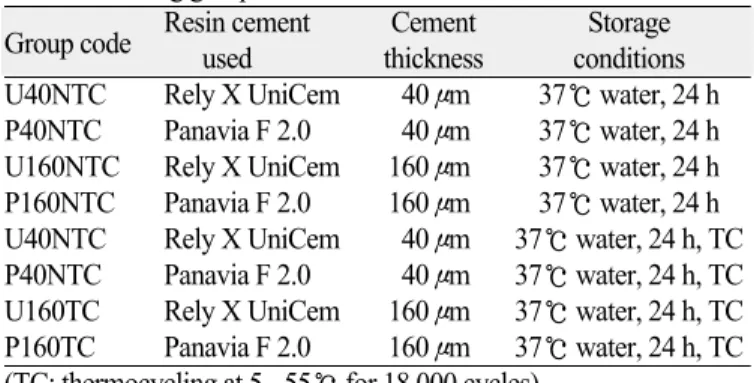
The zirconia discs and teeth were randomly divided into 8 groups according to the type of cement used, cement thickness, and storage conditions (Table 1).
Bonding of resin cement to zirconia and dentin surfaces A customized jig was fabricated to control the thickness of resin cement between the dentin and a zirconia disc. Each zir- conia disc was positioned on the stabilizing mold of the cus- tomized jig. Tofflemire matrix bands (Rihana, USA) with a thick- ness of approximately 40 μm were utilized to provide a resin cement thickness of either 40 or 160 μm. For specimens with a cement thickness of 40 μm, a single Tofflemire matrix band was positioned at each periphery of the bonding surface and stabilized by fixation screws. A small amount of cyano- acrylate (Zapit, Dental ventures of America Inc., Coraona, CA, USA) was additionally used to stabilize the bands to the zir- conia disc. For specimens with a cement thickness of 160 μm, 4 Tofflemire matrix bands were positioned at each periphery of the bonding surface, and fixation screws and cyanoacrylate were utilized to stabilize the bands. For specimens using Panavia F 2.0 (Kuraray Medical Inc, Japan) as the resin cement, primers A and B were mixed and applied on the
Table 1. Testing groups
Group code Resin cement Cement Storage
used thickness conditions
U40NTC Rely X UniCem40 μm37℃ water, 24 h P40NTC Panavia F 2.0 40 μm37℃ water, 24 h U160NTC Rely X UniCem160 μm37℃ water, 24 h P160NTC Panavia F 2.0 160 μm37℃ water, 24 h U40NTC Rely X UniCem40 μm37℃ water, 24 h, TC P40NTC Panavia F 2.0 40 μm37℃ water, 24 h, TC U160TC Rely X UniCem160 μm37℃ water, 24 h, TC P160TC Panavia F 2.0 160 μm37℃ water, 24 h, TC (TC: thermocycling at 5 - 55℃ for 18,000 cycles)
cut dentin surface for 60 s. The resin cement was mixed according to the manufacturer’s instructions and applied over the zirconia surface; subsequently, the dentin surface of each cut tooth was positioned on the resin cement. A constant pressure of 15 Ncm torque was applied for 5 min, and light irra- diation (Satelec Mini LED, Satelec Bordeaux, France) was then performed for 40 s from each side of the specimen (Fig. 1). The bonded zirconia-resin-tooth specimens were stored in distilled water for 24 h at 37℃.
Fabrication of microbeam specimens and artificial aging
Bonded zirconia-resin-tooth specimens were mounted on a custom holding device designed to rotate the specimen at 90�angles on a sawing machine (Topmet Metsaw-LS, R&B
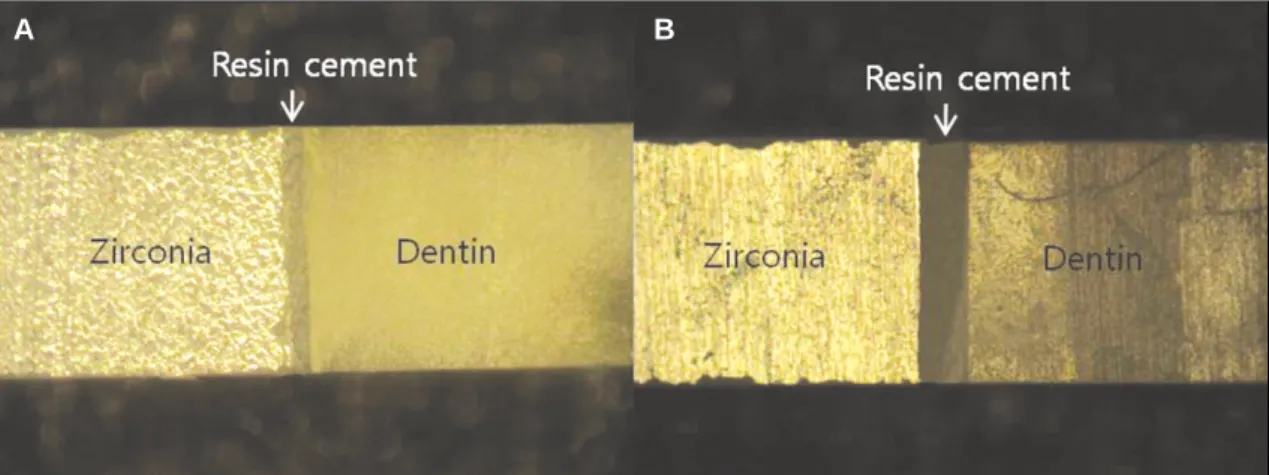
Inc., Daejun, Korea). The specimens were sectioned using a low-speed precision diamond saw (4”Wafering Blade, Allied High Tech Products Inc., Rancho Domingues, CA, USA) under water irrigation. Approximately 10 to 12 microbeams of 1 mm×1 mm×10 mm were obtained from each specimen (Fig. 2). A digital image of each microbeam was taken to mea- sure the cement thickness (Fig. 3) using the UTHSCA (University of Texas Health Science Center in San Antonio) Image Tool.
After measuring the cement thickness, the microbeams of non- thermocycled groups were submitted to a microtensile bond strength test. For the thermocycled groups, the microbeam spec- imens were submitted to thermocycling between 5 and 55℃
for 18,000 cycles (dwell time: 30 s, transfer time: 2 s), and then submitted to the microtensile bond strength test.
Fig. 1. Schematic image of customized jig for zirconia-resin-tooth bonding. Two lateral fixation screws stabilized Tofflemire matrix bands. A vertical fixation screw immobilized the cut tooth specimen and maintained constant torque during polymerization of the resin cement.
Fixation screw
Fixation screw for metal band
Tooth specimen
Zirconia block
Metal band Mold
Fig. 2. Preparation of microbeams. A customized holding device was used to rotate the specimen 90 degrees, resulting in microbeams with a rec- tangular cut surface.
Fig. 3. Measurement of cement thickness. Microbeams with cement thicknesses of 40 (A) and 160 μm (B).
A B
Microtensile bond strength test
Each specimen was fixed with cyanoacrylate (Zapit Base, Dental ventures of America Inc.) on the microtensile testing jig. The specimens were positioned parallel to the long axis of the jig in order to minimize bending stresses. The jig was mount- ed on a universal testing machine (EZ-S, Shimadzu, Japan) as parallel as possible relative to the applied tensile load. Testing was performed at a crosshead speed of 1 mm/min.
Failure mode analysis
After the microtensile test, all microbeams were analyzed using a light microscope (Nikon Cooperation, Japan) at 40× mag- nification to verify the failure modes. Failure modes were cat- egorized as follows: adhesive failure between resin and zirconia, cohesive failure of cement, or mixed failure.
Scanning electronic microscopy (SEM) evaluation
Two fractured microbeams were randomly selected from each experimental group. The microbeams were mounted, gold-sput- tered, and analyzed under scanning electronic microscopy (SEM) at 80× magnification.
Statistical analysis
A 3-way analysis of variance (ANOVA) and Scheffe’s post hoc test (SPSS for Windows Version 12.0; SPSS, Chicago, IL, USA) were applied at a 95% confidence level to analyze the effects of resin cement thickness, cement type, and ther- mocycling on the microtensile bond strength.
RESULTS
Resin cement thickness
Table 2 presents a summary of the measured resin cement thick- ness for each group. The mean values ranged from 62.65 to 68.19 μm and from 164.08 to 172.68 μm in groups with cement thick- nesses of 40 and 160 μm, respectively.
Microtensile bond strength
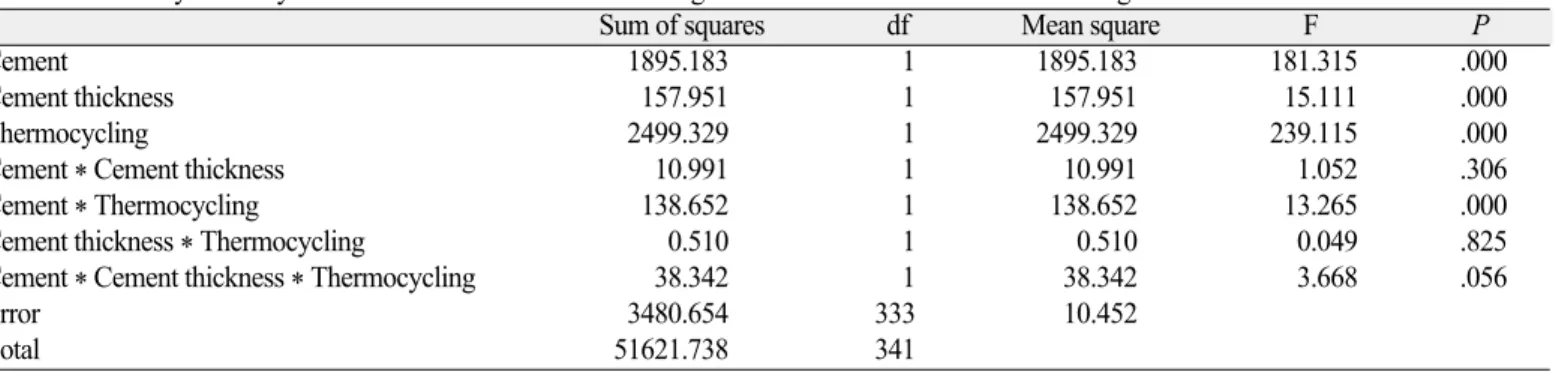
Table 3 presents the means and standard deviations of microtensile bond strength for each group. The specimens bond- ed with Panavia F 2.0 showed significantly greater microten- sile bond strength than those bonded with Rely X UniCem (P<.001). Thermocycled groups showed significantly lower microtensile bond strength than non-thermocycled groups. Table 4 shows a summary of the 3-way ANOVA for microtensile bond strength conducted at each level of interacting factor.
Table 2. Means and standard deviations of resin cement thickness (μm)
U40NTC P40NTC U160NTC P160NTC U40TC P40TC U160TC P160TC
(n = 41) (n = 45) (n = 44) (n = 43) (n = 41) (n = 41) (n = 44) (n = 42)
Mean 63.57 62.65 172.68 166.72 68.19 66.28 164.24 164.08
SD 3.99 4.98 5.47 4.10 3.30 3.48 3.72 3.82
(n = number of specimens; SD: standard deviation)
Table 3. Means and standard deviations of microtensile bond strength (MPa)
U40NTC P40NTC U160NTC P160NTC U40TC P40TC U160TC P160TC
(n = 41) (n = 45) (n = 44) (n = 43) (n = 41) (n = 41) (n = 44) (n = 42)
Mean 11.34bc 15.10de 13.09cd 16.22e 5.40a 10.36b 5.65a 12.68bcd
SD 3.14 3.86 3.56 4.52 2.25 2.52 2.06 2.85
(n = number of specimens; different superscript letters indicate groups that are statistically different, P<.05)
Table 4. Summary of 3-way ANOVA for microtensile bond strength conducted at each level of interacting factor
Sum of squares df Mean square F P
Cement 1895.183 1 1895.183 181.315 .000
Cement thickness 157.951 1 157.951 15.111 .000
Thermocycling 2499.329 1 2499.329 239.115 .000
Cement * Cement thickness 10.991 1 10.991 1.052 .306
Cement * Thermocycling 138.652 1 138.652 13.265 .000
Cement thickness * Thermocycling 0.510 1 0.510 0.049 .825
Cement * Cement thickness * Thermocycling 38.342 1 38.342 3.668 .056
Error 3480.654 333 10.452
Total 51621.738 341
Failure mode analysis
The failure modes in each group are summarized in Table 5.
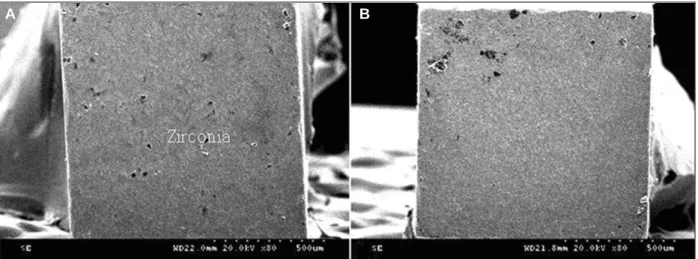
In non-thermocycled groups, the percentages of adhesive failure ranged from 19 to 48%, whereas they ranged from 62 to 93% in thermocycled groups. Fig. 4 and 5 showed typical SEM images of fractured surface.
DISCUSSION
Ever since zirconia was introduced as a dental restorative mate- rial, a great number of studies have evaluated the resin-zirconia bond strength using different zirconia surface treatments or resin cements with different compositions. One of the clinical concerns of zirconia restorations generated by CAD/CAM tech- niques is that the internal gap size is greater than that of
Fig. 4. SEM images of fractured non-thermocycled microbeams. The fractured surface reflects the mixed failure mode at the resin- zirconia interface (A: U40NTC; B: P160NTC).
A B
Fig. 5. SEM images of fractured microbeams which were thermally cycled 18,000 times. Both fractured surfaces represent adhesive failures at the resin-zirconia interface (A: U40TC, B: P40TC).
A B
Table 5. Failure mode analysis of tested specimens (%)
U40NTC P40NTC U160NTC P160NTC U40TC P40TC U160TC P160TC
(n = 41) (n = 45) (n = 44) (n = 43) (n = 41) (n = 41) (n = 44) (n = 42)
Adhesive 49 27 48 19 93 68 93 62
Mixed 51 73 52 81 7 32 7 38
Cohesive 0 0 0 0 0 0 0 0
(n = number of microbeams)
conventional metal-ceramic restorations,22,24which inevitably result in thicker layers of luting cement. The mechanical properties of the resin cement are degraded over the long term in an oral environment, which is often simulated experimen- tally by long-term water storage and thermocycling. During ther- mocycling, resin cement undergoes hydrolytic degradation, which contributes to the decrease in bond strength.25Therefore, for zirconia restorations, which commonly have greater internal and marginal gap size, the thickness of resin cement could be an influential factor for the resin-zirconia bond. Greater degradation may occur for thicker cement layers.
Thus far, there is no report on the effect of resin cement thick- ness on resin-zirconia bonding. The current study is the first to evaluate the influence of resin cement thickness on the microtensile bond strength between resin cement and air- abraded zirconia. In terms of experimental design, two cement thicknesses were selected for the current study. The thickness of 40 μm represented a good-fitting zirconia restoration whereas that of 160 μm represented a poorly fit restoration. The value of 160 μm was chosen on the basis of a previous study in which the maximum internal gap sizes of zirconia FPDs were 183.6 and 158.0 μm at the premolars and molars, respec- tively. Given that the thickness of a single Tofflemire matrix band was 40 μm, a thickness of 160 μm could be reproduced by applying 4 bands over the zirconia disc. Considering the cement thickness as a single influencing factor, thick cement resulted in significantly greater bond strength rather than thin cement (P<.001). One reason for this may be that a thicker resin cement provides greater plasticity than a thinner resin cement, absorbing a greater microtensile force until debonding. Another explanation draws upon the concept of a configuration factor (C-factor).26The C-factor was smaller in the 160 μm groups than in the 40 μm groups; therefore, thicker cement could cause less strain in the zirconia-resin-dentin complex and could lead possibly greater microtensile bond strength. However, when the experimental conditions were equat- ed for resin cement and storage condition, resin cement thick- ness had no influence on microtensile bond strength. As not- ed above, thermocycling is commonly used to simulate the in vivo oral environment. In the present study, the microtensile bond strength significantly decreased after thermocycling in every experimental group (NTC > TC, P<.001). Two major mechanisms are considered as the reasons of this effect. One is the hydrolytic degradation at the bonded interface between the composite resin and the zirconia surface. The other is the degradation of the composite matrix and the filler particles with- in the composite resin itself.18In this study, the number of adhe- sive failures increased in all thermocycled groups. In addition, no cohesive failure was observed in any experimental group.
Therefore, it is inferred that the decrease in bond strength after thermocycling was not due to the degradation of the resin matrix itself but in large part to the hydrolytic degradation at the bond-
ed interface. This explains why cement thickness had no influence on the microtensile bond strength between resin and air-abraded zirconia, as the bonded surface areas were not very different for the 40 and 160 μm groups (- 1 mm2) even though the cement thicknesses were different.
Cement selection is important for establishing effective bond strength to zirconia. Two types of dual-cured adhesive cement, Rely X UniCem and Panavia F 2.0, were used in this study. Rely X UniCem is a self-adhesive cement consisting of adhesive monomers with phosphoric acid groups. The phos- phoric acid groups are thought to establish stable and durable bonding by achieving chemical bonds with metallic oxide on the zirconia surface.15Panavia F 2.0 contains 10-MDP, an adhe- sive functional monomer, which forms chemical bonds between metallic oxide on the zirconia surface and the phos- phate ester itself.12Both cements are known to exhibit greater bond strengths with zirconia than conventional Bis-GMA cements.14In contrast, Amaral and colleagues reported that a combination of 10-MDP-containing resin cement and air- abraded zirconia did not yield stable microtensile bond strength after thermocycling.16 Durable bond strength was only achieved by silanization of the zirconia surface follow- ing laboratory or chairside silica coating even though 10- MDP-containing resin cement was used. In the present study, Panavia F 2.0 resulted in significantly greater microtensile bond strength than Rely X UniCem regardless of whether or not the specimens were thermocycled (P<.05). Although Rely X UniCem resulted in about 50% mixed failures in the non-ther- mocycled group, the incidence decreased to 7% after ther- mocycling. The incidence of mixed failures for Panavia F 2.0 also decreased after thermocycling, although the rate (32 - 38%) was still greater than that of Rely X UniCem.
There are several experimental methods to evaluate the bond strength between resin and zirconia ceramic. These include: 1) building up resin cement directly on the zirconia surface using a glass cylinder 2) bonding a composite resin spec- imen to zirconia using resin cement, and 3) bonding dentin to zirconia using resin cement. Oyagu¨e et al.13recommended using a resin cylinder rather than dentin to test the microtensile bond strength because the dentinal surface might have some unex- pected microstructural variations which could lead to misleading results. In the present study, all specimens were debonded at the resin-zirconia interface, and not within dentin nor at the resin- dentin interface. This implies that the use of dentin can be an appropriate method to measure the resin-zirconia bond strength.
As mentioned previously, it is assumed that the decrease in bond strength after thermocycling was mainly due to hydrolyt- ic degradation at the resin-zirconia interface. Therefore, future studies focusing on new surface-conditioning methods which could prevent hydrolytic degradation at the bonded interface should be designed to achieve durable resin-zirconia bonding.
CONCLUSION
Within the limitations of this study, the following conclusions may be drawn.
1. Difference in resin cement thickness had no significant effect on the microtensile bond strength between the resin cement and zirconia.
2. After 18,000 thermal cycles, the microtensile bond strength significantly decreased despite the application of adhesive monomer containing resin cement on the air-abrad- ed zirconia surface.
3. The incidence of adhesive failure increased in all exper- imental groups after thermocycling.
REFERENCES
1. Ozcan M, Vallittu PK. Effect of surface conditioning methods on the bond strength of luting cement to ceramics. Dent Mater 2003;19:725-31.
2. Phark JH, Duarte S Jr, Blatz M, Sadan A. An in vitro evaluation of the long-term resin bond to a new densely sintered high-pu- rity zirconium-oxide ceramic surface. J Prosthet Dent 2009;101:29- 38.
3. Palacios RP, Johnson GH, Phillips KM, Raigrodski AJ. Retention of zirconium oxide ceramic crowns with three types of ce- ment. J Prosthet Dent 2006;96:104-14.
4. Piconi C, Maccauro G. Zirconia as a ceramic biomaterial.
Biomaterials 1999;20:1-25.
5. Kosmac T, Oblak C, Jevnikar P, Funduk N, Marion L. The ef- fect of surface grinding and sandblasting on flexural strength and reliability of Y-TZP zirconia ceramic. Dent Mater 1999;15:426- 33.
6. Janda R, Roulet JF, Wulf M, Tiller HJ. A new adhesive technology for all-ceramics. Dent Mater 2003;19:567-73.
7. Kern M, Wegner SM. Bonding to zirconia ceramic: adhesion meth- ods and their durability. Dent Mater 1998;14:64-71.
8. Al-Dohan HM, Yaman P, Dennison JB, Razzoog ME, Lang BR.
Shear strength of core-veneer interface in bi-layered ceramics.
J Prosthet Dent 2004;91:349-55.
9. Oh WS, Shen C. Effect of surface topography on the bond strength of a composite to three different types of ceramic. J Prosthet Dent 2003;90:241-6.
10. Valandro LF, Della Bona A, Antonio Bottino M, Neisser MP.
The effect of ceramic surface treatment on bonding to densely sintered alumina ceramic. J Prosthet Dent 2005;93:253-9.
11. Guazzato M, Albakry M, Quach L, Swain MV. Influence of sur- face and heat treatments on the flexural strength of a glass-in- filtrated alumina/zirconia-reinforced dental ceramic. Dent
Mater 2005;21:454-63.
12. Burke FJ, Fleming GJ, Nathanson D, Marquis PM. Are adhesive technologies needed to support ceramics? An assessment of the current evidence. J Adhes Dent 2002;4:7-22.
13. Oyagu¨e RC, Monticelli F, Toledano M, Osorio E, Ferrari M, Osorio R. Effect of water aging on microtensile bond strength of dual- cured resin cements to pre-treated sintered zirconium-oxide ceramics. Dent Mater 2009;25:392-9.
14. Wolfart M, Lehmann F, Wolfart S, Kern M. Durability of the resin bond strength to zirconia ceramic after using different surface conditioning methods. Dent Mater 2007;23:45-50.
15. Yang B, Barloi A, Kern M. Influence of air-abrasion on zirco- nia ceramic bonding using an adhesive composite resin. Dent Mater 2010;26:44-50.
16. Amaral R, Ozcan M, Valandro LF, Balducci I, Bottino MA. Effect of conditioning methods on the microtensile bond strength of phosphate monomer-based cement on zirconia ceramic in dry and aged conditions. J Biomed Mater Res B Appl Biomater 2008;
85:1-9.
17. Aboushelib MN, Kleverlaan CJ, Feilzer AJ. Selective infil- tration-etching technique for a strong and durable bond of resin cements to zirconia-based materials. J Prosthet Dent 2007;98:379-88.
18. Wegner SM, Gerdes W, Kern M. Effect of different artificial ag- ing conditions on ceramic-composite bond strength. Int J Prosthodont 2002;15:267-72.
19. Lu¨thy H, Loeffel O, Hammerle CH. Effect of thermocycling on bond strength of luting cements to zirconia ceramic. Dent Mater 2006;22:195-200.
20. Leinfelder KF, Isenberg BP, Essig ME. A new method for generating ceramic restorations: a CAD-CAM system. J Am Dent Assoc 1989;118:703-7.
21. Molin MK, Karlsson SL, Kristiansen MS. Influence of film thick- ness on joint bend strength of a ceramic/resin composite joint.
Dent Mater 1996;12:245-9.
22. Reich S, Wichmann M, Nkenke E, Proeschel P. Clinical fit of all-ceramic three-unit fixed partial dentures, generated with three different CAD/CAM systems. Eur J Oral Sci 2005;113:
174-9.
23. Kohorst P, Brinkmann H, Dittmer MP, Borchers L, Stiesch M.
Influence of the veneering process on the marginal fit of zirconia fixed dental prostheses. J Oral Rehabil 2010;37:283-91.
24. Wettstein F, Sailer I, Roos M, Ha¨mmerle CH. Clinical study of the internal gaps of zirconia and metal frameworks for fixed par- tial dentures. Eur J Oral Sci 2008;116:272-9.
25. Sailer I, Fehe′r A, Filser F, Gauckler LJ, Lu¨thy H, Ha¨mmerle CH.
Five-year clinical results of zirconia frameworks for posterior fixed partial dentures. Int J Prosthodont 2007;20:383-8.
26. Feilzer AJ, De Gee AJ, Davidson CL. Setting stress in composite resin in relation to configuration of the restoration. J Dent Res 1987;66:1636-9.