TCP
Transl Clin Pharmacol http://dx.doi.org/10.12793/tcp.2017.25.2.106 2017;25(2):106-111Determination of sumatriptan in human plasma using liquid chromatography-mass spectrometry for pharmacokinetic study in healthy Korean volunteers
Seungil Cho*, Moonyoung Jegal, Boram Ohk, Bo Kyung Kim, Mi-Ri Gwon, Woo Youl Kang, Sook Jin Seong, Hyun-Ju Kim, Hae Won Lee and Young-Ran Yoon*
Department of Biomedical Science, BK21 Plus KNU Bio-Medical Convergence Program for Creative Talent and Clinical Trial Center, Kyungpook National University Graduate School and Hospital, Daegu 41944, Korea
*Correspondence: S. I. Cho; Tel: +82-53-200-6358, Fax: +82-53-422-4950, E-mail: [email protected] Y. R. Yoon; Tel: +82-53-420-4950, Fax: +82-53-426-4944, E-mail: [email protected]
Introduction
Sumatriptan is a selective 5-hydroxytryptamine (serotonin) type 1B receptor agonist.[1,2] It is effective for acute migraine treatment and is currently marketed as oral, subcutaneous, in- tranasal, and suppository (limited distribution) formulations.[3]
A pharmacokinetic study showed that sumatriptan was rapidly absorbed and eliminated with a half-life (T1/2) of about 2.4 h after oral administration of a 50-mg dose.[4] The median maxi- mum plasma drug concentration (Cmax) and the time to reach Cmax (Tmax) were ca. 30 ng/mL and 1.3 h, respectively.[4] The area under the curve for 12 h (AUC0–12) was ca. 111 ng·h·mL-1.
[4] The bioavailability of oral sumatriptan was low (~14%) due to pre-systemic metabolism and incomplete absorption of the drug after its oral administration.[5]
To develop appropriate individualized treatment strategies, it is important to understand the effects of covariates such as body weight, race, and sex on the pharmacokinetics.[6,7] Recently Munjal et al. examined the impact of these covariates on the plasma concentration profile of subcutaneous sumatriptan.
[8] They showed that exposure was higher in women than in men, which was attributed in part to differences in body weight.
[8] The area under the curve during the first 2 hours (AUC0–2), and total area under the curve (AUC0–∞) were lower in non- Caucasians compared with Caucasians.[8] Even though there are many reports on the pharmacokinetics of oral sumatriptan in Caucasians,[8–11] the pharmacokinetic study of oral sumat- riptan in non-Caucasians is rare. Recently, our group studied This study describes the development of an analytical method to determine sumatriptan levels in human plasma using high performance liquid chromatography (HPLC) coupled with triple quad- rupole tandem mass spectrometry (MS/MS) and its application to a pharmacokinetic study in healthy Korean volunteers. A single 50 mg dose of sumatriptan was orally administered to twelve healthy volunteers (nine women and three men). The HPLC-MS/MS analytical method was vali- dated with respect to its specificity, linearity, sensitivity, accuracy, precision, recovery, and stability.
The calibration curve was linear over a concentration range of 0.3–100 ng/mL (r > 0.999). The lower limit of quantitation for sumatriptan in plasma was 0.3 ng/mL. The accuracy and precision of the analytical method were acceptable within 15% at all quality control levels. We compared plasma concentration-time curves as well as pharmacokinetic parameters such as the area under the curve (AUC) and maximum plasma concentration (Cmax). Both the mean AUC and Cmax of sumatriptan were 1.56 times higher in women than in men. These differences could be largely explained by the difference in body weight (44%) between women and men. The outcomes may provide insights into developing appropriate individualized treatment strategies.
Received 24 May 2017 Revised 8 Jun 2017 Accepted 9 Jun 2017
Keywords
Sumatriptan, HPLC-MS/MS, Pharmacokinetic study, Human plasma, Method validation pISSN: 2289-0882 eISSN: 2383-5427
Copyright © 2017 Translational and Clinical Pharmacology
It is identical to the Creative Commons Attribution Non-Commercial License (http://creativecommons.org/licenses/by-nc/3.0/).
This paper meets the requirement of KS X ISO 9706, ISO 9706-1994 and ANSI/NISO Z.39.48-1992 (Permanence of Paper).
ORIGINAL ARTICLE
TCP
Transl Clin Pharmacol
the pharmacokinetics of oral sumatriptan in healthy Korean male volunteers using ultrahigh performance liquid chroma- tography (UPLC) coupled with triple quadrupole tandem mass spectrometry (MS/MS).[12,13] However, variability in Korean women’s response to oral sumatriptan has not been previously described.
This study describes the development and validation of an analytical method to determine sumatriptan levels in hu- man plasma and its application to a pharmacokinetic study in healthy Korean volunteers. We used high performance liquid chromatography (HPLC) coupled with MS/MS due to the un- availability of an UPLC-MS/MS system. To achieve comparable performance, we modified the previous analytical method and almost fully re-validated it as recommended in the Food and Drug Administration (FDA) guidelines.[14,15] This analytical method was applied to a pharmacokinetic study conducted with nine female and three male healthy volunteers.
Methods
Reagents and chemicals
Sumatriptan succinate (reference standard) was obtained from Tokyo Chemical Industry (Tokyo, Japan). Atenolol (internal standard, IS) was from Sigma-Aldrich (St. Louis, MO, USA).
HPLC-grade acetonitrile and ethyl acetate were obtained from Merck (Darmstadt, Germany). ACS reagent-grade formic acid was purchased from Junsei Chemical (Tokyo, Japan). De- ionized water (ca. 18 MΩ/cm resistivity) was obtained by us- ing a Milli-Q water purification system (Millipore, Molsheim, France). Sumatriptan succinate for oral administration was obtained from Myung In Pharm (Seoul, Korea). Blank human plasma samples were obtained from healthy Korean volunteers.
HPLC-MS/MS
An HPLC system (Agilent 1200 series, Santa Clara, CA, USA) was coupled with an MS/MS instrument (API5000; Sciex, Foster City, CA, USA). Chromatographic separation was performed on a Kinetex C18 column (150 × 2.1 mm, 5 µm; Phenomenex, Torrance, CA, USA). Mobile phase, 40% acetonitrile in water with 0.1% formic acid, was filtered through a 0.22 µm mem- brane filter (Millipore) prior to use. One microliter of sample was injected. An autosampler was maintained at 10°C. The mobile phase was eluted isocratically at a flow rate of 0.2 mL/
min, and the column was maintained at 40°C. The eluate was introduced into the mass spectrometer for the targeted analysis of analytes.
The mass spectrometer was operated in a positive electrospray ionization (ESI) mode. Samples were analyzed using a selected reaction-monitoring mode (SRM), which monitors the colli- sion-induced dissociation of a precursor ion to an abundant characteristic product ion. The following transitions of proton- ated molecular ions, [M+H]+, were selected: m/z 296 → m/z 58 for sumatriptan and m/z 267 → m/z 145 for atenolol. The
optimized MS parameters were as follows: source temperature, 600°C; ion spray voltage, 5.5 kV; declustering potential, 111 V;
entrance potential, 10 V; curtain gas flow, 12 L/min of nitrogen gas; nebulizing gas flow, 22 L/min of zero air; auxiliary gas flow, 8 L/min of zero air; collision energy, 31 and 37 eV for sumatrip- tan and atenolol, respectively; collision cell exit potential, 6 and 18 eV for sumatriptan and atenolol, respectively. Analyst 1.5.2 software package (Sciex) was used for instrument control as well as data acquisition and processing.
Preparation of standards and quality controls
We prepared primary stock solutions of sumatriptan and at- enolol (1 mg/mL) in methanol and water/methanol (50:50, v/v), respectively, and stored at 4°C. We prepared working standard solutions at concentrations of 3, 5, 10, 100, 200, 500, and 1000 ng/mL for sumatriptan and at 1μg/mL for IS by serial dilu- tion of the primary stock solutions. The blank pooled drug- free plasma was spiked with standard solutions to prepare the calibration standards of 0.3, 0.5, 1, 10, 20, 50, and 100 ng/mL of sumatriptan including 500 ng/ml of IS. Quality control (QC) samples were prepared at four concentration levels: 0.3, 0.9, 30, and 80 ng/mL representing the lower limit of quantitation (LLOQ), low, medium, and high QCs, respectively. The calibra- tion standards and QC samples were prepared fresh on the day of analysis.
Plasma sample preparation
Plasma samples were stored at –80°C and allowed to thaw gradually to room temperature before their processing. We transferred an aliquot (200 µL) of the plasma sample to a clean tube and added 20 µL of the IS solution (0.5 µg/mL). After the tube was briefly vortexed, 1.2 mL of ethyl acetate was added.
This mixture was vortexed for 5 min and then centrifuged at 13,200 rpm for 5 min at 4°C. The supernatant was transferred to a clean tube and evaporated to dryness in a SpeedVac vacuum evaporator (Savant Instruments, Holbrook, NY, USA) for ap- proximately 30 min at 45°C. The dry residue was reconstituted in 300 µL of the eluent, and vortexed for 3 min, and centrifuged at 13,200 rpm for 5 min at 4°C. The supernatant (100 μL) was then transferred to an HPLC vial for further HPLC-MS/MS analysis.
Method validation
We validated the method with regard to linearity, sensitivity, specificity, accuracy, precision, recovery, and stability in ac- cordance with the guidance on bioanalytical method validation published by both the US FDA and Korea FDA.[14,15]
Specificity
We evaluated the specificity of the method by analyzing drug- free plasma samples from six different individuals. We exam- ined any interference at the LC retention times of sumatriptan and IS by comparing the chromatograms of a double blank, Seungil Cho, et al.
TCP
Transl Clin Pharmacolplasma sample without sumatriptan and IS, with those of blank plasma samples spiked with sumatriptan at LLOQ (0.3 ng/mL) and/or IS (500 ng/mL).
Linearity and sensitivity
Calibration curves were obtained by plotting the peak area ratio of sumatriptan to IS vs. the nominal sumatriptan in the concentration range of 0.3–100 ng/mL. A weighted (1/x) least- squares regression was used to evaluate its linearity. Sensitivity is represented by the LLOQ, which is considered being the low- est calibration standard. The analyte signal of the LLOQ sample should be at least ten times as large as the signal of a blank sample when carry-over effects are considered.
Accuracy and precision
The intra-day accuracy and precision were assessed by analyz- ing five replicates of each QC sample (0.3, 0.9, 30, and 80 ng/
mL, respectively) on the same day. The inter-day accuracy and precision were determined by analyzing the QC samples on five different days. The accuracy was calculated as (measured con- centration/nominal concentration) × 100%, and the precision was expressed as the relative standard deviation (RSD). Accept- able accuracy and precision for all concentration levels were set within ±15% deviation, except at the LLOQ concentration level (within ±20%).
Recovery
Sumatriptan recovery was determined in triplicates at three concentrations (0.9, 30, and 80 ng/mL). Absolute recoveries were determined by comparing the peak area ratio of the spiked sumatriptan in a blank plasma sample before and after extrac- tion at the corresponding concentrations. IS recovery was deter- mined at a single concentration (500 ng/mL) level in a similar manner.
Stability experiments
Stability was measured at the low (0.9 ng/mL) and high (80 ng/
mL) QC concentrations in triplicate. We tested four stability conditions: post preparation stability at 10°C for 24 h, freeze/
thaw stability for three cycles, short-term stability at room tem- perature for 6 h, and long-term stability at –80°C for 211 days.
The concentrations obtained from all stability studies were ana- lyzed with the same calibration curve as described above and compared to those of freshly prepared QC samples.[14,15]
Pharmacokinetic application
We applied the validation method to a pharmacokinetic study of sumatriptan among healthy volunteers. The demographic information of study subjects is summarized in Table 1. The institutional review board of Kyungpook National University Hospital (Daegu, Korea) approved the pharmacokinetic study protocol. All the volunteers provided written informed consent.
After an overnight fast of 10 h, the volunteers received a single,
50-mg oral dose of sumatriptan with 150 mL of water. Addi- tional water intake was permitted 2 h after dosing. No volun- teers were allowed to take any concomitant medication during the study period. Blood samples (8 mL) were collected in tubes containing sodium heparin before (0 h) and at 0.25, 0.5, 0.75, 1, 1.5, 2, 2.5, 3, 4, 6, 8, 10, and 12 h after sumatriptan administra- tion. The plasma samples were immediately separated from the blood via centrifugation at 3000 rpm (800×g) for 10 min at 4
°C and were stored at –80°C until subsequent analysis. We used Phoenix WinNonlin® 6.4 (Certara, NJ, USA) to calculate the pharmacokinetic parameters of sumatriptan including AUC, Cmax, Tmax, and T1/2.
Results
HPLC-MS/MS
To determine characteristic transitions for the selected reac- tion monitoring of sumatriptan and IS, we performed MS/MS experiments in positive and negative ESI modes. We directly in- fused each solution in the mobile phase (1 μg/mL) into the mass spectrometer at a flow rate of 0.2 mL/min. MS/MS parameters were tuned to increase sensitivity for respective product ions.
Positive ion mode showed significantly greater ion abundances than did negative ion mode. Sumatriptan and IS yielded proton- ated molecular ions ([M+H]+) at m/z 296 and 267, respectively, in positive ion mode. The fully scanned mass spectra presented the most abundant and stable product ions at m/z 58 and 145 for sumatriptan and IS, respectively.
Analysis of sumatriptan was initiated under isocratic condi- tions as before.[13] Previously, the mobile phase of water–
acetonitrile–formic acid at 83:17:0.1 (v/v/v) was used for the chromatographic separation of sumatriptan and terazosin.[13]
For better performance, we adjusted the polarity of the mobile phase and decided to use water–acetonitrile–formic acid at 60:40:0.1 (v/v/v) as a mobile phase in this study. In addition, we chose atenolol as an IS instead of terazosin because of the similar chemical property of sumatriptan and atenolol. Sumat- riptan and IS were eluted from the column at 1.50 and 1.49 min, respectively, with good peak symmetry and reproducibility (data not shown here).
Sample preparation and recovery
Previously, the mean percent recovery rates of sumatriptan were 69.8, 72.9, and 62.3% at concentrations of 1, 10, and 50 ng/
mL, respectively, and the RSDs (%) of these values were within 11.8%.[13] In this study, the mean percent recovery rates of sumatriptan were 77.7, 77.2, and 67.7% for the plasma samples (n = 3) at concentrations of 0.9, 30, and 80 ng/mL, respectively.
Furthermore, the RSDs of these values were within 3.4%. The improvement in the mean percent recovery rate and RSD can be attributed to the higher similarity of sumatriptan to atenolol in chemical properties than to terazosin.
Pharmacokinetics of oral sumatriptan
TCP
Transl Clin Pharmacol
Seungil Cho, et al.
Specificity
In this study, we investigated the specificity using independent drug-free plasma. We compared the SRM chromatograms of the following four samples: blank human plasma, blank hu- man plasma spiked with sumatriptan at the LLOQ (0.3 ng/mL), blank human plasma spiked with IS (500 ng/mL), and blank human plasma spiked with both sumatriptan and IS. The chro-
matograms did not show any interfering endogenous peaks at the measured mass transitions and retention times of sumatrip- tan and IS in the highly selective SRM mode.
Linearity and LLOQ
The calibration curves were linear over the concentration range of 0.3–100 ng/mL with a correlation coefficient (r) of 0.999 or better. The measured LLOQ was 0.3 ng/ml. The sensitiv- ity of this method was slightly higher than that of the previous method (0.5 ng/mL),[13] and sufficient for the determination and pharmacokinetic analysis of sumatriptan in human plasma.
Accuracy and precision
Table 2 presents the intra- and inter-day precision and accu- racy at four QC levels (0.3, 0.9, 30, and 80 ng/mL). The RSDs for all QC samples were within 11.2%, while the relative errors (REs) in the accuracy were less than 6.3%. Thus, all QC samples met the currently accepted criteria of ±20% precision and accuracy at the LLOQ concentration level and
±15% for higher concentrations.
Stability
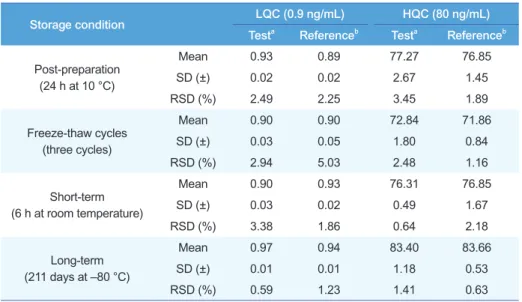
Table 3 summarizes the results from stability tests. The QC plasma samples at two concentrations (0.9 and 80 ng/mL) were stable during sample preparation procedures, storage, and after sample ex- traction. Stored sumatriptan and IS stock solutions were stable for up to 211 days at −80°C. Sumatriptan levels in human plasma varied only slightly as shown in Table 3. This indicates adequate sample stability under the exam- ined conditions.
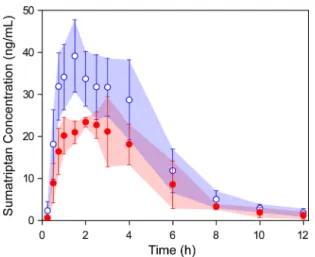
Pharmacokinetic application We applied the validated ana- lytical method to a pharmacoki- netic study of sumatriptan after oral administration of a 50-mg dose to nine female and three male healthy volunteers. The sumatriptan concentrations in plasma were higher than LLOQ and quantifiable at all the time points. Figure 1 shows the mean concentration–time profiles of sumatriptan in human plasma for women and men. In general, the exposure levels of women to oral sumatriptan were at least 40% or higher than those of men at each time point. Due to
Table 1. Demographic characteristics of study subjects
*Data are shown as the mean (range).
Variables Women (n=9) Men (n=3) Age (years) 25.4 (21–31) 30 (30–30) Weight (kg) 52.4 (50–58) 75.5 (66.4–81.7) Height (cm) 160.0 (154.4–167.0) 177.4 (171.4–184.1) BMI (kg/m2) 20.4 (19.4–21.0) 23.9 (22.6–25.1)
Table 2. Intra- and inter-day (n=5) accuracy and precision of QC samples of sumatriptan in plasma.
LQC, low quality control; MQC, middle quality control; HQC, high quality control.
Nominal Concentration (ng/mL)
Accuracy (%) Precision (RSD, %) Intra-day Inter-day Intra-day Inter-day
0.3 (LLOQ) 95.4 99.5 7.53 11.2
0.9 (LQC) 101.1 103.2 4.74 4.99
30 (MQC) 102.0 102.5 2.39 2.40
80 (HQC) 97.0 93.7 5.33 7.64
Table 3. Stability of sumatriptan standard in plasma under four different conditions (n=3)
aConcentration of samples stored under different storage conditions; bConcentration of freshly prepared samples.
Storage condition LQC (0.9 ng/mL) HQC (80 ng/mL)
Testa Referenceb Testa Referenceb
Post-preparation (24 h at 10 °C)
Mean 0.93 0.89 77.27 76.85
SD (±) 0.02 0.02 2.67 1.45
RSD (%) 2.49 2.25 3.45 1.89
Freeze-thaw cycles (three cycles)
Mean 0.90 0.90 72.84 71.86
SD (±) 0.03 0.05 1.80 0.84
RSD (%) 2.94 5.03 2.48 1.16
Short-term (6 h at room temperature)
Mean 0.90 0.93 76.31 76.85
SD (±) 0.03 0.02 0.49 1.67
RSD (%) 3.38 1.86 0.64 2.18
Long-term (211 days at –80 °C)
Mean 0.97 0.94 83.40 83.66
SD (±) 0.01 0.01 1.18 0.53
RSD (%) 0.59 1.23 1.41 0.63
TCP
Transl Clin Pharmacolrelatively high standard deviation at each time point, however, we cannot confirm if there are clear differences in the mean concentration-time profiles of sumatriptan between the two groups.
Table 4 presents calculated pharmacokinetic parameters. T1/2
and Tmax were similar between both groups. However, both Cmax
and AUC0-∞ of sumatriptan were 1.56 times higher in women than in men. In this study, men were 44% heavier than women were (Table 1). Therefore, relatively higher exposures in women are natural because of their generally lower body weight. To com- pensate for the differences in body weight, Cmax and AUC0-∞ were divided by body-weight normalized dosage to give Cmax/bw and AUC0-∞/bw, respectively. The body-weight adjusted parameters were still 7–9% higher in women than in men (Table 4). How- ever, Student’s t-test results show that the differences in Cmax and AUC0-∞ were not significant (P > 0.05) after correcting for body- weight differences.
Discussion
Previously, we demonstrated the successful development of an analytical method to determine sumatriptan levels in human plasma using UPLC-MS/MS.[13] Due to the unavailability of an UPLC-MS/MS system, however, we used an HPLC-MS/MS sys- tem in this study. To achieve comparable chromatographic per- formance, we replaced terazosin with atenolol as an IS. Further- more, we increased the acetonitrile content in the mobile phase to shorten overall retention times. Thus, the chromatographic analysis of sumatriptan and IS in human plasma could be per- formed within 5 min as before. The validation results in the cur- rent study were also comparable to those obtained in the previ- ous study.[13] The method accuracies were within 15%, and the RSDs of the intra- and inter-day precision were also within 15% at all quality control levels. The LLOQ was sufficiently low to quantitate sumatriptan concentrations at all the time points of interest. Additionally, the pharmacokinetic parameters of sumatriptan for healthy male volunteers in this study, including AUC0-∞ and Cmax, were comparable not only to those previously reported for healthy male volunteers [12,13] but also to those obtained by Moore et al.[4] However, these parameters for men were significantly different from those for women with a ratio of 1.56. Munjal et al. studied the statistically significant impact of body size [weight and body mass index (BMI)] and sex on sys- temic exposure to subcutaneously administered sumatriptan.[8]
They showed that sumatriptan exposure in women was higher than that in men with a typical ratio of ~1.2. Both body weight and BMI were important covariates for sumatriptan exposure.
In this study, however, it is unlikely that BMI (17% difference between the two groups) is a major factor to justify the observed difference in pharmacokinetic parameters. When data were ad- justed for body weight, the differences in pharmacokinetic pa- rameters became non-significant. This indicates that the lower body weight of women significantly correlates with the higher exposure of women than that of men. Nevertheless, care must be taken in interpreting our data to determine whether doses of orally administered sumatriptan should be adjusted based on body weight for comparable efficacy, because the sample size was small in this study. Detailed studies with a larger sample size will be required to understand better the mechanisms and observed sex-specific differences in pharmacokinetics
In conclusion, we developed and validated an HPLC-MS/MS analysis method for the quantitation of sumatriptan in human plasma. We successfully applied this method to a clinical phar- macokinetic study of sumatriptan in healthy Korean female and male volunteers. By comparing the pharmacokinetic param- eters of sumatriptan between women and men, we showed that the difference in body weight between women and men had a significant effect on sumatriptan pharmacokinetics. However, sex difference was not significant after the pharmacokinetic parameters were adjusted for body weight. Despite our study being limited by a small sample size, our preliminary results will be useful to develop a larger scale studies and to advance our
Table 4. Calculated pharmacokinetic parameters of sumatriptan after oral administration of 50-mg to healthy nine female and three male vol- unteers
*Data are shown as the mean±SD. aobtained by dividing its original parameter by body-weight normalized dosage.
Parameters Women Men P value
AUC0-12 (ng h/mL) 186±39 119±19 0.018 AUC0-∞ (ng h/mL) 194±42 125±19 0.023
AUC0-∞/bw (ng h/mL × 106)a 202±37 188±38 0.597
Cmax (ng/mL) 42.0±7.2 26.8±3.3 0.006
Cmax/bw (ng/mL × 106)a 43.8±7.1 40.0±1.3 0.391
Tmax (h) 2.0±0.9 2.0±1.0 1.000 T1/2 (h) 2.6±1.3 2.6±1.0 0.933 Figure 1. Mean plasma concentration-time profiles of sumatriptan after single oral dose 50-mg sumatriptan for nine female (blue open circle) and three male (red closed circle) healthy volunteers. Shaded areas with error bars represent standard deviation from the mean value.
Pharmacokinetics of oral sumatriptan
TCP
Transl Clin Pharmacol
understanding of sex-related difference in the pharmacokinetics of sumatriptan.
Acknowledgements
This study was supported by a grant of the Korean Health Technology R&D Project, Ministry of Health & Welfare, Re- public of Korea (HI14C2750). This work was supported by the Industrial Core Technology Development Program (10051129, Development of the system for ADME assessment using radio- labeled compounds) funded by the Ministry of Trade, Industry
& Energy (MOTIE, Korea).
Conflict of interest
The authors have no conflicts of interest to declare.
References
1. Humphrey PP. The discovery of a new drug class for the acute treatment of migraine. Headache 2007;47 Suppl 1:S10-S19.
2. Hoyer D, Clarke DE, Fozard JR, Hartig PR, Martin GR, Mylecharane EJ, et al. International Union of Pharmacology classification of receptors for 5-hy- droxytryptamine (Serotonin). Pharmacol Rev 1994;46:157-203.
3. Duquesnoy C, Mamet JP, Sumner D, Fuseau E. Comparative clinical phar- macokinetics of single doses of sumatriptan following subcutaneous, oral, rectal and intranasal administration. Eur J Pharm Sci 1998;6:99-104.
4. Moore KH, Leese PT, McNeal S, Gray P, O'Quinn S, Bye C, et al. The phar- macokinetics of sumatriptan when administered with clarithromycin in healthy volunteers. Clin Ther 2002;24:583-594.
5. Lacey LF, Hussey EK, Fowler PA. Single dose pharmacokinetics of sumat- riptan in healthy volunteers. Eur J Clin Pharmacol 1995;47:543-548.
6. Kaiser J. Gender in the pharmacy: does it matter? Science 2005;308:1572.
7. Federman DD. The biology of human sex differences. N Engl J Med 2006;
354:1507-1514.
8. Munjal S, Gautam A, Rapoport AM, Fisher DM. The effect of weight, body mass index, age, sex, and race on plasma concentrations of subcutane- ous sumatriptan: a pooled analysis. Clin Pharmacol 2016;8:109-116. doi:
10.2147/CPAA.S108966.
9. Sternieri E, Pinetti D, Coccia CP, Leone S, Bertolini A, Ferrari A. Pharma- cokinetics of sumatriptan in non-respondent and in adverse drug reaction reporting migraine patients. J Headache Pain 2005;6:319-321.
10. Ferrari A, Pinetti D, Bertolini A, Coccia C, Sternieri E. Interindividual vari- ability of oral sumatriptan pharmacokinetics and of clinical response in migraine patients. Eur J Clin Pharmacol 2008;64:489-495. doi: 10.1007/
s00228-007-0443-9.
11. Rani PU, Naidu MUR, Kumar TR, Shobha JC, Vijay T, Sekhar KR, et al. A bioequivalence study of two brands of sumatriptan tablets. Curr Ther Res Clin E 1996;57:589-598.
12. Lee J, Lim M-S, Seong SJ, Park S-M, Gwon M-R, Han S, et al. Population pharmacokinetic analysis of the multiple peaks phenomenon in sumatrip- tan. Transl Clin Pharmacol 2015;23:66-74.
13. Seo JJ, Park J, Bae MH, Lim MS, Seong SJ, Lee J, et al. Rapid determina- tion of sumatriptan in human plasma by ultra performance liquid chroma- tography-tandem mass spectrometry and its application to clinical phar- macokinetic study. J Chromatogr B Analyt Technol Biomed Life Sci 2013;
919-920:38-42. doi: 10.1016/j.jchromb.2013.01.004.
14. US Food and Drug Administration. Guidance for Industry: Bioanalytical method validation. http://www.fda.gov/downloads/drugs/guidancecompli- anceregulatoryinformation/guidances/ucm070107.pdf. Accessed 11 May 2017.
15. Korea Food and Drug Administration. Guideline on bioanalytical method validation. http://www.mfds.go.kr/index.do?mid=1161&seq=7560. Accessed 11 May 2017.
Seungil Cho, et al.