INTRODUCTION
Hypersensitivity to a mosquito bites (HMB) is a disorder characterized by intense skin reaction and various generalized symptoms subsequent to mosquito bites (1). While this dis- order is very rare, some cases of HMB mainly reported from East Asia, primarily from Japan (2). However, recently a 7- yr-old Latin American case was reported in 2005 (3). It has been suggested that HMB is associated with chronic Epstein- Barr virus (EBV) infection and natural killer (NK) cell leu- kemia/lymphoma (1, 4). We describe here a Korean child who had HMB associated with chronic EBV infection and NK cell lymphocytosis.
CASE REPORT
A 5-yr-old male was admitted with well-demarcated ne- crotic skin lesions and severe swelling on right ear lobe devel- oped after mosquito bites (Fig. 1). In addition to cutaneous lesion, he also had a high temperature. He had suffered sever- al similar symptoms since last summer, which complicated as deep scars on skin. Laboratory tests showed white blood cell (WBC) 7,280/ mL (neutrophil 39%, lymphocyte 56%), total eosinophil count 156/mL, IgE by PRIST above 1,000
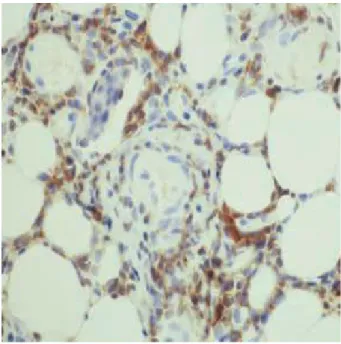
kIU/L. IgG, A, M levels were normal. Specific IgE for Aedes communis by radioallergosorbent test (RAST) was negative. To perform a skin patch test, we prepared salivary gland extracts from 2 mosquito species, including Aedes togoi (Ae. togoi) and Culex Pipiens (Cx. pipiens). These species were chosen because Ae. Togoi is prevalent throughout eastern Asia and Cx. pipi- ens is found worldwide (5), especially in Chungnam area of Korea. The protein concentration of the salivary gland extracts were as following; Ae. togoi, 0.079 mg/dL: Cx. pipiens, 0.523 mg/dL. The result of the skin patch tests showed a positive response to Cx. pipiens after 72 hr (Fig. 2). Lymphocyte sub- set analysis demonstrated increased NK cells (CD16+CD56, 43%) and decreased CD3 and CD4 cells. IgM for anti-nucle- ar antigen (EBNA), IgM for viral capsid antigen (VCA) and IgM for anti-early antigen (EA) DR to EBV were all nega- tive. However, the levels of anti-VCA IgG (>200 U/mL), anti- EA DR IgG (>150 U/mL) and anti-EBNA IgG (62 U/mL) were increased: these findings are consistent with chronic EBV infection. Type A EB virus was demonstrated in blood mono- nuclear cells by DNA polymerase chain reaction (PCR) method (Fig. 3). EBER (EBV encoded RNA) in situ hybridization was negative in necrotic tissues. Immunostaining with NK- cell marker (CD56) revealed many immunoreactive cells with the perivascular inflammatory infiltrates in necrotic tissue (Fig. 4). The patient had a bone marrow biopsy performed,
321
Eui Jung Roh1, Eun Hee Chung1, Young Pyo Chang1, Na Hye Myoung2, Young Koo Jee3, Min Seo4, and Jin Han Kang5
Departments of Pediatrics1, Clinical Pathology2, Internal Medicine3, and Parasitology4, College of Medicine, Dankook University, Cheonan; Department of Pediatrics5, College of Medicine, The Catholic University of Korea, Seoul, Korea
Address for Correspondence Eun Hee Chung, M.D.
Department of Pediatrics, College of Medicine, Dankook University, 16-5 Anseo-dong, Cheonan 330-715, Korea
Tel : +82.41-550-3935, Fax : +82.41-565-6167 E-mail : [email protected]
J Korean Med Sci 2010; 25: 321-3 ISSN 1011-8934
DOI: 10.3346/jkms.2010.25.2.321
A Case of Hypersensitivity to Mosquito Bite Associated with Epstein- Barr Viral Infection and Natural Killer Cell Lymphocytosis
Hypersensitivity to mosquito bites (HMB) is a disorder characterized by a necrotic skin reaction and generalized symptoms subsequent to mosquito bites. It has been suggested that HMB is associated with chronic Epstein-Barr virus (EBV) infection and natural killer cell leukemia/lymphoma. We describe here a Korean child who had HMB associated with chronic EBV infection and natural killer cell lymphocyto- sis. A 5-yr-old boy was suffered from necrotic skin lesions on the right ear lobe. Type A EB virus was detected from hlood cells and bone marrow biospy recognized hemo- phagocyrosis.
Key Words : Hypersensitivity; Culicidae; Epstein-Barr Virus Infections; Killer Cells, Natural; Lymphocytosis
Received : 11 June 2008 Accepted : 22 September 2008
ⓒ 2010 The Korean Academy of Medical Sciences.
This is an Open Access article distributed under the terms of the Creative Commons Attribution Non-Commercial License (http://creativecommons.org/licenses/by-nc/3.0) which permits unrestricted non-commercial use, distribution, and reproduction in any medium, provided the original work is properly cited.
and was diagnosed with the hemophagocytic syndrome 2 yr and 6 months after the first symptom appeared. During the immunosuppressive therapy, the patient had four additional episodes of mosquito bites, each of which gave rise to intense local skin reactions as well as a high fever.
DISCUSSION
HMB was first described in 1938 in a patient from Flori- da, USA (6). In 1990, Tokura et al. described a patient with HMB in whom 50% to 60% of the peripheral blood mono- nuclear cells were large granular lymphocytes that were iden- tified phenotypically and functionally as NK cells (4). On the other hand, HMB is seen in a considerable number of patients with chronic active EBV infection (7). Finally, accu- mulated clinical and laboratory studies have concluded that
HMB occurs in close association with NK cell disease where the cells are infected with monoclonal EBV (1). This entity referred to as “mosquito allergy” historically (2), is now refer- red to as “HMB-EBV-NK disease” (1).
HMB-EBV-NK disease is a very rare. A Korean adoles- cent who had HMB-EBV-NK disease was reported in 2003 (8). The mean age of onset is 6.7 yr and there is no gender predominance (1). The pathophysiological relationship bet- ween HMB, EBV infection, and NK cell neoplasms remains unclear. Tokura et al. (1) demonstrated that EBV infection immortalizes NK cells, which are activated by injection of some mosquito constituents, thereby exhibiting HMB as the primary clinical manifestation. In addition, he reported that NK cell predominant mononuclear cells are infiltrated into mosquito bite sites. The accumulation of NK cells may direct- ly or indirectly mediate the systemic symptoms, and a recur-
322 E.J. Roh, E.H. Chung, Y.P. Chang, et al.
Fig. 1. (A) The skin lesion that developed after mosquito bites on the right ear. (B) Necrotic change of the lesion on the right ear on the sixth hospital day.
A B
Fig. 2. (A) The skin patch test for the mosquito allergens Lt, Aedes togoi; Rt, Culex pipiens. (B) The skin patch test shows a positive reaction to Culex pipiens (Rt) and a negative reaction to Aedes togoi (Lt).
A B
Fig. 3. Polymerase chain reaction of EB virus in blood mononu-
clear cell. B, positive control; A, EB virus. Fig. 4. Imunostaining for the CD56 antigen, a NK-cell marker, re- veals many immunoreactive cells, suggesting the presence of NK cells (brown color) within the perivascular inflammatory infiltrates.
B A
rent and prolonged activated state of NK cells may induce additional genetic damage that leads to the development of leukemias or lymphomas (9).
The typical clinical course of patients with HMB-EBV- NK disease includes three clinical stages. Initailly, an exag- gerated reaction to mosquito bites is identified. Older pati- ents may exhibit several episodes with deterioration of gen- eral systemic symptoms. Some patients may already have leukemia or lymphoma when the first episode of HMB is diagnosed (1). The hemophagocytic syndrome is one of the major life-threatening complications that occur at the ter- minal stages (1). Most of the reported cases of HMB have shown a close relationship between mosquito allergy and EBV-infected NK-cell lymphoproliferation. Further inves- tigation of hypersensitivity to mosquito bite pathogenesis, and the relationship between EBV infection and subsequent oncogenesis of NK cell lymphoma/leukemia including chron- ic NK cell lymphocytosis, is needed.
REFERENCES
1. Tokura Y, Ishihara S, Tagawa S, Seo N, Ohshima K, Takigawa M.
Hypersensitivity to mosquito bites as the primary clinical manifesta- tion of a juvenile type of Epstein-Barr virus associated natural killer cell leukemia/lymphoma. J Am Acad Dermatol 2001; 45: 569-78.
2. Suzuki S, Negishi K, Tomizawa S, Shibasaki M, Kurome T. A case
of mosquito allergy. Immunological studies. Acta Allegol 1976; 31:
428-41.
3. Pacheco SE, Gottschalk SM, Gresik MV, Dishop MK, Okmaura T, McCormick TG. Chronic active Epstein-Barr virus infection of nat- ural killer cells presenting as severe skin reaction to mosquito bites.
J Allergy Clin Immunol 2005; 116: 470-2.
4. Tokura Y, Tamura Y, Takigawa M, Koide M, Satoh T, Sakamoto T, Horiguchi D, Yamada M. Severe hypersensitivity to mosquito bites associated with natural killer cell lymphocytosis. Arch Dermatol 1990; 126: 362-8.
5. Knight KL, Stone A. A catalog of the mosquitoes of the world. 2nd ed. Washington: Ent Soc Am (Thomas Say Found) 1977: 611.
6. Brown A, Griffitts TH, Erwin S, Dyrenforth LY. Arthus’ phenome- non from mosquito bites: report of a case with experimental studies.
South Med J 1938; 31: 590-6.
7. Ishihara S, Okada S, Wakiguchi H, Kurashige T, Morishima T, Kawa- Ha K. Chronic active Epstein-Barr virus infection in children in Ja- pan. Acta Pediatr 1995; 84: 1271-5.
8. Park SY, Cho YS, Kim HH, Lee CK, Yoo B, Kim SW, Oh HB, Park CJ, Moon HB. A case of hypersensitivity to mosquito bites with chron- ic Epstein-Barr virus infection and atypical lymphocytosis. J Asthma Allergy Clin Immunol 2003; 23: 408-13.
9. Tsuge I, Morishima T, Morita M, Kimura H, Kuzushima K, Matsuo- ka H. Characterization of Epstein-Barr virus infected natural killer cell proliferation in patients with severe mosquito allergy: establish- ment of an IL-2-dependent NK-like cell line. Clin Exp Immunol 1999;
115: 385-92.
A Case of Hypersensitivity to Mosquito Bite 323