• 검색 결과가 없습니다.

Development and Evaluation of Smart Secondary Controls Using iPad for People with Hemiplegic Disabilities

N/A
N/A
Protected

Academic year: 2021

Share "Development and Evaluation of Smart Secondary Controls Using iPad for People with Hemiplegic Disabilities"

Copied!
17
0
0

로드 중.... (전체 텍스트 보기)

전체 글

(1)

JESK http://jesk.or.kr eISSN:2093-8462

Development and Evaluation of Smart Secondary Controls Using iPad for People with

Hemiplegic Disabilities

Jeongheon Song, Yongchul Kim

Daegu University, Rehabilitation Science and Technology, Gyeongsansi, 712-714

Corresponding Author Yongchul Kim

Daegu University, Rehabilitation Science and Technology, Gyeongsansi, 712-714 Mobile : +82-10-9686-4240

Email : [email protected]

Received : August 04, 2014 Revised : January 29, 2015 Accepted : February 02, 2015

Copyright@2015 by Ergonomics Society of Korea. All right reserved.

ccThis is an open-access article distributed under the terms of the Creative Commons Attribution Non-Commercial License (http://

creativecommons.org/licenses/by-nc/3.0/), which permits unrestricted non-commercial use, distribution, and reproduction in any medium,

Objective: The purpose of this study was to develop and evaluate smart secondary controls using iPad for the drivers with physical disabilities in the driving simulator.

Background: The physically disabled drivers face problems in the operation of secondary control devices that accept a control input from a driver for the purpose of operating the subsystems of a motor vehicle. Many of conventional secondary controls consist of small knobs or switches that physically disabled drivers have difficulties in grasping, pulling or twisting. Therefore, their use while driving might increase distraction and workload because of longer operation time.

Method: We examined the operation time of conventional and smart secondary controls, such as hazard warning, turn signal, window, windshield wiper, headlights, automatic transmission and horn. The hardware of smart secondary control system was composed of iPad, wireless router, digital input/output module and relay switch.

We used the STISim Drive3 software for driving test, customized Labview and Xcode programs for interface control of smart secondary system. Nine subjects were involved in the study for measuring operation time of secondary controls.

Results: When the driver was in the stationary condition, the average operation time of smart secondary devices decreased 32.5% in the normal subjects ( p <0.01), 47.4%

in the subjects with left hemiplegic disabilities ( p <0.01) and 38.8% in the subjects with right hemiplegic disabilities ( p <0.01) compared with conventional secondary devices.

When the driver was driving for the test in the simulator, the average operation time of smart secondary devices decreased 36.1% in the normal subjects ( p <0.01), 41.7%

in the subjects with left hemiplegic disabilities ( p <0.01) and 34.1% in the subjects with right hemiplegic disabilities ( p <0.01) compared with conventional secondary devices.

Conclusion: The smart secondary devices using iPad for people with hemiplegic disabilities showed significant reduction of operation time compared with conventional secondary controls.

Application: This study can be used to design secondary controls for adaptive vehicles and to improve the quality of life of the people with disabilities.

Keywords: Secondary driving controls, Smart device, Driving simulator, Human machine interface (HMI)

1. Introduction

(2)

to drive in the safe environment. People with disabilities having driver's license are no exception in terms of safety. The number of disabled people, who acquired driver's license by 2012, was 136,616, took up about 0.5% out of total population having driver's license in Korea (Road Authority, 2012), and the number is steadily increasing each year. However, normal people still have negative thinking on the driving of disabled people, and one of the reasons for such negative thinking is about the safety issue (National Human Rights Commission of Korea, Driver license system meeting, 2002).

Even though, it is safe for drivers with disabilities to drive using adaptive driving devices modified to be suitable for their physical disabilities, there are no adaptive driving devices suitable for various physical characteristics of disabled people as shown in the advanced countries including the U.S. and Japan (Jung and Kim, 2012). Even worse, disabled people's safety and access to secondary controls such as windshield wipers, warning system and turn signals are in poorer state. Since secondary control devices correspond to communication between vehicles on the road, they play an important role in safety. The use of secondary controls that can be a language delivering system mutually in the complex road environment is essential to the prevention of dangers occurring from driver's external factors. The reason is that secondary controls are for mutual safety, although steering apparatus, and acceleration and braking systems can reduce accidents, according to driver's own capability. However, when people with disabilities use the secondary control devices inappropriately designed for their access and use, distraction and disruption to lane keeping may be caused (Roush and Koppa, 1992).

There are various types and shapes of the secondary control devices within conventional vehicles, according to vehicle development, design advance and ergonomic design. Most secondary control devices within conventional vehicles, however, do not consider disabled people's physical characteristics.

Therefore, those devices are designed for disabled people owning and driving a vehicle to use with huge inconveniences and difficult access. For example, the lever style turn signals and windshield wipers make it difficult for a person with hemiplegic disabilities, who has to manipulate steering wheel with one hand, to use them, if they are located in the direction of disability of the driver. The control devices including the knob style headlights or push button style electricity-operated windows need to be turned grabbing with fingers, or operating them with fingertip. For this reason, there will be difficulties in manipulating them, if a driver has upper limb disabilities.

Driving is a complex task to exhaust driver's attention, and doing some other thing simultaneously with driving reduces driving capability (Wester et al., 2008). Human factors are regarded as the causes to more than 90% of traffic accidents, and only vehicle defect factors took up only 3% (Najm et al., 1995). The traffic accidents caused by human factors took place, when driving capability was inadequate or a driver did not properly respond to various situations (Summala, 1996; Merat et al., 2005). Looking at normal people's use of the secondary control devices, while driving a vehicle, they have no problems in the use of such devices as windshield wipers, hazard warning and turn signals. However, people with left hemiplegic disabilities have difficulties in the use of turn signals, due to disability in left hand, and therefore, driving capability reduction may be caused, since workload increase, such as turn signal using, simultaneously steering the vehicle with right hand, is caused, when the driver wants to change lanes or turn left or right at the intersection. The secondary control devices can be a major cause to the lack of attention on the road, due to increase in driver's workload, and to distraction in disabled people's driving.

Looking into the studies on secondary driving controls, there are a study on comparison of the operation time of secondary controls by normal people through camera observation (Dingus et al., 1988), a study on comparison of driver's capabilities according to integrated control types within a vehicle (Lim et al., 2007) and a study on the importance of secondary controls within a vehicle (Roush and Koppa, 1992).

Although, many studies on navigation required by normal people (Baumann et al., 2004; Kun et al., 2009; Koo et al., 2009) and

(3)

on the distracted driving caused by manipulating cellphones (Brookhuis et al., 1991; Patten et al., 2004; Shinar et al., 2005; Park et al., 2010) have been conducted, there are few studies on driving workload and distraction caused by difficulties of access to the secondary control devices, while disabled people drive.

With regard to the development of secondary control devices for disabled people, the following devices are currently developed:

devices making possible for disabled people to access by increasing the lever style device's length (parking brake lever, right turn signal) and pad style button device attached to the steering wheel (Howell Ventures Ltd-RF360, Access Unlimited-Mini Touch), and touch screen system for severely-disabled people (Electronic Mobility Control-Aevit System, Independent Driving systems, Inc.-IDS PROXIMA). If a driver has disabilities in upper limb function, the development of a system using a smart device, where a touch screen is installed, that can be easily manipulated, and operation time can be minimized is required, because such a driver can have a difficulty in manipulating the lever style device or pad-shaped button style device. Therefore, this study aimed to supplement accessibility to conventional devices, reduce operation time and driving workload, and raise driver's safety by comparing the operation time measurement between conventional vehicles' secondary controls and the systems developed by using smart devices (iPad2).

The touch screen has the highest speed in usability among control devices (Baber, 1997), and the reason why operation time is measured is that driver's view stays at the device, and hand approaches and uses the device, when using the secondary driving device. When a driver drives a vehicle, the processed information is almost acquired by view channel (Mcknight and Adams, 1970), and he/she tends to limit the behavior going beyond the view on the road to about 1.5 seconds (Rockwell, 1988). As the operation time of the devices gets longer, the time that driver's view deviates from the road gets longer as well. A behavior deviating view on the road more than two seconds increases the traffic accident probability (Klauer, 2006).

This study measured the operation time of lever style devices or pad-shaped button style devices by people with hemiplegic disabilities having difficulties in manipulating those devices, due to upper limb function disabilities in the stationary state or driving a vehicle, compared the conventional secondary control devices and the smart device (iPad2) system developed in this study, and verified behavior performance.

2. Method 2.1 Subjects

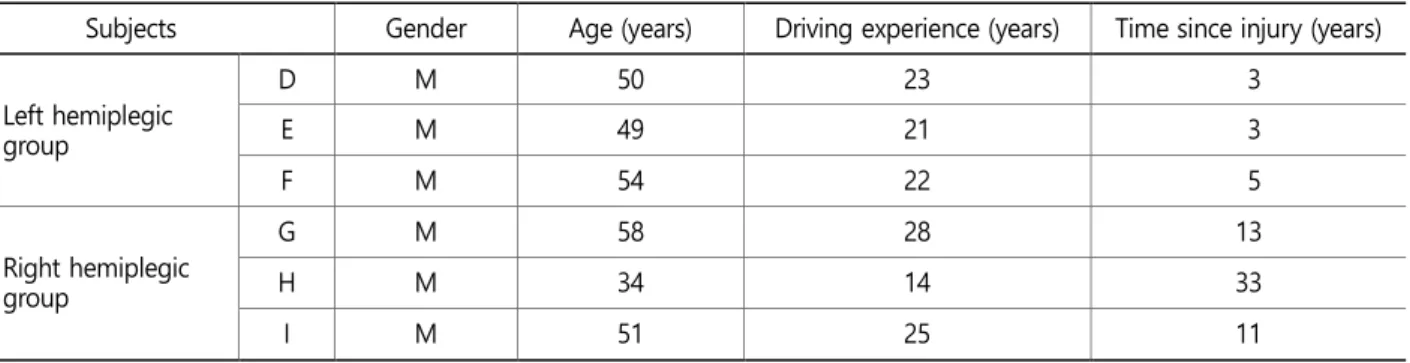
To evaluate the performance of secondary control system, this study carried out evaluation by dividing the subjects into three groups to perform experiments: normal group with more than 10 years of driving experience, after acquiring driver's license (three people), left hemiplegic group having acquired disabilities with more than 20 years of driving experience (three people) and right hemiplegic group with acquired and innate disabilities having more than ten years of driving experience. The experiment was performed targeting the subjects without stiffness and abnormality in visual perception and cognitive evaluation (Table 1).

Table 1. Characteristics of subjects

Subjects Gender Age (years) Driving experience (years) Time since injury (years)

Normal group

A M 59 24 N/A

B M 32 10 N/A

C F 53 26 N/A

(4)

Most subjects participating in the experiment are those who have hemiplegic disabilities, due to stroke. Because, the evaluation on the operation of secondary controls in the stationary and driving conditions is an experiment giving visual perception and cognitive burden, the visual perception and cognitive evaluation of the subjects was carried out before the experiment was performed. This study used Motor Free Visual Perception Test (MVPT), a visual perception evaluation tool, and Trail Marking Test (TMT) A & B, a cognitive evaluation tool, among brain damaged people's driving capability evaluation tools, since higher prediction on driving can be acquired, if they are used together. Therefore, MVPT and TMT A & B were used (Barbara and Mazer, 1998). Useful field of view (Visual Awareness Research Group, Inc., USA) was measured, since wide view angle needs to be maintained, and the visual attention aspect is important in order to use the secondary controls while driving (Table 2).

As a result of MVPT, if a subject's score is 32~36 points, the driver belongs to normal group. Concerning TMT A, if the operation time is more than 78 seconds, the driver is judged to have a problem in perception capability. Concerning TMT part B, if the operation time is more than 273 seconds, the driver is judged to have a problem in perception capability. Looking at the three evaluation results of the subjects, the TMT part A evaluation result of the subject F was 82.1 seconds (problematic in the case of more than 78 seconds). In the case of TMT B, it was 122.8 seconds (problematic in the case of more than 273 seconds).

As a result of the analysis, the subject F showed a problem in part A, due to tension on the experiment and slightly low hand function, but the subject had no problem in part B, of which difficulty was higher. Therefore, no effect is judged to affect the experimental result. In the case of the subject H, there was no problem in TMT parts A and B, but low score in MVPT-R and UFOV 4 level of high risk were shown. However, the subject H was allowed to participate in the experiment, since he was driving at the time of the experiment, and there was no effect in the study result upon the subject's use of the secondary controls Table 1. Characteristics of subjects (Continued)

Subjects Gender Age (years) Driving experience (years) Time since injury (years)

Left hemiplegic group

D M 50 23 3

E M 49 21 3

F M 54 22 5

Right hemiplegic group

G M 58 28 13

H M 34 14 33

I M 51 25 11

Table 2. Visual-perception evaluation results of disabled group

Subjects MVPT-R (score) TMT A (sec) TMT B (sec) UFOV

Level Risk

Left hemiplegic group

D 36.0 24.7 52.8 2 Low

E 34.0 60.0 60.5 1 Very low

F 30.0 82.1 122.8 3 Low to moderate

Right hemiplegic group

G 35.0 44.2 77.8 1 Very low

H 30.0 22.0 150.0 4 Moderate to high

I 35.0 17.5 64.0 1 Very low

(5)

before the experiment, and upon simulator training, and the subject was judged to obtain low score, due to high tension upon evaluation.

2.2 Experimental setup

To comparatively evaluate the operation time of conventional vehicle's secondary control devices and the smart interface controls developed in this study, a driving simulator was built so that subjects can practice driving in the virtual environment. For virtual driving program, an STISIM Drive (System Technology Inc., USA) was installed, and the vehicle body was manufactured by cutting up to B pillar (middle class sedan), which is the rear part of the driver's seat. The simulator retained the exactly same driver's seat as a real vehicle, and when the secondary controls (turn signals, horn, hazard warning, windows) were manipulated, they worked. Inside of the bonnet, computers and Internet router were placed. To use secondary controls with smart devices, the Labview 2012 program (National Instruments Co., USA) and digital input/output board were installed on the PC. A 120-inch wide beam projector and screen were used for display (Figure 1).

Two switches were installed on the steering wheel of a conventional vehicle to receive secondary controls' operation time data,

and also switches were installed on the conventional vehicle's secondary controls. For smart device's display design, the AEVIT

system of EMC was referred to. For operation time data measurement, conventional vehicle's secondary controls were made

work through output board by receiving data from the PC through WI-FI, when the screen is touched (Figure 2).

(6)

To mount the smart device, the holder of RAM MOUNTs was used, and its location and angle adjustment was made possible in line with user's use location. It was placed at the location judged to be the highest place in terms of surrounding environment view and to be optimal condition (Koo et al., 2009). For the secondary driving controls to be used for the experiment, the window, headlight, turn signal, horn, windshield wiper, hazard warning and auto transmission, of which importance is the highest to disabled drivers, were set, based on a study on the importance investigation of the secondary driving controls within a vehicle (Figure 3).

2.3 Control algorithms

By setting ASCII code values that can be outputted were set on each button of the screen, and they were sent to host IP by

making socket in user datagram protocol (UDP). And, a relay switch was controlled by programming the received data in the

control computer. Namely, when the ON ASCII code value comes in, after receiving the ON/Off ASCII codes outputted upon

(7)

monitor button touching, 12V digital signal is outputted, and when the Off ASCII code value comes in, 0V digital signal is outputted (Figure 4).

2.4 Experimental procedure

This study performed an experiment by dividing it into two cases: in the stationary condition and driving condition on the road in the simulator.

In the experiment in the stationary condition, a subject rode the simulator (DS1000), and tried to manipulate the conventional

secondary driving controls installed inside of the simulator for ten minutes, according to the evaluator's random instructions,

and learned the locations of the controls, before the experiment was carried out. For ten minutes before the experiment of the

secondary driving controls using the smart system, a subject manipulated the device, according to the evaluator's instructions,

and learned the location of buttons and icons on the monitor. When a subject comfortably sits, gazes the display in the front,

not moving, puts hands on the steering wheel, and the subject presses the switch on the steering wheel, when an instruction is

given (Figure 5(a), (d)), and operates the device by pressing the switch of the instructed secondary device (Figure 5(b), (e)). And

then, the subject presses the switches on the steering wheel (Figure 5(c), (f)), and gazes the front again. When the next instruction

is given, the subject presses the switches in this manner.

(8)

The secondary driving controls used for stationary condition experiment are seven (window, headlight, turn signal, horn, windshield wiper, warning system and auto transmission). On/off instruction is set up in the five devices except for horn and auto transmission. The experiment per device is repeated three times, and two instructional events are set per device in each experiment. The instruction interval is ten seconds, and the instructional events are randomly selected per experiment. When an experiment begins, a message is delivered, and instructional event starts. Time required for one time of experiment is about three minutes. The same instructional events are applied to the conventional secondary driving controls and smart interface system in the experiment. When a device operated wrongfully during the experiment, the experiment was not suspended, but it continued by manipulating the device again.

Although, disabled people can use the secondary driving controls, after stopping the vehicle, they have no other choice but to use them while driving in a situation, when stopping is impossible. After a subject comfortably rode the simulator (DS1000), gazed the display, put hands on the steering wheel, the driving simulation program, STISim Drive 3 (System Technology Inc., USA) started, the driver drove along the set course at 60km/h. The voice instruction is given in every 300m in distance, respectively. When the instruction is given, the subject presses the switch on the steering wheel in the driving condition in the same manner as in the stationary condition. And then, the subject presses the switch of the instructed secondary device, and operates the device.

By returning to the steering wheel, the subject presses the switch on the steering wheel. Because the voice instructional event takes place in every 300m, the instruction distance has slight difference, according to driving speed (Figure 6).

The experiments are performed for six devices except auto transmission, while a subject drives. Three times of experiments are conducted per device. The instructional event occurs randomly in the order of On/Off for random secondary control devices upon starting an experiment. Each experiment time is about 12 minutes, and 72 minutes in total are required, when six times of experiments are carried out. After one time of experiment was carried out, a ten-minute break was given, and the experiment was performed again, after checking any sickness arising from the simulator, before the experiment began again. In the same manner as the experiment in the stationary condition, the switch manipulation time during the driving was measured. To evaluate road-driving capability during driving, road-driving capability was evaluated, according to secondary driving devices in the driving simulator by deducting violations from the full mark of 100 points by referring to "Road Driving Test Scoring Criteria" of Attached Table of the Road Traffic Act.

2.5 Data analysis

To analyze the effects of operation time for two types of secondary controls (conventional and iPad-using smart secondary

devices) on the three groups (normal group, left hemiplegic group and right hemiplegic group), this study used an SPSS 18.0

statistics program. In addition, this study used Two-Way ANOVA to analyze use characteristics on the two independent variables

(the types of secondary controls and subject groups). If p value is below 0.05, this study defined it was statistically significant.

(9)

This study additionally carried out the statistical significance test among the three groups using the Tukey test as a post-hoc test method in case significance was shown among the three experimental groups in ANOVA.

3. Results

3.1 Statistical analysis between subjects and secondary devices with two-way ANOVA during stationary condition

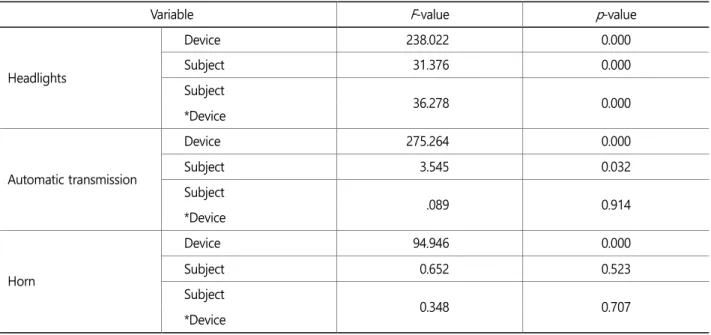
Table 3 reveals the Two-Way ANOVA results on the impacts of interactions and independent effects of the experimental subjects (normal, left hemiplegic and right hemiplegic groups) and input devices (conventional and iPad-using smart input devices) on the operation time of the secondary devices. Looking at the effects of seven secondary input devices, the operation time significantly diminished in terms of statistics in the secondary controls using iPad, compared with the conventional secondary controls in all the devices: warning system, turn signal, window, windshield wiper, highlight, auto transmission and horn ( p <0.01).

Looking at the effects by the three experimental groups, the operation time of the secondary driving controls using iPad significantly decreased in terms of statistics, compared with the conventional secondary driving controls in the turn signals, windows, windshield wipers, headlights and auto transmission ( p <0.05). The secondary driving controls significantly affected by interactions of the experimental subjects and secondary input devices were warning system, turn signals, windows, windshield windows and headlights ( p <0.01).

Table 3. Results of Two-way ANOVA

Variable F -value p -value

Hazard warning

Device 436.875 0.000

Subject 2.702 0.069

Subject

11.706 0.000

*Device

Turn signal

Device 183.552 0.000

Subject 14.597 0.000

Subject

18.396 0.000

*Device

Window

Device 154.508 0.000

Subject 11.477 0.000

Subject

16.514 0.000

*Device

Windshield wiper

Device 348.402 0.000

Subject 16.454 0.000

Subject

15.549 0.000

*Device

(10)

Looking at the operation time of the seven secondary controls in the stationary condition, more than two seconds were required, irrelevant of subjects, when the conventional devices were used (Figure 7). However, when an iPad-using smart device was used, it was less than two seconds on average, irrelevant of subjects. The iPad-using smart devices showed statistically significant differences, compared to the conventional devices, as a result of Two-Way ANOVA ( p <0.01).

As a result of Tukey's post-hoc test on the three experimental groups, statistically significant differences were shown between the left hemiplegic group and normal group, and between the left and right hemiplegic groups in turn signals (Figure 7(b)), windows (Figure 7(c)) and headlights (Figure 7(e)), which are located on the left side ( p <0.01). For windshield wipers (Figure 7(d)) and auto transmission (Figure 7(f)) located on the right side, statistically significant differences were revealed between the right hemiplegic group and normal group and between the right hemiplegic group and left hemiplegic group ( p <0.05).

Table 3. Results of Two-way ANOVA (Continued)

Variable F -value p -value

Headlights

Device 238.022 0.000

Subject 31.376 0.000

Subject

36.278 0.000

*Device

Automatic transmission

Device 275.264 0.000

Subject 3.545 0.032

Subject

.089 0.914

*Device

Horn

Device 94.946 0.000

Subject 0.652 0.523

Subject

0.348 0.707

*Device

(11)
(12)

3.2 Statistical analysis between subjects and secondary devices with two-way ANOVA during diving condition

Table 4 shows the two-way ANOVA results on the impacts of interactions and independent effects of the experimental subjects (normal group, left hemiplegic group, right hemiplegic group) and input devices (conventional vehicle input devices, iPad-using smart input devices) on the operation time of secondary driving controls. Looking at the effects of six secondary controls, the iPad-using smart devices showed statistically significant reduction of operation time, compared with the conventional vehicle secondary controls in all the hazard, such as warning, turn signals, windows, windshield wipers, headlights and horn ( p <0.01).

Looking at the experimental subjects in the three groups, the iPad-using secondary driving controls showed statistically significant reduction of operation time, compared with conventional vehicle secondary controls in terms of turn signals, windows, windshield wipers and headlights ( p <0.01).

The secondary driving controls affected by the interactions of the experimental subjects and the secondary input devices were turn signals, windows, windshield wipers and headlights ( p <0.01).

Table 4. Results of Two-way ANOVA

Variable F -value p -value

Hazard warning

Device 389.562 0.000

Subject 0.792 0.454

Device

0.815 0.444

*Subject

Turn signal

Device 235.259 0.000

Subject 8.977 0.000

Device

11.090 0.000

*Subject

Window

Device 294.228 0.000

Subject 9.888 0.000

Device

9.327 0.000

*Subject

Windshield wiper

Device 235.559 0.000

Subject 12.374 0.000

Device

8.699 0.000

*Subject

Headlights

Device 215.160 0.000

Subject 15.497 0.000

Device

16.870 0.000

*Subject

(13)

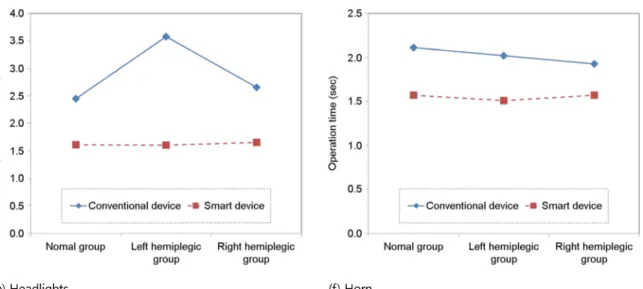
Looking at the operation time of six secondary devices in the simulator in the driving condition, more than 2 seconds on average were required, irrelevant of the subjects, when conventional devices were used (Figure 8). However, the operation time showed less than 2 seconds on average in all devices, irrelevant of the subjects, when iPad-using smart devices were used. As a result of two-way ANOVA, statistically significant differences were revealed in iPad-using secondary devices, compared with the conventional secondary devices ( p <0.01).

Table 4. Results of Two-way ANOVA (Continued)

Variable F -value p -value

Horn

Device 42.740 0.000

Subject 0.641 0.529

Device

0.672 0.513

*Subject

(14)

As a result of Tukey's post-hoc test on the experimental subjects in the three groups in the driving condition, statistically significant differences were revealed between the left hemiplegic group and normal group and between the left and right hemiplegic groups in the cases of turn signals (Figure 8(b)), windows (Figure 8(c)) and headlights located on the right side (Figure 8(e)) ( p <0.01). In the case of windshield wipers located on the right side (Figure 8(d)), statistically significant differences were revealed between the right hemiplegic group and normal group and between the right and left hemiplegic groups ( p <0.05).

3.3 Analysis of driving performance in different groups

Figure 9 shows on-road driving score, according to the experimental subjects and secondary input devices in the simulator. In the normal group, the on-road test score was 52.7 points on average in the case of using conventional secondary devices. The on-road test score, when iPad-using devices were applied, was 69.4 points on average, which increased 31.7%, compared with the conventional secondary devices. In the left hemiplegic group, the on-road test score was 54.0 points on average, when conventional vehicle secondary devices were used. The on-road test score, when the iPad-using smart devices were applied, was 69.0 points on average, which rose 27.8%. In the right hemiplegic group, the on-road test score was 47.8 points on average, when the conventional secondary controls were used. The on-road test score was 66.4 points, which increased 38.9%, when the smart devices were applied.

4. Conclusion

First, when iPad-using smart devices were used in the driving simulator under the stationary condition, the operation time was less than 2 seconds on average, and statistically significant reduction was revealed, compared with the conventional devices with more than 3 seconds of operation time on average ( p <0.01). As a result of Tukey's post-hoc test results on the experimental subjects in the three groups, the operation time of the left hemiplegic disabled people's group revealed statistically significant increase, compared with the other subject groups, in the turn signals, windows and headlights located on the left side ( p <0.01).

Concerning windshield wipers and auto transmission located on the right side, the operation time of right hemiplegic group

showed statistically significant increase, compared with the other groups ( p <0.01).

(15)

Second, the operation time was less than 2 seconds on average, when the iPad-using smart device was used in the driving stimulator in the driving condition, and statistically significant reduction was revealed, compared with the conventional devices, which showed more than 3 seconds on average ( p <0.01). As a result of Tukey's post-hoc test on the experimental subjects in the three groups, the operation time of the left hemiplegic group revealed statistically significant increase, compared with the other subject groups in driving condition in the cases of turn signals, windows and headlights located on the left side ( p <0.01).

Regarding the windshield wipers located on the right side, the operation time of the right hemiplegic group showed statistically significant increase, compared with the other subject groups ( p <0.05).

Third, as a result of on-road driving test, the driving score increased by 31.7%, 27.8% and 38.9% in the normal group, left hemiplegic group and right hemiplegic group, respectively, when the smart device was used, respectively, compared with the conventional vehicle's secondary devices.

Acknowledgements

This research was supported by R&D grant on rehabilitation by Korea National Rehabilitation Research Institute, Ministry of Health & Welfare.

References

Babara, L. and Mazer, B.L., Predicting ability to drive after stroke, Archives of Physical Medicine and Rehabilitation , 79, 743-750, 1998.

Baber, C., Beyond the Desktop: Designing and Using Interaction Devices, Academic Press , USA, 1996.

(16)

Baumann, M., Keinath, A., Ktems, J.F. and Bengler, K., Evaluating of in-vehicle HMI using occlusion techniques: experimental results and practical implications, Applied Ergonomics , 35, 197-205, 2004.

Brookhuis, K.A., Vries, G.D. and Waard, D.D., The effects of mobile telephoning on driving performance, Accident Analysis and Prevention , 23(4), 309-316, 1991.

Dingus, T.A., Antin, J.F., Hulse, M.C. and Wierwille, W.W., Human factors issues associated with in-car navigation system usage, Proceedings of the Human Factors Society , 1448-1452, 1988.

Jung, W. and Kim, Y., Development of smart driving system using iPod and its performance evaluation for people with severe physical disabilities in the driving simulator, Journal of the Ergonomics Society of Korea , 31(5), 637-646, 2012.

Klauer, S.G., Dingus, T.A., Neale, V.L., Sudweeks, J.D. and Ramsey, D.J., The impact of driver inattention on near-crash/crash risk:

An analysis using the 100-car naturalistic driving study data, U. S. Department of Transportation , 2006.

Koo, T., Kim, B., Ji, S., Bae, C., Park, J. and Suh, M., A Study on workload of using telematics while driving, Transactions of KSAE , 17(2), 26-33, 2009.

Kun, A.L., Paek, Tim, Medenica, Z., Memarovic, N. and Palinko, O., Glancing at personal navigation devices can affect driving:

experimental results and design implications, Proceedings of the First International Conference on Automotive user Interfaces and Interactive Vehicular Applications , 129-136, 2009.

Lim, H.U., Jung, E.S., Park, S. and Jeong, S.W., Comparisons of driver performance with control types of the driver information system, Journal of the Ergonomics Society of Korea , 26(1), 1-10, 2007.

Mazer, B.L., Korner-Bitensky, N.A. and Sofer, S., Predicting ability to drive after stroke, Archives of Physical Medicine and Rehabilitation , 79(7), 743-750, 1998.

Mcknight, A.J. and Adams, B., Driver education task analysis: Vol. 1. Task description, U. S. Department of Transportation , 1970.

Merat, N., Anttila, V. and Luoma, J., Comparing the driving performance of average and older drivers: the effect of surrogate in- vehicle information systems, Transportation Research Part F: Traffic Psychology and Behaviour , 8(2), 147-166, 2005.

National Human Rights Commission of Korea , Driver license system meeting, 2002.

Park, S-S., Hu., H. and Lee, W-S., A study on physical signal changes due to distraction in simulated driving, Journal of the Ergonomics Society of Korea , 29(1), 55-59, 2010.

Patten, C.J.D., Kircher, A., Ostlund, J. and Nilsson, L., Using mobile telephones: cognitive workload and attention resource allocation, Accident Analysis and Prevention, 36, 341-350, 2004.

Road Traffic Authority , driver's License Examination Office, http://www.dla.go.kr.

Rockwell, T.H., Spare visual capacity in driving-revisited: New empirical results for an old idea, Vision in Vehicle II, 317-324, Elsevier

Science , Netherlands, 1988.

(17)

Roush, L. and Koppa, R., A survey of activation importance of individual secondary controls in modified vehicles, Assistive Technology , 66-69, 1992.

Shinar, D., Tractinsky, N. and Compton, R., Effects of practice, age, and task demands, on interference from a phone task while driving, Accident Analysis and Prevention , 37, 315-326, 2005.

Summala, H., Accident risk and driver behavior, Safety Science , 22(1-3), 103-117, 1996.

Wester, A.E., Bocker, K.B.E., Volkerts, E.R., Verster, J.C. and Kenemans, J.L., Event-related potentials and secondary task performance during simulated driving, Accident Analysis and Prevention , 40(1), 1-7, 2008.

Author listings

Jeongheon Song: [email protected]

Highest degree: MS, Department of Rehabilitation Science and Technology, Daegu University Position title: PhD Candidate, Department of Rehabilitation Science and Technology, Daegu University Areas of interest: Driver Rehabilitation, Rehabilitation Engineering

Yongchul Kim: [email protected]

Highest degree: PhD, Department of Mechanical Engineering, POSTECH

Position title: Associate Professor, Department of Rehabilitation Science & Technology, Daegu University

Areas of interest: Biomechanics, Rehabilitation Engineering

수치

Table 1. Characteristics of subjects
Table 2. Visual-perception evaluation results of disabled group
Table 3 reveals the Two-Way ANOVA results on the impacts of interactions and independent effects of the experimental subjects  (normal, left hemiplegic and right hemiplegic groups) and input devices (conventional and iPad-using smart input devices) on the
Table 3. Results of Two-way ANOVA (Continued)
+4

참조

관련 문서

The reason why the Ni-HM secondary battery is not widely used is not necessarily the development technology of the negative electrode material but problem

SEM photographing of smart paints made with curing process using temperature and time parameters (10000X).. The resistance history by curing time and

especially to people who teach the biology in middle school at the moment and freshman of high school students, how do they recognition about

Experimental alveolar ridge augmentation by distraction osteogenesis using a simple device that permits secondary implant placement. Anteroinferior distraction of

Second, the analysis of differences by affiliation showed that the controlled coaching actions were perceived higher in order of the general, secondary, and

Data were analyzed using independent-sample t tests for checking the equivalency between the experimental and control groups at pretest and three-way analysis

– General controls with Special controls AND Premarket Approval (PMA) – PMA approval requires the safety and effectiveness of the

The result of using PLGA nanofiber membrane with bone graft material showed that the PLGA nanofiber membrane in the experimental group of 2 weeks were ten times more new