A Study on a Hybrid Energy System to Reduce CO
2Emission In Mavuva Island, Fiji
Tae Yong Jung†· Jung Hee Hyun · Seul Lee · Minkyung Huh
Graduate School of International Studies, Yonsei University
마부바섬의 이산화탄소 감축을 위한 복합 에너지 시스템에 대한 연구
정태용†·현정희·이 슬·허민경 연세대학교 국제학대학원
Abstract : Although the effects of climate change are universal, Small Island Developing States (SIDS) are considered to be most vulnerable. SIDS heavily rely on imported oil and fossil fuels for electricity generation and transportation, which makes them economically vulnerable and exposed to fluctuating oil price. Among the reasons SIDS highly depend on diesel fuel is due to the dispersed population living in remote islands which means, providing electricity through on on-grid system is difficult. Fiji as one of the SIDS, has actively promoted renewable sourced energy through a national plan to mitigate the impacts of climate change. In order to determine how feasible implementing a renewable energy (RE) system will be in Fiji, this study chose a remote island called Mavuva Island to test application of a hybrid RE system using HOMER. A combination of energy storage system (ESS), solar photovoltaic (PV) and diesel generator turns out to be the most cost effective and optimal configuration, resulting in effective greenhouse gas reduction for the given region.
Keywords : Renewable Energy, Hybrid Energy System, Off-grid System, Climate Change Effects
요 약 : 오늘날 대부분의 국가는 기후변화 문제에 직면해 있으며, 특히 군소도서개발국들(SIDS: Small Island Developing States)은 기후변화의 영향에 가장 취약하다. 이들은 전력생산 및 교통부문에 있어 수 입된 석유와 화석 연료에 크게 의존하고 있으므로 유가 변동에 따라 경제적으로 매우 영향을 받는다. 군 소도서개발국들(SIDS)이 디젤 연료에 의존하는 이유 중 하나는 외딴 섬에 인구가 분산되어 있어서 계통
First and Corresponding author: Tae Yong Jung, Graduate School of International Studies, Yonsei University, 50 Yonsei-Ro, Seodaemun- gu, Seoul, Korea, Tel: +82-2-2123-3594, E-mail: [email protected]
Co-Authors: Jung Hee Hyun, Graduate School of International Studies, Yonsei University, 50 Yonsei-Ro, Seodaemun-gu, Seoul, Korea, Tel: +82-2-2123-3594, E-mail: [email protected]
Seul Lee, Graduate School of International Studies, Yonsei University, 50 Yonsei-Ro, Seodaemun-gu, Seoul, Korea, Tel: +82-2- 2123-3594, E-mail: [email protected]
Minkyung Huh, Graduate School of International Studies, Yonsei University, 50 Yonsei-Ro, Seodaemun-gu, Seoul, Korea, Tel: +82- 2-2123-3594, E-mail: [email protected]
Received: 31 May, 2017. Revised: 29 June, 2017. Accepted: 2 August, 2017.
https://doi.org/10.14249/eia.2017.26.4.217
Research Paper
I. Introduction
The unique situation of Small Island Developing States (SIDS) was acknowledged at the United Nations Conference on Environment and Development in Rio de Janeiro in 1992. Fiji is one of the most developed economies in the SIDS and classified as an upper middle-income country by the World Bank due to an abundance of for- est, mineral, and fish resources. Most of the Pacific Islands Countries including Fiji sources its electricity mostly from large grid connected power plants to power refrigeration, air condi- tioning, lighting, and household appliances (IRENA 2015). Despite the ambitious national tar- get of Fiji, which is to provide electricity with 100% renewable energy (RE) by 2030, the use of RE technologies for power production has been limited due to the high costs. The condition of dispersed population makes energy system rely on cheap small scale diesel power generators since RE systems have high up-front cost and grid-connection cannot reach remote villages (Dornan 2011).
The main objective of this study is to identify the most cost-effective energy system among vari- ous system configurations with solar energy sources. In order to find how feasible implement- ing a RE system is, a remote island in Fiji called Mavuva Island is selected and HOMER is used
to test application of a RE system with relevant economic parameters and reduction of green- house gas (GHG) emissions.
Mavuva Island is located in Macuata Province, a traditional community just off the northern coast of Vanua Levu, Fiji’s second main island.
The island has been promoting its development into a unique off grid island community focused on sustainable living since 2016. Mavuva Island has been designated as one of 43 islands, 8% of all land, in Fiji that is freehold and can be owned outright privately by individuals (all other land only available to lease). The residents will be required to follow the Communities Environmental Management Plan (CEMP) by the Fijian govern- ment such as using renewable energy generator power systems and appropriate sewage treatment for environmental responsibility (Mavuva Island 2017).
There are currently various renewable power systems operated in Fiji – hydropower, biomass, wind, PV, etc., to meet the national renewable energy targets. However, these power systems have unique challenges for wider general use based on the specificities of each. The most com- mon problem for remote regions comes from the lack of accessibility to grid connection and local capacity to operate and manage RE technologies including, equipment erosion, malfunction, and poor management.
연결을 통한 전력공급이 어렵기 때문이다. 군소도서개발국들 중 피지(Fiji)는 기후변화의 심각성을 인식하 고 기후 변화의 영향을 줄이기 위한 ‘국가계획’을 통해 신재생에너지 사용을 적극 장려하고 있다. 본 연구 에서는 피지의 마부바 섬(Mavuva Island)을 대상으로 HOMER 프로그램을 사용하여 태양광, 에너지저 장장치 및 디젤 발전의 조합을 통하여 최적의 에너지 시스템을 시뮬레이션하고 분석한다. 태양광과 디젤 발전을 합친 하이브리드 에너지시스템이 이 지역의 실행가능성 및 가격 측면에서 가장 효과적이고, 온실 가스 감축효과도 큰 것으로 파악되었다.
주요어 : 신재생에너지, 하이브리드 에너지 시스템, 비계통 연계시스템, 기후변화영향
Various researches have already been done on the application of hybrid RE systems in remote islands, specifically in the Pacific (Palit & Chaurey 2011; Ajal & Krishna 2013; Dornan & Jotzo 2011).
Lal (2012) conducted a study on a techno-eco- nomic analysis of a Wind-PV-Diesel hybrid mini- grid system for Fiji Islands, Nabouwalu. HOMER was used for optimal configuration, net present cost (NPC), and the levelized cost of energy (LCOE). The study results show that 100%
renewable energy system consisting of PV, wind turbines with battery storage is feasible with the flexibility of a 10% capacity shortage. Lal (2012) found that without allowing for 10% annual capacity shortage the optimal configuration is a hybrid system of PV-Diesel. Jung et al. (2017)’s study on the feasibility of a hybrid PV-Diesel-ESS system for Kumundhoo, Maldives. An economic analysis was examined with different discount rates, feed-in tariff (FIT) rates to calculate the ben- efit-cost ratio, NPC, and internal rate of return (IRR). The study outlined that the hybrid solar PV-Diesel-ESS system is economically efficient for the Maldivian government given that the benefit cost ratio increases along with NPC and IRR over the project lifetime. Their result proves the finan- cial feasibility of the hybrid renewable system given a 9% IRR in 20 years.
In this study, to verify the most cost-effective hybrid energy system for Mavuva island, eco- nomic analysis included sensitivity analysis of uncertainty in the financial discount rate and car- bon price, which accounts for the social price of CO2 emissions. In the following sections, HOMER’s analysis methods, Mavuva’s energy demand assumptions, power system costs will be explained and tested. A conclusion will be made based on the results of the analysis.
II. Methodology
To test the technical and economic feasibility of different configurations of power systems applica- ble to Mavuva Island, HOMER simulation pro- gram was used for analysis. Developed by the National Renewable Energy Laboratory, HOMER aims to identify an optimal energy system by simulating different configurations of renewable and non-renewable energy sources and technolo- gies and finding the optimal system based on cost efficiency. As the final step, sensitivity analy- sis helps assess the effects of uncertainty or changes in the variables by performing multiple optimizations (Sureshkumar et al. 2012).
1. Economic Analysis with HOMER
HOMER utilizes the total NPC to represent the life cycle cost of energy systems, which includes all costs that could occur during the project life- time, with future cash flows discounted to the present. Another important cost information of energy system is represented as LCOE, which is the average cost per kilowatt-hour of electrical energy produced by the system (HOMER® Pro 2016). Regarding how HOMER calculates the NPC and LCOE, the following equation should be noted:
CNPC= (1)
where Cann,tot is the total annualized cost, i is the annual real interest rate (the discount rate), Rprojis the project lifetime, and CRF(*) is the capital recovery factor, which accounts for the time fac- tor. HOMER uses the following equation to cal- culate the levelized cost of energy:
LCOE = (2) where Cann,totis the total annualized cost, Eprimand
Cann,tot
CRF(i, Rproj)
Cann,tot
Eprim+ Edef
Edefare the total amounts of primary and deferrable load.
2. Input Assumptions for HOMER
According to Mavuva Island’s developer, the Pacific Development Group, 86 lots have been designated for residential purposes around the oceanfront as shown in the plan below.
For the purposes of this study, only the resi- dential energy demand of Mavuva Island will be analyzed. Since the island is yet to be developed
and inhabited, the energy demand load was con- structed based on similar use patterns of previous studies (Lal 2012; Charan 2014; UNDP 2014).
Based on seasonal variation, two scenarios of daily load patterns were synthesized as shown below.
The main difference in use pattern between the seasons is the increased use of cooling and decreased use of lighting during the hotter season while decreased cooling during the cooler months. The use of various appliances and num- ber of hours was estimated based on similar use patterns of private resort residences. The table below shows the average energy demands of each household and all 75 households for each season.
Given the total daily demand, variation of demand throughout the day needs to be sketched. Based on literature review of how daily demand scenarios are plotted, an evening peak between 18:00 and 21:00 is used as shown with
Table 1. Household Energy Demand Assumptions by Season
1 Household Peak Season (January – March) Low Season (June –August)
Name # Energy
(W) Use
(hrs) Total Day
Use (Wh) Use
(hrs) Total Day Use (Wh)
Appliances
TV 1 150 2 300 2 300
Computer 1 100 2 200 2 200
Charging 2 25 6 300 6 300
Washing Machine 1 50 0.5 25 0.5 25
Vacuum 1 500 0.5 250 0.5 250
Kitchen Appliances
Refrigerator 1 55 24 1320 24 1320
Microwave 1 1100 0.25 275 0.25 275
Oven 1 1200 0.25 300 0.25 300
Stovetop 1 730 2.5 1825 2.5 1825
Cooling Fan 2 25 9 450 4 200
AC 1 1500 2.5 3750 1 1500
Lighting Overhead CFL 12 15 3 540 3 540
Stand 2 12 0.5 12 1 12
Total 9547 Watts/day 7059 Watts/day
Source: Based on Author’s Calculation Figure 1. Mavuva Island Lot Plan
Source: Project Development Group (http://www.mavuvaisland.
com/index.php)
Pattern 1 in the figure below (Lal 2012; Charan 2014).
Another load pattern was found from a United Nations Development Programme report (UNDP 2014) on rural electrification and simulates a load pattern with a double peak ? one in the morning between 6 a.m. and 8 a.m. and second between 6 p.m. to 8 p.m. as shown in Figure 2 as Pattern 2.
3. System Assumptions
1) Economic Inputs (Sensitivity variables) To determine the feasibility of energy system configurations, the NPC of the system was dis- counted by 6%, 8% and 10% which accounts for the length of the project (20 years), country and system risk. Discount rates were selected as sensi- tivity variables based on previous feasibility stud- ies of RE systems in remote islands (Dornan 2011;
Charan 2014; Jung et al. 2017).
To account for the social cost of GHG emis-
sions, a price for carbon was inputted. Since the price of carbon has not yet to be stabilized and universally used and accepted via market pricing, three projected prices $5, $10, $15 per ton of car- bon were selected for analysis. In previous stud- ies examining the effect of carbon price (Adkins et al. 2011; EIA 2009) an economy-wide price of
$15/ton for the first half of the next decade was used. Additionally price projections ($15, $20, $25) by the Synapse Energy Economics, a research and consulting firm specializing in energy, economic, and environmental topics, was also noted.
(Luckow et al. 2015). For reference, the price of carbon (EU) as of July 7th, 2017 is $5.24/ton (Markets Insider 2017).
Lastly, the cost for diesel used for electric gen- eration was selected as a sensitivity variable con- sidering how the volatility of diesel price greatly affects the greater economy of Fiji. Thus for the purposes of this study the lowest, average and highest price per liter in the past twenty years recorded by German Agency for International Cooperation (GIZ) - $0.37, $0.83, $1.29, were used.
For reference, the average price of diesel in 2016- 2017 has been $0.75/L (Global Petroleum Price 2017). System technology specifications are explained by each component used for HOMER simulation as shown in Figure 3.
Figure 2. Daily load patterns of Fiji’s Remote Island (Pattern1) &
load pattern of developing countries (Pattern2) Source: Based on Author’s Calculation
Figure 3. Schematic Diagram of HOMER system inputs Source: HOMER Pro (version 3.7)
Table 2. Mavuva Island Households Energy
Peak Season Low Season
use/hour1 H.
(Wh) 75 H.
(kW)
H./hour75 (kWh)
use/hour1 H.
(Wh) 75 H.
(kW)
H./hour75 (kWh)
397 716 29 294 529 22
Source: Based on Author’s Calculation
2) Diesel Generator
For this simulation, an auto-size diesel fueled generator designed by HOMER was deployed.
The benefit of this model is that the generator automatically sizes itself to the meet the load, particularly useful to model due to ranging renewable energy potential.
3) PV System
HOMER models the PV array as a producer of DC electricity in direct proportion to the global solar radiation, independent of the exposed tem- perature and the voltage. Power output capacity of PV is calculated based on the following vari- ables: rated capacity (peak capacity), area and efficiency of PV module, and derating factor. For each hour of the year, HOMER calculates solar radiation using the region’s solar radiation data downloaded from NASA. In simulation, HOMER’s generic flat plate PV was deployed.
4) Batteries – lead acid, lithium
In an effort to seek alternative energy systems reflecting new technologies, a lithium ion battery produced by PNE Solutions was used for simula- tion. The lithium battery has a higher level of technical capacity than advanced lead acid batter- ies with extensive flexibility to adapt to load change.
5) Converter
A converter is a device that converts electric power from DC to AC in a process called inver- sion, and/or from AC to DC in a process called rectification. The converter size refers to the inverter capacity, meaning the maximum amount of AC power that the device can produce by inverting DC power. HOMER assumes that the inverter and rectifier capacities are not surge
capacities but rather, continuous capacities that the device can withstand for as long as necessary.
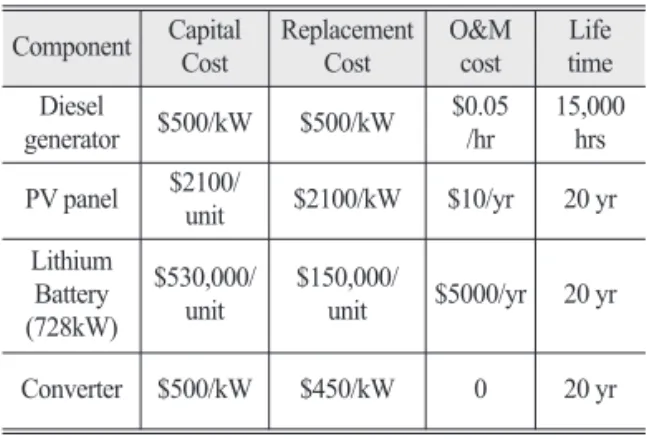
The above table summarizes the systems costs used from Jung et al. (2017)’s study and inputted in HOMER for the present study. Based on these inputs and selected sensitivity variables, including diesel and carbon price and discount rate, the results of the simulations are explained in the fol- lowing section.
III. Results
Simulation results of the two load patterns did not show much of a difference in LCOE, NPC, and renewable fraction. Thus for the purposes of this study load pattern 2 will solely be used as it most closely reflects the assumed use pattern of Mavuva Island as well as the specific condition of Fiji’s location (Lal 2012).
Among 8,298 simulations, 6,732 were feasible cases, 1,566 were infeasible due to the capacity shortage and 3 sensitivity variables in simulating load pattern 2. Electric production is stable for RE sourced power systems just as much as diesel sourced power systems simulation. Further analy- sis will focus on the economics of the system types.
Table 3. Summary of System Costs Component Capital Cost Replacement
Cost O&M cost Life
time Diesel
generator $500/kW $500/kW $0.05
/hr 15,000 hrs PV panel $2100/
unit $2100/kW $10/yr 20 yr Lithium
Battery (728kW)
$530,000/
unit $150,000/
unit $5000/yr 20 yr
Converter $500/kW $450/kW 0 20 yr
Source: Jung et al. (2017)
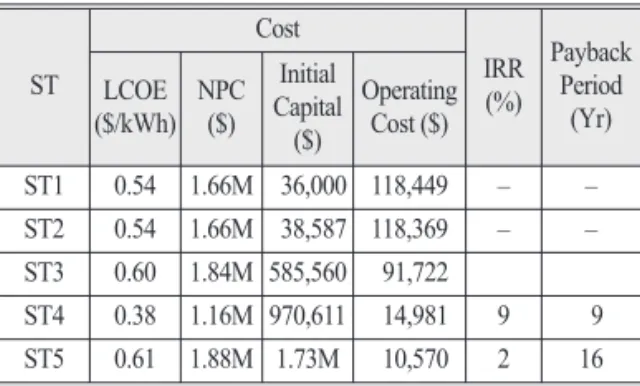
Among the five technically feasible system types resulting from HOMER’s simulation, ST1 consists of a diesel generator only. In this system, the LCOE is $0.54 and the NPC is $1.66 million.
Since there is no renewable power source used in this case, the renewable fraction, which is the portion of a system’s total electrical production originated from renewable power sources, is 0%.
ST2 uses both diesel generator and solar PV to generate electricity. This type has a LCOE of
$0.54 and NPC of $1.66 million. Since PV gener- ates only 1.2 (kW), the renewable fraction is 0%
and the economics is not much different form ST1. ST3 implements a diesel generator and ESS.
It shows a high LCOE of $0.60 and NPC of $1.84 million, compared to other system types due to the high investment cost of the ESS.
ST4 uses all three components evaluated in our study: diesel-generator, solar PV, and ESS. It is considered the most optimal case given that it has the lowest LCOE of $0.38 and NPC of $1.16 million compared to other systems and the high- est renewable fraction of 92.4%. The last system type consists of PV and ESS only. Despite the high initial cost of ST4, the reason its NPC is lower than ST1 and ST2 (which have lower initial costs) is because ST4 avoids the reoccurring cost of replacing diesel generators. Additionally, ST4 included environmental benefits evident in the
high renewable fraction. Lastly, ST5 has the high- est LCOE of $0.61 and NPC of $1.88 million because it is solely sourced by PV and ESS with 100% of RE fraction. However the system’s bene- fits include low yearly operating costs and zero GHG emissions.
1. Economic Analysis
Based on the results calculated by HOMER, between the hybrid RE-diesel system (ST4) and the most traditional option of diesel-only genera- tion (ST1), ST4 is the most economically feasible for off-grid electrification in Mavuva Island given an IRR of 9% and the relatively short payback period of less than 9 years. Table 7 summarizes the economic analysis results.
2. CO2emissions
Figure 4, shown below, is a summary of how much each system emits CO2 per year. ST1 and ST2 emit CO2the most, 209 tons per year, among other types since it is fueled mostly by diesel fuel. ST3, composed of a diesel generator and ESS system emits approximately 6 tons of CO2 per year less than ST1 and ST2. This shows the effect of storing excess energy during off-use times and making use of the energy during peak hours without needing to increase the overall capacity of the generator. ST4, which is a hybrid PV-ESS- Table 4. Economic results of each power system type
ST
Cost
IRR (%) Payback
Period LCOE (Yr)
($/kWh) NPC ($)
Initial Capital ($)
Operating Cost ($)
ST1 0.54 1.66M 36,000 118,449 – –
ST2 0.54 1.66M 38,587 118,369 – –
ST3 0.60 1.84M 585,560 91,722
ST4 0.38 1.16M 970,611 14,981 9 9
ST5 0.61 1.88M 1.73M 10,570 2 16
Figure 4. CO2Emissions by System Type
Diesel system, emits less CO2 compared to the previous system types, which were heavily sourced by diesel-fuel. In ST5 no diesel-fuel were used without CO2emissions.
3. Sensitivity Analysis
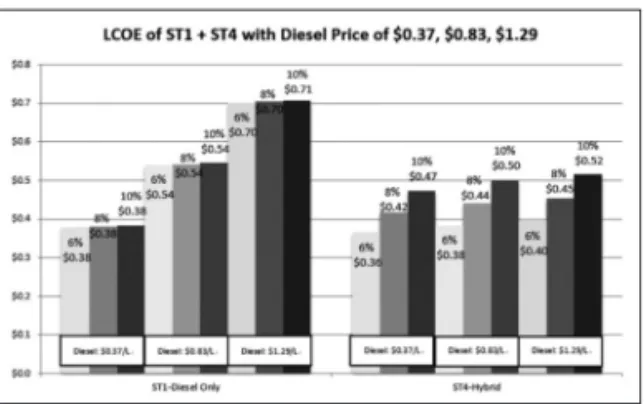
HOMER carried out sensitivity analysis with selected variables including the discount rate (6%, 8% and 10%), carbon price ($5, $10 and $15), and diesel price ($0.37, $0.83, $1.29). Figure 5 and 6 show the results of sensitivity analysis of the LCOE for System Type 1 (Diesel-only) and System type 4 (PV-Diesel-ESS).
As mentioned in the earlier section the cost and benefit of CO2emissions could be converted into monetary value to be accounted into the eco- nomic analysis of energy systems. For our research, a carbon price ($/ton) was included in calculating the LCOE and NPV as additional
O&M (operation and management) costs in HOMER. Figure 5 and 6 show that ST1 is less affected by the carbon penalty and discount rate while heavily affected by fluctuating diesel prices.
ST4’s LCOE varies only with discount rate changes.
Because the variation in carbon price was not as dramatic as for the diesel fuel prices, it did not affect the overall LCOE of ST1 as much. This result confirmed the issue of economic instability in using energy sourced from diesel fuel. In the case of ST4, due to the high initial investment cost, the financial burden of repayment across the project lifetime is sensitive to the discount rate, which is an indicator of the time factor in mone- tary value.
Since discount rate has an impact on ST4 as a financial variable for its high initial capital invest- ment, implementing RE system stresses the importance of financial analysis. This study con- firms that mitigating such financial risk is required to make more efficient and widespread use of RE systems.
IV. Conclusion
Renewable energy-based, off-grid power sys- tems could play a vital role in bringing sustain- able energy system to rural communities in the Pacific Islands. In this study, an economic analy- sis on decentralized hybrid energy systems in Mavuva Island was conducted with HOMER.
The results from simulation and sensitivity analy- sis showed that a Hybrid PV-ESS-Diesel system is a good alternative for off-grid electrification for the chosen location due to the potential fluctua- tions in oil price and environmental considera- tions.
Figure 5. Sensitivity Analysis of LCOE using Carbon Price and Discount Rate Differentials
Figure 6. Sensitivity Analysis of LCOE using Diesel-fuel Price and Discount Rate Differentials
This study specifically compared the current most used energy system, the diesel-based system type 1 and the most optimal energy system, the hybrid system type 4 to stress the different eco- nomic and environmental effects. The hybrid PV- Diesel-ESS system is less expensive than the diesel powered system and technically stable with the PV system at a sufficient level and the ESS having enough capacity to handle common vari- ations of insolation and usage. Finally, the sensi- tivity result of this study concludes that for a suc- cessful application of hybrid Diesel-PV-ESS, finan- cial feasibility must be secured due to uncertain future economic conditions, which is the cost of deploying an environmentally friendly energy system than the diesel-only energy type. However with higher and/or stable penalty of carbon price RE systems may have a greater benefit than the analysis done with the economic landscape of this research.
The unstable energy system with RE option only could be supplemented by ESS option.
However, the current capital cost of ESS could be burdensome to local people to set up off-grid energy system without proactive and supportive policies from the public sector. For example, financial support and tax incentives for the local people who install the RE energy system with ESS could be carefully developed by comparing the conventional fossil-fuel based system.
To further encourage renewable energy sourced power systems systematically, additional supple- mentary tariffs are suggested for scaled up, grid- connected RE systems. Such special tariffs, as suggested by Nand (2013) will be based on the benefit added by PVs to the Fiji Electricity Authority (FEA)’s grid during peak demand of electricity or line support during periods of low
rainfall or critical dam levels in dry seasons.
Further, FEA could also charge Independent Power Producers (IPP’s) to interface to their network.
As further measures to induce full penetration of renewable energy systems, the case of Mavuva Island of this study is an example of a bottom up approach to solving the issues of sourcing energy, especially renewable sourced, to remote islands that are most vulnerable to effects of climate change. With more cases of RE deployment as suggested for Mavuva Island, the collective actions of independent initiatives will scale up to become a mobilized global movement towards energy for all and tackling climate change.
References
Adkins L, Garbaccio R, Ho M, Moore E, Morgenstern R. 2012. Carbon Pricing with Output-Based Subsidies: Impacts on U.S.
Industries over Multiple Time frames.
National Center for Environmental Economics.
Ajal K, Krishna N. 2013. Wind Power Potential at Benau, Savusavu, Vanua Levu, Fiji.
International Journal of Energy, Information and Communications. 4(1): 51-62.
Charan V. 2014. Feasibility Analysis Design of a PV Grid Connected System for a Rural Electrification in Ba, Fiji. International Conference on Renewable Energy Research and Applications; 2014 Oct 19-22;
Milwaukee (USA).
Dornan M, Jotzo F. 2011. Electricity generation in Fiji: Assessing the Impact of Renewable Technologies on Costs and Financial Risk.
Australian Agricultural and Resource
Economics Society 55th Annual National Conference; 2011 Feb 8-11; Melbourne (Australia).
Dornan M. 2011. Solar-based Rural Electrification Policy Design: The Renewable Energy Service Company (RESCO) Model in Fiji.
Renewable Energy Journal 36: 797-803.
Diesel Price [Internet]. 2017. The German Agency for International Cooperation. [Cited 2017 July 07]. Available at: https://www.giz.
de/expertise/html/4317.html
EIA. 2009. Energy Market and Economic Impacts of H.R. 2454, the American Clean Energy and Security Act of 2009. SR-OIAF/2005- 05. Washington, DC: EIA.
Global Petroleum Prices. [Cited 2017 May 14].
Available at: http://www.globalpetrolprices.
com/Fiji/diesel_prices/
HOMER® Pro Version 3.7. Manual. 2016.
HOMER® Energy.
Jung TY, Kim YT, Hyun JH. 2017. An Economic Analysis of a Hybrid Solar PV-Diesel-ESS System for Kumundhoo, Maldives. Korea and the World Economy. 18(S1): 109-134.
Lal S, Raturi A. 2012. Techno-economic Analysis of a Hybrid Mini-grid System for Fiji Islands. International Journal of Energy and Environmental Engineering. 3(10): 1-10.
Lambert T, Gilman P, Lilienthal P. 2006.
Micropower system modeling with HOMER.
Integration of alternative sources of energy.
1(15): 379-418.
Luckow P, Stanton E, Fields S, Biewald B, Jackson S, Fisher J, Wilson R. 2015. 2015 Carbon Dioxide Price Forecast. Synapse Energy Economics, Inc. [Cited 2017 May 15].
Available at http://www.synapse-energy.com/
sites/default/files/2015%20Carbon%20Diox ide%20Price%20Report.pdf
Mavuva Island: Great Sea Reef Fiji [Internet].
[Cited 2017 May 01]. Available at: http://
www.mavuvaisland.com/vanua-levu.php.
Markets Insider [Internet]. CO2European Emissions Allowances. [Cited 2017 July 07]. Available at http://markets.businessinsider.com/
commodities/co2-emissionsrechte
Nand R, Raturi A. 2013. Feasibility Study of a Grid Connected Photovoltaic System for the Central Region of Fiji. Applied Solar Energy. 49(2): 110-115.
Palit D, Chaurey A. 2011. Off-grid Rural Electrification Experiences from South Asia: Status and Best Practices. Energy for Sustainable Development. 15: 266-276.
Sureshkumar U, Manoharan PS, Ramalakshmi APS. 2012. Economic Cost Analysis of Hybrid Renewable Energy System using HOMER. ICAESM. 2012 Mar 30-31.
Tamil Nadu (India).
UNDP. 2014. Integrated Sustainable Rural Development: Renewable Energy Electrification and Rural Productivity Zones.
New York: United Nations Development Programme.