• 검색 결과가 없습니다.

Factors Affecting Quality of Internal Control: A Case Study of Listed Banks in Vietnam

N/A
N/A
Protected

Academic year: 2021

Share "Factors Affecting Quality of Internal Control: A Case Study of Listed Banks in Vietnam"

Copied!
6
0
0

로드 중.... (전체 텍스트 보기)

전체 글

(1)

Print ISSN: 2288-4637 / Online ISSN 2288-4645 doi:10.13106/jafeb.2021.vol8.no5.0375

Factors Affecting Quality of Internal Control:

A Case Study of Listed Banks in Vietnam

Quoc Thinh TRAN

1

, Khanh Tuan NGUYEN

2

, Xuan Thuy LE

3

Received: January 15, 2021 Revised: March 21, 2021 Accepted: April 01, 2021

Abstract

Internal control is important for monitoring operations of organizations. In order to achieve the quality of internal control, organizations need to recognize different perspectives in which the components of internal control play a decisive role. Internal control is a process designed by the manager and it is applied within the organization to provide reasonable assurance of the reliability of financial information and to comply with policies, procedures, rules, regulations and laws. The article uses the ordinary least squares method and the seven-point Likert scale to test the variables affecting the quality of internal control in 18 Vietnamese listed banks. The article surveyed 179 leaders of listed banks. The results show that there are three variables out of a total of five variables that positively affect the quality of internal control, including the control environment, control activities, and monitoring. Accordingly, the managers of Vietnamese listed banks need to pay attention to building a corporate culture environment, improve the quality of control activities, and periodically and regularly conduct the monitoring. It contributes to improving the quality of internal control and is also an opportunity to increase economic benefits for Vietnamese listed banks in the context of international economic integration.

Keywords: Control Activities, Communication, Information, Quality, Monitoring, Risk Assessment JEL Classification Code: G28, G32, M41, M42

in evaluating quality is to consider the expected outcome in the plan with the actual performance across the activity. The quality of internal control (QIC) is goal fulfillment activities (Gamage et al., 2014). Reviewing the QIC has always been a challenge for businesses to ensure the achievement of the goals set out by the organization.

In the process of finalizing internal control regulations, Vietnam has issued a number of laws and guidelines to enforce internal control for enterprises in general and for banks in particular. Vietnamese accounting law stipulates internal control to ensure risk prevention, detection and timely handling and meeting set requirements (Vietnamese national assembly, 2015). The Central Bank of Vietnam also requires internal control to inspect and supervise risks, to ensure the operation of commercial banks, foreign bank branches achieve the goals (Central Bank of Vietnam, 2018).

However, the current status of compliance with regulations has not been guaranteed in the implementation process of some Vietnamese commercial banks, so QIC in some Vietnamese banks has not met the requirements (Tran et al., 2020). Therefore, QIC of Vietnamese listed banks (VLBs) always raises many problems to solve appropriately.

1

First Author and Corresponding Author. Associate Professor, Faculty of Accounting and Auditing, Industrial University of Ho Chi Minh City, Ho Chi Minh City, Vietnam [Postal address: 86 Nguyen Hong Street, Ward 1, Go Vap District, Ho Chi Minh City, 70000, Vietnam]

Email: [email protected]

2

Department of General Office, Banking University of Ho Chi Minh city, Vietnam. Email: [email protected]

3
Deputy Director, HDBank, Vietnam. Email: [email protected]

© Copyright: The Author(s)

This is an Open Access article distributed under the terms of the Creative Commons Attribution Non-Commercial License (https://creativecommons.org/licenses/by-nc/4.0/) which permits unrestricted non-commercial use, distribution, and reproduction in any medium, provided the original work is properly cited.

1. Introduction

Internal control is a process designed by the manager and it is applied within the organization to provide reasonable assurance of the reliability of financial information;

complying with policies, procedures, rules, regulations

and laws (Basel, 1998). Internal control ensures property

protection; realizes the mission, objectives and results of the

entity’s activities or programs; and guarantees integrity and

ethical values (Sultana & Haque, 2011). An important issue

(2)

2. Literature Review

Internal control encompasses many different concepts.

Internal control is the process performed by the board, the executive board and all employees. It is not just a procedure or a policy to be implemented, but it continues at all levels of management. The board establishes a cultural environment to facilitate the internal control process to be effective and that monitoring of that quality is carried out continuously (Basel, 1998). Internal control is a process governed by managers and employees designed to provide reasonable assurance to achieve the organization’s goals (Coso, 2013).

The Vietnamese accounting law stipulates that internal control is the establishment and implementation within an accounting unit that the internal mechanisms, policies, processes and regulations are consistent with the provisions of the law in order to ensure that ensure risk prevention, timely detection and treatment and meet the set requirements (Vietnamese national assembly, 2015). Internal control is the inspection and supervision of individuals and divisions in the implementation of mechanisms, policies, internal regulations, professional ethics standards, control culture to control conflicts of interest, controlling risks, ensuring the operation of commercial banks, foreign bank branches to achieve the set objectives while complying with the provisions of the law (Central bank of Vietnam, 2018).

QIC is determined to evaluate the level of implementation of predetermined goals and objectives for an activity or program that has been implemented (Shaman & Senan, 2019). QIC is the process by which the board and managers reasonably ensure that the three criteria of understanding the organization’s objectives are achieved to a certain extent;

financial reporting is being established and displayed reliably; and laws and regulations are strictly followed (Coso, 2013). Components of internal control include control environment, risk assessment, control activities, information

& communication, and monitoring (Basel, 1998; Coso, 2013).

The regulatory theory specifies problems in order to satisfy society’s need to correct the injustice or inefficiency of market prices to protect the common interests of society, a determination needs to be established; social interest groups often require the establishment of rules aimed at maximizing the interests of group members; responsible people in routine organizations behave on their own personal interests (Godfrey et al., 2010). Institutional theory shows that an organization will suffer technical problems related to how it handles everyday operations in order to make it highly effective and the institutional problems associated with it.

to expectations and values from the external environment rather than the unit itself (Fixsen et al., 2015).

Research on internal control and QIC is of interest to a number of authors. Phornlaphatrachakorn and Kalasindhu (2020) studied QIC and the business survival of Thai food

businesses. Hardiningsih et al. (2020) considered internal control influence the accountability of regional government organizations in Indonesia. However, research focusing on banks is limited and mainly focuses on qualitative research by descriptive statistical methods. Amudo and Inanga (2009) conducted an internal control evaluation study from Uganda in 2009. The results of the study showed that the factors that influence QIC including control activities, risk assessment, information & communication, monitoring, and information technology. Sultana and Haque (2011) checked an internal control of six private banks listed of Bangladesh in 2011 through data collection through questionnaires. The results indicate that no association is found in the system as well as the degree of influence of each component of internal control on QIC including control environment, risk assessment, information & communication, control activities, and monitoring. Gamage et al. (2014) studied QIC in 64 branches of two state-owned commercial banks of Sri Lanka in 2014. The results of the study showed that there is a positive impact of independent variables including the control environment, risk assessment, information &

communication, control activities, and supervision to QIC.

Shaman and Senan (2019) studied QIC in Saudi banks. The research results showed that the internal control system needed some improvements in the control environment, risk assessment, and information & communication.

Research on internal control of enterprises and banks in Vietnam is limited. The study considers an internal control affects bank credit risk in Vietnam (Pham, 2020) or the study checks the influence of components of internal control on QIC of transport construction enterprises in Vietnam (Vu et al., 2020). Some studies have focused on the QIC of banks. Typically, Nguyen and Ha (2010) studied groups of factors affecting QIC of commercial banks in 2010. The article used quantitative methods to test the factors of the model. The results showed that the factors that affect QIC include the management environment; risk assessment;

control activities; information & communication; monitoring and error correction. Ho (2016) considered the factors affecting QIC of Vietnamese commercial banks in 2014.

The article used the ordinary least squares (OLS) to test the

model. The results showed that factors influencing efficiency

include the control environment; risk assessment; control

activities; information & communication; monitoring; poli-

tical institutions; group benefits. Tran et al. (2020) evaluated

QIC of credit institutions in 2020. The article used quali-

tative methods with descriptive statistics of 382 experts in

most credit institutions. The results showed that the credit

institutions have strictly complied with the regulations

on internal control. The managers have been aware of the

need for the internal control system. However, the level of

managers’ risk awareness is not high to predict fluctuations

and human resources are not professional.

(3)

3. Methodology

The article collected data in quarter 4, 2020, from questionnaires submitted to 200 leaders of 18 VLBs. Some 179 questionnaires were returned, a rate of 89.5%. The questionnaire is designed with 29 observed elements related to the variables of the research model.

OLS is used through SPSS 20.0 software to determine and measure the impact of variables on QIC of VLBs. The data is measured by a 7-point Likert scale – 1-Strongly disagree, 2-Disagree, 3-More or less disagree, 4-Undecided, 5-More or less agree, 6-Agree, 7-Strongly agree.

Based on the results of previous authors and combined with the opinions of the Central bank’s experts to match the characteristics of VLBs, the article proposes the following research model:

QUALITY = β

0

+ β

1

* OVERSIGHT + β

2

* RISK + β

3

* CONTROL + β

4

* INFORMATION + β

5

* MONITORING + ε

Where:

QUALITY : quality of internal control (QIC) OVERSIGHT : control environment

RISK : risk assessment CONTROL : control activities

INFORMATION : information & communication MONITORING : monitoring

4. Research Results

4.1. KMO and Bartlett’s Test

Kaiser (1974) suggested that the value of KMO is greater than 0.5 and the significance of Bartlett’s test is less than 0.05, so it will ensure statistical conditions.

According to Table 1, KMO test was 0.876 and Bartlett test is significantly less than 0.05, so it meant mutually all variables.

4.2. Rotated Component Matrix

Hair et al. (2006) considered that the loading factor of EFA with the minimum level must be greater than 0.3. If it is greater than 0.5, it is more statistically significant.

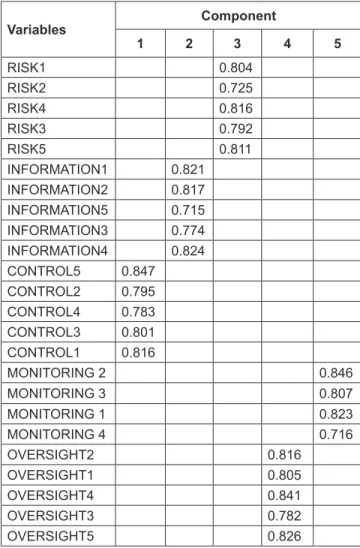
In the rotated component matrix above, there were five columns corresponding to five variables from 24 observed elements. The loading factors in Table 2 were higher than 0.7, so it was considered practical.

4.3. Descriptive Statistics

The results in Table 3 show that the variables have an average level of 3 and above. OVERSIGHT has the highest average and RISK has the lowest average. All variables have negligible standard deviations. It shows that there is little bias between the evaluated variables.

4.4. Model Summary

From Table 4, the adjusted R square is 0.632, so it means 63.2% of the variation of the dependent variable is explained with the independent variables in the model.

Table 1: KMO and Bartlett’s Test

Kaiser-Meyer-Olkin Measure of Sampling

Adequacy 0.876

Bartlett's Test of

Sphericity Approx. Chi-Square 682.076

Df 465

Sig 0.000

Table 2: Rotated Component Matrix

Variables Component

1 2 3 4 5

RISK1 0.804

RISK2 0.725

RISK4 0.816

RISK3 0.792

RISK5 0.811

INFORMATION1 0.821

INFORMATION2 0.817

INFORMATION5 0.715

INFORMATION3 0.774

INFORMATION4 0.824

CONTROL5 0.847

CONTROL2 0.795

CONTROL4 0.783

CONTROL3 0.801

CONTROL1 0.816

MONITORING 2 0.846

MONITORING 3 0.807

MONITORING 1 0.823

MONITORING 4 0.716

OVERSIGHT2 0.816

OVERSIGHT1 0.805

OVERSIGHT4 0.841

OVERSIGHT3 0.782

OVERSIGHT5 0.826

(4)

4.5. ANOVA Analysis

Table 5 shows the significance level of sig. is 0 and it is less than 0.05 so the model is considered suitable.

4.6. Regression

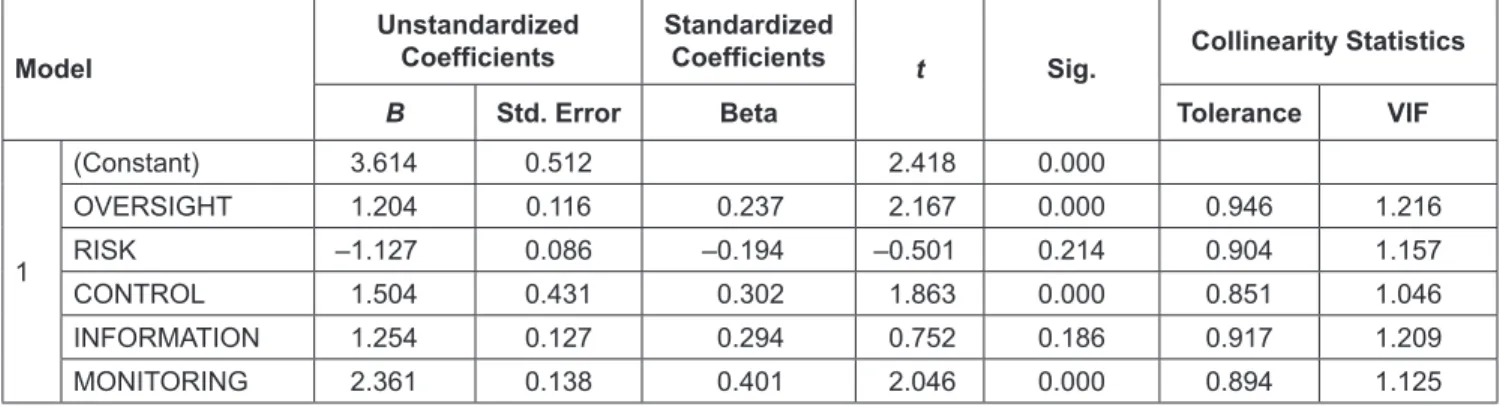
Table 6 shows the results of the regression equation including three variables that affect QIC including OVERSIGHT, CONTROL and MONITORING, as follows:

Table 3: Descriptive Statistics

Variables N Minimum Maximum Mean Std. Deviation

QUALITY 179 3 7 4.0276 1.4128

OVERSIGHT 179 3 6 5.4162 1.5642

MONITORING 179 4 7 5.3684 1.6841

RISK 179 1 5 3.0814 2.0147

CONTROL 179 2 6 4.6941 1.7604

INFORMATION 179 1 7 3.9214 1.9016

Valid N (listwise) 179 Table 4: Model Summary

Model R R square Adjusted

R square Std. Error of the Estimate

1 0.802 0.741 0.632 0.40168

Table 5: ANOVA Analysis

Model Sum of

Squares df Mean

Square F Sig.

1

Regression 104.612 5 22.902 45.021 0.000

Residual 48.596 172 0.347

Total 153.208 178

Table 6: Coefficients Model

Unstandardized

Coefficients Standardized

Coefficients t Sig. Collinearity Statistics

B Std. Error Beta Tolerance VIF

1

(Constant) 3.614 0.512 2.418 0.000

OVERSIGHT 1.204 0.116 0.237 2.167 0.000 0.946 1.216

RISK –1.127 0.086 –0.194 –0.501 0.214 0.904 1.157

CONTROL 1.504 0.431 0.302 1.863 0.000 0.851 1.046

INFORMATION 1.254 0.127 0.294 0.752 0.186 0.917 1.209

MONITORING 2.361 0.138 0.401 2.046 0.000 0.894 1.125

QUALITY = 3.614 + 1.204 * OVERSIGHT + 1.504 * CONTROL + 2.631 * MONITORING

5. Discussion and Policy Recommendations 5.1. Discussion

The results show that there are three variables affecting

QIC, of which MONITORING has the strongest influence,

followed by CONTROL and OVERSIGHT. This result is

(5)

quite similar to some previous studies of Vietnam because the results are consistent with the conditions and characteristics of VLBs.

The control environment variable (OVERSIGHT) has a relationship in the same direction as QUALITY. This result shows that a healthy control environment will be the foundation for QIC of VLBs.

The control activity variable (CONTROL) is also related in the same direction as QUALITY. This result shows that regular and effective control activities including reviewing and controlling activities in the bank will increase QIC of VLBs. Control activities should be increased and must be continually improved to meet management requirements in control activities at VLBs.

The monitoring variable (MONITORING) also has a relationship in the same direction with QUALITY. Regularly monitor all aspects of activity at VLBs, including periodic monitoring of objects at VLBs. Increasing internal and external supervision of activities at VLBs is the appropriate policy to enhance the QIC of VLBs.

5.2. Policy Recommendations

The control environment has an impact on QIC of VLBs. A good control environment will create the premise for the internal control to operate effectively. Therefore, the leadership of VLBs should continue to pay attention to building a corporate culture environment, working style, management style. Besides, the leadership should also have a reasonable organizational structure, and clear assignment of tasks among members to participate in activities and take responsibility for the assigned work, control and coordinate with each other in the work, all transactions must always be controlled. Ensure that the implementation of words must go hand in hand with actions, agree from top to bottom in activities through directing documents, working briefing conclusions attached to each specific policy and action.

Control activity is the variable that has a strong impact on QIC of VLBs. Therefore, VLBs need to improve the quality of control activities to increase QIC. The leadership of VLBs needs to pay attention and strengthen the evaluation as well as improvement of internal control activities continuously and synchronously.

Self-inspection and review of control activities at VLBs should be done periodically with a higher frequency to promptly detect and prevent mistakes and remedy.

On the other hand, the internal inspection and supervision department also needs to quantify, propose major mistakes and advise specific policy leaders to limit recurring mistakes.

6. Conclusion

The requirement to improve QIC of VLBs is more and more important to help the bank achieve efficiency. It helps VLBs develop safely and sustainably. The results show that QIC of VLBs is positively affected by variables including control environment, control activities, and monitoring.

Therefore, in order to improve QIC of VLBs, the managers of VLBs need to create a control environment focusing on business ethics and healthy corporate culture; enhancing the quality of regular and continuous check and control activities; and strengthen monitoring of activities including internal audit activities. It is an opportunity to ensure the stability and sustainable development of VLBs.

References

Amudo, A., & Inanga, E. L. (2009). Evaluation of Internal Control Systems: A Case Study from Uganda. International Research Journal of Finance and Economics, 27(2009), 125–144. https://

wenku.baidu.com/view/25987b785acfa1c7aa00ccd8

Basel (1998). Framework for internal control systems in Banking organization. Retrieved January 30, 2021, from https://www.

bis.org/publ/bcbs40.htm

Central Bank of Vietnam (2018). Circular No. 13/2018 (dated May 18th, 2018) Providing for the internal control system of commercial banks and foreign bank branches. Retrieved January 30, 2021, from https://luatvietnam.vn/tai-chinh/

thong-tu-13-2018-tt-nhnn-he-thong-kiem-soat-noi-bo-cua- ngan-hang-thuong-mai-chi-nhanh-ngan-hang-nuoc-ngoai- 163394-d1.html

Coso (2013). Internal Control–Integrated Framework. Retrieved January 30, 2021, from https://www.coso.org/Pages/ic.aspx Fixsen, D., Blase, K., Metz, A., & Van Dyke, M. (2015).

International Encyclopedia of the Social & Behavioral Sciences (2

nd

ed.). Oxford: Elsevier.

Gamage, C. T., & Lock, K. L., & Fernando, A. A. J. (2014).

Effectiveness of internal control system in state commercial banks in Sri Lanka. International Journal of Scientific Research and Innovative Technology, 1(5), 25–44. https://www.ijsrit.

com/uploaded_all_files/1633729483_o2.pdf

Godfrey, J., Hodgson, A., & Holmes, S. (2010). Accounting Theory.

Australia: John Wiley & Sons Australia.

Hair, J. J. F., Black, W. C., Babin, B. J., Anderson, R. E., &

Tatham, L. R. (2006). Multivariate Data Analysis. London:

Pearson International.

Hardiningsih, P., Udin, U., Masdjojo, G. N., & Srimindarti, C.

(2020). Does Competency, Commitment, and Internal Control Influence Accountability. Journal of Asian Finance, Economics and Business, 7(4), 223–233. https://doi.org/10.13106/jafeb.

2020.vol7.no4.223

(6)

Ho, T. V. (2016). The research of factors affecting the effecting the effectiveness of internal control systems in commercial banks –Empirical evidence in Viet Nam. International Business Research, 9(7), 144–153. https://doi.org/10.5539/

ibr.v9n7p144

Kaiser, H. F. (1974). An index of factorial simplicity. Psychome- trika, 39(1), 31–36. Retrieved from https://link.springer.com/

article/10.1007/BF02291575

Nguyen, A. P., & Ha, T. T. H. (2010). Improving the efficiency of internal control activities of commercial banks in Ho Chi Minh city. Journal of Economic Development (Vietnam), 10(2010), 41–48.

Pham, H. N. (2020). How Does Internal Control Affect Bank Credit Risk in Vietnam? A Bayesian Analysis. Journal of Asian Finance, Economics and Business, 8(1), 873–880. https://doi.

org/10.13106/jafeb.2021.vol8.no1.873

Phornlaphatrachakorn, K., & Kalasindhu, K. N. (2020). Internal Control Effectiveness and Business Survival: Evidence from Thai Food Businesses. Journal of Asian Finance, Economics and Business, 7(12), 927–939. https://doi.org/10.13106/

jafeb.2020.vol7.no12.927

Shaman, R. B., & Senan, N. (2019). A Study on Effectiveness of Internal Control System in Selected Banks in Saudi Arabia.

Asian Journal of Managerial Science, 8(1), 41–47. https://

www.researchgate.net/publication/333934194

Sultana, R., & Haque, M. E. (2011). Evaluation of Internal Control Structure: Evidence from Six Listed Banks in Bangladesh.

ASA University Review, 5(1), 69–81. http://asaub.edu.bd/data/

asaubreview/v5n1sl4.pdf

Tran, Q. T., Ly. H. A., & Nguyen, K. T. (2020). The effectiveness of the internal control system in Vietnamese credit institutions.

Banks and Bank Systems, 15(4), 26–35. https://doi.org/10.21511/

bbs.15(4).2020.03

Vietnamese National Assembly. (2015). Law on Accounting of Vietnam. Retrieved January 30, 2021, from https://

vanbanphapluat.co/law-no-88-2015-qh13-on-accounting Vu, T. T., Hoang, T. H. T., Do, T. H., Phan, D. T., & Nguyen, T. T.

(2020). Influence of Components of Internal Control on the Effectiveness of Internal Control: Evidence from Transport Construction Enterprises in Vietnam. Journal of Asian Finance, Economics and Business, 7(11), 1087–1095. https://doi.org/

10.13106/jafeb.2020.vol7.no11.1087

수치

Table 1: KMO and Bartlett’s Test
Table 6 shows the results of the regression equation  including three variables that affect QIC including  OVERSIGHT, CONTROL and MONITORING, as follows:

참조

관련 문서

This study has shown the difference in the factors affecting employees’ organizational commitment in IT enterprises in Ho Chi Minh City, decreasing influence from

Research results show that five factors have a positive influence on the application of management accounting including Competitive pressure, Decentralization

Based on the theory of planned behavior (Ajzen, 1991), the study found that there are 3 factors affecting the intention to choose a destination, including (1) overall

Based on the results that show the strong influence of the Effort Expectancy, Social Influence, Perceived Risk, Perceived Trust, Perceived Regulatory Support, and

The process of conducting tests and analysis of the study is to determine the impacting factors and the degree of influence on the IFRS application by Vietnamese enterprises

The results of the study show that that there are five key determinants affecting the dairy brand and student decision in buying fresh milk, including: (1) product quality,

The authors propose some solutions based on the research findings, including focusing on assigning the right employees to the right jobs, creating a competitive and

Key Words : Internal Control Weakness companies, Vulnerability Prediction Model, Credit rating, Asset soundness assessment, Internal Control over Financial