Print ISSN: 2288-4637 / Online ISSN 2288-4645 doi:10.13106/jafeb.2021.vol8.no3.0165
Nexus between Financial Development and Economic Growth:
Evidence from Sri Lanka
Kalideen FATHIMA RINOSHA
1, Abdul Majeed MOHAMED MUSTAFA
2Received: November 20, 2020 Revised: January 26, 2021 Accepted: February 03, 2021
Abstract
This paper examines the long-run relationship between financial development and economic growth. The effective function of financial development is crucial to promote the economic development of the country. To achieve the objective, this study used Gross Domestic Product as a dependent variable and Credit to The Private Sector, Ratio of the Gross Fixed Capital Formation to GDP, Trade, Consumer Price Index and Labour Force as an independent variable. Augmented Dickey-Fuller test statistic (ADF) to check the stationary. Bounds test for cointegration and Auto-Regressive Distributed Lag Models (ARDL) are used to check cointegrating relationship amongst the variables and causality between financial development and economic growth. Moreover, the Model selection method is Akaike Info Criterion (AIC).
This result demonstrates that the labor force and trade hold a significantly negative relationship with economic growth. Nevertheless, inflation, Credit to The Private Sector, and Ratio of the Gross Fixed Capital Formation to GDP show a significantly positive relationship with economic growth. Therefore, there is a statistically significant relationship between Financial Development and Economic growth in Sri Lanka and the Sri Lankan government should reform its trade policies.
Keywords: Economic growth, financial development, Private Sector, Gross Fixed Capital Formation, Consumer Price Index JEL Classification Code: C21, C24, C58, F43, G19
financial development means the development of financial intermediaries and the financial market. According to the World Bank definition of financial development is “about overcoming “costs” incurred in the financial system. This process of reducing the costs of acquiring information, enforcing contracts, and making transactions resulted in the emergence of financial contracts, markets, and intermediaries”. Financial development may successfully relate to the effective functioning of the financial system that facilitates the trading of goods and services, assemble the saving, encourage the exchanging, manage investment and risk and effectively allocate the resource and capital.
Financial sector development refers to both the stock market development as well as the banking sector’s growth.
A well-developed financial system enhances capital forma- tion and efficient resource allocation, which triggers growth (Kumar & Paramanik, 2020).
Financial development plays a significant role in promoting economic growth. It is essential to enhance economic development with economic growth, capital accumulation, technological progress, and innovation by encouraging investment and saving and efficiently managing the finance of an economy. Financial development plays a
1. Introduction
Finance refers to the management of money by people, investors, and financial institutions. In the financial system, a major role is played by financial intermediaries and financial markets, where the Bank is at the center of the financial intermediaries. In contrast, non-bank financial institutions are at the border of the financial system. Major players handle the money for borrowing, lending, investing, forecasting, and saving. The development of manage money is called as financial development. In other words,
1
First Author and Corresponding Author. Lecturer in Economics, Department of Economics and Statistics, South Eastern University of Sri Lanka, Sri Lanka [Postal Address: Oluvil, 32360, Sri Lanka]
Email: [email protected]
2
Senior Lecturer in Business Economics, Faculty of Management and Commerce, South Eastern University of Sri Lanka, Sri Lanka, Email: [email protected]
© Copyright: The Author(s)
This is an Open Access article distributed under the terms of the Creative Commons Attribution Non-Commercial License (https://creativecommons.org/licenses/by-nc/4.0/) which permits unrestricted non-commercial use, distribution, and reproduction in any medium, provided the original work is properly cited.
crucial role in developing the industrial sector by helping enterprises create a job. It also plays the right way of reducing poverty in a country. Several studies find that measurement of financial development, not an easy task. It is an extensive study. Based on the World Bank and the study of Gadanecz and Jayaram (2006), financial development measures use some proxy variables: depth, access, efficiency, stability, and Capital accumulation.
Depth measured by private sector credit to GDP, money supply, Financial Institutions’ asset to GDP, Gross value added of the financial sector to GDP, and Debt Securities to GDP. Access variable used Trade, percentage of firms with the line of credit (all firms), and Ratio of domestic to total debt securities. Efficiency variable used net interest margin, lending-deposits spread, the turnover ratio for the stock market and employment rate as sub-variables and price indicators and capital formation variables are used to calculate the stability and capital accumulation proxies.
In Sri Lanka, the economic system enables the state and central governments to boost both short-term and long-term funds through the difficulty of bills and bonds that carry attractive interest rates besides tax concessions. Furthermore, as a developing country, Infrastructure development, and budgetary gap filled with the help of financial development.
The financial market enables investors, servers, and the government to meet their financial needs in Sri Lanka. In this way, the development of the economy is ensured by the financial system. So, the question of this study is how the financial system affects economic development. Therefore, this study aims to investigate the long-run relationship between financial development and economic growth using panel unit root Autoregressive Distributed Lag (ARDL) cointegration technique in Sri Lanka using 28 years of data from 1990 to 2018.
2. Literature Review
The study of Tariq et al. (2020) about how financial development impacts economic growth in Pakistan? New evidence from the threshold model explored that there is a negative impact between economic growth and financial development when the threshold value blow than 0.51 and the threshold value up to 0.51, it had a positive relationship.
Therefore, it is revealed that the relationship between economic growth and financial development shows U shaped relationship in Pakistan.
Like that, Zhang and Yin (2018) found the nexus between regional financial development and corporate investment efficiency and the relationship between firm- level characteristics and corporate investment efficiency based on China using data from 2003 to 2016. According to the heterogeneous stochastic frontier model nature of property rights, namely firm size and Institutional factors, affect the regional financial development indirectly.
Another study was made by De Gregorio and Guidotti (1995) to investigate the empirical relationship between financial development and economic growth in the higher, middle- and low-income countries. Based on the results of this study said that large financial development leads to improved growth performance. However, the experience of Latin America from 1970 to 1980, unregulated financial liberalization, and government bailouts’ expectations can lead to a negative relationship between financial intermediation and growth. This study also suggested the efficiency of investment effect by the transmission from financial development to growth using review of literature method.
In line with this, the study was done by Calderona and Liu (2003) to find the direct relationship between financial development and economic growth using pooled data of 109 developing and industrial countries from 1960 to 1994 by Granger causality method. The findings of this study was that finance contributed to the growth of developing countries than in industrial countries and that productivity growth and capital accumulation lead to a significant relationship between economic growth and financial development. Demetriades and Hussein (1996) discussed that whether financial development causes economic growth? Using 16 developed countries tested by causality method. This study provided that financial development slightly leads to economic development. Those countries’
data implies the mixed results that considerable evidence shows bi-directional causation and some evidence of a reverse relationship between financial development and economic growth. Moreover, the strongly highlighted based on cross-section country studies, the difficulties of statistical inference treat different economies as homogeneous entities.
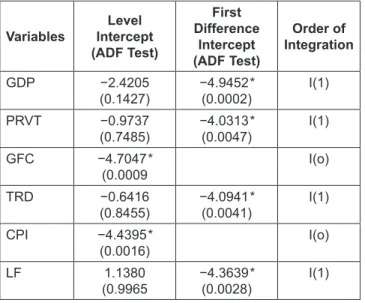
Further, the Augmented Dickey Fuller test is carried out, as a prerequisite test, to check the stationarity property (Mustafa et al., 2019).
Furthermore, in Sri Lanka, the study about financial development and economic growth done by Perera and Masaru (2016) using vector error correction methodology period from 1952 to 2014. This study used real per capita GDP as a dependent variable and the ratio of broad money to GDP, the ratio of investments to GDP, the deposit interest rate in real terms, and trade ratio as an independent variable. They found financial development reflects unidirectional effects on economic growth in Sri Lanka.
Nevertheless, the investment ratio and trade ratio negatively
affect the time broad money ratio, and the deposit interest
rate positively affects the real per capita GDP. The error
correction coefficients show economically and statistically
significant results among the five variables based on the
two cointegrating relationships. This is in line with the
short term, money supply affected economic growth,
and the government should consider the open economic
policy to ensure the significant effect of the money supply.
Another research done in Sri Lanka by Amarathunga (2008) states that the relationship between financial development and economic growth of Sri Lanka from 1960 to 2008.
Cointegration and causality method used to find the results and saving, investment, trade, and real interest rate into account are the variables of this research. This research discussed that there is no reverse causation between financial development and economic growth in Sri Lanka. This study also identified that investment significantly affects growth in the real sector of the economy.
3. Data Collection and Methodology
This research will be a panel data research; data will be collected from World Bank open data and Central Bank Annual report published by Central Bank of Sri Lanka from 1990 to 2018. Besides, this research employed Gross Domestic Product as dependent variable (GDP) and Credit to The Private Sector (PRVT), Ratio of the Gross Fixed Capital Formation to GDP (GFC), Trade (TRD), Consumer Price Index (CPI), and Labour Force (LF) are the independent variables. As a methodology, the data analysis procedures involve checking the stationary unit root level using Augmented Dickey-Fuller test statistic (ADF), testing for the long-run cointegrating relationship amongst the variables using Bounds test for cointegration, and finally testing for the long-run causality between financial development and economic growth by Auto-Regressive Distributed Lag Models (ARDL). Moreover, the Model selection method is Akaike Info Criterion (AIC), and lag choose using automatic selection.
So, the model specification is
GDP PRVT GFC TRD
CPI LF
t t t t
t t t
0 1 2 3
4 5