Print ISSN: 2288-4637 / Online ISSN 2288-4645 doi:10.13106/jafeb.2021.vol8.no5.0011
Economic Globalization and Financial Development:
Empirical Evidence from India and Sri Lanka
Chinmaya BEHERA
1Received: December 15, 2020 Revised: March 06, 2021 Accepted: April 01, 2021
Abstract
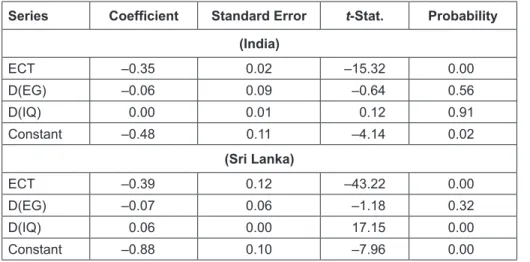
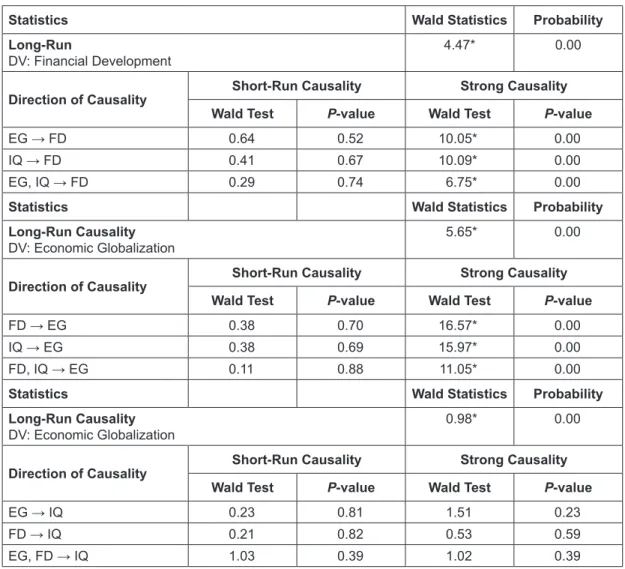
The paper examines the nexus between economic globalization, financial development and institutional reform in India and Sri Lanka during the period 1990–2017. Using the panel ARDL method, the study finds the long-run relationship between financial development, economic globalization, and institutional reforms. From the short-run equation, the study finds the negative and statistically significant impact of economic globalization on financial development in India whereas Sri Lanka has a positive impact of institutional quality on financial development. Then, the study finds no short-run causality between financial development, economic globalization and institutional reforms. However, the study finds bi-direction strong causality between economic globalization and financial development. Further, the study finds uni-directional strong causality from institutional quality to financial development and economic globalization. Moreover, there is an existence of long-run causality between financial development, economic globalization and institutional quality. For the robustness of the results, the study considers the financial market as a proxy for financial development. Then, the study applies the panel ARDL test and find the consistency in the results. The policymakers in India and Sri Lanka should focus on institutional reforms so that it can reap the benefit of economic globalization. In turn, the quality of institutional reforms can thereby lead to financial development.
Keywords: Economic Globalization, Financial Development, Institutional Reforms, Panel-ARDL, Financial Market JEL Classification Code: F41, F43, F62, F63
nexus between globaliszation and growth is weak. Similarly, Ali and Malik (2020) conclude that marginal change in the economic globalization has no impact on growth. Further, they find rich countries reap more benefits of globalization than poor countries. Similarly, several studies also focus on the financial development that leads to growth (De et al., 1995; Calderón et al., 2003; Redmond & Nasir, 2020).
De et. al. (1995) find that financial development positively impacts growth in a cross-country sample. Calderón et al.
(2003) find that financial development causes growth in emerging economies. Redmond and Nasir, (2020) conclude that financial development and institutional quality affect positively economic growth.
However, there have not been any studies that empirically prove the theory in the South Asian region after theoretical development by Mishkin (2009) on globalization and financial development. According to Mishkin (2009), globalization causes financial development through institutional reforms.
The empirical research that focuses on the economic globalization and financial development is scanty in the case of India and Sri Lanka. The economic globalization means the widespread international movements of goods, services,
1
First Author and Corresponding Author. Assistant Professor, General Management and Economics, Goa Institute of Management (GIM), India [Postal Address: F-21, Faculty Block, GIM, Sanquelim, Goa, 403505, India] Email: [email protected]
© Copyright: The Author(s)
This is an Open Access article distributed under the terms of the Creative Commons Attribution Non-Commercial License (https://creativecommons.org/licenses/by-nc/4.0/) which permits unrestricted non-commercial use, distribution, and reproduction in any medium, provided the original work is properly cited.
1. Introduction
A plethora of empirical studies examine the impact on globalization on different economic sectors in recent times that provide us mixed findings (Villaverde & Maza, 2011;
Baddeley, 2006; Bhanumurthy & Kumawat, 2020; Ali &
Malik, 2020, Vu et al. 2020; Long, 2020; Nguyen et al.,
2020). For instance, Villaverde and Maza, (2011) finds the
globalization is the key determinant of growth. However,
Baddeley (2006) finds globalization does not converge to
the economic outcome. Further, Bhanumruty and Kumawat,
(2018) study the financial globalization and economic growth
in the South Asian region, and their findings suggest that the
capital, information and technology. However, there are few empirical studies that talk about the nexus between economic globalization and financial development in different economies (Law et al., 2014; Kandil, 2015). For instance, Law et al. (2014) find the long-run nexus between economic globalisation financial developments in East Asia whereas, on the contrary, Kandil et al. (2015) find that globalization does not cause financial development. In nutshell, there are mixed findings when it come to the nexus between globalization and financial development.
From the above-mentioned discussions, the major aim of the paper is to examine the nexus between globalization and financial development in India and Sri Lanka. To be precise, the study attempts to solve the following research questions:
RQ1: Is there any persistence of a long-run equilibrium between financial development, institutional reforms, and economic globalization?
RQ2: How does economic globalization and institutional reforms affect financial development?
RQ3: Do economic globalization and institutional quality cause financial development?
To address the above-mentioned research questions, the study uses the IPS panel unit root test for stationarity.
Furthermore, the CD and CIPS test is used to examine cross dependency and stationarity. Panel ARDL-PMG method is used to examine the long-run relationship between economic globalization, institutional quality, and financial development. The direction of the causality among the variables is also observed from Wald test. For the robustness of results, the study uses the financial market in place of financial development, and then, Panel ARDL-PMG is used to see the consistency in the results.
The study contributes to the existing literature in three ways. First, unlike previous studies, this study attempts to find the relationship between economic globalization and financial development in the case of India and Sri Lanka.
Furthermore, the study takes institutional reforms as one of the determinants for financial development as per theory developed by Mishkin (2009). The study will help policymakers to formulate necessary policies to focus on intuitional quality and economic globalization that can lead to financial development.
Second, India and Sri Lanka make a crucial contribution to global growth. The lack of studies on economic globalization and financial development in emerging countries in South Asia regions motivates us to research by examining the dynamic relationship between economic globalization, institutional reforms, and financial development. The study finds a long-run relationship among the variables that comply with the findings of Law et al. (2014). This gives better insight for policymakers to issues related to economic globalization and financial development.
Finally, unlike recent studies, this study uses a broad sense of economic globalization and financial development variables. Economic globalization consists of trade and financial globalization whereas financial development index emanant from eight sub-indices that capture depth, access, and efficiency of market and institutions. Furthermore, the study considers the financial market as a proxy for financial development to check the robustness of the results. Moreover, an institutional reform index is created using principal component analysis. These results will help policymakers in an in-depth understanding of variables and their relationship for better policy prescriptions.
The next section represents relevant literature review.
Section 3 depicts data and sources. Section 4 presents different methodologies. Section 5 represents the main findings. Finally, section 6 concludes the paper with policy insight followed by references.
2. Literature Review
After pioneer work by Mishkin (2009) on globalization and financial development, there are only a few empirical studies that focus on a single country or multi-country analysis with mixed findings. He theoretically explains globalization as facilitating trade and financial markets to foreign countries, which will trigger an inflow of new sources of capital, technical know-how, and products into a given economy. To accommodate this inflow, communication facility and deregulation in the economy will enforce institutional reform in an economy. Thus, the quality of institutions will able to channelize the resources efficiently for productive investment and hence, financial development.
Mishkin further suggests that the legal course that processes agreement in quickly and transparently is necessary to strengthen the property rights and financial development.
Hence, the robust property right and the legal system helps the economics and financial systems to prosper. Mishkin’s (2009) theoretical development is a complement to the seminal paper developed by Ranjan and Zingales (2003).
Ranjan and Zingales (2003) earlier suggest that capital inflow and openness simultaneously support financial development. Falahaty and Law’s (2012) findings reveal that globalization affects financial development and economic growth. However, their study confirms that globalization does not cause institutional reforms. Law et al. (2014) find the relationship between economic globalization, real GDP, financial development, and institution in East Asia. Furthermore, they conclude that globalization causes financial development with and without the medium of intuitional reforms. On the contrary, Kandil et al.’s (2015) findings suggest that globalization affect growth positively.
However, globalization fail to cause financial development.
Zaidi et al. (2019) find that globalization causes both
financial development and growth.
This study is the extension of Mishkin (2019) and Law et al.’s (2014) paper. Katircioğlu and Zabolotnov (2020) studies the impact of financial development on globalization.
Using panel econometrics procedures on annual data of 181 countries, they find that financial development is crucial determinants of economic globalization. Further, they suggest that financial markets impact on positively on economic globalization in general except certain cases, where other macroeconomic variables such as national income, inflation, etc., might change the outcome (Redmond
& Nasir, 2020).
3. Data and Sources
Annual data from 1990 to 2017 for a panel work has been used in the study. The country and time period are selected purely based on data availability. The study considers three variables, namely, financial development, economic globalization, and institutional quality for the analysis. Financial development index consists of eight sub- indices from financial markets and institutions developed by the International Monetary Fund (IMF) (Svirydzenka, 2016). It considers depth, access and efficiency of financial market and institution. The financial development data is extracted from IMF database. Further, trade and financial globalization together constitute economic globalisation index. The economic globalization data is taken from KOF Globalization index database.
The institutional reforms data sets are from the International Country Risk Guide. The institutional reforms variables consider of time-varying factors for institutional development, which is available from the year 1984. Five indicators of Political Risk Services (PRS) have been consider where the parameters are scaled again from 0 to 10. Finally, all the variables are converted to log form. The rationale behind choosing India and Sri Lanka lies with the comparison of economic variables. For example, India is comparatively better in terms of financial development whereas Sri Lanka is better in the economic globalization.
Further, India performs better institutional quality than Sri Lanka. However, whenever comparison is done in terms of parameters of institutional reforms. Sri Lanka comes first in some parameters of institutional reforms such as political stability, rule of law, etc. India, the largest democracy, comes after Sri Lanka in terms of institutional reforms. Furthermore, India leads in effectiveness of government, and voice and accountability.
4. Methodology
The study clarifies two preliminary issues before applying panel techniques. Firstly, the issue of controlling cross-sectional dependency across the panel members. The
innovative shock of that affect one country might affect other countries in the high magnitude of globalization and of financial development (Menyah et al., 2014). Pesaran (2007) illustrates the necessity of cross-sectional dependency testing under panel study. Further, he shows the biasedness in the result when cross-sectional dependence test is absent (Pesaran, 2007). Secondly, there may be country- specific heterogeneity as economies faces different stages of development. Breitung (2005) finds country-specific homogeneity might cover the individual economies-specific characteristics.
4.1. Unit Root Test
The study uses panel unit root method to find the stationarity property of the three variables, i.e., financial development, economic globalization and institutional reforms. The test is developed by Im, Pesaran, and Shin (2003). The method adjusts the heterogeneity and finds t-statistics value from augmented Dicky-Fuller (ADF) regression. For the observation N group and time period, T, the IPS panel unit root regression can be written as follows;
∆ x
it i it
i i tx ∆ x
j k
it i t it
= + +
−+ +
=
∑
−α π β
, 1ϕ
,ε
1
1
(1)
Here, x refers observed time series, ∆ is the 1
stdifference operator, ε
itis the white noise error term. The white noise disturbance term. The ∆ x
i t,−1. term allows for serial correlation that can achieve white noise disturbance term.
Further, CD and CIPS has been used in the study. The method is propounded by Pesaran (2007). The CD test is to test cross sectional dependency whereas CIPS is for heterogeneity test across the group of countries.
4.2. Panel ARDL-PMG Test
The study uses panel Autoregressive Distributed Lag (ARDL-PMG) method to examine the relationship among financial development, economic globalisation and institutional quality (Pesaran et al.,1999). The merits of this method are that it can detect long-run relationships even if there is different in integration order of series such as I(1) or I(0). Further, this model addresses the problem of endogeneity by assigning lag length to both exogenous and endogenous variables . Further, it gives consistent and efficient estimators. The equation as follows;
∆
∆
FD FD EG IQ
FD
it i i it i it i it
pj
i it j i
= + + +
+ ∑ + ∑
− − −
= −
α β β β
γ
1 1 1 2 1 3 1
1 1 == −
= −
+ ∑ +
0 2
0 3 1
q i it j
iq
i it j it
γ
γ ε
∆
∆
EG IQ
(2)
∆
∆
EG EG FD IQ
EG
it i i it i it i it
jp
i it j i
= + + +
+ ∑ + ∑
− − −
= −
α β β β
γ
1 1 1 2 1 3 1
1 1 == −
= −
+ ∑ +
0 2
0 3 1
q i it j
iq
i it j it
γ
γ ε
∆
∆
FD IQ
(3)
∆
∆
IQ IQ FD EG
IQ
it i i it i it i it
jp
i it j i
= + + +
+ ∑ + ∑
− − −
= −
α β β β
γ
1 1 1 2 1 3 1
1 1 == −
= −
+ ∑ +
0 2
0 3 1
q i it j
iq
i it j it
γ
γ ε
∆
∆
FD EG
(4)
Where, FD, EG, IQ, and ∆ refer financial development, economic globalization index, institutional quality, and first different operator, respectively. Further, ε refers the error term. The lag length selection criteria is based on AIC and SB Criteria. The null hypothesis of equation 2, 3 and 4 gives H0: β
1i= β
2i= β
3i= 0. which indicates no cointegration and the alternative hypothesis, H1: β
1i≠ β
2i≠ β
3i≠ 0 refers existence of co-integration.
The panel ARDL bound test takes F-statistics or Wald statistics values for the interpretation. Bound tests, i.e., upper and lower bound critical values gives insight at certain level of significance (Pesaran et al., 2001). The initial bound test presumes that all observation are I(0), then the next bound test presumes I(1). The results reject no cointegration if calculated F-statistic value surpasses the upper critical bounds value. If F-statistic value falls within the bounds then the study considers cointegration as inconclusive. If F-statistic value is lower than the lower bound value then the null hypothesis cannot be rejected (Pesaran et al., 2001;
Behera et al., 2020).
Next, the study uses ECM (error correction mechanism) to study the short-run deviation of the series. The error correction mechanism equation as follows:
∆ FD
it i pj ij∆ FD
it j iq ij∆ EG
it jiq a
= + ∑ + ∑
+ ∑
=−
− =−
−
=−
α β β
β
1 1
1
1 0
1 2 0
1 3iij
∆IQ
it j−+ µ
1iECT
1,it−1+ ε
1it(5)
∆ EG
it i jp ij∆ EG
it j iq ij∆ FD
it jiq i
= + ∑ + ∑
+ ∑
=−
− =−
−
=−
α β β
β
1 1
1
1 0
1 2
0 1
3jj
∆IQ
it j−+ µ
1iECT
1,it−1+ ε
1it(6)
∆ IQ
it i jp ij∆ IQ
it j iq ij∆ FD
it jiq i
= + ∑ + ∑
+ ∑
=−
− =−
−
=−
α β β
β
1 1
1
1 0
1 2 0
1
3jj