158
and Safety
Available online at http://www.foodhygiene.or.kr
https://doi.org/10.13103/JFHS.2019.34.2.158
LC-MS/MS 를 이용한 식품 중 맥각 알칼로이드 시험법 개발
천소영
* ·정은아
·이봄내
·권진욱
·박혜영
1·김신희
·강길진
식품의약품안전처 식품의약품안전평가원 오염물질과1식품의약품안전처 식품의약품안전평가원 생약연구과
Development of Analytical Method for Ergot Alkaloids in Foods Using Liquid Chromatoraphy-Tandem Mass Spectrometry
So Young Chun*, Euna Chong, Bomnae Lee, Jin-Wook Kwon, Hye Young Park1, Sheenhee Kim, and Giljin Gang Food Contaminants Division, National Institute of Food and Drug Safety Evaluation,
Ministry of Food and Drug Safety, Osong, Korea
1Herbal Medicine Research Division, National Institute of Food and Drug Safety Evaluation, Ministry of Food Drug Safety, Osong, Korea
(Received February 26, 2019/Revised March 6, 2019/Accepted April 5, 2019)
ABSTRACT -
Ergot alkaloids are mycotoxin produced by fungi of the Claviceps genus, mainly by Claviceps pur- purea in EU. Recently obtained informations indicates necessity for control the ergot in imported grains. Recent occurrence data of ergot alkaloids from EU countries indicate the necessities of management and control these toxins from the imported grains like rye, wheat, oat etc. The aim of this study is to optimize the liquid chromatography-tandem mass spectrometry method for determination of ergot alkaloids (ergometrine, ergosine, ergotamine, ergocornine, ergocryptine, ergocristine and their epimers (-inines) from grain and grain-based food. The test method was optimized by extracting the sample with ace- tonitrile containing 2 mM ammonium carbonate, purification with Mycosep cartridge, and instrumental analysis by LC-MS/MS using Syncronis C18 column. The standard calibration curves showed linearity with correlation coefficents; R2 >0.99.
Mean recoveries ranged from 72.0 to 111.3% at three different fortified levels (20, 50, and 100µg/kg). The correlation coef- ficient expressed as precision was within the range of 1.9-12.9%. The limit or quantifications (LOQ) ranged from 0.012 to 0.058µg/kg. The developed analytical method met the criteria of AOAC Int. and CAC validation parameters like accuracy and sensitivity. As a result, it was confirmed that the test method developed in this study is suitable for the simultaneous analysis of six species of ergot alkaloid from grains and grain products.
Key words : Ergot alkaloid, Analytical method, Cereal products, LC-MS/MS
곰팡이독소(mycotoxin)는 식품과 사료에 오염되어 사람과 동물이 섭취하였을 때 건강상에 유해한 독성인자이다1-3). 곰 팡이독소의 인체 유해성에 대한 최초의 보고는 유럽의 맥 각중독(ergot-poisoning)연구와 관련이 있다. 맥각중독은 중 세에 ‘St. Anthony’s fire’라고도 불렸으며 프랑스, 인디아, 에 티오피아 등에서 발생하여 수 천명의 사망 사고와 다양한 중증 증상이 일어나기도 했다4). 맥각균(Claviceps purpurea) 에 오염된 곡물 섭취가 주 원인인 맥각 중독의 독성인자는 맥각알칼로이드로 밝혀졌으며, 특히, 호밀, 밀, 보리, 기장,
귀리 등의 곡물에서 주로 발생한다고 알려져 있다5-7). 맥각알칼로이드는 에르고메트린(ergometrine), 에르고신 (ergosine), 에르고타민(ergotamine), 에르고코르닌(ergocornine), 에르고크리스틴(erocristine), 에르고크립틴(ergocryptine)과 C-8 위치를 중심으로 생성되는 부분입체 이성질체 에르고 메트리닌(ergometrinine), 에르고시닌(ergosinine), 에르고타미 닌(ergotaminine), 에르고크립티닌(ergocryptinine), 에르고코 르니닌(ergocorninine), 에르고크리스티닌(erocristinine)으로, 이성질화 비율은 온도, pH 에 따라 다르다4). 최근 우리나 라는 FTA체결에 따라 미국은 물론, 러시아를 포함한 여 러 유럽연합 국가에서 호밀, 밀, 보리 등의 곡물을 다량 수입하고 있는데, 2017년 농림축산식품부의 수출입동향 통 계에 따르면 곡물의 수입량이 14,000천톤 이상이다. 이는 유럽에서 주로 발생한 맥각알칼로이드 오염사고의 국내
*Correspondence to: So Young Chun, Food Contaminants Division, National Institute of Food and Drug Safety Evaluation, Osong, Chungcheongbuk-do 363-700, Korea
Tel: 82-43-719-4254, Fax: 82-43-719-4250 E-mail : [email protected]
발생가능성 등의 우려와 이에 대한 안전관리의 필요성 강 화 등을 시사한다.
맥각 알칼로이드는 인체에 미량 노출 시 메스꺼움, 복 통, 근육 수축, 두통 등을 유발하며8), 다량 노출 시 심혈관 수축작용으로 인한 혈액순환장애 등의 급성 독성 작용을, 장기간 노출 시 만성 부작용으로 유산, 저체중아 출산, 모 유 생산능력 상실 등의 문제가 생길 수 있다9-12). 국제식품 규격위원회에서는 곡류 중 맥각 및 맥각알칼로이드 오염방 지 및 저감화를 위한 실행규범 초안을 마련하였고13), 유럽 연합은 2017년 12월 맥각알칼로이드에 대한 잠정기준을 설 정하여 관리하고 있다. 반면, 우리나라는 맥각알칼로이드의 표준 시험법이 없어 관련 사고 발생 시 대처가 어려운 실 정이다. 최근의 연구는 보리, 호밀, 밀, 귀리 등 곡류에 대 해 LC-MS/MS를 이용한 시험법을 제시하고있으나14-22),우 리나라는 표준시험법의 부재로 수입·유통 곡류와 곡류 가 공식품에 대한 분석 및 모니터링이 보고된 바 없다. 따라 서 본 연구는 곡류 및 곡류가공품 중 맥각알칼로이드에 대 한 선제적 안전관리를 위해 공인 시험법을 개발하고자 하였다.
Materials and Methods
시약 및 재료
표준품은 Romer사(Tulln, Austria)의 에르고메트린 (98%, Cat. No. 002067), 에르고신(95.9%, Cat. No. 002068), 에 르고타민(95.1%, Cat. No. 002069), 에르고코르닌(97.8%, Cat. No. 0002064), 에르고크리스틴(98.7%, Cat. No.
002065), 에르고크립틴(97.6%, Cat. No. 002066)과 각각의 이성질체 에르고메트리닌(98%, Cat. No. LMY-090), 에르 고시닌(99%, Cat. No. LMY-089), 에르고타미닌(95.8%, Cat. No. 002075) 에르고크립티닌(97.1%, Cat. No.
002074), 에르고코르니닌(95.6%, Cat. No. 002072), 에르고 크리스티닌(96.6, Cat. No. 002073)을 사용하였다. 특히, 에 르고메트린, 에르고타민, 에르고타미닌은 마약 원료물질 1 급에 해당되어 마약류 관리에 관한 법률 제 4조에 따라 사용을 승인받았다.
추출 및 분석에 사용한 아세토니트릴(acetonitrile), 메탄 올(methanol) 등은 Merck(Darmstadt, Hesse, Germany)의 HPLC 등급을, 탄산암모늄(Ammonium carbonate,
≥ 99.999%)은 Sigma-Aldrich(St. Louis, MO, USA)의 특급 또는 분석용을 사용하였다. Mycosep column 150 ergot (Romer, Tulln, Austria)를 사용하였으며, 여과용 필터 polytetrafluoroethylene(PTFE) syringe filter(Advantec, Tokyo, Japan)를 사용하였다. 시험용 시료의 선정은 맥각 알칼로이드가 주로 검출된다고 보고된5) 곡류(호밀)와 가 공품(맥주, 크래커)을 대상으로 시중에서 구입하였고, 분쇄·
균질화하여 분석 전까지 냉동고(-20oC)에 보관하였다. 공시 험 시료(matrix blank) 는 일련의 시험과정 개발을 통해 맥
각 알칼로이드가 검출되지 않음을 확인하여 선정하고, 밀 봉된 용기에 담아 -20oC 이하에서 보관하면서 시험에 사 용하였다.
표준원액 및 표준용액의 조제
에르고메트린, 에르고신, 에르고타민, 에르고크립틴, 에 르고코르닌, 에르고크리스틴 표준품 0.5 mg을 각각 아세 토니트릴 5 mL에 용해하여 100 μg/mL로 조제하였다. 이 성질체인 에르고메트리닌, 에르고시닌, 에르고타미닌, 에 르고크립티닌, 에르고코르니닌, 에르고크리스티닌의 표준 품 0.125 mg을 각각 아세토니트릴 5 mL에 용해하여 25 μg/
mL로 조제하였다. 총 12종 표준원액은 갈색 유리병에 각 각 담아 -70oC에서 보관하면서 실험 직전에 희석하여 혼 합표준용액을 20, 50, 100 μg/L로 조제하여 사용하였다.
시료 전처리 방법
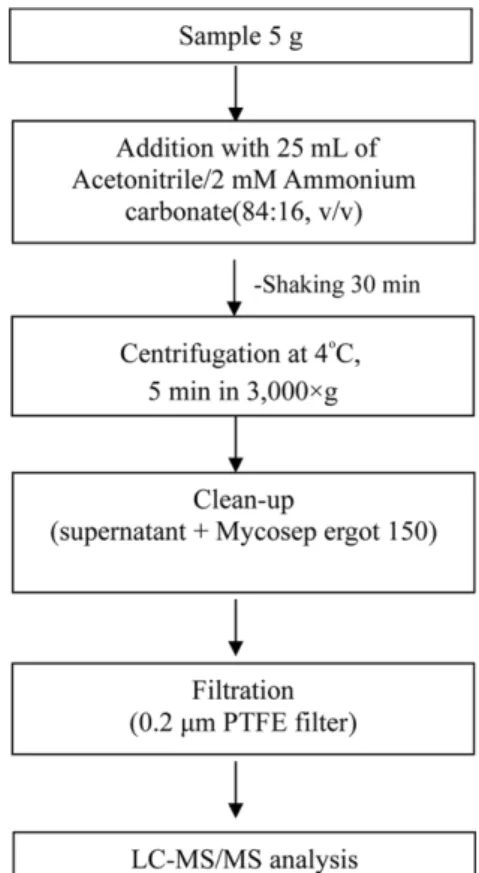
균질화한 시료 5 g을 50 mL 원심 분리관에 취하여, 25 mL 의 2 mM 탄산암모늄/ 아세토니트릴 혼합용액 (16:84, v/v) 을 가하여 30분간 추출하고 상온에서 3,000 G로 5분간 원 심분리한 후 상징액을 취하였다. 상징액 4 mL을 취하여 Mycosep 카트리지로 정제하고 0.2 μm PTFE 멤브레인 필 터로 여과한 시험용액을 기기분석에 이용하였다 (Fig. 1).
Fig. 1. Analytical procedure for Ergot alkaloid in sample.
기기분석조건
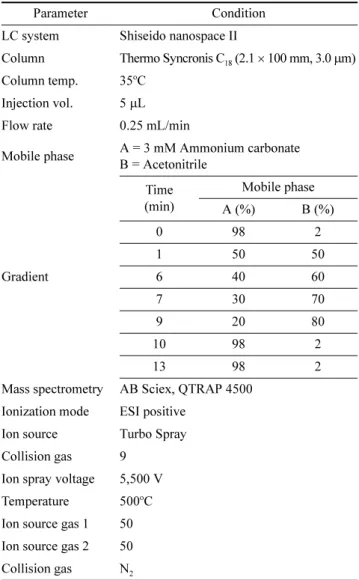
기기분석은 액체크로마토그래프-질량분석기(LC: Shiseido nanospace II, Japane – MS/MS: AB Sciex QTRAP 4500, USA)로 수행하였으며, 대상 맥각알칼로이드의 분자량 확 인 등 일련의 기기분석 조건 설정을 위해, 맥각알칼로이 드 12종은 컬럼을 통과하지 않고 표준용액 (100 ng/mL)을 질량분석기에 직접 주입하였다. HPLC 분리는 C18 칼럼 (2.1× 100 mm, 3.0 μm, Thermo Fisher Scientific, USA)으 로, 3 mM 탄산 암모늄과 아세토니트릴을 이동상 용매로 0.25 mL/min 유속과 35oC 온도조건으로 각 시료를 5 μL를 주입하였다.
Table 1은 LC-MS/MS 분석조건으로, 이온화는 전기분무 이온화 (electro-spray ionization, ESI)로 양이온모드 (positive-ion mode)에서 전구이온(precursor ion)을 선택하 였고, 충돌에너지 (collision energy)를 조절하여 토막이온 (product ion)을 생성시킨 후 정량 및 정성이온을 결정하 는 multiple reaction monitoring (MRM)조건을 확립하였다.
시험법 검증
시험법은 AOAC 가이드라인23) 에 따라, 직선성 (linearity), 회수율 (recovery), 반복성 (repeatability), 재현성 (reproducibility) 등을 확인하였다. 검량선은 각각의 시료가 지닌 매질 특성의 영향을 최소화 하기 위해, 추출 시료의 시험용액에 혼합표준용액을 1, 2, 5, 10, 20, 50 ng/mL 농 도로 첨가(matrix-matched) 하였으며, 회수율은 공시험 시 료 각각에 혼합표준용액을 가하여 20, 50, 100 μg/kg 농도 가 되게 하고, 5반복 시험을 통해 그 결과값과 표준편차 (standard deviation)를 구하였다(Table 3). 또한 반복성 (repeatability) 확인을 위해 3반복으로 동일 일자와 시간차 를 두는 일간 시험을, 재현성(reproducibility) 확인을 위해 타 시험소간의 결과도 비교·확인하였다. 다만, 검출한계 (limit of detection, LOD), 정량한계(limit of quantification, LOQ)는 ICH24)의 가이드라인을 적용하여 검량선을 통해 다음과 같이 산출하였다.
LOD = 3.3 × σ / S LOQ = 10 × σ / S
σ: 검량선에서 반응의 표준편차, S: 검량선의 기울기
Results and Discussion
LC-MS/MS 분석조건 최적화
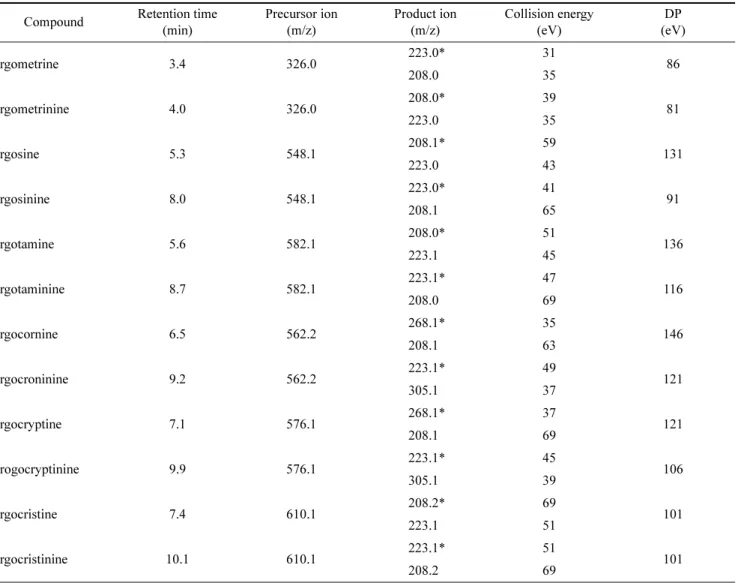
맥각알칼로이드 12종의 동시·정량을 위한 LC-MS/MS 기 기분석법은, 맥각알칼로이드의 Log Pow값을 근거로 극성 도에 대해 넓은 스펙트럼을 가지며, 분석물질이 분배의 원 리로 분리되는 C18 칼럼을 선택하였고, 3 mM 탄산암모늄 용액과 아세토니트릴을 이동상으로 하는 기울기 용리 방식 을 선택하였다. 이온화법으로는 전기분무이온화법(ESI)의 positive ion mode 및 multiple reaction monitoring(MRM) mode 조건으로 분석되었다. 선구이온(precursor ion)은 full scan mode 에서 질량 스펙트럼을 확인하여 맥각알칼로이드 12종의 질량 값(exact mass, M)에 양성자(H+)가 결합된 [M+H]+ 형태로, 각각의 선구이온으로 에르고메트린 m/z 326, 에르고메트리닌 m/z 326, 에르고신 m/z 548, 에르고시 닌 m/z 548, 에르고타민 m/z 582, 에르고타미닌 m/z 582, 에르고코르닌 m/z 562, 에르고코르니닌 m/z 562, 에르고크 립틴 m/z 575, 에르고크립티닌 m/z 576, 에르고크리스틴 m/
z 610, 에르고크리스티닌 m/z 610으로 확인하였다. MS/MS 분석 시 collision energy를 조절하여 생성이온 (product ion) 의 감도와 S/N ratio가 최적이 되도록 조정하고, 모든 조건 을 만족하는 precursor/product ion pair를 선정하였다. 이를 통해 안정적이고 높은 감도를 나타내는 생성이온을 정량이 온으로 하여 최적의 MRM 조건을 확립하였으며, 선정된 이 온과 머무름 시간은 Table 2에 나타내었다.
Table 1. Analytical parameters of LC-MS/MS for ergot alkaloids in food
Parameter Condition
LC system Shiseido nanospace II
Column Thermo Syncronis C18 (2.1× 100 mm, 3.0 µm) Column temp. 35oC
Injection vol. 5µL Flow rate 0.25 mL/min
Mobile phase A = 3 mM Ammonium carbonate B = Acetonitrile
Gradient
Time (min)
Mobile phase
A (%) B (%)
0 98 2
1 50 50
6 40 60
7 30 70
9 20 80
10 98 2
13 98 2
Mass spectrometry AB Sciex, QTRAP 4500 Ionization mode ESI positive
Ion source Turbo Spray Collision gas 9
Ion spray voltage 5,500 V Temperature 500oC Ion source gas 1 50 Ion source gas 2 50 Collision gas N2
Table 2. Mass spectrometry parameters for quantification and confirmation for ergot alkaloids Compound Retention time
(min)
Precursor ion (m/z)
Product ion (m/z)
Collision energy (eV)
DP (eV)
Ergometrine 3.4 326.0 223.0* 31
208.0 35 86
Ergometrinine 4.0 326.0 208.0* 39
223.0 35 81
Ergosine 5.3 548.1 208.1* 59
223.0 43 131
Ergosinine 8.0 548.1 223.0* 41
208.1 65 91
Ergotamine 5.6 582.1 208.0* 51
223.1 45 136
Ergotaminine 8.7 582.1 223.1* 47
208.0 69 116
Ergocornine 6.5 562.2 268.1* 35
208.1 63 146
Ergocroninine 9.2 562.2 223.1* 49
305.1 37 121
Ergocryptine 7.1 576.1 268.1* 37
208.1 69 121
Erogocryptinine 9.9 576.1 223.1* 45
305.1 39 106
Ergocristine 7.4 610.1 208.2* 69
223.1 51 101
Ergocristinine 10.1 610.1 223.1* 51
208.2 69 101
*Quantification ion
추출 및 정제조건 확립
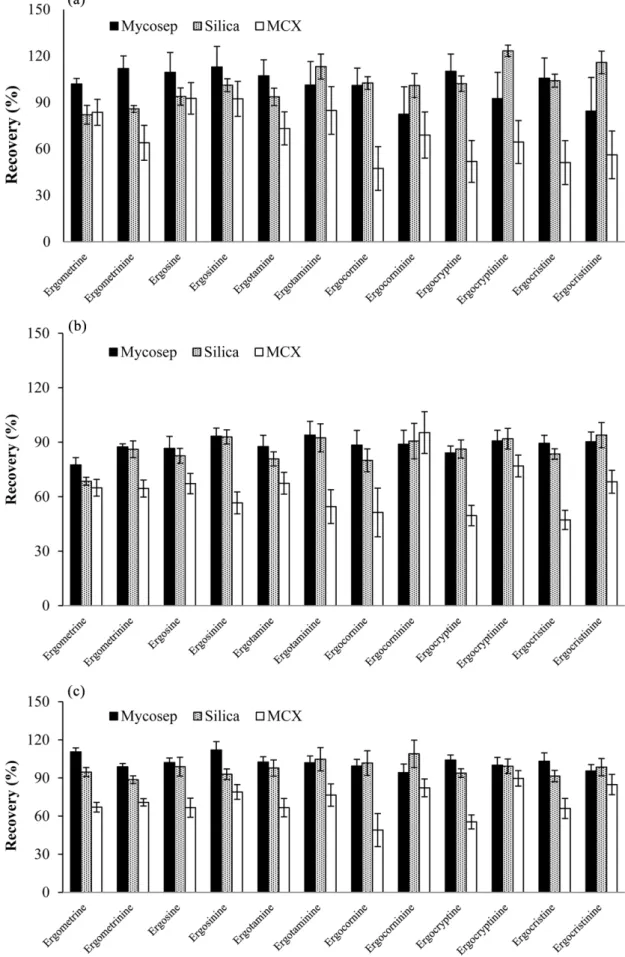
추출용매는 맥각알칼로이드의 이성질체가 변형되지 않도 록 비양자성 용매 (aprotic solvent)인 아세토니트릴을 사용 하였다. 추출시 아세토니트릴은 비극성물질을 상당히 감소 시킨다고 보고되어25). 극성과 비극성을 균형화 시키기 위해 아세토니트릴과 2 mM 탄산암모늄 용액을 16:84 (v/v)의 비 율로 사용하였다. 이 추출용매는 Guo 등25)이 사용한 방법 중 탄산암모늄의 몰 농도를 약간 변형 한 것이다. 곡물의 지방, 단백질, 탄수화물을 제거하기 위해 Mycocep 150 Ergot column, Silica, MCX카트리지를 적용하여 회수율을 확인해 보았다. 그 결과 Silica, Mycocep 150 Ergot column 을 사용 하는 것이 MCX를 사용하였을 때보다 회수율이 높게 나타 났으며, Mycocep 150 Ergot column과 Silica로 정제하였을 경우는 회수율은 유사하나 (Fig. 2), Mycocep 카트리지가, Silica 보다 전처리단계가 간단하여 본 연구에서는 전처리 시간 단축을 위해 Mycocep column 을 사용하였다.
분석법 검증
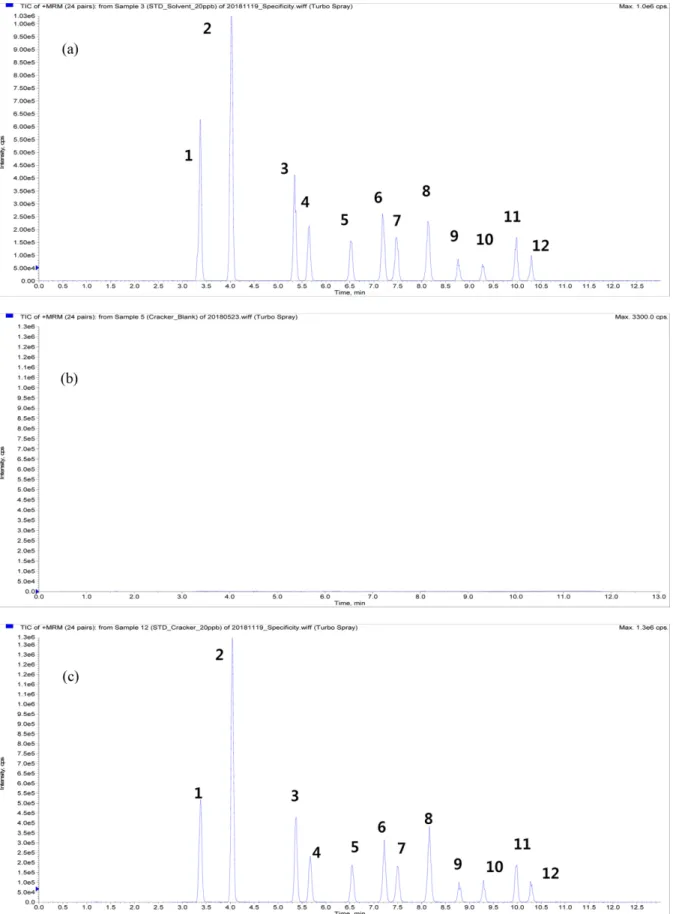
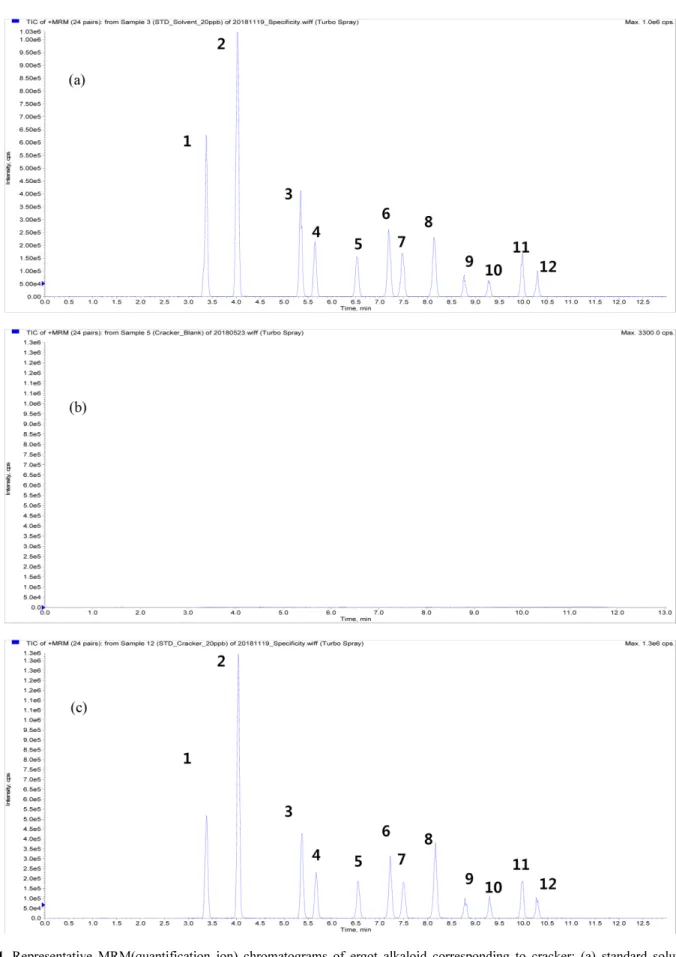
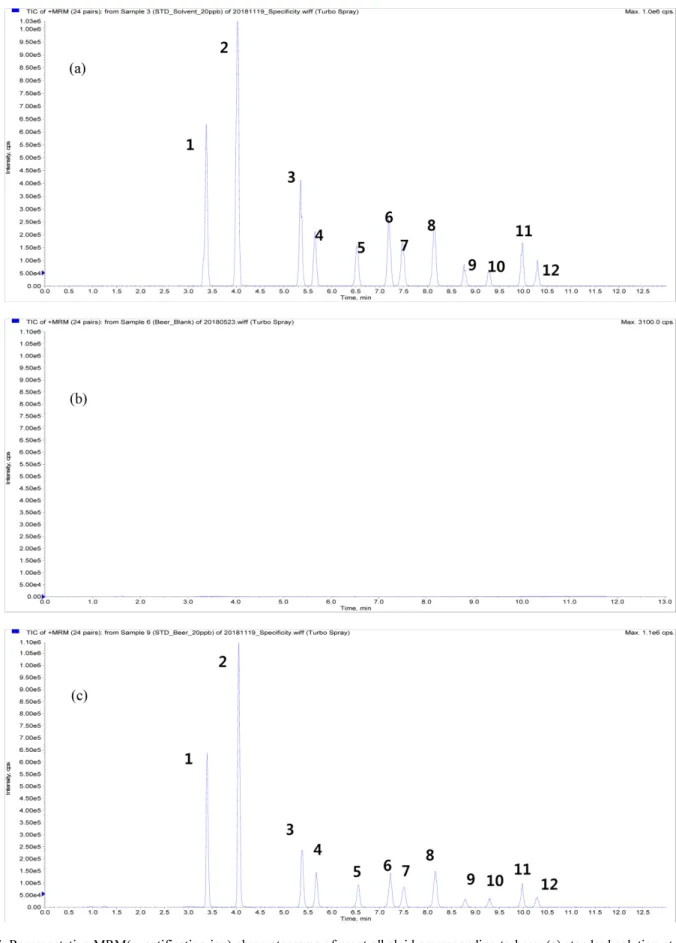
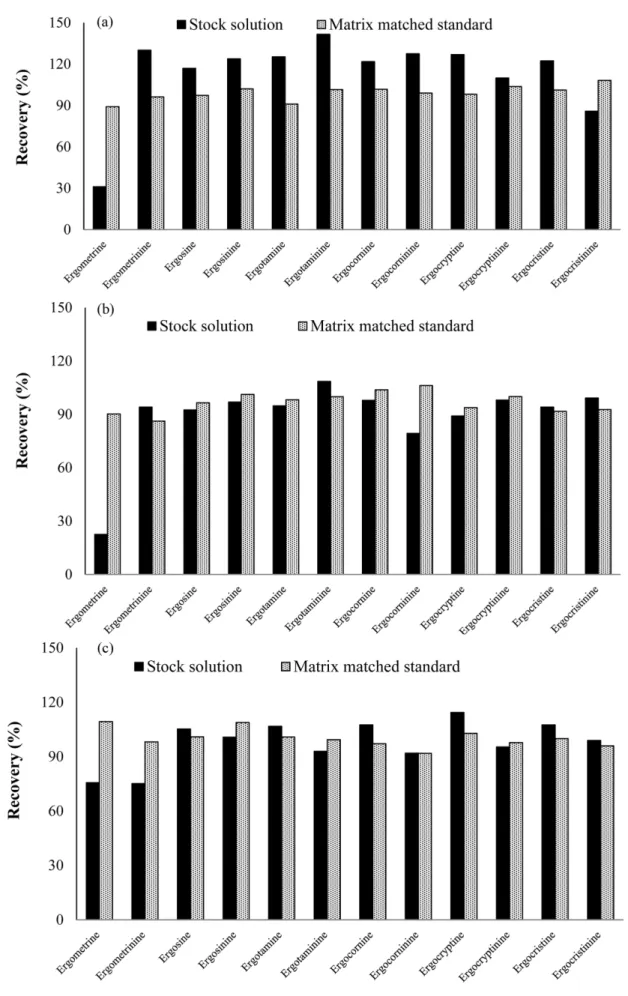
맥각알칼로이드 12종 동시분석법의 선택성 (selectivity), 특 이성 (specificity), 직선성 (linearity)을 검증하기 위해 호밀, 크래커, 맥주 공시험 시료 (control), 혼합표준용액, 공시험 시료에 혼합표준용액을 첨가하여 크로마토그램을 비교하였 다 (Fig. 3-5). 그 결과, 공시험 시료 중 맥각알칼로이드 12 종과 같은 머무름 시간을 갖는 어떤 방해물질도 검출되지 않아 분리능과 선택성이 확인되었으나, 매질의 영향도 확인 되었다. 특히 에르고타민과 그 이성질체 에르고타미닌에 가 장 큰 영향을 받는 것으로 나타났다 (Fig. 6). 이는 Meri Kokkonen과 Marika Jestoi15)의 연구결과와 유사하게 나타났 다. 이러한 이유로 대상 시료 별 매질의 영향을 최소화하기 위해 공시료에 표준물질 첨가 방법의 검량선 작성 방법을 사용하였다. 검량선의 상관계수는 0.99 이상으로 AOAC 가 이드라인에서 권장하는 R2 > 0.98을 만족하였다. 정량한계는 검량선의 기울기와 반응의 표준편차에 따라 10 × σ / S 식
Fig. 2. Recoveries of 12 ergot alkaloids in (a) rye, (b) cracker and (c) beer by purification with three different purification procedures.
Fig. 3. Representative MRM (quantification ion) chromatograms of ergot alkaloid corresponding to rye: (a) standard solution at 20 µg/kg, (b) control, (c) fortification of 20µg/kg.
1: Ergometrine, 2: Ergometrinine, 3: Ergosine, 4: Ergotamine, 5: Ergocornine, 6: Ergocryptine, 7: Ergocristine, 8: Ergosinine, 9: Ergota- minine, 10: Ergocorninine, 11: Ergocryptinine, 12: Ergocristinine.
Fig. 4. Representative MRM(quantification ion) chromatograms of ergot alkaloid corresponding to cracker: (a) standard solution at 20µg/kg, (b) control, (c) spiked at 20 µg/kg.
1: Ergometrine, 2: Ergometrinine, 3: Ergosine, 4: Ergotamine, 5: Ergocornine, 6: Ergocryptine, 7: Ergocristine, 8: Ergosinine, 9: Ergota- minine, 10: Ergocorninine, 11: Ergocryptinine, 12: Ergocristinine.
Fig. 5. Representative MRM(quantification ion) chromatograms of ergot alkaloid corresponding to beer: (a) standard solution at 20 µg/
kg, (b) control, (c) spiked at 20µg/kg.
1: Ergometrine, 2: Ergometrinine, 3: Ergosine, 4: Ergotamine, 5: Ergocornine, 6: Ergocryptine, 7: Ergocristine, 8: Ergosinine, 9: Ergota- minine, 10: Ergocorninine, 11: Ergocryptinine, 12: Ergocristinine.
Fig. 6. Matrix effect for the analyzed ergot alkaloids in (a) rye, (b) cracker, and (c) beer.
Table 3. Validation results of the developed method for ergot alkaloids in rye
Compound
LOQ Calibration Recovery (%) Repeatability (%)
µg/kg R2 20*
µg/kg
50*
µg/kg
100*
µg/kg Intra day Inter day
Ergometrine 0.03 1.00 92.7±1.8 102.0±2.9 100.6±9.2 4.6 5.4
Ergometrinine 0.02 1.00 93.5±6.4 107.2±5.3 103.4±3.4 5.0 3.8
Ergosine 0.03 1.00 99.7±5.2 108.4±7.8 97.4±4.0 5.5 4.6
Ergosinine 0.02 1.00 91.7±4.5 109.4±5.8 100.6±7.1 5.7 4.3
Ergotamine 0.04 1.00 101.3±6.5 107.0±6.6 98.4±5.2 6.0 4.2
Ergotaminine 0.03 0.99 79.6±4.9 96.9±6.5 101.0±9.0 7.2 7.7
Ergocornine 0.03 0.99 87.5±3.8 97.6±4.1 89.7±4.1 4.4 5.2
Ergocroninine 0.04 0.99 73.5±5.5 79.3±4.0 81.6±8.3 7.6 8.1
Ergocryptine 0.06 0.99 99.5±6.9 109.4±8.8 103.8±2.0 5.7 3.9
Erogocryptinine 0.05 0.99 75.0±3.6 85.9±2.8 90.8±2.6 3.7 5.6
Ergocristine 0.02 1.00 89.2±4.4 103.7±5.7 94.0±7.2 6.0 3.3
Ergocristinine 0.03 0.99 76.3±8.8 82.5±13.9 84.9±8.6 12.9 6.8
* fortification level
Table 4. Validation results of the developed method for ergot alkaloids in cracker
Compound
LOQ Calibration Recovery (%) Repeatability (%)
µg/kg R2 20*
µg/kg
50*
µg/kg
100*
µg/kg Intra day Inter day
Ergometrine 0.03 0.99 89.4±3.9 77.5±2.4 72.0±1.8 3.3 4.0
Ergometrinine 0.03 1.00 86.4±3.9 87.5±1.3 89.5±1.9 2.7 2.7
Ergosine 0.03 0.99 95.8±5.1 85.9±4.9 84.1±2.3 4.6 3.6
Ergosinine 0.04 1.00 101.6±7.4 93.1±1.7 91.5±3.3 4.2 3.0
Ergotamine 0.05 0.99 97.0±5.0 89.5±5.2 82.6±3.7 5.2 3.7
Ergotaminine 0.04 0.99 100.5±9.6 93.4±6.3 91.2±5.3 7.4 4.9
Ergocornine 0.04 0.99 103.6±7.0 87.2±4.4 83.0±1.8 4.7 4.9
Ergocroninine 0.01 0.99 106.1±8.4 88.0±2.4 86.3±3.0 4.7 5.0
Ergocryptine 0.03 0.99 93.4±7.9 83.7±1.3 83.5±2.7 4.4 2.6
Erogocryptinine 0.02 0.99 91.3±6.7 100.5±10.3 90.7±5.0 7.7 4.1
Ergocristine 0.02 1.00 90.0±2.3 89.6±2.7 87.3±4.1 3.4 2.7
Ergocristinine 0.03 0.99 93.7±8.3 90.5±2.1 91.5±2.6 4.7 3.5
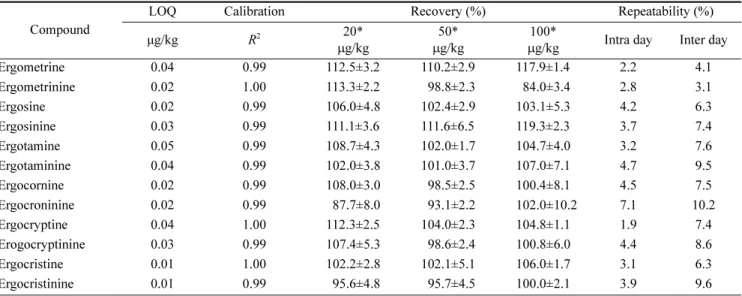
Table 5. Validation results of the developed method for ergot alkaloids in beer
Compound
LOQ Calibration Recovery (%) Repeatability (%)
µg/kg R2 20*
µg/kg
50*
µg/kg
100*
µg/kg Intra day Inter day
Ergometrine 0.04 0.99 112.5±3.2 110.2±2.9 117.9±1.4 2.2 4.1
Ergometrinine 0.02 1.00 113.3±2.2 98.8±2.3 84.0±3.4 2.8 3.1
Ergosine 0.02 0.99 106.0±4.8 102.4±2.9 103.1±5.3 4.2 6.3
Ergosinine 0.03 0.99 111.1±3.6 111.6±6.5 119.3±2.3 3.7 7.4
Ergotamine 0.05 0.99 108.7±4.3 102.0±1.7 104.7±4.0 3.2 7.6
Ergotaminine 0.04 0.99 102.0±3.8 101.0±3.7 107.0±7.1 4.7 9.5
Ergocornine 0.02 0.99 108.0±3.0 98.5±2.5 100.4±8.1 4.5 7.5
Ergocroninine 0.02 0.99 87.7±8.0 93.1±2.2 102.0±10.2 7.1 10.2
Ergocryptine 0.04 1.00 112.3±2.5 104.0±2.3 104.8±1.1 1.9 7.4
Erogocryptinine 0.03 0.99 107.4±5.3 98.6±2.4 100.8±6.0 4.4 8.6
Ergocristine 0.01 1.00 102.2±2.8 102.1±5.1 106.0±1.7 3.1 6.3
Ergocristinine 0.01 0.99 95.6±4.8 95.7±4.5 100.0±2.1 3.9 9.6
으로 산출하였으며, 0.01 ~ 0.05 μg/kg 이었다.
본 시험법의 정확성을 확인하기 위해 호밀, 크래커, 맥 주에 맥각알칼로이드 12종 혼합표준용액을 처리농도 20, 50, 100μg/kg 이 되도록 첨가하여 회수율 실험을 5회 반 복하여 수행하였다. LC-MS/MS를 사용하여 맥각알칼로이 드를 분석한 결과 평균 회수율은 72.0 ~ 113.3% 이였고, 분 석오차는 1.1 ~ 10.3%로 확인되었다. 또한 3일간 각 시료 에 반복 실험을 진행하여 일간(inter day) 정밀성(변동계수, RSD, %)을 확인한 결과 호밀에서의 3.3 ~ 8.1%, 크래커 에서는 2.7 ~ 5.0%, 맥주에서는 3.1 ~ 10.2%로 나타내었 다(Table 3-5). 그 결과 각 시료별 농도의 유효성검증 결 과값이 AOAC 가이드라인의 권장기준을 대부분 충족하여 시험법의 적합성을 확인할 수 있었다.
Acknowledgement
본 연구는 식품의약품안전처 연구개발과제 (18161MFDS021) 에 의해 수행되었음.
국문요약
우리나라의 해외 곡류 수입량과 수입국가의 다변화를 고 려 해 볼 때, 호밀, 밀, 귀리 등 맥류에서 주로 발생하는 것으로 알려져 있는 맥각알칼로이드의 노출가능성도 배제 할 수 없다. 따라서 본 연구는 곡류 및 곡류가공품 중 맥 각알칼로이드에 대한 선제적 안전관리를 위해 호밀 및 가 공품 (크래커, 맥주) 으로 부터 에르고메트린을 포함한 12 종 맥각알칼로이드의 공인 시험법을 개발하고자 하였다.
아세토니트릴이 함유된 2 mM 탄산암모늄용액 추출과 Mycocep catridge를 이용한 정제·농축이 전처리 방법으로 적합함이 확인되었고, 기기분석을 통해 표준물질 첨가 검 량선의 직선성이 12개 알칼로이드 모두 R2 >0.99 이상이 었으며, 정량한계는 0.01 ~ 0.05 μg/kg수준이었다. 시험법 검증을 통해 대상 품목간의 차이는 있으나, 12개 맥각 알 칼로이드 모두 회수율은 72~113% 수준이었으며, 반복성 은 2~10% 수준으로 적합성이 확인되었다.
References
1. Audenaert K., Vanheule A., Höfte M., Haesaert G.: Deoxyni- valenol: A major player in the multifaceted response of fusarium to its environment., Toxins., 6, 1-19 (2013).
2. Rasmussen T.B.: Identity and effects of quorum-sensing inhibitors produced by Penicillium species., Microbiology.
151, 1325-1340 (2005).
3. Sanzani S., Reverberi M., Punelli M., Ippolito A., Fanelli C.:
Study on the role of patulin on pathogenicity and virulence of Penicillium expansum. Int. J. Food Microgiol. 153, 323-331
(2012).
4. Meri K., Marika J.: Determination of erogot alkaloids from grains with UPLC-MS/MS, J.Sep. Sci., 33, 2322-2327 (2010).
5. Muller C., Klaffke H.S., Krauthause W., Wittkowski R.:
Determination of ergot alkaloids in rye and rye flour, Myco- toxin Research, 22, 197-200 (2006).
6. Storm I.D., Haverasmussen P., Stobel B.W., Hansen H.C.B.:
Ergot alkaloids in rye flour determined by solid-phase cat- ion-exchange and high-pressure liquid chromatography with flourescence dtection, Food Additive and Contaminants, 25, 338-346 (2008).
7. Muller C., Sabine K., Klaffke.H, Krauthause W., Weigert A.P., Wittkowski R.: A basic tool for risk assessment: A new method for the analysis of ergot alkaloids in rye and selected rye products, Mol. Nurt. Food Res. 53, 500-507 (2009).
8. Komarova E.L., Tolkachev O.N.: The chemistry of peptide ergot alkaloids. Part 1. Classification and chemistry of ergot peptides, Pharmceutical Chemistry Journal 35, 504-513 (2001).
9. Floss, H.G., Anderson, J.A.: Biosynthesis of ergot toxins: In Steyn PS (ed) The biosynthesis of mycotoxins a study in sec- ondary metabolism academic press New York. pp. 17-67 (1980).
10. Janssen G.B., Beems R.B., Speijers G.J. Egmond H.P.: Sub- acute toxicity of alpha ergocryptine in Sprague-Dawley rats.
1: general toxicological effects. Food. Chem. Toxicology, 38, 679-688 (2000).
11. Bennett, J.W. Klich, M.: Mycotoxins, Clinical Microbiology Reviews. 16, 497-516 (2003).
12. Hussein, S.H., Brasel, J.M.: Toxicity, metabolism, and impact of mycotoxins on humans and animals. Toxicology, 167, 101-134. (2001).
13. Codex Alimentarius Commission Code of Practice for the prevention and reduction of mycotoxin contamination in cereals (CAC/RCP 51-2003, revised 2014).
14. Josep R., Zbynek D., Marta V., Milena Z., Carla S., Jana H.:
Anaylsis of mycotoxins in Barley using ultra high liquid chromatography ghig resolution mass spectrometry : com- parison of effiency and efficacy of different extraciotn proce- dure, Talanta, 99, 712-719 (2012).
15. Reinhard H., Rupp H., Zoller O.: Ergot alkaloids : quantita- tion and recognition challenges., Mycotoxin Research, 24, 7- 13 (2008).
16. Sheryl A.T., Daninna D., Mike R., Twylla M.: Occurrence of ergot and ergot alkaloids in wstern canadian wheat and other cereals., J. Agri. Food Chem, 63, 6644-6650 (2015).
17. Mulder P.P.J., Fauw D.P.K.H.P., Hoogenboom R.L.A.P., Stoppelaar J., Nijs M.: Tropane and alkaloids in train-based products for infants and young children in the Netherlands in 2011-2014, Food Additive & Contminats : Part B, 8, 284- 290 (2015).
18. Burk G., Hobel W., Richt A.: Ergot alkaloid in cereal prod- ucts, Mol. Nutr. Food Res, 50, 437-442 (2006).
19. Krska R., Stubbings G., Macarthur R. Crews C.: Simultane-
ous determination of six major ergot alkaloids and their epi- mers in cereals and foodstuffs by LC-MS-MS, Anal. Bioanal Chem, 391, 563-576 (2008).
20. Mohameda R., Gremauda E., Payot J.R., Tabet J.C., Guy P.A.: Quantitaive determination of five ergot alkaloids in rye flour by liquid chromatography-electrospray ionisation tan- dem mass spectrometry, J. of Chrom., 1114, 62-72 (2006).
21. Mavungu J.D.M., Malysheva S.V., Snders M., Larionova D., Robbens J., Dugruel P., Peteghem C.V., Saeger S.D.: Devel- opment and validation of a new LC-MS/MS method for the simutaneous determination of six major ergot alkaloids and their correspoding epimers. Application to some food and feed commodities, Food Chem., 135, 292-303 (2012).
22. Krska R., Crews C.: Significance, chemistry and determina-
tion of ergot alkaloids: A review, Food Additive & Contmi- nats : Part A, 25, 722-731 (2008).
23. AOAC guidelines for single laboratory validation of chemi- cal methods for dietary supplements and botanicals. Gaith- ersburg, MD, USA: AOAC International pp. 18-25, (2002).
24. The International Council for Harmonisation of Technical Requirements for Pharmaceuticals for Human Use (ICH) validation of analytical procedures: text and methodology, ICH Harmonised Tripartite Guideline p11-13) (2005).
25. Guo Q., Shao B., Du Z., Zhang J.: Simultaneous Determina- tion of 25 Ergot Alkaloids in Cereal Samples by Ultraperfor- mance Liquid Chromatography- Tandem Mass Spectrometry, J. Agri. Food Chem. 64, 7033-7039 (2016).