Received: August 3, 2018 Revised: November 21, 2018 Accepted:December 7, 2018
OPEN ACCESS
HORTICULTURAL SCIENCE and TECHNOLOGY 37(2):190-205, 2019
URL: http://www.kjhst.org pISSN : 1226-8763 eISSN : 2465-8588
This is an Open Access article distributed under the terms of the Creative Commons Attribution Non-Commercial License which permits unrestricted non-commercial use, distribution, and reproduction in any medium, provided the original work is properly cited.
Copyrightⓒ2019 Korean Society for Horticultural Science.
This research was funded by the Technology Development Program for Agriculture and Forestry, Ministry for Food, Agriculture, Forestry and Fisheries, Republic of Korea (Project No.
319008-01).
The Growth and Development of ‘Mini Chal’
Tomato Plug Seedlings Grown under
Monochromatic or Combined Red and Blue Light-Emitting Diodes
Hye Min Kim 1 and Seung Jae Hwang 1,2,3,4*
1
Division of Applied Life Science, Graduate School of Gyeongsang National University, Jinju 52828, Korea
2
Department of Agricultural Plant Science, College of Agriculture & Life Science, Gyeongsang National University, Jinju 52828, Korea
3
Institute of Agriculture & Life Science, Gyeongsang National University, Jinju 52828, Korea
4
Research Institute of Life Science, Gyeongsang National University, Jinju 52828, Korea
*Corresponding author: [email protected]
Abstract
This study was conducted to examine the effects of monochromatic or combined LEDs lighting on the growth and development of tomato plug seedlings. ‘Mini Chal’ tomato ( Solanum lycopersicum L.) seedlings were grown under diniconazole or various light quality treatments [fluorescent lamp (FL), 150 mg·L
-1diniconazole treatment under FL (Dini), and combination of red (R) and blue (B) LEDs as follows: R:B = 100:0 (R), R:B = 70:30 (R7B3), R:B = 50:50 (R5B5), R:B = 30:70 (R3B7), or R:B = 0:100 (B)] for 23 days. Combined R and B lighting resulted in shorter plants except for Dini, and monochromatic or combined LEDs lighting led to thickened stems than Dini. High R light environments resulted in the highest number of leaves. The leaf area was lower for plants in all LEDs environments and Dini compared to plants in FL. Dini and all LEDs environments except B increased the leaf thickness, with the thickest leaves observed for seedlings in R3B7 among LEDs treatments. The fresh and dry weights were the highest for plants in R and R3B7, respectively. Dini, R5B5, and R3B7 slightly increased the dry matter of plants. Combined LEDs environments increased the compactness, with R3B7 resulting in the largest increase. After transplanting to hydroponics culture systems, combined LEDs lighting induced accelerated flowering of the first and second clusters. In conclusion, the results of this study suggest that R3B7 is the most suitable light environment to produce high-quality ‘Mini Chal’ tomato plug seedlings.
Additional key words: compactness, flowering, light quality, light source, starch content
Introduction
Plug seedlings are usually grown in individual plug tray cells that contain a small amount of a
growing medium. Some advantages of using plug seedlings are the ability to produce uniform
seedlings, low labor requirement, high space utilization efficiency, flexible scheduling of transplants,
and ease of transplanting (McAvoy, 1988; Peppler, 1990). For these reasons, plug seedling use has
steadily increased since the 1990s (Jeong et al., 2016). Nowadays, most farms use plug seedlings, and
extensive research has been performed to produce high-quality seedlings.
The seedling age, cultivation environment, and starch and sugar accumulation that is used as a mid- to long-term energy source for plant growth at the seedling stage affect the growth and yields of plants after transplanting (Nesmith, 1993;
Streb and Zeeman, 2012; White, 1980; Whitwell and Crofts, 1972). It has been reported that red (R) light-emitting diodes (LEDs) used in the seedling period led to higher initial yields and average weight of paprika fruit compared to blue (B) LEDs, fluorescent lamps (FL), and natural light (Lee et al., 2012). In addition, growth of strawberry plantlets and early fruit yields were dependent on the type of soil (Park et al., 2015). It was also observed that shorter seedling periods resulted in better quality of seedlings and better yields of pepper fruits (Kim et al., 2015). Therefore, it is very important to manage the seedling period by providing the appropriate environmental conditions. Seedlings with proper stem diameter and leaf size, highest possible leaf thickness with a high assimilation ability, and no excessive stretching are considered high-quality seedlings.
In recent years, LEDs have found their way into agriculture as supplementary light, in light culture, and in grafting and healing processes of plug seedlings. The biggest advantage of LEDs is that they can be used to select specific wavelengths, also known as the light quality (Yeh and Chung, 2009). R and B LEDs are mainly used to study plant growth responses in basic research because the light utilization efficiency is high for these LEDs (Hopkins and Hüner, 2004;
Terashima et al., 2009). Many studies using these light qualities have been carried out for various crops to investigate their growth responses. For Cymbidium plantlets, R light improved and B light deteriorated the leaf growth (Tanaka et al., 1998). For strawberry plantlets, R light showed greater enhancement than B light of both the leaf growth and chlorophyll content (Nhut et al., 2003). Paprika grown under B LEDs was significantly taller than those grown under R LEDs (Lee et al., 2012). These results demonstrate that the light quality has different effects on the growth and development of plants.
There are many studies that relate the light quality with the growth of leafy vegetables, flowers, seedlings, succulent plants, medicinal plants, cereals, and herbs (Bae et al., 2017; Choi et al., 2014; Im et al., 2013; Jeon et al., 2018; Kim et al., 2018; Lee et al., 2016a; Lee et al., 2016b; Nam et al., 2018). However, there isn’t much research on the relationship between the light quality and plug seedlings of tomato widely found in Korea.
Therefore, this study was conducted to examine the effects of monochromatic and combined LEDs lighting on the growth and development of ‘Mini Chal’ tomato plug seedlings in a closed-type plant production system and to examine the method to produce the high-quality seedlings with short stems and high compactness from seeding to production in a closed environment.
Materials and Methods
Plant Materials and Growth Conditions
Seeds of ‘Mini Chal’ tomato (Solanum lycopersicum L.) were sown in 40-cell plug trays (54 × 28 × 4.8 cm, Bumnong
Co. Ltd., Jeongeup, Korea) filled with a commercial growing medium on January 15, 2018, and grown in a closed-type
plant production system (CPPS, C1200H3, FC Phoibe Co. Ltd., Seoul, Korea) at 25°C temperature, 50% relative humidity
(RH), and 200 µmol·m
-2·s
-1photosynthetic photon flux density (PPFD) using fluorescent lamps (FL, FHF32SSEX-D,
OSRAM GmbH, Munich, Germany) for 7 days before light quality treatments. Eight days after sowing, 3 replicates of 20
seedlings per treatment were used for this experiment. The growth conditions were set with 25°C/18°C day and night temperatures, respectively, 50 ± 10% RH, and 200 µmol·m
-2·s
-1PPFD on the basis of the upper leaves of the plants with a 12/12-hour light/dark photoperiod. To ensure that these settings were correct, measurements were confirmed with a temperature/RH meter (TR-72U, T&D Co. Ltd., Nagano, Japan) at all times. The light intensity was measured and adjusted at the top of the plant every 3 days using a photometer (HD2101.2, Delta Ohm SrL, Caselle, Italy). The nutrient solution was supplied by subirrigation every day at 08:30 am (Sonneveld and Straver, 1994), with pH 6.5 and 0.5 - 1.5 dS ·m
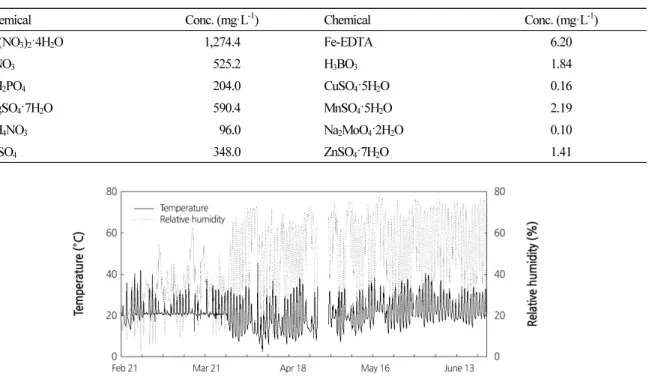
-1EC (electrical conductivity) that gradually increased in concentration (Table 1) . Plug trays were rearranged every day after irrigation to provide uniformly distributed light wavelengths and intensities. Seedlings were grown for 23 days after treatment (DAT) with various light treatments.
At 24 DAT, the seedlings were transplanted into slab-type rockwool media (Grodan Co. Ltd., Roermond, The Netherlands) in a Venlo-type glasshouse. Three seedlings were planted per slab. The nutrient solution was automatically drip-irrigated two to three times a day for 10 minutes (Sonneveld and Straver, 1994), and pH and EC were 6.5 and 1.5 - 2.0 dS ·m
-1, respectively (Table 1) . The mean temperature and RH in the daytime were approximately 22°C and 40%, respectively (Fig. 1) .
Table 1. Composition of the nutrient solution used in the experiment
Chemical Conc. (mg·L
-1) Chemical Conc. (mg·L
-1)
Ca(NO
3)
2·4H
2O 1,274.4 Fe-EDTA 6.20
KNO
3525.2 H
3BO
31.84
KH
2PO
4204.0 CuSO
4·5H
2O 0.16
MgSO
4·7H
2O 590.4 MnSO
4·5H
2O 2.19
NH
4NO
396.0 Na
2MoO
4·2H
2O 0.10
K
2SO
4348.0 ZnSO
4·7H
2O 1.41
Fig. 1. Temperature and relative humidity in a Venlo-type glasshouse after transplanting the tomato seedlings during 122 days.
Light Quality Treatments
The light qualities for this experiment were sourced from FL and combinations of R and B LEDs [R:B = 100:0 (R), R:B
= 70:30 (R7B3), R:B = 50:50 (R5B5), R:B = 30:70 (R3B7), or R:B = 0:100 (B) LEDs (LP1827RB-120C, L-PEC Co. Ltd.,
Jeonju, Korea)] (Fig. 2) . These ratios are based on PPFD. To compare the effects of chemicals used to suppress plant
height and to enhance the quality of seedlings at the farm readily, 150 mg·L
-1of diniconazole (Binnari, Dongbang Agro Co. Ltd., Seoul, Korea) was additionally applied one time to seedlings under FL (Dini) by foliar spray when two true leaves of a plant appeared. The light spectral distribution was measured using a spectroradiometer (ILT950, International Light Technologies Inc., Peabody, MA, USA) at five points (center and four edges) at the bottom of the tray (Fig. 2) . The PPFD of wavelengths in each treatment were determined from bandwidth integration (Table 2) .
A B C
D E F
Fig. 2. The spectral distribution of light used in the closed-type plant factory: A, Fluorescent lamp; B, R LEDs (red:blue = 100:0); C, R7B3 LEDs (red:blue = 70:30); D, R5B5 LEDs (red:blue = 50:50); E, R3B7 LEDs (red:blue = 30:70); and F, B LEDs (red:blue = 0:100).
Table 2. Light intensity of each wavelength in different light quality combinations
Light quality
zPPFD
y(µmol ·m
-2·s
-1)
400 - 499 nm 500 - 599 nm 600 - 700 nm
FL 70.2 82.2 42.1
R 0.2 0.2 199.2
R7B3 58.1 0.6 140.9
R5B5 100.0 0.8 98.8
R3B7 138.0 0.9 60.4
B 198.5 1.1 0
z
The light qualities are as follows: FL, fluorescent lamp; R, red:blue = 100:0; R7B3, red:blue = 70:30; R5B5, red:blue = 50:50; R3B7, red:blue
= 30:70; and B, red:blue = 0:100.
y
Photosynthetic photon flux density.
Growth Characteristics
Plant growth parameters, such as the plant height, stem diameter, number of leaves, leaf area, leaf shape index, specific
leaf weight (SLW), SPAD value, fresh and dry weights of stem and leaf, dry matter, compactness, and chlorophyll
fluorescence (Fv/Fm) were measured at 23 DAT. The stem diameter was measured at 1 cm above the medium surface
using digital vernier calipers (CD-20CPX, Mitutoya Corp., Kawasaki, Japan). The number of leaves was measured by
counting all plant leaves except for the cotyledons. The leaf area was measured using a leaf area meter (LI-3000, LI-COR Inc., Lincoln, NE, USA). The SPAD value was measured on the fifth leaf from the top using a chlorophyll meter (SPAD-502, Konica Minolta Inc., Osaka, Japan). The fresh weight was measured with an electronic scale (EW 220-3NM, Kern&Sohn GmbH., Balingen, Germany). The dry weight was measured after drying the divided samples of the stem, leaf, and root for 72 hours in a drying oven (Venticell-222, MMM Medcenter Einrichtungen GmbH., Munich, Germany) at 70°C. The Fv/Fm was measured in diurnal time courses using a portable saturation-pulse chlorophyll fluorometer (PAM-2100, Heinz Walz GmbH, Effeltrich, Germany).
After transplanting, the flowering speed, position of flower clusters, and cluster height were measured at 122 days after transplanting. The flowering speed was calculated as the percentage of the flowering of the first flower in the first or second cluster in a total of 9 plants per treatment. The leaf shape index, SLW, dry matter, and compactness of tomato seedlings were calculated using the following formulae:
Leaf shape index = leaf length/leaf width
SLW (mg·cm
-2) = dry weight of leaf (mg)/total leaf area (cm
2)
Dry matter (%) = [dry weight of shoot (g)/fresh weight of shoot (g)] × 100 Compactness (mg·cm
-1) = dry weight of shoot (mg)/plant height (cm)
Determination of Starch and Total Sugar Contents
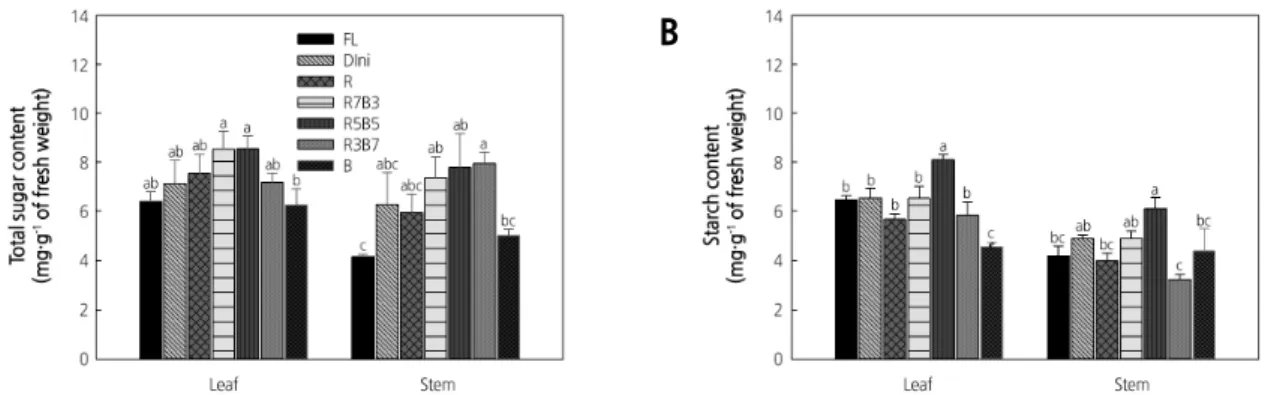
To determine the total sugar content, all leaves of a plant were ground with liquid nitrogen at 23 DAT, stored in a deep freezer at - 70°C, and then determined using the modified method of Dubois et al. (1956). Three 0.3-g samples were taken per light treatment. The samples were mixed with 10 mL of 80% ethanol and then ground for 1 minute. After being boiled in a 60°C water bath, the supernatant was separated by centrifugation (908 × g, 20°C, 30 min). The remaining precipitate was mixed with 10 mL of 80% ethanol, boiled in a water bath at 60°C for 30 minutes, and then centrifuged in the aforementioned manner. After 2 centrifugations, the supernatant was diluted with 40 mL of 80% ethanol, 0.5 mL of 5%
phenol reagent was added and vortexed, and 2.5 mL of 98% sulfuric acid was added and vortexed. After being cooled to room temperature, the absorbance was measured at 490 nm using a UV spectrophotometer, and the total sugar content was calculated using glucose as the standard.
To determine the starch content, all leaves of a plant were ground with liquid nitrogen at 23 DAT, stored in a deep freezer at - 70°C, and then determined using the modified method of Lim et al. (2003). Three 0.3-g samples were taken per light treatment. To solubilize the samples, 10 mL of 80% ethyl alcohol was added to the samples, shaken for 30 minutes, and then centrifuged at 300 × g for 30 minutes at 20°C. Ethanol (40%) was then added to the residue and centrifuged again at the same conditions. Two milliliters of 30% HClO
4and 1 mL of dimethyl sulfoxide were added to the residue and kept at room temperature for 30 minutes. After that, 2 mL of distilled water and 5 mL of H
2SO
4were added and kept in a 100°C water bath for 1 hour and subsequently centrifuged again at the same conditions. To 0.5 mL of this sample, 0.5 mL of 5%
phenol reagent was added and vortexed, and 2.5 mL of 98% sulfuric acid was added and vortexed. After being cooled to
room temperature, the absorbance was measured at 470 nm using a UV spectrophotometer, and the starch content was
calculated using glucose as the standard.
Statistical Analysis
A randomized complete block design with 3 replications and 5 plants in each replication was employed in the experiment. After transplanting, completely randomized designs with 3 replications and 3 plants in each replication were employed in a glasshouse. The statistical analysis was carried out using the statistical analysis system program (SAS 9.1, SAS Institute Inc., Cary, NC, USA). The experimental results were subjected to an analysis of variance (ANOVA) and Duncan’s multiple range tests. Graphing was performed with the SigmaPlot program (SigmaPlot 12.0, Systat Software Inc., San Jose, CA, USA).
Results and Discussion Growth Characteristics
The plant height and stem diameter of tomato plug seedlings were measured 9, 16, and 23 DAT, which showed
significant differences depending on the light treatment (Figs. 3 and 4) . R LEDs resulted in the tallest plant height,
followed by FL and B LEDs (Fig. 3A) . Combined R and B LEDs treatments and Dini produced short plants. Several
studies report that plant height is promoted or suppressed by R or B light, respectively (Tanaka et al., 1998; Wang et al.,
2009; Johkan et al., 2010; Shimizu et al., 2011). Our results that plants grown under R LEDs were taller than plants grown
under B LEDs agreed with these reports. Monochromatic R and B lights are known to have excellent light use efficiency,
absorbing both wavelengths by chlorophylls a and b efficiently (Hopkins and Hüner, 2004; Terashima et al., 2009). This
aligns with the results of our study, where monochromatic LEDs enhanced the height of seedlings compared to combined
R and B LEDs. On the other hand, combined R and B LEDs treatments produced short plants. Similar results were
observed for Korean melon seedlings, where the height of plants grown under combined R and B LEDs was smaller than
the height of plants grown under monochromatic B LEDs (Lee et al., 2016a). These results suggest that combined R and
B LEDs can limit seedling elongation. Despite the fact that FL contains all wavelengths between 400 and 700 nm,
seedlings grown under FL were still taller than seedlings grown under combined R and B LEDs. The difference between
combined R and B LEDs and FL is that FL contains green (G) light (500 - 599 nm) of 82.2 µ mol ·m
-2·s
-1(Table 2) . It is
known that G light acts antagonistically to R and B light (Folta and Maruhnich, 2007). Therefore, it is considered that the
G light included in the FL partially canceled the roles of the B light of 70.2 µ mol ·m
-2·s
-1and the R light of 42.1 µ mol ·m
-2·s
-1,
which make the plant short. For this reason, it is thought to be the reason that plants grown under FL were taller than plants
grown under combined R and B LEDs. At 16 and 23 DAT, the stem diameter was the greatest for plants grown in R7B3
among all considered R and B LEDs combinations, and the smallest in for plants grown in Dini (Fig. 3B) . A previous study
reported that tomato plants grown under combined lights (combined R, B, and G LEDs) had stronger stems than plants
grown under monochromatic lights (yellow, G, or R LEDs) (Liu et al., 2009). However, our result was not only different
from this result, but the treatment was also different from our study. All LEDs treatments were thicker than Dini. With the
exception of plants grown under Dini, there were no differences in stem diameter among plants. Therefore, treatments of
combined R and B LEDs are advantageous to producing high-quality fruit-vegetable seedlings with short and thick stems.
A B
Fig. 3. The effects of the light quality on the plant height (A) and stem diameter (B) of ‘Mini Chal’ tomato (Solanum lycopersicum L.) measured 9, 16, and 23 days after treatment. Refer to Fig. 2 for details on the light quality. Vertical bars indicate the mean ± S.D. (n = 15).
Fig. 4. ‘Mini Chal’ tomato (Solanum lycopersicum L.) plug seedlings grown under various light qualities at 23 days after treatment. Refer to Fig. 2 for details on the light quality.
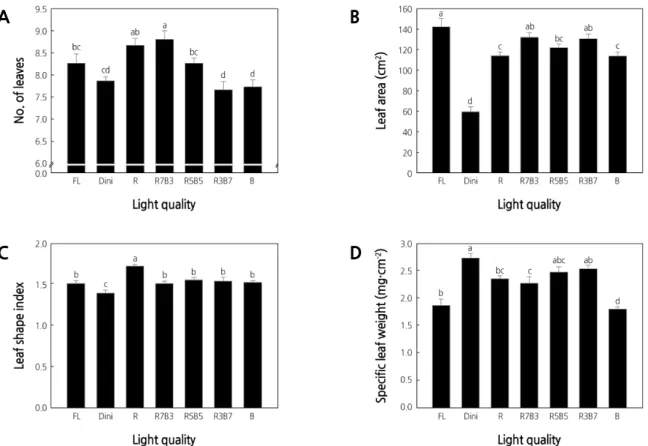
The number of leaves was the highest for plants grown in R7B3 and the lowest for plants grown in R3B7 and B (Fig.
5A) . This demonstrates that a high B light ratio reduces the formation of new leaves. The total leaf area per plant was the
largest for plants grown in FL, followed in order by plants grown in R7B3 and R3B7, and the lowest was for plants grown
in Dini (Fig. 5B) . Despite plants grown in R3B7 having few leaves, the large leaf areas observed are thought to be more
advantageous for photosynthesis. Sufficient leaf area is essential to plant growth as it is responsible for photosynthesis,
fixing CO
2, and accumulating starch (Tsukaya, 2004). A wider range of tendencies was observed for leaf area of plants
grown under combined LEDs than under monochromatic LEDs. This demonstrates that the treatment of combined R and B LEDs on seedlings affects the growth of leaves more than stems. In ‘Cuty’ tomato plant, leaf area was greater in seedlings grown under combined R and B LEDs (R:B = 65:35 ratio) than under monochromatic R LEDs (Son et al., 2018).
However, leafy vegetables such as lettuce, spinach, and komatsuna showed different results, and leaf area was wider in monochromatic R or B LEDs, except for spinach. Leaf area of spinach was similar between R and combined LEDs (Ohashi-Kaneko et al., 2007). As a result of leaf growth of spinach ‘Sushiro’ and ‘Worldstar’ irradiated with white, monochromatic R or B, and combined R and B LEDs, cell density and size of spinach leaves showed different responses as affected by light quality in two cultivars (Lee et al., 2018). Therefore, leaf growth is considered a variety and genetic characteristic. These results suggest that a proper combination of R and B LEDs is essential to the leaf growth in ‘Mini Chal’ tomato (Britz and Sager, 1990; Hoenecke et al., 1992).
Leaf shape, size, and thickness are phenotypically plastic and responsive to changes in the environment, such as light intensity and quality (Givnish, 1988; Smith and Whitelam, 1997; Yano and Terashima, 2001). The leaf shape index was the highest for plants in R and the lowest for plants in Dini (Fig. 5C) . Plants exposed to other light treatments had similar leaf shape indices. A high leaf shape index signifies a long and narrow leaf, and a low leaf shape index means a short and wide leaf (Fig. 6) . This indicates that R light produces long leaves, which have been reported in previous studies using lettuce (Lee et al., 2010; Son et al., 2012).
A B
C D
Fig. 5. The effects of the light quality on the number of leaves (A), leaf area (B), leaf shape index (C), and specific leaf weight
(D) of ‘Mini Chal’ tomato (Solanum lycopersicum L.) plants measured 23 days after treatment. Refer to Fig. 2 for details
on the light quality. Vertical bars indicate the mean ± S.D. (n = 15). Different letters above the bars indicate significant
differences by Duncan’s multiple range test at p ≤ 0.05.
The SLW is presented as an indicator of the leaf thickness. The SLW was the greatest for plants grown in Dini, followed by plants grown in R3B7 and R5B5, and the lowest for plants grown in FL and B (Fig. 5D) . Leaf thickness is an important factor for water availability in plants and is indicative of the plug seedling quality. Thin leaves quickly desiccate (Tsukaya, 2004). Dini, R3B7, and R5B5 environments produced leaves with relatively higher SLW compared to leaves of plants grown in other light treatments. The light qualities used in FL and Dini were identical, but plants showed drastically different responses to these two treatments. In contrast, leaves of plants grown under R5B5 and R3B7 were similar to leaves of plants grown under Dini. It was shown that monochromatic LEDs did not have a positive effect on the leaf growth. R7B3, with a high R light ratio, increased the number and area of leaves but resulted in low SLW and was therefore detrimental to leaf growth. In contrast, R3B7 increased the total leaf area and SLW and seems to influence leaf growth more positively, even when restricting the formation of new leaves.
The SPAD value, indicative of the chlorophyll content, was the highest for plants in Dini. Seedlings grown in R5B5 and R3B7 had higher SPAD values compared to that of seedlings in all other environments (Fig. 7) . Seedlings grown under B LEDs had the smallest SPAD value. It was previously thought that B light enhances chlorophyll biosynthesis, supported by observations in lettuce, cucumber, and spinach (Matsuda et al., 2007; Hogewoning et al., 2010; Lee et al., 2010).
However, the SPAD value of plants increased with increasing B light ratio up to 70% in this study, while 100% B light resulted in the lowest SPAD value. In ‘Sunmang’ lettuce, the SPAD value increased with increasing B light proportion up to 47%, up to 59% in ‘Grand Rapid TBR’ (Son and Oh, 2013), and up to 35% in ‘Cuty’ tomato. These results suggest that a proper ratio of R and B LEDs, rather than B light alone, improves the SPAD value of seedlings (Son et al., 2018). Also, this result seems to be related to the leaf thickness, where a similar trend was observed (SLW, Fig. 5D ). Several studies report that the SLW is positively correlated with the chlorophyll concentration (Buttery and Buzzell, 1977; Buttery et al., 1981; Hesketh et al., 1981). It is possible that appropriate combinations of R and B LEDs (R5B5 and R3B7) increased the leaf thicknesses and led to increased SPAD values.
The fresh and dry weights of leaves and stems of ‘Mini Chal’ tomato plants are shown in Table 3 . Total fresh weight of seedlings was the greatest in R LEDs. R7B3 produced plants with the greatest fresh leaf weight, followed by R and R3B7.
Fig. 6. Leaf shapes of ‘Mini Chal’ tomato (Solanum lycopersicum L.) under different light treatments at 23 days after
treatment. Refer to Fig. 2 for details on the light treatments. Scale bar = 20 mm.
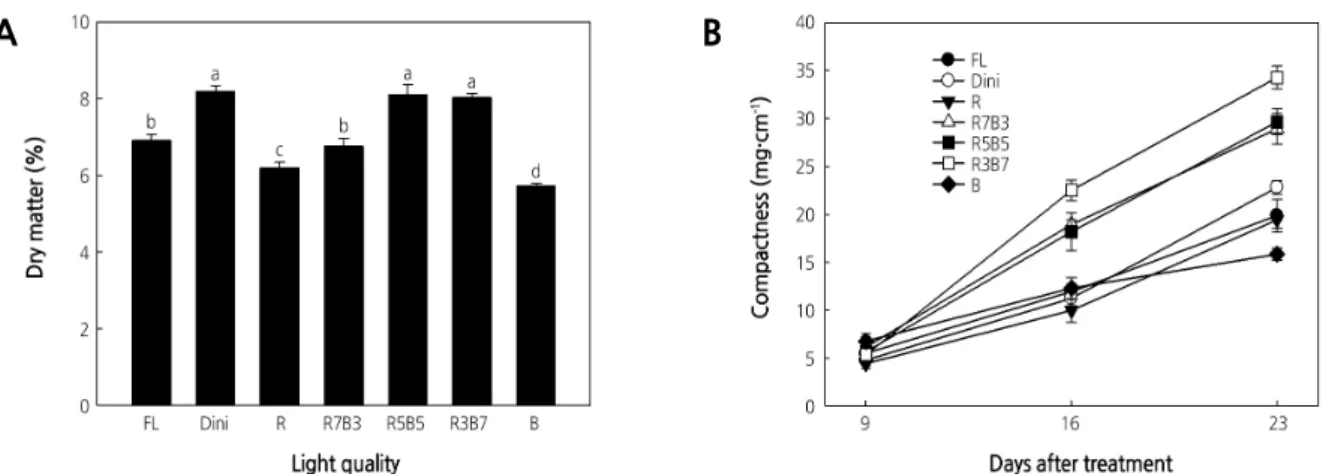
Of all LEDs environments considered, R resulted in the greatest, and R5B5 and R3B7 resulted in the lowest fresh stem weight. R light promoted both stem and leaf developments. By contrast, R3B7 had the highest fresh leaf weight despite the lowest fresh stem weight. Fresh leaf and stem weights were the lowest in Dini of all considered environments. Several studies indicate that R light increases the fresh and dry shoot weights in various crops, such as lettuce, ice plant, and perilla (Nishimura et al., 2009; Johkan et al., 2010; Shimizu et al., 2011; Kim et al., 2016), as R light activates the phytochromes that promote plant growth by expanding leaves and elongating stems and petioles (Johnson et al., 1994; Mockler et al., 1999; Franklin and Quail, 2009; Kebrom and Mullet, 2016). For this reason, R light promoted the growth of seedlings and increased the fresh weight. However, seedlings grown in R5B5 and R3B7, which had low fresh stem weights, showed similar total dry weights as seedlings grown under R LEDs, which had high fresh stem weights. These results indicate that both R5B5 and R3B7 produce more compact seedlings because they produce seedlings with similar total dry weights as seedlings with higher stem fresh weights.
Fig. 7. The effects of the light quality on the SPAD value of ‘Mini Chal’ tomato (Solanum lycopersicum L.) measured 23 days after treatment. Refer to Fig. 2 for details on the light qualities. Vertical bars indicate the mean ± S.D. (n = 15). Different letters above the bars indicate significant differences by Duncan’s multiple range test at p ≤ 0.05.
Table 3. Fresh and dry weights of leaf and stem of ‘Mini Chal’ tomato (Solanum lycopersicum L.) measured 23 days after treatment
Light quality
zFresh weight (g) Dry weight (g)
Leaf Stem Total Leaf Stem Total
FL 3.13 c
y1.93 c 5.06 bc 0.268 b 0.086 a 0.354 b
Dini 1.72 d 0.81 f 2.54 d 0.158 d 0.050 b 0.208 d
R 3.59 ab 2.39 a 5.98 a 0.267 b 0.103 a 0.370 ab
R7B3 3.87 a 1.62 d 5.49 ab 0.296 ab 0.076 a 0.373 ab
R5B5 3.25 bc 1.38 e 4.63 c 0.298 ab 0.076 a 0.375 ab
R3B7 3.56 ab 1.45 e 5.01 bc 0.328 a 0.075 a 0.403 a
B 2.83 c 2.16 b 4.99 bc 0.204 c 0.083 a 0.287 c
z
Refer to Fig. 2 for details on the light quality.
y