Ⅰ. 서 론
조현병은 정신증에 속하는 대표적인 장애로 현실 검증 력이 손상되어 비현실적인 지각과 비논리적인 사고를 나 타내고 혼란스러운 심리상태에 빠져든다(Kwon, 2014).
조현병 환자는 인지기능, 사고, 감정의 장애를 보이면서 대인관계, 직업적 능력에 부적응적인 영향을 미치고, 감 소된 언어능력, 둔마된 정동, 열약한 운동능력과 계획 혼 란, 맥락에 맞지 않은 부적절한 반응, 인지적 유연성 감 소, 빈약한 문제해결 능력 등이 조현병 환자에게서 보고
대한지역사회작업치료학회지 제10권 제1호
The Journal of Korean Society of Community Based Occupational Therapy Vol. 10 No. 1 (April 2020), 17-30
ISSN 2234-0866 https://doi.org/10.18598/kcbot.2020.10.1.02
만성조현병 환자를 위한 식료품 쇼핑 기술 강화 프로그램 기초연구:
델파이기법
김용섭*, 이성아**
*태안군 정신건강복지센터 작업치료사
**순천향대학교 작업치료학과 교수
― 국문초록 ―
목적 : 본 연구는 델파이 조사를 통해 국내 조현병 환자의 수단적 일상생활활동 훈련 중 식료품 쇼핑이라는 구체적인 수행 과제를 적용한 프로그램을 개발하기 위한 연구이다.
연구방법 : 델파이 1~3차 조사를 통해 최종 프로그램 항목 및 내용을 완성하는 단계로 2018년 8월부터 2019년 3월까지 진행되었다. 전문가 구성은 정신보건과 관련 있는 작업치료사 23명을 선정하였다. 개방형 문항으로 구성된 1차 설문 으로부터 작성된 2차 설문지는 중요한 정도를 리커트 5점 척도를 이용하여 표시하도록 하였다. 3차 설문의 응답결과 로 평균 및 표준편차, 내용타당도비율(Content Validity Ratio; CVR) 분석을 통해 전문가의 합의 수준을 다시 확인 하였다.
결과 : 3차에 걸친 델파이 조사 결과 식료품 쇼핑의 견해, 물건 구매 전략, 필요한 기능, 구매 결정 방법에 대한 전문가의 지식과 경험에 의한 의견을 구하는 4개의 문항으로 1차 개방형 델파이 설문을 실시하여 4가지 영역에 24가지 항목을 선정하였다. 2차, 3차 델파이 설문을 거쳐 각 항목의 적합도 기준에 미달하거나 내용이 중복되는 4개의 항목을 삭제 하고 최종적으로 20개의 항목을 추출하였다.
결론 : 만성조현병 환자들이 회복하고 사회의 일원으로 참여할 수 있도록 작업치료적 관점으로 식료품 쇼핑 기술에 전문가들의 합의를 도출하였다.
주제어 : 델파이, 식료품 쇼핑, 작업치료, 조현병
교신저자: 이성아([email protected])
접수일: 2020년 3월 20일 심사일: 2020년 3월 31일 게재승인일: 2020년 4월 24일
되고 있다(Semkovska, Bédard, Godbout, Limoge, &
Stip, 2004).
Rempfer, Mcdowd와 Brown(2017)은 조현병 환자에 게서 흔히 주의 및 정보처리 및 기억력 그리고 실행기능 의 장애가 발견되고, 이런 인지장애가 삶의 질, 활동능력, 적응상태에 중요한 영향을 미친다고 보고하였다. 실행기 능 장애(executive dysfunction)는 조현병의 가장 보편적 인 특징 중 하나이며(Bowie & Harvey, 2005), 직업 및 사회적 영역에서 발생할 수 있는 기본적인 자기관리 기 술, 일과 생산적인 활동 및 사회적 능력인 기능적 결과 (functional outcomes)와 관련이 있다(Green, Kern. Braff,
& Mintz, 2000; Reed, Harrow, Herbener, & Martine, 2002). 따라서 조현병 환자의 경우 개개인 마다 일상적인 기능에 상당한 차이가 있음에도 불구하고, 만족스럽지 못한 기능적 결과로 인해 자기관리 및 다른 사람돌보기, 주택관리, 직장, 개인 의사소통 등과 같은 삶의 영역에서 기능 저하를 초래한다(Lipskaya, Jarus, & Kotler, 2011).
최근까지 조현병 환자를 대상으로 적용한 기능적 결과 에 관한 연구는 주로 신경심리학적 검사를 사용하였다.
이 검사들은 인지기능장애에 대한 중요한 정보를 제공 하지만 과제수행을 하는데 계획하고 구조화가 필요한 실제 생활의 복잡한 상황(예 : 쇼핑, 식사준비 또는 약물 관리)에서 기능을 예측하는 능력이 제한적이다(Chaytor, Schmitter-Edgecombe, & Burr, 2006). 실제 환경에서 수 행을 관찰하면 일상생활에서 활동하는 기능적 결과를 올 바르게 반영할 수 있다. 특히 다양한 정보를 처리하는데 결핍을 경험하는 조현병 환자는 미묘하고 복잡한 환경 단서를 처리하거나(Cornblatt & Keilp, 1994), 혼란스러 운 상황을 차단하는데 어려움이 있고(McDowd, Filion, Harris & Braff, 1993), 단기 기억이 부족하여 의미가 있 는 자극에 반응하는 능력에 영향을 미쳐(Knight, 1993), 환경에서 공간 및 시간적 일관성을 유지하는 능력이 감 소하게 된다(Hemsley, 1996). 식료품 쇼핑 기술은 충동 구매를 유발하도록 고안된 실제 매장에서 저렴한 가격으 로 원하는 제품을 선택해야 하는 과제이기 때문에 조현 병 환자가 어려워하는 기술 중 하나이다. 인지적으로 복 잡한 기술이 요구되고, 시끄러운 실제 상황을 감안할 때, 식료품 쇼핑 기술은 조현병 환자의 기능적 결과 향상을 위해 선택되어야 한다.
최근까지 만성 조현병 환자를 대상으로 하는 식료품 쇼 핑에 대한 선행연구를 보면 Brown, Rempfer와 Hamera
(2002)는 식료품 쇼핑 개입이 상품 구입에 있어 정확도와 중복구매를 개선하는데 전반적인 효과가 있었다고 보고 하였고, Rempfer, Hamera, Brown과 Cromwell(2003)은 조 현병환자의 식료품 쇼핑이 독립적인 생활 기술과 관련이 있다고 보고하였다. 식료품 쇼핑은 수단적 일상생활활동 (IADL)이며 독립적인 공동체 생활에 필수적이고, 정신 질환을 앓고 있는 환자가 이 과제를 수행함에 있어 상당 한 걸림돌이었다(Hamera & Brown, 2000). 그렇기 때문 에 조현병 환자가 지역사회에서 적응하기 위해 식료품 쇼핑 훈련이라는 매우 구체적인 프로그램이 필요하다.
지적장애, 발달장애인을 대상으로 하는 마트장보기 프 로그램은 멀티미디어, 스마트폰 등 다양한 방법으로 연 구되었지만(Ju, Kim, & Mo, 2017; Kwon, 2012), 국내 조 현병 환자를 대상으로 수단적 일상생활활동 증진을 위한 식료품 쇼핑이라는 구체적인 중재 방법으로 접근한 문헌 이 없는 실정이다. 국외에는 식료품 쇼핑 훈련 프로그램 이 정신과 환자들에게 적용되어 많이 개발되고 시행되어 져 오고 있다(Arbesman & Logsdon, 2011; Rempfer et al., 2003). 따라서 조현병 환자의 수단적 일상생활 활동 의 일환인 식료품 쇼핑에 대한 관심과 중재에 대한 필요 성이 요구되고, 정신과 영역에서 작업치료 분야의 확장 으로 이어지고 있다. 델파이 조사를 통해 국내 조현병 환 자를 위한 식료품 쇼핑 기술 강화 프로그램 개발을 위한 기초자료로 삼고자 한다.
Ⅱ. 연구 방법 1. 델파이 연구 설계
지역사회 기반의 만성 조현병 환자를 위한 식료품 쇼 핑 프로그램 개발을 위해 델파이(Delphi) 기법을 사용하 였다. 델파이 기법은 의사결정에 필요한 핵심내용에 대 해 전문가의 의견을 각각 조사하고 종합하여 결론을 도 출해 내는 신뢰도 높은 연구방법이다(Lee, 2001). 양적인 방법에 의한 측정으로는 쉽게 결정할 수 없는 정책이나 사회적 이슈에 대해 전문가 집단의 의견과 판단을 추출 하고 종합하여 집단적 합의를 도출해내는 기법이다(Lee
& Moon, 2016). 본 연구는 아직 식료품 쇼핑 기술 강화 프로그램에 대한 명확한 근거를 가지고 있지 않음으로 전문가들의 의견을 종합해 합의점에 도달해야 하는 점에
서 델파이 기법을 실시하였다. 연구 과정은 개방형 설문 선정, 1~3차 델파이 조사 순으로 진행하였다(Figure 1).
델파이 기법을 사용한 연구에서 원하는 목적을 달성하기 위해 전문가 패널을 선정하는 일이 가장 중요하다(Lee &
Shin, 2002). 그러므로 본 연구에서 델파이 조사 대상자 는 전문적인 견해와 지식을 보유하고 있고, 정신보건 작 업치료 임상 경력 3년 이상인 자, 작업치료 관련 박사학 위 이상인 자, 작업치료에서 정신보건 작업치료관련 강 의와 연구 경험이 있는 자들로 판단하여 26명을 선정하 였다. 총 3차에 걸쳐 설문을 진행하였고, 전자 우편 또는 인편제출을 통해 회수 하였다. 1차 델파이 조사에 참여한 전문가는 3명 탈락한 23명, 2~3차 델파이 조사에 참여한 전문가는 23명이었다.
2. 개방형 설문지 개발
본 단계는 델파이 1차 조사를 위해 개방형 설문지를 개발하는 단계이다. 식료품 쇼핑 기술 평가(The Test of Grocery Shopping Skills: TOGSS)(Hamera & Brown, 2000)와 실제 환경에서 쇼핑(Real World Shopping:
RWS)(Faith & Rempfer, 2018)의 식료품 쇼핑 평가 과정
을 토대로 번안, 추출, 재구조화를 통해 1차 초안을 개발 하였다. TOGSS에서는 10개의 식료품 항목에 대한 올바 른 항목을 정확한 크기 및 최저 가격의 물건을 선택하는 과정을 측정하고, 쇼핑 작업을 수행하는 시간을 측정하 는 도구이다. RWS는 관찰과 자가보고 및 시간측정의 3 가지 영역을 고려하는 도구이다.
RWS 관찰의 항목은 1) 식료품 목록을 사용하겠습니 까?, 2) 식료품 카트를 사용하겠습니까?, 3) 상점(자체) 상품을 구매 하겠습니까?, 4) 전체 선반을 스캔하여 최적 의 구매 물품을 찾겠습니까?, 5) 물건을 얻지 않고 상점 의 일부(통로 또는 주변)를 걷습니까?, 6) 같은 식료품 통 로나 주변을 두 번 이상 내려가십니까?, 7) 상품 찾는 것 을 포기 하시겠습니까?, 8) 선택한 품목에 대해 지불 할 충분한 돈이 있습니까?, 같은 항목으로 구성되었다.
RWS 자가 보고는 참가자가 식료품 쇼핑 후 쇼핑에 대한 것을 자체 보고하는 과정이다. 항목으로는 1) 집에 서 어떤 음식을 먹었는지 확인했나요? 2) 필요한 것들의 목록을 작성했습니까?, 3) 필요한 모든 품목을 찾았습니 까?, 4) 구매하고자 작성했던 목록에 있거나 일반적으로 구입하지 않는 품목을 구매했습니까?, 5) 품목을 찾는데 문제가 있었습니까?, 6) 원하는 것보다 항목을 찾기 위해
Open
Questionnaire
Literature Review
Extraction and restructuring of retrieved documents Develop the first program draft
Delphi Survey
First Delphi Survey
1. Development of the 1st open questionnaire through literature review 2. Provide open surveys to experts
3. Item categorization and extraction of response cases by question 4. Completion of the 2nd Delphi Survey
Second Delphi Survey
1. Each category is presented on a Likert 5-point scale
2. Mean and Standard Deviation, Convergence, Consensus, CVR Analysis 3. Low average or CVR or duplicate content, edit and delete items based
on comments
4. Completion of the 3rd Delphi Survey
Third Delphi Survey
1. Present the second response result statistics together to the expert 2. Provide an opportunity to review the expert's own opinion
3. Mean and Standard Deviation, Convergence, Consensus, CVR Analysis 4. Low average or CVR, duplicate content, edit and delete items based
on comments
5. Derivation of final program contents
Figure 1. Delphi Survey Process시간이 더 걸렸습니까?, 7) 전체 선반을 스캔하여 최적을 상품을 찾았습니까?, 8) 생각보다 많은 돈을 사용했습니 까?, 9) 저렴한 상품을 찾기 위해 도움을 요청하는데 어 려움이 있었습니까?, 10) 필요한 브랜드, 맛 또는 크기를 결정하는데 어려움이 있었습니까?, 11) 상점에 있는 주변 사람들에게 도움을 요청하는 것에 어려움이 있었습니 까?, 12) 천장 안내표지판을 사용하여 어떤 통로를 찾을 수 있었습니까?, 13) 상점의 구역을 찾는데 어려움이 있 었습니까?, 14) 상품 찾기를 포기했습니까?, 15) 하나 이 상의 품목 브랜드를 비교하여 원하는 것을 얻을 수 있었 습니까?, 16) 쇼핑하는 동안 쉽게 산만해집니까?, 17) 원 하지 않는 상품을 구매했습니까?, 18) 쇼핑 활동에 계속 집중할 수 있습니까?, 19) 자체 브랜드 상품이나 광고되 지 않는 상품을 구매했습니까?, 20) 세일 중인 상품에 대 한 매장 행사를 확인했습니까?, 같은 항목을 구성되었다.
이를 토대로 전문가들의 의견을 수렴하고자, 지역사회 회복을 위한 식료품 쇼핑 기술의 견해, 물건 구매 전략, 필요한 기능, 구매 결정 방법에 대한 전문가의 지식과 경 험에 의한 의견을 구하는 자유 서술형 문항으로 총 4문 항의 1차 델파이 개방형 설문지를 완성하였다.
3. 델파이 조사
델파이 1~3차 조사를 통해 최종 프로그램 항목 및 내 용을 완성하는 과정으로 2018년 8월부터 2019년 3월까지 진행되었다. 첫 번째 단계로 개방형 델파이 설문을 통해 얻은 전문가들의 응답을 바탕으로 4개의 영역에 24개의 문항을 추출, 범주화를 통해 2차 델파이 항목을 완성하였 다. 2차 델파이 조사는 연구자의 내용분석에 대한 신뢰도 를 검증하는 과정으로 추가되거나 통합, 분리되어야 할 항목이 있는지 검토하였다. 작성된 2차 설문지는 중요한 정도를 리커트 5점 척도를 이용하여 표시하도록 하였다.
3차 델파이 조사는 2차 설문지 같은 문항으로 하여 패널 의 합의를 구하는 과정이었다. 3차 설문지에는 2차 조사 의 집단합의라고 할 수 있는 각 항목에 대한 평균값의 범 주를 음영으로 표시하고 제시함으로써 응답자가 각 항목 의 중요도를 재평가하는데 다른 전문가의 의견을 참고할 수 있도록 하였다. 3차 조사의 응답결과로 평균 및 표준 편차, 내용타당도비율(CVR) 분석을 통해 전문가의 합의 수준을 다시 확인하여 항목 재구성을 통해 최종 프로그 램 내용을 도출하였다.
4. 자료 분석
3회에 걸쳐 수집된 자료는 SPSS 25.0 소프트웨어와 EXCEL 프로그램을 사용하여 분석하였다. 1차 델파이 조사 자료 분석은 프로그램 초안을 기반으로 하여 만들 어진 개방형 설문을 사용하였으므로 통계 분석 대신 연 구자들의 토론으로 문항을 유형화하였다. 2, 3차 델파이 조사는 리커트 척도를 사용하였으므로 연구 참여자의 일 반적 정보는 기술통계를 사용하였고, 수집된 값은 평균 과 표준편차, 내용타당도, 수렴도, 합의도를 산출하였다.
문항의 내용타당도를 확인하기 위하여 Lawshe(1975)가 제시한 내용타당도의 비율(Content Validity Ratio;
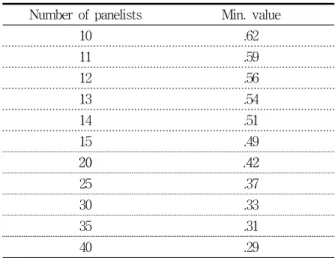
CVR)을 바탕으로 분석하였다. CVR은 참여 전문가의 수 에 따라 최솟값이 결정되는데 본 연구에서는 2, 3차 23명 으로 20명의 기준에 따라 CVR의 최솟값은 .42이다 (Table 1). 최솟값 이상이 되었을 때 문항에 대한 내용타 당도가 있는 것으로 판단된다. 이를 계산하는 공식은 다 음과 같다.
n
e: 리커트 척도 4점과 5점에 응답한 인원들을 합한 수
N : 문항에 대하여 응답한 전체 수Table 1. Minimum values of content validity ratio
Number of panelists Min. value
10 .62
11 .59
12 .56
13 .54
14 .51
15 .49
20 .42
25 .37
30 .33
35 .31
40 .29
Lawhe(1975)로부터 인용
설문조사의 의견통합을 확인하기 위한 안정도 검사는 변이계수(coefficient of variation; CV)로 측정하였는데, 각 문항의 표준편차를 산술평균으로 나눈 값이다. 변이
계수가 0.5이하인 경우 추가적인 설문이 필요 없으며, 0.
5~0.8인 경우 비교적 안정적이고, 0.8 이상일 경우 반복 설문을 통하여 의견의 합의를 도출하기로 정하였다(Noh, 2006). 문항의 타당도는 전문가의 의견이 수렴하고 있는 지를 확인하기 위하여 합의도와 수렴도를 분석하였다.
수렴도는 0.5미만, 합의도는 0.75이상일 때 패널 간 의견 이 합의됨을 의미한다(Lim, Son, & Kam, 2012). 이와 함 께 합의도와 수렴도를 사용하여 각각의 전문가 응답의 합의정도를 판단하는 기준으로 활용하였다. 2, 3회기 델 파이 설문조사에서 전문가들의 의견에 대한 합의도와 수 렴도를 구하는 공식은 다음과 같다(Kang, 2008).
합의도
수렴도
Mdn은 중앙값, Q1과 Q3은 사분위 범위의 제1사분위 와 제3사분위의 계수로 전체 응답수의 누적값 중, 25%와 75%의 지점을 의미한다. 합의도는 1에 근접할수록 합의 에 가깝다고 해석하며, 수렴도는 0에 가까워 질 때 의견 이 수렴된다고 해석된다(Lee, 2012).
Ⅲ. 연구 결과 1. 연구 패널에 대한 일반적인 특성
본 연구의 설문에 응답한 전문가 23명 중 20대가
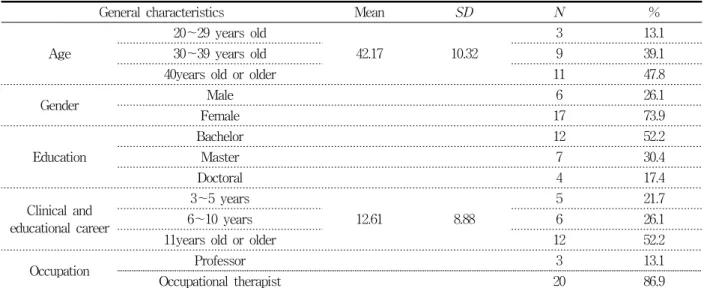
13.1%인 3명, 30대가 39.1%인 9명, 40대 이상이 47.8%인 11명으로 평균 연령은 42.17(10.32)로 나타났다. 남성이 26.1%인 6명, 여성이 73.9%인 17명으로 나타났다. 평균 임상 및 교육 경력은 12.61(8.88)년으로 3~5년이 21.7%
인 5명, 6~10년이 26.1%인 6명, 11년 이상이 52.2%인 12 명으로 나타났다. 직업군으로는 교수가 3명 13.1%, 작업 치료사가 20명 86.9%로 나타났다(Table 2).
2. 개방형 설문조사 결과
개방형 설문은 식료품 쇼핑의 견해, 물건 구매 전략, 필요한 기능, 구매 결정 방법에 대한 전문가의 지식과 경 험에 의한 의견을 구하는 문항으로 총 4가지의 개방형 질문으로 이루어 졌다. 회수율은 26명 중 23명으로 88.4%로 나타났으며, 각 전문가 집단에 수집된 반응을 근거로 삭제, 명칭 또는 내용 수정, 추가, 통합의 기준으 로 나누어 기록을 정리하였다. 전문가 의견 수렴 후 기준 에 따른 분류는 연구자들과 토의를 통하여 의견 반영 여 부를 결정하여 4가지 영역에 24가지 항목으로 나눴다. 개 방형 설문 결과를 바탕으로 항목 당 리커트 5점 척도로 구조화된 2차 설문지를 작성하였다(Table 3).
3. 2차 델파이 설문조사 결과
2차 델파이 설문조사는 전문가들이 개방형 설문에서 제시한 내용을 다시 정리하여 수정하였고, 리커트 5점 척 도로 제시하였다. 1차 델파이 설문에서 수집된 값은 평균
Table 2. General Characteristics of Experts Who Participated in the Survey (N=23)
General characteristics Mean SD N %
Age
20~29 years old
42.17 10.32
3 13.1
30~39 years old 9 39.1
40years old or older 11 47.8
Gender Male 6 26.1
Female 17 73.9
Education
Bachelor 12 52.2
Master 7 30.4
Doctoral 4 17.4
Clinical and educational career
3~5 years
12.61 8.88
5 21.7
6~10 years 6 26.1
11years old or older 12 52.2
Occupation Professor 3 13.1
Occupational therapist 20 86.9
과 표준편차, 내용타당도, 수렴도, 합의도를 산출하였다.
산출결과 “사회적 활동 참여 및 수단적 일상생활활동 제 한이 조현병 환자들이 지역사회에 복귀하는데 큰 걸림돌 이다. / 조현병 환자들이 실제 환경에서 식료품 쇼핑을 위한 프로그램이 부족하다. / 조현병 환자들에게 식료품 쇼핑 수행은 지역사회 복귀를 위한 필수적인 프로그램이 다. / 식료품 쇼핑이라는 구체적인 작업 기반의 수행을 통해 일상적 생활에 필요한 기술을 습득할 수 있다. / 필 요한 물건을 정확하게 선택할 수 있도록 하는 전략이 필 요하다. / 불안감을 줄여주고, 혼란스럽지 않도록 하는 안정화 전략이 필요하다. / 언어, 시각, 주의력, 실행기능 등의 인지적 기능이 필요하다. / 시간을 허비하지 않도록 구매할 물건을 작성해서 쇼핑을 한다.” 항목은 수렴도 0.5미만, 합의도 0.75이상, 내용타당도(CVR) 최솟값이
0.42이상으로 타당한 것으로 나타났다(Table 4). 그 외의 항목에서 의견의 합의도와 수렴도가 기준에 미달되었지 만 델파이 연구 특성상 연구를 진행하면서 합의에 도달 하는 과정으로 보고, 2차 델파이 설문조사에서 의견 합의 를 이루지 못한 항목에 대해서 3차 델파이 설문조사 때 의견의 합의와 수렴도를 재측정 하였다.
4. 3차 델파이 설문조사 결과
2차 델파이 조사 결과를 토대로 4개의 영역에 24가지 문항에 대한 중요도를 확인할 수 있도록 사분위 범위를 검은색 바(bar)로 표시하였다. 이는 다른 전문가의 의견 에 대한 범주를 시각적으로 표현한 것이며 2차 설문에서 응답한 자신의 의견을 비교할 수 있도록 하였다. 3차 델 Table 3. Second Delphi Survey item based on open survey results
Area Content
Opinion about grocery shopping in Instrumental Activities of Daily Living
Participation in social activities and limited means of daily living are major obstacles for schizophrenic patients to return to their communities.
Schizophrenic patients lack programs for grocery shopping in the real world
For schizophrenic patients, grocery shopping is an essential program for community return.
The specific task-based practice of grocery shopping can help you gain the skills you need for everyday life.
Grocery shopping can help with leisure activities and stress relief.
In a complex, real-world environment, carrying out grocery shopping is a challenge that requires planning and organizational structure
Strategies required to purchase goods
in real-world stores
You need a strategy to focus in a complex environment.
You need a strategy that will allow you to choose exactly what you need.
You need a strategy that will help you remember and buy things consistently, without impulsive buying.
A stabilization strategy is needed to reduce anxiety and to avoid confusion.
When you're hungry, you don't need to go grocery shopping.
By not using a large shopping cart, you need a strategy to see what you bought.
You need a strategy to check the groceries left in the refrigerator and to buy things in stores.
You need a strategy to enter the store and learn the whole process from the check out.
Necessary features for
grocery shopping
Cognitive skills such as language, vision, attention, and execution are required.
You need money skills to calculate things.
Problem solving skills are needed to cope with the sudden situation.
It is necessary to suppress impulse purchases due to various product advertisements and promotions.
There is a need for a technology that can control energy consumption and time consumption by unnecessary movement within the mart.
Skills needed to determine
grocery purchases
If it's the same kind of thing, choose the cheapest one.
Check whether the product is from a famous manufacturer or its own brand.
Distinguish capacity and size to see if it contains a lot of content for the price.
Choose a product that can be refilled or purchased only.
Write something to buy so you don't waste time shopping.
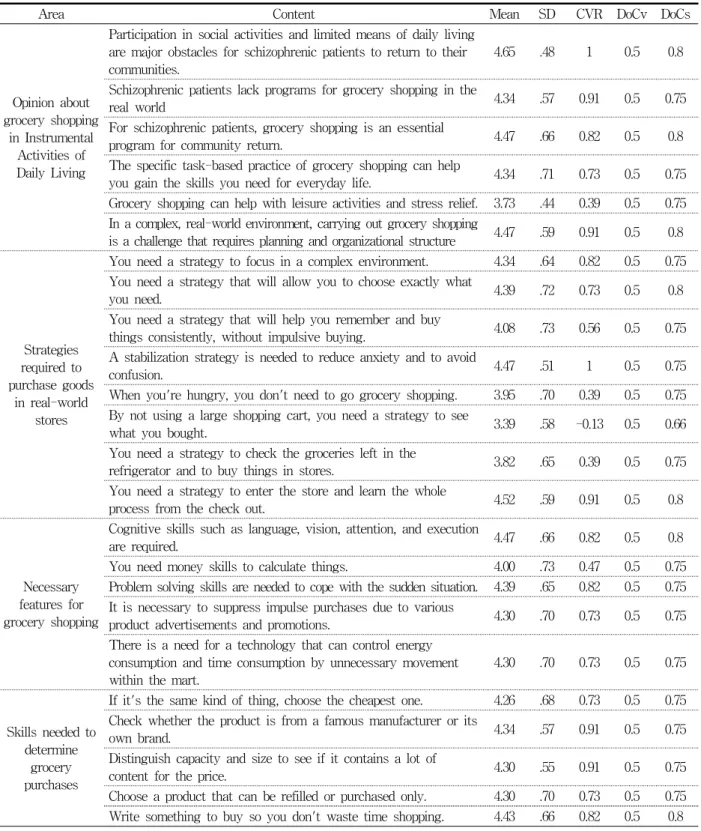
파이 설문에서 수집된 값은 평균과 표준편차, 내용타당 도, 수렴도, 합의도를 산출하였다(Table 5). 2차 델파이 조사 결과 보다 각 문항마다 타당도가 높아졌으며 합의 도와 수렴도의 범위가 좁아져 합의지점에 도달하고 있는
모습을 보였다. “식료품 쇼핑이 여가활동이나 스트레스 해소에 도움이 된다. / 배고플 때 식료품 쇼핑을 하지 않 는 전략이 필요하다. / 대형쇼핑카트를 사용하지 않음으 로 어떤 물건을 구매했는지 확인할 수 있는 전략이 필요 Table 4. Second Delphi Survey Results
Area Content Mean SD CVR DoCv DoCs
Opinion about grocery shopping
in Instrumental Activities of Daily Living
Participation in social activities and limited means of daily living are major obstacles for schizophrenic patients to return to their communities.
4.39 .78 0.65 0.5 0.8
Schizophrenic patients lack programs for grocery shopping in the
real world 3.87 .45 0.65 0.5 0.75
For schizophrenic patients, grocery shopping is an essential
program for community return. 4.04 .70 0.56 0.5 0.75
The specific task-based practice of grocery shopping can help
you gain the skills you need for everyday life. 3.87 .62 0.47 0.5 0.75 Grocery shopping can help with leisure activities and stress relief. 3.34 .57 -0.21 0.5 0.66 In a complex, real-world environment, carrying out grocery shopping
is a challenge that requires planning and organizational structure 4.09 .79 0.47 1 0.5
Strategies required to purchase goods
in real-world stores
You need a strategy to focus in a complex environment. 3.91 .73 0.39 0.5 0.75 You need a strategy that will allow you to choose exactly what
you need. 3.96 .70 0.47 0.5 0.75
You need a strategy that will help you remember and buy
things consistently, without impulsive buying. 3.74 .61 0.30 0.5 0.75
A stabilization strategy is needed to reduce anxiety and to avoid
confusion. 3.96 .47 0.73 0.5 0.75
When you're hungry, you don't need to go grocery shopping. 3.56 1.03 0.04 0.5 0.75 By not using a large shopping cart, you need a strategy to see
what you bought. 3.08 .73 -0.39 0.5 0.66
You need a strategy to check the groceries left in the
refrigerator and to buy things in stores. 3.47 .73 -0.30 0.5 0.66
You need a strategy to enter the store and learn the whole
process from the check out. 4.04 .87 0.30 1 0.5
Necessary features for grocery shopping
Cognitive skills such as language, vision, attention, and execution
are required. 4.00 .52 0.73 0.5 0.75
You need money skills to calculate things. 3.74 .68 0.21 0.5 0.75
Problem solving skills are needed to cope with the sudden situation. 3.78 .95 0.04 1 0.5 It is necessary to suppress impulse purchases due to various
product advertisements and promotions. 3.70 .92 0.13 0.5 0.75
There is a need for a technology that can control energy consumption and time consumption by unnecessary movement within the mart.
3.74 .96 0.13 1 0.5
Skills needed to determine
grocery purchases
If it's the same kind of thing, choose the cheapest one. 3.70 .76 0.39 0.5 0.75 Check whether the product is from a famous manufacturer or its
own brand. 3.61 .94 0.13 0.5 0.75
Distinguish capacity and size to see if it contains a lot of
content for the price. 3.70 .70 0.13 0.5 0.75
Choose a product that can be refilled or purchased only. 3.65 .98 0.30 0.5 0.75
Write something to buy so you don't waste time shopping. 4.00 .79 0.56 0.5 0.75
Note. SD=Standard deviation, CVR=Content Validity Ratio, DoCv=Degree of Convergence, DoCs=Degree of Consensus
하다. / 냉장고에 남아 있는 식료품을 확인하고 매장에서 물건을 구매하는 전략이 필요하다.” 문항은 수렴도 0.5미 만, 합의도 0.75이상, 내용타당도(CVR) 최솟값이 0.42미 만으로 내용의 타당성과 전문가들의 의견 차이를 보여
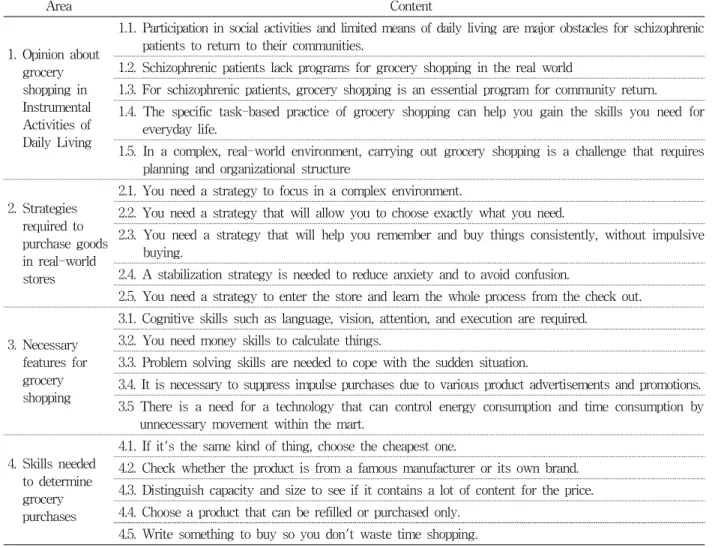
삭제 가능한 문항으로 나타났다. 합의도, 수렴도, 타당도 모두 기준에 충족한 과제를 정리하면 최종 24개에서 20 개로 축소되었다. 최종 문항에 대한 결과는 다음에 정리 하였다(Table 6).
Table 5. Third Delphi Survey Results
Area Content Mean SD CVR DoCv DoCs
Opinion about grocery shopping
in Instrumental Activities of Daily Living
Participation in social activities and limited means of daily living are major obstacles for schizophrenic patients to return to their communities.
4.65 .48 1 0.5 0.8
Schizophrenic patients lack programs for grocery shopping in the
real world 4.34 .57 0.91 0.5 0.75
For schizophrenic patients, grocery shopping is an essential
program for community return. 4.47 .66 0.82 0.5 0.8
The specific task-based practice of grocery shopping can help
you gain the skills you need for everyday life. 4.34 .71 0.73 0.5 0.75 Grocery shopping can help with leisure activities and stress relief. 3.73 .44 0.39 0.5 0.75 In a complex, real-world environment, carrying out grocery shopping
is a challenge that requires planning and organizational structure 4.47 .59 0.91 0.5 0.8
Strategies required to purchase goods
in real-world stores
You need a strategy to focus in a complex environment. 4.34 .64 0.82 0.5 0.75 You need a strategy that will allow you to choose exactly what
you need. 4.39 .72 0.73 0.5 0.8
You need a strategy that will help you remember and buy
things consistently, without impulsive buying. 4.08 .73 0.56 0.5 0.75
A stabilization strategy is needed to reduce anxiety and to avoid
confusion. 4.47 .51 1 0.5 0.75
When you're hungry, you don't need to go grocery shopping. 3.95 .70 0.39 0.5 0.75 By not using a large shopping cart, you need a strategy to see
what you bought. 3.39 .58 -0.13 0.5 0.66
You need a strategy to check the groceries left in the
refrigerator and to buy things in stores. 3.82 .65 0.39 0.5 0.75
You need a strategy to enter the store and learn the whole
process from the check out. 4.52 .59 0.91 0.5 0.8
Necessary features for grocery shopping
Cognitive skills such as language, vision, attention, and execution
are required. 4.47 .66 0.82 0.5 0.8
You need money skills to calculate things. 4.00 .73 0.47 0.5 0.75
Problem solving skills are needed to cope with the sudden situation. 4.39 .65 0.82 0.5 0.75 It is necessary to suppress impulse purchases due to various
product advertisements and promotions. 4.30 .70 0.73 0.5 0.75
There is a need for a technology that can control energy consumption and time consumption by unnecessary movement within the mart.
4.30 .70 0.73 0.5 0.75
Skills needed to determine
grocery purchases
If it's the same kind of thing, choose the cheapest one. 4.26 .68 0.73 0.5 0.75 Check whether the product is from a famous manufacturer or its
own brand. 4.34 .57 0.91 0.5 0.75
Distinguish capacity and size to see if it contains a lot of
content for the price. 4.30 .55 0.91 0.5 0.75
Choose a product that can be refilled or purchased only. 4.30 .70 0.73 0.5 0.75
Write something to buy so you don't waste time shopping. 4.43 .66 0.82 0.5 0.8
Note. SD=Standard deviation, CVR=Content Validity Ratio, DoCv=Degree of Convergence, DoCs=Degree of Consensus
Ⅳ. 고 찰
본 연구는 지역사회 기반의 만성 조현병 환자를 위한 식료품 쇼핑 기술 강화 프로그램 개발을 위한 기초 연구 로 진행되었다. 문헌고찰과 Hamera와 Brown(2000) 및 Faith와 Rempfer(2018)의 식료품 쇼핑 기술 평가 과정을 토대로 개념적 기틀을 구성하였다. 체계적인 연구를 위 해 국내 정신건강의학과 작업치료사로 근무하고 있는 전 문가를 대상으로 자문을 받아 델파이 조사를 실시하였 다. 3차에 걸친 델파이 조사 결과 4개의 개방형 문항을 제작하였고, 1차 개방형 델파이 설문을 실시하여 4가지 영역에 24가지 항목을 선정하였다. 2차, 3차 델파이 설문 을 거쳐 각 항목의 적합도 기준에 미달하거나 내용이 중 복되는 4개의 항목을 삭제하고 최종적으로 20개의 항목 을 추출하였다. 본 연구의 전문가 패널은 정신보건 작업 치료 관련 분야의 임상 및 교육 경력이 12.6년 이상으로
확인되었기에 전문가적 관점이 반영되어 신뢰할 만하다 고 볼 수 있다.
연구결과 조현병 환자들의 수단적 일상생활활동 중 식 료품 쇼핑에 대한 전문가의 견해와 필요한 전략과 기능, 효과적인 상품 구매 방법이라는 총 4개의 영역으로 구분 되었다. 국내 조현병 환자를 대상으로 식료품 쇼핑 기술 훈련에 관한 선행연구가 없어 연구결과를 직접적으로 비 교할 수 없지만, 미국과 유럽 등 선진국의 조현병 환자를 대상으로 한 연구가 있어 본 연구의 결과를 뒷받침 할 수 있다.
식료품 쇼핑에 대한 전문가의 견해로 식료품 쇼핑이라 는 구체적인 작업 기반의 수행을 통해 일상적인 생활 기능 에 필요한 기술을 습득할 수 있다고 하였다. 조현병 환자의 독립적인 생활 기술 향상과 식료품 쇼핑 중재가 실제 매장 에서 물건을 구매하는데 전반적으로 개선 효과가 있었다 고 보고되었다(Brown et al., 2002 Rempfer et al., 2003).
Table 6. Final content based on Third Delphi results
Area Content
1. Opinion about grocery shopping in Instrumental Activities of Daily Living
1.1. Participation in social activities and limited means of daily living are major obstacles for schizophrenic patients to return to their communities.
1.2. Schizophrenic patients lack programs for grocery shopping in the real world
1.3. For schizophrenic patients, grocery shopping is an essential program for community return.
1.4. The specific task-based practice of grocery shopping can help you gain the skills you need for everyday life.
1.5. In a complex, real-world environment, carrying out grocery shopping is a challenge that requires planning and organizational structure
2. Strategies required to purchase goods in real-world stores
2.1. You need a strategy to focus in a complex environment.
2.2. You need a strategy that will allow you to choose exactly what you need.
2.3. You need a strategy that will help you remember and buy things consistently, without impulsive buying.
2.4. A stabilization strategy is needed to reduce anxiety and to avoid confusion.
2.5. You need a strategy to enter the store and learn the whole process from the check out.
3. Necessary features for grocery shopping
3.1. Cognitive skills such as language, vision, attention, and execution are required.
3.2. You need money skills to calculate things.
3.3. Problem solving skills are needed to cope with the sudden situation.
3.4. It is necessary to suppress impulse purchases due to various product advertisements and promotions.
3.5 There is a need for a technology that can control energy consumption and time consumption by unnecessary movement within the mart.
4. Skills needed to determine grocery purchases
4.1. If it's the same kind of thing, choose the cheapest one.
4.2. Check whether the product is from a famous manufacturer or its own brand.
4.3. Distinguish capacity and size to see if it contains a lot of content for the price.
4.4. Choose a product that can be refilled or purchased only.
4.5. Write something to buy so you don't waste time shopping.
식료품 쇼핑 기술은 조현병 환자들이 실제 거주하는 지역 사회 환경 속에서 수행하는 과제이다(Chevignard et al., 2008; Robertson & Schmitter-Edgecombe, 2017; Zaya, Rempfer, Gajewsk, & Brown, 2011). 클라이언트가 인위 적인 구조가 아닌 자연스러운 실제 환경 속에서 이루어지 고, 복잡한 다중작업이 요구된다(Baum & Edwards, 1993;
Gaudette & Anderson, 2002). 이것은 수행에 장애가 있는 지 파악하기 위해서는 특정 수단적 일상생활활동 목표를 위해 자연스러운 환경에서 실시되어야 한다는 Burgess (2000)의 견해와 동일하다고 할 수 있다.
필요한 전략방법과 기능으로 복잡한 환경에서 집중할 수 있는 언어, 시각, 주의력, 실행기능 등의 인지적 기능 과 충동구매 억제를 위한 충동조절, 금전기술, 불안감을 줄여주기 위한 안정화기법, 에너지와 시간관리가 필요하 다고 하였다. 대부분의 참여자는 제품 및 매장에 설치된 광고(point of purchase) 정보와 같은 복잡한 매장 내 자 극을 처리하면서 식료품 쇼핑활동을 한다. 매장 내 소비 자 행동에 관한 연구에서 구매결정 요인으로 상품 위치 변경(brand switching)을 통해 눈에 잘 띄게 물건을 배치 하는 것과 밀접한 관계가 있었다(Mortimer & Weeks, 2019). 새로운 매장을 방문하게 되면 물건 배치 상황에 대해 알지 못해 탐색활동이 외부 기억(external memory) 에 의해 이뤄지므로 물건을 찾고 고르는데 상당한 노력 이 필요하고, 수행능력을 감소시킨다. 반대로 익숙한 매 장에서 쇼핑을 할 때, 탐색은 주로 내부기억(internal memory)에 의해 이뤄지므로 최소한의 노력으로 의사결 정을 수행할 수 있다(Barch, 2013). 의사결정에 영향을 주는 요인으로는 시간의 제한 및 압박(time pressure)이 있을 수 있다. 압박은 각성이나 스트레스 수준을 증가시 켜(Miletic & Maanen, 2019) 익숙한 정보를 상기시키는 데 필요한 기억 탐색을 방해한다(Aubin, Beliveau &
klinger, 2018). 시간압박을 느끼게 되면 매장 환경을 정 확하게 인지하지 못하고 선호하는 제품을 찾기 어려워짐 으로 제품을 다른 것으로 변경하기 쉽다. 또한 자주 노출 되는 자극에 긍정적인 태도를 갖는 노출효과(exposure effects) 및 다른 것과 비교해서 두드러지게 보이는 현저 성 효과(salience effect) 등으로 충분한 처리 없이 제품 변경, 충동구매를 하게 만든다.
조현병 스펙트럼 장애는 심각한 정신질환으로 임상 집 단에서 불안이 흔하고, 불안의 존재는 자살 및 정신병 재 발의 위험 증가뿐 아니라 사회적 기능 저하 및 주관적인
삶의 질 악화와 관련이 있기 때문이다(Pallanti et al., 2014). 여러 연구에 따르면 상태 및 특성 불안이 다양한 유형의 작업 활동에서 기능을 방해할 수 있다는 사실을 입증하였다(Meissel and Salthouse, 2016). 조현병 환자 에게 식표품 쇼핑 기술을 촉진시키고 학습된 행동반응을 위한 전략으로 불안을 관리할 필요가 있고, 불안관리가 기능적 결과 향상 및 성공적인 재활의 역할을 할 수 있다 고 보고되었다(Racette, Fowler, & Remfer, 2016). 그러 므로 본 연구의 필요한 전략방법과 기능의 결과와 일치 하는 것이 확인되었다.
정신건강영역에서 근무하는 작업치료사들은 식료품 쇼핑 기술에 대해 매우 필수적이고, 구체적인 작업 기반 의 수행을 통해 일상적 생활 기능에 필요한 기술을 습득 할 수 있다고 확인하였다. 조현병 환자들에게 필요한 전 략으로는 집중, 기억과 같은 인지적인 요소와 불안감 해 소를 통해 혼란스럽지 않고 충동구매를 억제할 수 있는 전략이 필요하다고 확인되었다. 또한 불필요한 이동을 자제하여 에너지 절약과 시간소비를 조절할 수 있는 기 술이 필요하다고 강조하였다. 경제적인 부분을 고려한 저렴한 물건 선택하기, 유명제품 피하기, 용량과 크기를 구별하기 등 효과적인 물건 구매에 대한 방법도 논의되 었다.
작업치료에서의 작업은 개인에게 의미와 목적이 있는 일상의 활동으로, 사람은 작업을 통해 삶을 영위하고 그 안에서 성취감과 행복감을 느끼며 살아가는 존재이며, 이것은 개인의 재활에 있어 가장 중심적인 역할을 한다 (Lee et al, 2009). 국가정신건강사업 지침에서 작업치료 의 목표는 ‘독립적 일상생활과 능동적 사회 참여’이다. 특 히 정신과 작업치료의 1차 목표는 격리 및 수용이 아닌 사회복귀, 즉 의미 있는 작업을 통한 사회 참여에 초점을 두고 있음으로 치료 효과 향상을 통한 정신보건서비스의 질적 개선이 가능하다(Gordon, 2009). 델파이 연구를 바 탕으로 조현병 환자를 대상으로 한 식료품 쇼핑 기술 강 화를 위한 프로그램 및 중재를 적절하게 제공할 수 있는 기틀이 마련되었으면 한다.
Ⅴ. 결 론
국내 조현병 환자들이 회복(recovery)하고 사회의 일 원으로 참여할 수 있도록 작업치료적 관점으로 식료품
쇼핑 기술에 전문가들의 합의를 도출하였다. 정신보건 영역에서 작업치료사는 다른 전문 영역과 팀 접근을 바 탕으로 조현병 환자의 증상관리 및 지역사회 복귀를 책 임질 수 있는 전문성이 있다. 미국, 영국 등 정신건강영 역에서 작업치료사는 중요한 역할을 하고 있다. 하지만 국내 정신보건 영역에서 작업치료사의 전문성과 필요성 의 인식은 매우 낮은 수준이다. 정신건강증진 및 정신질 환자 복지서비스 지원에 관련 법률 일부개정으로 정신건 강전문요원에 작업치료사가 포함되었다. 이제 작업치료 사들도 그 역할을 잘 수행하기 위해 적극적인 준비가 필 요하다.
REFERENCES
Arbesman, M., & Logsdon, D. W. (2011). Occupational therapy interventions for employment and education for adults with serious mental illness: A systematic review. American Journal of Occupational Therapy,
65(3), 238-246.
Aubin, G., Beliveau, M., & Klinger, E. (2018). An exploration of the ecological validity of the Virtual Action Planning-Supermarket(VAP-S) with people with schizophrenia. Neuropsychological Rehabilitation,
28(5), 189-708.
Barch, D. M. (2003). Cognition in schizophrenia: Does working memory work? Current Directions in
Psychological Science, 12, 146-150.
Baum, C., & Edwards, D. F. (1993). Cognitive performance in senile dementia of the alzheimer's type: The kitchen task assessment. American
Journal of Occupational Therapy, 47, 431-436.
Bowie, C. R., & Harvey, P. D. (2005). Cognition in schizophrenia: Impairments, determinants, and functional importance. Psychiatric Clinics of North
America, 28, 613-633.
Brown, C., Rempfer, M., & Hamera, E. (2002). Teaching grocery shopping skills to people with schizophrenia.
Occupational Therapy Journal of Research, 22,
S90-S91.Burgess, P. W. (2000). Strategy application disorder:
The role of the frontal lobes in multitasking.
Psychological Research, 63, 279-288.
Chaytor, N., Schmitter-Edgecombe, M., & Burr, R.
(2006). Improving the ecological validity of executive functioning assessment. Archives of
clinical Neuropsychology, 21(3), 217-227.
Chevignard, M. P., Taillefer, C., Picq, C., Poncet, F., Noulhiane, M., & Pradat-Diehl, P. (2008). Ecological assessment of the dysexecutive syndrome using execution of a cooking task. Neuropsychologiacal
Rehabilitation, 18(4), 461-485.
Cornblatt, B. A., & Keilp, J. G. (1994). Impaired attention, genetics, and the pathophysiology of schizophrenia.
Schizophrenia Bulletin, 20(1), 31-46.
Faith, L. A., & Rempfer, M. V. (2018). Comparison of performance-based assessment and real world skill in people with serious mental illness: Ecological validity of the test of grocery shopping skill.
Psychiatry Research, 266, 11-17.
Gaudette, M., & Anderson, A. (2002). Evaluating money management skills following brain injury using the assessment of functional monetary skills. Brain
Injury, 16(2), 133-148.
Gordon, D. M. (2009). The history of occupational therapy. In E. B. Crepeau, E. S. Cohn & B. A. Boyt Schell (Eds.), Willard & Spackman’s occupational
therapy (11th ed., pp. 202-215). Philadelphia:
Lippincott Williams & Wilkins.
Green, M. F., Kern, R. S., Braff, D. L., & Mintz, J. (2000).
Neurocognitive deficits and functional outcome in schizophrenia: Are we measuring the “right stuff”?
Schizophrenia Bulletin, 26, 119-136.
Hamera, E., & Brown, C. (2000). Developing context-based performance measures: Grocery shopping skills in individuals with schizophrenia.
American Journal of Occupational Therapy, 54,
20-25.Hemsley, D. R. (1996). Schizophrenia: A cognitive model and its implications for psychological intervention.
Behavior Modification, 20, 139-169.
Ju, Y. M., Kim, D. Y., & Mo, Y. H. (2017). Development
and effectiveness of occupational based grocery shopping skill training program for person with development disability. The Journal of Korean
Society of Community Based Occupational Therapy, 7(3), 43-58.
Kang, Y. J. (2008). Understanding and application of delphi technique. Korea Employment Agency for
the Disabled, 1(17), 1-17.
Knight, R. A. (1993). Comparing cognitive models of schizophrenia’ input dysfunction. In R. L. Cromwell
& C. R. Snyder (Eds.), Schizophrenia: Origins,
processes, treatment and outcome (pp. 151-175).
New York: Oxford University Press.
Kown, Y. D. (2012). The effects of community based
instruction using multimedia resources on shopping skills for middle school students who has intellectual disabilities. master’s thesis, Catholic
university, Seoul.Kwon, S. M. (2014). Modern ideal psychology. Seoul:
Hakjisa.
Lawshe, C. H. (1975). A quantitative approach to content validity. Personnel Psychology, 28(4), 563-575.
Lee, C., & Shin, J. S. (2002). The effect of dietary fiber content of rice on the post prandial serum glucose response in normal subject. Journal of the Korean
Physical Society Food Science Nutrition, 15(2),
173-177.Lee, H. Y., & Moon, Y. P. (2016). A delphi analysis of enhancement plans for long-term care insurance coverage. Social Security Research, 32(2), 219-243.
Lee, J. S. (2001). Delphi method. Seoul: Education Science.
Lee, S. Y. (2012). Understanding mental health law and
policy, theory and practice of mental health social welfare. Seoul: Korean Association of Mental
Health Workers.Lee, T. Y., Jung, M. Y., Jung, B. I., Yoo, E. Y., Jang, S. J., & Nam, E. W. (2009). Quality of life and activity levels in the elderly based on the model of human occupation. Korean Society of Occupation
Therapy, 17(1), 1-15.
Lim, E. A., Son, K. C., & Kam, J. K. (2012).
Development of elements of horticultural therapy evaluation indices(HTEI) through delphi method.
Korean Journal of Horticultural Science &
Technology, 30(3), 308-324.
Lipskaya, L., Jarus, T., & Kotler, M. (2011). Influence of cognition and symptoms of schizophrenia on IADL performance. Scandinavian Journal of
Occupational Therapy, 18, 180-187.
McDowd, J. M., Filion, D. L., Harris, J., & Braff, D. L.
(1993). Sensory gating and inhibitory function in late-life schizophrenia. Schizophrenia Bulletin,
19(4), 733-746.
Meissel, E. E. E., & Salthouse, T. A. (2016). Relations of naturally occurring variations in state anxiety and cognitive functioning. Personality and Individual
Differences, 98, 85-90.
Miletic, S., & Maanen, L. V. (2019). Caution in decision-making under time pressure in mediatied by timing ability. Cognitive Psychology, 110, 16-29.
Mortimer, G., & Weeks, C. S. (2019). How unit price awareness and usage encourages grocery brand switching and expenditure. Journal of Retailing
and Consumer Services, 49, 346-356.
Noh, S. Y. (2006). Delphi technique: Predict the future with professional insights. Korea Research
Institute for Human Settlements, 9, 53-62.
Pallanti, S., Quercioli, L., & Hollander, E. (2014). Social anxiety in outpatients with schizophrenia: A relevant cause of disability. The American Journal
of Psychiatry, 161(1), 53-58.
Racette, E. H., Fowler, C. A., & Rempfer, M. V. (2016).
State anxiety as a moderator of real world grocery shopping performance among people with serious mental illness. Psychiatry Research, 246, 672-675.
Reed, R. A., Harrow, M., Herbener, E. S., & Martine, E. M. (2002). Executive function in schizophrenia:
Is it linked to psychosis and poor life functioning?
The Journal of Nervous and Mental Disease, 190,
725-732.Rempfer, M. V., Hamera, E. K., Brown, C. E., &
Cromwell, R. L. (2003). The relations between cognition and the independent living skill of shopping in people with schizophrenia. Phychiatry
Research, 117(2), 103-112.
Rempfer, M. V., Mcdowd, J. M., & Brown, C. E. (2017).
Measuring learning potential in people with schizophrenia: Acomparison of two tasks. Phychiatry
Research, 258, 316-321.
Robertson, K., & Schmitter-Edgecombe, M. (2017).
Naturalistic tasks performed in realistic environment:
A review with implications for neuropsychological
assessment. The clinical Neuropsychologist, 31(1), 16-42.
Semkovska, M., Bédard, M., Godbout, L., Limoge, F., &
Stip, E. (2004). Assessment of executive dysfunction during activities of daily living in schizophrenia.
Schizophrenia Research, 69, 289-300.
Zayat, E., Rempfer, M., Gajewski, B., & Brown, C. B.
(2011). Patterns of association between performance in a natural environment and measures of executive function in people with schizophrenia. Psychiatry
Research, 187, 1-5.
Abstract
Development of Grocery Shopping Skills Enhancement Program for Chronic Schizophrenia Using Delphi Study
Kim, Yong-Sub*, Ph.D., O.T., Lee, Seong-A**, Ph.D., O.T.
*Taeangun Community Mental Health Center/Occupational Therapist
**Dept. of Occupational Therapy, Soonchunhyang University/Professor
Objective : The purpose of this study is to provide basic data for the development of a instrumental activities of daily living training program called grocery shopping for schizophrenic patients in Delphi.
Methods : The final program items and contents were completed through the first and third delphi surveys from August 2018 to March 2019. The expert composition selected 26 occupational therapists related to mental health. Three surveys were conducted and 23 experts participated in the Delphi survey. The second questionnaire, which was created from an open questionnaire, was designed to indicate the degree of importance using the Likert 5-point scale. As a result of the response of the 3rd questionnaire, the level of expert consensus was reconfirmed by analyzing average, standard deviation, and content validity ratio (CVR).
Results : Three rounds of Delphi research reveal four categories of questions: grocery shopping views, product purchase strategies, necessary functions, and expert knowledge and experience on how to make purchase decisions. 24 items were selected. Through the 2nd and 3rd Delphi surveys, 4 items that did not meet the criteria of goodness of fit of each item or duplicated the contents were deleted and finally 20 items were extracted.
Conclusion : Experts' agreement on grocery shopping technology was drawn from an occupational therapy perspective so that patients with schizophrenia living in the community could recover and participate as a member of society.
Key words : Schizophrenia, Grocery shopping, Delphi, Occupational therapy