JDCS Vol. 18, No. 8, pp. 1551-1560, Dec. 2017
가상현실을 활용한 중독치료의 동향과 전망을 위한 체계적 문헌고찰
Narcie Faith Amista
1 · 김 진 수1* · 김 나 미11
삼육대학교 중독과학과 대학원
Trend and Future of Virtual Reality for Addiction Treatment of Substance Use Disorders: A Systematic Review
Narcie Faith Amista
1· Jinsoo Jason Kim
1*· Nami Kim
11
Department of Addiction Science, Sahmyook University Graduate School, Seoul 01795, Korea
[요 약]
본 논문의 목적은 가상현실을 활용한 중독치료의 동향 파악을 위해 중독의 종류와 물질사용장애에 대한 가상현실치료 방법을 분류하고 분석하는 것이다. 가상현실은 다양한 정신장애 및 심리문제를 치료하기 위한 새로운 패러다임으로 활용되어 왔다. 최근 에는 많은 연구가 수행되어 중독치료, 특히 물질사용장애에 대한 가상현실치료의 효과를 입증하였다. 이러한 연구들의 경향을 파 악하기 위하여, 이 논문은 학술문헌 데이터베이스인 ScienceDirect, MEDLINE, ProQuest 그리고 Embase에 등재된 논문들을 체계 적으로 검토하였다. 그 결과 45편의 연구논문들이 검색되었는데, 이 연구들 중에서 니코틴/흡연에 관하여 가장 많은 연구 (73 %, n = 33)가 되었고, 알코올 (18 %, n = 8), 대마초/마리화나 (2 %, n = 1), 그리고 헤로인, 코카인, 메스암페타민 등 기타 약물(7 %, n = 3)에 대한 연구가 이루어졌다. 이 논문은 이러한 연구들의 결과를 분석하고, 장점뿐만 아니라 몇 가지 한계점을 발견했으며, 가상 현실기술을 이용한 중독치료에 대한 추가연구 방향을 제시하였다.
[Abstract]
The aim of this review is to analyze the trend of using Virtual Reality (VR) in addiction treatment by categorizing the types of addictions and methods of Virtual Reality Therapy (VRT) for substance use disorders. VR has been utilized as a new paradigm for treating various mental and psychological problems. In recent years, a number of researches have been done to demonstrate the effectiveness of VRT for addiction treatment, specifically substance use disorders. In order to comprehend the tendency of these researches, the current study performed a systematic review of published book and journal articles using the following bibliographical databases: ScienceDirect, MEDLINE, ProQuest, and Embase. Forty-five (45) articles were retrieved; out of these researches, nicotine/smoking has garnered the highest number of studies (73%, n=33); alcohol (18%, n=8); cannabis/marijuana (2%, n=1); and other drugs such as heroin, cocaine and methamphetamine (7%, n=3). This paper analyzed the results of those studies, found some limitations as well as strengths, and made suggestions for further research on VRT for addiction treatment.
색인어 :
가상현실, 가상현실치료, 중독치료, 물질사용장애
Key word : Virtual reality, Virtual reality therapy, Addiction treatment, Substance use disorders
http://dx.doi.org/10.9728/dcs.2017.18.8.1551
This is an Open Access article distributed under the terms of the Creative Commons Attribution Non-CommercialLicense(http://creativecommons .org/licenses/by-nc/3.0/) which permits unrestricted non-commercial use, distribution, and reproduction in any medium, provided the original work is properly cited.
Received 17 November 2017; Revised 18 December 2017 Accepted 25 December 2017
*Corresponding Author; Jinsoo Jason Kim Tel: +82-2-3399-1908
E-mail: [email protected]
Ⅰ. Introduction
Virtual reality (VR) is a remarkable technology that will be able to make significant impact on future life. VR refers to a technology that helps users indirectly experience situations in the real world by expanding the users’ five sense experience in a 3D virtual space created by computer simulation [1]. Recently this technology has been widely used in education, architectural design, medicine, entertainment, film, and tourism. It offers a new paradigm, especially in the field of psychology and treatment of mental disorders. Psychotherapy using virtual reality technology, which was termed Virtual Reality Therapy (VRT), has been treating clients with anxiety and specific phobias such as aviophobia (fear of flying), acrophobia (fear of heights), agoraphobia (fear of public places), arachnophobia (fear of spiders) and social phobia [1]-[2].
The advantages of VR applications in psychotherapy include the possibility of adjusting virtual environments to a client’s specific needs, controlling the conditions that might be unsafe to the client, and allowing the client to experience the sense of presence (the psychological sensation of "being there") in immersive VR environments [3]. As computer technology has remarkably developed and the cost of hardware has considerably decreased, the applications of VR on psychotherapy are becoming more feasible and more extensive, including panic disorder, posttraumatic stress disorder, obsessive-compulsive disorder, eating disorders, autism, and schizophrenia. Systematic reviews of controlled studies using VR in psychological treatment confirmed the effectiveness of VRT for mental disorders [3]-[4].
Many researches also have been performed to prove the efficacy of VR for the treatment of addictions, specifically, substance use disorders since the late 1990s. Given the fact that drug-dependent people are prone to relapse in the environments related to drug use, VR could be an appropriate platform from which to study between their reaction of craving to specific cues (e.g., cigarettes, bottles) and the settings (e.g., party, bar) associated with drug use [5]. A meta-analysis on cue-specific craving for tobacco suggested that presentations of smoking cues through VR can produce strong craving among smokers [6]. Also a systematic review of cue-exposure therapy in substance use disorders indicated that VR can successfully increase craving for drug-dependent people [7].
The purpose of the current review is to analyze the trend of using VR in addiction treatment by categorizing the types of addictions and methods of VR therapy for substance use disorders. This study begins with explaining the design of methods and the procedure of selection of published research
articles. This review then analyzes the results of studies that utilized VRT for the treatment of substance use disorders, and looks into the research trend on specific substances, grouped as alcohol, nicotine/smoking, cannabis/marijuana, and other drugs such as heroin, cocaine and methamphetamine. After the analysis of the effectiveness of addiction treatment using VR, this study concludes with recommendations for further researches on VRT as a treatment tool for substance use disorders.
Ⅱ. Methods
2-1 Design
In the current study, a systemic review was conducted including case studies and randomized controlled trials, which have utilized VRT in addiction treatment, specifically for substance use disorders. Studies comparing immersive or interactive VR to a control condition were included in this review.
Immersive VR is a VR environment displayed in color and 3D using a head mounted display (HMD). The user’s motions and the computer-generated images were coordinated, and then creating a virtual world where the participant can feel as immersed as in real life [8].
2-2 Selection Procedure
Wide-ranging literature searches were conducted in bibliographical databases including ScienceDirect, MEDLINE, ProQuest, and Embase. Studies were counted in this review if they were published between 1999 and 2016; written in English;
enclosed original experimental findings; published in a peer-reviewed journal; and focused on the usefulness or effectiveness or procedure of VRT. Researches were excluded from the current review if not written in English; non-treatment studies; protocol studies and reviews. The current study grouped the data into four categories according to the following substances: (1) alcohol, (2) nicotine/smoking, (3) cannabis/marijuana, and (4) other drugs.
2-3 Search Criteria
Studies for review were selected following a keyword search for the terms ‘virtual reality' in conjunction with ‘treatment’ OR
‘therapy,’ OR ‘substance use disorder,’ OR ‘alcohol,’ OR
‘smoking,’ OR ‘nicotine,’ OR ‘drugs,’ OR ‘cannabis,’ OR
‘marijuana,’ OR ‘heroin,’ OR ‘cocaine,’ OR ‘methamphetamine.’
The search resulted in 1,867 articles published from 1999 to 2015
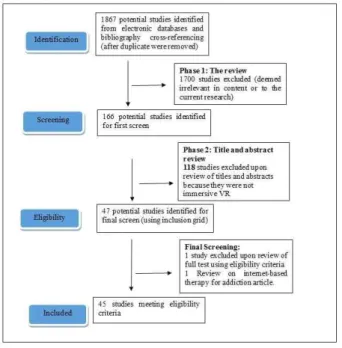
(final search conducted October 2017) after searching from electronic databases. Subsequently, forty-five (45) studies were able to meet the eligibility criteria using the Preferred Reporting Items for Systematic Review and Meta-Analysis (PRISMA) Diagram of selected studies (see Fig. 1).
Fig. 1. Preferred Reporting Items for Systematic Reviews and Meta-Analysis (PRISMA) Diagram of selected studies
Ⅲ. Result
3-1 Research Trend on Virtual Reality Therapy for Substance Use Disorders.
This systematic review resulted in forty-five (45) articles which were published between 1999 and 2015. The results were grouped according to specific substances, on which treatments utilizing virtual reality (VR) had been provided: alcohol;
nicotine/smoking; heroin/cocaine/methamphetamine; and cannabis. These studies met the inclusion criteria as above mentioned. This review found that nicotine and/or smoking has garnered the highest number of studies (73%, n=33); alcohol (18%, n=8); heroin/cocaine/methamphetamine (7%, n=3); and cannabis (2%, n=1). (see Fig.2)
Fig. 2. Percentage of researches on VRT for substance use disorders
The first research on VRT for addiction treatment, specifically on nicotine/smoking, was published in 1999 [9]. There was no research made in the years 2000, 2002, and 2003. From the year 2004 up to 2015, researches were focused more on nicotine/smoking than other substances. In the year 2011, researches on VRT for tobacco use disorders alone peaked with seven studies produced during that time period. However, research on VRT for substance use disorders has declined from 2011 to the present. In general, researches on addiction treatment using VR have focused more on nicotine/smoking and alcohol than other drugs. (see Fig. 3)
Fig. 3. Trend of researches on VRT for substance use disorders
3-2 Effectiveness of Virtual Reality Therapy for Substance Use Disorders
The current review found that the majority of researches
were done to prove the effectiveness of cue exposure therapy
(CET) using VR environments. Studies showed that CET alone
has decreased its efficiency over time, while most researches
have focused on participants’ craving for substances in scenes
of VR environments. Subsequently, virtual reality cue exposure
therapy (VR-CET) has become more popular in the treatment to cigarette cravings and is found to be effective [10]. Later, the combination of VR-CET and cognitive behavioral therapy (CBT) were developed. These two techniques were established as potential smoking relapse prevention interventions. As researches progress, the integration of Lifestyle Skills Training (LST) and VRT have proven to be an effective approach of treating substance use disorders.
Out of forty-five retrieved articles, the majority of studies employed VR-CET for the treatment of alcohol and nicotine dependences. Two studies utilizing VR therapy combined with CBT proved to be more effective than the traditional therapy [11]-[12]. One study on smoking prevention among adolescents integrated VRT with Life Skills Training (LST) for developing coping skills [9]. Overall, this review concluded that researches on addiction treatment using VRT have shown a potential for the treatment of substance use disorders.
3-3 Main Findings and limitations of Studies on Virtual Reality Therapy for Substance Use Disorders
The current review briefly summarized each study, its treatment condition and substance, main findings, and its limitations (see Table 1). This review on VRT for substance use disorders has shown more effectiveness than treatment as usual,
and it has presented parallel results with CBT and/or in vivo exposure therapy. The available evidence varied depending on the substance use disorder reviewed, and our results confirmed that treatment procedure of VRT for addiction treatment can be a valuable tool for substance use disorders, specifically for alcohol [13]-[20]; tobacco [9]-[12] [21]-[49]; heroin [50];
cocaine [51]; methamphetamine [52]; and cannabis [53].
This review also considered the findings of above studies in light of some limitations. Results showed that most of the researches had small sample sizes (55% of researches was done with less than 20 subjects) and often lacked statistical power.
Furthermore, the number of treatment sessions was inadequate, for example, 50% of studies on alcohol had less than four sessions; 49% of researches on smoking; and 100% on other drugs. There was relatively high dropout rate because the treatment using VRT is markedly confronting. In addition, the use of VR headsets may cause cyber sickness, a side effect, which triggers nausea and dizziness. Furthermore, a number of studies did not conduct control group and most of the researches did not have follow-up sessions after the treatment was finished. It is also important to note that the cost for the set-up of the equipment and programs (both hardware and software) is substantially expensive. Therefore, addiction treatment with VRT has several areas to be ameliorated for future researches.
Table 1. List of Researches on Application of Virtual Reality for Treatment of Substance Use Disorders Authors
(Year)
Substance Treatment Conditions
No. of Sessions
N Main Findings Limitations
Montgomery et al. 2006 [13]
Alcohol VR 6 weeks 86 Effective approach to educate the youth about danger of drinking and driving
More work is needed to demonstrate the impact of the VR simulator
Lee et al.
2007 [14]
Alcohol VR-CET 8 weeks 8 VR-CET reduce in craving and enhanced the effectiveness of CET
Small sample size.
No control group Bordnick et al.
2008. [15] Alcohol VR-ACRAS 1-time 40 Support the use of VR based cue reactivity environments for alcohol cue-based treatment
No follow up
Cho et al.
2008 [16]
Alcohol VR-CET 1-time 10 More alcohol craving was induced when alcohol was present than when it was not
Small sample size
Lee et al.
2008 [17] Alcohol VR-CET 1-time 14 Patients with alcohol
dependence reported enormously high level of craving
Small sample size No follow up Lee et al.
2009 [18]
Alcohol VRT P-ADP, nVRTP-ADP
10 weeks 38 Useful as an adjunct to treat alcohol dependence
Relatively small sample size
Ryan et al.
2010 [19] Alcohol VR-CET 1-time 23 Binge drinkers reported considerably higher craving for and thought of alcohol than non-binge drinkers.
Small sample size
Son et al.
2015 [20]
Alcohol VRT 10 weeks 12 Decreased brain metabolism after VRT
Clinical therapy in a hospital setting Small sample size Nemire et al.
1999 [9]
Nicotine/
Smoking
VRE 8 weeks 72 More likelihood of using coping and refusal skills
Self-report
Lee et al.
2004 [21]
Nicotine/
Smoking
VR-CET 1-time 22 VR cue exposure elicits more craving symptoms than the classical devices.
No Follow up
Bordnick et al.
2004 [22]
Nicotine/
Smoking
VR-CET 6 sessions 13 Cessation of craving with anti-craving medications applied
Small sample size Lee et al.
2005 [23]
Nicotine/
Smoking
CET 6 sessions 16 Craving for cigarettes was gradually decreased
Small sample size Bordnick et al.
2005 [24]
Nicotine/
Smoking
VR Cues 1-time 1 Craving for cigarettes increased after the exposure to VR smoking cues
Case study
Bordnick et al.
2005 [25] Nicotine/
Smoking VR Cues 1-time 11 Subjective cigarette craving
increased significantly No follow up Lee et al.
2005 [26]
Nicotine/
Smoking
VR 1-time 8 Obtained more attention, visual balance, and coordinating movement
No follow up
Baumann et al.
2006 [27] Nicotine/
Smoking VR CET 1-time 20 The virtual reality elicits more cravings than the traditional devices
No follow up
Woodruff et al.
2007 [28]
Nicotine/
Smoking
Internet based VR
1-time 136 Abstained from smoking during the treatment period
Follow up after a year Traylor et al.
2008 [29]
Nicotine/
Smoking
VR -NCRAS 1-time 20 Young adult smokers responded strongly compared to adults
Self-report Carter et al.
2008 [30] Nicotine/
Smoking IVR 1-time 22 Complex signs of craving
displayed Broad implications for
craving Girard et al.
2009 [31]
Nicotine/
Smoking
VRT 4 weekly
sessions, 3 sessions follow up
91 Reduction in nicotine addiction The findings remain unclear and deserves further study Moon et al.
2009 [32] Nicotine/
Smoking VE 6 sessions 8 Effective method of treating
nicotine craving The brain regions may not imply its correlations with symptoms of craving Traylor et al.
2009 [33]
Nicotine/
Smoking
VR 1-time &
1 follow up interview
20 Significant increases in attention to cues and thoughts on smoking
Small sample size
Ferrer-García et al. 2010 [34]
Nicotine/
Smoking
VRE 1-time 25 Able to generate the desire to smoke; a direct relation was found between sense of presence and craving
Low levels of dependence shown by participants
Choi et al.
2011 [35]
Nicotine/
Smoking
VRE 4 weeks 10 Elicited more
psychophysiological responses and cravings for smoking
Small sample size, only one female did not employ a control group
Gamito et al.
2011 [36] Nicotine/
Smoking VRE 1-time 60 Increased craving for nicotine Lack of significant differences García-Rodrígez
et al. 2011 [37] Nicotine/
Smoking VRE 1 day 154 Shown valid and reliable treatment of nicotine addicts who want to stop smoking
Self-report craving results
Kaganoff et al.
[38] 2011
Nicotine/
Smoking
VR-NCRAS/
VR
10 Weeks 46 Determine treatment decisions. The sample may not represent the characteristic of smokers in other areas Pericot-Valverde
et al. [39] 2011
Nicotine/
Smoking
VR CET 1-time 46 The results could contribute to determine exposure parameters
No follow up Paris et al.
2011 [40] Nicotine/
Smoking VRE 1-time 24 Exposing cigarette smokers to the full range of VR environments increases stimuli to more nicotine craving
While cues are absent, the smokers may assume or perceive explicit the cues are present
Traylor et al.
2011 [41]
Nicotine/
Smoking
VRCRC 1 day 21 Increased craving for nicotine in the VR smoking stimuli
Masked the cue presentation effects Bordnick et al.
2012 [42] Nicotine/
Smoking VRST/VR 10 weeks 46 Smoking rates and craving for nicotine reduced significantly;
while self-confidence and coping skills increased significantly
Cannot be determined whether VR component was the primary factor in their successful outcome Culbertson et al.
2012 [11]
Nicotine/
Smoking
VR/CBT/CET Bi-weekly 15 Proved useful in enhancing the effectiveness of CBT for nicotine dependence
Low sample size, lack of gender and ethnic diversity, and not entirely balanced Ferrer-García et
al. 2012 [43]
Nicotine/
Smoking
VRE 1-time 46 Very helpful for improving CET for substance use disorders
Small sample size
Self-report
Ⅳ. Conclusion
The aim of the current paper was to review published studies, to analyze the research trend of addiction treatment using virtual reality, and to make recommendations for further researches. The present review indicated the effectiveness of virtual reality (VR) for the treatment of substance use disorders along with some limitations. As mentioned earlier, the research trend showed that the first study of virtual reality therapy (VRT) for treatment of tobacco use disorder was produced in 1999. This review also indicated that researches on VRT for substance use disorders peaked with seven articles in 2011, but the number of studies has been decreased since then. Based upon the main findings and limitations of the previous studies, the current review makes some suggestions for further researches on VRT for addiction treatment as the following.
First, more researches are required for treatment using VRT on such substances as heroin, cocaine, methamphetamine and marijuana since many numbers of studies have been made on nicotine/smoking (33) and alcohol (8). Second, future research
necessitates more number of VR treatment sessions including follow-ups in order to examine the long-term effectiveness of VRT for addiction treatment. Third, the small sample of subjects and the lack of control group necessitate more randomized experiments for exploring the VR efficacy for addiction treatment and strengthening the statistical power of research results. Fourth, the integration of virtual reality cue exposure therapy (VR-CET) with cognitive behavioral therapy (CBT) including lifestyle skills training (LST) for the development of coping skills is needed for future researches.
Finally, VR can be combined with augmented reality (AR) technology for the treatment of substance use disorders in future studies. Augmented reality is an interactive visualization system that allows inserting digital contents in the real world in order to enhance the user’s sensory perception of reality in real time [54].
Compared to VR characterized by a computer-generated environment eliciting the user’s sense of presence, AR applies both virtual and real elements in a real scene expanding the user’s perception of the world [55]. In other words, AR allows the augmentation of real experience mixing both “virtual elements”
and “real-world elements,” which may contain not only the view but also touch, smell, and hearing.
García-Rodríguez et al. 2012 [44]
Nicotine/
Smoking
VE and CET 1-time 90 Capable of eliciting craving No follow up
Pericot-Valverde et al. 2012 [45]
Nicotine/
Smoking
VR 6 weeks 40 Obtained effectiveness of VSS for smoking cessation
Self-reported craving Acker et al.
2013 [46] Nicotine/
Smoking IVR 1-time 47 Significant increases in tobacco
craving No follow up
Bordnick et al.
2013 [47]
Nicotine/
Smoking
VR 1-time 82 Provide strong evidence that VR can be a useful tool by social workers and other clinical professionals
No Follow up
García-Rodríguez et al. 2013 [48]
Nicotine/
Smoking
VRE 1-time 45 Effective proximal cue that can be used for triggering cravings.
Small sample size Park et al.
2014 [12]
Nicotine/
Smoking
CET/CBT 4-week
treatment, 12-week follow up
30 Effective for treatment of tobacco dependence at a level comparable to CBT
Small sample size
Pericot-Valverde et al. 2014 [10]
Nicotine/
Smoking
VR-CET 5 weekly sessions
48 Decreased over every session as a result of extended exposure
Small sample size Thompson-Lake
et al. 2015 [49]
Nicotine/
Smoking
VR cues 2-day session
36 Withdrawal symptoms, and nicotine dependence severity predict cue-induced craving
Self-report
Kuntze et al.
2001 [50]
Heroin CET/IVR 1-time 15 Immersive virtual reality (IVR) is as good or even better in eliciting subjective and physiological craving.
No Follow up
Saladin et al.
2006 [51]
Cocaine VR 1-day
session
12 VRT has potential utility in exposure-based behavioral and pharmacological interventions
Needs more development and refinement
Culbertson et al.
2010 [52]
Methamp hetamine
VR 1-day
session
17 effective of a newl VR drug cue model produced in an online virtual world.
Small sample size
Bordnick et al.
2009 [53] Cannabis/
Marijuana VRE 1 session 20 Offers a novel technology-based method to advance research on and treatment of addiction
Small sample size
No follow up
It is argued that both VR and AR can transform human experience through the high level of effectiveness and self-reflectiveness [54]. A review of the studies on using AR in the treatment of psychological disorders indicated that AR can be an efficient tool for the treatment of specific phobias [55]. So far, AR technology has not been employed for the treatment of substance use disorders. Therefore, the combination of VR and AR, that is, mixed reality (MR) can be a new research field for addiction treatment because the virtual elements offer the real situations with valuable and significant information regarding the use of substances.
VR technology is now becoming more assessable since it is affordable and user friendly than before, and the cost of VR equipment is significantly reduced by overcoming technological barriers. Researches are also being done for reducing users’ cyber sickness in VR environments [56]. Furthermore, developing mobile applications with the use of VR gears can provide for clients to get easy access to treatment tools anytime and anywhere without the need to visit the clinic. In conclusion, this review recommends that more researches will be implemented to apply VR for the treatment of substance use disorders in diverse therapeutic scenes and for various types of clients with addiction issues in the future.
Abbreviations
AR = Augmented Reality CE = Cue Exposure
CET = Cue Exposure Therapy IVE = Immersive Virtual Environment LST = Lifestyle Skills Training MR = Mixed Reality
VAS = Visual Analog Scale VR = Virtual Reality
VRT = Virtual Reality Therapy
VR-CET = Virtual Reality Cue Exposure Therapy
References