4)
†Corresponding author: Myung Cheon Lee ([email protected])
http://dx.doi.org/10.17702/jai.2017.18.3.134
보호필름용 자외선경화형 점착제
Jamarosliza Jamaluddin
1,2⋅이명천
1†1동국대학교 화학공학과 고분자연구실⋅2Facultyof Chemical Engineering, Universiti Technologi Malaysia (2017년 8월 9일 접수, 2017년 9월 11일 수정, 2017년 9월 14일 채택)
UV-cured Pressure Sensitive Adhesive for Protective Film Application
Jamarosliza Jamaluddin
1,2and Myung Cheon Lee
1†1
Department of Chemical and Biochemical Engineering, 30, Pilding-ro 1gil Choong-gu, Dongguk University,Seoul, 04620, Korea
2
Faculty of Chemical Engineering, Universiti Technologi Malaysia, Universiti Teknologi, Malaysia, 81310 Skudai, Johor Bahru, Malaysia
(Recived August 9, 2017; Revised September 11, 2017; Accepted September 14, 2017)
요 약: 본 연구에서는 포호필름 코팅 용도를 목적으로 silicone-urethaneacrylate (SUA) 올리고머를 포함 하는 자외선 경화형 점착제를 제조하였으며 SUA올리고머의 양과 자외선조사량이 접착물성에 미치는 영 향을 조사하였다. 그 결과, 올리고머의 양과 자외선조사량이 증가 할 수 록 박리강도는 감소하였으나 응 집력은 증가하였다. 자외선 조사가 시작되면서 젤함량은 초기에 급속히 증가하였으나 이후 일정량을 유 지하였다. 탈착시험 결과 70%의 올리고머 함량의 시편 S70이 다른 S50(올리고머 50%함량)과 S60(올리고 머 60%함량)과 비교하여 가장 우수한 탈착성을 보였으며 탈착 후 기재에 아무런 잔사를 남기지 않았다.S70의 경우 1857 자외선 조사량과 2270 mJ/cm2 에서 26mJ/m2 이하의 표면에너지를 보였으며 95% 이상 의 광투과도를 보였으며 이러한 물성은 보호용 필름이 요구하는 물성에 적절하다.
Abstract: In this study, we made UV cured acrylic pressure sensitive adhesive containing silicone-urethane- acrylate (SUA) oligomer for a coating on protective film and investigated the effect of SUA oligomer content and UV-dose on adhesion properties. The results illustrated that peel strength decreases with increasing oligomer content and UV-dose, while holding power increases. The gel fractions sharply increased after UV irradiation and then remain constant with prolonged UV exposure. From peel-off test, sample S70 (70%
oligomer content) shows the best peelability and removability without remaining any mark or adhesive material on the test substrate than S50 (50% oligomer content) and S60 (60% oligomer content). Sample S70 also showed a surface energy lower than 26mJ/m
2and a transmittance higher than 95% at UV-dose 1857 and 2270 mJ/cm
2which met the required properties for protective film application.
Keywords: adhesion, peel strength, holding power, surface energy
1. Introduction
Pressure sensitive adhesives (PSAs) are viscoelastic- elastomeric materials which can adhere strongly to solid surfaces by applying a light contact pressure and do not undergo any physical transformation or chemical reaction during the bonding process [1-4]. It is well known that four manufacturing technologies are widely used for PSAs: solution, emulsion, hot melt and UV-curing.
Among this, UV-curing has become a well established technology in the market and allows the production of a wide range of UV cured PSAs.
Commercial interest in UV cured PSAs continues to grow in recent years because they offer several advantages such as low emission of volatile organic compounds (VOCs), solvent-free process, fast production rate at ambient temperature and modest requirement for operating space [1,5,6]. The main components of UV cured PSAs are oligomers, prepolymers, monomers containing double-bond and photoinitiators. The oligomers and prepolymers are used in making PSAs to reduce shrinkage and for easy coating process. In a UV-cured PSAs formulation, monomers are also one of an important component used to lower the viscosity of the uncured material. They are also used to make adjustments of the formulation such as improving the surface wetting, leveling and physical properties. The monomers can be divided into monofunctional monomers which used primarily as reactive diluents and multifunctional monomers which normally used as a crosslinker. Another important component is photoinitiator. Photoinitiators are compounds that decompose into free radical when exposed to light. There are two basic categories of photoinitiators. The first group involves type I photoinitiators which undergo a direct photofragmentation process (α-cleavage) and second group known as type II photoinitiators which undergo hydrogen atom abstraction[7,8].
One of the important applications of PSAs is a protective film, which can protect the surface of touch screen and flat panel display screen from contaminations or scratches [9,10]. For the production of more environmentally-friendly protective film, UV-cured PSAs need to substitute the previous solvent type PSAs. The substrates of the protective film are typically fabricated using polyethylene (PE) or polyethylene terephthalate (PET) with PSAs coated on one side. PSAs for the
protective film should adhere strongly to the substrates, while they should have proper tack, low peel strength and strong holding power.
The application of PSAs as a surface protective film for optical film applications have been reported in some papers and patents. For example, Sumi [11] has fabricated a surface protective film that has an adhesive layer which can easily peel off after stuck on substrates.
Niino et al. [9] have fabricated a protective tape used for optical membranes which have a low adhesive property.
Tomita [12] has fabricated PSAs containing the ingredients of (A) a (methyl) acrylic copolymer and (B) an isocyanate crosslinking agent. The synthesized PSAs demonstrated a peel strength 20gf/inch and have excellent in release property. Jin et al. [8] successfully synthesize acrylic PSAs using radical copolymerization of 2-ethylhexyl acrylate (2-EHA), methyl methacrylate (MMA) and acrylic acid (AA). The copolymer then crosslinked using cross-linking reagent (SC-200) and give a holding power above 120hrs and suitable for LCD protective film application. However, there has been no published report regarding the effect of difunctional silicone-urethane-acrylate oligomer contents on the adhesive properties of UV-cured PSAs having protective film application.
In this research work, the effects of difunctional silicone-urethane-acrylate oligomer content and UV-dose on the adhesive properties of UV-curable PSA were investigated. At the same time, surface energy, peel-off test and UV-Vis measurement were also carried out.
2. Experimental
2.1. Materials
Difunctional silicone-urethane-acrylate oligomer was obtained from Bomar Specialties Co. (USA), 2-ethyl-hexyl acrylate (2-EHA) and methyl methacrylate (MMA) was purchased from Sigma Aldrich Co.
Trimethylopropane triacrylate was supplied by TCI Co.
and 1-hydroxy-cyclohexyl-phenyl-ketone (Sigma Aldrich) was used as photoinitiator. All the chemicals were an analytical grade and used without further purification.
2.2. Preparation of UV-curable PSA
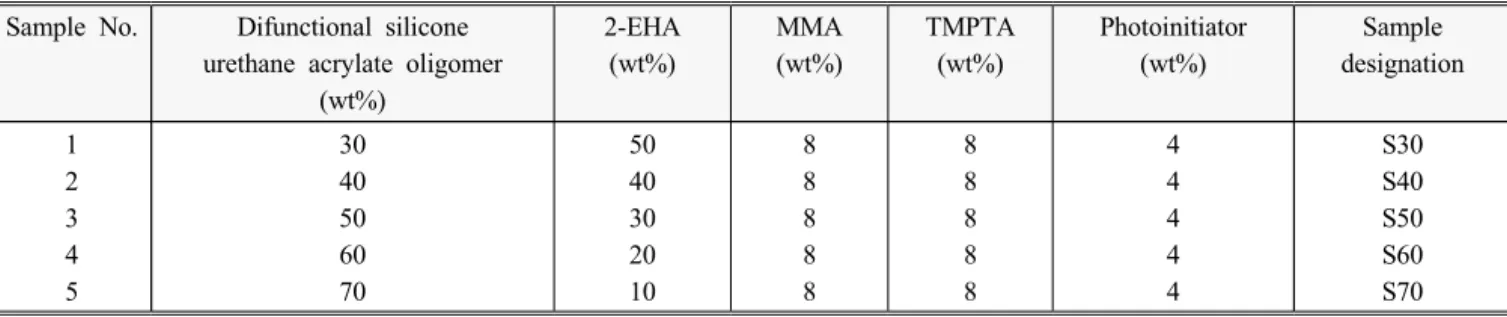
ll samples were designated as shown in Table 1.
Before UV curing, the photoinitiator was dissolved in
monomers under stirring at room temperature for 1 h.
After that, the mixture was added to oligomer and stirred for another 1 hr. Then, each formulation was coated on the PET film (30 cm x 27 cm) by using bar coater and was cured under UV lamp (4.8 kW, main wavelength:
365 nm) using conveyer type UV machine (LZ-UH402RCH, South Korea). The curing was carried out under the condition of 2 m/min conveyor speed and 2270 mJ/cm
2energy per pass. The thickness of the cured film was ca. 30 μm.
2.3. Adhesion properties 2.3.1 Holding test
The UV-cured PSA film was cut to make 25mm x 150mm test film. One end part (25 mm x 25 mm) of the test film was placed on the stainless steel test plate followed by rolling twice with a 2 kg weight auto rubber roller. The testing plate was put into the rack of sample holder and 1 kg weight was attached to the other end.
The measurements were carried out based on ASTM D3654.
2.3.2 peel test
The surface of UV-cured PSA film (25 mm x 250 mm) was attached to the surface of the stainless steel test plate by rolling twice with a 2 kg rubber roller. The pressed test film was kept for 20 min. at 23
oC with 50
% relative humidity. 180
opeel strength was measured according to the method suggested by ASTM D 3330.
2.4. Gel fraction
The gel fraction of film after UV radiation was determined by soaking the samples in toluene for 24 h at room temperature. The insoluble part of UV-curable
PSA was removed by filtration and dried at 50
oC to constant weight. The gel fraction was calculated by the following equation:
Gel fraction (%) = (W
24/W
0) x 100
Where W
0is the weight before filtration and W
24is the weight after filtration.
Oligomer content (wt%)
20 30 40 50 60 70 80
Peel strength (g/25mm)
0 2 4 6 8
Figure 1. Effect of oligomer content on peel strength.
2.5. Contact angle
Contact angles () were measured using water and di-iodomethane. The surface energy (s) was calculated from contact angles and known values of dispersive and polar components of surface tension
1dand
1pof water (21.8 and 51mJ/m
2) and di-iodomethane (DIM) (
1=
1d= 50.8 mJ/m
2. Surface energy (
S) was calculated by the following equation [11]:
Sample No. Difunctional silicone urethane acrylate oligomer
(wt%)
2-EHA (wt%)
MMA (wt%)
TMPTA (wt%)
Photoinitiator (wt%)
Sample designation
1 2 3 4 5
30 40 50 60 70
50 40 30 20 10
8 8 8 8 8
8 8 8 8 8
4 4 4 4 4
S30 S40 S50 S60 S70 Table 1. Sample designation of various blend samples
Oligomer content (wt%) 30 40 50 60 70
Holding power (h) 5 38 >120 >120 >120
Table 2. Effect of oligomer content on holding power
2.6. Residue-free peeling test
The film surface was directly stuck on steel by rolling a rubber roller. The surface to which the film stuck is stored at 50
oC and 80 % relative humidity over periods of one week and four weeks. The film are then was peeled off by hand once slowly and once rapidly. The residue on the substrates surface is inspected [12]. The following scale is used for the evaluation:
1. Substrates surface unchanged
2. Contours of the protective film noticeable on the surface
3. Impression of the film discernible as a shadow 4. Some residue of adhesive on the surface
5. Portion of the adhesive layer transferred to the surface
6. Adhesive layer completely transferred to the surface 7. Peeling is judged according to the following scale:
A. Almost no adherence B. Peelable
C. Peelable with difficulty
2.7. UV-Vis
Transmittance of the UV cured PSA film at a wavelength 550 nm were measured using Lambda 35 UV/Vis spectrometer Perkin Elmer .The transmission mode was used and the wavelength range was set from 300 to 800 nm.
3. Results and Discussion
3.1. Effect of oligomer content on the adhesive properties In this study difunctional silicone-urethane-acrylate oligomer was selected because it offered an unusual combination of desirable properties such as softness, flexibility and temperature resistance. Figure 1 shows the effect of oligomer content on the peel strength. It is shown that the peel strength decreases with increasing oligomer content up to 40 wt% of oligomer and then levels off. 2-EHA usually shows a property of increasing the peel strength in pressure sensitive adhesive.
Therefore, it can be explained that the oligomer contributes much to the lowering the peel strength of the PSA.
The effect of difunctional silicone-urethane-acrylate oligomer on the holding power is illustrated in Table 2.
The holding power for UV-cured PSAs enhanced up to above 120 h when amount of oligomer above 40wt%.
Therefore, samples with oligomer content 50 wt% (S50), 60 wt% (S60) and 70 wt% (S70) were selected for following study.
3.2. Effect of UV-dose on adhesion properties
Proper UV-dose must be determined and optimizing
UV-dose (mJ/cm2) Holding power (h)S50 S60 S70
281 0.3 7.9 >120
755 4 107 >120
1103 26 >120 >120
1517 66 >120 >120
1857 151 >120 >120
2270 187 >120 >120
Table 3. Effect of UV-dose on holding power
UV dose (mJ/cm2)
0 500 1000 1500 2000 2500
Peel strength (g/25mm)
0 2 4 6 8 10 12
S50 S60 S70
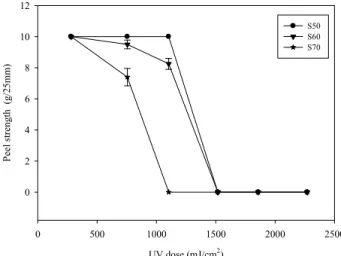
Figure 2. Effect of UV-dose on peel strength.
according to processing requirements because it will greatly affect adhesive performance. The peel strength results of S50, S60 and S70 at different UV-dose are shown in Figure 2. From this graph we can see that the peel strength decreased with increasing UV-dose. This could be explained that UV-dose contributed to the higher cohesive property after forming more network and gelation.
The effect of UV-dose on holding power is shown in Table 3. At dose of 281mJ/cm
2, sample S50 showed very low holding power compared to sample S60 and S70. In this case the reason is that the adhesive was not fully polymerized and crosslinked and showed a fluid-like behavior [13]. However, when the UV-dose increases, the holding power drastically increases because of polymerization and more crosslinked network in the adhesive and which therefore lead to higher cohesive.
3.3. Effect of UV-dose on gel fraction
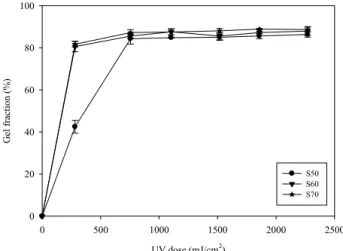
Figure 3 compares gel fraction results of S50, S60 and S70 at different UV dose. From this Figure 3, we can see that the gel fraction for S60 and S70 increase rapidly with
UV dose (mJ/cm2)
0 500 1000 1500 2000 2500
Gel fraction (%)
0 20 40 60 80 100
S50 S60 S70
Figure 3. The change of gel fraction as a function of UV-dose.
Figure 5. The schematic diagram of crosslinking formation after UV dose.
Figure 4. FTIR Spectroscopy shows the crosslinking process with the UV dose by exhibiting the decrease of C=C bond peak.
Sample designation
With- drawal
UV-dose (mJ/cm2)
281 755 1103 1517 1857 2270
1 week 4 weeks 1 week 4 weeks 1 week 4 weeks 1 week 4 weeks 1 week 4 weeks 1 week 4 weeks
S50 Slow B3 B3 B3 B3 B3 B3 B2 B3 B2 B3 B1 B1
Fast B5 B5 B3 B3 B3 B3 B3 B3 B1 B2 B1 B1
S60 Slow B3 B3 B2 B2 B1 B2 B1 B1 B1 B1 B1 B1
Fast B3 B3 B2 B2 B1 B1 B1 B1 B1 B1 B1 B1
S70 Slow B2 B2 B1 B1 B1 B1 B1 B1 B1 B1 B1 B1
Fast B3 B2 B1 B1 B1 B1 B1 B1 B1 B1 B1 B1
Table 4. Residue-free peeling test
UV dose. This increment is caused by crosslinking of TMPTA monomer after UV exposure as shown in FTIR spectroscopy (Figure 4). While, S50 showed a lower gel fraction compare to S60 and S70 at 281 mJ/m
2UV dose, suggesting incomplete cure. However, the gel fractions did not reach 100% for all samples when prolonged exposed to UV. This was due to some C=C bonds could not react with the photoinitiator because they were trapped in the PSA network [6, 14], which was shown in schematic diagram Figure 5.
3.4. Residue-free peeling test
Residue-free peeling test consist in the evaluation of the appearance of the surface to be protected after the UV- cured film peeled from the substrates surface. Table 4 show the residue-free peeling test result for samples S50, S60 and S70. Sample S70 show better peelable and removed cleanly from a test substrate without causing any damage to the test substrates compared to sample S50 and S60.
3.5. Surface energy
Contact angles () were measured in order to test whether surface properties of UV-cured PSA are change depending upon UV-dose. Table 5 shows the value of contact angles and surface energy for S50, S60 and S70 samples at different UV-dose. The contact angles, thus surface energy for all samples slightly changed after UV exposure. This is might be due to either smaller change in work of adhesion or little sensitivity measured by contact angles. However, for protective film applications, surface energy should be higher than 15mJ/m
2and lower
than 26mJ/m
2as to easily stuck on and peel off from the protected surface [9]. Therefore sample S70 at UV -dose 1857 and 2270 mJ/cm
2met the requirement for this application.
3.6. Optical properties
The transmittance of UV-cured PSA was measured by UV-visible spectrometer. In order to be used in optical films, the sample should show transmittance higher than 95%. Figure 6 show a transmittance at 550 nm wavelength for PET film and sample S70 at UV- dose 1857 and 2270 mJ/cm
2. As shown in this figure, the transmittances of S70 at UV dose 1857 and 2270 mJ/cm
2were higher than 95% demonstrating high transparency at 550nm wavelength.
4. Conclusion
As a conclusion the effect of oligomer content and UV-dose on adhesion properties were successfully investigated. The peel strength decreases with increasing oligomer content and UV-dose, while holding power increases. From residue-peeling test, sample S70 show better peelable and remove cleanly without causing any damage to the test substrate. Sample S70 also give a surface energy lower than 26mJ/m
2and show a transmittance higher than 95% which met the requirement properties for protective film application.
References
1. Joo H.S., Do H.S, Park Y.J., Kim H.J. J. Adhes.
Sci. Technol., 20, 1573 (2006).
2. Tobing S.D., Klein A., J. Appl. Polym. Sci., 79, 2230 (2001).
3. Asahara J., Hori N., Takemura A., Ono H., J. Appl.
Polym. Sci., 87, 1493 (2003).
4. Taghizadeh S.M., Ghasemi D., Iran Polym. J., 19(5), 343 (2010).
5. Rolando T.E.: Solvent-free adhesives. RAPRA Technology Ltd. (1998).
6. Park Y.J., Lim D.H, Kim H.J., Joo H.S., Do H.S.
J. Adhes. Sci. Technol., 22, 1401 (2008).
7. Niino T., Imono S., Okumura K., Sano K. US Patent No.7,270,877 B2, (2007).
8. Jin X., Bai Y.P., Shao L., Yang B.H., Tang Y.P.
Express Poly. Lett., 3, 814 (2009).
9. Sumi H. US Patent No. 6,582,789 B1, (2003).
10. Tomita K. US Patent No. 2006/0177651 A1,
Transmittance at 550 nm wavelength (%)
0 50 100 150 200
Wavenumber (nm)
300 400 500 600 700 800 900
Transmittance (%)
0 20 40 60 80 100
PET film S70-1857mJ/cm2
S70-2270mJ/cm2
(a) (b) (c)
Figure 6. Transmittance of (a) PET film and sample S70 at (b) 1857 mJ/cm2 and (c) 2270 mJ/cm2 UV-dose.