Pattern Characteristic by Electrostatic Field Induced Drop-On-Demand Ink-jet Printing
J.Y. Choi*·Y.J. Kim**· S.U. Son*· Y.M. Kim*· S.H. Lee*· D.Y. Byun†· H.S. Ko**
Key Words : Electrostatic field induced inkjet head, droplet ejection, patterning, industrial printing Abstract
This paper presents the pattern characteristic using the electrostatic drop-on-demand ink-jet printing system. In order to achieve the pattern characteristic of electrostatic inkjet printing, the capillary inkjet head system is fabricated using capillary tube, Pt wire and electrode, and is packaged by acrylic board for the accurate alignment between wire and electrode-hole. The applied DC voltage of 1.4 ~ 2.0 kV used for the observation of electrostatic droplet ejection. Electrostatic droplet ejection is directly observed using a high- speed camera. For investigated pattern characteristic, conductive inkjet silver ink used. The higher voltage has a good condition which has micro dripping mode. Also, the droplet size decreases with increasing the supplied DC voltage. This paper shows the pattern which is formed by about 300um. Also, capillary inkjet head system will be applied industrial area comparing conventional electrostatic inkjet head system.
1. Introduction
Ink-jet printing technology is very attractive for forming micro-size patterns for flat panel displays (FPDS), semiconductor, biological and optical devices [1-2]. Further the necessity of the industrial inkjet system has grown in the past years due to its advantage [3]. The conventional drop-on-demand print heads available to date are based on pushing out the liquid in a chamber through a nozzle by actuators, such as thermal bubble and piezoelectric actuators [4]. The performance of these print heads depends critically on that of actuators, since the power exerted by the actuators determines the droplet speed and volume, and ultimately the ejection frequency [5]. For the print heads based on pushing, a considerable portion of the actuator power has to be wasted either along the flow path to the orifice or along the flow inlet by a backflow. This waste of actuator power may become more serious as the size of devices is scaled down in order to increase the device density. For a thermal bubble actuator, keeping excessive heat of a device from influencing neighboring devices is also critical, which is in fact a very limiting factor for further scaling down of a
thermal bubble print head [6]. Lastly, there are rather serious limitations on the properties of liquid that piezoelectric or thermal bubble print heads are capable of handling due either to viscosity or to chemical composition. Alternatively, it may be the type of electrostatic actuator based on the direct manipulation of liquid by an electric field that appears to be more promising [7].
In this paper, we presents the fabrication and pattern characteristic of the electrostatic drop-on-demand inkjet printing system, to overcome the limitation and problem of thermal and piezoelectric print heads described above.
In order to investigate the performance of an electrostatic drop-on-demand ejector, we carried out a macro scale of experimentation, using a capillary inkjet head system with a pole type nozzle. The pole type nozzle has a 50 um diameter of conductive pole at the center of the nozzle orifice. The inner diameter of the glass capillary is 100 um wide and the gap between the ring shaped upper electrode and the orifice is set 2.0 mm. After that, we manufacture capillary inkjet head system which assembly capillary tube and electrode using bonding and do an experiment. Then, capillary inkjet head system has easy to get result and apply industrial inkjet head system through comparing results. Therefore, we fabricated the capillary inkjet head system for the measurement and analysis of the electrostatic drop-on-demand pattern characteristic in this paper.
† 회원, 건국대학교 항공우주공학과
E-mail : [email protected]
TEL : (02)450-4195 FAX : (02)444-6670 * 성균관대학교 정보통신공학부
** 성균관대학교 기계공학부
451
2. Experiment 2.1 Fabrication of capillary inkjet head
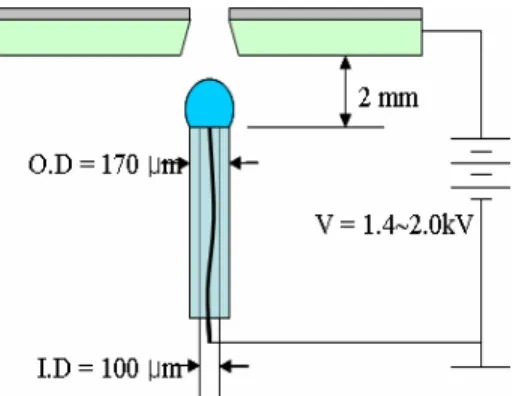
Fig. 1 shows schematic diagram of electrode and nozzle. The pole type nozzle has a 50 um diameter of conductive pole at the center of the nozzle orifice. The inner and outer diameter of the glass capillary are 100 um and 170 um, respectively. The gap between the capillary and the Al electrode is keep at 2.0 mm. The electrode is fabricated by semiconductor process and sand blaster using the aluminum (Al) deposited glass wafer. In order to eject droplets, a DC voltage is applied between the conductive pole and an Al electrode. To assemble the electrode and capillary nozzle for forming the capillary inkjet head system, we used the acrylic board shown in Fig. 2(a). The capillary inkjet head system is composed of capillary tube, Pt wire and electrode, and is packaged by acrylic board for the accurate alignment between wire and electrode-hole.
Fig. 2(b) shows the photo image of the capillary inkjet head installed at the experimental system, and the substrate is located in the upper of the inkjet head for the observation of the droplet ejection. The capillary tube is aligned in the center of the electrode orifice and fixed by the fabricated acrylic board.
2.2 Experimental system
The schematic experimental setup to observe droplet ejection from the inkjet head is shown in Fig. 3. It consists of capillary inkjet head and measurement equipments. A high speed camera (IDT XS-4) with a micro-zoom lens and a halogen lamp was used to visualize droplet ejection. The high speed camera can image 8000 frames in a second at a 160 x 1280 resolution. A high voltage power supply (maximum voltage of 3.0kV) was used with a relay switch to control electrostatic field. Liquid was supplied to a grounded nozzle by a micro-syringe, and an electrode was placed above the nozzle. A linear motor was used to move glass and PET substrate for forming only one droplet pattern.
Fig. 1. Schematic diagram of an electrode and nozzle for forming capillary inkjet head.
Fig. 2. The photograph of (a) assembly of capillary inkjet head, (b) capillary inkjet head installed at the experimental system.
Fig. 3. Schematic diagram of the experiment setup for observation of droplet ejection.
We investigated the electrostatic droplet ejection using the capillary inkjet head system. The effect of the droplet ejection of the applied voltage is observed. The conductive ink is patterned on a substrate by moving the stage. Electrostatic droplet ejection is directly observed using a high-speed camera.
For investigated pattern characteristic, conductive inkjet silver ink used. The ink have viscosity of 8~15 cps, surface tension of 30~32 dynes/cm, and density of 1.07 g/cm3 at 25℃. Also, metal contents of the ink has 15 wt %.
452
3. Result and Discussion
Fig. 4 and 5 show the result of capillary inkjet head system using conductive silver ink. Fig. 4 shows the series of image frames showing the ink droplet ejection.
The supplied voltage is kept at a direct current (DC) voltage of 1.9 kV between the Al electrode and pole type ground. The constant flow rate by a micro pump is kept at 10 ㎕/min. These results show that the micro dripping mode of tiny droplet size is observed by experimental system.
Fig. 5 shows the images of droplet ejection observed by high-speed camera at the various supplied DC voltage of 1.4~2.0 kV. The droplet is jetted from capillary tube electrode to the top electrode. The flow rate of 10 ul/min is used, and the gap between the capillary and the Al electrode is keep at 2.0 mm. The pole type nozzle has a 50 um diameter of conductive pole at the center of the nozzle orifice. The inner and outer diameter of the glass capillary are 100 um and 170 um, respectively.
In the supplied voltage below 1.8 kV, the meniscus of triangle shape cannot be observed, but in the voltage above 1.9 kV, the meniscus is observed by experimental system. In other words, the meniscus edge has sharpness in higher voltage described in Fig. 5. Therefore, higher voltage has a good condition which has micro dripping mode. Also, the droplet size of ejection ink is measured as a function of the supplied DC voltage. Fig. 6 shows that the droplet size decreases with increasing the supplied voltage.
Fig. 4. Ejection processing of droplet in 1.9kV
Fig. 5. Droplet ejection process; images of changing 1.4kV ~ 2.0kV DC voltage
Fig. 6. Variations of droplet diameter; applied 1.4kV ~ 2.0kV the DC voltage.
As a result, the droplet size is bigger than nozzle size in lower voltage and smaller size in higher voltage described in Fig. 6. Then, the result of over 1.9kV has tiny droplet size so that presents micro dripping mode.
Specially, 2.0kV result in the smallest droplet size. Also, droplet ejection takes place at regular frequencies ranged from a few tens of droplets to several tens of thousands of droplets per second, giving uniform droplet sizes. In micro dripping mode, a droplet size ranged from about 37 um to 40 um.
Fig. 7 shows a dot patterned on the glass substrate.
This result represents that droplet size of lower voltage has bigger than higher voltage. Also, this result did experiment in nozzle outer size 170um. Dot pattern size is about 180um that the smaller dot pattern size will get result in smaller than 170 um nozzle size. Also, because the glass and PET substrate are hydrophilic surface, the droplet in spread so that size of dot patterned in much larger than size of droplet. Therefore, capillary inkjet head system has higher voltage and hydrophobic substrate which to get more tiny patterned dot and line.
(a)
(b)
Fig. 7. Dot pattern on glass substrate; (a) 1.4kV DC (b) 1.8kV DC.
453
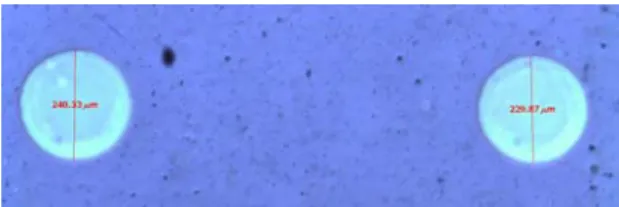
Fig. 8. Dot pattern on PET substrate; applied 1.7kV Table. 1 Measures of dot patterned on PET substrate
Mean Std. Dev
Dot Diameter 227.50 um 8.38um Between Distance
Dot and Dot 957.22 um 25.69um Fig. 8 shows a dot patterned on PET substrate and Table 1 has pattern characteristic. In this result, the uniformity is good and the dot pattern shape is almost circle. Therefore, electrostatic capillary inkjet head system will be applied industrial area possible. Also, between distance dot and dot mean about 957.22 um. In this experiment, linear motor speed is 0.2 m/s so that the natural frequency is about 200 Hz in applying voltage 1.7kV. As a result, this result has a good uniformity and natural frequency. Therefore, if we use a pulse generator for higher ejecting frequency, make a good electrostatic drop-on-demand inkjet head system.
Fig. 9 shows a line patterned on PET substrate. It has the sintering process after line patterned. The sintering condition is 30 min in 130℃. This result has no good uniformity but the line is charged with electricity after sintering process. Therefore, a line which good uniformity will has a result with control linear motor speed.
Fig. 9. Line pattern on PET substrate; applied 1.7 kV
4. conclusion
We present the fabrication of the capillary inkjet head system, and the pattern characteristic of the electrostatic drop-on-demand ejection. The capillary inkjet head system is composed of capillary tube, Pt wire and electrode, and is packaged by acrylic board for the accurate alignment between wire and electrode-hole.
Using this inkjet head, we investigated the electrostatic droplet ejection of conductive ink about the
various DC supplied voltage. The range of the supplied voltage is 1.4 ~ 2.0 kV, and the flow rate of the micro pump is 10 ㎕ /min. The effect of the droplet ejection of the applied voltage is observed. Electrostatic droplet ejection is directly observed using a high-speed camera.
Also, the conductive ink is patterned on a substrate by moving the stage using the linear motor.
As a result, micro dripping mode has an experiment result in higher applying voltage. The patterned dot size decreases with increasing the supplied DC voltage and various droplet sizes are gained in each applying voltage.
Therefore, electrostatic capillary inkjet head system will be applied in industrial area and to overcome the limitation of conventional print heads such as thermal bubble or piezoelectric inkjet heads which droplet size is similar nozzle size.
Acknowledgment
This work was supported by Korea Research Foundation (KRF-2004-0055-B00045) and Seoul R&BD Program.
References
(1) E. Lee, “Microdrop Generation,” CRC Press, 2003 (2) H.S. Koo, M. Chen, P.C. Pan, L.T. Chou, F.M. Wu,
S.J. Chang, T. Kawai, “Fabrication and chromatic characteristics of the greenish LCD colour-filter layer with nano-particle ink using inkjet printing technique,”
Displays 27 pp. 124-129, 2006
(3) J. Park, Y. Oh, “Fatigue Test of MEMS Device: a Monolithic Inkjet Print,” KSME International Journal, Vol 18, pp. 798~807, 2004
(4) M. Madou, Fundamentals of Microfabrication. Boca Raton, FL: CRC, CH. 9, 1997.
(5) G. T. A. Kovacs, Micromachined Transducers Sourcebook. New York: McGraw-Hill, CH. 9, 1998, (6) C. M. Ho, "Fluidics-the link between micro and
nano sciences and technologies-," in Proc. IEEE Int.
Conf. MEMS, Interlaken, pp. 375-384, 2001
(7) S. Lee, D. Byun, S. J. Han, S. U. Son, Y. Kim, H. S.
Ko “Electrostatic Droplet Formation and Ejection of Colloid”, 2004 MHS (Micro-Nano Mechatronics for an Information-Based Society), H. Simpson, Dumb Robots, 3rd ed., Springfield: UOS Press, pp.6-9, 2004
454