• 검색 결과가 없습니다.

Hand Gesture Recognition using Improved Hidden Markov Models

N/A
N/A
Protected

Academic year: 2021

Share "Hand Gesture Recognition using Improved Hidden Markov Models"

Copied!
6
0
0

로드 중.... (전체 텍스트 보기)

전체 글

(1)

Hand Gesture Recognition using Improved Hidden Markov Models

Wenkai Xu

, Eung-Joo Lee

††

ABSTRACT

In this paper, an improved method of hand detecting and hand gesture recognition is proposed, it can be applied in different illumination condition and complex background. We use Adaptive Skin Threshold (AST) to detect the areas of hand. Then the result of hand detection is used to hand recognition through the improved HMM algorithm. At last, we design a simple program using the result of hand recognition for recognizing “stone, scissors, cloth” these three kinds of hand gesture. Experimental results had proved that the hand and gesture can be detected and recognized with high average recognition rate (92.41%) and better than some other methods such as syntactical analysis, neural based approach by using our approach.

Key words: Hand Detecting; Hand Gesture Recognition; YCbCr Skin Color Space; HMM

※ Corresponding Author : Eung-Joo Lee, Address : Dept.

of I.C. Eng., Tongmyong University, 535 YongDang- Dong, Nam-Gu, Busan 608-711, Korea, TEL : +82-51- 629-3700, FAX : +82-51-629-3729, E-mail : [email protected] Receipt date : Mar. 23, 2011, Revision date : May 15, 2011 Approval date : June 1, 2011

††

Dept. of Information Communication Engineering, Tongmyong University

(E-mail: [email protected])

††
Dept. of Information Communication Engineering, Tongmyong University

1. INTRODUCTION

The technology of hand gesture recognition has been a very important research topic of human- computer interaction(HCI). The main purpose of researching hand gesture recognition is to use this nature manner to implement human-computer interaction. With the rapid development of com- puter technology, the research on new hu- man-computer interface,which suits human’s communication custom, has obtained the great evolvement. The hand gesture acts as one of the common communication methods in human life, So the hand gesture recognition has become the re- search focus. Nevertheless,because of the varie- ty, multi vocal,otherness in both temporal field

and spatial field uncertainty in vision and that the hand is complicated plasmodium,the research has become a multi-knowledge inter across problem filled with challenge.

Hand gesture recognition from visual images has a number of potential application in HCI (human computer interaction), machine vision, VR (virtual reality), machine control in the industry field, and so on. Most conventional approaches to hand gesture recognition have employed data gloves. But, for more natural interface, hand ges- ture must be recognized from visual images as in the communication between humans without using any external devices. Our research is intended to find a high efficiency approach to improve the al- gorithm of hand detecting and hand gesture recognition.

Our research is intended to find a better ap-

proach to detect the position of human face and

hand. In the detected region, we are using the skin

color model to detect the precise of positioning the

face and hand location in YCrCb. After that, we

extract the characteristic vector of several hand

gestures by using improved HMM algorithm. The

experimental results show that, the proposed

(2)

method of hand detection can detect the hand loca- tion regions quickly overall, and to a large extent suppress the background noise and the changes of back ground region, and the recognition rate of hand gesture is also quite satisfying.

2. HAND DETECTION ALGORITHM

2.1 Color Space Foundation

A color model is an abstract mathematical model describing the way colors can be represented as tuples of numbers, typically as three or four values or color components (e.g. RGB and CMYK are col- or models). However, a color model with no asso- ciated mapping function to an absolute color space is a more or less arbitrary color system with no connection to any globally-understood system of color interpretation.

Human skin color has been used and proved to be an effective feature in many applications from human face detection to hand tracking [1].

However, most studies use either simple thresh- olding or a single Gaussian distribution to charac- terize the properties of skin color. Although skin colors of different races fall into a small cluster in normalized RGB or HSV color space, we find that a single Gaussian distribution is neither sufficient to model human skin color nor effective in general applications. Although different people have differ- ent skin color, several studies have shown that the major difference lies largely in their intensity rath- er than their chrominance. Several color spaces have been utilized to label pixels as skin including RGB, normalized RGB, HSV (or HSI), YCbCr, YIQ, YES, CIE XYZ, and CIE LUV.

2.2 The YCbCr Color Model

Cathode ray tube displays are driven by red, green, and blue voltage signals, but these RGB sig- nals are not efficient as a representation for storage and transmission, since they have a lot of mutual

redundancy[2].YCbCr and Y′CbCr are a practical approximation to color processing and perceptual uniformity, where the primary colors correspond- ing roughly to red, green and blue are processed into perceptually meaningful information. By doing this, subsequent image/video processing, trans- mission and storage can do operations and in- troduce errors in perceptually meaningful ways. Y' CbCr is used to separate out a luma signal (Y') that can be stored with high resolution or trans- mitted at high bandwidth, and two chroma compo- nents (Cb and Cr) that can be bandwidth-reduced, subsampled, compressed, or otherwise treated sep- arately for improved system efficiency. One prac- tical example would be decreasing the bandwidth or resolution allocated to "color" compared to

"black and white", since humans are more sensitive to the black-and-white information. The following formula (1) can express how to convert RGB color space to YCbCr color space:

Y=0.299R+0.587G+0.114B

Cb=0.564(B-Y) (1)

Cr=0.713(R-Y)

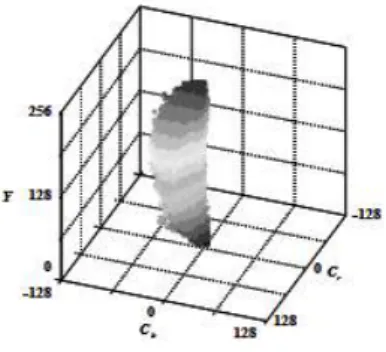
In human skin color, Cr is the most important component(we can find that in Fig. 1), so our method just cares about Cr component.

Fig. 1. Skin Color in YCbCr Color Space.

2.3 Hand Detection Based on Adaptive Skin Threshold (AST) segmentation

Threshold is very significant problem in image

processing and pattern recognition [3]. However,

(3)

Fig. 2. Hand region detection flowchart.

one threshold cannot give satisfactory result in yellow, black and white color. To overcome this shortcoming, we propose a improved method for skin detection which using Adaptive Skin Threshold (AST).

The covariance of face and another body part is very small, therefore, the extracted AST from face region becomes the best selection for hand re- gion detection. We can express the relation be- tween them as the formula (2) as followed:

(2) Here:

means detecting face region width means detecting face region height Cr (x, y) means Cr value at (x, y) pixel

From the threshold extracted by using AST method of face region, we can use it for detecting hand region. Fig. 2 shows the proposed hand region detection flowchart. To begin with, we should do some preprocessing on the image we get through the camera. Firstly we convert the original image into binary and apply some morphology method such as Dilation and Erosion, used for noise re- moval and separate close white region. Based on

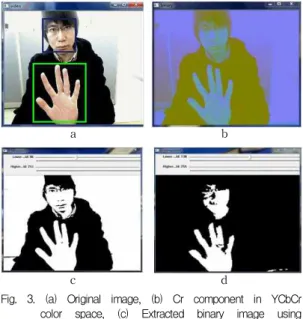
the face region size, we can remove the small ob- jects firstly and then find edge for remained skin region. For every hand region, it always includes edge not only on its boundary, but also within the contour. So, if any skin region doesn’t satisfy this constraint, it will be removed. The biggest one of remained region is become hand region. The hand region detection process is shown as the following flowchart. Fig. 3 shows an example of hand de- tection

a b

c d

Fig. 3. (a) Original image, (b) Cr component in YCbCr color space, (c) Extracted binary image using YCbCr,(d)Hand and face region

3. GESTURE RECOGNITION ALGORITHM BASED ON HMM

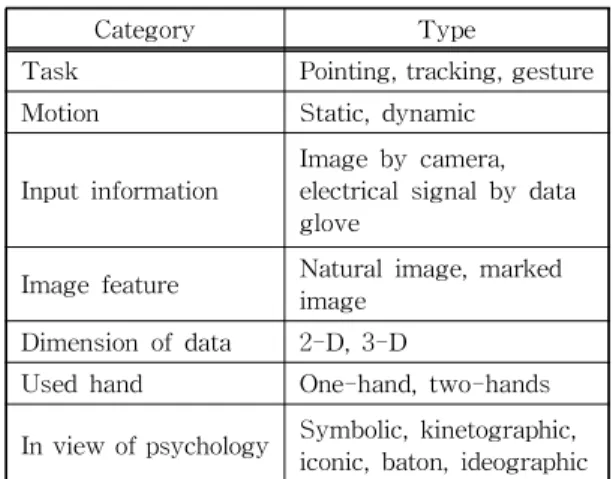
Hand gesture recognition can be classified into several categories as shown in Table 1 [4].

Up to the present, the level of recognition tech- nology is far beyond that of human, therefore most researches have been done on the strong gesture grammar in the confined environment [5].The ba- sic recognition methods are mainly based on the statistical model of optical flow, HMM using dy- namic feature, and the analysis of syntactical grammar.

Since the speech recognition field adopted

(4)

Table 1. Classification of Hand Gesture Recogni- tion

Category Type

Task Pointing, tracking, gesture

Motion Static, dynamic

Input information Image by camera, electrical signal by data glove

Image feature Natural image, marked image

Dimension of data 2-D, 3-D

Used hand One-hand, two-hands In view of psychology Symbolic, kinetographic,

iconic, baton, ideographic

a. Cloth b. Scissors c. Stone Fig. 4. Three hand gesture sample.

HMMs with great success many years ago, these techniques are just now entering the computer vi- sion area where time variation is significant.

Hidden Markov models have intrinsic properties which make them attractive for gesture recog- nition, and also explicit segmentation is not neces- sary for either training or recognition.

A hidden Markov model is a collection of finite states connected by transitions [6]. Each state is characterized by two sets of probabilities: a tran- sition probability, and either a discrete output probability distribution or a continuous output probability density function. HMM can be defined by: (1) A set of states {S} with an initial state S

i

and a final state S

F

; (2) The transition probability matrix, A={a

ij

}, where a

ij

is the transition proba- bility of taking the transition from state i to state j;(3) The output probability matrix B. For a dis- crete HMM, B= {b

j

(O

k

)}, where O

k

represents dis- crete observation symbol. For a continuous HMM, B= {b

j

(x)}, where x represents continuous ob- servation of K-dismensional random vectors. With the initial state distribution π={π

i

}, the compactly as λ=(A, B, π). HMM can be based either on dis- crete observation probability distributions or con- tinuous mixture probability density functions. In the discrete HMM, the discrete probability dis- tributions are sufficiently powerful to characterize

random events with a reasonable parameters. The principal advantage of continuous HMM is the ability to directly model the parameters of a con- tinuous signal. A semi-continuous HMM provides a framework for unifying the discrete and con- tinuous HMMs. In our research, we only consider a discrete HMM. There are three basic problems that must be solved for the real application of HMM: 1) evaluation, 2) decoding, and3) learning.

The solution to these three problems are the Forward-Backward algorithm, the Viterbi algo- rithm, and the Baum-Welch algorithm. The evalu- ation problem is that given an observation se- quence and a model, what is the probability that the observed sequence is generated by the model (P(O|λ

i

)). If this can be calculated for all compet- ing models for an observation sequence, then the model with highest probability can be selected as the 1

st

objective gesture model. In our research, the observation symbol O is represented as the se- quence of O

i

.

O=O

1

, O

2

, ……, O

t-1

(3)

Where O

t-1

is the 8 directional chain code be- tween time t-1 and t. Therefore our problem is to find the gesture model with the highest probability on given O.

Max {P(λ

i

| O)} (4)

Where λ

i

is the i

'th

vocabulary gesture. In this research, the gesture vocabulary consists of three gestures: λ

1

, λ

2

, λ

13

as shown in Fig. 4. This probability is not computable directly but using Bayes’s Rule gives

P(λ

i

| O)=P(O | λ

i

)P(λ

i

) / P(O) (5)

(5)

Fig. 6. Experimental Results.

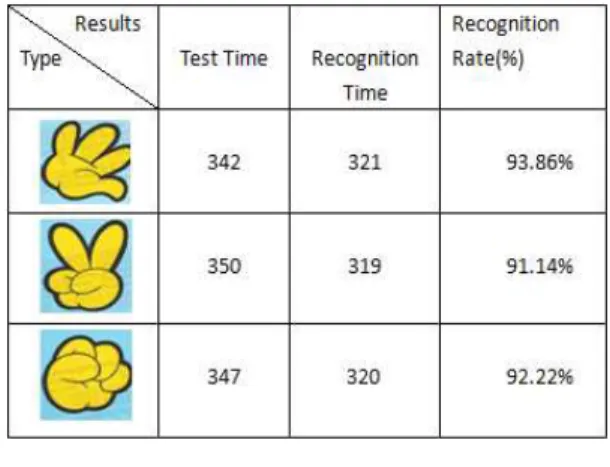
Table 2.The Experimental Results The initial topology for HMM can be determined

by estimating how many different states are in- volved in specifying a gesture. While different top- ologies can be organized for each gesture, a 4-state HMM with skip transition is determined to be suf- ficient for our work as shown in Fig. 5.

The input information is a (x

i

, y

i

) center coor- dinate of a hand position on time series (t

i

), there- fore the input data are (x

1

, y

1

, t

1

), (x

2

, y

2

, t

2

)……

(x

n

, y

n

, t

n

). These are converted to (O

1

, O

2

, ……, O

n-1

), where O

i

means the chain code between (x

i

, y

i

, t

i

) and (x

i+1

, y

i+1

, t

i+1

). The redundant trajectory made before and after the key gesture is eliminated by an interactive spotting.

Fig. 5. The 4-state HMM used for recognition.

4. EXPERIMENTAL RESULTS

We design a simple program using the result of hand recognition for recognizing “stone, scissors, cloth” these three kinds of hand gestures. This system operated by hand gesture is running on the hardware environment of CPU Intel 2.3GHz Core2, a Logitech Web camera, and the software environ- ment of Windows 7 and Visual Studio 2008 using OpenCV. Fig. 6 and Table 2 show the experimental results of the program.

These results show that the recognition results can be enhanced with the increased training. In real operating, the recognition results highly depend on the real gesture and at the same time all real data are new data. The described test was done on the batch processing condition of the accumulated data.

5. CONCLUSION

In this paper, a improve method of hand detect- ing and hand gesture recognition is proposed. We use Adaptive Skin Threshold (AST) to detect the areas of hand. Then the result of hand detection is used to hand recognition through the improved HMM algorithm. It can apply in different illumina- tion condition and complex background. And the recognition rate of hand gesture is also quite satisfying.

ACKNOWLEDGEMENT

This work is financially supported by the

Ministry of Education, Science and Technology

(6)

(MEST), the Ministry of Knowledge Economy (MKE) through the fostering project of HUNIC.

REFERENCE

[ 1 ] Mubarak Shah. “Face Detection and Gesture Recognition for Human-Computer Interaction,”

Chapter 4, pp. 83.

[ 2 ] Bai yu, “A New Method for Hand Tracking and Hand Gesture Recognition Using Improved CAMSHIFT and SVM Algorithm,” Master's Dissertation, Tongmyong University Image Processing Lab, pp. 17, 2010.

[ 3 ] N. A.Viet, “A Development of Non-touch Human Computer Interface Technology using Gesture Information,” Master's Dissertation Tongmyong ,University Image Processing Lab, pp. 15, 2008.

[ 4 ] B.W. Min, H.S. Yoon, and Toskiaki Ejima,

“Hand Gesture Recognition Using Hidden Markov Models,” IEEE Transactions on P attern Analysis and Machine Intelligence, Vol.24, No.1, 1997.

[ 5 ] T.E. Startner and A.Pentland, “Visual Recog- nition of American Sign Language using Hidden Markov Models,” In Proceedings of the First International Workshop on Auto- matic Face and Gesture Recognition, pp.

189-194, 1995.

[ 6 ] J. Yang, et al., “Human Action Learning Via Hidden Markov Model,” IEEE Trans. On Systems, Man, and Cybernatics, Vol.27, No.1, pp. 34-44, January 1997.

[ 7 ] Bai Yu, Sang-Yun Park, Yun-Sik Kim, In- Gab Jeong, Soo-Yol Ok, and Eung-Joo Lee,

“Hand Tracking and Hand Gesture Recogni- tion for Human Computer Interaction,”

Journal of Korea Multimedia Society, Vol.14, No.2, pp. 182-193, 2011.

Wenkai Xu

received his B. S. at Dalian Polytechnic University in China (2006 - 2010). From 2010 to now he is a M. S student of Tongmyong University, Korea.

His main research tops are im- age processing, computer vision, biometrics and hand recognition.

Eung-Joo Lee

received his B. S. , M. S. and Ph.

D. in Electronic Engineering from Kyungpook National Uni- versity, Korea, in 1990, 1992, and Aug. 1996, respectively. Since 1997 he has been with the Department of Information &

Communications Engineering, Tongmyong University, Korea, where he is currently a professor. From 2000 to July 2002, he was a president of DigitalNetBank Inc..

From 2005 to July 2006, he was a visiting professor

in the Department of Computer and Information

Engineering, Dalian Polytechnic University, China. His

main research interests includes biometrics, image

processing, and computer vision.

수치

Fig. 1. Skin Color in YCbCr Color Space.
Fig. 2. Hand region detection flowchart.
Table 1. Classification of Hand Gesture Recogni- Recogni-tion
Table 2.The Experimental ResultsThe initial topology for HMM can be determined

참조

관련 문서

Many researches have been turned to research of human Hand Gesture Recognition with different methods, those methods can be divided into ap- pearance based approaches and model

In this paper, we propose a method of hand gesture recognition based on CNN (Convolutional Neural Network) for various applications such as media consumption in

This paper presents a novel gesture recognition method using tree classification and multiclass SVM(Support Vector Machine).. In the learning step, 3D trajectory

Due to the combination of signal processing and machine learning algorithm for gesture recognition, the radar parameters governing the range and Doppler resolutions should be

W., 2018, Hand Gesture Recognition Using Surface Electromyogram, Transactions of the Korean Society for Noise and Vibration Engineering, Vol. W., 2020, Design of Prosthetic

Key Words : Pattern recognition, Millimeter wave radar, Zernike moment, Hand gesture, Bag of features, Global and local descriptor... 위한 더 많은

To recognize hand gesture of a new user, the most proper recognition model among several well trained models is selected using model selection algorithm and incrementally

Objective: This study presents the effect of visual feedback on one-hand gesture performance in vision-based gesture recognition system when people use gestures to control