Growth and Physiological Adaptations of Tomato Plants
( Lycopersicon esculentum Mill) in Response to Water Scarcity in Soil
Hwang Seungmi1, Kwon Taekryun1, Doh Eun-Soo2, and Park Mehea3*
1Bio-crops Development Division, National Academy of Agricultural Science, Suwon 441-857, Korea
2Department of Herbal Pharmaceutical Science, Joongbu University, Geumsan-gun 312-702, Korea
3Vegetable Division, National Institute of Horticultural and Herbal Science, Suwon 441-440, Korea
Abstract. This study aim to investigate fundamentally the growth and physiological responses of tomato plants in responses to two different levels of water deficit, a weak drought stress (−25 kPa) and a severe drought stress (−100 kPa) in soil. The two levels of water deficit were maintained using a micro-irrigation system consisted of soil sensors for the real-time monitoring of soil water content and irrigation modules in a greenhouse experiment. Soil water contents were fluctuated throughout the 30 days treatment period but differed between the two treatments with the average −47 kPa in −25 kPa set treatment and the −119 kPa in
−100 kPa set treatment. There were significant differences in plant height between the two different soil water statuses in plant height without differences of the number of nodes. The plants grown in the severe water-deficit treatment had greater accumulation of biomass than the plants in the weak water-deficit treat- ment. The severe water-deficit treatment (−119 kPa) also induced greater leaf area and leaf dry weight of the plants than the weak water-deficit treatment did, even though there was no difference in leaf area per unit dry weight. These results of growth parameters tested in this study indicate that the severe drought could cause an adaptation of tomato plants to the drought stress with the enhancement of biomass and leaf expan- sion without changes of leaf thickness. Greater relative water content of leaves and lower osmotic potential of sap expressed from turgid leaves were recorded in the severe water deficit treatment than in the weak water deficit treatment. This finding also postulated physiological adaptation to be better water status under drought stress. The drought imposition affected significantly on photosynthesis, water use efficiency and sto- matal conductance of tomato plants. The severe water-deficit treatment increased PSII activities and water use efficiency, but decreased stomatal conductance than the weak water-deficit treatment. However, there were no differences between the two treatments in total photosynthetic capacity. Finally, there were no dif- ferences in the number and biomass of fruits. These results suggested that tomato plants have an ability to make adaptation to water deficit conditions through changes in leaf morphology, osmotic potentials, and water use efficiency as well as PSII activity. These adaptation responses should be considered in the screen- ing of drought tolerance of tomato plants.
Key words : drought adaptation, osmotic potential, tomato, water deficit
Introduction
Tomato, Lycopersicon esculentum Mill., is one of the most important vegetable crops in the world in terms of consumption per capita. Fruits of tomato are not only eaten directly as a fresh vegetable but also additive ingre- dient to other food items. They contribute significantly to the dietary intake of vitamins A and C, essential minerals and other nutrients. Furthermore, tomatoes are the richest
source of lycopene, a photochemical that protects cells from oxidants causing cancer (Giovannucci, 1999).
It is widely distributed as an annual vegetable crop adapted to diverse climates. However, in spite of its broad adaptation, the production is concentrated in a few warm and rather dry areas particularly in tropical and sub-tropical climates (Cuartero and Fernandez-Munoz, 1999). In the tropical and subtropical regions, environ- mental extremities such as drought and salinity are major factors contributing and limiting the plant growth and productivity due to disturbing the intercellular water bal- ance (Chaves et al., 2002).
*Corresponding author: [email protected]
*Received August 6, 2010; Revised August 14, 2010;
*Accepted October 13, 2010
(Bray, 1997).
Usually, plants synthesize and accumulate osmolytes as a physiological response to counter balance the abiotic stresses. In Arabidopsis, the drought signal is mediated through abscisic acid (ABA)-dependent and -indepen- dent pathways which is often regulated by the expres- sion of gene under drought. Similarly, during vegetative growth, roots of many angiosperms synthesize ABA and transport to the shoots under prevalent drought condi- tions which have been reported in various crop plants such as rice, wheat, alfalfa etc. (Leung and Giraudat, 1998; Shinozaki and Yamaguchi-Shinozaki, 1997, 2000).
However, physiological responses of drought tolerant plants have not been critically considered so far.
Besides, there is a range of mechanisms of adaptation to drought stress in higher plant mentioned by some workers. For example, drought-induced osmotic adjust- ment is important to maintain low water potential and to maintain cellular turgor pressure. Likewise, drought- induced reduction of stomatal conductance and transpi- ration are critical to save internal water under the water deficit condition (Costa Franca et al., 2000). However, studies related to mechanism of adaptation to drought stress in tomato plant are rather scarce.
Specially, the physiological response of tomato to drought stress has not been extensively studied particu- larly throughout vegetative and reproductive periods.
Presumably, each stage may be considered as separate traits and may require different evaluation methods. Fur- ther it is known that no reliable physiological evaluation procedure can be employed successfully and effectively to examine the drought tolerance in each phenophasis. So the present study describes the growth and physiological
1. Plant growth conditions and treatments
Tomato seeds (Lycopersicon esculentum Mill.) ‘Picco’, a popular cherry tomato, were used in this study which had carried out from 31 March to 12 July 2006. Seeds were sterilized with sodium benlate solution (× 1/200) for 30 min. After that, the sterilized seeds were washed with distilled water several times before sowing in wet paper.
‘Picco’ raised in horticultural institute lab in 40 days.
Seeds were sown and germinated seedling then trans- planted into sub-irrigation system after 45 days. Germi- nated seeds were transferred into pots having size about 21× 20 cm. Eighteen pots were prepared with two sets of nine pots, weak water-deficit treatment (−25 kPa) and severe water-deficit treatment (−100 kPa). Pots were arranged randomly and filled with perlite. Plants were grown in the greenhouse especially, located National Institute of Agricultural Biotechnology, Rural Develop- ment Administration, Suwon, Republic of Korea (altitude 37.2669 No, latitude 126.9669 Eo). Each treatment was replicated nine times with two plants in each pot. Plants were irrigated with half-strength Hoagland solution while drought treatments were maintained as −47 kPa and
−119 kPa by micro-irrigation system, respectively. The treatments were started from 12 June to 12 July, 2006.
2. Drought treatment system using micro-irrigation monitoring system
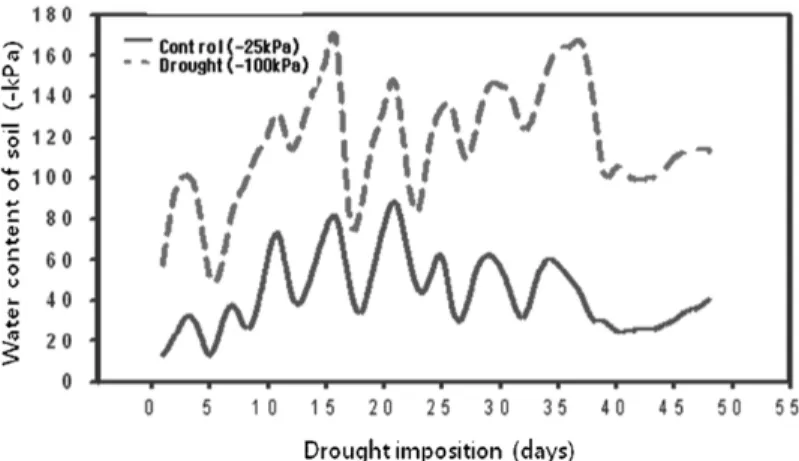
Precise imposition of drought stress can be achieved thought a controlled micro-irrigation system with water sensors and drip irrigation. Micro-irrigation monitoring system set up the two different water statues, weak water- deficit treatment (−25 kPa) as control and severe water-
deficit treatment (−100 kPa) for 30 days. This system revealed drought imposition significantly affected the water status of the soil. As shown as Fig. 1, the drought treatment (−100 kPa) increased the soil water content compared to weak drought (−25 kPa) as control. Throughout the 30 days treatment period, soil water contents were fluctuated but differed among the two treatments with average −47 kPa- in −25 kPa-set treatments and −119 kPa- in −100 kPa-set treatments (Fig. 1). It indicated that relative humidity caused significant change in drought condition However, the average temperature and relative humidity were maintained as 24.3oC and 64.3%, respectively.
3. Sampling and physiological analysis
Plants were harvested on 12 July after 30 days treat- ment, and height, nodes, fruit rate, leaf area, dry weights, photosynthesis, relative water contents (RWC) and osmotic potential were measured. Total 18 plants were used per each treatment. Whole sample, leaf and fruit were dried at 65oC for 72 hours.
Leaf area was determined using a LI-3100 area meters (Delta Area Meter MK2, Delta-T Devices Ltd, England).
Relative water content (RWC) was calculated from gravi- metric measurements using the following formula (Catsky, 1960):
RWC (%) = (Fresh Weight− Dry Weight /Turgid Weight− Dry Weight) × 100.
Randomly selected leaves per plant were weighed immediately after cutting off (fresh weight), rehydrated
in distilled water at 95% humidity (turgid weight) for 4 hours and then oven dried at 65oC for 72 hr (dry weight). For the determination of osmotic potential, leaf samples were frozen in liquid nitrogen and kept at −20oC.
Systemically, the expressed sap solution was prepared with the homogenates at 12000 g for 20 min at 4oC.
Osmotic potential of a 10µL of the expressed sap was determined using a vapor pressure osmometer (model 5520; Wescor, Inc, USA) and then calculated based on the van’t Hoff relation reported by Nobel (1983). For tur- gid osmotic potential, the leaf samples were kept in dis- tilled water for 4 hours before frozen and homogenate.
Photosynthesis was measured in terms of net assimilation Fig. 1. Effect of drought imposition on soil water contents using micro-irrigation system.
Fig. 2. Effect of drought imposition on the fruit morphol- ogy of L. esculentum.
4. Data analysis
Statistical analysis was performed with SAS soft ware (SAS, Statistical Institute, Cary, NC, USA). Significant differences from two treatment means were determined P≤ 0.05. Least Significant Difference (L.S.D.) was used to identify dissimilar treatment means.
Results and Discussion
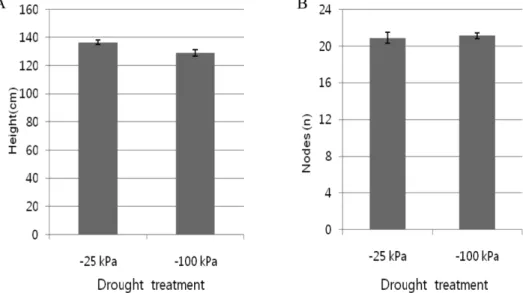
1. Effects of drought stress on agronomic parameters We observed several growth parameters of tomato growing under two levels of water status, −25 kPa and
−100 kPa, each. Drought imposition (−100 kPa) showed
There is no significant difference of fruit dry weight between −100 kPa and −25 kPa (Fig. 5). Although the deficit irrigation resulted in substantial yield loss com- pared to the standard practice, marketable tomato fruits was increased by 27% at −30 kPa treatment compared to the −15 kPa treatment (Nam et al., 2006).
The experiment season was June to July when it is usually very hot and humid. The high humidity during this experiment might affect stomata opening which cause water absorption, leading to large leaf area and dry weight. However, we observed that leaf thickness and leaf dry weight were not affected during the experimental periods (Fig. 4). Non-significant difference was recorded in leaf area per unit dry weights, rate of fruit set, and fruit
Fig. 3. Effect of drought imposition on height and nodes of L. esculentum cv ‘Picco’. Vertical lines on the bar graph repre- sent standard error (n = 18).
dry weight (Fig. 4 and 5). That means tomato 'Picco' has ability to keep its growth without any significant yield loss under drought stress.
We conclude that drought imposition did not inhibition of growth inducing tomato fruit setting throughout −25 to
−100 kPa during this experiment period using micro-irri- gation system. In tomato, most commercial cultivars are sensitive to drought stress throughout the ontogeny of the plant, yet genotypic variation for drought tolerance exists within the cultivar (Wudiri and Henderson, 1985). The cultivar experiments indicate the potential for factors such as maturity, yield potential, and adaptation to gen- erate spurious correlations. It has been also observed that within a set of cultivar having more similar yield poten- tial and adaptation, grain yield in a dry season environ- ment was not closely associated with leaf RWC (Lafitte, 2002). For instance, yield variation that is not related to plant water status may reflect variation in mechanisms such as the tolerance to root or leaf-source signals that reduce grain set under stress, or difference in the response of grain formation to varying levels of carbo- hydrate mobilization near flowering to fruiting. More- over, high leaf water status levels allow the plant to grow well, high water status under stressed conditions is not necessarily advantageous for biomass production at least at the young stage (Daniele et al., 2005).
Thus, it is assumed that these responses associated with plant growth stages and cultivars might be the adap- tation mechanism of ‘Picco’ tomato plant. There is a
range of mechanisms for adaptation to drought stress in higher plants which are maintenance of turgor, low osmotic potential, better osmotic adjustment value, high relative water contents, better water use efficiency, sto- matal regulation, photosynthetic performance, etc.
(Anyia and Herzog, 2004; Bohnert et al., 1995).
2. Effects of drought stress on physiological parameters
Based on the results of this study, it is presumed that tomato shows its adaptability under −100 kPa drought treatments. This study also goes on to demonstrate appro- priate physiological responses such as RWC, osmotic potential, photosynthesis, CO2 assimilation rate under drought stress. We investigated whether drought imposi- tion affects those phisysiological parameters inducing the growth difference. The result showed drought imposi- tion significantly affects on the relative water content of L. esculentum. The maximum relative water content was recorded in −100 kPa treated sample compared to
−25 kPa water deficit. Similarly, osmotic potential was almost the same in both −25 and −100 kPa treated sam- ples (Table 1). In addition, −100 kPa treatment showed a little higher in turgid osmotic potential than those of
−25 kPa. Water use efficiency was significantly increased due to drought compared to −25 kPa unstressed condition Maintenance of leaf relative water content in drought resistant plant could be an important strategy under drought stress. Some studies have demonstrated that Fig. 4. Effect of drought imposition on the leaf area, leaf dry weight of L. esculentum. Vertical lines on the bar graph repre-
sent standard error (n = 18).
desert Caragana species have secondary xylem, which is typical in xerophytes and young stems and leaves have a xeromorphic structure (Chang and Zhang, 1997) show-
ing lower transpiration rate and higher water use effi- ciency than other species. Undoubtedly, in plants that have high water potential, reduction of stomatal conduc- tance and transpiration rate are critical to save water (Costa Franca et al., 2000). Its photosynthesis system is adaptable to drought, high temperature and strong solar radiation (Ma et al., 2004). Furthermore, drought-tolerant plants have a stronger ability to adjust stomatal conduc- tance, enabling them to maintain water balance in an arid environment (Vacher, 1998).
In the present study, −100 kPa increased the net CO2
assimilation rate and photo systemII (PSII) values of tomato compared to stomatal conductance where signif- icant reduction was recorded (Table 2). In particular, PS II, the main reaction centre of the photochemical effi- ciency of photosynthesis, which is located on cell mem- branes, is very sensitive to water stress (Glynn and Colin, 2002). It is presumed that physiological responses such as RWC, osmotic potential, stomatal conductance, pho- tosynthetic rate, water use efficiency are all associated responses under drought environments especially for the cultivar which are better adopted as shown in the present study (Table 2).
Many experiments have shown that stomata close in response to hydraulic and chemical signals produced when soil moisture decreased (Chaves et al., 2002;
Davies et al., 2000). The soil water content and the root water status directly affected stomatal conductance, which diminishes considerably before any observable change in leaf water potential occurs. Stomatal conduc- tance generally decreases as the soil water content falls below an adequate level to sustain normal plant water uptake. In dry soils, stomata opens and closes very rap- Fig. 5. Effect of drought imposition on the fruit set, fruit dry
weight, total dry weight of L. esculentum on 30 days after micro-irrigation. Vertical lines on the bar graph repre- sents standard error (n = 18).
idly after the beginning of an irrigation event in response to changes in soil water conditions (Zavala, 2004). Since stomata influence the influx of CO2 into leaves, the reduction in stomatal conductance to conserve water inevitably indicates a lower photosynthetic rate since sto- mata influence the influx of CO2 into leaves. However,
−100 kPa treatment showed the reduction in stomatal conductance but did not induce the less photosynthetic rate (Table 2). This is probably due to the high degree of co-regulation of stomatal conductance and photosynthe- sis in ‘Picco’.
Moreover, all physiological attributes indicate the use- fulness of this study on adaptability of tomato to drought.
It can be thought that the cultivar optimizes its biomass production before plant growth due to its higher water use efficiency, so as to mobilize stored assimilates when the stomata are closed. Among varieties, a high relative transpiration level, generally associated with a low water potential, is often observed in the most productive plant varieties under drought. In addition, cell membrane tol- erance has proven to be an important trait regardless of the type of water stress (Bajji et al., 2002), and could be associated with other favorable attributes for drought adaptation in plant (Daniele et al., 2005).
We explored the growth, yield and their subsequent physiological response of tomato in drought stress. The present study found drought has less significant effects on growth, yield and physiological responses of tomato
‘Picco’ that has various capacity of adoptability. Further- more, it is expected to contribute for evaluation of drought tolerance in tomato genotype or other crops. Ear- lier, species naturally adapted to drought, such as bean or groundnut, has improved their agronomic performance (Costa Franca et al., 2000). This study is a first try to
establish the adopted mechanism of vegetable crops as tomato using unique micro-irrigation system. However, further molecular studies related to drought tolerance mechanism of ‘Picco’ tomato plant are needed.
Acknowledgements
This work was financially supported by Rural Devel- opment Administration, Suwon, Republic of Korea.
Literature Cited
1. Anyia, A.O. and H. Herzog. 2004. Water-use effi- ciency, leaf area and leaf gas exchange of cowpeas under mid-season drought. Europ. J. Agron. 20:327- 339.
2. Bajji, M., T.M. Kient, and L. Stanley. 2002. The use of the electrolyte leakage method for assessing cell mem- brane stability as a water stress tolerance in durum wheat. Plant Growth Regul. 36:61-70.
3. Bohnert, H., D. Nelson, and G. Richard. 1995. Adapta- tion to environmental stresses. Plant Cell. 7:1099-1111.
4. Bray, E.A. 1997. Plant responses to water deficit.
Trends Plant Sci. 2:48-54.
5. Catsky, J. 1960. Determination of water deficit in discs cut out from leaf blades. Biol. Plant. 2:76-77.
6. Chang, C.Y. and M.L. Zhang. 1997. Anatomical struc- tures of young stems and leaves of some Caragana species with their ecological adaptabilities. Bulletin of Botanical Research 17:65-71.
7. Chaves, M.M., J.S. Pereira, J. Maroco, M.L. Rod- rigues, C.P.P. Ricardo, M.L. Osorio, I. Carvalho, T.
Faria, and C. Pinheiro. 2002. How plants cope with water stress in the field. Photosynthesis and growth.
Ann. Bot. 89:907-916.
8. Costa Franca, M.G., A.T. Pham Thi, C. Pimental, R.O.
Pereyra Rossiello, Y. Zuily-Fodil, and D. Laffray.
2000. Differences in growth and water relation among Table 2. Effect of drought imposition on the photosynthesis, stomatal conductance, photo system II and water use efficiency,
of c.v. ‘Picco’ L. esculentum.
Drought treatment
CO2 assimilation rate (µmolm−2s−1)
Stomatal conductance (molH2Om−2s−1)
Photo SystemII
Water use efficiency (µmolCO2mol H2O m−2s−1)
0−25 kPa y8.79y 0.14 0.20 3.45
−100 kPa 8.96 0.10 0.23 4.57
LSDz 0.05 ns 0.01* 0.02* 0.5*
zLeast significant difference at P = 0.05.
NS,* Non significant or Significant difference between −25 kPa and −100 kPa treatments (P = 0.05).
yValues are mean of 18 plants, each.
12. Giovannucci, E. 1999. Tomatoes, tomato-based prod- ucts, lycopene, and cancer; Review of the epidemio- logic literature. J. Nart. Cancer. Inst. 91:317-331.
13. Glynn, C.P. and N. Colin. 2002. Identification of drought tolerant woody perennial using chlorophyII fluorescence. J. Arboricult. 28:215-223.
14. Kang, N.J., M.W. Cho, J.K. Kweon, H.C Rhee, and Y.H. Choi. 2006. Effects of deficit irrigation on the total soluble soilds and fruit yields of fresh tomato. J Bio-Environment Control. 15:335-339.
15. Lafitte, R.. 2002. Relationship between leaf relative water content during reproductive stage water deficit and grain formation in rice. Field Crops Research. 76:
165-174.
16. Leung, J. and J. Girauda. 1998. Abscisic acid signal
naling pathways. Current Opinion in Plant Biology. 3:
217-223.
21. Vacher, J.J. 1998. Responses of two main Andean crops, quinoa (Chenopodium quinoa Willd) and papa amarga (Solanum juzepczukii Buk.) to drought on the Bolivian Altiplano: significance of local adaptation.
Agriculture, Ecosystems and Environment. 68:99-108.
22. Wudiri, B.B. and D.W. Henderson, 1985. Effects of water stress on flowering and fruit set in processing tomatoes. Sci. Hortic. 27:189-198.
23. Zavala, M. 2004. Integration of drought tolerance mechanisms in Mediterranean sclerophylls: a func- tional interpretation of leaf gas exchange simulators.
Ecol. Model. 176:211-226
토양 수분 결핍에 따른 토마토의 생육과 생리적응
황승미1·권택륜1·도은수2·박미희3*
1국립농업과학원 신작물개발과, 2중부대학교 한방제약과학과, 3국립원예특작과학원 채소과
적 요. 본 연구는 토마토의 토양 수분결핍조건에서의 생장과 생리적인 반응을 근본적으로 조사하기 위 하여 수행되었다. 토양에 두가지 수분조건, 심한 수분결핍(−100kPa)과, 대조구인 약한 수분결핍 처리 (−25kPa)는 실시간 토양수분함량을 모니터링을 할 수 있는 토양센서와 관수 모듈을 갖춘 micro-irrigation 시스템을 고안, 온실에서 유지되었다. 토양수분함량은 30일동안 변동되었으며, −25kPa로 맞춰진 처리구는 평균 −47kPa, −100kPa 처리구는 평균 −119kPa로 차이를 나타냈다. 이 두 가지 다른 토양수분상태에서 자란 식물체 사이의 생육을 비교해 본 결과 수분결핍상태(−100kPa)에서 자란 식물체가 대조구인 약한 수 분결핍(−25kPa) 처리구에 비해 절간수의 차이없이 신장이 유의하게 감소하였으며 건물중의 축적은 더 높 게 나타났다. 또한 건물중 당 엽면적의 차이 없이, 엽면적과 엽건중이 수분 결핍이 약한 처리구에 비해 수분결핍이 심한 처리구가 더 높게 나타났다. 이러한 생육상의 차이는 심한 수분스트레스가 엽두께의 변 화없이 생체중의 증가와 엽면적 확보를 통해 토마토의 수분스트레스에 적응을 야기시킬 수 있음을 제시 했다. 수분결핍에 따른 토마토 생육기간동안, 생리적변화를 조사한 결과, −100kPa 처리구에서 자란 토마 토가 대조구인 −25kPa 처리구에 비해 엽의 상대수분함량의 증가와 잎의 삼투압이 낮게 나타났다. 이는 수분스트레스아래서 토마토의 더 나은 수분상태를 유지하기 위한 생리적인 적응을 설명해준다. 아울러 심 한 수분스트레스는 대조구에 비해 PSII 활성과 수분활용도를 증가되었으며, 낮은 기공저항도를 나타내었 다. 처리간의 광합성의 차이는 없었으며, 토마토 과실의 수와 생육량의 차이는 없었다. 이러한 결과는 토
마토 ‘Picco’가 엽형태의 변형과 삼투압, 수분활용도와 PSII의 활성을 통해 수분결핍상태에서 적응할 수 있게 만들 능력을 보여준다. 본 연구결과에서 나타난 토마토의 수분스트레스 적응 메커니즘은 토마토의 가뭄저항성 스크린에 있어서 고려되어져야 할 것으로 보인다.
주제어 : 가뭄적응성, 삼투압, 수분결핍, 토마토