Introduction
Plug seedling production has shown an increasing proportion of the horticulture industry, due to its efficiency and economy of scale (Choi et al., 1997). In particular, since nursery techniques of container seedlings have been applied to agricultural production, specialized vegetable seedlings production has become a highly competitive business (Herrera et al., 2008).
Control of stretching is a high priority for the Korean nursery industry, because the high stem density at which the seedlings are grown, together with either low natural
radiation levels during the monsoon season and winter, or hot summer, often result in the production of batches of badly stretched seedlings (Kim et al., 2008). Hence, the importance of growth control, referring to numerous production practices in which overgrowth is one of the most frequently stated problems affecting seedling quality, especially in high-temperature season has been emphasized.
Vegetable seedlings can rapidly outgrow the optimal size of transport and transplantation. In addition, seedlings with excessive stem elongation show decreased survival in the field. Therefore, research on practicable methods to inhibit excessive growth and to improve the quality of seedlings has shown to be necessary.
A considerable amount of literature has been published on growth control to grow high-quality seedlings. It has
Control of Stretching of Tomato (Lycopersicon esculentum Mill.) on Cylindrical Paper Pot Seedling Using High-Salinity Potassium Fertilizers
Chan Xu
1, Si Hong Kim
1, Dae Hoon Kim
1, Jae Kyung Kim
1, Jae Yun Heo
2, Ngoc Thang Vu
3, Ki Young Choi
4, Il Seop Kim
5and Dong Cheol Jang
6*
1
Graduate Student, Department of Horticulture, Kangwon National University, Chuncheon 24341, Korea
2
Professor, Deptartment of Plant Science, Gangneung-Wonju National University, Gangneung 25457, Korea
3
Lecturer, Faculty of Agronomy, Vietnam National University of Agriculture, Hanoi, Vietnam
4
Professor, Department of Controlled Agriculture, Kangwon National University, Chuncheon 24341, Korea
5
Professor, Department of Horticulture, Kangwon National University, Chuncheon 24341, Korea
6
Post-doc, Department of Horticulture, Kangwon National University, Chuncheon 24341, Korea
Abstract. This study was conducted to examine the potential of inducing salinity stress on cylindrical paper pot tomato seedlings to inhibit overgrowth. Potassium fertilizers, sulfate of potash (K
2SO
4), muriate of potash (KCl), and monopotassium phosphate (KH
2PO
4), were prepared as two solutions of (5 and 10) dS·m
-1salinity level, respectively, to investigate the influence on tomato (Lycopersicon esculentum Mill.) seedling growth. We also investigated the adaptability and survivability of treated tomato seedlings with high-salinity potassium (10 dS·m
-1KCl) to harsh environmental conditions (water deficit, low temperature, and storage conditions). Repeated addition of high-salinity level KCl, K
2SO
4, or KH
2PO
4markedly decreased the dry matter of shoot and root, leaf area, and net assimilate rates (NAR) but increased the stem diameter of seedlings. Among the three sources, the relative growth rate of plant height (RGR
H) was most sensitive to KCl addition; increasing salinity levels of KCl solution decreased the RGR
Hof seedlings.
The compactness, which directly reflects the stocky growth index, increased in KCl or KH
2PO
4treatments. After a week’s water deficit, severely wilted seedlings were observed in control seedlings (untreated with KCl), but no wilted seedlings were observed in the KCl treated seedlings, and the relative water content (RWC) of the untreated seedlings significantly decreased by 23 %, while that of the pretreated seedlings only decreased by 8 %. The increase in ion leakage of KCl treated seedlings at low temperatures was less than that of untreated seedlings. Furthermore, there was far lower damage proportion on pretreated seedlings at (9, 12, and 15)°C storage temperatures after 20 days, compared with on unpretreated seedlings. Our results suggest that high-salinity potassium fertilizer, especially KCl, is effective in preventing tomato seedling overgrowth, while it also improves tolerance.
Additional key words : growth control, potassium fertilizer, salinity stress, tomato seedling, tolerance
*Corresponding author: [email protected]
Received July 28, 2020; Revised August 19, 2020;
Accepted August 21, 2020
established that manipulating the difference in day and night temperature can enhance the quality of seedlings, and help to keep seedlings at stocky size since the stem growth rates show a positive relationship with this difference (Erwin and Heins, 1995; Liu 2018). However, during the production season, it is difficult and costly to cool to the optimal temperature, considering the current production model of growing seedlings in large greenhouses, especially in warm climates. Brushing, a mechanical method, has been used, but it can easily cause physical damage (Latimer and Thomas 1991). Several attempts have been made to restrict the water supply to gain stocky and stress-resistant seedlings (Alem et al., 2015; Liptay et al., 1998). Determination of water quantity and irrigation timing before too much stress causes damage demand abundant experience, and over- stressed seedlings resulting from serious water deficits show stunted growth, and poor stand establishment when transplanted (Alem et al., 2015; Liptay et al., 1998). Another typical method is to apply plant growth retardants (PGRs), which are also effective at suppressing height growth (Agehara and Leskovar, 2017). But the drawback of PGRs, as agrochemicals, should not be ignored. PGRs can cause environmental pollution; and if overdosed, may have negative effects on seedling quality. The previously men- tioned methods, which essentially impose internal or external stress to stunt or slow the growth, are admittedly effective but do not fully meet the requirements of the growers, such as low cost, eco-friendliness, and practicality in the seedling nursery.
However, there has been little discussion to date about the possibility of growth control using the theory of salinity stress-induced seedling growth inhibition. Salinity in irrigation water, and in soil characterized by a high concentration of soluble salts, limits plant growth (Acosta- Motos et al., 2017). When the electrical conductivity (EC) is 4 dS·m
-1or more, equivalent to 40 mM NaCl, the irrigation water or soil is thought to be saline (Munns and Tester, 2008). Most studies in this field of salinity stress have only focused on the adverse effects caused by salinity stress, the salt resource is usually Na
+, and the studies have addressed how to mitigate the damage (Acosta-Motos et al. (2017). In this article, we attempt to discuss a method to control growth using high-salinity stress (EC > 4 dS·m
-1). Potassium (K)
salt is a better source of salt stress than sodium (Na) salt, with the advantages that it is abundant in nature, and plays an important role in all living organisms, related to all abiotic and biotic stresses (Zörb et al., 2014). As a source of potassium, agricultural potash fertilizer is widely used in agricultural production, with more than 30 billion kg consumed worldwide each year (FAO, 2019); in other words, it is an easily accessible source for seedling growers.
This study provides new insights into salinity stress- induced seedling growth inhibition. We supposed that a high-salinity level of potassium salt could inhibit vegetable seedling growth, and expected a balance between the inhibition and the seedling quality. Considering the widesp- read consumption of tomatoes, and the specialized seedling production of tomatoes has long been a commercial activity, it was used as the research species in this study.
Materials and Methods
1. Plant material and growth conditions
Tomato (Lycopersicon esculentum Mill.) seedlings from Hoban Seedling Company (Chuncheon, Korea) were used.
The seedlings were grown in a cylindrical paper pot placed in 32-hole plug trays (Bumnong Co., Ltd., Jeongeup, Korea). When three true leaves had unfolded, the tomato seedlings were transported from Hoban's seedling nursery to the experimental greenhouse on the farm of Kangwon National University (Chuncheon, Korea). During the seedling experiment, the seedlings commercial fertilizer (Wonder Grow Fertilizers, Chobi Co., Ltd., Seoul, Korea) was applied twice a week, the same management as Hoban nursery. This research was conducted during the crop season of 2018 and 2019 in greenhouse conditions.
2. Potassium salts stress and tolerance tests
Potassium was added in the form of sulfate of potash (SOP;
K
2SO
4), muriate of potash (MOP; KCl), and monopotassium
phosphate (MKP; KH
2PO
4), which are commonly used as
fertilizer in agricultural production. Two solutions of each
potassium salt were prepared at salinity levels of (5 and 10)
dS·m
-1, respectively, by dissolution in tap water. A
conductivity meter (HI-8633 Multi-range Conductivity
Meter, USA) was used to measure the EC of the solution. The
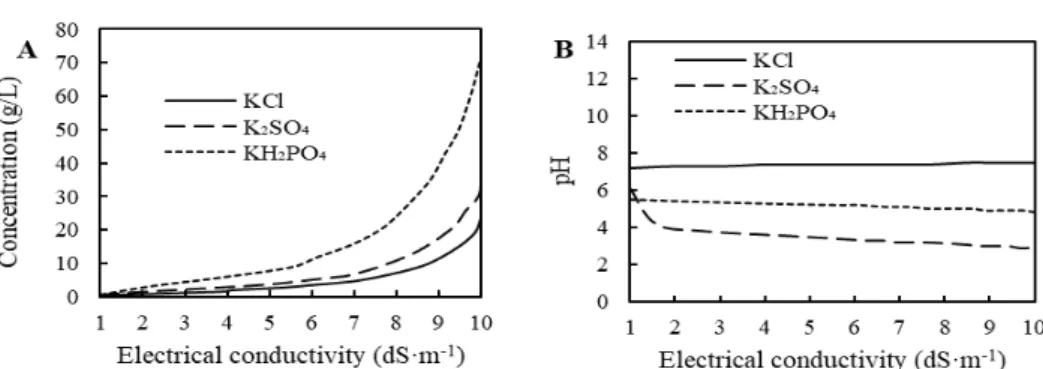
pH and concentration of all potassium sources with different salinity levels were measured at the start of the experiments, and Fig. 1 shows their relative curves.
After three true leaves had unfolded, tomato seedlings were treated with the potassium solutions. Each saline solution was used to treat the seedlings by saturating the substrate of seedlings one, two, or three times, respectively.
The interval between treatment times was 5 days. The control seedlings were irrigated only by tap water (EC 0.2 dS·m
-1). During the experiment, all the seedlings were grown under the same conditions.
After the above experiments, an optimal combination (the type of potash fertilizer, salinity level, and addition times) was selected to investigate the adaptability and survivability of the tomato seedling treated by excessive potassium fertilizer to harsh environmental conditions, including drought, chilling, and storage conditions. In drought and chilling tests, tomato seedlings were pretreated with potassium and then grown for a week. For drought tolerance investigation, the water provided to the treated seedlings and control was restricted; and for chilling resistance test, they were grown at low temperature (5°C). In storage experiments, pretreated and untreated seedlings were stored in low temperature (5, 9, 12, and 15)°C storage room after potassium pre-treatment. During this experiment, the seedlings were exposed to darkness and drought, referring to the transportation conditions after the sale of seedlings from the seedling nursery.
3. Measurements
Growth indices were investigated at the initial time of
treatment, and at the time that the seedlings reached the sale size of tomato seedling, which is normally at the seven or eight leaves stage. Eight seedling samples from each treatment were randomly selected. The substrate was removed from the root by gently flowing water. The weight of the seedlings was measured by electronic balance. The plant height was determined by a ruler from the main stem base to the top, and the stem diameter was determined by Vernier calipers at the internode above cotyledons (Fan et al., 2013). The relative chlorophyll contents (SPAD) of leaves were determined using a SPAD analyzer (SPAD-502 Plus, Konica Minolta Sensing Inc., Osaka, Japan). All fully unfolded true leaves were separated from the shoot, and the total leaf area per plant was determined by leaf area meter (LI-300; LI-COR). Samples were dried at 60°C in the oven (Mov-212F, Sanyo Electric Co., Ltd., Osaka, Japan) for at least 72 hours, to obtain constant mass. Relative water content (RWC) in seedling leaf was assessed using the ratio of leaf fresh weight to leaf turgid weight in water restriction treatment. Relative ion leakage in leaf was estimated by leakage of electrolytes during chilling stress. The damage of the shoot was assessed on a qualitative 10-point scale for every seedling during the storage period.
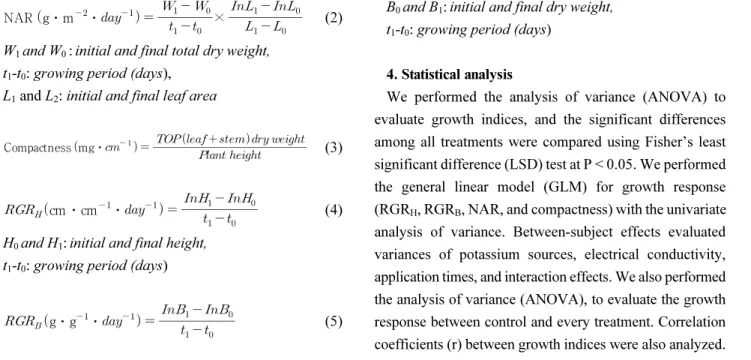
Root-to-shoot ratio (R/S; Eq. (1)), net assimilates rates (NAR; Eq. (2)), compactness (Eq. (3)), the relative growth rate of plant height (RGR
H; Eq. (4)), and relative growth rate of biomass (RGR
B; Eq. (5)) values were calculated as follow:
RS g⋅g
(1)
Fig. 1. The relation curves of sulfate of potash (K
2SO
4), muriate of potash (KCl), and monopotassium phosphate (KH
2PO
4) between electrical
conductivity value and concentration (A) and between electrical conductivity value and pH (B)
NAR g⋅m
⋅
×
(2) W
1and W
0: initial and final total dry weight,
t
1-t
0: growing period (days), L
1and L
2: initial and final leaf area
Compactness mg⋅
(3)
cm⋅cm
⋅
(4) H
0and H
1: initial and final height,
t
1-t
0: growing period (days)
g⋅g
⋅
(5)
B
0and B
1: initial and final dry weight, t
1-t
0: growing period (days)
4. Statistical analysis
We performed the analysis of variance (ANOVA) to evaluate growth indices, and the significant differences among all treatments were compared using Fisher’s least significant difference (LSD) test at P < 0.05. We performed the general linear model (GLM) for growth response (RGR
H, RGR
B, NAR, and compactness) with the univariate analysis of variance. Between-subject effects evaluated variances of potassium sources, electrical conductivity, application times, and interaction effects. We also performed the analysis of variance (ANOVA), to evaluate the growth response between control and every treatment. Correlation coefficients (r) between growth indices were also analyzed.
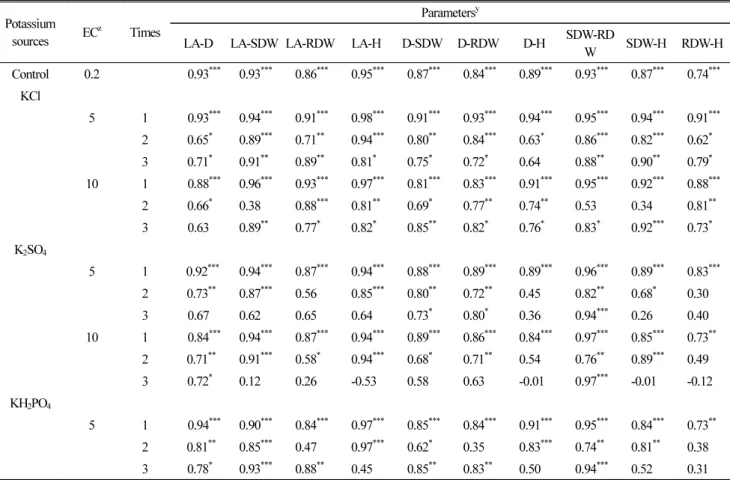
Table 1. Influence of potassium salts with different salinity and application times on dry matter production, SPAD, leaf area, stem diameter, and root to shoot ratio on tomato seedlings growth.
Potassium
sources EC
zTimes Dry matter production (g)
SPAD
yLeaf area
(cm
2) Stem diameter
(mm) R/S
Shoot Root Total
Control 0.2 1.69 ab
x0.33 a-c 2.02 a-c 46.1 a 234.4 ab 4.61 b 0.19 ab
KCl
5 1 1.63 a-c 0.30 a-d 1.93 a-e 46.0 a 230.2 ab 4.90 ab 0.19 ab
2 1.54 a-d 0.27 b-d 1.82 a-f 42.3 ab 221.1 a-d 4.88 ab 0.18 b 3 1.30 b-d 0.25 b-d 1.55 c-f 40.1 bc 184.4 b-e 4.77 ab 0.19 ab
10 1 1.69 ab 0.37 a 2.06 ab 46.1 a 244.7 a 5.30 a 0.22 ab
2 1.45 a-d 0.26 b-d 1.72 a-f 42.5 ab 195.1 a-e 5.18 ab 0.18 ab
3 1.19 d 0.23 d 1.42 f 36.4 c 175.1 c-e 4.88 ab 0.20 ab
K
2SO
45 1 1.55 a-d 0.33 a-c 1.88 a-f 45.7 a 212.9 a-e 5.01 ab 0.22 ab
2 1.47 a-d 0.29 a-d 1.76 a-f 44.8 ab 198.8 a-e 4.80 ab 0.20 ab 3 1.27 cd 0.24 cd 1.51 d-f 42.3 ab 172.0 de 4.81 ab 0.19 ab 10 1 1.65 a-c 0.33 ab 1.98 a-d 45.2 ab 233.2 ab 4.92 ab 0.20 ab 2 1.60 a-c 0.29 a-d 1.89 a-f 44.7 ab 226.1 a-c 4.61 b 0.18 ab
3 1.26 cd 0.23 d 1.49 ef 42.5 ab 162.6 e 4.64 b 0.18 ab
KH
2PO
45 1 1.82 a 0.33 a-c 2.15 a 45.1 ab 238.5 a 4.96 ab 0.18 ab
2 1.53 a-d 0.29 a-d 1.82 a-f 44.6 ab 219.5 a-d 4.76 ab 0.19 ab 3 1.30 b-d 0.28 a-d 1.59 b-f 39.9 bc 177.4 c-e 4.66 b 0.22 a
z
Potash solution salinity (electrical conductivity, dS·m
-1).
y
Relative chlorophyll content.
x
Values followed by different letters indicate a significant difference between the treatments according to Fisher’s Least Significant Difference
(LSD) test at the P < 0.05 level. The hyphen in the middle of letters represents the omission of the middle letter.
Results
Shoot and root growth of tomato seedlings responded strongly to repeated potassium addition with high salinity levels. At the salinity level of 10 dS·m
-1, adding KCl three times reduced the shoot dry matter production, root dry matter production, and leaf area by (29.6, 30.3, and 25.3) %, respectively, while adding K
2SO
4three times reduced them by (25.4, 24.2, and 30.6) %, respectively (Table 1); however, the addition of 10 dS·m
-1KH
2PO
4resulted in leaf damage, so no data was recorded. At the salinity level of 5 dS·m
-1, adding KCl or K
2SO
4three times reduced those characte- ristics similarly, but their reductions were less than for the higher salinity condition. However, with 5 dS·m
-1KH
2PO
4addition, except for the leaf area, there were no significant decreases in shoot and root dry matter production (Table 1).
SPAD value was not significantly affected by K
2SO
4addition by either the different salinity levels or application times, but the thrice application of KCl or KH
2PO
4caused a reduction (Table 1). There were no significant effects of potassium salinity stress on the root-to-shoot ratio (Table 1).
Stem diameter tended to be thicker when potassium salts were added, while 10 dS·m
-1KCl addition once was the most effective among all treatments, with a significant increase of 15 % (Table 1). There were highly significant direct correlations between all measured items with the one-time addition of KCl, K
2SO
4, or KH
2PO
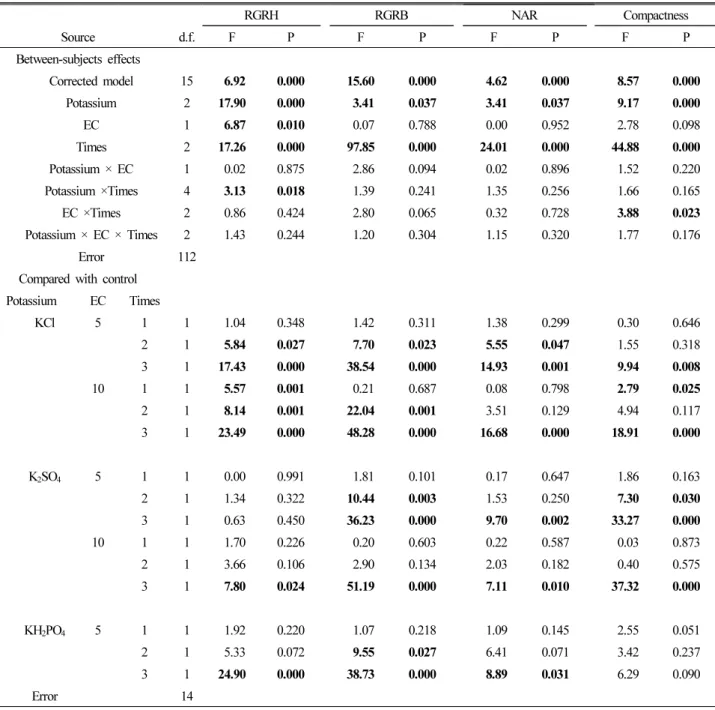
4, the same as control. However, the lowest correlations – non-significant or negative – were recorded for two- and three-times addition (Table 2).
In the ANOVA, the results of between-subject effects showed that potassium types and application times were the
Table 2. Correlation coefficients (r) between growth indices in tomato seedlings as affected by potassium salts with different salinity and application times.
Potassium
sources EC
zTimes
Parameters
yLA-D LA-SDW LA-RDW LA-H D-SDW D-RDW D-H SDW-RD
W SDW-H RDW-H
Control 0.2 0.93
***0.93
***0.86
***0.95
***0.87
***0.84
***0.89
***0.93
***0.87
***0.74
***KCl
5 1 0.93
***0.94
***0.91
***0.98
***0.91
***0.93
***0.94
***0.95
***0.94
***0.91
***2 0.65
*0.89
***0.71
**0.94
***0.80
**0.84
***0.63
*0.86
***0.82
***0.62
*3 0.71
*0.91
**0.89
**0.81
*0.75
*0.72
*0.64 0.88
**0.90
**0.79
*10 1 0.88
***0.96
***0.93
***0.97
***0.81
***0.83
***0.91
***0.95
***0.92
***0.88
***2 0.66
*0.38 0.88
***0.81
**0.69
*0.77
**0.74
**0.53 0.34 0.81
**3 0.63 0.89
**0.77
*0.82
*0.85
**0.82
*0.76
*0.83
*0.92
***0.73
*K
2SO
45 1 0.92
***0.94
***0.87
***0.94
***0.88
***0.89
***0.89
***0.96
***0.89
***0.83
***2 0.73
**0.87
***0.56 0.85
***0.80
**0.72
**0.45 0.82
**0.68
*0.30
3 0.67 0.62 0.65 0.64 0.73
*0.80
*0.36 0.94
***0.26 0.40
10 1 0.84
***0.94
***0.87
***0.94
***0.89
***0.86
***0.84
***0.97
***0.85
***0.73
**2 0.71
**0.91
***0.58
*0.94
***0.68
*0.71
**0.54 0.76
**0.89
***0.49
3 0.72
*0.12 0.26 -0.53 0.58 0.63 -0.01 0.97
***-0.01 -0.12
KH
2PO
45 1 0.94
***0.90
***0.84
***0.97
***0.85
***0.84
***0.91
***0.95
***0.84
***0.73
**2 0.81
**0.85
***0.47 0.97
***0.62
*0.35 0.83
***0.74
**0.81
**0.38 3 0.78
*0.93
***0.88
**0.45 0.85
**0.83
**0.50 0.94
***0.52 0.31
*
,
**,
***Significant at the 0.05, 0.01 and 0.001 probability level, respectively.
z
Potash solution salinity (electrical conductivity, dS·m
-1).
y
LA: leaf area; SDW: shoot dry weight; RDW: root dry weight; H: plant height; D: stem diameter
most significant factors for NAR, compactness, RGR
H, and RGR
B, and the EC levels were significant only in RGR
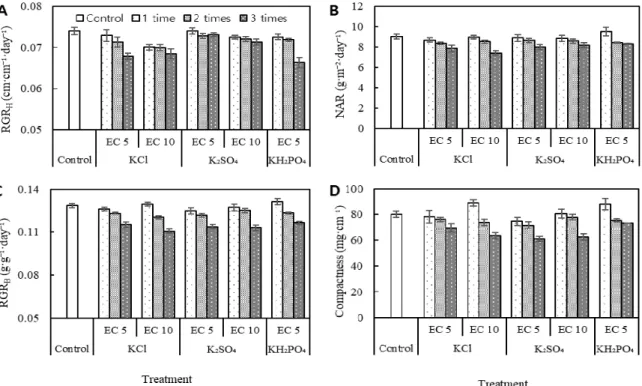
H(Table 3). Mean RGRH ( ± ), during the 20 day growth period, varied from ((0.066 ± 0.001) to (0.074 ± 0.001)) cm·cm
-1· day
-1. There were significant decreases in RGR
Hof (5.4, 5.6, and 7.5) % with 10 dS·m
-1KCl addition once, twice, and thrice, respectively, and of (3.7 and 8.4) % with
5 dS·m
-1KCl addition twice and thrice, respectively, compared with control (Fig. 2A, Table 3). There were also significant decreases with 10 dS·m
-1K
2SO
4or 5 dS·m
-1KH
2PO
4addition for only three application times (Fig. 2A, Table 3). RGR
Bvaried from ((0.111 ± 0.002) to (0.131 ± 0.002)) g·g
-1·day
-1and also tended to decrease with the repeated addition of three times of potassium salts (Fig. 2B,
Table 3. Results of analysis of variance for the relative growth rate of seedling height (RGR
H), and biomass (RGR
B), net assimilate rates (NAR), and compactness of tomato seedlings as affected by potassium salts with different salinity and application times. Bold type indicates the statistical significance of P < 0.05.
RGRH RGRB NAR Compactness
Source d.f. F P F P F P F P
Between-subjects effects
Corrected model 15 6.92 0.000 15.60 0.000 4.62 0.000 8.57 0.000
Potassium 2 17.90 0.000 3.41 0.037 3.41 0.037 9.17 0.000
EC 1 6.87 0.010 0.07 0.788 0.00 0.952 2.78 0.098
Times 2 17.26 0.000 97.85 0.000 24.01 0.000 44.88 0.000
Potassium × EC 1 0.02 0.875 2.86 0.094 0.02 0.896 1.52 0.220
Potassium ×Times 4 3.13 0.018 1.39 0.241 1.35 0.256 1.66 0.165
EC ×Times 2 0.86 0.424 2.80 0.065 0.32 0.728 3.88 0.023
Potassium × EC × Times 2 1.43 0.244 1.20 0.304 1.15 0.320 1.77 0.176
Error 112
Compared with control Potassium EC Times
KCl 5 1 1 1.04 0.348 1.42 0.311 1.38 0.299 0.30 0.646
2 1 5.84 0.027 7.70 0.023 5.55 0.047 1.55 0.318
3 1 17.43 0.000 38.54 0.000 14.93 0.001 9.94 0.008
10 1 1 5.57 0.001 0.21 0.687 0.08 0.798 2.79 0.025
2 1 8.14 0.001 22.04 0.001 3.51 0.129 4.94 0.117
3 1 23.49 0.000 48.28 0.000 16.68 0.000 18.91 0.000
K
2SO
45 1 1 0.00 0.991 1.81 0.101 0.17 0.647 1.86 0.163
2 1 1.34 0.322 10.44 0.003 1.53 0.250 7.30 0.030
3 1 0.63 0.450 36.23 0.000 9.70 0.002 33.27 0.000
10 1 1 1.70 0.226 0.20 0.603 0.22 0.587 0.03 0.873
2 1 3.66 0.106 2.90 0.134 2.03 0.182 0.40 0.575
3 1 7.80 0.024 51.19 0.000 7.11 0.010 37.32 0.000
KH
2PO
45 1 1 1.92 0.220 1.07 0.218 1.09 0.145 2.55 0.051
2 1 5.33 0.072 9.55 0.027 6.41 0.071 3.42 0.237
3 1 24.90 0.000 38.73 0.000 8.89 0.031 6.29 0.090
Error 14
Table 3). The trend of NAR was similar to that of RGR
B(Fig. 2C, Table 3). Repeated addition with KCl, K
2SO
4, or KH
2PO
4also decreased seedling compactness (Fig. 2D, Table 3); however, only one-time addition with 10 dS·m
-1KCl or 5 dS·m
-1KH
2PO
4increased compactness by (11 or 9.6) %, respectively.
Added high-salinity KCl declined RWC by 8 % and increased ion leakage by 1.67 % on seedling leaves, compared with unpretreated seedlings (Figs. 3 and 4). After water restriction, the RWC of control seedlings declined by 23 %, but that of the KCl pretreated seedlings only declined by 8
%, while the RWC of pretreated seedlings under drought
Fig. 2. Effects of KCl, K
2SO
4and KH
2PO
4addition with EC levels of 5 dS·m
-1and 10 dS·m
-1and tomato seedling growth. Panel A shows relative growth rate of height (RGR
H). Panel B shows relative growth rate of biomass (RGR
B). Panel C shows net assimilate rates (NAR). Panel D shows compactness. Bar charts with different fillings denote the potassium addition times. Bars represent mean values (± SE). See Table 3 for complete statistical results.
Fig. 3. Changes in relative water content of high salinity potassium chloride (10 dS·m
-1KCl) pretreated and unpretreated seedlings subjected to water deficit.
Fig. 4. Changes in relative water content of high salinity potassium
chloride (10 dS·m
-1KCl) pretreated and unpretreated seedlings
during chilling.
was higher than that of unpretreated seedlings (Fig. 3).
Importantly, after a week of water deficit, severely wilted seedlings were observed in the control treatment, but they were not observed in the treated seedlings. At the beginning of the chilling stress, ion leakage value of the unpretreated seedlings held steady at about 8.5 %. It was not until two days’ stay in the chilling condition that a substantial increase was observed. However, the increment of the ion leakage in pretreated seedlings was more moderate than that in the unpretreated seedlings (Fig. 4). Seedling damage occurred after a long period of storage. There was a lower damage proportion of KCl pretreated seedlings at (9, 12, and 15)°C after 20 days’ storage compared with unpretreated; however, under low storage temperature (5°C), their damage degree was similar (Fig. 5).
Discussion
Our high-salinity level potassium salt stress experiment establishes that increasing the salinity levels of potassium salt induces seedling growth suppression of tomato seedlings.
As mentioned in the literature review, a noticeable response of growth to salinity stress is a decrease in shoot growth (Negrão et al., 2017); consistent with this report, repeated addition of high-salinity levels of KCl, K
2SO
4, or KH
2PO
4markedly decreased shoot dry matter production (Table 1).
High-salinity stress can change the allocation of biomass
between root and shoot (Negrão et al., 2017), even though in some species, it can improve the root system (Álvarez and Sánchez‐Blanco, 2014). Acosta-Motos et al. (2017) reported a 10 dS·m
-1NaCl solution significantly increased the root-to-shoot ratio. However, changes in the root-to-shoot ratio with potassium addition were not significant, due to the decrease of root dry matter production, which showed the same trend as shoot. This suggests that the growth responses induced by potassium salts stress differ from those induced by sodium stress. The growth response to added excessive potassium salts observed in the leaf area is consistent with the mechanism that salinity stress affects cell expansion in young leaves, causing a decrease in leaf area (Munns and Tester, 2008). The correlation of various growth indices was also significantly changed, which also demonstrated the large effect of potassium salts on growth (Table 2). These results are consistent with the possibility that increasing the salinity level of potassium salts is an effective means of inhibiting the rapid growth of seedlings. An increase in stem diameter was observed, regardless of the addition of any of the three potash fertilizers (Table 1). This may be associated with the physiological processes that potassium plays a particularly crucial role in controlling the process of photoassimilate loading into the phloem (Ache et al., 2001;
Gajdanowicz et al., 2011), and then stimulates the thickening of the stem. A thicker diameter is helpful for transplanting, not to mention the key role of the stem in the transportation of water, and the translocation of carbohydrates (Kanai et al., 2008).
We expected to select an optimal potassium fertilizer to balance seedling quality and growth suppression, because the different accompanying anions may cause different effects. The SPAD has been shown to decrease under salinity (Negrão et al., 2017); consistent with this idea, repeated addition times of high-salinity levels of KCl or KH
2PO
4also significantly reduced SPAD; however, with K
2SO
4addition, the reduction of SPAD was not striking. As well, K
2SO
4addition showed a minor effect on inhibiting the growth of plant height, while KCl or KH
2PO
4addition showed much better (Fig. 2). These different responses may be associated with the accompanying anions in each potassium compound. On the other hand, because of the demand of the seedlings consumption market, we expected Fig. 5. Damage proportion on high salinity potassium chloride (10
dS·m
-1KCl) pretreated and unpretreated seedlings after 20 days’
storage.
high-salinity stress would yield stocky size seedlings, and did not expect an increasing growth response to fertilizer addition, so potassium salts that contain nitrogen, like KNO
3, were excluded because the nitrogen element in the nitrogen-containing fertilizer can greatly promote the vegetative growth of seedlings. Consistent with this expectation, we found that among the three sources, RGR
Hwas most sensitive to KCl addition, while increasing the salinity levels of KCl solution declined the RGR
Hof seedlings (Table 3, Fig. 2a). Also, the compactness, which directly reflects the stocky growth index, increased in KCl or KH
2PO
4treatments (Table 3, Fig. 2d). Despite the increment effect of compactness, the addition of 10 dS·m
-1KH
2PO
4caused severe leaf damage, which may be attributed to the excessively high concentration. It is important to note that the same salinity level solution with different potassium fertilizers required different amounts. Among the three potassium solutions, to prepare 10 dS·m
-1solutions, the usage amount of KH
2PO
4is far more than of KCl or K
2SO
4(Fig. 1b). The plant height growth inhibitory effect of K
2SO
4was not obvious, and if the salinity level was too high, KH
2PO
4increased the risk of damage to seedlings, so these two kinds of potassium salts may not be satisfactory for achieving the target effect. KCl may be a desirable option for increasing salinity to inhibit seedlings growth, and to obtain stock size seedlings.
We expected the potassium treated seedlings would show better adaptability and survivability because potassium is associated with extensive adaptive responses of plants to the environment (Anschütz et al., 2014). A high accumulation of potassium, of which content exceeds the growth of plants, was considered as an “insurance policy” to enable the plant to better survive environmental stress (Kafkafi, 1990; Zörb et al., 2014), such as drought and chilling stress (Cakmak, 2005; Wang et al., 2013). Increasing potassium supply in a manner that increases the salinity level of potassium solution may enable increasing uptake, according to the idea that uptake of potassium by root is not usually limiting and it can be stored inorganically with little cost, and concentrated in the plant cell’s vacuole, depending on the supply. Initially, in the absence of environmental stress, only the addition of high-salinity KCl caused a stress effect on the seedlings, which was manifested as a decrease in RWC, and an
increase in ion leakage; these results may be explained by the mechanism that plants under stress often lose some water from their tissues, which can have rapid and large effects on physiological processes, such as cell expansion, cell division, and abscisic acid accumulation. This again demonstrates the effect on growth suppression by high- salinity potassium application. However, after the intervention of environmental stress factors, the RWC and ion leakage index reversed; that is, the pretreated seedlings showed better adaptability than the seedlings without potassium addition. Not only that, KCl addition substantially increased the viability in long- term storage conditions, indicating that potassium addition is beneficial for long-distance transportation from nursery to the planting site. Additionally, low-temperature storage is generally an effective way to keep seedlings at an approp- riate size for extension of the period of commercial sale.
These findings suggest that it is possible to apply the theory of salt stress-induced inhibition to growth control in seedling production. Seedling growth responded to high- salinity potassium supply, indicating that the properly increased salinity level of KCl or KH
2PO
4supply can inhibit growth to overcome the problem of overgrowth, and to obtain stocky seedlings. Simultaneously, tolerance improve- ment in high-salinity KCl treated seedlings indicates that this environmentally friendly method can improve tomato seedling quality. This is the first attempt to document the combination of high-salinity potassium stress and seedling quality. A limitation of this research is that only one variety of one plant species was employed. Therefore, in our future research, we will test various cultivars and investigate the performance of transplanting.
Literature Cited
Ache, P., D. Becker, R. Deeken, L. Dreyer, H. Weber, J.
Fromm, and R. Hedrich. 2001. VFK1, a Vicia faba K
+channel involved in phloem unloading. The Plant Journal.
27:571-580.
Acosta Motos, J.R., M.F. Ortuño, A. Bernal Vicente, P. Diaz Vivancos, M.J. Sanchez Blanco, and J.A. Hernandez. 2017.
Plant responses to salt stress: adaptive mechanisms. Agronomy 7, p. 18.
Agehara, S. and D.I. Leskovar. 2017. Growth suppression by
exogenous abscisic acid and uniconazole for prolonged
marketability of tomato transplants in commercial conditions. HortScience. 52:606-611.
Alem, P., P.A. Thomas, and M.W. van Iersel. 2015. Controlled water deficit as an alternative to plant growth retardants for regulation of poinsettia stem elongation. HortScience.
50:565-569.
Álvarez, S. and M. Sánchez‐Blanco. 2014. Long‐term effect of salinity on plant quality, water relations, photosynthetic parameters and ion distribution in Callistemon citrinus.
Plant Biology. 16:757-764.
Anschütz, U., D. Becker, and S. Shabala. 2014. Going beyond nutrition: regulation of potassium homoeostasis as a common denominator of plant adaptive responses to environment.
Journal of plant physiology.171:670-687.
Cakmak, I. 2005. The role of potassium in alleviating detrimental effects of abiotic stresses in plants. Journal of Plant Nutrition and Soil Science. 168:521-530.
Choi, J.M., J.W. Ahn, J.H. KU, and Y.B. Lee. 1997. Effect of medium composition of physical properties of soil and seedling growth of red-pepper in plug system. J. Kor. Soc.
Hort. Sci. 38:618-624 (in Korean).
Erwin J.E. and R.D. Heins. 1995. Thermomorphogenic responses in stem and leaf development. HortScience.
30:940-949.
Fan, X.X., Z.G. Xu, X.Y. Liu, C.M. Tang, L.W. Wang, and X.I.
Han. 2013. Effects of light intensity on the growth and leaf development of young tomato plants grown under a combination of red and blue light. Scientia horticulturae.
153:50-55.
FAO. 2019. World fertilizer trends and outlook to 2022. Rome.
http://www.fao.org.
Gajdanowicz, P., E. Michard, M. Sandmann, M. Rocha, L.G.G.
Corrêa, S.J. Ramírez-Aguilar, J.L. Gomez-Porras, W.
González, J.B. Thibaud, and J.T. Van Dongen. 2011.
Potassium (K
+) gradients serve as a mobile energy source in
plant vascular tissues. Proceedings of the National Academy of Sciences. 108:864-869.
Herrera, F., J. Castillo, A. Chica, and L.L. Bellido. 2008. Use of municipal solid waste compost (MSWC) as a growing medium in the nursery production of tomato plants.
Bioresource technology. 99:287-296.
Kafkafi, U. 1990. The functions of plant K in overcoming environmental stress situations. 22nd Colloquium, International Potash Institute, Switzerland. p. 81-93.
Kanai, S., J. Adu Gymfi, K. Lei, J. Ito, K. Ohkura, R.E.
Moghaieb, H. El-Shemy, R. Mohapatra, P.K. Mohapatra, and H. Saneoka. 2008. N-deficiency damps out circadian rhythmic changes of stem diameter dynamics in tomato plant. Plant science. 174:183-191.
Kim, I.S., C.H. Zhang, H.M. Kang, and M. Bruce. 2008.
Control of stretching of cucumber and tomato plug seedlings using supplemental light . Hort. Environ. Biotechnol. 49:
287-292.
Latimer, J.G. and P.A. Thomas. 1991. Application of brushing for growth control of tomato transplants in a commercial setting HortTechnology. 1:109-110.
Liptay, A, P. Sikkema, and W. Fonteno. 1998. Transplant growth control through water deficit stress—a review.
HortTechnology. 8:540-543.
Munns, R. and M. Tester. 2008, Mechanisms of salinity tolerance. Annu. Rev. Plant Biol. 59:651-681.
Negrão, S., S. Schmöckel, and M. Tester. 2017. Evaluating physiological responses of plants to salinity stress. Annals of botany. 119:1-11.
Wang, M., Q. Zheng, Q. Shen, and S. Guo. 2013, The critical role of potassium in plant stress response. International journal of molecular sciences. 14:7370-7390.
Zörb, C., M. Senbayram, and E. Peiter. 2014. Potassium in
agriculture–status and perspectives. Journal of plant
physiology. 171:656-669.
고농도 칼륨처리를 활용한 원통형 종이포트 토마토묘의 도장억제
수 찬
1ㆍ김시홍
1ㆍ김대훈
1ㆍ김재경
1ㆍ허재윤
2ㆍ넉탕부
3ㆍ최기영
4ㆍ김일섭
5ㆍ장동철
6*
1
강원대학교 원예학과 학생,
2강릉원주대학교 식물생명과학과 교수,
3베트남국립대학교 강사,
4