• 검색 결과가 없습니다.

Research on the Influence of the Collaboration between Fashion Brands and Artists on Consumer Needs - Centered on the Collaboration Series between Uniqlo and KAWS -

N/A
N/A
Protected

Academic year: 2021

Share "Research on the Influence of the Collaboration between Fashion Brands and Artists on Consumer Needs - Centered on the Collaboration Series between Uniqlo and KAWS -"

Copied!
10
0
0

로드 중.... (전체 텍스트 보기)

전체 글

(1)

1. INTRODUCTION

Emotional design in marketing has received much attention over the recent years, because emotion is an indispensable part of life, affecting how we feel, behave and think, therefore, it has gained considerable attention in product design [1].

Research has found that fashion brands are in- creasingly willing to associate themselves with well-known artists to show their avant-garde and elite brand images [2]. With the rise of artists themselves as brands, they also cooperate with fashion brands. This cooperation mode both ex- pands the range of influence of artists, but also en- hances the personality of cooperative fashion brands [3]. This marketing model transforms the needs into emotional products that can meet per- sonal emotional needs,rather than products that

emphasize practicality and functionality, and these changes are the result of global cultural sharing and information exchange[4], However, most of the literature focuses on the related research on the co- operation between luxury goods and art, and there is a lack of related research on the collaboration between fashion brands and artists. Fashion brands, unlike luxury goods, are easily purchased and accepted by the public, and collaboration with artists is also a favorite and popular mode of coop- eration among younger generation of consumers, Values are thought to be relatively stable for adults and can activate human behaviors [5], so it is nec- essary to employ whether to meet the needs of consumers as a measure. This paper targets the research object at young people with the ages of 20 to 50 with certain income ability, and conducts targeted research on their needs.

Research on the Influence of the Collaboration between Fashion Brands and Artists on Consumer Needs

- Centered on the Collaboration Series between Uniqlo and KAWS -

Zhang Jiaru

, Chee-Yong Kim

††

ABSTRACT

Based on Maslow's hierarchy of needs theory, this research only employs whether to meet consumer needs as a measure, and focuses on the Collaboration Series between Uniqlo and KAWS to discuss the influence of the collaboration between fashion brands and artists on consumer needs. What’s more, this paper also proposes whether the collaboration with artists as brands can meet the higher needs of consumers and influence new consumer groups. Finally, it is concluded that the collaboration between fashion brands and artists plays an active role in meeting the higher needs of consumers and can expand new consumer groups, which will provide reference and theoretical basis for enterprises to conduct collaboration with art, incorporate the needs of consumers into the scope of planning, and consider the collaboration with artists more comprehensively.

Key words: Fashion Brands, Artist, Consumer Needs, Uniqlo, KAWS

※ Corresponding Author : Chee-Yong Kim, Address:

(47340) 176 Um Gwang-ro, Busanjin-gu, Busan City, Dong-Eui University, TEL : +82-10-4584-4036, FAX : +82-51-890-2265, E-mail : [email protected] Receipt date : Jul. 9, 2020, Approval date : Jul. 29, 2020

††

Dept. of Storytelling, Graduate School, Dong-Eui University

([email protected])

††

Major of Game Animation Engineering, Dong-Eui

University

(2)

This paper focuses on the collaboration series of fashion brands Uniqlo and New York artist KAWS officially released on June 3, 2019. KAWS is an American graffiti artist and designer known for toys, paintings and prints, Born on November 4, 1974 in Jersey City, NJ. Formerly known as Brian Donnelly, KAWS graduated from the School of Visual Arts in New York as a Bachelor of Arts, and later worked in animation industry. Having started as a graffiti artist in New York in the early 1990s, KAWS began to recreate advertisements in his distinctive style, gaining both street recognition and a recent gallery exhibition. His work can be found from the collections of the High Museum of Art in Atlanta, the Modern Art Museum of Fort Worth, and the Rosenblum Museum in Paris. From Fig. 1 the UNIQLO annual operating financial statements broken line chart, we can see that the net sales, customer numbers and average purchase of June 2019 are the annual peaks, compared with June 2018, the year-on-year growth rate of Net Sales was 127.3%, the growth rate of Customer Numbers was 125.6%, and the Average Purchase growth rate was 101.4%.

At the same time, from the release date of June 3th till June 5th, the Weibo topic of #All KAWS#

reached 440 million views and 81,000 discussions,

and Weibo topic of #The Collaboration of Uniqlo and KAWS Sold Out Quickly# reached 470 million views and 55,000 discussions. From these data, we can see the huge market potential brought by the collaboration of brand and artist, and consumers’

attention to the brand and artist.

In this paper, a total of 208 valid questionnaires were collected and sorted out in the form of social questionnaires, and SPSS were used to further systematically analyze the respondents with dif- ferent genders, ages, occupations and incomes in order to deeply explore the influence of the collabo- ration between artists and fashion brands on con- sumer needs.

2. THEORY

2.1 Maslow's Hierarchy of Needs

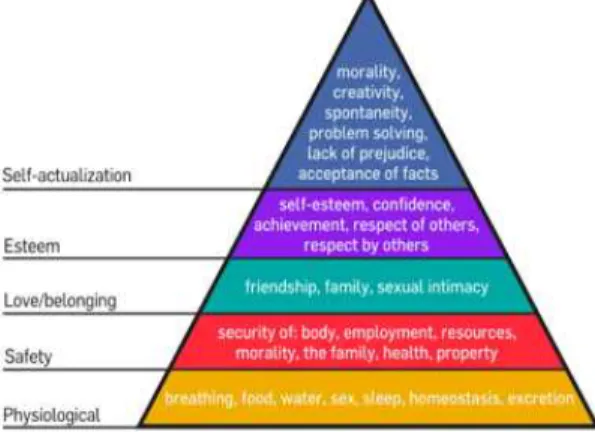
Maslow's Hierarchy of Needs theory was pro- posed by Abraham Maslow in 1943 and is one of the famous human motivation theories [6]. He div- ided human needs from low to high into five hier- archies: Physiological needs, Security needs, Social needs, Esteem needs and Self-actualization needs.

Fashion brands use the artists' personal charm to expand their brand personality. Consumers will benefit from using the brand for self-expression

Fig. 1. the UNIQLO annual operating financial statements broken line chart. Data source: UNIQLO'sannual operating

financial statements (from September 1, 2018 to August 31, 2019).

(3)

when they think the brand has aspecial personality (Belk, 1988), thereby strong buying demands will be generated.The value provided by art exceeds the objective needs of consumers and brings power, esteem and social differences. Sheth believed that brands could obtain emotional value through art to increase consumers' attachment and loyalty to the brand. Only when brands and artists interconnect or complement each other, can they meet the needs of consumers and finally achieve a win-win coop- eration [7].

2.2 Classic cases of the collaboration between other brands and artists

Collaboration is usually a cross-border coopera- tion between two cross-domain brands. The dif- ferent attributes of the two parties can trigger con- sumer' perception of the brand at different levels.

Different positive emotions have distinct functions and therefore have different influences on consum- er behaviors [8]. Given that the artists represent a unique brand, they can vividly convey the per- sonality of brand through art [9]. Brands take the advantages of each other, work together under the premise of finding mutually beneficial value points, which can add up to double attention and meet the higher psychological needs of consumers. For ex- ample, ZARA paid tribute to the deceased artist Jean-Michel Basquia in 2019, and released the

Basquiat autumn and winter series of jackets. In order to maintain sales and attention, the fashion brand H&M will cooperate with artists to design its “Hot Sale” every year. Nowadays, more and more classic cooperation cases show that fashion brands are more and more willing to connect them- selves with artists, and show their avant-garde and trendy images through collaboration clothing, peripheral products to obtain good economic bene- fits, which has become a new and effective mar- keting model. The artist participates in the brand design directly or indirectly, creates artistic prod- ucts, endows the products with artistic attributes to create fashion brands with artistic character- istics. Such products can stimulate the emotional resonance of consumers, meet the psychological needs of consumers, make art a natural extension of the basic attributes of the brand, This shows that the participation of the spectator is also an im- portant part of the creation of artistic works[10].

and at the same time can promote the new collabo- ration products to potential new customer groups.

3. RESEARCH METHODS AND HYPOTHESES

3.1 Experimental tools

The questionnaire was designed according to the measurement tool developed by Kim Do hee in 2019 based on Maslow’s hierarchy of needs theory [11]. The scale used SPSS and AMOS pro- grams to analyze the reliability and validity of scale factors. The Cronbach Alpha is from 0.778 to 0.904, indicating that the reliability is sufficient and the measurement tools developed in this research have no difficulty in measuring the degrees of sat- isfaction of each requirement. In data analysis, the physiological needs, security needs, social needs, esteem needs and self-actualization needs under the collaboration series of clothing between UNIQLO and KAWS are abbreviated as KPN, KSeN, KSoN, KEN, KSAN, respectively, and the physiological needs, security needs, social needs, esteem needs Fig. 2. Maslow's hierarchy of needs.

Fig. 2. Maslow's hierarchy of needs.

(4)

and self-actualization needs under common cloth- ing of Uniqlo are abbreviated as UPN, USeN, USoN, UEN, and USAN respectively.

3.2 Research methodand hypotheses

Through a summary analysis of the existing relevant literature based on the literature review method, we found that people at the bottom of the pyramid (BOP) who are defined as the income pop- ulation with a daily income of $2 to $8, and their annual income does not exceed $3000. However, the research found that these people were more ea- ger for luxury goods despite poverty, they still hope to use the same products as the upper middle class in society. Such consumer groups are defined as ideal consumer groups that aim to enhance or express self-esteem and social status and achieve self-realization by purchasing luxury goods. BOP consumer groups expect to buy luxury goods or products with the same attributes as luxury goods to reflect their social class and social status. Due to the structural closeness between brands and ar- tists[12], the poor have a low literacy rate and therefore low resistance to attractive marketing practices. This indicates the market potential for high-quality products in BOP markets [13]. As a top trending IP with commercial value, KAWS it- self has become a luxury brand in the art world.

Moreover, this UT series is the last cooperation between KAWS and Uniqlo, which creates scarcity for the brand, and this kind of hunger marketing method and the artistic value brought by the col- laboration have aroused consumers' desire to con- sume. This paper explores the influence of collabo- ration between brands andartists on consumers’

psychological needs from the perspectives of con- sumer needs and whether consumer groups have been expanded. Based on Maslow’s Hierarchy of Needs theory, this paper conducts a comparative analysis from five aspects: physiological needs, se- curity needs, social needs, esteem needs and- self-actualization needs, and puts forward the fol-

lowing hypotheses:

H1: The collaboration clothing between fashion brand Uniqlo and artist KAWS can better meet consumers' physiological needs than the common clothing of Uniqlo.

H2: The collaboration clothing between fashion brand Uniqlo and artist KAWS can better meet consumers' security needs than the common cloth- ing of Uniqlo.

H3: The collaboration clothing between fashion brand Uniqlo and artist KAWS can better meet consumers' social needs than the common clothing of Uniqlo.

H4: The collaboration clothing between fashion brand Uniqlo and artist KAWS can better meet consumers' esteem needs than the common cloth- ing of Uniqlo.

H5: The collaboration clothing between fashion brand Uniqlo and artist KAWS can better meet consumers' self-actualization needs than the com- mon clothing of Uniqlo.

H6: The UT series in the collaboration between fashion brand Uniqlo and artist KAWS can expand new consumer groups

In order to verify the hypotheses, a survey for about two months from May 3, 2020 to July 1, 2020 had been conducted. Through quantitative research of 220 consumers, we distributed a total of 220 questionnaires and recalled 208 valid question- naires, with an effective rate of 94.5%. The ques- tionnaire was made in the form of a Likert five- point scale, completely dissatisfied: 1 point; dissat- isfied: 2 points; average: 3 points; satisfied: 4 points; very satisfied: 5 points. Besides, SPSS and Cronbach Alpha were used to indicate reliability, exploratory factor analysis and confirmatory fac- tors were used to analyze and explore the validity.

The numerical variables were described in the

form of mean ± standard deviation, and the paired

t-test was used to compare the needs in the collab-

oration between the artist and Uniqlo. Two in-

(5)

dependent sample t-tests and one-way analysis of variance were adopted to compare the differences between different groups. Two independent sample t-tests and one-way analysis of variance were adopted to compare the differences among the fac- tors of gender, age, income and so on in different groups.

4. EXPERIMENTAL RESULTS AND DISCUSSION

4.1 Variable Description and Reliability and Validity Analysis

Cronbach's Alpha of each dimension was great- er than 0.7, indicating that the reliability of the questionnaire was good. CR (Construct Reliability) reflects whether all the topics in each latent varia- ble explain the latent variable in a consistent man- ner, CR higher than 0.70 indicates that the latent

variable has good construct reliability. AVE (Ave- rage Variance Extracted) reflects how much of the variation explained by each latent variable comes from all topics in the latent variable, and AVE greater than 0.50 indicates that the latent variable has better convergence validity.

4.2 Comparison of the Needs between the Colla- boration Series of Uniqlo and KAWS and the Common Clothing of Uniqlo

The paired t-test was used to compare the phys- iological needs(PN) between the collaboration ser- ies of Uniqlo and KAWS and the common clothing of Uniqlo, (P stands for probability, it’s also called significance, P≤0.05 indicates that the difference is of statistical significance, otherwise it is not of statistical significance),P=0.002<0.05,the differ- ence was statistically significant. It is considered

Table 1. Descriptive statisticsand reliability and validity

Variable Minimum Maximum Mean SD Cronbach

Alpha CR AVE

KPN 2.000 5.000 4.295 0.685 0.778 0.784 0.551

KSeN 2.000 5.000 4.327 0.611 0.826 0.826 0.487

KSoN 2.000 5.000 4.243 0.664 0.858 0.858 0.549

KEN 1.286 5.000 4.133 0.685 0.895 0.896 0.551

KSAN 1.250 5.000 4.046 0.740 0.903 0.903 0.538

UPN 1.667 5.000 4.103 0.736 0.799 0.798 0.568

USeN 1.600 5.000 4.007 0.748 0.876 0.877 0.587

USoN 1.400 5.000 3.478 0.876 0.868 0.868 0.569

UEN 1.143 5.000 3.418 0.898 0.904 0.905 0.576

USAN 1.250 4.750 3.319 0.921 0.895 0.895 0.516

Table 2. Comparison of needs between the collaboration series of Uniqlo and KAWS and the common clothing of Uniqlo

Pair Variable U+K U t P

Pair 1 PN 4.29±0.69 4.10±0.74 3.183 0.002

Pair 2 SeN 4.33±0.61 4.01±0.75 5.938 0.000

Pair 3 SoN 4.24±0.66 3.48±0.88 10.429 0.000

Pair 4 EN 4.13±0.68 3.42±0.90 10.146 0.000

Pair 5 SAN 4.05±0.74 3.32±0.92 9.572 0.000

Pair 6 N 4.21±0.52 3.66±0.62 11.238 0.000

(6)

that the collaboration series can better meet the physiological needs of consumers than the common clothing, therefore the H1 hypothesis is valid. The paired t-test was used to compare the security needs (SeN) between the collaboration of Uniqlo and KAWS and the common clothing of Uniqlo, P<0.001, the difference was statistically significant.

It is considered that the collaboration series can better meet the security needs of consumers than the common clothing, therefore the H2 hypothesis is valid. The paired t-test was used to compare the social needs (SoN) between the collaboration of Uniqlo and KAWS and the common clothing of Uniqlo, P<0.001, the difference was statistically significant. It is considered that the collaboration type can better meet the social needs of consumers than the common clothing, therefore the H3 hy- pothesis is valid. Similarly, the collaboration series can better meet the esteem needs and self-actuali- zation needs of consumers than the common cloth- ing, therefore H4 and H5 hypotheses are valid. A one-sample t-test was used to compare KPI with 3, P<0.001, the difference was statistically sig- nificant, M=4.14, indicating that KPI was higher than 3. It is considered that the UT series in the

collaboration between fashion brand Uniqlo and artist KAWS can expand new consumer groups, therefore the H6 hypothesis is valid.

4.3 Comparison of Needs between Genders The Analysis of the demographic characteristics of the sample shows that there are 99 males, ac- counting for 47.6%, and 109 females, accounting for 52.4%, so it can be considered that the male and female samples are almost the same. The two in- dependent samples t-test was used to compare the physiological needs(PN) between genders under the collaboration of Uniqlo and KAWS, P=0.476>

0.05. It is considered that there is no difference in KPN between male and female. Similarly, as for KSeN, P=0.023<0.05, the difference was statisti- cally significant, therefore it is considered that the collaboration series can better meet the SeN of females. As for PI, P=0.003<0.05,it is considered that females have stronger PI, and there is no dif- ference for the rest.

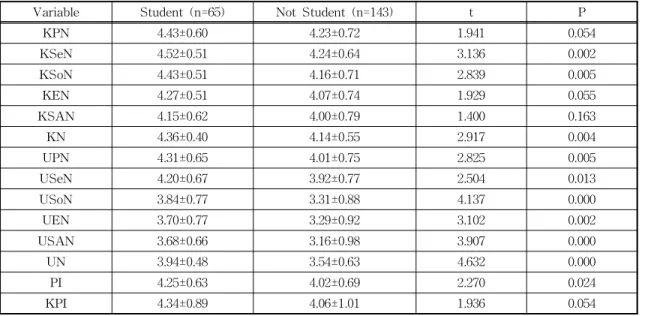
Two independent samples t-test was used to compare the KPN between students and non-stu- dents, P=0.054>0.05, the difference was not stat- istically significant, therefore it is considered that

Table 3. Comparison about whether consumers arestudents

Variable Student (n=65) Not Student (n=143) t P

KPN 4.43±0.60 4.23±0.72 1.941 0.054

KSeN 4.52±0.51 4.24±0.64 3.136 0.002

KSoN 4.43±0.51 4.16±0.71 2.839 0.005

KEN 4.27±0.51 4.07±0.74 1.929 0.055

KSAN 4.15±0.62 4.00±0.79 1.400 0.163

KN 4.36±0.40 4.14±0.55 2.917 0.004

UPN 4.31±0.65 4.01±0.75 2.825 0.005

USeN 4.20±0.67 3.92±0.77 2.504 0.013

USoN 3.84±0.77 3.31±0.88 4.137 0.000

UEN 3.70±0.77 3.29±0.92 3.102 0.002

USAN 3.68±0.66 3.16±0.98 3.907 0.000

UN 3.94±0.48 3.54±0.63 4.632 0.000

PI 4.25±0.63 4.02±0.69 2.270 0.024

KPI 4.34±0.89 4.06±1.01 1.936 0.054

(7)

there is no difference in KPN between students and non-students. As for KseN, P=0.002<0.05, the dif- ference was statistically significant, it is consid- ered that the collaboration of Uniqlo and KAWS can better satisfy the PN of students. As for KsoN, P=0.005<0.05,it is considered that compared with non-students, the collaboration of Uniqlo and KAWS can better satisfy the KsoN of students.

Similarly, there is no difference in KEN and KSAN between students and non-students, while the UPN, UseN, UsoN, UEN, USAN and UN of stu- dents are higher.

One Way ANOVA was used to compare the KPN between different ages, P=0.001<0.05, the difference was statistically significant, it is consid- ered that there are differences in KPN between dif- ferent age groups, the KPN of ages between 20 and 29 is higher. Similarly, the KseN, KsoN, KEN, KSAN and KN of ages between 20 and 29 are higher. For the needs of common clothing of Uniqlo, there is no difference in UPN, UseN and UEN in different age groups, there are differences in UseN, USAN and UN in different age groups, and the age group above 40 are relatively lower.

For the comparison of needs between different

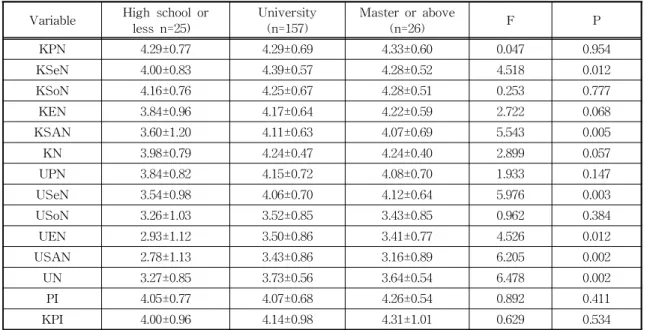
educational levels, there is no difference in KPN, KsoN, KEN, KN, UPN and UsoN(P>0.05), and the consumers with educational level of high school or less are relatively lower in KseN, KSAN, UseN, UEN, USAN and UN(P<0.05).

4.4 Correlation Analysis of Collaboration Correlation coefficient: <0.4, weak correlation;

0.4-0.7 medium correlation, >0.7 high correlation;

>0, positive correlation; <0, negative correlation.

For the correlation analysis between KPN and KSeN, the correlation coefficient is 0.494, P<0.05, the difference was statistically significant, it is considered that the KPN and KSeN are of medium positive correlation. For the correlation analysis between KPN and KSoN, the correlation coefficient is 0.564, P<0.05, the difference was statistically significant, it is considered that the KPN and KSoN are of medium positive correlation. The correlation of each need for collaboration is weak/medium positive correlation.

4.5 Correlation analysis of the need of Uniqlo For the correlation analysis between UPN and Table 4. Comparison between different ages

Variable 20-29(n=115) 30-39(n=59) ≥40(n=34) F P

KPN 4.44±0.58 4.19±0.71 3.99±0.83 7.090 0.001

KSeN 4.43±0.54 4.37±0.54 3.91±0.78 10.417 0.000

KSoN 4.39±0.59 4.15±0.60 3.89±0.84 9.070 0.000

KEN 4.27±0.63 4.05±0.58 3.82±0.91 6.352 0.002

KSAN 4.23±0.6 3.98±0.60 3.55±1.08 12.627 0.000

KN 4.35±0.42 4.15±0.41 3.83±0.74 15.774 0.000

UPN 4.10±0.71 4.25±0.66 3.86±0.89 3.029 0.051

USeN 4.12±0.69 4.06±0.68 3.52±0.86 9.328 0.000

USoN 3.47±0.89 3.63±0.76 3.25±0.99 2.150 0.119

UEN 3.48±0.9 3.50±0.71 3.08±1.11 3.032 0.050

USAN 3.36±0.89 3.46±0.81 2.93±1.12 4.026 0.019

UN 3.71±0.55 3.78±0.53 3.33±0.83 6.772 0.001

PI 4.11±0.71 4.07±0.62 4.05±0.68 0.126 0.882

KPI 4.08±1.04 4.27±0.87 4.15±0.96 0.751 0.473

(8)

USeN, the correlation coefficient is 0.607, P<0.05, the difference was statistically significant, it is considered that the UPN and UseN are of medium positive correlation. For the correlation analysis between KPN and KSeN, the correlation coefficient

is 0.416, P<0.05, the difference was statistically significant, it is considered that the KPN and KSeN are of medium positive correlation. The correlation of the needs of Uniqlo is weak/medium positive correlation.

Table 5. Comparison between different educational levels Variable High school or

less n=25) University

(n=157) Master or above

(n=26) F P

KPN 4.29±0.77 4.29±0.69 4.33±0.60 0.047 0.954

KSeN 4.00±0.83 4.39±0.57 4.28±0.52 4.518 0.012

KSoN 4.16±0.76 4.25±0.67 4.28±0.51 0.253 0.777

KEN 3.84±0.96 4.17±0.64 4.22±0.59 2.722 0.068

KSAN 3.60±1.20 4.11±0.63 4.07±0.69 5.543 0.005

KN 3.98±0.79 4.24±0.47 4.24±0.40 2.899 0.057

UPN 3.84±0.82 4.15±0.72 4.08±0.70 1.933 0.147

USeN 3.54±0.98 4.06±0.70 4.12±0.64 5.976 0.003

USoN 3.26±1.03 3.52±0.85 3.43±0.85 0.962 0.384

UEN 2.93±1.12 3.50±0.86 3.41±0.77 4.526 0.012

USAN 2.78±1.13 3.43±0.86 3.16±0.89 6.205 0.002

UN 3.27±0.85 3.73±0.56 3.64±0.54 6.478 0.002

PI 4.05±0.77 4.07±0.68 4.26±0.54 0.892 0.411

KPI 4.00±0.96 4.14±0.98 4.31±1.01 0.629 0.534

Table 6. Correlation Analysis of Each Need for Collaboration

Variable KPN KSeN KSoN KEN KSAN KN

KPN 1          

KSeN .494** 1        

KSoN .564** .466** 1      

KEN .470** .470** .488** 1    

KSAN .353** .450** .416** .601** 1  

KN .753** .741** .766** .799** .753** 1

**. Correlation is significant at the 0.01 level (2-tailed).

Table 7. Correlation analysis of the need of Uniqlo

Variable UPN USeN USoN UEN USAN UN

UPN 1          

USeN .607** 1        

USoN .416** .341** 1      

UEN .327** .327** .465** 1    

USAN .402** .353** .532** .482** 1  

UN .721** .686** .762** .726** .774** 1

**. Correlation is significant at the 0.01 level (2-tailed).

(9)

5. CONCLUSION

The research results show that the collaboration between fashion brands and artists has a positive effect on meeting the higher-level needs of con- sumers and can expand new consumer groups.

Cooperation with artists can improve the brand image through the reputation of artists, and can al- so meet the higher level of consumer needs. The result of data analysis shows that the collaboration between brands and artists has a significant effect on meeting the security needs of female consumers.

In terms of physiological needs, social needs, es- teem needs, and self-actualization needs, males and females are almost the same, all of which have improved significantly compared with the data pri- or to the collaboration. The sample occupations were divided into two parts: students and non- students. The results indicated that for the collabo- ration between fashion brands and artists, there was no difference between students and non-stu- dents in social needs, esteem needs and self-actu- alization needs, both were significantly higher than before and had a higher influence on student groups. Through the comparative analysis of the consumers from different age groups, it can be concluded that the collaboration has a higher influ- ence on consumer groups aged between 20 and 29 at the five levels of needs, while has an influence on consumer groups aged over 40, but the influence was relatively low. Through the comparison of the needs of consumers with different income, the re- sults show that there is no significant difference (P>0.05). Fashion brands can enhance their brand image by collaborating with artists. Through the correlation analysis of the needs of consumers be- fore and after the collaboration, we can see that the products before and after the collaboration can both meet the physiological needs and security needs of consumers, while the products after the collaboration can significantly better meet the se- curity needs, social needs, esteem needs and self- actualization needs of consumers. This paper also

has limitations, for example, the samples of the in- vestigation and data analysis were only for Chi- nese consumers. Due to the different artistic envi- ronments and aesthetic needs of various countries, it can't cover all countries and regions. This paper only conducted a comprehensive analysis of Chi- nese consumers. In the future, it is possible to di- vide the population according to the country to an- alyze the differences in the needs of consumers in various countries, and to conduct a more compre- hensive market analysis for enterprises for more accurate and planned marketing. This research is of strategic significance for the collaboration be- tween fashion brands and artists. It is suggested that the target consumer group of the collaboration between fashion brands and artists should be fo- cused on young people aged from 20 to 40, and fashion brands should make rational use of the val- ue of artists, incorporate the satisfaction of con- sumer needs into the scope of planning, and con- sider the collaboration with artists in a more com- prehensive way.

REFERENCE

[ 1 ] K. Halimahtun, “Embracing Diversity in User Needs Affective Design,” Applied Ergonomics, Vol. 37, No.4, pp. 409-418, 2006.

[ 2 ] C. Claude, “Art as A Means to Recreate Luxury Brands'Rarity and Value,” J ournal of Business Research, Vol. 85, No.1, pp. 414- 423, 2018.

[ 3 ] K. Pielah, V. Rajiv, H. Chang, “Using Brand Alliances with Artists to Expand Retail Brand Personality,” Journal of Business Research, Vol. 85, No.C, pp. 424-433, 2018.

[ 4 ] N. Song, A Study on the Type of User’s Subjectivity Perception for Art Collaboration Product Business, Master’s Thesis of Kyonggi University Graduate School Department of Industrial Design, 2019.

[ 5 ] K. Aydm, M. Burcu, and T. Mustafa, “Analysis

(10)

on Young Consumer’s Consumer Values and Their Attitudes Toward Foreign Firms,” Pro- cedia-Social and Behavioral Sciences, Vol. 58, No.1, pp. 1326-1335, 2012.

[ 6 ] P. Kotlor, G. Armstrong, P rinciples of Mar- keting, Edition published 1999 by Prentice Hall Europe, 1999.

[ 7 ] M, A Young, BACS(BrandArt Collaboration S- trategy): A Study on Art Collaboration Branding, Kookmin University, Graduate School of Design, Master of Design and Visual Communication Design, 2018.

[ 8 ] S. Abhinav, M. Srabanti, and J. Charles,

“Aspirational Consumption at the Bottom of Pyramid: A Review of Literature and Future Research Directions,” J ournal of Business Research, Vol. 110, No.3, pp. 246-259, 2020.

[ 9 ] K. Pielah, V. Rajiv, H. Chang, and S. Leslie,

“Using Brand Alliances with Artists to Expand Retail Brand Personality,” Journal of Business Research, Vol. 85, No.4, pp. 424-433, 2018.

[10] JY. Wang, YY. Wang , N. Zhang, EJ. Li, YB. Li, and G. Liao, “The Key to The Future Development of Interactive Art–Virtual Reality Technology,” Journal of Multimedia Information System, Vol. 5, No. 4, pp. 277-282, 2018.

[11] D. Kim, “Validation of the Korean Version of The Five Need Satisfaction Measure based on Maslow's Hierarchy of Needs Theory,”

Journal of Rehabilitation Psychology, Vol. 26, No. 4, pp. 77-97,2019.

[12] E. Koronaki, “The Emotional Value of Arts- BasedInitiatives: Strengthening the Luxury Brand-Consumer Relationship,” J ournal of Business Research, Vol. 85, No. 4, pp. 406-413, 2018.

[13] S. Abhinav, M. Srabanti, and J. Charles,

“Aspirational Consumption at the Bottom of Pyramid: A Review of Literature and Future Research Directions,” J ournal of Business Research, Vol. 110, No.3, pp. 246-259, 2020.

Zhang Jiaru She was admitted to lu Xun Academy of Fine Arts as a de- sign major in 2010, and grad- uated with a bachelor’s degree in Design in 2014. She majored in Animation as a postgraduate at the same college in 2015, and graduated with a master’s degree in Design in 2018.

Then, in 2019, she studied in Dong-Eui University for a doctorate in Storytelling. In 2015, she pressed her personal book–Fast Designing Sketch; during 2016 to 2018, held art exhibition on the theme of Uncool Plastic, around environmental topics, at 789 ArtDist in Beijing every year. In 2017, she won a gold award in Creative China National Design Art Awards. And in 2018, she obtained the honor of Excellent Graduate in LuXun Academy of Fine Arts.

Chee-Yong Kim

He received the B.S. degree, M.

S. degree and Ph.D. degree from Inje University, Republic of Korea in 1991, 1994 and 2000 Respectively.

He is visiting professor at Ox- ford University in 2007, and vis- iting professor of the Digital Clothing Center at Seoul National University in 2012.

Currently, he is a professor of Major of Game Anima- tion Engineering at Dong-Eui University. Prof. Kim held private exhibitions four times both in Seoul and China and joined over 230 international group ex- hibitions.

With his deep interest in 3D Animation, Multimedia

Design, Chaos & Fractal Design, VR / AR, Game Con-

tent Design, Virtual Fitting System and Transmedia

Storytelling.

수치

Fig. 1. the UNIQLO annual operating financial statements broken line chart. Data source: UNIQLO'sannual operating  financial statements (from September 1, 2018 to August 31, 2019).
Fig. 2. Maslow's hierarchy of needs.
Table 2. Comparison of needs between the collaboration series of Uniqlo and KAWS and the common clothing of  Uniqlo
Table 3. Comparison about whether consumers arestudents
+2

참조

관련 문서

The purpose of this study is to verify whether The mediating effects of planned happenstance skills on the relationship between perceived social support

Therefore, nurses should be responsible for the relations to resolve the needs of care between nurses and patients and through communication with the patients,

Eroticism make-up will be the best solution to appeal to the buyer and expression of make-up that is based on pure emotions and sexual tangle is developed by the needs of

For the relationship between these variables, this study analyzed the influence of parental rearing attitude on juvenile subjective well-being and examined

A culture service (Oks) operated by the Min- istry was established to create contact between artists and culture workers on the one hand and schools,

This chapter aims to discuss the organic relations between Shakespeare’s literature and Star Trek series based on The Sonnets that is characteristic of the

Therefore, this research focuses on the naturally occurring leaders' implicit followership theories on the employees' effectiveness as the test of

On the other hand, annual per capita poverty threshold or the minimum income required to meet the basic food and nonfood needs was estimated at Php21,753.. Based on the